 How to resolve AdBlock issue?
News
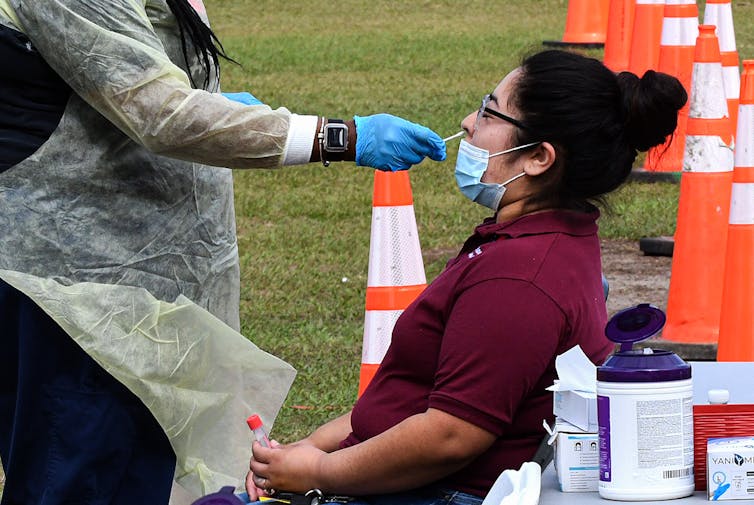
The omicron variant quickly took over the global coronavirus landscape after it was first reported in South Africa in late November, 2021. The U.S. became the 24th country to report a case of omicron infection when health officials announced on Dec. 1, 2021, that the new strain had been identified in a patient in California.
How do scientists know what versions of the coronavirus are present? How quickly can they see which viral variants are making inroads in a population?
Alexander Sundermann and Lee Harrison are epidemiologists who study novel approaches for outbreak detection. Here they explain how the genomic surveillance system works in the U.S. and why it’s important to know which virus variants are circulating.
What is genomic surveillance?
Genomic surveillance provides an early warning system for SARS-CoV-2. The same way a smoke alarm helps firefighters know where a fire is breaking out, genomic surveillance helps public health officials see which coronavirus variants are popping up where.
Labs sequence the genome in coronavirus samples taken from patients’ COVID-19 tests. These are diagnostic PCR tests that have come back positive for SARS-CoV-2. Then scientists are able to tell from the virus’s genome which coronavirus variant infected the patient.
By sequencing enough coronavirus genomes, scientists are able to build up a representative picture of which variants are circulating in the population overall. Some variants have genetic mutations that have implications for prevention and treatment of COVID-19. So genomic surveillance can inform decisions about the right countermeasures – helping to control and put out the fire before it spreads.
For example, the omicron variant has mutations that diminish how well existing COVID-19 vaccines work. In response, officials recommended booster shots to enhance protection. Similarly, mutations in omicron reduce the effectiveness of some monoclonal antibodies, which are used both to prevent and treat COVID-19 in high-risk patients. Knowing which variants are circulating is therefore crucial for determining which monoclonal antibodies are likely to be effective.
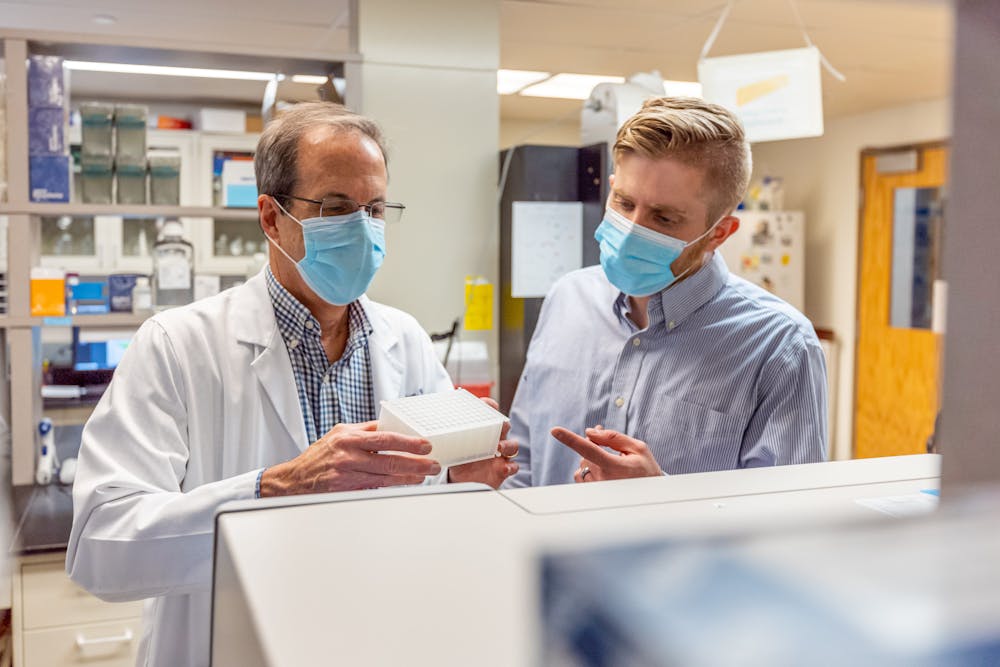
How does genomic surveillance work in the US?
The U.S. Centers for Disease Control and Prevention leads a consortium called the National SARS-CoV-2 Strain Surveillance (NS3) system. It gathers around 750 SARS-CoV-2-positive samples per week from state public health labs across the U.S. Independent of CDC efforts, commercial, university and health department laboratories sequence additional specimens.
Each type of lab has its own strengths in genomic surveillance. Commercial laboratories can sequence a high number of tests, rapidly. Academic partners can provide research expertise. And public health laboratories can supply insight into local transmission dynamics and outbreaks.
Regardless of the source, the sequence data is generally made publicly available and therefore contributes to genomic surveillance.
What data gets tracked?
When a lab sequences a SARS-CoV-2 genome, it uploads the results to a public database that includes when and where the coronavirus specimen was collected.
The open-access Global Initiative on Sharing Avian Influenza Data (GISAID) is an example of one of these databases. Scientists launched GISAID in 2008 to provide a quick and easy way to see what influenza strains were circulating across the globe. Since then, GISAID has grown and pivoted to now provide access to SARS-CoV-2 genomic sequences.
The database compares a sample’s genetic information to all the other samples collected and shows how that particular strain has evolved. To date, over 6.7 million SARS-CoV-2 sequences from 241 countries and territories have been uploaded to GISAID.
Taken together, this patchwork of genomic surveillance data provides a picture of the current variants spreading in the U.S. For example, on Dec. 4, 2021, the CDC projected that omicron accounted for 0.6% of the COVID-19 cases in the U.S. The estimated proportion rose to 95% by Jan. 1, 2022. Surveillance gave a stark warning of how quickly this variant was becoming predominant, allowing researchers to study which countermeasures would work best.
It’s important to note, however, that genomic surveillance data is often dated. The time between a patient taking a COVID-19 test and the viral genome sequence getting uploaded to GISAID can be many days or even weeks. Because of the multiple steps in the process, the median time from collection to GISAID in the U.S. ranges from seven days (Kansas) to 27 days (Alaska). The CDC uses statistical methods to estimate variant proportions for the most recent past until the official data has come in.
How many COVID-19 samples get sequenced?
Earlier in 2021, the CDC and other public health laboratories were sequencing about 10,000 COVID-19 specimens per week total. Considering that hundreds of thousands of cases have been diagnosed weekly during most of the pandemic, epidemiologists considered that number to be too small a proportion to provide a complete picture of circulating strains. More recently, the CDC and public health labs have been sequencing closer to around 60,000 cases per week.
Despite this improvement, there is still a wide gap in the percentages of COVID-19 cases sequenced from state to state, ranging from a low of 0.19% in Oklahoma to a high of 10.0% in North Dakota within the past 30 days.
Moreover, the U.S. overall sequences a much smaller percentage of COVID-19 cases compared to some other countries: 2.3% in the U.S. compared to the 7.0% in the U.K., 14.8% in New Zealand and 17% in Israel.
Which COVID-19 tests get sequenced?
Imagine if researchers collected COVID-19 tests from only one neighborhood in an entire state. The surveillance data would be biased toward the variant circulating in that neighborhood, since people are likely transmitting the same strain locally. The system might not even register another variant that is gaining steam in a different city.
That’s why scientists aim to gather a diverse sample from across a region. Random geographically and demographically representative sampling gives researchers a good sense of the big picture in terms of which variants are predominant or diminishing.

Why don’t patients in the US get variant results?
There are a few reasons patients are generally not informed about the results if their specimen gets sequenced.
First, the time lag from specimen collection to sequence results is often too long to make the information clinically useful. Many patients will have progressed far into their illness by the time their variant is identified.
Second, the information is often not relevant for patient care. Treatment options are largely the same regardless of what variant has caused a COVID-19 infection. In some cases, a doctor might select the most appropriate monoclonal antibodies for treatment based on which variant a patient has, but this information can often be gleaned from faster laboratory methods.
As we begin 2022, it is more important than ever to have a robust genomic surveillance program that can capture whatever the next new coronavirus variant is. A system that provides a representative picture of current variants and fast turnaround is ideal. Proper investment in genomic surveillance for SARS-CoV-2 and other pathogens and data infrastructure will aid the U.S. in fighting future waves of COVID-19 and other infectious diseases.
Alexander Sundermann, Clinical Research Coordinator & DrPH Candidate in Epidemiology, University of Pittsburgh Health Sciences and Lee Harrison, Professor of Epidemiology, Medicine, and Infectious Diseases and Microbiology, University of Pittsburgh Health Sciences
This article is republished from The Conversation under a Creative Commons license. Read the original article.
Benjamin Wilkinson, 62, was taken into custody in the case.
The sheriff’s office said deputies were dispatched to the area of the 11000 block of Garden Court in Clearlake Oaks shortly after 8 p.m. Tuesday on reports of shots being fired but were unable to identify the responsible party.
At 4:30 a.m. Wednesday, Central Dispatch received numerous reports of shots being fired in the same area, the sheriff’s office reported.
Deputies arrived on the scene and set up a perimeter to ensure the community’s safety, the agency reported.
The sheriff’s office said deputies were able on Wednesday morning to identify Wilkinson as having been responsible for the shooting.
While deputies were arresting Wilkinson, he attempted to spray a deputy with bear spray. The sheriff’s office said a short struggle ensued before deputies took Wilkinson into custody.
No injuries related to the shots fired or Wilkinson being taken into custody were reported, the sheriff's office said.
Wilkinson was later transported and booked at the Lake County jail for felony shooting at inhabited dwellings, resisting arrest and misdemeanor illegal use of tear gas.
The Lake County Sheriff’s Office is continuing to investigate the incident and asks anyone with information related to this incident to contact Det. Jeffrey Mora of the Lake County Sheriff’s Office Major Crimes Unit, at
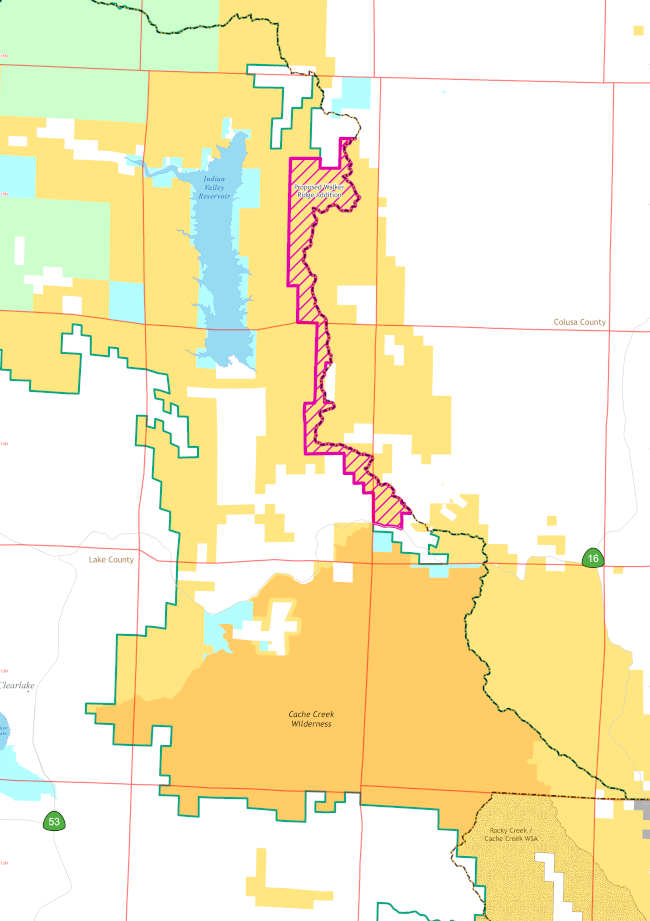
LAKE COUNTY, Calif. — New legislation introduced Tuesday by Lake County’s two members of Congress seeks to expand the Berryessa Snow Mountain National Monument to protect the Walker Ridge area, which will be renamed in honor of the area’s tribal history.
Congressman John Garamendi (D-CA-03) introduced the “Berryessa Snow Mountain National Monument Expansion Act” (H.R.6366) with Congressman Mike Thompson (D-CA-05) as the bill’s original cosponsor.
This legislation would expand the National Monument designated by President Obama in 2015 by nearly 4,000 acres to include an adjacent federally owned land parcel in Lake County known as the “Walker Ridge” tract.
The 330,780-acre National Monument covers Napa, Yolo, Solano, Lake, Colusa, Glenn and Mendocino counties. Two-thirds of it is located within Lake County.
In November 2019, the Board of Supervisors presented a proclamation declaring the town of Lucerne as the gateway to the National Monument following action by the Lucerne Town Hall in September.
“Conserving California’s special places has been a lifelong passion throughout my tenure in the state legislature, as deputy secretary of the Interior to President Clinton, and now as a member of Congress representing Lake County. Walker Ridge is one of those special places, and I am thrilled to continue working in Congress to conserve this unique landscape for future generations of Californians to enjoy,” said Garamendi.
“In 2016, I worked to designate the Berryessa Snow Mountain region as a National Monument to protect the pristine landscape and biodiversity of the region while creating countless recreational opportunities and boosting our local economy. This legislation will expand the Snow Mountain region to include Walker Ridge, protecting even more public land. I’m honored to work with Congressman Garamendi to ensure that our public lands are protected for generations to come,” said Thompson.
Congressman Garamendi’s bill also renames the entire ridgeline in Lake and Colusa counties from “Walker Ridge” to “Condor Ridge — which means “Molok Luyuk” in the Patwin language — befitting the area’s cultural significance to Native Americans like the federally recognized Yocha Dehe Wintun Nation.
“Molok Luyuk — or Condor Ridge — is a special part of Northern California and deserves special protections. We appreciate Congressman Garamendi’s leadership on this and his insistence that Native American voices be part of the conversation,” said Chairman Anthony Roberts of the Yocha Dehe Wintun Nation. “Our ancestors traveled and traded there for centuries. With these protections, the unique resources on Molok Luyuk will endure, and Californians will be able to enjoy its natural beauty for generations to come.”
Today, the area known as Walker Ridge attracts a wide range of people who use the Bureau of Land Management, or BLM, property to hike, ride horses, cycle, birdwatch, and drive legal off-highway vehicles.
The legislation would provide much-needed, lasting protection for Molok Luyuk along with the requirement for a Monument Management Plan within one year.
The legislation also would secure ongoing comanagement with affected federally recognized tribes by requiring federal agencies to consult with tribes in the development of the management plan, subsequent management decisions, and “continued meaningful engagement” in the implementation of the plan.
Don Amador, a longtime trail recreation and resource management professional, explained that Molok Luyuk’s management plan would make it easier for the BLM to designate routes that provide connectivity to increase public access and enhance recreation opportunities for all user groups.
“The expanded monument also would mark an important step toward helping the State of California and the Biden Administration meet the critical goal of protecting 30% of U.S. lands and waters by the year 2030,” added Elyane Stefanick, California program director for the Conservation Lands Foundation, in reference to California’s 30x30 Initiative and the federal America the Beautiful call-to-action.
"Conservation Lands Foundation supports Congressman Garamendi’s goal to expand the Berryessa Snow Mountain National Monument and ensure this remarkable landscape has a robust management plan,” Stefanick said. “The history of public lands is complex. The addition of Molok Luyuk honors the original stewards and caretakers of these lands and will help protect the area’s rich biodiversity.”
Many years of effort
Currently managed by the Bureau of Land Management, the area currently known as Walker Ridge is “a jewel of biodiversity,” said Nick Jensen, conservation program director for the California Native Plant Society, referring to Molok Luyuk’s 30 species of rare plants, ancient blue oak woodlands, rugged rock outcrops, wildflower meadows and extensive stands of McNab cypress.
For years, advocates called for lasting protection of Walker Ridge, helping to deter repeated development proposals for large-scale wind energy.
The wind energy proposals persist, despite the California Energy Commission’s finding that the area had only moderate to low energy potential.
In 2005 and again in 2011, CNPS submitted proposals to designate the region an Area of Critical Environmental Concern over worries that the area’s irreplaceable habitats would be permanently altered.
In 2014, Congressman Thompson championed bicameral legislation to establish the Berryessa Snow Mountain National Monument, with then-Senator Barbara Boxer (D-CA) and Congressman Garamendi.
In July 2015, President Obama declared the federal land surrounding Lake Berryessa as a National Monument, at the Congressmen’s urging.
On July 29, 2021, Congressman Garamendi announced a public comment period on this draft legislation to expand the Berryessa Snow Mountain National Monument.
Over the nearly 200 public comments submitted to the Congressman’s office, all but one supported the proposed expansion.
“Congressman Garamendi has given California a precious gift by working to secure permanent protection for Molok Luyuk,” said Jensen. “We thank him for listening and responding to our Tribal partners and coalition of scientists, outdoor enthusiasts, and conservation advocates.”
“The Berryessa Snow Mountain National Monument Expansion Act will safeguard Molok Luyuk’s natural beauty, wildlife, rare plants, and indigenous treasures while respecting Tribal stewardship over the lands,” said Tuleyome Executive Director Sandra Schubert. “It will also secure continued recreation opportunities in the area while providing a boost for local communities that have long called for permanent protection of the area. We commend Congressman Garamendi for this historic legislation protecting Molok Luyuk and all of the Monument’s treasures.”
The Berryessa Snow Mountain National Monument Expansion Act would:
• Expand the existing National Monument to include approximately 3,925 acres of adjacent public land administered by the BLM in Lake County known previously as the “Walker Ridge” tract.
• Not impact privately owned, state, tribal, or nonfederal land in any way and does not include the portion of the BLM’s Walker Ridge tract in Colusa County.
• Direct the BLM and the U.S. Forest Service, or USFS, to finally complete the management plan for the National Monument, unfinished since 2015.
• Require the federal land management agencies (BLM and USFS) to engage in meaningful consultation with federally recognized Indian tribes regarding the development and implementation of the National Monument’s management plan.
• Provide opportunities for federal land management agencies (BLM and USFS) to enter into voluntary agreements with federally recognized Indian tribe for day-to-day management of the National Monument, including historic preservation, archaeological sites and forest health.
• Rename the BLM’s entire “Walker Ridge” tract in Lake and Colusa counties to “Condor Ridge” translated from “Molok Luyuk” in the Patwin language of the Yocha Dehe and other federally recognized tribes indigenous to the area.
Those endorsing the bill include the Lake County Board of Supervisors, Yocha Dehe, Sierra Club, California Wilderness Coalition, California Native Plant Society and the Woodland-based nonprofit, Tuleyome.
Berryessa Snow Mountain National Monument Expansion Act text by LakeCoNews on Scribd
Dr. Gary Pace, who continues to serve as interim Public Health officer, gave the board its first COVID-19 update of the year.
“The situation’s really changing quickly,” said Pace, noting the large spike in cases due to the Omicron variant across the state and nationwide.
He said questions revolve around how protective the vaccine will be, how bad the hospitalization and death rates could be from the variant and how society will be impacted.
Schools and businesses are struggling with staffing; Pace said no lockdowns are being considered in Lake County due to Omicron.
Pace said that so far Omicron hasn’t been identified in Lake County through genetic sequencing. However, he said that’s a function of not doing a lot of sampling and having a testing lag.
Elsewhere around the region, however, Pace said he believes the spiking case numbers are due to Omicron. “It’s incredibly contagious” and the spread is “remarkable.”
Because of that spread, which is unlike that seen in previous variants, “You can’t really rely on your previous habits to keep you safe,” Pace said.
He urged people to continue to use masks — in particular, N95s — and to take part in fewer gatherings.
“There’s a lot of worry, there’s a lot of concern about what may be coming in the coming weeks,” he said, explaining that people who are vaccinated can get the variant and spread it.
Since July 1, 85% of people hospitalized for COVID-19 in Lake County were not vaccinated while 15% had received the vaccine, said Pace.
He told the board he expects to see case numbers rising, noting that 200 cases are now being processed.
Looking at previous case increases, particularly in the late summer and fall due to the Delta variant and a year ago due to the original virus, Pace believes Lake County will surpass those totals in the coming weeks.
“This is not something to ignore or minimize,” he said.
Case data shows the highest case numbers now are in the 18 to 34 and 35 to 49 age groups. The middle and high school age groups also are seeing increases, Pace said.
He said 60% of Lake County residents, or 36,500 people, are fully vaccinated. Of that group, 36% have had boosters. Another 32%, or 19,500, remains unvaccinated and 8%, or 4,500 people, are partially vaccinated, Pace said.
From the public health viewpoint, Pace said the big question is, are enough people in Lake County vaccinated to keep the hospitals from being overwhelmed.
While people feel it’s their right to protect themselves in their own way, Pace referred to a “community responsibility” in protecting against the virus.
In addition to being vaccinated, he encouraged people to wear N95 masks, stay home when sick and not participate in large gatherings.
He noted that on Monday night, Sonoma County announced it was shutting down large gatherings and asking people to stay at home for the next few weeks.
While Pace said he didn’t see the same thing happening in Lake County, “This is the level of concern that we’re seeing in the area.”
He said Sonoma County is where a lot of Lake County patients go when hospitalized. “They’re kind of raising the red flag right now.”
The question, said Pace, is how to live life in this surge. “It’s a good time to lay as low as possible for the next four to six weeks,” especially if you have underlying health conditions or are unvaccinated.
Pace said there is a lot of interest in looking back now to see how useful the lockdowns were and how well vaccinations have helped fight the pandemic. “It seems like it has helped quite a bit” and more death and misery were avoided.
He said moving forward, the longer-term approach is living with COVID-19 like the flu, but it’s too early to make that shift.
Jennifer Baker, interim deputy director for Lake County Health Services, reported to the board during the update that they are working with the California Department of Public Health on sewage testing for COVID-19.
The testing will begin at the county’s wastewater treatment facility in Clearlake, the most populous area, and will take place three days a week starting at the end of this month. They expect to get the data in early February, Baker said.
She said other wastewater facilities are on a list of sites to be added as the testing is expanded.
Supervisors decide against closing chambers
In a later discussion, due to concerns of an impending Omicron surge, such as Pace described, County Administrative Officer Carol Huchingson asked the board to consider closing the board chambers to the public again as it had last year, having the public participate virtually.
“I wish we weren’t back having this conversation. I have to start by saying that,” said Huchingson, noting they took action to close the board chambers at this time last year due to a growing number of cases in county facilities.
She recounted having more employees do work remotely in order to reduce in-office density, with the board chambers reopening later in the spring and summer months, at which time most county offices returned to work full time once conditions improved.
“In light of the impending Omicron surge, I’m asking you to look at that again,” she said, and to ask department heads to have employees work remotely to the amount that it’s reasonable.
Huchingson was concerned that if they wanted until things were out of control, they'd have waited too long.
She said she’s aware of 17 employees who have tested positive since Jan. 4, with the most recent positive test coming in on Tuesday morning.
The county’s workforce also has a low vaccination rate of less than 50%, which is less than the general public, she said. “We’re probably more susceptible to transmission.”
Huchingson said the vast majority of participation through board meetings — at 90% — is coming through Zoom.
As such, she recommended the board close the chambers to the public and reevaluate the action in 30 days.
She said they were planning to have 21 department heads in the chambers — which now has a COVID-related capacity of 24 — for a Jan. 20 governance workshop. “Bringing a lot of people into one room is a big concern.”
Huchingson said one county department now has six or seven employees who have tested positive and they had attended a large meeting or training together.
At the very least, Huchingson asked the board to remind department heads of their authority to have staff work remotely as much as possible to keep offices open.
Ultimately, board members decided against closing the chambers.
“It’s not a perfect situation, but it’s as safe as it can be,” said Supervisor Jessica Pyska, who added that staff is likely getting infected when not at work.
Supervisor Tina Scott suggested limiting the number of people who could come in the chambers at any one time, including having some supervisors attend virtually. She also wanted department heads to do their due diligence with staff and explore who could work from home.
Supervisor Bruno Sabatier said he felt it would be a mistake to close the chambers and that it would send the community a message that they haven’t learned anything over the course of the last two years.
Board Chair EJ Crandell said he supported the remote work policy as long as it was productive and there’s a way to measure it. He also worried about the impact if staff get the fast-moving variant and are unable to work.
Supervisor Moke Simon suggested moving the date of the governance workshop, which Huchingson said had been scheduled early in the year, before department heads start formulating their budgets, which are due around April 15.
Simon said that in every other year he would agree with that, and in 2023 it would be the plan to be on a normal schedule. “Fingers crossed.”
The rest of the board agreed to postpone that meeting. Huchingson said they will plan to determine a new date for the workshop at the board’s Jan. 25 meeting.
The board also reached consensus to have Huchingson write a message to department heads encouraging them to use the remote work policy based on their own judgment.
There also won’t be a special requirement for management — which Huchingson said had arisen during informal discussions — to be in the office a larger portion of the time when compared to other staff, due to the surge.
In other COVID-related business, the board on Tuesday voted unanimously to update the county’s COVID-19 workplace protocols to be in line with the latest state and federal rules.
Email Elizabeth Larson at
The meeting originally had been scheduled for 6 p.m. Wednesday, Jan. 12.
However, Superintendent Tim Gill told Lake County News that the meeting has been postponed until 6 p.m. Tuesday, Jan. 18.
“One of our board members is in Covid quarantine,” he wrote in an email. “With the vaccine mandate resolution on the agenda, we want all of our board members present.”
The Middletown Unified board is set to consider, for the second time, a resolution that asks that state not to mandate the COVID-19 vaccination for its students and staff.
It’s a resolution identical to those approved last month by the Lakeport Unified, Lucerne Elementary and Konocti Unified school boards.
Middletown Unified’s trustees originally had considered the resolution at its Dec. 15 meeting.
That was the first board meeting for new board members Annette Lee and Allison Berlogar, appointed Dec. 1 to fill two vacancies that resulted this fall from the resignations of LaTrease Walker and Thad Owens.
At that time, Lee suggested alternate language that emphasized choice, calling for the district to uphold California citizens’ rights to provide informed consent and to petition the state to ensure and maintain the personal belief exemption in any and all upcoming COVID-19 legislation.
The board ultimately didn’t accept that language and put off taking action on the resolution.
However, Lee’s attempt at taking all sides into account has made her the target of a petition to challenge her provisional appointment. Berlogar’s appointment has not been challenged and so has gone into effect.
The Lake County Office of Education is working with the Registrar of Voters Office to verify the signatures on the petitions, a process that must be completed by the end of this month.
In the meantime, the board is going to take up the resolution again. No changes have been made to it since it was considered last month.
Email Elizabeth Larson at
.
011222 MUSD COVID Resolution by LakeCoNews on Scribd
The meeting will begin at 9 a.m. Thursday, Jan. 13, in the board chambers on the first floor of the Lake County Courthouse, 255 N. Forbes St., Lakeport.
The agenda is here.
To participate in real-time, join the Zoom meeting by clicking this link.
The webinar ID is 969 1770 2795, the pass code is 102691.
Access the meeting via one tap mobile at +16699006833,,96917702795#,,,,*102691# or dial in at 669-900-6833.
The meeting also can be viewed on the county’s website or Facebook page.
In an item timed for 9:10 a.m., the commission will hold a public hearing to consider an amendment to a major use permit, adoption of a major use permit and an addendum to a mitigated negative declaration for Hilltop Recovery Services Inc.
Located at 14725 Catholic Church Road in Clearlake Oaks, Hilltop Recovery Services is proposing to expand its substance abuse rehabilitation treatment facility to allow a total maximum capacity of 20 residents to serve only women in an existing residential home to be converted as a treatment facility.
The staff report says planning staff recommend approval of the project.
On Thursday, the commission also will hold public hearings on three cannabis projects, two located in Kelseyville and one in Middletown.
The full agenda follows.
AGENDA
9:05 a.m.: Public hearing on consideration of a major use permit (UP 20-75) and a mitigated negative declaration (IS 20-88). The project applicant North Coast Select Inc., is proposing a co-location/clustering of permits for cannabis cultivation operation to allow 70,560 square feet mixed-light canopy area within greenhouses equipped with air filtration systems in a total of 168,680 square feet cultivation area. The project includes additional greenhouses for immature plants, a processing facility, a drying building, thirty-two 2,500 gallon water tanks, security and a perimeter fence. The project is located at 1496 Bell Hill Road, Kelseyville; and further described as A.P.N. (s): 017-002-02, 007-010-24, and 017-002-01.
9:10 a.m.: Public hearing on consideration of an amendment to major use permit (UP 15-15), to adopt major use permit (UP 21-24) and an addendum to a mitigated negative declaration (IS 15-34). The project applicant Hilltop Recovery Services Inc., Lori Carter-Runyon, is proposing an expansion of a substance abuse rehabilitation treatment facility to allow a total maximum capacity of 20 residences to serve only women in an existing residential home to be converted as a treatment facility. The project is located at 14725 Catholic Church Road, Clearlake Oaks; and further described as APN(s): 010-046-06.
9:15 a.m.: Public hearing on consideration of approving an amendment (MMU 21-20) of original major use permit (UP 18-43) and an addendum to a mitigated negative declaration (IS 18-58), The applicant Sunny S Ranch / Shannon Sanders is proposing four 2,499 square foot nursery areas (greenhouses) for immature cannabis plants in conjunction with previously approved project. The project location is 19424 Butts Canyon Road, Middletown; and further described as APN: 014-004-20.
9:20 a.m.: Public hearing on consideration of major use permit (UP 20-74) and a Mitigated Negative Declaration (IS 20-87). The applicant Mountain Green Farms, LLC/Cheryl Forberg is proposing for a cannabis cultivation operation to allow 21,000 square feet of mixed-light canopy area (Located within seven 3,000 square foot greenhouses) and 43,560 square feet of outdoor canopy area located within a total of 67,080 square feet cultivation area. The project includes a processing/drying building, a shed for fertilizer and pesticide storage, four 2,500 gallon water tanks, security and a perimeter fence. The project is located at 7661 State Highway 29, Kelseyville; and further described as APN(s): 009-022-33.
Email Elizabeth Larson at