 How to resolve AdBlock issue?
News
Research published by the California Policy Lab reports a decline of 38% in the number of people migrating to the Golden State from elsewhere in the U.S. At the same time, the number of people leaving the state for other U.S. locations has increased by 12% since the start of the pandemic.
The sharply falling in-migration and steadily rising out-migration, taken together, have doubled domestic migration away from California since March 2020, the study authors concluded.
“Most of the public's attention has been focused on whether there are more people leaving the state, but as we found, there's also significantly fewer people moving into California from other states,” said report co-author Natalie Holmes, a research fellow at the California Policy Lab and a Ph.D. student at the Goldman School of Public Policy at UC Berkeley.
"If these trends continue," Homes added, "the implications for California are significant, ranging from federal funding allocations and tax revenues to how many seats we have in Congress. Population swings can have even more dramatic effects on local jurisdictions."
Using anonymous credit bureau data, the researchers found that all of California’s 58 counties have seen fewer people moving in from out of state since the start of the pandemic.
The impact is especially pronounced in the Bay Area. Between March 2020, when the first pandemic lockdowns were imposed, and the end of September 2021, the number of people migrating to the Bay Area was down by 45% — and by over 50% in San Francisco and Santa Clara counties.
Of course, people are always moving, and for decades the population of California has risen as people have arrived here from other states and countries to pursue their dreams. California is still the largest U.S. state, by far. In 2019, births in California were nearly double the number of deaths, the study says.
But the state has been losing population to domestic migration for more than a decade, Holmes said. International migration was not included in the study, but it has produced substantial gains for more than a decade, she added.
Overall, the state’s population growth has slowed significantly in recent decades. The state Department of Finance estimated in 2021 that for the first year since the start of the 20th century, California suffered a net loss of population in 2020.
Some analysts, including a number of conservative critics, have pressed the argument that California is a failing state and that people are fleeing in droves to avoid high housing costs and high taxes.
A complex, multi-institution study released earlier this year by the University of California President’s Office found no evidence of an unusual recent exodus of California residents to other states.
Edward Lempinen writes for the UC Berkeley News Center.
Call Lake County Animal Care and Control at 707-263-0278 or visit the shelter online for information on visiting or adopting.
The following cats at the shelter have been cleared for adoption.

Male domestic shorthair
This young male domestic shorthair cat has a gray and white coat.
He is in cat room kennel No. 53a, ID No. LCAC-A-2384.

‘Blackette’
“Blackette” is a young male domestic shorthair with a black and white coat.
He is in kennel No. 53b, ID No. LCAC-A-2385.

‘Blackie’
“Blackie” is a young male domestic shorthair with a black and white coat.
He is in cat room kennel No. 53c, ID No. LCAC-A-2386.

Male domestic shorthair
This young male domestic shorthair has a unique striped gray tabby coat.
He is in cat room kennel No. 53d, ID No. LCAC-A-2383.

Male domestic shorthair kitten
This male domestic shorthair kitten has an orange tabby coat.
He is in cat room kennel No. 96a, ID No. LCAC-A-1871.

Male domestic shorthair kitten
This male domestic shorthair kitten has an orange tabby coat.
He is in cat room kennel No. 96c, ID No. LCAC-A-1873.

Female domestic shorthair kitten
This female domestic shorthair kitten has an orange tabby coat.
She is in cat room kennel No. 96d, ID No. LCAC-A-1874.

Female domestic shorthair kitten
This female domestic shorthair kitten has a gray tabby coat.
She is in cat room kennel No. 101a, ID No. LCAC-A-1945.
Email Elizabeth Larson at
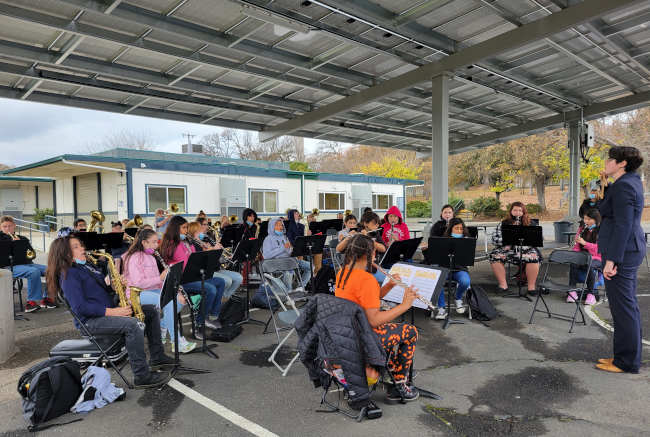
LOWER LAKE, Calif. — A major new federal grant is giving the Konocti Unified School District the resources it needs to build a new music program for elementary students.
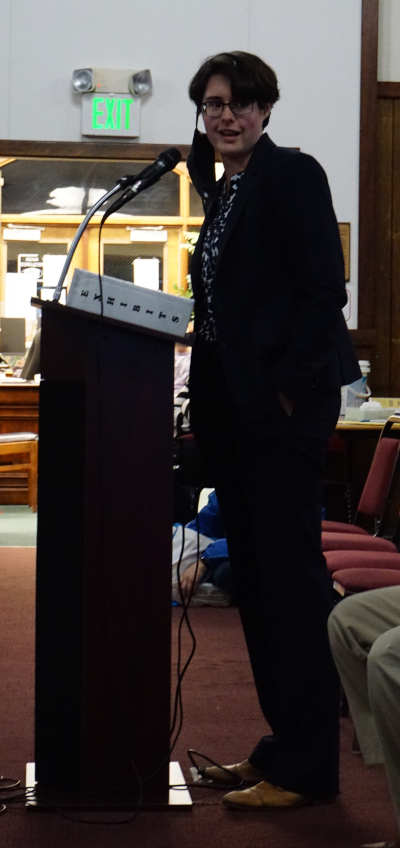
On Dec. 8, at the last regular school board meeting of the year, Katherine Wiley, who teaches and serves as band director at Lower Lake High and the Konocti Education Center, gave the trustees the good news.
Wiley said the district has received a $1.6 million Assistance for Arts Education Program grant from the U.S. Department of Education to bring music back to the elementary schools.
Konocti Unified received one of 27 grants — eight of them given to sites in California — awarded through the program this year.
“I’m really excited,” said Wiley, now in her seventh year with the district.
She said she hopes the effort will build up a program that’s serving the district long after she retires. “I still have 35 years,” she quipped, adding, “I’m super stoked.”
In an interview with Lake County News, Wiley said she’s unaware of the district ever receiving such a large arts-related grant before.
“It’s a pretty big deal,” Wiley said.
She said Konocti Unified’s “On-Ramp” grant is to be dispersed to the district over four years. The plan is to have the new music program ready for the start of the 2022-23 school year.
“There are four primary goals of our grant,” Wiley said.
She said those goals are to hire a full-time elementary music teacher, offer training and continued support for up to 32 arts integration specialists, create an online arts education curriculum that elementary school teachers can use throughout the year and bring in community artists to help supplement those arts integration lessons.
She said the district has about 2,000 students in grades kindergarten through seventh grade, with four elementary schools and one arts education magnet school, Konocti Education Center, or KEC.
An opportunity arises
Wiley said the grant was brought to the district’s attention in the spring by Robert Bullwinkel and Kim Morin of Big Idea Consulting, a firm that helps schools and communities work together to bring high quality arts education to their students, according to the company’s website.
Big Idea Consulting has been working with Konocti Unified for two years, and Wiley said Bullwinkel thought the grant would be a good fit for the district.
The grant aims to help rural districts, which serve at-risk youth, that want to create a rigorous arts program, “Which is everything we were about,” Wiley said.
Wiley said the application was due in April, which gave the district a really short turnaround time. However, Bullwinkel did most of the work in writing the grant, with district staff providing the needed information.
They needed to get letters of support and provide information about the student body, such as the fact that 36% of the district’s students fall below the federal poverty line, with 84% qualifying for free and reduced lunch, Wiley said.
Wiley said the rest of the grant preparation process included laying out what the program would look like and what the district’s qualifications for a successful program would be.
They tied the grant to the English language reading standard, as many of the district’s students read below grade level. Wiley said they believe rigorous arts education improves reading scores.
Wiley said they found out in mid-October that they had received the grant. They’re now in the planning process, which Wiley called “very exciting.”
The next steps in creating the program include getting input from teachers, parents and the community at large, she said.
The district will host its first informational meeting on the program from 3:30 to 5 p.m. Thursday, Jan. 13, in the Carol McClung Conference Center at the Konocti Unified School District Office, 9430-B Lake St. in Lower Lake.
Wiley, who is the program manager and will be responsible for making most executive decisions, said that as they begin to solidify what the On-Ramp program will look like, the district plans to host an additional informational meeting and celebration of the arts sometime in late spring.
At that event, Wiley said community members will be invited to participate in arts activities while learning about the opportunities their students have in the coming school years.
She said there isn't a date or location set for that event yet, but it will be held sometime in the evening to allow more community members to attend.
“After that, we’ll be looking for volunteers to serve on the steering committee,” Wiley said. “We want that to be a collection of teachers, support staff, administrators and community members.”
Wiley said that the steering committee will consist of about 10 people who will serve throughout the length of the grant, be the feedback group, brainstorm ideas, be proactive problem solvers and “really make sure this thing takes off.”
She added, “They’re the foundation.”
Wiley said district Superintendent Becky Salato will have a role in making sure everything is running smoothly.
Building a new program
The music program the district is building will focus on the elementary grades because, between KEC and the high school, “We have a pretty vibrant arts education program,” said Wiley.
KEC is excellent for middle school level students and the high school has a wide variety of classes, she said.
Part of the motivation for the grant is that Wiley said teachers noticed artistic students coming into high school who were lacking foundational skills.
As an example, she said they were seeing music students who haven’t seen a quarter note and don’t know what it’s called.
Like many school districts, Konocti Unified was impacted by the financial impacts of the Great Recession, Wiley said.
“We had a pretty solid elementary music program before the recession,” she said. Then, when cuts to staffing happened, the elementary music teacher position eventually went away.
A couple of years ago the district tried to have an elementary school music position again but it didn't continue after the first two years, Wiley said.
Wiley said a lot of that had to do with how the effort was rolled out, with that teacher expected to serve all four elementary schools at the same time and only getting the chance to see students once every other week. “It was a very difficult task that the person was asked to do.”
The new music teacher position the district wants to create will divide their time between Burns Valley and Lower Lake Elementary, and also will focus on forming relationships, Wiley said.
She said that position is to be funded in part by the grant for the first few years, with a commitment from the district to pay the base salary when the grant is done.
There also will be an arts integration component. Wiley said they can teach music, visual and drama standards while still doing what is considered a more standard curriculum. “How to do that though is a little tricky,” and not a lot of teachers have that arts integration background.
So the development of 32 arts integration specialists will take place over the summer. Participants in the program — which Wiley said will be for existing teachers and volunteers — will learn how to integrate the arts with other subjects in a meaningful way. There also will be a person on site to support teachers in art integration.
In envisioning a successful program, Wiley said they want every student to enjoy it, and for students entering middle school to know what they are passionate about and what they want to pursue for electives both at the middle and high school levels.
She said they want to encourage literacy, and see students reading and comprehending at higher levels. They believe that arts integration will help students that feel separated from material to feel connected again.
They want to see standardized testing scores rise along with a significant increase in students reading at or above grade level, she said.
Wiley said they also want the community to feel more welcome at school sites by putting on performances and exhibits of student art work on a regular basis.
She said most of the pieces of the program should be together by August, in time for the school year to start. By that point she expects the elementary music teacher should be hired.
Community members are invited to the Jan. 13 meeting to learn more about the program and how to get involved.
Email Elizabeth Larson at
The governor’s budget also calls for new legislation to implement supplemental paid sick leave policies given the current situation being driven by the Omicron variant to better protect our front line workers.
“From day one, California has taken swift and direct action to battle COVID-19 with policies that have saved tens of thousands of lives, but there’s more work to be done,” said Gov. Newsom. “Our proposed COVID-19 Emergency Response Package will support our testing capacity, accelerate vaccination and booster efforts, support front line workers and health care systems and battle misinformation, with a focus on the hardest-hit communities.”
Gov. Newsom’s overall package includes:
$1.2 BILLION: BOLSTER TESTING
Expand hours and capacity at testing sites throughout the state to help slow the spread.
Distribute millions of COVID-19 antigen tests to local health departments, community clinics and county offices of education and schools. This is critical to the state’s operational readiness and continued efforts to combat COVID-19, and it includes a $1.4 billion emergency appropriation request to the Legislature for California’s immediate needs.
Supporting the state’s testing facilities, including specimen collection and expanding capacity in order to meet demand.
Supporting state departments in testing their staff and congregate populations
$583 MILLION: GET MORE CALIFORNIANS VACCINATED AND BOOSTED, COMBAT MISINFORMATION
Continue the “Vaccinate all 58” public education campaign to provide reliable information and build vaccine confidence while combating misinformation, all of which is in partnership with 250 ethnic media outlets.
Continue a robust community outreach and direct appointment assistance campaign by conducting door-to-door canvassing, phone banking and texting with over 700 CBOs and community partners in partnership with philanthropy.
In-home vaccination and testing programs to meet Californians where they’re at.
Provide free transportation to vaccination appointments throughout the state to help get more Californians vaccinated and boosted.
$614 MILLION: SUPPORT OUR FRONT LINE WORKERS AND HEALTH CARE SYSTEMS
Support and distribution of critical personnel resources for health care systems to help protect front line workers, patient care and hospital surge capacity as well as additional staffing for vaccination sites.
$200 MILLION: SUPPORT STATE RESPONSE OPERATIONS
Resources to enhance the state’s emergency response and public health capacities, including staffing and information technology at California Department of Public Health, Office of Emergency Services and Emergency Medical Services Authority.
$110 MILLION: SUPPORT VULNERABLE POPULATIONS AND BOLSTER CONTACT TRACING EFFORTS
Increased public health and humanitarian efforts at the California-Mexico border to keep migrants safe, including vaccinations, testing and isolation and quarantine services.
Expanded statewide contact tracing activities to help keep Californians safe and slow the spread.
Health care leaders applauded Gov. Newsom’s proposed action to protect Californians and expand efforts to combat this pandemic.
“This emergency response package to boost testing, vaccine distribution and support health care workers comes at a critical time as cases of the Omicron variant surge nationwide," said California Medical Association President Robert E. Wailes, M.D. "The California Medical Association appreciates Gov. Newsom’s leadership as his administration continues to work to anticipate the state’s needs and implement strong public health measures that will save lives.”
“As the current Omicron surge demonstrates, no one knows for how long the COVID-19 pandemic will endure or the enormity of its impact on California for years to come,” said President and CEO of the California Hospital Association Carmela Coyle. “What we do know is that the demands on our state’s health care system have never been greater, and we need all the support we can get. The governor's request for this funding, including resources to shore up a depleted workforce, represents a vital step toward making sure the health care needs of every Californian are met as a crisis with no known end date continues to claim lives every day.”
"Gov. Newsom's announcement today to invest $2.7 billion in ongoing COVID-19 emergency response comes at a pivotal time in our fight against this deadly disease and the rapid spread of the Omicron variant. We commend the governor for taking these decisive actions to help protect the health and well-being of local communities through the expansion of vaccines, testing, and booster shots and efforts to combat misinformation that has caused unnecessary deaths and illness. These actions will ultimately help save lives, which remains a top priority for local public health,” said Executive Director of the County Health Executives Association of California Michelle Gibbons.
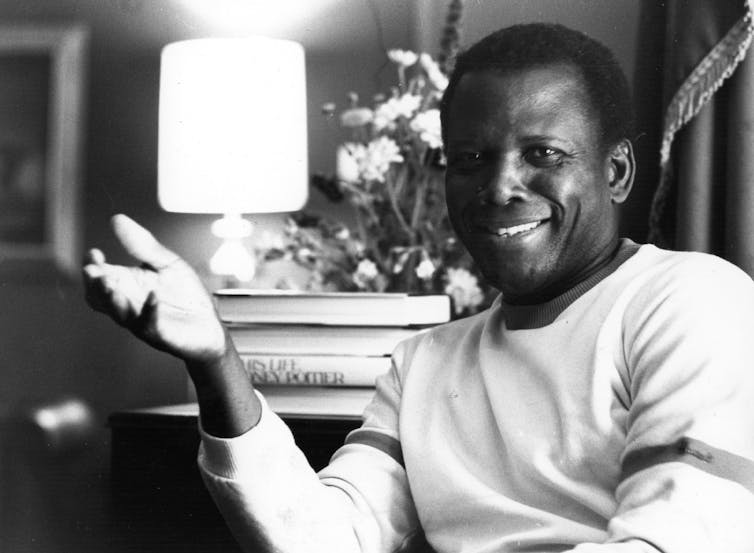
In the summer of 1967, Martin Luther King Jr. introduced the keynote speaker for the 10th-anniversary convention banquet of the Southern Christian Leadership Conference. Their guest, he said, was his “soul brother.”
“He has carved for himself an imperishable niche in the annals of our nation’s history,” King told the audience of 2,000 delegates. “I consider him a friend. I consider him a great friend of humanity.”
That man was Sidney Poitier.
Poitier, who died at 94 on Jan. 7, 2021, broke the mold of what a Black actor could be in Hollywood. Before the 1950s, Black movie characters generally reflected racist stereotypes such as lazy servants and beefy mammies. Then came Poitier, the only Black man to consistently win leading roles in major films from the late 1950s through the late 1960s. Like King, Poitier projected ideals of respectability and integrity. He attracted not only the loyalty of African Americans, but also the goodwill of white liberals.
In my biography of him, titled “Sidney Poitier: Man, Actor, Icon,” I sought to capture his whole life, including his incredible rags-to-riches arc, his sizzling vitality on screen, his personal triumphs and foibles and his quest to live up to the values set forth by his Bahamian parents. But the most fascinating aspect of Poitier’s career, to me, was his political and racial symbolism. In many ways, his screen life intertwined with that of the civil rights movement – and King himself.
An age of protests
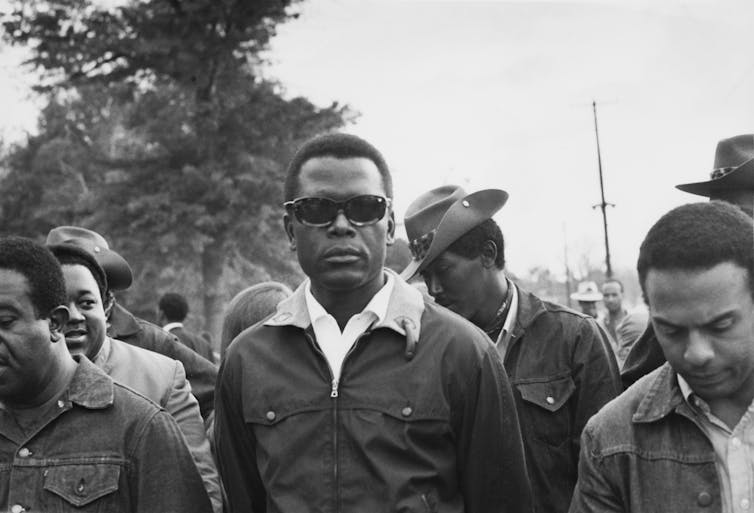
In three separate columns in 1957, 1961 and 1962, a New York Daily News columnist named Dorothy Masters marveled that Poitier had the warmth and charisma of a minister. Poitier lent his name and resources to King’s causes, and he participated in demonstrations such as the 1957 Prayer Pilgrimage and the 1963 March on Washington. In this era of sit-ins, Freedom Rides and mass marches, activists engaged in nonviolent sacrifice not only to highlight racist oppression, but also to win broader sympathy for the cause of civil rights.
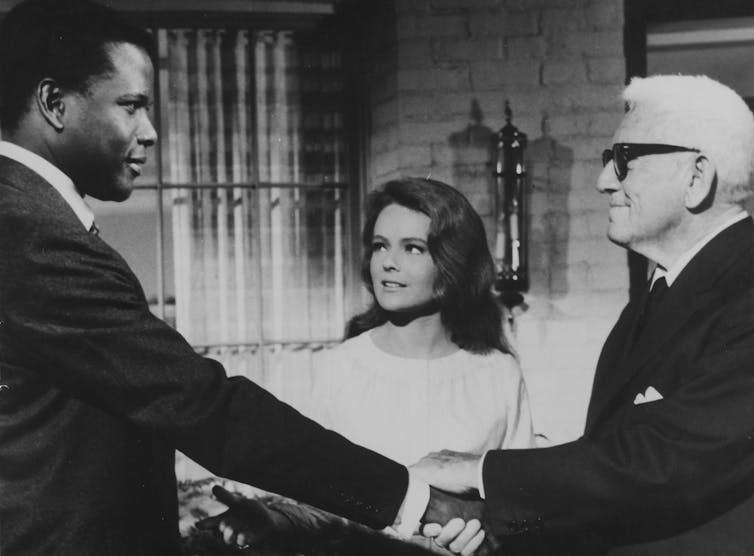
In that same vein, Poitier deliberately chose to portray characters who radiated goodness. They had decent values and helped white characters, and they often sacrificed themselves. He earned his first star billing in 1958, in “The Defiant Ones,” in which he played an escaped prisoner handcuffed to a racist played by Tony Curtis. At the end, with the chain unbound, Poitier jumps off a train to stick with his new white friend. Writer James Baldwin reported seeing the film on Broadway, where white audiences clapped with reassurance, their racial guilt alleviated. When he saw it again in Harlem, members of the predominantly Black audience yelled “Get back on the train, you fool!”
King won the Nobel Peace Prize in 1964. In that same year, Poitier won the Oscar for Best Actor for “Lilies of the Field,” in which he played Homer Smith, a traveling handyman who builds a chapel for German nuns out of the goodness of his heart. The sweet, low-budget movie was a surprise hit. In its own way, like the horrifying footage of water hoses and police dogs attacking civil rights activists, it fostered swelling support for racial integration.
A better man
By the time of the actor’s Southern Christian Leadership Conference speech, both King and Poitier seemed to have a slipping grip on the American public. Bloody and destructive riots plagued the nation’s cities, reflecting the enduring discontent of many poor African Americans. The swelling calls for “Black Power” challenged the ideals of nonviolence and racial brotherhood – ideals associated with both King and Poitier.
When Poitier stepped to the lectern that evening, he lamented the “greed, selfishness, indifference to the suffering of others, corruption of our value system, and a moral deterioration that has already scarred our souls irrevocably.” “On my bad days,” he said, “I am guilty of suspecting that there is a national death wish.”
By the late 1960s, both King and Poitier had reached a crossroads. Federal legislation was dismantling Jim Crow in the South, but African Americans still suffered from limited opportunity. King prescribed a “revolution of values,” denounced the Vietnam War, and launched a Poor People’s Campaign. Poitier, in his 1967 speech for the SCLC, said that King, by adhering to his convictions for social justice and human dignity, “has made a better man of me.”
Exceptional characters
Poitier tried to adhere to his own convictions. As long as he was the only Black leading man, he insisted on playing the same kind of hero. But in the era of Black Power, had Poitier’s saintly hero become another stereotype? His rage was repressed, his sexuality stifled. A Black critic, writing in The New York Times, asked “Why Does White America Love Sidney Poitier So?”
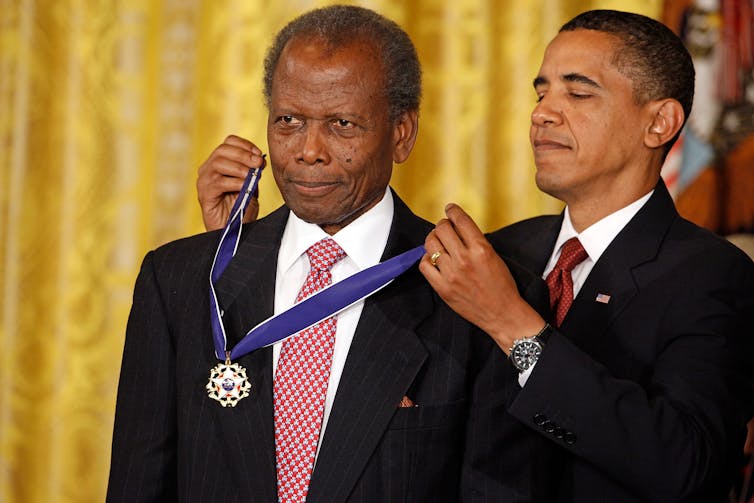
That critic had a point: As Poitier himself knew, his films created too-perfect characters. Although the films allowed white audiences to appreciate a Black man, they also implied that racial equality depends on such exceptional characters, stripped of any racial baggage. From late 1967 into early 1968, three of Poitier’s movies owned the top spot at the box office, and a poll ranked him the most bankable star in Hollywood.
Each film provided a hero who soothed the liberal center. His mannered schoolteacher in “To Sir, With Love” tames a class of teenage ruffians in London’s East End. His razor-sharp detective in “In the Heat of the Night” helps a crotchety white Southern sheriff solve a murder. His world-renowned doctor in “Guess Who’s Coming to Dinner” marries a white woman, but only after winning the blessing of her parents.
“I try to make movies about the dignity, nobility, the magnificence of human life,” he insisted. Audiences flocked to his films, in part, because he transcended racial division and social despair – even as more African Americans, baby boomers and film critics tired of the old-fashioned do-gooder spirit of these movies.
Intertwined lives
And then, the lives of Martin Luther King Jr. and Sidney Poitier intersected one final time. After King’s assassination on April 4, 1968, Poitier was a stand-in for the ideal that King embodied. When he presented at the Academy Awards, Poitier won a massive ovation. “In the Heat of the Night” and “Guess Who’s Coming to Dinner” captured most of the major awards. Hollywood again dealt with the nation’s racial upheaval through Poitier movies.
But after King’s violent murder, the Poitier icon no longer captured the national mood. In the 1970s, a generation of “Blaxploitation” films featured violent, sexually charged heroes. They were a reaction against the image of a Black leading man associated with Poitier. Although his career evolved, Poitier was no longer a superstar, and he no longer bore the burden of representing the Black freedom movement. Yet for a generation, he had served as popular culture’s preeminent expression of the ideals of Martin Luther King.
[Get the best of The Conversation, every weekend. Sign up for our weekly newsletter.]
Aram Goudsouzian, Bizot Family Professor of History, University of Memphis
This article is republished from The Conversation under a Creative Commons license. Read the original article.
Dogs available for adoption this week include mixes of Akita, black mouth cur, border collie, Chihuahua, German shepherd, Labrador retriever, pit bull and Rhodesian ridgeback.
Dogs that are adopted from Lake County Animal Care and Control are either neutered or spayed, microchipped and, if old enough, given a rabies shot and county license before being released to their new owner. License fees do not apply to residents of the cities of Lakeport or Clearlake.
The following dogs at the Lake County Animal Care and Control shelter have been cleared for adoption (additional dogs on the animal control website not listed are still “on hold”).
Call Lake County Animal Care and Control at 707-263-0278 or visit the shelter online for information on visiting or adopting.

Black mouth cur-Labrador retriever mix
This 5-year-old female black mouth cur-Labrador retriever mix has a golden coat with white markings.
She is in kennel No. 2, ID No. LCAC-A-2449.

Male German shepherd
This 1-year-old male German shepherd has a black and tan coat.
He is in kennel No. 12, ID No. LCAC-A-1892.

‘Cinnamon’
“Cinnamon” is a 5-year-old female chocolate Labrador retriever-pit bull mix with a short chocolate-colored coat.
She is in kennel No. 13, ID No. LCAC-A-1769.

‘Bruce’
“Bruce” is a 2-year-old male pit bull terrier with a short brown coat.
He is in kennel No. 14, ID No. LCAC-A-2351.

Male pit bull terrier
This male pit bull terrier has a short tan coat with white markings.
He is in kennel No. 17, ID No. LCAC-A-2444.

‘Nioki’
“Nioki” is a 1-year-old female shepherd with a black coat.
She is in kennel No. 21, ID No. LCAC-A-2442.

Female border collie mix
This 2-year-old female border collie mix has a black and white coat.
She is in kennel No. 23, ID No. LCAC-A-2207.

Female Chihuahua
This 2-year-old female Chihuahua has a short black coat.
She is in kennel No. 24, ID No. LCAC-A-2446.

‘Brownie’
“Brownie” is a young male Chihuahua mix with a red and white coat.
He is in kennel No. 25a, ID No. LCAC-A-2414.

‘Nugget’
“Nugget” is a male Chihuahua mix puppy with a short tan coat.
He is in kennel No. 25b, ID No. LCAC-A-2413.

Male German shepherd
This 2-year-old male German shepherd has a black and tan coat.
He is in kennel No. 26, ID No. LCAC-A-1903.

Male German shepherd
This 2-year-old male German shepherd has a black and tan coat.
He is in kennel No. 29, ID No. LCAC-A-2400.

‘Duke’
“Duke is a 1-year-old male Rhodesian ridgeback with a short brown coat.
He is in kennel No. 30, ID No. LCAC-A-2219.

Female Akita-shepherd mix
This 1-year-old female Akita-shepherd mix has a black and tan coat.
She is in kennel No. 33, ID No. LCAC-A-2438.
Email Elizabeth Larson at