 How to resolve AdBlock issue?
News
Lake Family Resource Center received a $550,000 three-year grant in 2019 from the Office for Victims of Crime, part of the U.S. Department of Justice.
Kara Roberts, Lake Family Resource Center’s human trafficking program coordinator, said they are now in the third year of the grant and preparing to apply for more funding.
The federal Bureau of Justice Statistics reported that arrests, prosecutions and sentencings in human trafficking cases have increased nationwide.
Human trafficking is estimated to be a $32 billion industry worldwide, according to
Roberts said Human Trafficking Awareness Month is a chance to educate the community about the crime, but she said the first question people ask her is if it’s happening here in Lake County.
“It’s a victimization that’s as old as time,” said Roberts, who called it “modern day slavery.”
In 2020, the first year of the grant, Lake Family Resource Center built its program to help the victims of human trafficking, Roberts said.
She said in year two — which was last year — they began providing direct services. In 2021, Lake Family Resource Center served 18 clients, of which 13 had been the victims of sex trafficking and five had been subjected to labor trafficking.
Altogether, Roberts said the organization provided 1,108 services that year to those 18 clients last year.
Services that she said are offered include one on one counseling, crisis intervention, referrals for therapy, emergency shelter, financial assistance for food and clothing, and advocacy — both personal and in the courts — along with support groups and transportation.
For the community at large, they are continuing their education efforts. However, Roberts noted that while she believes more people are understanding the issue, “There is a long way to go.”
She said they will work with Upper Lake High School in the next month to educate the high school students there and have plans to work with other local schools.
Roberts said it’s important to speak to students about the dangers, as the average age of recruitment for the victims of human trafficking is 12 to 14, Roberts said.
“They like to get them young” because they are easier to manipulate and brainwash, she said of traffickers.
Roberts added that when it comes to human trafficking, “It’s hard for people to talk about.”
This month, Roberts has received proclamations from the Board of Supervisors and the Clearlake and Lakeport city councils declaring Human Trafficking Awareness Month in Lake County.
She said the center also has done extensive outreach, including outdoor banners, social media and blue magnets placed on law enforcement vehicles. Of the magnets, Roberts said, “That was exciting. That was our second year doing that.”
They’ve also distributed stencils to be placed in the front windows of county businesses, with business owners and organizations also signing a pledge to combat human trafficking.
Roberts said Susie Q’s doughnuts also did a blue doughnut this month to raise funds for Lake Family Resource Center, Roberts said.
To find out more about the center’s human trafficking program, call 707-279-0563, visit the group’s Facebook page or its website.
Email Elizabeth Larson at

People living in the western U.S. have been concerned about wildfires for a long time, but the past two years have left many of them fearful and questioning whether any solutions to the fire crisis truly exist.
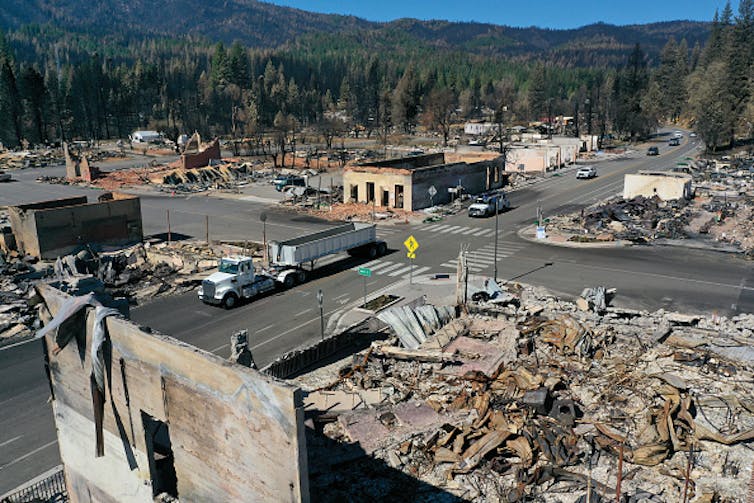
The Dixie Fire in the Sierra Nevada burned nearly 1 million acres in 2021, including almost the entire community of Greenville, California. Then strong winds near Lake Tahoe sent the Caldor Fire racing toward homes, forcing the evacuation of tens of thousands of people – including one of us. They followed destructive wildfires in 2020 in California, and Colorado and Oregon also saw devastating fires in the past two years.
As foresters who have been working on wildfire and forest restoration issues in the Sierra Nevada for over a quarter of a century, the main lesson we gather from how these fires have burned is that fuels reduction and forest restoration projects are our best tools for mitigating wildfire impacts amid a changing climate, and not nearly enough of them are being done.
A new 10-year plan announced by the U.S. Forest Service in early 2022 aims to change that. It outlines an ambitious strategy, but Congress will now have to follow through with enough funding to carry it out.
Fuels reduction projects can work
The Dixie and Caldor fires provided evidence that forest fuels reduction projects can work.
The fires spread quickly over vast areas, but both burned less severely in areas with proactive forest restoration and fuels management projects, including near South Lake Tahoe and near Quincy.
Fuels reduction projects include thinning out trees, burning off woody debris and reducing “ladder fuels” like small trees and brush that can allow fire to reach the tree canopy. Forest restoration projects focus on forest structure, density and composition as well as reducing fuels.
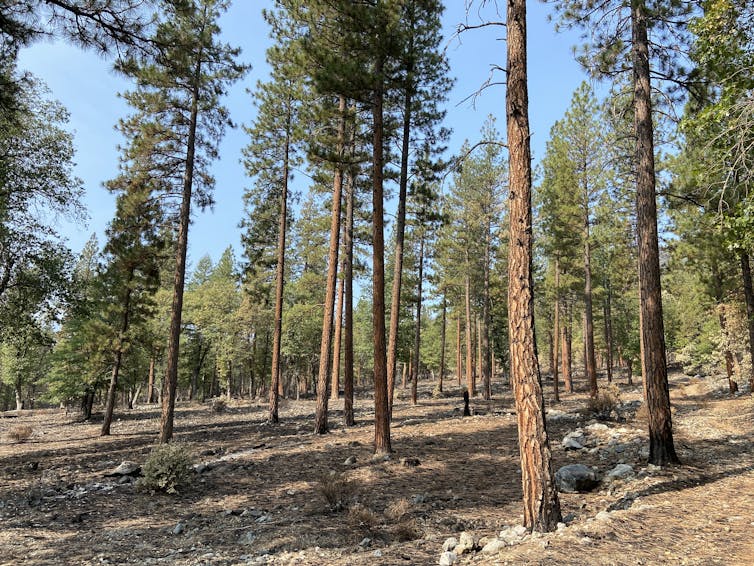
These projects create more open forests that are less likely to fuel severe megafires. They also create strategic areas where firefighters can more easily fight future blazes. And because fires burn less intensely in thinned forests, these projects leave more intact forest after a fire for regenerating new trees and sequestering carbon.
A new 10-year plan
The Forest Service’s new 10-year plan sets a goal to treat as much as 50 million additional acres across the West over 10 years, just under 80,000 square miles. For comparison, the Forest Service treats around 2 million to 3 million acres a year now.
The first priorities in the plan are high-risk areas where communities have been threatened by out-of-control fires, including in the Sierra Nevada in California, the eastern side of the Rockies in Colorado and parts of the Pacific Northwest and the Southwest.
The Forest Service already has a “shared stewardship” agreement with California, reached in 2020, aiming to treat 1 million acres annually by 2025. Though, research indicates that current levels of treatment are closer to 30% of that million-acre goal. Remember that 1 million acres is about how much the Dixie Fire burned.
A lingering question is how the 10-year plan will be paid for, considering that it will require a workforce larger than the U.S. has seen in decades.
So far, Congress has approved additional funding through the 2021 infrastructure bill, which included about $655 million a year for fire management for five years. That’s in addition to the Forest Service’s annual funding for this work, which was about $260 million this fiscal year.
But in California alone, a group of scientists, land managers and former government leaders has recommended spending $5 billion a year on proactive management, roughly equivalent to what was spent to suppress fires in the state in 2020. Known as “The Venado Declaration,” this proposal, championed by former Gov. Jerry Brown and former Cal Fire Director Ken Pimlott, calls for addressing forest resiliency on every acre and acknowledges that more than just funding is needed. It also discusses building infrastructure and a workforce and reevaluating regulatory barriers.
Four key steps
To manage fires in an era of climate change, when drier, hotter weather creates ideal conditions for burning, experts estimate that the area treated for fuels reduction needs to increase by at least an order of magnitude. We believe government needs to accomplish these four things to succeed:
1) Drastically increase funding and staff for agencies’ fuels reduction projects, as well as outreach, cost-sharing and technical assistance for private forestland owners. The new plan is a good start. Funding more federal and state agency positions would add forest restoration capacity for the long term. The Biden administration’s proposal for a Civilian Climate Corps could also bring in more young workers.

2) Reduce regulations on forest and fuels management efforts for both public and private land. While California and the federal government have made recent strides to streamline regulations, land management agencies need to acknowledge the biggest risk is doing nothing. Agencies need to plan larger restoration projects and drastically cut the time needed to implement them.
3) Invest in communities’ capacity to carry out local forest restoration work by providing long-term support to local organizations that provide outreach, technical assistance and project coordination services. Funding restoration through competitive grants makes development of long-term community capacity challenging at best. The new plan’s inclusion of state, tribal and private lands is an opportunity for partnerships.
4) Provide funds and financial incentives for at-risk communities to retrofit homes to withstand wildfires and reduce fuels around homes, communities and infrastructure.
Amid a changing climate, we will have to learn to coexist with wildfires in the U.S. West. This will require concerted action and a cultural shift in how we view and manage our forests and communities to be resilient.
This is an updated version of an article first published on Oct. 13, 2021.
Ryan E. Tompkins, Cooperative Extension Forester and Natural Resources Advisor, University of California, Division of Agriculture and Natural Resources and Susan Kocher, Cooperative Extension Forester and Natural Resources Advisor, University of California, Division of Agriculture and Natural Resources
This article is republished from The Conversation under a Creative Commons license. Read the original article.

Some assets belong inside of one’s living trust and other assets do not. It is important to know the difference.
The primary purposes of a living trust are to avoid probate and to distribute assets according to one’s wishes in the most cost and time effective manner.
Assets normally titled inside of one’s living trust include real property, investment and bank accounts — other than one’s day to day checking account. Doing so may avoid a probate becoming necessary if the combined gross value of all such assets were to exceed the $166,250 threshold at which a probate is required.
Generally speaking, administering an estate owned inside of a decedent’s living trust is less expensive, time consuming and aggravating than administering the same estate inside a probate, i.e., when the assets are owned personally in the decedent’s name. While trusts require administration after the settlor (owner) dies the total expense of administration is usually less with a trust administration.
Other assets remain outside of the living trust. That is, retirement accounts – e.g., Individual Retirement Accounts (“IRA’s”), 401k defined contribution plans, and pensions – are not transferable into a trust while the account holder is alive.
These assets pass according to death beneficiary designation forms. Typically a participant will name his or her spouse as the primary death beneficiary and the participant’s children as the alternative death beneficiaries.
The surviving spouse is able to roll over the retirement plan into his or her own IRA as though the surviving spouse had funded the rollover IRA with his or her own contributed earnings. The alternative beneficiaries are typically the children.
A trust, however, if it meets certain income tax requirements, can be named as the death beneficiary to retirement accounts.
A trust might be named to receive and distribute a decedent’s retirement monies at death to beneficiaries for various reasons, such as the beneficiaries are minors, receive special needs benefits, have creditor problems, etc. In addition, a trust allows for more contingency planning.
Annuities and life insurance policies can either name individuals or a trust as death beneficiary to receive the proceeds on the death of the insured.
With a married couple, the insurance may name the spouse or the couple’s trust as the primary death beneficiary. If the trust receives the money it reduces the risk of a possible probate if the surviving spouse does not put the money into the trust.
Joint tenancy assets, pay on death, or POD, and transfer on death, or TOD, financial accounts also avoid probate. Unlike trusts they do not require administration for the death beneficiary to inherit. These assets are collected using certified death certificates and associated legal paperwork that varies with the asset.
Trust or probate administration each involve notification to the deceased settlor’s surviving heirs and death beneficiaries of the estate. The notice informs these persons of their right to dispute the trust or will.
Assets that pass automatically to surviving beneficiaries or surviving joint tenants, however, require no notices and thus are less likely to be contested.
It is advisable to have some amount of money in a POD or joint account readily available outside of a trust or probate administration to cover immediate financial needs pending a trust or probate administration.
Even use of the small estate affidavit procedure – applicable when the decedent’s estate is under $166,250 (2022) — still requires that 40 days pass from the date of the owner’s death before the claimant presents the affidavit to obtain assets, such as bank accounts.
The foregoing is not legal advice. Consult an attorney if you are confronting these issues.
Dennis A. Fordham, attorney, is a State Bar-Certified Specialist in estate planning, probate and trust law. His office is at 870 S. Main St., Lakeport, Calif. He can be reached at
The International Space Station orbits Earth in the cold, solitary vastness of space.
But look closer. There’s a cornucopia of species bringing the interior of the station to life, and with it a plethora of scientific knowledge contributing to humans learning not only how to survive in space, but thrive both on Earth and beyond the edge of our planet.
Animals that fly in the air, animals that swim, squirt and float in water, animals that creep, crawl, walk and run on land — all are being studied to learn how they react, and adapt to microgravity conditions.
Since many share similar cells, tissues and other organic structures to humans, each is studied for what they can reveal to help astronauts withstand the rigors of long-range space travel. Some examples:
The tardigrade, or Water Bear, is well known to possess genes that can withstand extreme hot and cold temperatures, dehydration and radiation. What can we learn from these amazing creatures that might help keep astronauts safer in extreme environments?
Astronauts exercise two hours a day and closely monitor their diet, however the loss of muscle mass that occurs in space is still a serious obstacle that researchers are working to overcome. As such Roundworms were exposed to a microscopic obstacle course to study their unusual muscle strength, while Zebrafish have helped researchers develop countermeasures for muscle weakness.
Another fish, the Japanese medaka, have helped improve our understanding of the mechanisms behind organ tissue changes.
And of course, one of the most common space travelers, the rodent, was found to be more physically active in space than their Earthbound counterparts in one experiment. Why? This matters to scientists who are studying the effect of microgravity on bone loss.
Jennifer Buchli is the deputy chief scientist for the International Space Station Program Research Office at NASA’s Johnson Space Center. She explains how studying multi generational organisms can have a big impact on our understanding of both animal and plant biology in space.
“Fruit flies multiply so quickly, we can observe several generations at one time. We can trace the actual development of an organism from conception to birth to adulthood and old age. And the genetic changes from one generation to another are easy to track.”
Regarding plants, Buchli says: “Plants develop differently in microgravity. They don't know which way is down anymore. They no longer have a gravity signal for their root structure. So we examine their RNA to see how it’s giving directions and signals, and how that differs from the way plants behave on Earth.” Many types of plants are grown on the station, from flowering plants to leafy greens to vegetables. What we learn could influence our approach to growing different plant types in the future.
Practical benefits for those on Earth have come from studying all these various forms of life in space. Traditional fertilizer can’t be used on plants in space, as they’re not grown with traditional soil. As a result, NASA scientists, working closely with the private sector, developed a fertilizer that would release its nutrients over a specific amount of time. The process proved to be not only successful in space — it can also be used on Earth in vertical farms and urban plant factories.
Life in space is not new. The study of numerous species going back several decades have given researchers multiple views of how life can exist and thrive in the harsh environment of space.
Buchli concludes: “We’ll conduct hundreds of experiments during each six-month expedition. We want to study a broad diversity of organisms that will help us travel beyond low earth orbit, while also giving us insights that may improve life on Earth.”
For more information about the multitude of life on board the Space Station, go to www.nasa.gov/iss-science.
To discover more about the space on, around, and beyond our planet visit http://science.nasa.gov.
Hilltop Recovery Services receives approval for new inpatient residential treatment center for women

LAKE COUNTY, Calif. — The county of Lake has given the final approvals for a new substance abuse treatment center in Lake County, which will be the only facility of its kind focusing just on women.
Hilltop Recovery Services’ new facility, Hilltop for Women Leandra’s House, received the Lake County Planning Commission’s approval for its major use permit on Jan. 13.
The facility is located in an expansive and fully remodeled former single-family home on 20 acres at 14725 Catholic Church Road in Clearlake Oaks.
Lori Carter-Runyon and her husband, Ryan Runyon, acquired the site in 2017, and have been working on plans to open the treatment center there since 2020.
Ryan Runyon said it will be Lake County’s only inpatient residential treatment center just for women, with a maximum of 20 beds at build out.
Another program in the county, Tule House in Upper Lake, is an eight-bed residential substance abuse treatment program but it’s different from Hilltop for Women in that it’s not for the general population but instead focuses on the perinatal population, welcoming women with children up to age 12.
Hilltop for Women is just across the road from Hilltop Recovery’s inpatient residential treatment center for men, which they purchased in 2015. That facility, located on five acres, has a capacity of 38 and as of Thursday had 32 residents, Runyon said.
Hilltop Recovery Services had been located for years on a 320-acre property that once had been a hot springs resort near Anderson Springs.
The 2015 Valley fire destroyed that treatment facility, prompting the Runyons to move their operations to Clearlake Oaks. They also have a clinic and three sober living environments — two for men and one for women — in Lucerne, Ryan Runyon said.
He said they purchased the Hilltop for Women property and did a complete renovation of the 3,500 square foot home, which also has a large garage.
Runyon said Leandra’s House is named for family friend Leandra Green, a talented young woman who was living on the East Coast when she overdosed on fentanyl and died.
A large sign with her picture is just to the right of the front door.
“That’s why we’re doing it, right there,” Runyon said, pointing to the sign and noting the danger of a drug that could kill such a capable and talented person.
The remodeled home has four bedrooms with bunk beds and four and a half bathrooms, and it’s ready to welcome residents.
On the walls are posters that read, “Bet on yourself” and “Actually I can.”
They’ve added a new pool in the big backyard, which also is being landscaped.

Runyon said residents from the men’s program have helped with the work and projects around the property. As part of their recovery, he trains them in new skills.
“Anything they learn they’re excited about,” he said.
The Leandra’s House property, much of it an old walnut orchard, occasionally sees bears and their cubs rambling through the trees. Runyon said they also have deer.
Nearby sits an RV and a trailer for evacuations. They’ve had experience evacuating, not just the south Lake County site but also from the men’s facility across the road, Runyon said.
At the men’s facility, two friendly dogs — Doofus, a big, good-natured mutt with a brindle coat who is good at scaring bears and Hope, with the looks of a large Labrador mix — roamed around and played with staff and residents.
The men’s facility also has a pool, a regulation-size beach volleyball court, a nine-hole movable disc golf course, a garden and a huge and ancient oak tree that Runyon hopes someday will feature a treehouse.
Lori Carter-Runyon said they are training staff for the women’s facility and it could be open as early as Feb. 15. If the training isn’t completed, they will plan for a March 6 opening.
“We have a waiting list,” Ryan Runyon said, explaining they have been doing screenings ahead of the county’s final approval in order to be ready, since they knew the need.
“We want people to get services,” he said.
Runyon said those who come for treatment often stay around 90 days, which in the scheme of things for an individual trying to rebuild their life after years of addiction isn’t long.
He said they’ve also had people stay longer — from six months and even up to a year.
Runyon said it’s not about going from bad to good; he wants the people who come for treatment to be happy and do well.
“I want them to heal,” he said.
Email Elizabeth Larson at

The California Department of Social Services, or CDSS, said it is issuing one‑time $500 bonus payments to roughly 550,000 In-Home Supportive Services, or IHSS, providers throughout California.
The payments, which are already being distributed to IHSS providers, recognize these care providers for their critical efforts to help keep IHSS recipients safe during the COVID-19 pandemic.
The IHSS program provides critical care and support to some of California’s most vulnerable residents, allowing them to remain safely in their own homes.
To be eligible, recipients must be over 65 years of age, or disabled, or blind. Disabled children may also be eligible for IHSS.
The California Department of Social Services reported that there are more than 1,800 IHSS providers in Lake County, serving more than 2,150 authorized recipients.
As of Jan. 1, due to an updated contract between the county of Lake and SEIU Local 2015 Union, the union which represents Lake County’s IHSS providers, the providers’ wages now are $15.65 per hour.
“I’d like to personally thank all IHSS care providers for their continued hard work, which helped protect the health and safety of some of the most vulnerable residents in our state during the pandemic,” said CDSS Director Kim Johnson. “In addition to helping caregivers, we hope these payments help encourage caregivers to continue providing these essential services.”
IHSS providers began receiving their payments automatically on January 20, 2022. Current IHSS providers who provided care to program recipients for a minimum of two months between March 2020 and March 2021 are eligible.
A total of $275 million in federal funds are set to be delivered through this effort. The funds were included in California’s Home and Community-Based Services spending plan.
IHSS providers who receive their regular payments through direct deposit will receive the $500 within 2-3 business days of issuance. It can take up to five to seven business days, or 10 calendar days, for providers who receive paper checks due to mail time.
The IHSS program is considered an alternative to out-of-home care, such as nursing homes or board and care facilities.
The types of services which can be authorized through IHSS are housecleaning, meal preparation, laundry, grocery shopping, and various personal care services.
“These $500 payments mark an important investment in the IHSS workforce who provide these critical services,” Johnson added. “We remain committed to supporting the continued recruitment and retention of California’s IHSS providers.”
Visit the CDSS website for information on how to receive IHSS care or how to become an IHSS provider.