 How to resolve AdBlock issue?
News

The Federal Reserve on Jan. 26, 2022, signaled plans to begin raising interest rates “soon” – possibly in March – in a bid to tamp down inflation before it poses a serious risk to the U.S. economy. A separate report released the next day showed the economy grew 6.9% in the fourth quarter of 2021. An interest rate hike would be the first time the central bank has increased its benchmark lending rate in over three years.
Lifting the borrowing costs consumers and businesses pay for loans has the effect of slowing economic activity, which in turn could curb inflation. But there are also concerns that it could put on the brakes too quickly. We asked Alexander Kurov, a finance professor at West Virginia University, and Marketa Wolfe, an economist at Skidmore College, to explain what the Fed is doing and what it means for you.
1. Why is the Fed raising interest rates?
Short-term interest rates in the U.S. are now essentially zero.
The Fed quickly cut rates to zero at the beginning of the COVID-19 crisis in March 2020 in an attempt to soften the blow of the sharp recession that began that month as the U.S. went into lockdown. As a reminder of how bad things were back then, over 40 million workers – a quarter of the American workforce – filed for unemployment in the first few months of the pandemic, a staggering number with no precedent in the job market.
Although the recession was short-lived – lasting only two months – and the economy has mostly recovered, the Fed has kept rates at rock bottom because many workers and businesses still need support as the pandemic continues to rage.
The big problem for the Fed now is that U.S. consumer prices have surged. For 10 months in a row, inflation has been above the Fed’s 2% target and reached an annual pace of about 7% in December. This is the highest rate of inflation recorded in the U.S. in the last 40 years. High inflation means the prices people pay for goods and services are continually going up – especially for basic items like meat and gasoline, as well as for manufactured goods like cars.
The Fed can ill afford to allow this to continue because if higher inflation becomes entrenched, it would damage the economy. And the longer it lasts, the harder – and more painful for consumers and businesses – it is going to be to bring it back to a more sustainable 2%.
So the Fed has to act quickly before it’s too late.
2. How does the Fed raise rates?
The Fed sets a target range for what is called the “federal funds rate.” This rate acts like a benchmark for all interest rates in the economy.
While the Fed’s statement didn’t specify a time when it plans to raise rates, Chair Jerome Powell said “the committee is of a mind to raise the federal funds rate at the March meeting, assuming that the conditions are appropriate for doing so. Analysts expect it to be a 0.25 percentage point increase. This would affect banks’ cost of borrowing, which in turn slowly filters throughout the economy as lenders charge more for loans on homes, cars, businesses, college tuition and anything else you might want to buy with debt. Banks would also gradually increase the interest they offer on deposits and savings accounts.
The Fed does not directly control all these other rates, and the exact path they will take is not completely predictable, but the overall trend will be up if the Fed keeps raising its target rate.
Markets expect the Fed to raise interest rates at least two more times in 2022.
3. What does that mean for consumers and businesses?
Put simply, higher interest rates mean borrowers would need to pay more for the loans they get.
If the Fed lifts interest rates this year by 0.75 percentage point, as expected, this would translate into about US$45,000 in additional interest payments on a 30-year, $300,000 mortgage.
[Get the best of The Conversation, every weekend. Sign up for our weekly newsletter.]
So if you want to borrow to start a business, pay for college, buy a car or do anything else, you should expect your borrowing costs to be higher later this year.
On the other hand, higher rates is good news for savers and investors, as their returns from activities like making deposits and buying bonds will go up.
4. And how will it affect the broader economy?
Higher interest rates would likely slow down business activity. While this can help reduce inflation, it also means lower economic growth.
The Fed always makes decisions based on what is happening in the economy and on how economic conditions are expected to change. And changes in the economy are often hard to predict.
The biggest unknown at this point is what will happen to inflation later this year. This is uncertain because inflation is driven by multiple factors, such as supply chain shortages and strong demand.
In addition, the labor force participation rate has still not recovered to pre-pandemic levels, and the economy is experiencing labor shortages, which could push wages and prices higher. If these COVID-19-related pressures don’t ease up soon, inflation could continue to stay high or continue to accelerate, which may force the Fed to increase interest rates faster than currently expected.
On the other hand, if economic or employment growth stalls, this will make it much harder for the Fed to raise rates without making things worse. The Fed will need to find the right balance between taming inflation and avoiding slowing down the economy too much.
Article updated to add GDP report and Powell comment.
Alexander Kurov, Professor of Finance and Fred T. Tattersall Research Chair in Finance, West Virginia University and Marketa Wolfe, Associate Professor of Economics, Skidmore College
This article is republished from The Conversation under a Creative Commons license. Read the original article.
Call Lake County Animal Care and Control at 707-263-0278 or visit the shelter online for information on visiting or adopting.
The following cats at the shelter have been cleared for adoption.

Domestic shorthair kitten
This domestic shorthair kitten has a black coat.
He is in cat room kennel No. 6b, ID No. LCAC-A-2480.

Male domestic shorthair
This young male domestic shorthair has a unique striped gray tabby coat.
He is in cat room kennel No. 53d, ID No. LCAC-A-2383.

‘Artista’
“Artista” is a female orange tabby kitten with a short coat.
She is in cat room kennel No. 146, ID No. LCAC-A-2475.
Email Elizabeth Larson at
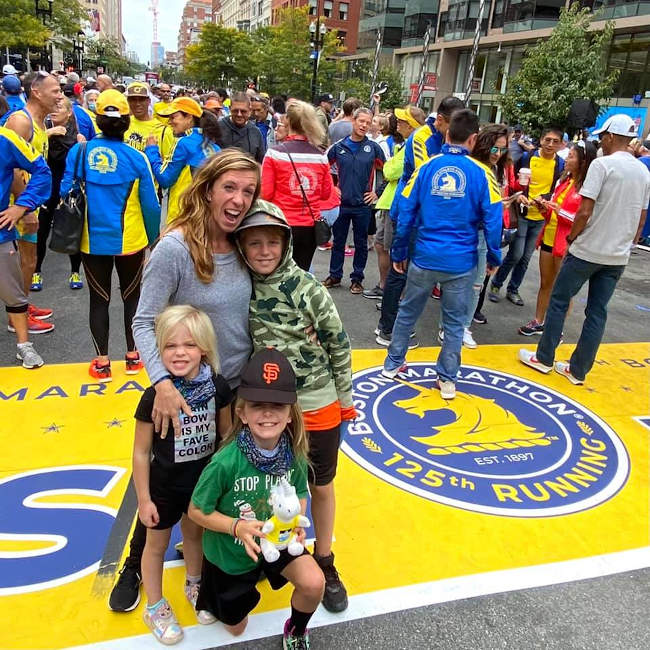
LAKE COUNTY, Calif. — Lower Lake resident Rachel Ahlmann says she came late to the marathon game.
Even so, at age 37 and after roughly three years of training, she found herself at one of the most renowned foot races in the world, the Boston Marathon.
Though it was her first time running the historic race in Boston, she wasn’t a stranger to marathons, having done four of them locally before her trip to Boston in October of last year — one each in the Napa Valley and Sacramento, and two in Santa Rosa.
“Marathon racing is intense,” said Ahlmann, who is part of the Six Sigma Ranch and Winery family. “All the stars need to line up for success. So many little things can cause poor performance, even the caffeine in my morning cup of coffee.”
Thankfully, the stars lined up for her at the Boston Marathon, one of the world’s great running events. Some might say it’s the holy grail of marathon races.
The Boston Marathon is not only the nation’s oldest marathon race, it’s the longest running annual marathon in the world. Established in 1897, it was inspired by the success of the first marathon competition in the 1896 Summer Olympics held in Athens, Greece.
Now an American institution, the Boston Marathon historically takes place every third Monday in April. This is also Patriots’ Day, when the first battles of the Revolutionary War are commemorated.
Ahlmann, who was born to American missionary parents in New Zealand, became involved with competitive running at the young age of 8 after the family returned to the United States.
It was Ahlmann’s mother who served as her running coach during childhood races in the summers between school years.
A runner herself, Ahlmann’s mother held the record for the fastest time in the women’s 800-meter dash at Kansas State University, a record that stood, impressively, for 25 years.
In high school Ahlmann ran competitively as a member of the track and cross-country teams, as well as playing basketball.
Raised in a family that cherishes athletics (her father still coaches youth basketball in his 60s), the entire clan enjoyed a variety of sports together. Ahlmann’s two older sisters were also runners but instead focused more on other pursuits — one was an accomplished musician, the other a talented gymnast. It was youngest sister Rachel who became an able and proficient competitive runner.
Like her mother, Ahlmann attended Kansas State but, unlike her, decided against competitive running while in college.
“Looking back, I have some regrets about not running, but by college I was ready for something else,” said Ahlmann. “Though my mother was a wonderful coach and I never felt pushed, I was just a little burned out by then. I had opportunities to run but turned them down.”
This break continued until after the birth of her oldest child, a son, in 2010, when she entered the running world again through a half marathon.
Ahlmann credits the Lake County Milers, a local running club, for reviving her interest in running in the years after that. Specifically, it was during one of their annual “Spring Has Sprung” races in Hidden Valley Lake that she was reminded of how much she loves running.
By this time, she was the mother of three children — two daughters in addition to her son — and she jokingly calls that 5K race her “first hurrah” after her last child was born.
Though her love of running was rekindled, it wasn’t until a few years later, in 2018, that she began marathon training in earnest.
“I’m a late comer to the marathon game,” said Ahlmann. “Many with the Lake County Milers have been running marathons for years. There’s a very strong running community in this county.”
Ahlmann ran her first marathon in Napa County in the spring of 2019 with a time that easily qualified her for the Boston Marathon, roughly 3 hours and 15 minutes.
In the fall of that year, her time in a Santa Rosa marathon was even better — a few seconds over two hours, 59 minutes.
Feeling ready for Boston, which requires a qualifying time of 3 hours, 30 minutes, she planned to run it in the spring of 2020.
By then, however, the worldwide coronavirus pandemic had reared its ugly head, which put a stop to those plans.
For the first time, the Boston Marathon was pushed back — to September of 2020 — but with the virus still a factor, the race that year ended up being virtual.
Ahlmann ran the virtual marathon on the paved roads throughout Hidden Valley Lake and, along with everyone else, got a medal for her participation.
Race officials had hoped to bring the race back in April 2021, its normal month, but because of COVID, it was pushed back again, this time to Oct. of that year.
In addition to the unusual two-year plus lapse between races, the field size was reduced from 30,000 to 20,000, making the qualifying window smaller. Even so, Ahlmann made it in, and she, along with her family, headed to Boston for the race, their first time in that city.
The morning of the race dawned with perfect conditions for running, an overcast 50 degrees with no wind. With a rolling start time of 9 a.m., Ahlmann was loaded onto a bus at 7:30 a.m. that morning for her trip to the starting line.
During a typical Boston Marathon, runners are bunched up behind the starting line and the race begins with a gun. Depending on where you are, it can take a full 10 minutes to cross the starting line.
This time, precautions were taken to prevent runners from being too close to one another. There was no gun to start the race en masse. Instead, runners had rolling start times and crossed the starting line in staggered numbers. This was made possible by a timing chip on the runners’ bibs.
Ahlmann enjoyed this more relaxed approach, as she could cross the starting line when warmed up and ready. At one point she almost crossed by mistake, but quickly retreated to remove her sweatshirt before beginning.
Ahlmann, who runs every day along the steep trails of Six Sigma Ranch and Winery that reach up to 1,600 feet in elevation, found the hilly sections of the sea level Boston Marathon less challenging than she anticipated.
She was surprised to find that she wasn’t struggling as some of the other runners were. Her training in the mountainous terrain outside her front door paid off.
Ahlmann had decided to run a smart race, rather than push herself with possible negative results. She wanted to finish well, and she did, with a time of just over two hours, 59 minutes, not unlike her time in the Santa Rosa marathon. That race, however, didn’t have the hills that the Boston Marathon does.
She jokes that marathon running is “voluntary torture.” Even so, it felt wonderful to run in Boston, to challenge her body and test its limitations.
Ahlmann was especially impressed by the encouragement of the spectators along the way. A particularly favorite memory was running through Wellesley College, where all the students were outside to cheer them on.
As Ahlmann says, “the organizers really know how to put on a marathon. Every inch was planned.” It was the most fun she’s ever had while running a marathon.
Her husband, Christian Ahlmann, posted his wife’s progress on Facebook in real time via a marathon app that used the runners’ timing chips to track them. He and their three children were at the finish line, craning their necks to see their wife and mother come through.
Though the experience was beyond her expectations, at this point Ahlmann doesn’t have plans to run the Boston Marathon again. Instead, she’s looking toward a March marathon in the Napa Valley, where she’ll run the familiar and spectacularly beautiful Silverado Trail.
She’ll continue to run at least a mile a day, fitting it in around parenting her three children and working in sales and hospitality at Six Sigma alongside husband Christian, who’s general manager of the ranch and winery.
When asked what she likes best about running, she referred to a quote from the 1981 movie Chariots of Fire, where the great Scottish Olympic runner, Eric Liddell, tells his sister that God made him fast. “And when I run, I feel his pleasure.”
Ahlmann relates to that. She also enjoys seeing what the human body can do, how far it can be pushed.
And the worst thing for her about running?
“Endurance exercise is terribly painful — it shows how crazy you are,” said Ahlmann. “I get black and blue toes and it takes a lot of time.”
Two years ago, Ahlmann found something much worse than a sore body and finding scarce time to do marathon training — coming face-to-face with a mountain lion, which happened on a near dark morning during a sunrise run.
On that morning, Ahlmann was running along a paved rural road with her usual audiobook playing. For safety, she never puts the headphones on. Instead, she allows the book to play so that nearby critters can hear her coming.
Somehow, her senses alerted her to padded footsteps following behind her along the road. She turned around, and there it was — a full-grown mountain lion, with a look on its face like a house cat playing with its food. She realized then that she was its prey.
Once she registered what was happening, she threw her water bottle at it, then a series of rocks. She said it stopped advancing, but stood firm, looking at her.
At that moment a car happened by, and the cat retreated into the woods, still lurking. By a providential stroke of luck, the next car was a co-worker, who was able to drive her to safety.
Since then, Ahlmann has been determined not to run in the dark. When time pressures prevent a daylight run, she does a tiny loop around her home or uses her treadmill.
Ahlmann’s advice for aspiring runners is to run with others, rather than by yourself. Having a running buddy (or buddies) makes it more fun and provides accountability.
If marathons are your goal, she suggests doing a lot of long, slow miles. This makes it easier to do the first 20 miles of a marathon, which, as Ahlmann says, is “the warm-up for the 10K at the end.”
Ahlmann’s mother jokes that one gets 10 good years of running before the body gives up, and Ahlmann wants to make the most of the yet unused part of those 10 years. In addition to doing again the three local marathons she’s tackled in the past, Ahlmann has her eye on the possibility of a “destination marathon” in another part of the world.
As a final note, Ahlmann lost a toenail at the Boston Marathon, just 200 yards short of the finish line. Those last yards were excruciating for her, but she made it, limping across the finish line.
Despite that moment (and like the true runner she is), Ahlmann said, “But I felt so awesome afterward.”
Esther Oertel is a freelance writer in Middletown who's contributed to Lake County News since 2010. She especially enjoys writing about the people and places that make Lake County unique. For comments, questions and story suggestions, she may be reached at
This protective impact was found even in people whose brains at autopsy were riddled with toxic proteins associated with Alzheimer’s and other neurodegenerative diseases.
“Our work is the first that uses human data to show that synaptic protein regulation is related to physical activity and may drive the beneficial cognitive outcomes we see,” said Kaitlin Casaletto, Ph.D., an assistant professor of Neurology and lead author on the study, which appears in the Jan. 7 issue of Alzheimer’s & Dementia: The Journal of the Alzheimer’s Association.
The beneficial effects of physical activity on cognition have been shown in mice but have been much harder to demonstrate in people.
Casaletto, a neuropsychologist and member of the UCSF Weill Institute for Neurosciences, worked with William Honer, M.D., a professor of psychiatry at the University of British Columbia and senior author of the study, to leverage data from the Memory and Aging Project at Rush University in Chicago. That project tracked the late-life physical activity of elderly participants, who also agreed to donate their brains when they died.
“Maintaining the integrity of these connections between neurons may be vital to fending off dementia, since the synapse is really the site where cognition happens,” Casaletto said. “Physical activity — a readily available tool — may help boost this synaptic functioning.”
More proteins mean better nerve signals
Honer and Casaletto found that elderly people who remained active had higher levels of proteins that facilitate the exchange of information between neurons. This result dovetailed with Honer’s earlier finding that people who had more of these proteins in their brains when they died were better able to maintain their cognition late in life.
To their surprise, Honer said, the researchers found that the effects ranged beyond the hippocampus, the brain’s seat of memory, to encompass other brain regions associated with cognitive function.
“It may be that physical activity exerts a global sustaining effect, supporting and stimulating healthy function of proteins that facilitate synaptic transmission throughout the brain,” Honer said.
Synapses safeguard brains showing signs of dementia
The brains of most older adults accumulate amyloid and tau, toxic proteins that are the hallmarks of Alzheimer’s disease pathology. Many scientists believe amyloid accumulates first, then tau, causing synapses and neurons to fall apart.
Casaletto previously found that synaptic integrity, whether measured in the spinal fluid of living adults or the brain tissue of autopsied adults, appeared to dampen the relationship between amyloid and tau, and between tau and neurodegeneration.
“In older adults with higher levels of the proteins associated with synaptic integrity, this cascade of neurotoxicity that leads to Alzheimer’s disease appears to be attenuated,” she said. “Taken together, these two studies show the potential importance of maintaining synaptic health to support the brain against Alzheimer’s disease.”
Additional authors on the study include Anna VandeBunte of UCSF. For other authors, please see the study. Funding: This work was supported by NIH grants R01AG17917, K23AG058752, R01AG072475 and UCSF ADRC P30AG062422, as well as the Alzheimer’s Association AARG-20-683875.
Dogs available for adoption this week include mixes of American Staffordshire terrier, Anatolian shepherd, Great Pyrenees, husky, Labrador retriever, mastiff, Rhodesian ridgeback, Shar-Pei, shepherd and pit bull.
Dogs that are adopted from Lake County Animal Care and Control are either neutered or spayed, microchipped and, if old enough, given a rabies shot and county license before being released to their new owner. License fees do not apply to residents of the cities of Lakeport or Clearlake.
The following dogs at the Lake County Animal Care and Control shelter have been cleared for adoption (additional dogs on the animal control website not listed are still “on hold”).
Call Lake County Animal Care and Control at 707-263-0278 or visit the shelter online for information on visiting or adopting.

Male shepherd mix
This 2-year-old male shepherd mix has a medium-length black and tan coat.
He is in kennel No. 4, ID No. LCAC-A-2467.

‘Iris’
“Iris” is a 3-year-old American Staffordshire terrier with a short black coat with white markings.
She is in kennel No. 10, ID No. LCAC-A-1727.

Male pit bull
This 2-year-old male pit bull has a short black and white coat.
He is in kennel No. 14, ID No. LCAC-A-2473.

Male pit bull
This 2-year-old male pit bull has a short brindle coat.
He is in kennel No. 15, ID No. LCAC-A-2462.

Male pit bull
This 3-year-old male pit bull has a short tan and white coat.
He is in kennel No. 16, ID No. LCAC-A-2429.
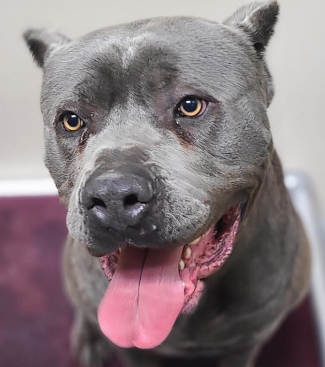
Male pit bull-mastiff
This 1-year-old male pit bull terrier-mastiff mix has a short gray coat.
He is in kennel No. 17, ID No. LCAC-A-2468.

‘Nova’
“Nova” is an 8-year-old female yellow Labrador retriever with a short coat.
She is in kennel No. 18, ID No. LCAC-A-2509.

Male pit bull
This 6-year-old male pit bull terrier has a brown brindle coat with white markings.
He is in kennel No. 20, ID No. LCAC-A-2471.

‘Nioki’
“Nioki” is a 1-year-old female shepherd with a black coat.
She is in kennel No. 21, ID No. LCAC-A-2442.

Male husky mix
This 2-year-old male husky mix has a short black and tan coat.
He is in kennel No. 22, ID No. LCAC-A-2512.

Female Shar-Pei-Rhodesian ridgeback mix
This 2-year-old female Shar-Pei-Rhodesian ridgeback mix has a short tan coat.
She is in kennel No. 23, ID No. LCAC-A-2560.
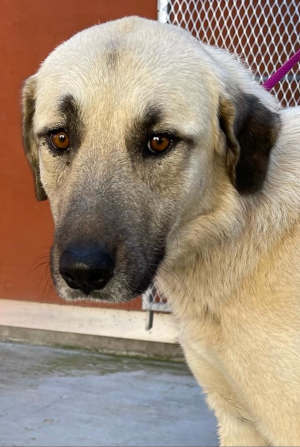
Anatolian shepherd mix
This 2-year-old female Anatolian shepherd mix has a short tan coat with black markings.
She is in kennel No. 26, ID No. LCAC-A-2535.

Anatolian shepherd-Great Pyrenees mix
This 2-year-old male Anatolian shepherd-Great Pyrenees mix has a short white coat.
He is in kennel No. 27, ID No. LCAC-A-2536.

Labrador-pit bull mix puppy
This male Labrador retriever-pit bull mix puppy has a short brindle coat.
He is in kennel No. 31b, ID No. LCAC-A-2521.

Labrador-pit bull mix puppy
This male Labrador retriever-pit bull mix puppy has a short tan coat.
He is in kennel No. 31c, ID No. LCAC-A-2523.

‘Coal’
“Coal” is a male Labrador retriever-pit bull mix puppy with a short black coat.
He is in kennel No. 34, ID No. LCAC-A-2472.
Email Elizabeth Larson at
Space travel is all about momentum.
Rockets turn their fuel into momentum that carries people, satellites and science itself forward into space. 2021 was a year full of records for space programs around the world, and that momentum is carrying forward into 2022.
Last year, the commercial space race truly took off. Richard Branson and Amazon founder Jeff Bezos both rode on suborbital launches – and brought friends, including actor William Shatner. SpaceX sent eight astronauts and 1 ton of supplies to the International Space Station for NASA. The six tourist spaceflights in 2021 were a record. There were also a record 19 people weightless in space for a short time in December, eight of them private citizens. Finally, Mars was also busier than ever thanks to missions from the U.S., China and United Arab Emirates sending rovers, probes or orbiters to the red planet.
In total, in 2021 there were 134 launches that put humans or satellites into orbit – the highest number in the entire history of spaceflight. Nearly 200 orbital launches are scheduled for 2022. If things go well, this will smash last year’s record.
I’m an astronomer who studies supermassive black holes and distant galaxies. I have also written a book about humanity’s future in space. There’s a lot to look forward to in 2022. The Moon will get more attention than it has had in decades, as will Jupiter. The largest rocket ever built will make its first flight. And of course, the James Webb Space Telescope will start sending back its first images.
I, for one, can’t wait.
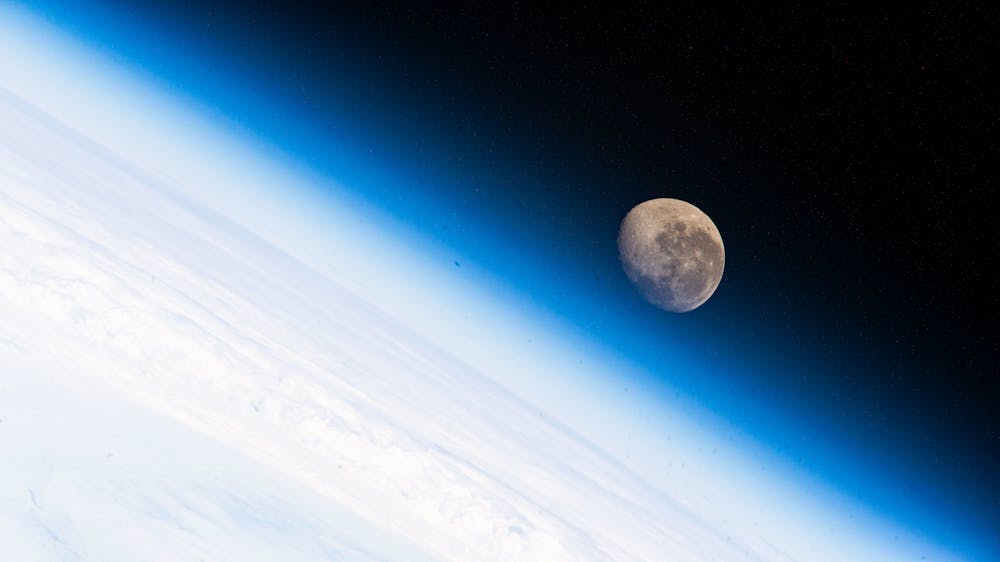
Everyone’s going to the Moon
Getting a rocket into orbit around Earth is a technical achievement, but it’s only equivalent to a half a day’s drive straight up. Fifty years after the last person stood on Earth’s closest neighbor, 2022 will see a crowded slate of lunar missions.
NASA will finally debut its much delayed Space Launch System. This rocket is taller than the Statue of Liberty and produces more thrust than the mighty Saturn V. The Artemis I mission will head off this spring for a flyby of the Moon. It’s a proof of concept for a rocket system that will one day let people live and work off Earth. The immediate goal is to put astronauts back on the Moon by 2025.
NASA is also working to develop the infrastructure for a lunar base, and it’s partnering with private companies on science missions to the Moon. A company called Astrobotic will carry 11 payloads to a large crater on the near side of the Moon, including two mini-rovers and a package of personal mementos gathered from the general public by a company based in Germany. The Astrobotic lander will also be carrying the cremated remains of science fiction legend Arthur C. Clarke – as with Shatner’s flight into space, it’s an example of science fiction turned into fact. Another company, Intuitive Machines, plans two trips to the Moon in 2022, carrying 10 payloads that include a lunar hopper and an ice mining experiment.
Russia is getting in on the lunar act, too. The Soviet Union accomplished many lunar firsts – first spacecraft to hit the surface in 1959, first spacecraft to soft-land in 1966 and the first lunar rover in 1970 – but Russia hasn’t been back for over 45 years. In 2022, it plans to send the Luna 25 lander to the Moon’s south pole to drill for ice. Frozen water is an essential requirement for any Moon base.
All aboard the Starship
While NASA’s Space Launch System will be a big step up for the agency, Elon Musk’s new rocket promises to be the king of the skies in 2022.
The SpaceX Starship – the most powerful rocket ever launched – will get its first orbital launch in 2022. It’s fully reusable, has more than twice the thrust of the Saturn V rocket and can carry 100 tons into orbit. The massive rocket is central to Musk’s aspirations to create a self-sustaining base on the Moon and, eventually, a city on Mars.
Part of what makes Starship so important is how cheap it will make bringing things into space. If successful, the price of each flight will be US$2 million. By contrast, the price for NASA to launch the Space Launch System is likely to be over $2 billion. The reduction in costs by a factor of a thousand will be a game-changer for the economics of space travel.
Jupiter beckons
The Moon and Mars aren’t the only celestial bodies getting attention next year. After decades of neglect, Jupiter will finally get some love, too.
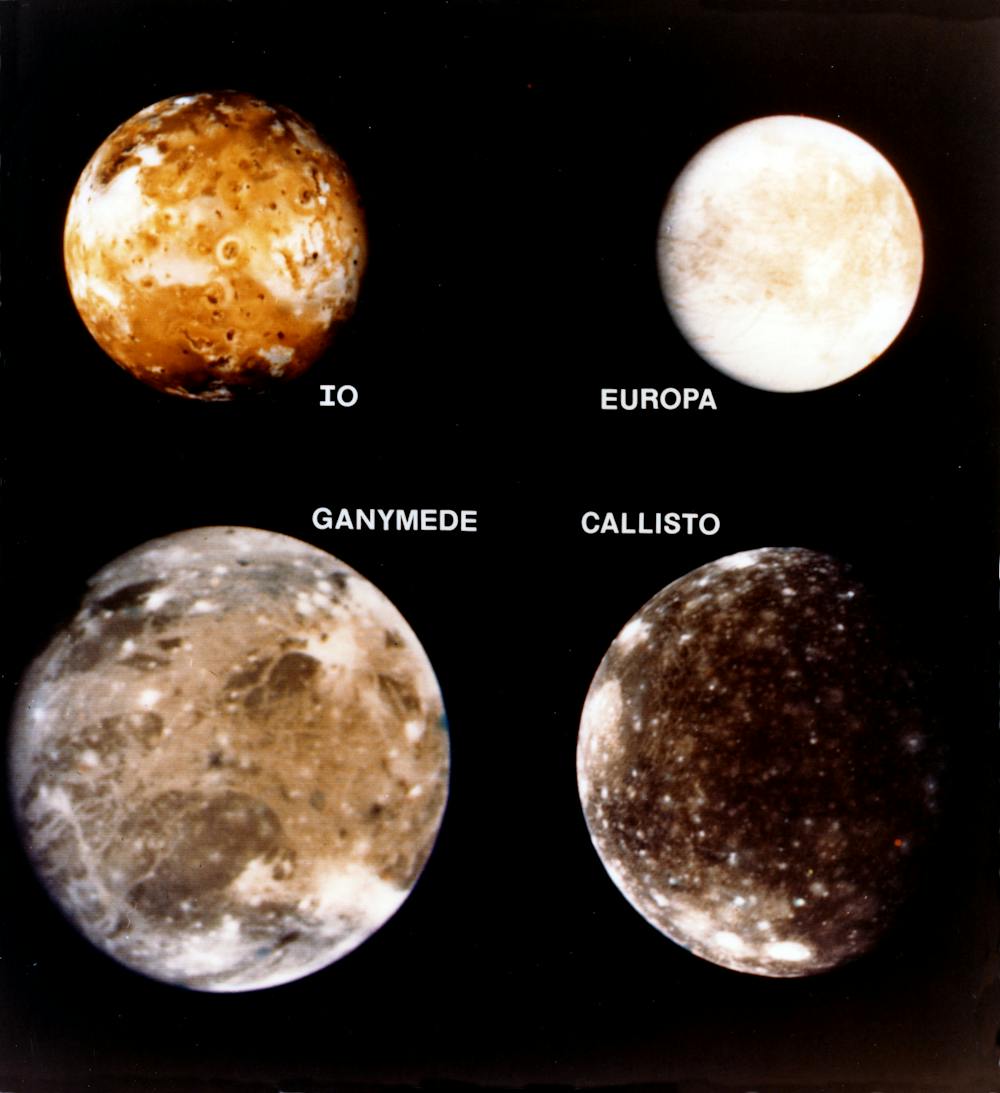
The European Space Agency’s Icy Moons Explorer is scheduled to head off to the gas giant midyear. Once there, it will spend three years studying three of Jupiter’s moons – Ganymede, Europa and Callisto. These moons are all thought to have subsurface liquid water, making them potentially habitable environments.
Additionally, in September 2022, NASA’s Juno spacecraft – which has been orbiting Jupiter since 2016 – is going to swoop within 220 miles of Europa, the closest-ever look at this fascinating moon. Its instruments will measure the thickness of the ice shell, which covers an ocean of liquid water.
Seeing first light
All this action in the Solar System is exciting, but 2022 will also see new information from the edge of space and the dawn of time.
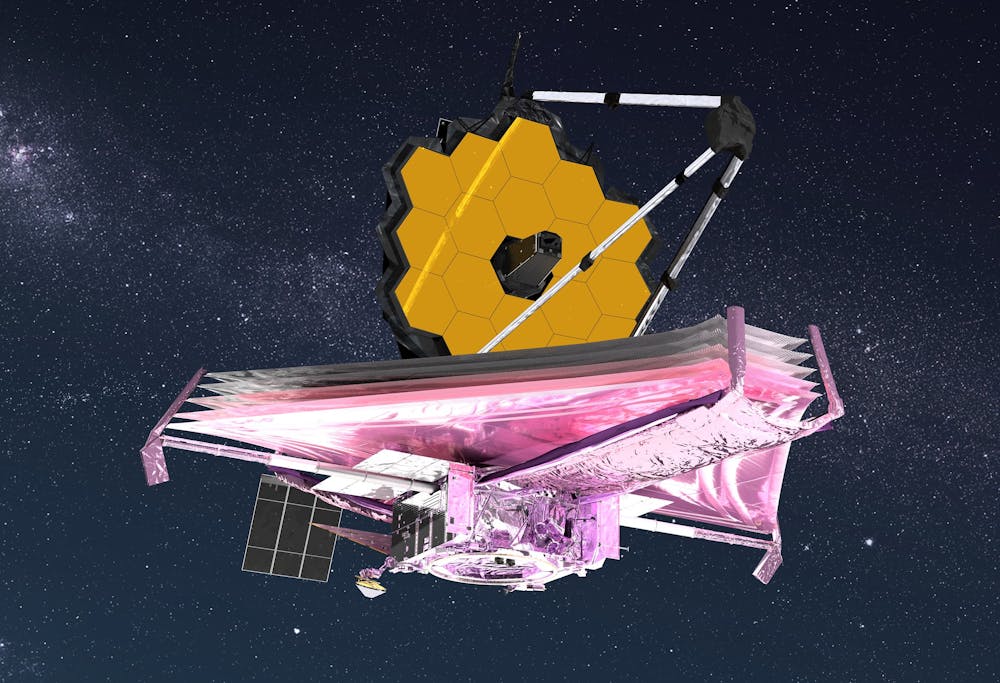
After successfully reaching its final destination, unfurling its solar panels and unfolding its mirrors in January, NASA’s James Webb Space Telescope will undergo exhaustive testing and return its first data sometime midyear. The 21-foot (6.5-meter) telescope has seven times the collecting area of the Hubble Space Telescope. It also operates at longer wavelengths of light than Hubble, so it can see distant galaxies whose light has been redshifted – stretched to longer wavelengths – by the expansion of the universe.
[Research into coronavirus and other news from science Subscribe to The Conversation’s new science newsletter.]
By the end of the year, scientists should be getting results from a project aiming to map the earliest structures in the universe and see the dawn of galaxy formation. The light these structures gave off was some of the very first light in history and was emitted when the universe was only 5% of its current age.
When astronomers look out in space they look back in time. First light marks the limit of what humanity can see of the universe. Prepare to be a time traveler in 2022.
Chris Impey, University Distinguished Professor of Astronomy, University of Arizona
This article is republished from The Conversation under a Creative Commons license. Read the original article.