 How to resolve AdBlock issue?
News
Among the grantees is the Lake County Library.
In total, the NEA is investing $1,071,140 to support programming centered around one of 15 different contemporary books, with the aim of inspiring meaningful conversations, artistic responses, and new discoveries and connections in participating communities.
The NEA Big Read showcases a diverse range of contemporary titles that reflect many different voices and perspectives, aiming to inspire conversation and discovery.
The Lake County Library is a recipient of a $9,500 grant to host the NEA Big Read countywide with dynamic community reading programs, and has selected Postcolonial Love Poem by Natalie Diaz for 2023 programming.
Activities will take place from February 2023 to March 2023.
Winner of the 2021 Pulitzer Prize in Poetry, Postcolonial Love Poem is a collection of poetry by Arizona poet Natalie Diaz — who is Mojave, an enrolled member of the Gila River Indian Tribe, Latinx and queer.
The poems push against the forces of racism, environmental destruction, addiction, and mental illness with the power of desire, love, and language.
From publisher Gray Wolf Press, “Postcolonial Love Poem is an anthem of desire against erasure. Natalie Diaz’s brilliant second collection demands that every body carried in its pages — bodies of language, land, rivers, suffering brothers, enemies, and lovers — be touched and held as beloveds.”
Confirmed partners for the 2023 program include the County of Lake Board of Supervisors, Scotts Valley Band of Pomo Indians, Mendocino College Lake Center, Lake County Campus of Woodland Community College, Lake County Special Districts, Lake County Library Genealogy and Local History Group, Museums of Lake County, Lake County Office of Education, Lake County Farmers’ Finest, Lake County Arts Council, Middletown Art Center and O'Meara Bros. Brewing Company. Organizers expect to add more partners as planning continues.
Follow the Lake County Library on Facebook, Instagram and Twitter, or sign up for their online newsletter for updates. Visit the Lake County Library’s website at http://library.lakecountyca.gov.
Georgina Marie Guardado is the Lake County Library’s Adult Literacy Program coordinator.
In Lake County, PG&E plans to underground approximately 15 miles of overhead distribution power lines and harden 21 miles in high fire-threat areas to reduce wildfire risk in 2022.
“As part of our efforts to evolve with California’s changing weather conditions, we are working year-round to make our system safer, and that includes placing overhead lines underground where we can and installing stronger power poles with covered conductors,” said Ron Richardson, regional vice president for PG&E’s North Coast Region. “Not only will undergrounding reduce ignition risk by 99% on undergrounded circuits, but it will reduce spending on temporary repairs and recurring costs such as vegetation management and curb the need for wildfire safety-related outages.”
Crews have started preliminary work to underground approximately 9 miles of a distribution line in sections from Clearlake Oaks along parts of Highway 20 to Spring Valley.
PG&E has notified customers of field surveys to be conducted through the second half of June.
As part of the surveys, field crews will locate property corners and pick up topographical features. Helicopters may also be used to gather this information.
Residents in these areas may also see different colors of spray paint on the ground and around PG&E equipment. These are markings so workers know where existing underground utilities are located, such as power lines, water, sewer, storm drains and communications.
PG&E will be marking the ground over the next three weeks with red spray paint where electrical equipment is located. Each commodity has a different color to mark the location of their underground equipment.
“Customers in the areas of future undergrounding may also notice markings on the ground that look like “X’s” or a chess board. These are flight panels that help us establish horizontal and vertical control. It’s how everyone working on the project can be on the same coordinate system,” said Brett Brusatori, supervisor for PG&E Land Surveying.
Undergrounding is part of PG&E’s Community Wildfire Safety Program, which the company launched in 2018 to help keep customers and communities safe in the face of growing wildfire risk across our state.
Nearly one-third of the electric power lines that serve PG&E’s customers are now in High Fire-Threat Districts designated by the California Public Utilities Commission.
Undergrounding is just one of the system-hardening tools PG&E uses to reduce wildfire risks.
Depending on the needs of the community, PG&E reviews additional risk-reduction efforts including installing stronger poles, covered power lines and sectionalizing devices; conducting enhanced vegetation management; adjusting power line safety settings; and implementing public safety power shut-offs.
Even though PG&E’s power lines will be moved underground, some of the power poles in these areas could remain in place to carry service lines that feed customer homes and to carry telecommunications equipment for other companies.
On July 21, 2021, PG&E announced a new, multiyear infrastructure safety initiative to underground approximately 10,000 miles of power lines in and near high fire-threat areas. It’s reported to be the largest effort in the U.S. to underground power lines as a wildfire risk reduction measure.
This legislation is reported to be one of the most significant investments in wildlife and habitat conservation in a generation.
“The need for wildlife conservation efforts in the United States is more pressing than ever as climate change, invasive species, and habitat loss puts many species at an increased risk of extinction,” said Thompson. “The Recovering America’s Wildlife Act will protect our endangered species and make conservation efforts more efficient. By funding State Wildlife Action Plans and other wildlife conservation and habitat restoration activities, we will take direct action to address the conservation crisis. As an outdoorsman, protecting wildlife and their habitats is personal, and I am proud to support these efforts to combat climate change and preserve our beautiful flora and fauna for future generations to come.”
Included in RAWA is $57 million for California to help manage fish and wildlife species of greatest conservation need.
The Recovering America’s Wildlife Act would:
• Provide tribes critical funding for wildlife conservation. RAWA provides a $97.5 million annual noncompetitive Tribal Wildlife Conservation and Restoration grant program to assist Tribes in carrying out wildlife conservation and habitat restoration efforts.
• Protect threatened and endangered species. At least 15% of RAWA funding must be spent on species that are listed under the Endangered Species Act or are considered threatened or endangered under tribal law.
• Make wildlife conservation more effective and cost-efficient. RAWA funding will help states, territories, and Tribes put conservation measures in place for species before they become threatened or endangered, making species protection less difficult and less costly. RAWA will also provide much-needed funding for non-hunted species.
• Address climate change by building more resilient ecosystems. State wildlife action plans often include habitat restoration projects (e.g., removing invasive species, fighting wildlife disease) that simultaneously benefit forest, watershed, and coastal health. These improvements help make ecosystems more resilient to severe weather events caused by climate change, including wildfires, hurricanes, and drought.
• Boost the outdoor economy. By supporting wildlife conservation, RAWA funds will boost our $887 billion outdoor economy, which already supports over 7.6 million jobs and is fueled by more than 100 million American wildlife enthusiasts, hunters, anglers, birders, and hikers. A portion of the funds will also support wildlife education.
Thompson represents California’s Fifth Congressional District, which includes all or part of Contra Costa, Lake, Napa, Solano and Sonoma counties.
At the same time, officials are maintaining California’s nation-leading testing and vaccination programs and protecting hospital capacity, which are key components of the state’s SMARTER Plan to guide California’s pandemic response.
“As California navigates the evolving pandemic, the state remains laser-focused on keeping Californians safe while advancing our ongoing recovery,” said Gov. Newsom. “We’re continuing to deploy proven strategies and programs that allow us to swiftly and effectively respond to changing pandemic conditions, take on equity gaps, and keep us moving forward."
The governor’s action on Friday immediately terminates five provisions related to Cal/OSHA’s COVID-19 Emergency Temporary Standards, following updated workplace safety rules that took effect last month.
Fifteen additional provisions are set to expire on June 30, after which only 5% of the COVID-19 related executive order provisions issued throughout the pandemic will remain in place.
Important measures still in effect to bolster the state’s COVID response and recovery efforts include provisions that support:
• COVID testing – Providing flexibility to support the state’s testing program, which under the SMARTER Plan will continue being able to process at least 500,000 tests per day. For example, through executive action the Governor has waived a provision that would require a health care professional to review each test result before it was released electronically to patients, and expanded scopes of practice for pharmacists and pharmacy technicians to conduct COVID tests.
• Vaccinations and boosters – Ensuring flexibility to advance the state’s vaccination and booster programs, which under the SMARTER Plan will continue being able to distribute at least 200,000 doses per day. This includes waiving licensing requirements temporarily to enable pharmacists and pharmacy technicians to administer COVID vaccines and waiving requirements so that the state can offer mobile vaccine clinics.
• Protecting hospital capacity and vulnerable populations – Provisions to protect both capacity in our health care delivery system and vulnerable populations, particularly during COVID surges. This includes provisions allowing health care workers from out of state to provide services in California and enabling the Department of Developmental Services to provide remote and expanded nonresidential services for more clients.
• Infant formula price gouging protections – Provisions that provide consumer protections against price gouging on infant formula in response to the ongoing supply chain challenges caused by the pandemic and the closure of a manufacturing facility that further impacted supply. To help improve access for parents and caretakers, sellers are generally prohibited from selling formula for a price that is more than 10 percent greater than the price they charged on February 17.

NASA is scheduled to release the first images taken by the James Webb Space Telescope on July 12, 2022. They’ll mark the beginning of the next era in astronomy as Webb – the largest space telescope ever built – begins collecting scientific data that will help answer questions about the earliest moments of the universe and allow astronomers to study exoplanets in greater detail than ever before. But it has taken nearly eight months of travel, setup, testing and calibration to make sure this most valuable of telescopes is ready for prime time. Marcia Rieke, an astronomer at the University of Arizona and the scientist in charge of one of Webb’s four cameras, explains what she and her colleagues have been doing to get this telescope up and running.
1. What’s happened since the telescope launched?
After the successful launch of the James Webb Space Telescope on Dec. 25, 2021, the team began the long process of moving the telescope into its final orbital position, unfolding the telescope and – as everything cooled – calibrating the cameras and sensors onboard.
The launch went as smoothly as a rocket launch can go. One of the first things my colleagues at NASA noticed was that the telescope had more remaining fuel onboard than predicted to make future adjustments to its orbit. This will allow Webb to operate for much longer than the mission’s initial 10-year goal.
The first task during Webb’s monthlong journey to its final location in orbit was to unfold the telescope. This went along without any hitches, starting with the white-knuckle deployment of the sun shield that helps cool the telescope, followed by the alignment of the mirrors and the turning on of sensors.
Once the sun shield was open, our team began monitoring the temperatures of the four cameras and spectrometers onboard, waiting for them to reach temperatures low enough so that we could start testing each of the 17 different modes in which the instruments can operate.

2. What did you test first?
The cameras on Webb cooled just as the engineers predicted, and the first instrument the team turned on was the Near Infrared Camera – or NIRCam. NIRCam is designed to study the faint infrared light produced by the oldest stars or galaxies in the universe. But before it could do that, NIRCam had to help align the 18 individual segments of Webb’s mirror.
Once NIRCam cooled to minus 280 F, it was cold enough to start detecting light reflecting off of Webb’s mirror segments and produce the telescope’s first images. The NIRCam team was ecstatic when the first light image arrived. We were in business!
These images showed that the mirror segments were all pointing at a relatively small area of the sky, and the alignment was much better than the worst-case scenarios we had planned for.
Webb’s Fine Guidance Sensor also went into operation at this time. This sensor helps keep the telescope pointing steadily at a target – much like image stabilization in consumer digital cameras. Using the star HD84800 as a reference point, my colleagues on the NIRCam team helped dial in the alignment of the mirror segments until it was virtually perfect, far better than the minimum required for a successful mission.
3. What sensors came alive next?
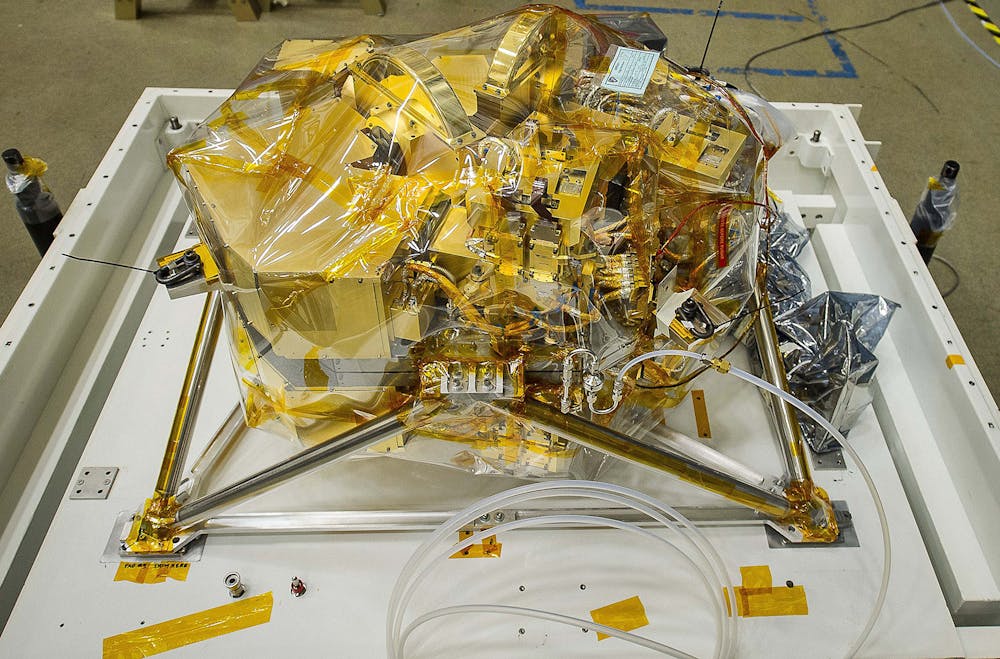
As the mirror alignment wrapped up on March 11, the Near Infrared Spectrograph – NIRSpec – and the Near Infrared Imager and Slitless Spectrograph – NIRISS – finished cooling and joined the party.
NIRSpec is designed to measure the strength of different wavelengths of light coming from a target. This information can reveal the composition and temperature of distant stars and galaxies. NIRSpec does this by looking at its target object through a slit that keeps other light out.
NIRSpec has multiple slits that allow it to look at 100 objects at once. Team members began by testing the multiple targets mode, commanding the slits to open and close, and they confirmed that the slits were responding correctly to commands. Future steps will measure exactly where the slits are pointing and check that multiple targets can be observed simultaneously.
NIRISS is a slitless spectrograph that will also break light into its different wavelengths, but it is better at observing all the objects in a field, not just ones on slits. It has several modes, including two that are designed specifically for studying exoplanets particularly close to their parent stars.
So far, the instrument checks and calibrations have been proceeding smoothly, and the results show that both NIRSpec and NIRISS will deliver even better data than engineers predicted before launch.

4. What was the last instrument to turn on?
The final instrument to boot up on Webb was the Mid-Infrared Instrument, or MIRI. MIRI is designed to take photos of distant or newly formed galaxies as well as faint, small objects like asteroids. This sensor detects the longest wavelengths of Webb’s instruments and must be kept at minus 449 F – just 11 degrees F above absolute zero. If it were any warmer, the detectors would pick up only the heat from the instrument itself, not the interesting objects out in space. MIRI has its own cooling system, which needed extra time to become fully operational before the instrument could be turned on.
Radio astronomers have found hints that there are galaxies completely hidden by dust and undetectable by telescopes like Hubble that captures wavelengths of light similar to those visible to the human eye. The extremely cold temperatures allow MIRI to be incredibly sensitive to light in the mid-infrared range which can pass through dust more easily. When this sensitivity is combined with Webb’s large mirror, it allows MIRI to penetrate these dust clouds and reveal the stars and structures in such galaxies for the first time.
5. What’s next for Webb?
As of June 15, 2022, all of Webb’s instruments are on and have taken their first images. Additionally, four imaging modes, three time series modes and three spectroscopic modes have been tested and certified, leaving just three to go.
On July 12, NASA plans to release a suite of teaser observations that illustrate Webb’s capabilities. These will show the beauty of Webb imagery and also give astronomers a real taste of the quality of data they will receive.
After July 12, the James Webb Space Telescope will start working full time on its science mission. The detailed schedule for the coming year hasn’t yet been released, but astronomers across the world are eagerly waiting to get the first data back from the most powerful space telescope ever built.
Marcia Rieke, Regents Professor of Astronomy, University of Arizona
This article is republished from The Conversation under a Creative Commons license. Read the original article.
LAKE COUNTY, Calif. — For the second year in a row, the Clearlake City Council has approved a budget far larger than normal thanks to millions in grants and increasing revenue.
Clearlake’s fiscal year 2022-23 budget has $39,116,857 in expenses and $37,160,179 in revenue, and is structurally balanced, said Finance Director Kelcey Young.
General fund revenue totals $7.9 million, with expenses totaling $8.3 million and the use of $516,000 in fund balance, Young said.
The budget includes a move to contracting out for animal control services with North Bay Animal Services, at a cost of $375,000 annually for 10 years, and the creation of a new recreation and event department, with a city goal that it be self-funded within two years.
The new fiscal year budget is the second-largest in the city’s history.
The largest was passed a year ago this month, with $57.4 million in expenditures and $53.6 million in revenue.
Before its regular meeting on Thursday evening, the council held an hour-long workshop during which Young led council members through a budget overview.
Young, hired this month a year ago, has taken the lead on creating this year’s budget.
When the council went to approve the budget with a unanimous vote during the council’s meeting later in the evening, City Manager Alan Flora said it was the first time since he’s been with the city that he hasn’t been very involved in the budget process, “which has certainly been a pleasure for me.”
Highlights of the budget include $15.4 million in grants and Pacific Gas and Electric settlement funds for the Sulphur fire, and property and sales tax totaling $11.2 million.
The city plans $22 million in capital projects in the coming year, with personnel costs totaling $7.8 million.
When it comes to personnel expenses and staffing, Young said Clearlake’s government is “extremely lean” for a city of its population size.
Overall, she said they are seeing increases in revenues — from sources such as the Measure V road sales tax — “which is exciting.”
Young said the city also is moving forward with its plan to finance additional roadwork with debt financing totaling $14,755,000.
The 2022-23 budget report can be found here.
The council on Thursday also approved an 18-month closure of multiple dirt roads in the area of the Cache fire, and Park Street from Sonoma to Oregon, and gave the OK to the 10-year contract with North Bay Animal Services for animal care and control services.
Council members also approved memorandums of understanding between the city and the Clearlake Miscellaneous Employees Association and the Clearlake Police Officers Association, a lease with Dell Financial Services for computer workstations for the police department, an ordinance amending the Clearlake Municipal Code relating to traffic and parking regulations, and job descriptions and placement into salary schedule for certain administrative positions.
Also on Thursday, the city council received a presentation on the Cache fire recovery from the California Governor’s Office of Emergency Services and Lake County Water Resources, and heard about the plan to plant 100 valley oaks at the Anderson Marsh State Historic Park.
Email Elizabeth Larson at