 How to resolve AdBlock issue?
News
CDFW’s North Central Region initiated this statewide, family-friendly competition during the COVID-19 pandemic as a delightful and educational way for families to explore nature close to home — in their backyards, neighborhoods and local wild areas — while having some outside fun and working together to complete some nature-related activities.
Last year, families from across the state participated in the challenge. This year, we hope your family does too.
The 2022 challenge includes two scavenger hunts: one provided by CDFW and the other to be created by your family. There is also an extra credit element of cataloging your found items — just like a scientist.
The challenge is open to all California families with the deadline to enter on Aug. 31, 2022.
To sign up and receive the Nature Bowl 2022: Family Challenge packet, please email
The Family Challenge packet – along with additional information – is available at CDFW’s Nature Bowl webpage.
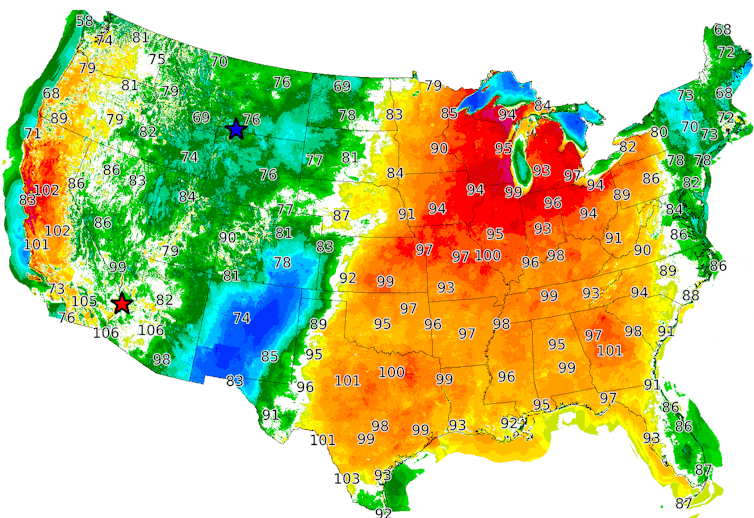
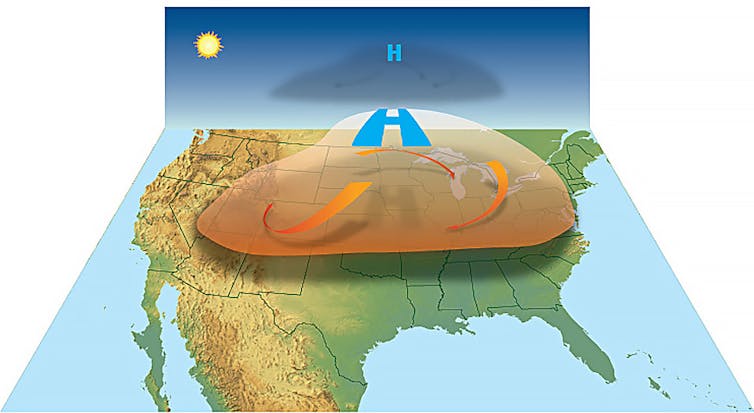
A heat dome occurs when a persistent region of high pressure traps heat over an area. The heat dome can stretch over several states and linger for days to weeks, leaving the people, crops and animals below to suffer through stagnant, hot air that can feel like an oven.
Typically, heat domes are tied to the behavior of the jet stream, a band of fast winds high in the atmosphere that generally runs west to east.
Normally, the jet stream has a wavelike pattern, meandering north and then south and then north again. When these meanders in the jet stream become bigger, they move slower and can become stationary. That’s when heat domes can occur.
When the jet stream swings far to the north, air piles up and sinks. The air warms as it sinks, and the sinking air also keeps skies clear since it lowers humidity. That allows the sun to create hotter and hotter conditions near the ground.
If the air near the ground passes over mountains and descends, it can warm even more. This downslope warming played a large role in the extremely hot temperatures in the Pacific Northwest during a heat dome event in 2021, when Washington set a state record with 120 degrees Fahrenheit (49 Celsius), and temperatures reached 121 F in British Columbia in Canada, surpassing the previous Canadian record by 8 degrees F (4 C).
The human impact
Heat domes normally persist for several days in any one location, but they can last longer. They can also move, influencing neighboring areas over a week or two. The heat dome involved in the June 2022 U.S. heat wave crept eastward over time.
On rare occasions, the heat dome can be more persistent. That happened in the southern Plains in 1980, when as many as 10,000 people died during weeks of high summer heat. It also happened over much of the United States during the Dust Bowl years of the 1930s.
A heat dome can have serious impacts on people, because the stagnant weather pattern that allows it to exist usually results in weak winds and an increase in humidity. Both factors make the heat feel worse – and become more dangerous – because the human body is not cooled as much by sweating.
The heat index, a combination of heat and humidity, is often used to convey this danger by indicating what the temperature will feel like to most people. The high humidity also reduces the amount of cooling at night. Warm nights can leave people without air conditioners unable to cool off, which increases the risk of heat illnesses and deaths. With global warming, temperatures are already higher, too.
One of the worst recent examples of the impacts from a heat dome with high temperatures and humidity in the U.S. occurred in the summer of 1995, when an estimated 739 people died in the Chicago area over five days.
William Gallus, Professor of Atmospheric Science, Iowa State University
This article is republished from The Conversation under a Creative Commons license. Read the original article.

NASA announced Friday the Psyche asteroid mission, the agency’s first mission designed to study a metal-rich asteroid, will not make its planned 2022 launch attempt.
Due to the late delivery of the spacecraft’s flight software and testing equipment, NASA does not have sufficient time to complete the testing needed ahead of its remaining launch period this year, which ends on Oct. 11.
The mission team needs more time to ensure that the software will function properly in flight.
NASA selected Psyche in 2017 as part of the agency’s Discovery Program, a line of low-cost, competitive missions led by a single principal investigator.
The agency is forming an independent assessment team to review the path forward for the project and for the Discovery Program.
“NASA takes the cost and schedule commitments of its projects and programs very seriously,” said Thomas Zurbuchen, associate administrator for NASA’s Science Mission Directorate in Washington. “We are exploring options for the mission in the context of the Discovery Program, and a decision on the path forward will be made in the coming months.”
The independent assessment team, typically made up of experts from government, academia, and industry, will review possible options for next steps, including estimated costs. Implications for the agency’s Discovery Program and planetary science portfolio also will be considered.
The spacecraft’s guidance navigation and flight software will control the orientation of the spacecraft as it flies through space and is used to point the spacecraft’s antenna toward Earth so that the spacecraft can send data and receive commands.
It also provides trajectory information to the spacecraft’s solar electric propulsion system, which begins operations 70 days after launch.
As the mission team at NASA’s Jet Propulsion Laboratory in Southern California began testing the system, a compatibility issue was discovered with the software’s testbed simulators.
In May, NASA shifted the mission’s targeted launch date from Aug. 1 to no earlier than Sept. 20 to accommodate the work needed.
The issue with the testbeds has been identified and corrected; however, there is not enough time to complete a full checkout of the software for a launch this year.
“Flying to a distant metal-rich asteroid, using Mars for a gravity assist on the way there, takes incredible precision. We must get it right. Hundreds of people have put remarkable effort into Psyche during this pandemic, and the work will continue as the complex flight software is thoroughly tested and assessed,” said JPL Director Laurie Leshin. “The decision to delay the launch wasn’t easy, but it is the right one.”
The mission’s 2022 launch period, which ran from Aug. 1 through Oct. 11, would have allowed the spacecraft to arrive at the asteroid Psyche in 2026.
There are possible launch periods in both 2023 and 2024, but the relative orbital positions of Psyche and Earth mean the spacecraft would not arrive at the asteroid until 2029 and 2030, respectively. The exact dates of these potential launch periods are yet to be determined.
“Our amazing team has overcome almost all of the incredible challenges of building a spacecraft during COVID,” said Psyche Principal Investigator Lindy Elkins-Tanton of Arizona State University (ASU), who leads the mission. “We have conquered numerous hardware and software challenges, and we’ve been stopped in the end by this one last problem. We just need a little more time and will get this one licked too. The team is ready to move forward, and I’m so grateful for their excellence.”
Total life-cycle mission costs for Psyche, including the rocket, are $985 million. Of that, $717 million has been spent to date. The estimated costs involved to support each of the full range of available mission options are currently being calculated.
Two ride-along projects were scheduled to launch on the same SpaceX Falcon Heavy rocket as Psyche, including NASA’s Janus mission to study twin binary asteroid systems, and the Deep Space Optical Communications technology demonstration to test high-data-rate laser communications that is integrated with the Psyche spacecraft. NASA is assessing options for both projects.
ASU leads the Psyche mission. JPL, which is managed for NASA by Caltech in Pasadena, California, is responsible for the mission’s overall management; system engineering; integration and test; and mission operations. Maxar is providing the high-power solar electric propulsion spacecraft chassis. NASA’s Launch Services Program, based at the agency’s Kennedy Space Center in Florida, is managing the launch.
For more on the Psyche mission, visit https://www.nasa.gov/psyche.
The commission held a two-hour hearing to consider Monte Cristo Vineyards LLC’s cannabis project.
During the Thursday meeting, only three of the commissioners — Everardo Chavez Perez, Maile Field and Christina Price — were present, with John Hess and Batsulwin Brown not in attendance. That meant that all three had to vote to support the project.
However, with only two of the three commissioners voting in support, the project failed to pass.
That result is expected to be appealed to the Board of Supervisors.
The situation with Monte Cristo is another case of neighbors voicing opposition to cannabis growing in proximity to small neighborhoods on the edges of the county’s community growth boundaries.
Jacqueline and Jonathan Dharmapalan are the owners of Monte Cristo, located at 11230 and 11250 Cerrito Drive in Clearlake Oaks.
Jonathan Dharmapalan is founder and chief executive officer of eCurrency Mint Limited, a digital security company and technology infrastructure provider that allows central banks to issue digital currency.
He and his wife have had property in Lake County since 1999. On their 452-acre property, they farm 128 acres of vineyard, and they said they’ve done so mindful of the environment and their neighbors.
Now, faced with challenges including winegrape crops that have been lost entirely to smoke damage — as Jonathan Dharmapalan said was the case in 2018 — they’re seeking to diversify their farming operation, a process that he said has already been very expensive.
They’re proposing to remove 40 acres of vineyard and plant 22 acres of cannabis, and seeking 22 A-Type 3 “medium outdoor” licenses.
While it would be one of the largest single plantings of cannabis in Lake County, the Dharmapalans said they’ve tried to lessen the impact by planting cannabis in the part of the property that’s the farthest away from neighbors.
Community Development Department staff said the 22 acres of canopy would be planted in stages over four distinct areas of the property. Only 14 acres would be planted during the drought emergency.
In addition to the cultivation area, the plan calls for a 6,000 square foot processing and harvest storage facility, two 3,000 square foot greenhouses, two 120-square-foot pesticide and agriculture chemicals storage areas, a 120-square-foot security center and shed, and 6 feet of woven wire fencing around the cultivation area.
The property currently has a residence, metal barn, an off-stream reservoir with 20 acre feet of water and five existing on-site groundwater wells.
The project is expected to use 15 million gallons of water per year, compared to the nearly 28 million gallons the vineyard currently uses.
While the proponents said water usage would be down, overall daily trips would increase on a narrow country road that neighbors said is not in good shape.
In addition, in a June 9 letter on the project, Northshore Fire Chief Mike Ciancio said the project would be subject to fire mitigation fees totaling $970,680.
Based on the evaluation of the project, county staff recommended the commission adopt a mitigated negative declaration to allow it to move forward.
Neighbors, cannabis proponents disagree on project
During the public comment portion of the hearing, the project received support from cannabis industry members but opposition from neighbors, who raised issues common in cases where such operations intersect with rural communities: noise, dust, traffic, fire danger and crime, with special emphasis on water usage.
Clearlake Oaks resident Chuck Lamb said he was “pretty disappointed” that planning staff recommended a mitigated negative declaration, saying that impacts on health, safety and welfare haven’t been mitigated.
Jennifer Smith, president of the Lake County Cannabis Alliance, said she heard the concerns from neighbors, but maintained there is no significant change in conditions when converting from winegrapes to cannabis.
“It’s still a plant. It’s still being harvested by the same labor force that would be harvesting the winegrapes that already exist there,” and using the same water, said Smith.
“It feels prejudiced against one plant versus another when there’s no change in any other conditions,” said Smith, suggesting that it should be approved for that reason alone.
Smith said she had toured the property and met with the owners, and believes their plans are beautiful and in alignment with what the cannabis industry wants. They also have worked with the ecology and topography of their land to be sustainable, and it’s a great conversion.
The project’s consultant, Trey Sherrill, said that commercial cannabis requires mitigation measures that will address things like dust that the vineyard, as an agricultural use, did not have requirements to address. Monte Cristo’s irrigation also has been improving so that it uses less water.
Sherrill said the number of employees on site will increase slightly, from an average of 16.7 employees to 18.4 with cannabis, and in addition to the September grape harvest there will be an October cannabis harvest period.
Project neighbor Randy Wilk referred to a petition with 165 signatures and close to 30 letters submitted in opposition to the project, which he said is right in a tranquil neighborhood.
Wilk and other residents have criticized the Dharmapalans for lack of outreach to their neighborhood about the project.
Jonathan Dharmapalan told the commission that in April he found out the neighbors had written to the county.
“This is a big project,” he said, and if the neighbors have concerns he suggested they weren’t much different from his own, as he and his business are trying to understand how the project will change their farming operation.
If neighbors are still concerned, “We really want them to reach out to us,” Dharmapalan said, adding they want to surpass the county’s standards and be a good example of how to do such a project right.
Commissioner Maile Field raised issues with having applicants hire consultants to complete hydrology studies, which she suggested may end up in those studies not being objective.
She brought up another issue as well. “We’re likely to see property used under the ag ordinance to destroy wild lands, and then people come forward to convert that ag use to something else. And if we approve this kind of project, then we’re setting a precedent.”
Field told Dharmapalan that the concerns were not about who he is. “This is about land use planning.”
She also questioned why he wanted to change the beautiful vineyard to cannabis.
Field said she was concerned for the health, safety and welfare of neighbors. “You have overwhelming opposition to this project in your neighborhood.”
While Field said she thought he had done everything right, she questioned how, in a democracy, it could be allowed to go forward with so much opposition. “There’s just too many issues.”
Dharmapalan explained that adding cannabis was a matter of diversification. “Just farming grapes at one point was a viable option. “It’s getting quite hard to do now,” he said, noting the loss of entire crops due to smoke damage.
Field said she understood diversification, having grown pears, walnuts and winegrapes herself.
However, Field said she doesn't consider cannabis to be farming, and neither does the law.
“You need to convince your neighborhood, because this is a democracy,” she said.
Everardo Chavez Perez said he supported the project but he was concerned due to the two missing commissioners and moved to continue the hearing to July 28.
Commissioner Christina Price seconded the motion, with the vote being 2-1. Due to not having at least three votes, that motion failed.
Chavez Perez then moved to find that the major use permit wouldn’t have a significant effect
on the environment and to approve a mitigated negative declaration, with Price seconding.
However, again, the vote was 2-1, with Field dissenting.
With that motion failing, the commission could not go forward with approving the major use permit.
The Dharmapalans have seven calendar days to file an appeal to the Board of Supervisors.
Email Elizabeth Larson at
The City of Clearlake Animal Association also is seeking fosters for the animals waiting to be adopted.
Call the Clearlake Animal Control shelter at 707-273-9440, or email
Visit Clearlake Animal Control on Facebook or on the city’s website.
The following dogs are available for adoption, with the newcomers at the top.

‘Bro’
“Bro” is a male terrier mix with a short tan coat.
He has been neutered.
Bro is dog No. 50262527.

‘Glory’
“Glory” is a female German shepherd with a copper and black coat.
She has been spayed.
“Glory” is dog No. 50242291.

‘Hondo’
“Hondo” is a male Alaskan husky mix with a buff coat.
He has been neutered.
He’s dog No. 50227693.

‘Kubota’
“Kubota” is a male German shepherd mix with a short tan and black coat.
He has been neutered.
Kubota is dog No. 50184421.

‘Newman’
“Newman” is a 1-year-old male American pit bull terrier mix with a black and white coat.
He has been neutered.
Newman is dog No. 49057809.

‘Ziggy’
“Ziggy” is a male American pit bull terrier mix with a short gray and white coat.
He has been neutered.
Ziggy is dog No. 50146247.

‘Andy’
“Andy” is a male American pit bull mix with a short gray and white coat.
He is dog No. 48995415.

‘Bear’
“Bear” is a male Labrador retriever-American pit bull mix with a short charcoal and fawn coat.
He has been neutered.

‘Big Phil’
“Big Phil” is a 13-year-old male American pit bull terrier mix with a blue coat.
He is dog No. 49951647.

‘Chai’
“Chai” is a female Alaskan husky mix with a gray and white coat.
She has been spayed.
She is dog No. 49279552.

‘Colt’
“Colt” is a male Rhodesian Ridgeback mix with a short rust and black coat.
He has been neutered.
He is dog No. 49812106.

‘Snowball’
“Snowball” is a male American Staffordshire mix terrier with a white coat.
He has been neutered.
He is dog No. 49159168.

‘Terry’
“Terry” is a handsome male shepherd mix with a short brindle coat.
He gets along with other dogs, including small ones, and is discovering that he enjoys toys. He also likes water, playing fetch and keep away.
Staff said he is now getting some training to help him build confidence.
He is dog No. 48443693.
Email Elizabeth Larson at
The office manages 270,000 acres of public land within nine counties in Northern California, including Lake.
The fire prevention order, issued by Field Manager Nick Lavrov, goes into effect on Friday, June 24, and is in effect until Lavrov rescinds it.
It prohibits campfires or open flames of any kind, except those within approved fire pits or grills in developed recreation sites; recreational target shooting, except with a valid hunting license as part of legal hunting; operating any internal combustion engine — including chainsaws, generators and ATVs — off of BLM-designed roads and trails; smoking, unless within an enclosed vehicle or trailer, or designated campground in a cleared area; possession of welding or open flame torches; and explosives.
The full order is published below.
Due to increased wildland fire danger, the Bureau of Land Management Ukiah Field Office is prohibiting the following acts under the authority of the Federal Land Policy and Management Act of 1976 (43 U.S.C. 1701, et. seq.) and pursuant to 43 Code for Federal Regulations (CFR) §9212.2, within the boundaries of the BLM Ukiah Field Office starting at 12:01 a.m. on June 24, 2022, and until rescinded by the Ukiah Field Manager. These prohibitions are in addition to acts already prohibited under 43 CFR §9212.1 and year-round California Fire Order CA910-2020-001.
In the interest of wildfire prevention, public safety, and in compliance with 43 CFR §9212.2, these BLM actions complement and support state and local wildfire prevention; all state and local wildfire prevention laws and regulations shall apply to all BLM-managed public lands within the State of California.
Acts prohibited and defined under this order:
• Setting, building, maintaining, attending, or using a campfire or open flame of any kind is prohibited, except campfires within approved fire pits and grills already provided in developed recreation sites (see exhibit A), with a valid California campfire permit. Controlled flame devices, such as portable stoves and lanterns with shut-off valves, using gas, jellied petroleum, or pressurized liquid fuel are allowed and require a valid California campfire permit. California campfire permits are available free at all BLM, U.S. Forest Service and Cal Fire offices or at www.readyforwildfire.org/prevent-wildfire/campfire-safety/.
• All recreational target shooting is temporary prohibited under this order. Visit www.wheretoshoot.org for alternative recreational target shooting locations.
o except with a valid State of California hunting license and being actively engaged in the legal take/pursuit of game and non-game species in accordance with current California hunting regulations.
• Operating or using any internal combustion engine (e.g., chainsaws, generators, ATVs) off BLM designated roads and trails. All internal combustion engines, with the exception of registered street legal vehicles, must be equipped with a properly installed and maintained spark arresting device.
• Smoking, except within an enclosed vehicle or camp trailer or while stopped/standing in a designated developed campground with a three-foot diameter area barren or cleared of all flammable materials and away from federal facility doors, windows and air ducts.
• The possession or operating of any welding, acetylene device or other open flame torch that uses oxygen and fuel gases to weld and cut steel or metallic components. Welding and torch definitions and direction pursuant to 43 CFR §912.2, U.S. Department of Labor – Occupational Safety and Health Administration 1910.252(a).
• No explosives.
Exemptions
Pursuant to Title 43 CFR §9212.2(b)(3), each of the following persons are exempt from this order:
1) Any Federal, state, or local officer, or member of an organized rescue or firefighting force in performance of an official duty.
2) Persons with a permit or contract specifically authorizing the otherwise prohibited acts.
Red Flag Warnings
During the issuance of Red Flag Warnings and Fire Weather Watches, as determined by the National Weather Service (NWS), all use of campfires, is temporarily suspended to reduce the potential of unintended wildland fire ignitions for the period of the event.
Penalties for violating this order
Anyone who is found guilty of violating a fire prevention order, which may be classified as a Class A Misdemeanor Offense under 43 U.S.C. 1733(a) FLPMA, 18 U.S.C. 3559, and 18 U.S.C. 3571 Sentence of Fine – Sentencing Reform Act, Oct. 12, 1984, that does not result in death, may be fined not more than $100,000 and/or imprisonment for not more than 12 months, or in accordance with the applicable provisions of 18 U.S.C. 3571. Restitution for total fire suppression and damage costs incurred may be borne by the trespasser.
Additional Information
A map of current restrictions and active Fire Prevention Orders are available online at https://go.usa.gov/xmUEG.
Fire weather forecasts are available through the National Weather Service at https://www.weather.gov/fire/.
These prohibitions are in addition to the General Fire Restrictions contained in 43 CFR 9212.1. Issued in Ukiah, California this 21st day of June, 2022.
For questions, please call 707-468-4000, Monday – Friday, 8 a.m. – 4 p.m.
Nick Lavrov
BLM Ukiah Field Manager
Ukiah Field Office
2550 N. State Street, Suite 2, Ukiah, CA 95482