From a position in the shallow "Yellowknife Bay" depression, NASA's Mars rover Curiosity used its right Mast Camera (Mastcam) to take the telephoto images combined into this panorama of geological diversity. Credits: NASA/JPL-Caltech/MSSS.
Scientists using data from NASA’s Curiosity rover measured the total organic carbon — a key component in the molecules of life — in Martian rocks for the first time.
“Total organic carbon is one of several measurements [or indices] that help us understand how much material is available as feedstock for prebiotic chemistry and potentially biology,” said Jennifer Stern of NASA’s Goddard Space Flight Center in Greenbelt, Maryland. “We found at least 200 to 273 parts per million of organic carbon. This is comparable to or even more than the amount found in rocks in very low-life places on Earth, such as parts of the Atacama Desert in South America, and more than has been detected in Mars meteorites.”
Organic carbon is carbon bound to a hydrogen atom. It is the basis for organic molecules, which are created and used by all known forms of life.
However, organic carbon on Mars does not prove the existence of life there because it can also come from non-living sources, such as meteorites and volcanoes, or be formed in place by surface reactions.
Organic carbon has been found on Mars before, but prior measurements only produced information on particular compounds, or represented measurements capturing just a portion of the carbon in the rocks. The new measurement gives the total amount of organic carbon in these rocks.
Although the surface of Mars is inhospitable for life now, there is evidence that billions of years ago the climate was more Earth-like, with a thicker atmosphere and liquid water that flowed into rivers and seas.
Since liquid water is necessary for life as we understand it, scientists think Martian life, if it ever evolved, could have been sustained by key ingredients such as organic carbon, if present in sufficient amounts.
Curiosity is advancing the field of astrobiology by investigating Mars’ habitability, studying its climate and geology.
The rover drilled samples from 3.5-billion-year-old mudstone rocks in the Yellowknife Bay formation of Gale crater, the site of an ancient lake on Mars. Mudstone at Gale crater was formed as very fine sediment (from physical and chemical weathering of volcanic rocks) in water settled on the bottom of a lake and was buried. Organic carbon was part of this material and got incorporated into the mudstone.
Besides liquid water and organic carbon, Gale crater had other conditions conducive to life, such as chemical energy sources, low acidity, and other elements essential for biology, such as oxygen, nitrogen and sulfur.
The NASA Mars rover Curiosity used its left Navigation Camera to record this view of the step down into a shallow depression called "Yellowknife Bay." It took the image on the 125th Martian day, or sol, of the mission (Dec. 12, 2012), just after finishing that sol's drive. Credits: NASA/JPL-Caltech.
“Basically, this location would have offered a habitable environment for life, if it ever was present,” said Stern, lead author of a paper about this research published June 27 in the Proceedings of the National Academy of Sciences.
To make the measurement, Curiosity delivered the sample to its Sample Analysis at Mars, OR SAM, instrument, where an oven heated the powdered rock to progressively higher temperatures.
This experiment used oxygen and heat to convert the organic carbon to carbon dioxide, or CO2, the amount of which is measured to get the amount of organic carbon in the rocks.
Adding oxygen and heat allows the carbon molecules to break apart and react carbon with oxygen to make CO2. Some carbon is locked up in minerals, so the oven heats the sample to very high temperatures to decompose those minerals and release the carbon to convert it to CO2.
The experiment was performed in 2014 but required years of analysis to understand the data and put the results in context of the mission’s other discoveries at Gale Crater. The resource-intensive experiment was performed only once during Curiosity’s 10 years on Mars.
This process also allowed SAM to measure the carbon isotope ratios, which help to understand the source of the carbon. Isotopes are versions of an element with slightly different weights (masses) due to the presence of one or more extra neutrons in the center (nucleus) of their atoms.
For example, Carbon-12 has six neutrons while the heavier Carbon-13 has seven neutrons. Since heavier isotopes tend to react a bit more slowly than lighter isotopes, the carbon from life is richer in Carbon-12.
“In this case, the isotopic composition can really only tell us what portion of the total carbon is organic carbon and what portion is mineral carbon,” said Stern. “While biology cannot be completely ruled out, isotopes cannot really be used to support a biological origin for this carbon, either, because the range overlaps with igneous (volcanic) carbon and meteoritic organic material, which are most likely to be the source of this organic carbon.”
The research was funded by NASA’s Mars Exploration Program. Curiosity’s Mars Science Laboratory mission is led by NASA’s Jet Propulsion Laboratory in Southern California; JPL is managed by Caltech. SAM was built and tested at NASA’s Goddard Space Flight Center in Greenbelt, Maryland. Charles Malespin is SAM's principal investigator.
Bill Steigerwald works for the NASA Goddard Space Flight Center in Greenbelt, Maryland.
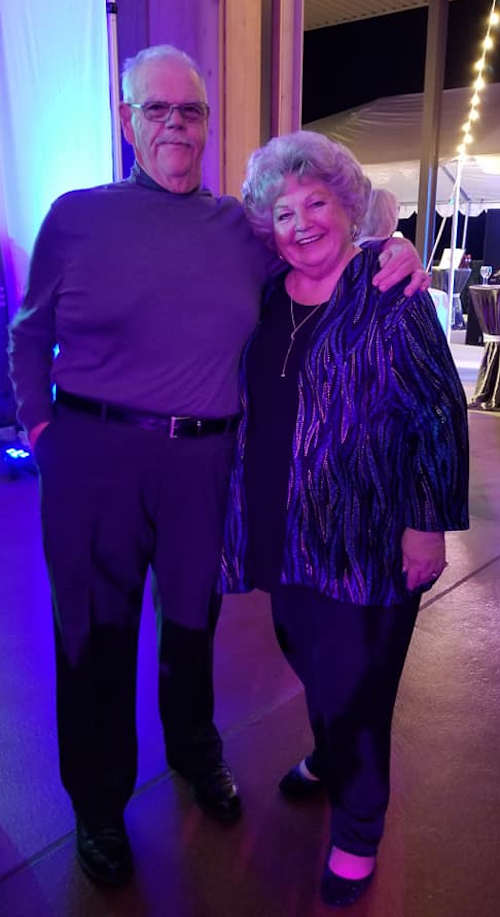
LAKE COUNTY, Calif. — Two longtime Lake County residents who have spent years in public service will be honored as the grand marshals of Saturday’s Redbud Parade.
Jim and Sue Burton of Clearlake Oaks will be the honorees during the event, which is part of Clearlake’s Independence Day celebration, which takes place beginning on Saturday morning.
The parade starts at Redbud Park at 11 a.m. before proceeding down Lakeshore Drive to Austin Park.
The theme of this year’s parade is “Rocking Lake County.”
“It is an honor,” Sue Burton told Lake County News.
Jim Burton was born and raised in Clearlake Oaks.
For 36 years he worked for the Clearlake Oaks Fire District, serving as fire chief for 26 of those years before his retirement. The district has since consolidated with several other fire districts to become Northshore Fire Protection District.
He has served as a member of the Northshore Fire District Board for 19 years, and also is a member of the Clearlake Oaks Water Board, vice president of the East Region Town Hall and president of the Clearlake Oaks Moose Lodge No. 2284.
Sue Burton has lived in Clearlake Oaks for more than 53 years. For 28 of those years, she owned her own business in the town.
She served on the Konocti Unified School District Board of Trustees for 20 years and also has been a member of the Redbud Health Care District for the past two decades.
Now, she is the first woman administrator for the Clearlake Oaks Moose Lodge.
More information about the 64th annual Redbud Parade and Festival is available here.
Email Elizabeth Larson at This email address is being protected from spambots. You need JavaScript enabled to view it.. Follow her on Twitter, @ERLarson, or Lake County News, @LakeCoNews.
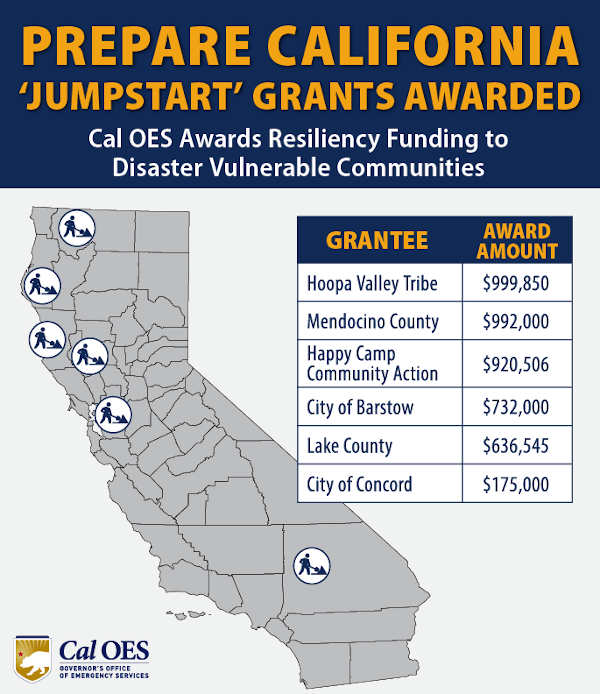
LAKE COUNTY, Calif. – The California Governor’s Office of Emergency Services on Thursday announced the first round of awardees for the first-in-the-nation Prepare California Program, with Lake County selected to receive funds to hire a chief climate resilience officer.
In total, Cal OES awarded nearly $4.5 million to six applicants through the “Jumpstart” portion of the Prepare California Program.
Ranging from cities and counties to tribal governments and private nonprofits situated all over the state, this funding will be used to invest in infrastructure improvements designed to protect people and property.
“We are proud of the work being done to ensure the state helps communities prepare before the next emergency,” said Mark Ghilarducci, Cal OES director. “We hope over time that these local investments will safeguard communities and their infrastructure from natural disasters.”
Launched in January, the groundbreaking program leverages funds approved in Gov. Gavin Newsom’s 2021-22 State Budget aimed at reducing long-term risks of disasters, such as flooding, earthquakes, wildfires, landslides or dam failure, in communities that are considered socially vulnerable and have a high hazard risk.
Lake County will receive $636,545 to hire a chief climate resilience officer to develop and implement a comprehensive local resilience strategy, develop low or no-cost solutions to reduce disaster risks, secure and manage mitigation grant funding, and pursue community resilience education and training.
“Lake County has endured an unparalleled series of nine wildfire disaster events since 2015,” said Lake County District 1 Supervisor Moke Simon. “Two-thirds of our land mass and more than 5.5% of our housing supply have burned. Every Lake County community has faced evacuation. In recent years, we have been working hard to bring people with separate and related roles in disaster preparedness together, and this grant will fund a critically-needed full-time chief climate resilience officer position. We couldn’t be more excited for this award.”
“As a county that has repeatedly come under climate change-informed threat it’s essential we do all we can to become more resilient to future events, and that starts with staff capacity to look ahead, and leverage any and all funding opportunities to make our communities safer,” said Lake County District 5 Supervisor Jessica Pyska. “We can’t wait to get a chief climate resilience officer in place.”
Designed to unlock federal matching funds for improvement projects that vulnerable communities would otherwise be unable to access, there are two types of grant funding available through Prepare California, with a total of $100 million available.
That includes $15 million in state funding that’s dedicated to helping eligible communities jumpstart their development and implementation of resilience planning.
The remaining $85 million is earmarked for communities applying for the federal Hazard Grant Mitigation Program and is intended to cover the required local cost share.
The state identified these disaster vulnerable communities by prioritizing California census tracts according to their estimated hazard exposures and social vulnerability.
Hazard exposure is based on the State Hazard Mitigation Plan which includes an analysis of several datasets related to wildfire, flood, earthquake, drought and heat wave frequencies. Social vulnerability is based on the CDC Social Vulnerability Index.
Additional information about Prepare California, including the inception of the program and the application process, can be found at www.caloes.ca.gov/preparecalifornia.
The full list of the first round awardees is below.
2022 Prepare California ‘Jumpstart’ awardees:
Hoopa Valley Tribal Government: $999,850. Hire a full-time hazard mitigation officer and a coordinator to determine cost-effective hazard mitigation projects, catalog vulnerable infrastructure, and provide education and outreach to residents and community partners.
“The Hoopa Valley Tribe is humbled and grateful for this funding opportunity from CalOES,” said Serene White, Hoopa Valley Tribe Office of Emergency Services emergency manager. “The Hoopa Valley tribe is the second largest tribe and provides service to their neighboring tribes and communities as well. This grant will greatly affect the need to better serve our community, membership and all the surrounding areas. This funding will help mitigate future events, disasters, and create a more continued resilient response effort on behalf of the Tribe. Tsediyah’ (thank you).”
Mendocino County: $992,000. Hire a part-time resilience-focused grant coordinator and grant consultant to conduct outreach and education campaigns and secure grant funding for projects that directly benefit the most socially vulnerable members of the community.
“The county of Mendocino is appreciative and excited to hear about the award from Cal OES,” said Darcie Antle, Mendocino County interim chief executive officer. “The Prepare California ‘Jumpstart’ grant will allow us to hire staff to help build capacity around hazard mitigation projects. The Board of Supervisors and the Prevention, Recovery, Resiliency, and Mitigation team have been working towards a grant management unit. This funding will build capacity around mitigation projects and expand on the great work being done by the PRRM team since the 2017 Wildfire. The team looks forward to working with Cal OES in the future.”
Happy Camp Community Action (Private nonprofit/Siskiyou County): $920,506. Hire additional staff, including a chief resilience officer, that would be responsible for identifying and implementing various wildfire mitigation projects, getting Happy Camp certified in the Community Emergency Response Team program, and providing fire-safe education and outreach to Happy Camp communities.
“The Slater Fire Long-Term Recovery Group is honored to receive this grant award from the California Office of Emergency Services,” said the group’s co-chair, Abigail Yeager. “Our rural community of Happy Camp, California was devastated by the 2020 Slater Fire; this grant is a huge step forward in our recovery journey and will improve our fire resiliency tremendously. This opportunity would not have been possible without the partnership between Happy Camp Community Action, Inc. and SiskiyouWorks, two non-profit Slater Fire LTRG member organizations who co-wrote the grant.”
City of Barstow, San Bernardino County: $732,000. Hire a part-time chief resilience officer to develop local climate resilience strategies and initiatives aimed at assisting the most socially vulnerable residents.
Lake County: $636,545. Hire a chief climate resilience officer to develop and implement a comprehensive local resilience strategy, develop low or no-cost solutions to reduce disaster risks, secure and manage mitigation grant funding, pursue community resilience education and training.
City of Concord, Contra Costa County: $175,000. Create an equity-minded planning initiative that is based on language access and focuses on emergency preparedness education and outreach within Limited English Proficient communities.
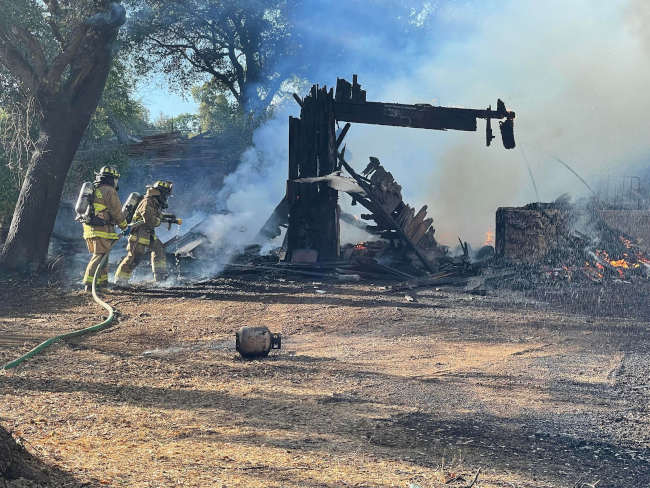
Firefighters work at the scene of a structure fire on Konocti Street in Clearlake, California, on Thursday, June 30, 2022. Photo courtesy of Clearlake Police Chief Andrew White. LAKE COUNTY, Calif. — Firefighters quickly contained a structure fire in Clearlake that threatened numerous other buildings on Thursday evening.
The fire in the 14000 block of Konocti Street was dispatched shortly after 6:30 p.m.
Initial reports said the fire was burning two structures, with multiple additional structures threatened.
The Clearlake Police Department sent out an alert asking people to avoid the area, and officers closed Konocti Road at Lakeshore Drive.
By 7 p.m., incident command reported that the fire had been contained to one property with minimal extension into the wildland. Additional resources were canceled.
At that point, with the fire completely knocked down, mop up was estimated to take a few hours.
Reports from the scene said the property was abandoned.
Email Elizabeth Larson at This email address is being protected from spambots. You need JavaScript enabled to view it.. Follow her on Twitter, @ERLarson, or Lake County News, @LakeCoNews.
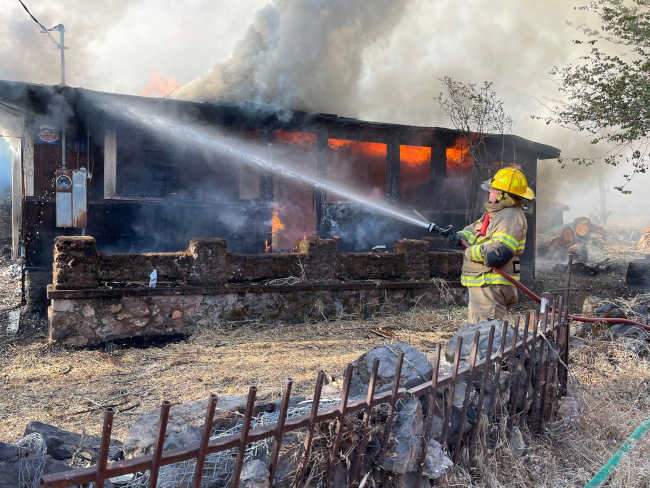
A fire burned two structures at a property on Konocti Street in Clearlake, California, on Thursday, June 30, 2022. Photo courtesy of Clearlake Police Chief Andrew White.
CLEARLAKE, Calif. — Clearlake Animal Control has more new dogs waiting to be adopted.
The City of Clearlake Animal Association also is seeking fosters for the animals waiting to be adopted.
Call the Clearlake Animal Control shelter at 707-273-9440, or email This email address is being protected from spambots. You need JavaScript enabled to view it. to inquire about adoptions and schedule a visit to the shelter.
Visit Clearlake Animal Control on Facebook or on the city’s website.
The following dogs are available for adoption, with the newcomers at the top.
“Matata.” Photo courtesy of Clearlake Animal Control. ‘Matata’
“Matata” is male shepherd mix with a tan coat.
He has been neutered.
He is dog No. 50176912.
“Sister.” Photo courtesy of Clearlake Animal Control. ‘Sister’
“Sister” is a female terrier mix with a short tan coat.
She has been spayed.
She is dog No. 50262516.
“Andy.” Photo courtesy of Clearlake Animal Control. ‘Andy’
“Andy” is a male American pit bull mix with a short gray and white coat.
He is dog No. 48995415.
“Bear.” Photo courtesy of Clearlake Animal Control. ‘Bear’
“Bear” is a male Labrador retriever-American pit bull mix with a short charcoal and fawn coat.
He has been neutered.
“Big Phil.” Photo courtesy of Clearlake Animal Control. ‘Big Phil’
“Big Phil” is a 13-year-old male American pit bull terrier mix with a blue coat.
He is dog No. 49951647.
“Bro.” Photo courtesy of Clearlake Animal Control. ‘Bro’
“Bro” is a male terrier mix with a short tan coat.
He has been neutered.
Bro is dog No. 50262527.
“Colt.” Photo courtesy of Clearlake Animal Control. ‘Colt’
“Colt” is a male Rhodesian Ridgeback mix with a short rust and black coat.
He has been neutered.
He is dog No. 49812106.
“Hondo.” Photo courtesy of Clearlake Animal Control. ‘Hondo’
“Hondo” is a male Alaskan husky mix with a buff coat.
He has been neutered.
He’s dog No. 50227693.
“Kubota.” Photo courtesy of Clearlake Animal Control. ‘Kubota’
“Kubota” is a male German shepherd mix with a short tan and black coat.
He has been neutered.
Kubota is dog No. 50184421.
“Newman.” Photo courtesy of Clearlake Animal Control. ‘Newman’
“Newman” is a 1-year-old male American pit bull terrier mix with a black and white coat.
He has been neutered.
Newman is dog No. 49057809.
“Snowball.” Photo courtesy of Clearlake Animal Control. ‘Snowball’
“Snowball” is a male American Staffordshire mix terrier with a white coat.
He has been neutered.
He is dog No. 49159168.
“Terry.” Photo courtesy of Clearlake Animal Control. ‘Terry’
“Terry” is a handsome male shepherd mix with a short brindle coat.
He gets along with other dogs, including small ones, and enjoys toys. He also likes water, playing fetch and keep away.
Staff said he is now getting some training to help him build confidence.
He is dog No. 48443693.
“Ziggy.” Photo courtesy of Clearlake Animal Control. ‘Ziggy’
“Ziggy” is a male American pit bull terrier mix with a short gray and white coat.
He has been neutered.
Ziggy is dog No. 50146247
Email Elizabeth Larson at This email address is being protected from spambots. You need JavaScript enabled to view it.. Follow her on Twitter, @ERLarson, or Lake County News, @LakeCoNews.
On Thursday, the same day that the U.S. Supreme Court dealt a blow to the federal government’s ability to reduce pollution and tackle climate change, California took action to cut plastic pollution and hold the plastics industry accountable for their waste.
Gov. Gavin Newsom signed SB 54, requiring all packaging in the state to be recyclable or compostable by 2032, cutting plastic packaging by 25% in 10 years and requiring 65% of all single-use plastic packaging to be recycled in the same timeframe.
Additionally, the legislation shifts the plastic pollution burden from consumers to the plastics industry by raising $5 billion from industry members over 10 years to assist efforts to cut plastic pollution and support disadvantaged communities hurt most by the damaging effects of plastic waste.
“Our kids deserve a future free of plastic waste and all its dangerous impacts, everything from clogging our oceans to killing animals — contaminating the air we breathe, the water we drink, and the food we eat. No more. California won’t tolerate plastic waste that’s filling our waterways and making it harder to breathe. We’re holding polluters responsible and cutting plastics at the source,” said Gov. Newsom.
Newsom’s office said SB 54 is the most significant overhaul of California’s plastics and packaging recycling policy in history, goes further than any other state on cutting plastics production at the source and continues to build a circular economy that is necessary to combat climate change.
A global study in 2018 found that only 9% of plastics actually get recycled — leaving 91% to litter land and oceans.
Legislation signed Thursday requires all plastic packaging in California to be recycled at the following levels:
• At least 30% on and after January 1, 2028. • At least 40% on and after January 1, 2030. • At least 65% on and after January 1, 2032.
The legislation is a result of negotiations between lawmakers and stakeholders in response to a pending initiative on the November ballot, which has since been removed as a result of Thursday’s action.
“In this time of extreme polarization in our nation, California was able to show that we can pass strong environmental legislation with bipartisan support that brought together the environmental and business communities,” said Sen. Ben Allen (D-Santa Monica), author of the legislation. “I’m so grateful to the ballot measure proponents who helped to force this issue, the many advocates who worked so hard through the negotiations, and the Governor, legislators, and staff who recognized the need for action. With this new law, California continues its tradition of global environmental leadership – tackling a major problem in a way that will grow markets in sustainable innovations, create incentives for investment, and set the stage for partnership with other states and countries on these issues.”
“As someone who grew up and represents the San Fernando Valley, I see firsthand how disadvantaged and low-income communities bear the brunt of plastic pollution. With the amendments that were proposed by my Assembly Natural Resources Committee, we now have one of the strongest plastics reduction laws in the nation. I feel proud to have jointly authored SB 54,” said Assemblywoman Luz Rivas (D-San Fernando Valley).
“This is an extraordinary day for California, solidifying our role as a leader in environmental policy and the fight against plastic pollution. SB 54 will fundamentally decrease our dependence on single-use plastics, and the ripple effects of California implementing such bold changes cannot be overstated. So goes California, so goes the nation,” said Senator Bob Hertzberg (D-San Fernando Valley).
Thursday’s action builds on the California Climate Commitment, the biggest climate investment in history — a $53.9 billion plan to combat extreme weather and accelerate the transition to clean energy.
 How to resolve AdBlock issue?