 How to resolve AdBlock issue?
News
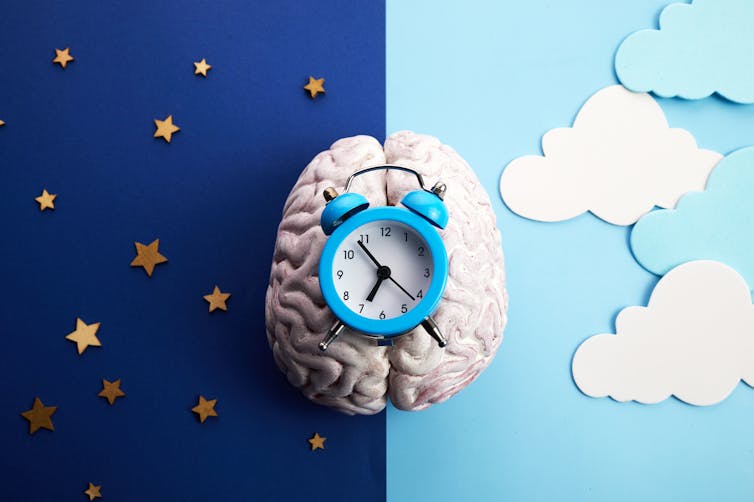
Anyone who has suffered from jet lag or struggled after turning the clock forward or back an hour for daylight saving time knows all about what researchers call your biological clock, or circadian rhythm – the “master pacemaker” that synchronizes how your body responds to the passing of one day to the next.
This “clock” is made up of about 20,000 neurons in the hypothalamus, the area near the center of the brain that coordinates your body’s unconscious functions, like breathing and blood pressure. Humans aren’t the only beings that have an internal clock system: All vertebrates – or mammals, birds, reptiles, amphibians and fish – have biological clocks, as do plants, fungi and bacteria. Biological clocks are why cats are most active at dawn and dusk, and why flowers bloom at certain times of day.
Circadian rhythms are also essential to health and well-being. They govern your body’s physical, mental and behavioral changes over each 24-hour cycle in response to environmental cues like light and food. They’re why more heart attacks and strokes occur early in the morning. They’re also why mice that are missing their biological clocks age faster and have shorter lifespans, and people with a mutation in their circadian clock genes have abnormal sleep patterns. Chronic misalignment of your circadian rhythm with external cues, as seen in night-shift workers, can lead to a wide range of physical and mental disorders, including obesity, Type 2 diabetes, cancer and cardiovascular diseases.
In short, there is ample evidence that your biological clock is critical to your health. And chronobiologists like me are studying how the day-night cycle affects your body to better understand how you can modify your behaviors to use your internal clock to your advantage.
How biological rhythms affect your health
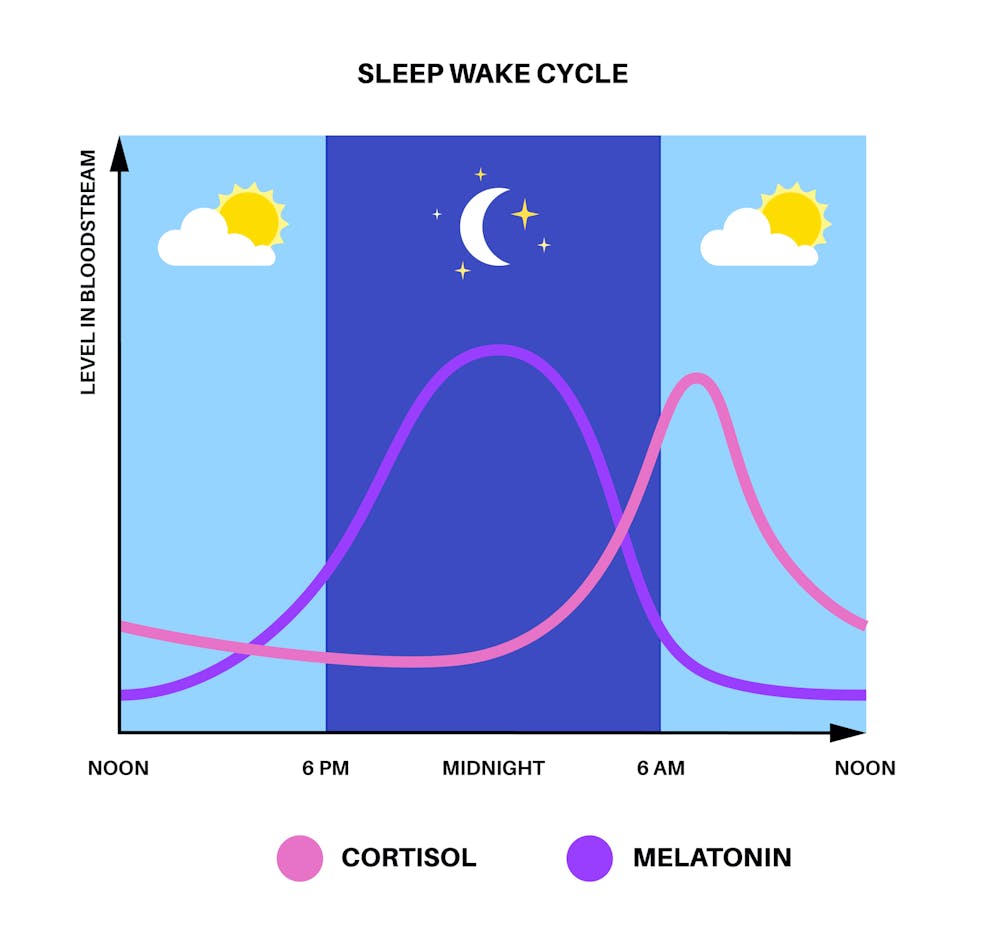
Your biological clock affects your health by regulating your sleep-wake cycles and fluctuations in blood pressure and body temperature. It does this primarily by syncing your endocrine system to environmental light-dark cycles so that certain hormones are released in certain amounts at certain times of day.
The pineal grand in your brain, for example, produces melatonin, a hormone that helps regulate sleep in response to darkness. Doctors advise reducing exposure to artificial blue light from electronic devices before bedtime because it can disrupt melatonin secretion and sleep quality.
Your circadian rhythm also affects your metabolism. Among other things, sleep helps you regulate leptin, a hormone that controls appetite. Your leptin levels fluctuate throughout the day according to a rhythm set by your circadian clock. Insufficient or irregular sleep can disrupt leptin production, which can make us hungrier and lead to weight gain.
In recent years, researchers have discovered even more ways your circadian clock can affect your health. For example, there is now research suggesting that eating at set times of day, or time-restricted feeding, can prevent obesity and metabolic diseases. Depression and other mood disorders may also be linked to dysfunctional circadian control that lead to changes in how your genes are expressed.
The time of day when you take your medicine can also affect how well it works and how severe any side effects might be. Likewise, your biological clock is a potential target for cancer chemotherapies and anti-obesity treatments.
And finally, even your personality might be shaped by whether your internal clock make you a “morning person” or a “night person.”
Getting the most out of exercise
Circadian clocks also provide a potential answer to when is the best time of day to maximize the benefits of physical exercise.
To study this, my colleagues and I collected blood and tissue samples from the brains, hearts, muscles, livers and fat of mice that exercised either before breakfast in the early morning or after dinner in the late evening. We used a tool called a mass spectrometer to detect approximately 600 to 900 molecules each organ produced. These metabolites served as real-time snapshots of how the mice responded to exercise at specific times of day.
We stitched these snapshots together to create a map of how exercise in the morning versus evening affected each of the mice’s different organ systems – what we called an atlas of exercise metabolism.
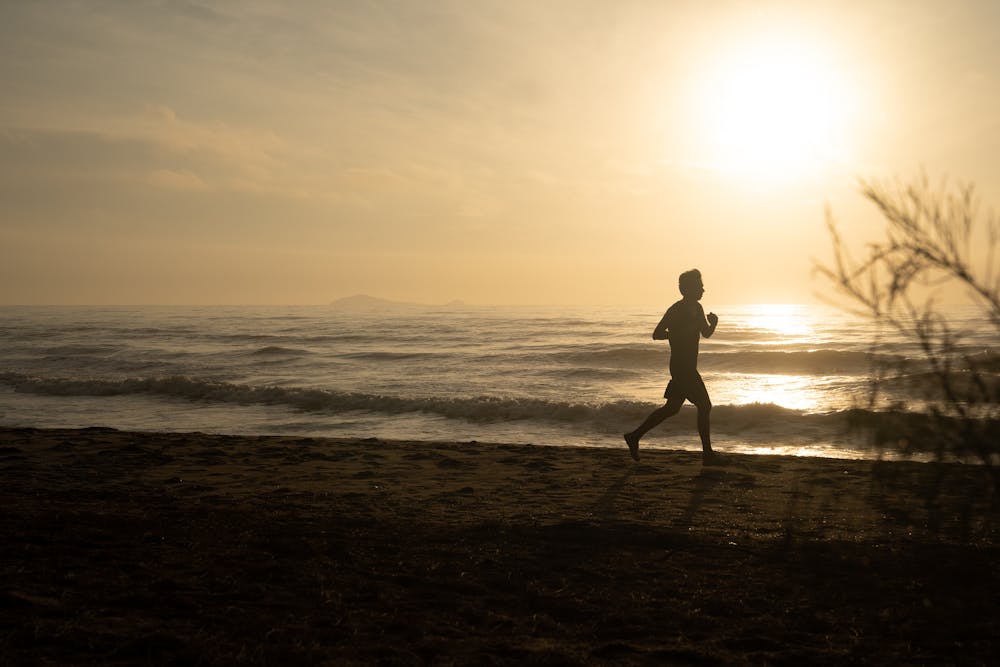
Using this atlas, we saw that time of day affects how each organ uses energy during exercise. For instance, we found that early morning exercise reduced blood glucose levels more than late evening exercise. Exercise in the late evening, however, allowed the mice to benefit from energy they stored from their meals and increased their endurance.
Of course, mice and humans have many differences along with their similarities. For one, mice are more active at night than during the day. Still, we believe that our findings could help researchers better understand how exercise affects your health and, if timed appropriately, can be optimized based on time of day to meet your personal health goals.
Getting along with your biological clock
I believe that the field of chronobiology is growing, and we will produce even more research providing practical applications and insights into health and well-being in the future.
In my own work, for example, a better understanding of how exercising at different times of day affects your body could help tailor exercise plans to maximize specific benefits for patients with obesity, Type 2 diabetes and other diseases.
There is still much to learn about how your circadian clock works. But in the meantime, there are some tried and true ways people can synchronize their internal clocks for better health. These include regular exposure to sunlight to trigger the endocrine system to produce vitamin D, staying active during the day so you fall asleep more easily at night and avoiding caffeine and reducing your exposure to artificial light before bedtime.
Shogo Sato, Assistant Professor of Biology, Texas A&M University
This article is republished from The Conversation under a Creative Commons license. Read the original article.
What's up for July? The planets at dawn, the dog days of summer, and the Teapot points to the center of the Milky Way.
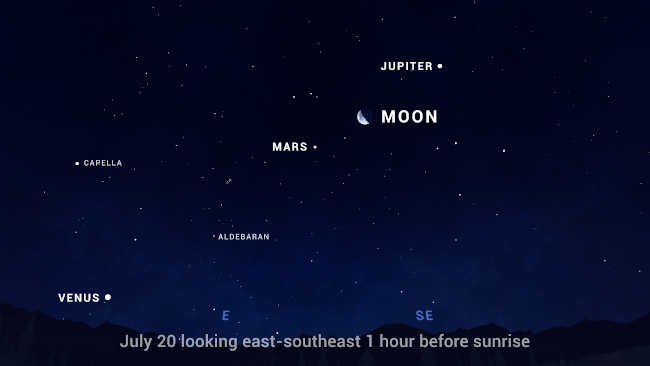
The planets Mars, Jupiter and Saturn dominate morning skies in July. Venus is there as well, but appears low in the east, so you'll need a clear view toward the horizon to see it.
The planets are spread out across the morning sky, accompanied by bright stars, Capella, Aldebaran, and Fomalhaut. On July 20, look for the half-full, last-quarter moon between Mars and Jupiter. And the following morning, you'll find the Moon sitting right next to Mars.
July is a time for sweltering hot weather in the Northern Hemisphere, and you may have heard this time of year referred to as the "dog days of summer." Well that phrase actually dates back to ancient times and has to do with the brightest star in the sky, Sirius.
At the peak of summer, the Sun lies in the same part of the sky as Sirius, which the ancient Greeks and Romans associated with the dog-shaped constellation Canis major, just as we do today. Sirius is its most prominent star, and it's sometimes called "the dog star."
In Ancient Greek, Sirius means "the scorcher," and both the Greeks and Romans believed the blazing bright star's proximity in the sky added to the Sun's heat during that time of the year making it even more oppressive. And so they called this hot time of year the "dog days."
Of course, today we know the only star close enough to affect our temperatures on Earth is the Sun. And the heat we experience in July is the result of the Northern Hemisphere being tilted toward the Sun. This yields longer days and more direct sunlight, and thus warmer weather. The situation is reversed in the Southern Hemisphere, where July is right in the middle of winter.
Facing southward on July nights after sunset, you'll find a sky teeming with bright stars. Looking in that direction this time of year, you're facing the center of our galaxy, the Milky Way, all night, and there are quite a number of bright stars in that part of the sky — particularly in the constellations Scorpius and Sagittarius.

Now if you find yourself under dark skies you'll be able to fully enjoy the Milky Way core — densely packed with stars and dark clouds of dust and gas. It's dazzling this time of year, and it's visible toward the south as soon as it gets fully dark out.
But even if you're under urban skies too bright to observe the Milky Way core, the group of stars in Sagittarius known as the Teapot will help you pinpoint its location on the sky.
The Teapot is a well-known asterism, or pattern of stars, and like Scorpius the scorpion nearby, once you're familiar with it, it's hard not to see a teapot there in the sky. The galaxy's core lies just right of the stars of the Teapot's "spout."
Over the course of the night, it appears to tilt as if its spout is pouring out a cosmic "cuppa." And under dark skies, the Milky Way appears as a plume of steam rising from the spout. So here's hoping you get a chance to enjoy the Milky Way in July, or at least that you find your way to the galaxy's core thanks to the Teapot.
Preston Dyches works for NASA's Jet Propulsion Laboratory.

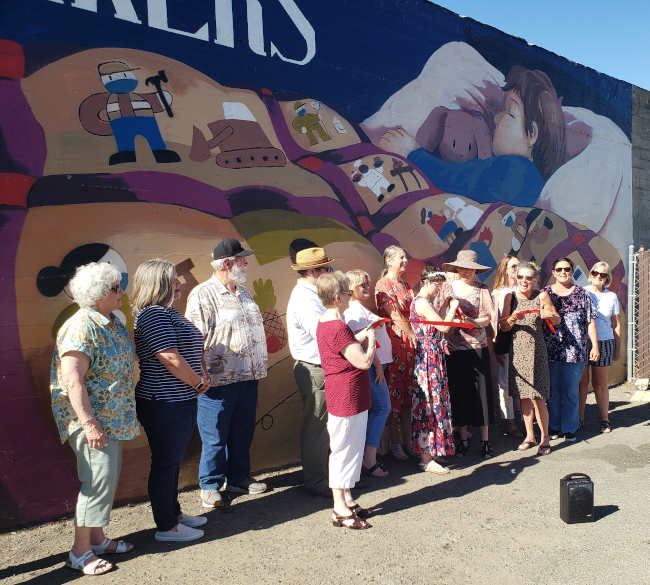
LAKEPORT, Calif. — A new public art installation in downtown Lakeport that celebrates essential workers was formally dedicated on Friday evening.
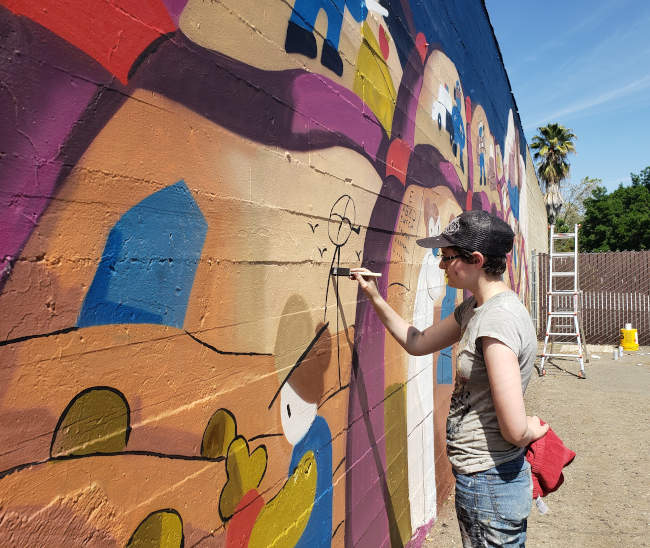
The new mural by Loch Lomond artist Emma Wakefield is located on the side of the Meals on Wheels Thrift Store at 120 N. Main St.
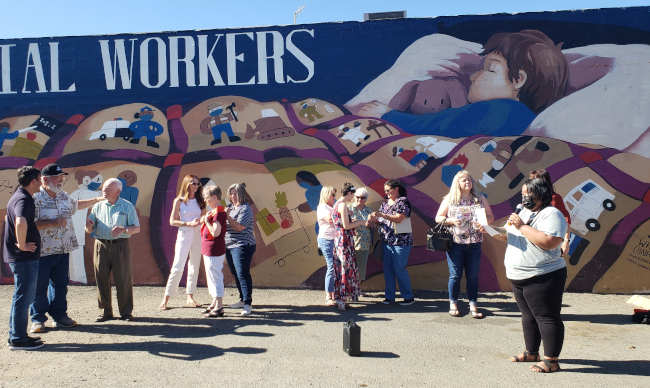
It portrays a sleeping boy, holding his stuffed rabbit, and tucked under a quilt, the blocks of which illustrate the many professions that are critical to daily life and whose importance has been amplified by the pandemic: health care workers, police and firefighters, construction and utility workers, teachers, cooks, farmworkers, postal workers and store clerks.
Wakefield started painting the mural on May 16, completing it a week later.
It’s the latest of several murals that now decorate the city’s downtown as part of an effort to create more public art throughout Lake County.
“This was the coolest community effort I’ve ever seen,” said Barbara Clark, executive director of the Lake County Arts Council.
She said many groups quickly came together with the Arts Council to get the project off the ground, including the Lake Family Resource Center, city of Lakeport, Lake County Rural Arts Initiative, the Lakeport Senior Center and Lakeport Main Street Association.
Mayor Pro Tem Mireya Turner noted the speed of the project coming together and being completed.
She said it expresses appreciation for those who work for the community.
Clark told Lake County News that they still have about half of the $8,000 to raise to cover the mural’s cost.
Tax-deductible, charitable donations may be made to the Lake County Arts Council at
https://lakearts.org/essential-worker-appreciation-mural-project/.
After Wakefield cut a ceremonial ribbon provided by the Lake County Chamber, Lake County Poet Laureate Georgina Marie Guardado read a dedication poem.
Guardado’s poem spoke to the work of the people portrayed in the mural and their contributions.
She said that nature may be saying it’s time to reap what has been sown.
In response, her poem ended with the voice of the people who continued to work as COVID-19 shut down the world: “Not if we can help it.”
Email Elizabeth Larson at

LAKE COUNTY, Calif. — Lake County will celebrate Independence Day with numerous festivals and fireworks displays through this three-day holiday weekend.
The following is a list of fireworks shows around Lake County this weekend.
Saturday, July 2
Clearlake
The Lakeshore Lions Club is presenting the 64th annual Redbud Parade and Festival on Saturday.
The celebration includes a parade that starts at 11 a.m., and a daylong festival and carnival.
The fireworks display begins at dark offshore of Austin Park and beach.
Lakeport
The Lakeport Speedway will present a fireworks display after the races on Saturday night.
For more information visit the speedway’s Facebook page.
Sunday, July 3
Clearlake Oaks
The Clearlake Oaks Glenhaven Business Association will host a fireworks show at dark at the Clearlake Oaks boat ramp.
Lakeport
Konocti Vista Casino and Resort, Twin Pine Casino & Hotel, Lake County Tribal Health Consortium, Mission Grown Medicinals and BVR Smokeshop will host a fireworks show at 10 p.m.
The barge will be firing north of our marina on Clear Lake.
There also will be music and food trucks.
Monday, July 4
Lakeport
The city of Lakeport will host its festival and street fair from 10 a.m. to 10 p.m. on Park Street and in Library Park.
The fireworks begin at dark offshore of Library Park.
Court Executive Office Krista LeVier said Friday that amendments and additions to the Penal Code were passed by the Legislature and signed into law by the governor.
The new legislation allows for remote appearances in many criminal proceedings. LeVier said the legislation applies to Penal Code sections 977 and 977.3.
As a result, LeVier said remote appearances will continue to be allowed on the criminal law and motion calendars when allowed under the law.
Preliminary hearings, felony sentencings, settlement conferences and trials continue to require in-person appearances, LeVier said.
She said counsel is required to appear in-person with any client who intends to appear in-person, as there is no means for private communication between the defendant and counsel prior to and during the proceedings.
Additional information can be found on the Lake County Superior Court website.
The allocations approved by the California Transportation Commission, or CTC, include $1.3 million toward roadway, guardrail, drainage and other improvements on Highway 29 near Clear Lake from Spruce Grove Road to Diener Drive in Lake County.
Senate Bill (SB) 1, the Road Repair and Accountability Act of 2017, accounts for more than $930 million of the total funding.
“The CTC’s decision to invest in our state highways while protecting city and county infrastructure will help make California’s roadways safer and more resilient one shovel, one project and one community at a time,” said Caltrans Director Tony Tavares.
In addition to the work in Lake County, projects approved this week include:
• Approximately $8.4 million toward drainage improvements along Route 299 from Blue Lake to Willow Creek in Humboldt County.
• Approximately $1.5 million toward the construction of a retaining wall along Route 36 near Bridgeville in Humboldt County.
• Approximately $4.1 million toward drainage and fish-passage improvements along U.S. 101 near Crescent City in Del Norte County.
• Approximately $1 million toward the construction and repair of buildings at the Ukiah Maintenance Station along U.S. 101 as well as the Boonville Maintenance Station along Route 128 in Mendocino County.
• Approximately $1 million toward the construction of a median barrier along U.S. 101 from Route 20 to south of North State Street near Ukiah in Mendocino County.
• Approximately $3.1 million toward drainage and fish-passage improvements along Route 1 near Philo and Boonville in Mendocino County.
• Approximately $1.1 million toward road and guardrail repairs and ADA curb ramps along Route 1 from south of Iverson Avenue to Philo Greenwood Road near Point Arena in Mendocino County.
• Approximately $1.1 million toward roadway and guardrail repairs along U.S. 101 from north of Robinson Creek Bridge to Pomo Lane Undercrossing near Ukiah in Mendocino County.
• Approximately $5.7 million toward the construction of a retaining wall along U.S. 101 near Hopland in Mendocino County.
• Approximately $588,000 toward roadway and guardrail repairs along U.S. 101 from north of the Humboldt County line to Leggett in Mendocino County.
• Approximately $1.4 million toward pavement and guardrail upgrades along Route 1 from Mill Creek Bridge to Robinson Creek Bridge near Boonville in Mendocino County.
The $1.3 billion federal local assistance allocation in fiscal year 2023 is thanks to programs that were created or expanded under the Infrastructure Investment and Jobs Act, also referred to as the Bipartisan Infrastructure Law.
Caltrans oversees funds that are available to more than 600 cities, counties, and regional agencies for the purpose of improving their transportation infrastructure and services.
Funding from new programs that were created by the law includes $45 million to build community resilience in the face of extreme weather and natural disasters and $63 million to help develop carbon reduction strategies that address the climate crisis.
SB 1 provides $5 billion in annual transportation funding annually that is split between the state and local agencies. Road projects progress through construction phases more quickly based on the availability of SB 1 funds, including projects that are partially funded by SB 1.
For more information about transportation projects funded by SB 1, visit www.RebuildingCA.ca.gov.