 How to resolve AdBlock issue?
News

Heat waves are becoming supercharged as the climate changes – lasting longer, becoming more frequent and getting just plain hotter. One question a lot of people are asking is: “When will it get too hot for normal daily activity as we know it, even for young, healthy adults?”
The answer goes beyond the temperature you see on the thermometer. It’s also about humidity. Our research shows the combination of the two can get dangerous faster than scientists previously believed.
Scientists and other observers have become alarmed about the increasing frequency of extreme heat paired with high humidity, measured as “wet-bulb temperature.” During the heat waves that overtook South Asia in May and June 2022, Jacobabad, Pakistan, recorded a maximum wet-bulb temperature of 33.6 C (92.5 F) and Delhi topped that – close to the theorized upper limit of human adaptability to humid heat.
People often point to a study published in 2010 that estimated that a wet-bulb temperature of 35 C – equal to 95 F at 100% humidity, or 115 F at 50% humidity – would be the upper limit of safety, beyond which the human body can no longer cool itself by evaporating sweat from the surface of the body to maintain a stable body core temperature.
It was not until recently that this limit was tested on humans in laboratory settings. The results of these tests show an even greater cause for concern.
The PSU H.E.A.T. Project
To answer the question of “how hot is too hot?” we brought young, healthy men and women into the Noll Laboratory at Penn State University to experience heat stress in a controlled environment.
These experiments provide insight into which combinations of temperature and humidity begin to become harmful for even the healthiest humans.

Each participant swallowed a small telemetry pill, which monitored their deep body or core temperature. They then sat in an environmental chamber, moving just enough to simulate the minimal activities of daily living, such as cooking and eating. Researchers slowly increased either the temperature in the chamber or the humidity and monitored when the subject’s core temperature started to rise.
That combination of temperature and humidity whereby the person’s core temperature starts to rise is called the “critical environmental limit.” Below those limits, the body is able to maintain a relatively stable core temperature over time. Above those limits, core temperature rises continuously and risk of heat-related illnesses with prolonged exposures is increased.
When the body overheats, the heart has to work harder to pump blood flow to the skin to dissipate the heat, and when you’re also sweating, that decreases body fluids. In the direst case, prolonged exposure can result in heat stroke, a life-threatening problem that requires immediate and rapid cooling and medical treatment.
Our studies on young healthy men and women show that this upper environmental limit is even lower than the theorized 35 C. It’s more like a wet-bulb temperature of 31 C (88 F). That would equal 31 C at 100% humidity or 38 C (100 F) at 60% humidity.
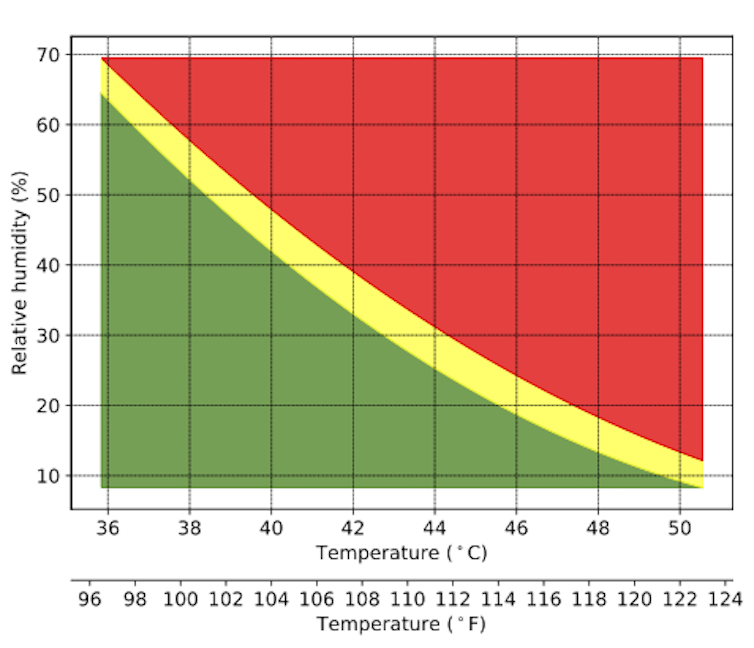
Dry vs. humid environments
Current heat waves around the globe are approaching, if not exceeding, these limits.
In hot, dry environments the critical environmental limits aren’t defined by wet-bulb temperatures, because almost all the sweat the body produces evaporates, which cools the body. However, the amount humans can sweat is limited, and we also gain more heat from the higher air temperatures.
Keep in mind that these cutoffs are based solely on keeping your body temperature from rising excessively. Even lower temperatures and humidity can place stress on the heart and other body systems. And while eclipsing these limits does not necessarily present a worst-case scenario, prolonged exposure may become dire for vulnerable populations such as the elderly and those with chronic diseases.
Our experimental focus has now turned to testing older men and women, since even healthy aging makes people less heat tolerant. Adding on the increased prevalence of heart disease, respiratory problems and other health problems, as well as certain medications, can put them at even higher risk of harm. People over the age of 65 comprise some 80%-90% of heat wave casualties.
How to stay safe
Staying well hydrated and seeking areas in which to cool down – even for short periods – are important in high heat.
While more cities in the United States are expanding cooling centers to help people escape the heat, there will still be many people who will experience these dangerous conditions with no way to cool themselves.
Even those with access to air conditioning might not turn it on because of the high cost of energy – a common occurrence in Phoenix, Arizona – or because of large-scale power outages during heat waves or wildfires, as is becoming more common in the western U.S.
A recent study focusing on heat stress in Africa found that future climates will not be conducive to the use of even low-cost cooling systems such as “swamp coolers” as the tropical and coastal parts of Africa become more humid. These devices, which require far less energy than air conditioners, use a fan to recirculate the air across a cool, wet pad to lower the air temperature, but they become ineffective at high wet-bulb temperatures above 21 C (70 F).
All told, the evidence continues to mount that climate change is not just a problem for the future. It is one that humanity is currently facing and must tackle head-on.
W. Larry Kenney, Professor of Physiology, Kinesiology and Human Performance, Penn State; Daniel Vecellio, Geographer-climatologist and Postdoctoral Fellow, Penn State; Rachel Cottle, Ph.D. Student in Exercise Physiology, Penn State, and S. Tony Wolf, Postdoctoral Researcher in Kinesiology, Penn State
This article is republished from The Conversation under a Creative Commons license. Read the original article.
Dogs available for adoption this week include mixes of border collie, boxer, bulldog, bull terrier, German shepherd, Great Pyrenees, Labrador retriever, pit bull, poodle, shar pei, shepherd, terrier and treeing walker coonhound.
Dogs that are adopted from Lake County Animal Care and Control are either neutered or spayed, microchipped and, if old enough, given a rabies shot and county license before being released to their new owner. License fees do not apply to residents of the cities of Lakeport or Clearlake.
The following dogs at the Lake County Animal Care and Control shelter have been cleared for adoption.
Call Lake County Animal Care and Control at 707-263-0278 or visit the shelter online for information on visiting or adopting.

Female boxer
This 5-year-old female boxer has a short brown coat.
She is in kennel No. 11, ID No. LCAC-A-3672.

Female Great Pyrenees
This 3-year-old female Great Pyrenees has a white coat.
She is in kennel No. 13, ID No. LCAC-A-3669.

‘Misty’
“Misty” is a 4-year-old female bulldog with a short white coat.
She is in kennel No. 14, ID No. LCAC-A-3667.

‘BonBon’
“BonBon” is a 2-year-old male poodle with a long curly coat.
He is in kennel No. 15, ID No. LCAC-A-3668.

‘Autumn’
“Autumn” is a 6-year-old female treeing walker coonhound with a tricolor coat.
She is in kennel No. 16, ID No. LCAC-A-1776.

‘Cali’
“Cali” is a female pit bull terrier with a short black and white coat.
She is in kennel No. 17, ID No. LCAC-A-3571.

Shar Pei-pit bull mix
This 9-year-old female shar pei-pit bull mix has a short black and white coat.
She is in kennel No. 19, ID No. LCAC-A-3622.

‘Missy’
“Missy” is a 3-year-old female pit bull terrier with a black and white coat.
She is in kennel No. 20, ID No. LCAC-A-3524.

Male pit bull terrier mix
This 3-year-old male pit bull terrier mix has a short black and white coat.
He is in kennel No. 22, ID No. LCAC-A-3627.

Female pit bull
This young female pit bull has a short black and white coat.
She is in kennel No. 24, ID No. LCAC-A-3630.

Male pit bull terrier
This 2-year-old male pit bull terrier has a short brown coat with white markings.
He is in kennel No. 25, ID No. LCAC-A-3640.

Male German shepherd
This 1-year-old male German shepherd has a short black and tan coat.
He is in kennel No. 26, ID No. LCAC-A-3642.

Female shepherd
This 2-year-old female shepherd mix has a short white coat.
She is in kennel No. 27, ID No. LCAC-A-3643.

Pit bull-bull terrier mix
This 1-year-old male pit bull-bull terrier has a short white coat.
He is in kennel No. 28, ID No. LCAC-A-3644.

Male American bulldog mix
This 2-year-old male American bulldog mix has a short tan coat.
He is in kennel No. 29, ID No. LCAC-A-3645.

Border collie-Labrador retriever mix
This young male border collie-Labrador retriever mix has a short black and white coat.
He is in kennel No. 30, ID No. LCAC-A-3646.

Female bulldog
This 2-year-old female bulldog has a short white coat with brown markings.
She is in kennel No. 31, ID No. LCAC-A-3658.
Email Elizabeth Larson at

After analyzing data gathered when NASA’s OSIRIS-REx spacecraft collected a sample from asteroid Bennu in October 2020, scientists have learned something astonishing: The spacecraft would have sunk into Bennu had it not fired its thrusters to back away immediately after it grabbed dust and rock from the asteroid’s surface.
It turns out that the particles making up Bennu’s exterior are so loosely packed and lightly bound to each other that if a person were to step onto Bennu they would feel very little resistance, as if stepping into a pit of plastic balls that are popular play areas for kids.
“If Bennu was completely packed, that would imply nearly solid rock, but we found a lot of void space in the surface,” said Kevin Walsh, a member of the OSIRIS-REx science team from Southwest Research Institute, which is based in San Antonio.
The latest findings about Bennu’s surface were published on July 7 in a pair of papers in the journals Science and Science Advances, led respectively by Dante Lauretta, principal investigator of OSIRIS-REx, based at University of Arizona, Tucson, and Walsh.
These results add to the intrigue that has kept scientists on the edge of their seats throughout the OSIRIS-REx mission, as Bennu has proved consistently unpredictable.
The asteroid presented its first surprise in December 2018 when NASA’s spacecraft arrived at Bennu. The OSIRIS-REx team found a surface littered with boulders instead of the smooth, sandy beach they had expected based on observations from Earth- and space-based telescopes. Scientists also discovered that Bennu was spitting particles of rock into space.
“Our expectations about the asteroid’s surface were completely wrong,” said Lauretta.
The latest hint that Bennu was not what it seemed came after the OSIRIS-REx spacecraft picked up a sample and beamed stunning, close-up images of the asteroid’s surface to Earth. “What we saw was a huge wall of debris radiating out from the sample site,” Lauretta said. “We were like, ‘Holy cow!’”
Scientists were bewildered by the abundance of pebbles strewed about, given how gently the spacecraft tapped the surface. Even more bizarre was that the spacecraft left a large crater that was 26 feet (8 meters) wide. “Every time we tested the sample pickup procedure in the lab, we barely made a divot,” Lauretta said. The mission team decided to send the spacecraft back to take more photographs of Bennu’s surface “to see how big of a mess we made,” Lauretta said.
Mission scientists analyzed the volume of debris visible in before and after images of the sample site, dubbed “Nightingale.” They also looked at acceleration data collected during the spacecraft’s touch down. This data revealed that as OSIRIS-REx touched the asteroid it experienced the same amount of resistance — very little — a person would feel while squeezing the plunger on a French press coffee carafe.
“By the time we fired our thrusters to leave the surface we were still plunging into the asteroid,” said Ron Ballouz, an OSIRIS-REx scientist based at the Johns Hopkins Applied Physics Laboratory in Laurel, Maryland.
Ballouz and the research team ran hundreds of computer simulations to deduce Bennu’s density and cohesion based on spacecraft images and acceleration information. Engineers varied the surface cohesion properties in each simulation until they found the one that most closely matched their real-life data.
Now, this precise information about Bennu’s surface can help scientists better interpret remote observations of other asteroids, which could be useful in designing future asteroid missions and for developing methods to protect Earth from asteroid collisions.
It’s possible that asteroids like Bennu — barely held together by gravity or electrostatic force — could break apart in Earth’s atmosphere and thus pose a different type of hazard than solid asteroids.
“I think we’re still at the beginning of understanding what these bodies are, because they behave in very counterintuitive ways,” said Patrick Michel, an OSIRIS-REx scientist and director of research at the Centre National de la Recherche Scientifique at Côte d’Azur Observatory in Nice, France.
Goddard provides overall mission management, systems engineering, and the safety and mission assurance for OSIRIS-REx. Dante Lauretta of the University of Arizona, Tucson, is the principal investigator.
The university leads the science team and the mission's science observation planning and data processing. Lockheed Martin Space in Littleton, Colorado, built the spacecraft and provides flight operations. Goddard and KinetX Aerospace are responsible for navigating the OSIRIS-REx spacecraft. OSIRIS-REx is the third mission in NASA's New Frontiers Program, managed by NASA's Marshall Space Flight Center in Huntsville, Alabama, for the agency's Science Mission Directorate Washington.
Lonnie Shekhtman works for NASA's Goddard Space Flight Center, Greenbelt, Maryland.
The Main fire was first spotted at around 2:45 p.m. Friday by a Mount Konocti fire lookout volunteer.
It was dispatched a short time later in the area of Main Street and Highway 29 in Lower Lake, with dispatch reporting they had received numerous calls with multiple different locations for it given.
The first units to arrive on scene just after 3 p.m. said the fire was three to five acres, with a moderate to rapid rate of spread and wind pushing it.
Cal Fire, Lake County Fire, Northshore Fire and Kelseyville Fire all sent resources to the incident. In addition to engines, Cal Fire sent air attack, tankers, helicopters and dozers. Some of the engines that responded were sent to protect nearby structures.
Just before 6 p.m., incident command reported that hose and dozer lines were all around the incident and that additional resources were not needed.
Air attack reported mapping the fire at nearly 21 acres.
Incident command reported that the fire would be an extended incident, with resources to stay on it overnight and into Saturday.
Information on a cause wasn’t immediately available.
Email Elizabeth Larson at

Gun control legislation almost never passes Congress, even when there is widespread public support for action in the wake of mass shootings such as those in Buffalo and Uvalde.
That’s why we did not expect that on June 25, 2022, President Joe Biden would sign into law a bill containing a set of gun reform provisions known as the “Bipartisan Safer Communities Act.”
Based on our expertise studying public opinion and the U.S. Congress, here are four reasons we believe some gun control measures got enacted this time around.
1. Public attention
Public opinion is fickle. What concerns people on a given day may not concern them soon after, especially if the news cycle loses sight of it.
In this case, the issue of gun control did not fade from the public agenda after the Buffalo and Uvalde shootings in May. It rose in importance. While just after the shootings gun control was not at the top of the public’s congressional to-do list, by mid-June it was, rivaling the economy – 48% to 51%, respectively – as a top priority. In addition, public support for stricter gun control laws continued to climb in the intervening period.

What happened to increase the public’s support and demand for gun control? One of many factors is that Texas Sen. John Cornyn, a Republican and staunch Second Amendment supporter, came out publicly and declared, “I’m interested in what we can do to make the tragic events that occurred less likely in the future.” Within a week of the Uvalde shooting, he and Sen. Chris Murphy, a Connecticut Democrat, announced they would start meeting to discuss potential gun legislation. The actual possibility of reform kept the issue on the media’s, and thereby the public’s, agenda.
Media and public attention were also stoked by an impassioned public plea from Uvalde native and Hollywood star Matthew McConaughey at the White House, which went viral on social media. Additionally, emotional testimonies in a U.S. House committee hearing provided graphic details of the horrific experiences of students, teachers and parents.
2. Noncontroversial provisions
The new law enhances background checks for gun buyers between ages 18 and 21, provides money for states that enact “red flag” laws that allow a judge to take away the someone’s gun if they’re deemed dangerous to themselves or others, provides funding for mental health and school safety, and closes the so-called “boyfriend loophole,” which allows abusive boyfriends and even stalkers to have access to guns. How did these provisions get past Republican filibusters, which have stymied other gun reform bills?
One key factor is that provisions like these receive widespread support from both Democrats and Republicans.
Reports indicate that Cornyn, the lead Republican negotiator in the Senate, presented internal poll numbers showing broad support for these specific provisions among gun owners to his fellow Senate Republicans during deliberations. This reassurance of support from their base likely helped sway the 15 Republican senators who ended up voting for the bill. In the end, these 15 Republican votes were crucial to creating a filibuster-proof majority – at least 60 senators – in support of the bill.
While the legislation certainly is an accomplishment, it is a far cry from what large majorities of the public actually want, including most Republican voters. In the most recent Morning Consult/Politico poll, the public expressed strong majority support for aspects of legislation that were rejected in these negotiations. The mid-June poll shows 89% support universal background checks; 81% support a mandatory three-day waiting period; 80% support selling assault weapons only to those age 21 or older and 79% support raising the minimum age for any gun purchase to 21.
So while the law makes some progress, it’s not clear whether the public’s attention will move on, or whether the public will continue to press for further action.

3. Who’s got an election?
Contrary to expectations, the Republican Senate minority leader, Mitch McConnell, gave a green light to the bipartisan efforts for gun control. This was evident when he appointed Cornyn to serve as the GOP’s lead negotiator.
McConnell’s support for passing a bill favored by Democrats represents an about-face. During Obama’s presidency, McConnell discouraged GOP senators from supporting Democratic proposals because it would make the ruling Democrats look reasonable and effective.
Why the flip? This time around McConnell seems to be betting that it is his party that needs to look reasonable heading into the 2022 midterm elections. Republicans only need to gain a total of one more seat to make McConnell the Senate majority leader once again. Close races are taking place in “purple” states such as Georgia, Arizona, Nevada and Pennsylvania. The path to victory in these states goes through moderate suburban voters, who are supporters of gun reform.
A bipartisan gun reform bill may help inoculate the Republican Party and its candidates from Democratic charges of extremism and lack of concern for the safety of American schoolchildren. This thought appeared to be on McConnell’s mind when he said shortly before the bill’s passage: “I hope it will be viewed favorably by voters in the suburbs we need to regain in order to hopefully be in the majority next year.”
Not only does the new law provide cover for prospective Republican candidates in purple states, but it also required few red state Republicans to cast a vote that would put them in electoral danger.
Of the 15 Republican senators who voted for the bill, only two are up for reelection this year: Lisa Murkowski from Alaska, who does not have to run in a closed Republican primary, and Tod Young of Indiana, who had already won his Republican primary by the time of the vote. Another four of the 15 GOP Senate supporters are retiring and won’t have to face voters: Roy Blunt, Richard Burr, Rob Portman and Pat Toomey.
4. Democratic leaders’ need for a legislative win
Democrats, specifically Senate Majority Leader Charles Schumer, appear to have also been rethinking their electoral strategy when it comes to gun control.
In the past, Democrats have often reflexively rejected gun reform proposals put forward by Republicans as insufficient half-measures – even going so far as to vote against them. In turn, Democrats offer up gun control measures they know in advance have no chance of passing, because Republicans staunchly oppose them and will have to go on record as doing so.
Republicans charge that Democrats would prefer to have gun control remain as a political issue to embarrass them rather than to engage in sincere compromise to get something done.
After Buffalo and Uvalde, Schumer faced the familiar pressure from progressives not to settle for what they saw as watered-down solutions to gun violence. Schumer could have once again forced Republicans to vote against universal background checks or an assault weapons ban.
But the context was somewhat different than in 2016.
For over a year, Senate Democrats have been unable to pass any version of President Biden’s signature Build Back Better plan, or much of any notable legislation at all. The party’s need for some sort of policy win could well have weighed more than taking a principled stance and fighting for a more comprehensive, but legislatively doomed, bill.
Schumer’s decision to allow his lead negotiator, Sen. Chris Murphy, to abandon some long-held Democratic priorities in order to compromise with Republicans may have been crucial to the U.S. Congress finally getting a gun reform bill enacted after decades of frustration.
Monika L. McDermott, Professor of Political Science, Fordham University and David R. Jones, Professor of Political Science, Baruch College, CUNY
This article is republished from The Conversation under a Creative Commons license. Read the original article.
Protecting and preserving assets in a decedent’s estate may require important actions to be taken soon after the decedent’s death and before a general probate administration commences.
For example, if the decedent’s estate includes investment or business assets were owned by the decedent individually, and not jointly or inside a trust and/or business entity, e.g., LLC or partnership, then protecting and preserving such assets may require the immediate appointment of a personal representative; sooner than when a personal representative is otherwise eventually appointed under the primary petition for probate.
In California, section 8540 of the Probate Code provides that, “(a) if the circumstances of the estate require the immediate appointment of a personal representative, the court may appoint a special administrator to exercise any powers that may be appropriate under the circumstances for the preservation of the estate.”
Section 8540 fashions the scope of the appointment to the circumstances. That is, “(b) the appointment may be for a specified term, to perform particular acts, or on any other terms specified in the court order.”
Section 8544 provides the special administrator with so-called “limited powers” to do the following: “(1) Take possession of all of the real and personal property of the estate of the decedent and preserve it from damage, waste, and injury; (2) Collect all claims, rents, and other income belonging to the estate; (3) Commence and maintain or defend suits and other legal proceedings; and (4) Sell perishable property.”
Additional specific powers may be requested as needed.
For example, a special administrator may be appointed to control the finances of a business so that its employee payroll and other business expenses are timely paid. Otherwise, a going business might fail and the estate lose a valuable asset. Often the same person is petitioning to be appointed as the general personal representative is appointed as the interim special administrator.
Sometimes even “general powers” — the same as granted the personal representative appointed under a general petition for probate — are also granted when the special administration is expected to be long lasting.
Consider a will contest where competing petitions to appoint different persons as the personal representative are before the superior court. Pending the outcome of the will contest lawsuit, a special administrator may serve for months before a personal representative is eventually appointed.
The administration of the estate cannot be delayed that long. In such a situation a neutral professional private fiduciary is often appointed to serve as special administrator.
If the special administrator is granted only limited powers, he or she has a limited scope of authority and responsibility respecting the estate. That is, the special administrator with limited authority does not notify creditors of the estate to file creditor claims and does not deal with preparing the decedent’s last income tax returns.
A petition for special administration can only be filed when a petition for general administration has already been filed (or when both are filed at the same time).
The general administration is about notifying and paying creditors, filing tax returns and paying tax liabilities, and distributing assets to the beneficiaries of the estate. Whereas any interim special administration is about safeguarding and preserving the estate’s assets pending the general administration.
The foregoing is not legal advice. Anyone confronting the issue of protecting and preserving the assets of a decedent’s estate should seek appropriate legal and investment counsel before proceeding.
Dennis A. Fordham, attorney, is a State Bar-Certified Specialist in estate planning, probate and trust law. His office is at 870 S. Main St., Lakeport, Calif. He can be reached at