 How to resolve AdBlock issue?
News
The city solicited ensign teams to develop the finalized streetscape design earlier this year and selected BKF Engineering.
The contract with BKF Engineering covers two phases of the Lakeshore Drive design and is not to exceed $450,000, plus the authorization of a 10% contingency if necessary.
Finance Director Kelcey Young said the project has been ongoing for several years and is very challenging. That’s because of its location next to the lake, the narrow roadway and being a tourism destination with significant opportunity for increased visitation.
She said they were looking forward to finally getting the project ready to go, and staff had been working on negotiating the agreement for months.
There have been previous plans, including the Lakeshore Drive Downtown Corridor Plan completed in February 2014, which included community engagement, focus groups and design concepts.
Young reported there also were preliminary plan line design documents created in 1997 that include curb, gutter and sidewalks.
BKF Engineering will incorporate those previous plans into its work. Young said that based on the 2014 plan, the team will refine the conceptual design to define the project. That will include complete streets, with pedestrian and bicycle connections, and refining options for intersection configurations, parking, gateway and visual opportunities, and stormwater.
The designers also will come up with conceptual streetscape Alternatives and their costs oh, young reported.
The company also will help find additional grant funding to complete the project, Young said.
Young said the firm will complete the work in stages, which Young said will allow for construction to be completed in stages, as more funding becomes available, if the city decides to pursue that option.
The second stage, corridor preliminary design, will include surveys, design, cost estimates, and public validation and grant support, Young said.
Young said they want the project to look good and be accessible, and to be affordable while not skimping on style.
She said they will update the community as design comes near to completion, and will engage stakeholders regarding murals initiatives and community initiatives.
Young said the city has other initiatives to improve Lakeshore Drive, including the $1,557,158 Clean California Grant the city received, which will be used to clean and beautify the downtown and install wayfinding signage and murals on exterior walls of businesses painted by local artists, as Lake County News has reported.
There also will be an application submitted for road resurfacing through Community Development Block Grant Disaster Recovery fund and an application submitted for small business support with the United States Department of Agriculture.
City Manager Alan Flora said one of the priorities is not throwing out the work that’s already been done.
He said it could have been done cheaper with a straight engineering firm. However, “This is really our downtown area and it needs to be a little sexier than that,” he said, noting he really likes the company’s team.
Councilman Russ Cremer moved to authorize the contract and Councilman Russ Perdock “wholeheartedly” seconded, with the council voting 5-0 to approve it.
In other business during the July 7 meeting, the council held a public hearing and approved a partial abandonment of Spruce and Armijo avenues north of 18th Avenue, which Flora said was done to give more space and facilitate the development there of a new hotel.
The council also approved a development agreement with Erin McCarrick for a commercial cannabis operation located at 2250 Ogulin Canyon Road, got an update from two water companies on water supply and drought measures, held the first reading of an ordinance relating to traffic and parking regulations, approved nine on-call consulting contracts, not to exceed $200,000 per contract over a five-year period, awarded the 2022 chip seal project contract, adopted updates to the management classification and benefits plan and appointed voting delegates for the League of California Cities annual conference in September.
Email Elizabeth Larson at
The city is seeking to annex 50 parcels totaling 137 acres in the area adjacent to South Main Street and Soda Bay Road and east of Highway 29.
In a process that took place in May, owners of 16 of the 50 parcels — accounting for 36% of the land valuation — protested the annexation, which triggered the election. At least a 25% protest total is required for such elections to occur.
As a result, in June, the Lakeport City Council approved a resolution calling for a special municipal election to be held on the annexation on Nov. 8.
It will be consolidated with the general election that’s also happening that day.
The special election on Measure P will be decided by less than 20 voters who live specifically in the annexation area, stretching from 2325 South Main St. to 96 Soda Bay Road.
The question that will go to voters is as follows:
“Shall the order adopted on March 30, 2022, by the Local Agency Formation Commission of Lake County ordering the annexation to the City of Lakeport of the territory described in that order and designated “City of Lakeport Annexation to the City of Lakeport (LAFCO file 2019-0006) (South Lakeport Annexation)” be confirmed?”
The city reported that arguments for or against the proposition must be submitted to the city clerk for printing and distribution to the voters no later than July 25 at 5 p.m.
Residents entitled to vote on the proposal, or an association of such residents, are invited to submit and file an argument for or an argument against the proposal.
In addition, the legislative body of any affected agency, or any members of the legislative body of any affected agency authorized by it, may file an argument for or an argument against the proposal, the city said.
The arguments for or against the proposal may not exceed 300 words in length.
Those arguments shall be accompanied by the printed names and signatures of the authors submitting them, but not more than five signatures, or if submitted on behalf of an organization, the name of the organization and the printed name and signature of at least one of its principal officers who is the author of the argument, in accordance with Article 4, Chapter 3, Division 9 of the Elections Code.
The argument may be changed or withdrawn until and including July 25, after which no arguments for the proposition may be submitted to the city clerk.
If more than one argument for or against the proposition is received, the city clerk shall select one argument for and one argument against for printing and distribution to the voters giving preference and priority in accordance with Government Code section 57145(b) and Elections Code section 9287.
The rebuttal arguments in favor or against the proposition must be submitted to the city clerk no later than Aug. 4 at 5 p.m.
The city said the author or a majority of the authors of an argument relating to the proposition may prepare and submit a rebuttal argument or may authorize in writing any other person or persons to prepare, submit or sign the rebuttal argument.
The rebuttal argument shall not exceed 250 words and shall not be signed by more than five people.
Any direct argument, rebuttal argument, or impartial analysis filed under the authority of the Elections Code or Government Code will be available for public examination in the city clerk’s office for not less than 10-calendar days from the deadline for the filing of the direct arguments, rebuttal arguments and analysis.
More information about the election can be found on the city’s elections page.
Email Elizabeth Larson at
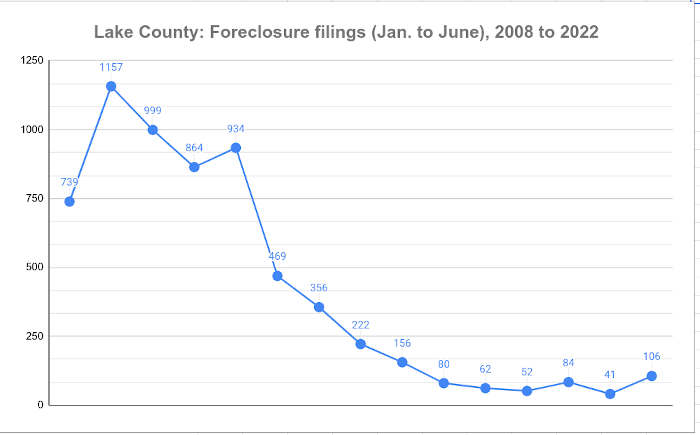
LAKE COUNTY, Calif. — A new report shows that foreclosure filings nationwide for the first half of this year are up significantly compared to last year, which is true in Lake County as well.
ATTOM, a leading curator of real estate data nationwide for land and property data, released its Midyear 2022 U.S. Foreclosure Market Report, which shows there were a total of 164,581 U.S. properties with foreclosure filings — default notices, scheduled auctions or bank repossessions — in the first six months of 2022.
That figure is up 153% from the same time period a year ago but down just one% from the same time period two years ago.
In Lake County, there were 106 foreclosure filings in the first half of this year, compared to 41 in the same period last year, a 158% increase.
In Lake’s neighboring counties, the trend is holding true. Glenn has 11, a 450% increase; Mendocino, 66, 135% increase; Napa, 57, 119%; Sonoma, 220, 92%; and Yolo, 72, 300%. Colusa County reported having no such filings in 2022, and only two in 2021.
“Foreclosure activity across the United States continued its slow, steady climb back to pre-pandemic levels in the first half of 2022,” said Rick Sharga, executive vice president of market intelligence at ATTOM. “While overall foreclosure activity is still running significantly below historic averages, the dramatic increase in foreclosure starts suggests that we may be back to normal levels by sometime in early 2023.”
Bucking the national trend with decreasing foreclosure activity compared to a year ago in the nation’s most populated metros during the first half of 2022, where only seven of the 223 metro areas analyzed.
Those metros included Lake Havasu, Arizona (down 47%); Eugene, Oregon (down 27%); Springfield, Illinois (down 19%); Shreveport, Louisiana (down 9%); and Brownsville, Texas (down 8%).
Nationwide 0.12% of all housing units (one in every 854) had a foreclosure filing in the first half of 2022.
States with the highest foreclosure rates in the first half of 2022 were Illinois (0.26% of housing units with a foreclosure filing); New Jersey (0.24%); Ohio (0.21%); Delaware (0.20%); and South Carolina (0.19%).
Other states with first-half foreclosure rates among the 10 highest nationwide were Florida (0.18%); Nevada (0.18%); Indiana (0.16%); Georgia (0.13%); and Michigan (0.13%t).
Among 223 metropolitan statistical areas with a population of at least 200,000, those with the highest foreclosure rates in the first half of 2022 were Cleveland, Ohio (0.40% of housing units with foreclosure filings); Atlantic City, New Jersey (0.33%); Jacksonville, North Carolina (0.31%); Chicago, Illinois (0.30%); and Columbia, South Carolina (0.30%).
Other metro areas with foreclosure rates ranking among the top 10 highest in the first half of 2022 were Rockford, Illinois (0.30% of housing units with a foreclosure filing); Lakeland, Florida (0.27%); Akron, Ohio (0.24%); Fayetteville, North Carolina (0.24%); and Trenton, New Jersey (0.23%).
Foreclosure starts up 219% from last year
A total of 117,383 U.S. properties started the foreclosure process in the first six months of 2022, up 219% from the first half of last year and up 19% from the first half of 2020.
States that saw the greatest number of foreclosures starts in the first half of 2022 included, California (12,805 foreclosure starts); Florida (11,448 foreclosure starts); Tennessee (10,970 foreclosure starts); Illinois (8,411 foreclosure starts); and Ohio (6,987 foreclosure starts).
“It’s important to note that many of the foreclosure starts we’re seeing today – in fact, much of the overall foreclosure activity we’re seeing right now – is on loans that were either already in foreclosure or were more than 120 days delinquent prior to the pandemic,” Sharga added. “Many of these loans were protected by the government’s foreclosure moratorium, or they would have already been foreclosed on two years ago. There’s very little delinquency or default activity that’s truly new in the numbers we’re tracking.”
Bank repossessions climb in first half of 2022
Lenders foreclosed, or REOs, on a total of 20,750 U.S. properties in the first six months of 2022, up 30% from the last half of 2021 and up 113% from the first half of 2020.
States that posted the greatest number of REOs in the first half of 2022 included, Illinois (2,434 REOs); Michigan (2,259 REOs); Pennsylvania (1,290 REOs); California (1,043 REOs); and Florida (1,041 REOs).
There were a total of 90,139 U.S. properties with foreclosure filings in Q2 2022, up 15% from the previous quarter and up 165% from a year ago.
The national foreclosure activity total in Q2 2022 was 68% below the pre-recession average of 278,912 per quarter from Q1 2006 to Q3 2007, making Q2 2022 the 23rd consecutive quarter with foreclosure activity below the pre-recession average.
Second quarter foreclosure activity was below pre-recession averages in 177 out 223 (79%) metropolitan statistical areas with a population of at least 200,000 and sufficient historical foreclosure data, including New York, Los Angeles, Chicago, Dallas, Houston, Miami, Atlanta, San Francisco, Riverside-San Bernardino, Phoenix and Detroit.
Metro areas with second quarter foreclosure activity above pre-recession averages included Honolulu, Richmond, Virginia-Beach, Albany, and Montgomery.
Properties foreclosed in the second quarter of 2022 took an average of 948 days from the first public foreclosure notice to complete the foreclosure process, up from 917 days in the previous quarter and up from 922 days in the second quarter of 2021.
The U.S. economy added more jobs than expected in June, signaling the labor market remains strong even as the Federal Reserve tries to weaken it to tame inflation. The July 8, 2022, jobs report also showed the unemployment rate remained at a 70-year low of 3.6%.
Does this mean the U.S. will avoid a Fed-induced recession?
We asked Christopher Decker, an economist at the University of Nebraska Omaha, to explain the numbers and what they mean for the Fed and the economy.
What did we learn in the June jobs report?
The report showed that the economy added 372,000 jobs in June. While this figure is down from a revised increase of 384,000 in May and is much lower than other recent gains, it’s still very good by historical standards.
Gains were across the board with all key sectors adding to the total increase in nonfarm payrolls.
Generally speaking, people continue to be pulled back into the labor force, largely by higher wages as well as the rising cost of living, which makes it harder for families to go without a steady income stream. For example, the number of people employed part time for economic reasons declined by 707,000 in June. This seems to suggest that there is increased desire for, and an ability to secure, a higher-paying, more stable full-time job.
The female labor force participation rate declined slightly to 56.8% – which is over a percentage point below what it was before the COVID-19 pandemic. This figure is worth watching closely and may be because women are hesitant to reenter the workforce or are struggling to find child care.
So does this mean there won’t be a recession?
That’s the big question.
June gains were strong, but the job market is clearly cooling off. And there’s evidence the broader economy is weakening – two signs the Fed’s recent aggressive efforts to reduce inflation by choking off growth are working.
The housing market is a case in point. Average 30-year mortgage rates shot up to a 13-year high of 5.8% in June after the Fed lifted rates by 0.75 percentage point, which has had a chilling effect on home purchases.
And now we’re seeing the effect in residential construction jobs, which declined for the first time in a year as higher borrowing costs dampened demand. This is a sector I like to look at closely to help determine if what the Fed is doing is taking root in the economy.
In addition, in May, retail sales unexpectedly declined and a forward-looking economic index fell for a second straight month – both signals of a slowing economy.
Can a recession be avoided?
It may seem strange that the U.S. central bank is trying to actually hurt economic growth, but that just shows how important policymakers think it is to fight soaring inflation, which is currently the highest in over 40 years.
The problem of rising prices is of major concern to the Fed, as it is a key component of its “dual mandate” to control inflation and maintain healthy job growth.
Runaway inflation is cancerous to any economy. When price growth outpaces that of income, consumers have to curb spending. Production declines and people lose their jobs. The Fed’s only means of reducing inflation is to curb demand by reducing the supply of money and increasing interest rates. This, however, also curbs economic growth. So the Fed is trying to manage a “soft landing” – which means reducing inflation without hurting growth so much that it causes a recession.
There are some early signs the Fed is succeeding. The economy is slowing, though June jobs show underlying strength in the labor market. At the same time, inflation appears to be easing as well, in part thanks to falling global demand for oil. U.S. gasoline prices – the most visible price consumers see every single day – has come down in recent weeks after peaking at a record US$5 in June.
But executing a soft landing is a delicate dance for the Fed. The central bank can reduce demand for things via interest rates, but it can’t do much about supply. The primary reason energy and food costs have been skyrocketing in recent months is not high demand but the war in Ukraine.
Sanctions on Russia, the world’s second-largest crude oil exporter, and reduced shipments from Russia to parts of Europe have disrupted energy markets and driven up global oil prices.
And Ukraine, a key producer of food and other agricultural goods, is struggling to export corn, wheat and other products because Russia is blockading key ports.
Continuing shortages of energy and food mean inflation could stay elevated no matter what the Fed does. And that could result in the Fed’s having to lift interest rates a lot and cut growth to the bone to have a meaningful effect on rising prices.
This makes the Fed’s current dance the most delicate it has attempted since the 1980s, and it must be executed flawlessly for it to succeed. The June jobs report is good news, but the economy isn’t out of the woods yet. Data in August and September will be crucial to knowing in which direction the economy is heading – toward recession or not.
Christopher Decker, Professor of Economics, University of Nebraska Omaha
This article is republished from The Conversation under a Creative Commons license. Read the original article.
Scott, now halfway through her second term, was first elected in 2016.
She announced April 14 that she was stepping down, effective July 31, to become the new career technical education food service and hospitality teacher at Clear Lake High School, beginning in the fall.
Scott is the first supervisor in four decades to step down before completing a term.
Since her resignation announcement, county officials had said on several occasions that the board would take up the matter and plan for how to fill the seat. It was on the agenda for the May 17 meeting but was pulled.
The matter didn’t finally make it to a board discussion phase until Tuesday.
And even when it did, little resulted.
However, the Governor’s Office already has confirmed to Lake County News in an email that “the Governor will have an opportunity to make an appointment to fill this vacancy. Following the resignation, the opening will be listed on the Governor’s Office appointments website. Interested parties are encouraged to complete the appointment application form at gov.ca.gov/appointments.”
County Counsel Anita Grant, Registrar of Voters Maria Valadez and the County Administrative Office researched state law and looked at how other counties have handled filling supervisorial seats.
Grant produced a five-page memo that went over the options, and on Tuesday she told the supervisors she believed they had two choices. “Neither one is perfect.”
One is to do a special election which would be consolidated with the general election that’s already scheduled on Nov. 8. It would be considered a special election because the time frames for candidates will be abbreviated.
She said the office is not considered vacant until the end of this month.
Grant said the other option was to wait for the Governor’s Office to make the appointment to fill the seat. That’s a process that has worked more quickly for some jurisdictions than for others.
She said the county was not able to discern a completely common and standard approach to filling supervisorial vacancies, and election law has gaping holes.
There was still a third option: Grant said the board could accept Scott’s resignation on Tuesday, but it would not be vacant until July 31. The county could then begin the process of filling the seat, and Scott would not be able to withdraw her resignation.
“Ultimately this would be your board’s decision to make,” Grant said.
A proposed resolution setting a special election that staff presented to the board called for opening the period for candidate nomination papers on July 18 and continuing to Aug. 12. It also noted that while supervisorial boundaries have been updated, the boundaries would be the same as they were when Scott was elected to her last term in 2020.
“I don’t feel comfortable today,” said Supervisor Bruno Sabatier.
Sabatier said Scott could still change her mind, and he raised the issue that by taking action it was akin to replacing by force or firing a colleague.
During his comments, Sabatier said they had already experienced a public official giving a resignation letter and then withdrawing it. That was a reference to Treasurer-Tax Collector Barbara Ringen, who Sabatier and the board had pressured to resign before she pushed back and changed her mind.
He said the majority of other counties wait until after the vacancy occurs to move forward with filling a seat.
“We’ve already asked the governor to appoint somebody,” said Sabatier, noting he wasn’t happy about it as it hadn’t come before the board.
Sabatier was referring to a letter sent to the Governor’s Office on April 21 by then-County Administrative Office Carol Huchingson before the board had any formal public discussion on the matter.
The letter, which Lake County News obtained through a Public Records Act request, can be seen below.
In it, Huchingson — whose abruptly announced retirement went into effect eight days after the letter was written — said that pursuant to Government Code, “Lake County requests your timely action to fill this vacancy by appointment.”
The letter said county staffers also were “taking steps to prepare for voters to elect a replacement at the next General Election; Tuesday, November 8, 2022.”
Grant explained to the board Tuesday that the special election was the only solution staff determined to be viable in dealing with the tight timelines.
Sabatier responded that, whether or not it goes to election or appointment, it was up to Scott. “That is not up to us.”
Scott said she appreciated Sabatier’s statement.
“This seat is not vacant. I’m still here,” she said, adding that the discussion needed to happen when she’s gone.
Supervisor Jessica Pyska said that to not have the primary process and whittling it down to two candidates was setting them up for someone winning without a majority. “I find that fundamentally unfair,” she said, adding she felt the same way about the old boundaries applying.
Valadez said that if the matter came back to the board on Aug. 1, it didn’t give her enough time to prepare and readjust the voting boundaries according to the previous supervisorial district outline, as the candidate filing period ends Aug. 12.
Board Chair EJ Crandell asked how much time Valadez needed if the board met in August.
Valadez said it would be very difficult and she didn’t know how much time it would take to make the adjustments.
Several letters were submitted by community members saying that the position wasn’t open until after Scott left.
Letters from Clearlake Mayor Dirk Slooten and Lakeport City Council member Michael Green emphasized the governor’s power to appoint. Green specifically opposed the resolution calling for a special election and instead asked the board to come back on Aug. 2 and consider a resolution asking Gov. Gavin Newsom to fill the vacancy.
One of the letter writers, Gillian Parrillo, also spoke briefly to the board. Parrillo, who was Scott’s original campaign manager as well as the manager for Pyska’s campaign, said the board could take no action until Scott leaves on July 31.
Grant said the supervisors could come back in August and make an official request of the governor as a board.
As a result, the board chose to take no action until after Scott leaves office at the end of this month.
Email Elizabeth Larson at
Letter to Governor Newsom Re Need to Fill District 4 BOS Vacancy Effecti... (1) by LakeCoNews on Scribd
Middletown Unified Superintendent Thad Owens administered the oath of office to Charise Reynolds at the start of the two-hour meeting, held at the Middletown Library Community Room.
“For the first time in months, we have a full board,” said Board President Larry Allen.
In a hotly contested race, Reynolds won the seat over Bryan Pullman in the June primary.
The primary results were finalized on July 7, and showed that Reynolds had received 55.21% of the vote compared to Pullman’s 44.79%.
The election for the Middletown Unified School Board seat actually was a special one that was consolidated with the general primary.
It was necessitated when a petition challenged the board's Dec. 1 appointment of Annette Lee to fill a seat vacated months earlier by LaTrease Walker.
Lee’s efforts to add more inclusive language to a resolution the board was considering that opposed the state’s proposed COVID-19 vaccine mandates had made her a target.
Walker and Austin Pullman, Bryan Pullman’s son, were among the signatories on the petition that challenged Lee’s appointment and resulted in her being removed from the board in January.
Allison Berlogar, who was appointed at the same time as Lee to fill a seat vacated by Owens — before he was named superintendent — was not challenged.
Nor was Chris Ochs’ appointment in March to succeed Misha Grothe, who resigned immediately after Owens’ appointment as superintendent in early March.
Reynolds and her fellow board members — Allen, Berlogar, Ochs and Zoi Bracisco — spent the morning in a workshop on public input procedures on agendized items. Other board training was rescheduled due to the district’s legal counsel being unable to attend.
Reynolds’ newly won seat is for a partial term and will be back on the ballot in the fall.
Email Elizabeth Larson at