 How to resolve AdBlock issue?
News

The James Webb Space Telescope team has released the first science-quality images from the new telescope. In them are the oldest galaxies ever seen by human eyes, evidence of water on a planet 1,000 light-years away and incredible details showing the birth and death of stars. Webb’s purpose is to explore origins – of the universe, of galaxies, of stars and of life – and the five images released on July 12, 2022, make good on that promise.
Once the suite of instruments onboard all cooled down and were running smoothly, astronomers wasted no time in putting Webb to work. Each of the first images contains enough data to produce major scientific results on their own.
Webb was designed to collect light across the entire red to mid-infrared spectrum – wavelengths of light that are blocked by Earth’s atmosphere. And with its giant mirror and sun-shade blocking infrared emitted by the Sun, Earth and Moon, Webb can produce images of a sharpness never before achieved by any other telescope.
The buzz among professional astronomers like me has been electric since members of the Webb team shared tantalizing test images. And the real images are even better than anyone could have hoped for. During the presentation where the first images were released, Webb project scientist Jane Rigby remarked “for Webb there is no blank sky, everywhere it looks it sees distant galaxies.” Most of those galaxies were invisible until now.

Ancient galaxies and the early universe
The first Webb image the world saw is of a galaxy cluster known to astronomers as SMACS 0723. It lies in the southern hemisphere sky and is 5.12 billion light-years from Earth.
The detail of the thousands of individual galaxies in the image is stunning. It is like the universe in high definition, and I encourage you to look at the full resolution image and zoom in to truly appreciate the details.

The large white galaxies in the middle of the image belong to the cluster and are similar in age to the Sun and Earth. Surrounding and interspersed among the cluster galaxies are more distant galaxies, but stretched into spectacular arcs as if seen through a magnifying glass. And that is exactly what is happening. The background galaxies are much farther from Earth but appear magnified, as their light is bent toward Earth by the gravity of the much closer cluster.
In the background you can see faint red galaxies scattered like rubies across the sky. Those galaxies are even farther away. By measuring precise attributes of their light, astronomers can tell that they formed over 13 billion years ago and even determine the abundance of different elements in these early galaxies.
Webb is not only producing incredibly sharp images, but it is doing so easily when compared to its predecessor, the Hubble Space Telescope, which was launched in 1990. As Rigby quipped, “… the Hubble Extremely Deep Field took two weeks of exposure, Webb went deeper before breakfast.” Once Webb carries out longer observations that allow it to collect more light from faint stars or galaxies, astronomers will be able to see some of the first stars and galaxies that formed right after the Big Bang.
Understanding planets around other stars
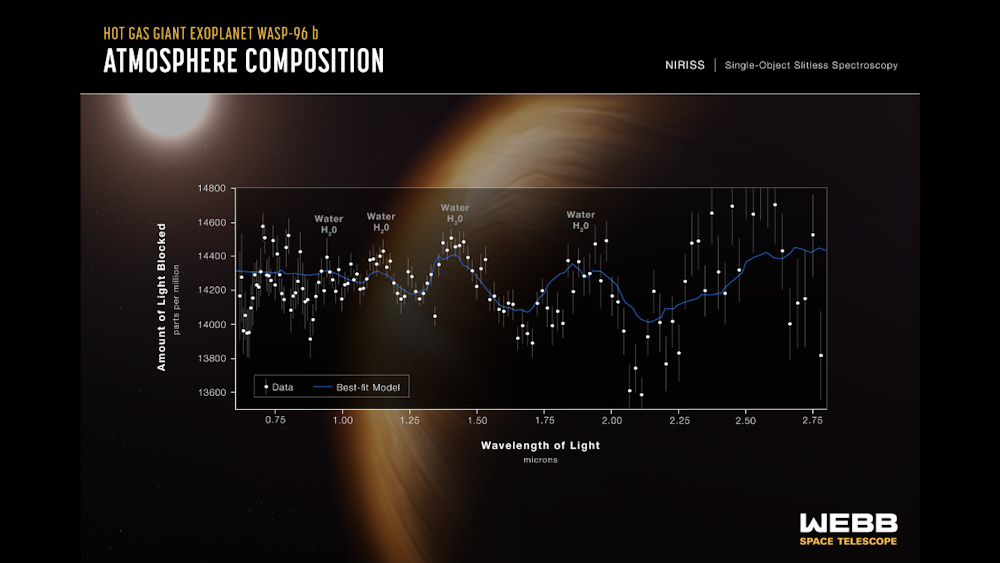
The second reveal was not of an image but a spectrum – a breakdown of the strength of light at different wavelengths.
Webb pointed its mirror at the exoplanet WASP 96-B – a giant hot gas planet orbiting a star about 1,000 light-years from Earth – as the planet passed in front of its parent star. During this transit, a portion of the star’s light was filtered through the planet’s atmosphere and left a “chemical fingerprint” in the light’s unique spectrum. The specifics of this fingerprint strongly suggest that there is water vapor, clouds and haze in the atmosphere of WASP 96-B.
As Webb moves on to observe smaller planets that could potentially harbor life, astronomers expect to detect the fingerprints of oxygen, nitrogen, ammonia and carbon in the form of methane and other hydrocarbons. The goal is to find biosignatures of life – that is, chemistry that would point toward the atmosphere being modified by living organisms.
The technical challenge of doing this type of observation, called transit spectroscopy, is enormous, and this initial result barely scratches the surface of the scientific content of the spectrum.

Galactic dances and the lives of stars
The last three images showed the incredible resolution of Webb’s optics as the telescope explored the birth and death of stars.
Webb’s ability to capture light in the mid-infrared range allows its cameras to cut through dense clouds of dust and gas. This ability helped Webb to capture spectacular details of the Carina Nebula where stars are born.

Webb is also excellently suited to study the end of a star’s life. As stars get old, they can puff off their outer layers and form nebulas like the stunning Southern Ring Nebula, which was imaged by Webb. The image revealed never-before-seen details of successive waves of matter expelled by the dying central star. While Hubble was unable to see through the expanding cloud of dust and debris, Webb provided the first look at the binary star system that formed the nebula.
The last photo from Webb’s coming out party showed Stephan’s Quintet, a group of five galaxies 300 million light-years from Earth, interacting in a cosmic dance. Thanks to the suite of complementary instruments aboard Webb, the telescope can simultaneously pick up details of individual stars in these galaxies, see the cold dust and gas fueling star formation within these galaxies and – most remarkably – block out the stars, gas and dust to see the material swirling around the supermassive black hole at the center of one of the galaxies.
Webb also captured data on the spectra of hundreds of individual star-forming regions in the Quintet, which will take months to analyze and study.
Webb is the result of 25 years of work by thousands of scientists, engineers and administrators belonging to an international collaboration of space agencies, companies, research centers and universities worldwide. John Mather, a project leader for Webb, emotionally described the journey: “This was hard to do. It is difficult to express just how hard this was. There were so many thousands of ways it could have gone wrong.”
But it didn’t go wrong. It all came together, and now humanity’s greatest space telescope is open for business.
This story was updated to correct the description of the photo of the Southern Ring Nebula.
Silas Laycock, Professor of Astronomy, UMass Lowell
This article is republished from The Conversation under a Creative Commons license. Read the original article.
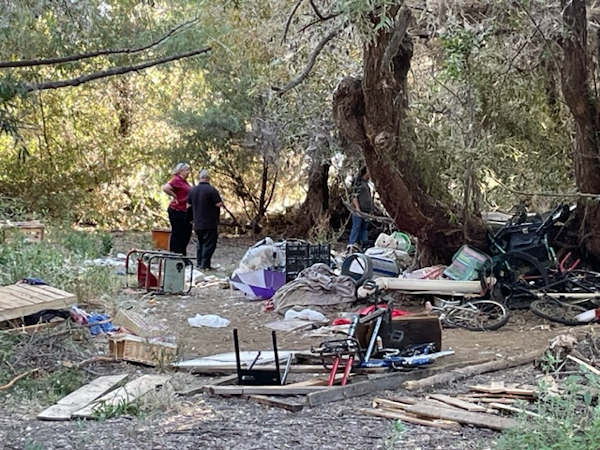
LAKEPORT, Calif. — Lakeport Police officers and Lakeport Public Works staff on Wednesday removed a significant homeless encampment from public property.
The camp was located along the shoreline of Clear Lake, off the east side of the private properties of 1 First St. and 2 C St., said Police Chief Brad Rasmussen.
The persons using the encampment were trespassing across the private properties to gain access.
For approximately the past two years this location has been a regular site of camps and a source of concern for surrounding residential and commercial property owners for numerous reasons including safety, sanitary conditions and fire danger, Rasmussen said.
He said that in recent months several wildland fires have started in the area and caused threats for surrounding neighborhoods.
Officers surveyed the property and contacted the occupants numerous times over the past few months in efforts to mitigate the situation.
Police officers and their embedded crisis responder from Lake Family Resource Center worked with occupants to offer resources from the many agencies working on homelessness in Lake County.
On July 6, by Rasmussen’s direction, the property was ordered vacated, with written notices posted as well as personally served on occupants giving them sufficient time to remove their belongings.
On both July 6 and July 13, officers took crisis and outreach staff from Lake County Behavioral Health with them to offer additional resources for any persons remaining in the encampment. The written notices and removal times are required by federal court case law decisions.
Upon arrival at 7 a.m. Wednesday, three occupants were located in the camp. Rasmussen said the occupants were again offered and one did accept resources and transportation to a local homeless shelter. The person’s valuables which could not be transported to the shelter were secured and safeguarded.
The other two individuals declined resources and were ordered to vacate immediately or face arrest. They left the area without further incident, Rasmussen said.
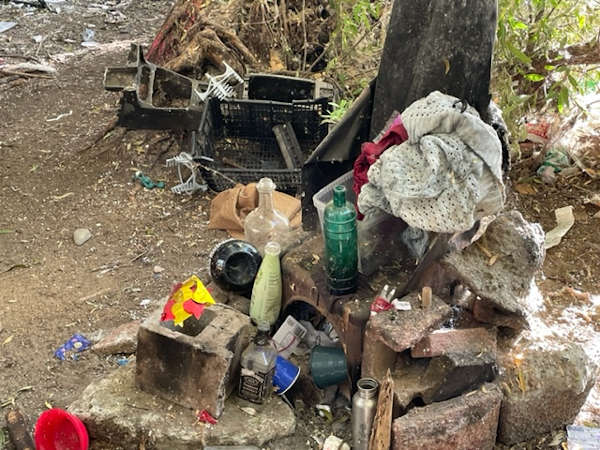
A crew of 10 public works and police staff with necessary equipment proceeded to clean the camp and rehabilitate the area over the next nine hours. Rasmussen said this work included hauling off 75 yards of garbage totaling 22,360 pounds.
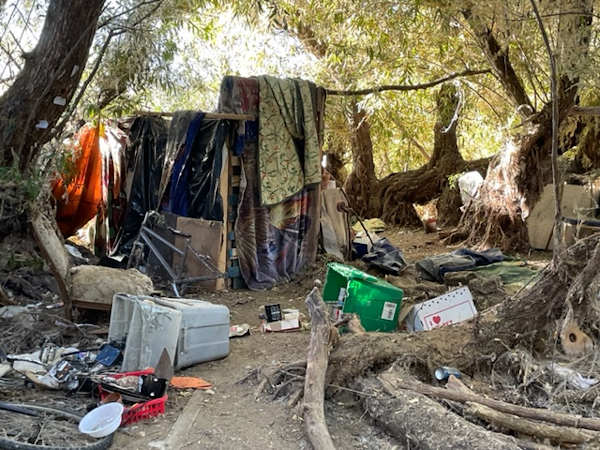
Rasmussen said that had this trash not been removed, when the Clear Lake water levels returned to full or higher, it would have entered the lake.
On Thursday, another 10-person crew rehabilitated the area to ensure it is safe and clean and to reduce fire danger.
In the future, Rasmussen said officers will conduct extra patrol of the area to ensure the encampment does not reestablish.
The cleanup process alone, not including all of the previous outreach, is estimated to have cost the public $15,000, he said.
Rasmussen said the removal of homeless camps from public property is complex. “When we take this action we want to be sure that the problem will not just move down the street to the next neighborhood or business district. For this reason we are very persistent with offering resources and assistance with connecting people to programs including those for housing, medical care, behavioral health and drug and alcohol addiction.”
He added, “The most significant reasons we see people being in a homeless situation are behavioral health and substance abuse problems. Many of the people causing issues for neighborhoods and businesses are people who refuse our assistance because they do not want to recognize or change their conditions.”
Additionally, Rasmussen said many of the tools his agency had used previously to deal with misdemeanor criminal behavior have been removed by voter or legislative initiatives.
“Much of this type of criminal behavior affects the lives of the residents and business owners and generally makes people feel unsafe or hesitant to use their public spaces or even being able to run their business,” he said.
“It is sometimes difficult for us to address this bad behavior but we want the community to know we continue to work hard every day to keep Lakeport safe,” Rasmussen said. “Please continue to contact us with your concerns.”
Mary Darby, who has been Community Development director since October, has tendered her resignation following a Tuesday closed session evaluation with the Board of Supervisors.
Deputy County Administrative Officer Matthew Rothstein confirmed to Lake County News that Board Chair EJ Crandell accepted Darby’s resignation on behalf of the board.
Darby’s last day with the county will be Nov. 4, Rothstein said.
“Staff are working to prepare for Board discussion of a recruitment strategy to fill this important County position,” Rothstein said in an email.
He said that discussion is expected to take place during the board’s meeting on Tuesday, July 19.
Lake County News emailed Darby to ask for comment but she did not respond.
The Board of Supervisors hired Darby on Aug. 31, with her appointment effective on Oct. 4. In a Sept. 9 special meeting, the board appointed Darby in an extra-help capacity ahead of her official appointment date.
Officials at the time hailed her skill sets and experience as key to helping the county take the next steps to improve the department, which plays a key role in the county’s development and economy.
Darby, a University of California, San Diego graduate who also holds a Master of Arts degree in city planning from the Georgia Institute of Technology, has spent most of her career in Georgia. She said at the time of her hire that she had been hoping to return to California.
She said she looked forward to providing Lake County with professionalism, loyalty and a high standard of customer service, and pledged that her team would operate with one main goal — “Successful results!”
Since her hire, the board had five scheduled closed session performance evaluations with Darby. Such evaluations usually happen once or twice a year at most.
Darby’s departure emphasizes the county’s ongoing challenge in filling the Community Development director’s job.
She is the sixth person to head the department since the start of 2016.
Darby’s resignation follows by less than a month that of Dr. Erik McLaughlin, the Public Health officer.
McLaughlin, who was on the job for less than four months and was working remotely from his home in Las Vegas, also gave the board his resignation following a June 21 closed-session performance review, the fifth of his tenure.
Email Elizabeth Larson at
LAKE COUNTY, Calif. — A big slate of seats on local school and special district boards will be up for election this fall.
The Lake County Registrar of Voters office said the numerous school and special district elections have been consolidated with the Nov. 8 general election.
The first day a candidate may file for office is Monday, July 18; the last day is Friday, Aug. 12, at 5 p.m.
Official declaration of candidacy forms for eligible candidates desiring to file may be obtained from the Lake County Registrar of Voters office in person at 325 N. Forbes St., Lakeport, during regular office hours of 8 a.m. to 5 p.m. Monday through Friday. The office is closed on county holidays and weekends.
For additional information call 707-263-2372 or toll-free at 888-235-6730.
The Elections Office said eligible voters have the opportunity to file for candidacy for the following offices.
Mendocino-Lake Community College District
Trustee Area No 6: One vacancy, four year term
Yuba Community College District
Trustee Area No 7: One vacancy, two year unexpired term
Lake County Board of Education
Trustee Area No 3: One vacancy, four year term
Trustee Area No 4: One vacancy, four year term
Trustee Area No 5: One vacancy, four year term
Kelseyville Unified School District
Two vacancies: Four year terms
Konocti Unified School District
Three vacancies: Four year terms
Lakeport Unified School District
Two vacancies: Four year terms
One vacancy: Two year unexpired term
Lucerne Elementary School District
Two vacancies: Four year terms
Middletown Unified School District
Three vacancies: Four year terms
One vacancy: Two year unexpired term
Upper Lake Unified School District
Three vacancies: Four year terms
Kelseyville Fire Protection District
Three vacancies: Four year terms
Lake County Fire Protection District
Four vacancies: Four year terms
One vacancy: Two year unexpired term
Lake Pillsbury Fire Protection District
Three vacancies: Four year terms
One vacancy: Two year unexpired term
Northshore Fire Protection District
At-large, one vacancy: Four year term
Lucerne zone, one vacancy: Four year term
Nice zone, one vacancy: Four year term
South Lake County Fire Protection District
Two vacancies: Four year terms
Anderson Springs Community Services District
Three vacancies: Four year terms
One vacancy: Two year unexpired term
Butler-Keys Community Services District
Two vacancies: Four year terms
Hidden Valley Lake Community Services District
Two vacancies: Four year terms
Redbud Health Care District
Zone 2, one vacancy: Four year term
Zone 4, one vacancy: Four year term
Buckingham Park Water District
Three vacancies – 4 year terms
Callayomi County Water District
Three vacancies: Four year terms
One vacancy: Two year unexpired term
Clearlake Oaks County Water District
Two vacancies: Four year terms
Cobb Area County Water District
Three vacancies: Four year terms
Konocti County Water District
Three vacancies: Four year terms
Upper Lake County Water District
Two vacancies: Four year terms
One vacancy: Two year unexpired term
Villa Blue Estates Water District
Three vacancies: Four year terms
Three vacancies: Two year terms
The City of Clearlake Animal Association also is seeking fosters for the animals waiting to be adopted.
Call the Clearlake Animal Control shelter at 707-273-9440, or email
Visit Clearlake Animal Control on Facebook or on the city’s website.
The following dogs are available for adoption. The newest additions are at the top.
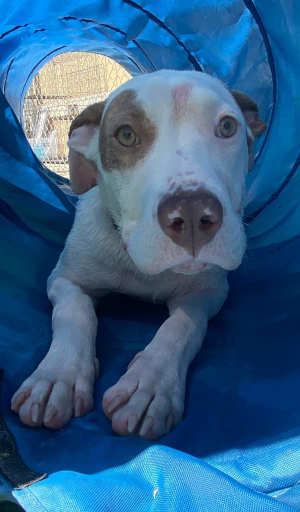
‘Betsy’
“Betsy” is a female American pit bull mix with a short white coat.
She has been spayed.
She is dog No. 50236145.
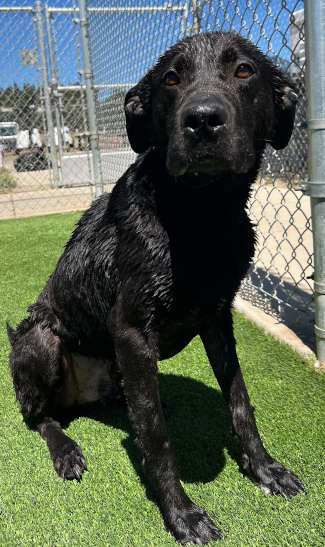
‘Bluey’
“Bluey” is a male retriever mix with a short black coat.
He has been neutered.
He is dog No. 50552999.

‘Hakuna’
“Hakuna” is a male shepherd mix with a tan coat.
He has been neutered.
He is dog No. 50176912.

‘Precious’
“Precious” is a female terrier mix with a short tan and black coat.
She has been spayed.
She is dog No. 50467529.
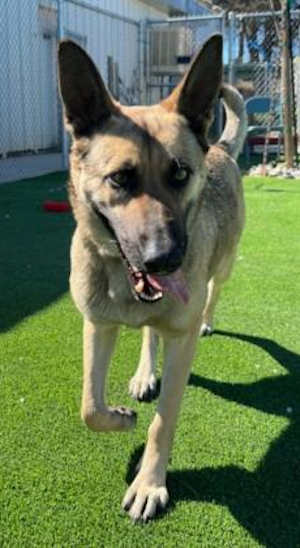
‘Sadie’
“Sadie” is a female German shepherd mix with a black and tan coat.
She has been spayed.
She is dog No. 49802563.
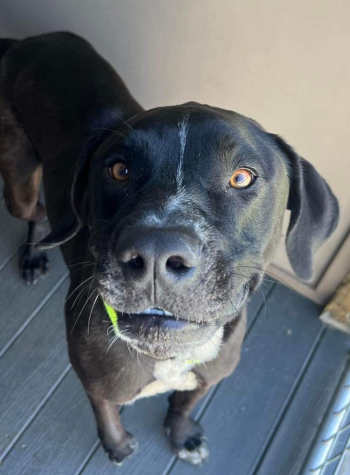
‘Taz’
“Taz” is a male Labrador retriever mix with a short black coat and white markings.
He has been neutered.
He is dog No. 50467817.

‘Andy’
“Andy” is a male American pit bull mix with a short gray and white coat.
He is dog No. 48995415.

‘Bear’
“Bear” is a male Labrador retriever-American pit bull mix with a short charcoal and fawn coat.
He has been neutered.
He is dog No. 48443153.
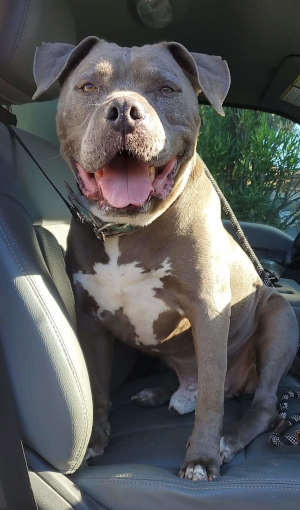
‘Big Phil’
“Big Phil” is a 13-year-old male American pit bull terrier mix with a blue coat.
He has been neutered.
He is dog No. 49951647.

‘Bro’
“Bro” is a male terrier mix with a short tan coat.
He has been neutered.
Bro is dog No. 50262527.

‘Colt’
“Colt” is a male Rhodesian Ridgeback mix with a short rust and black coat.
He has been neutered.
He is dog No. 49812106.

‘Hondo’
“Hondo” is a male Alaskan husky mix with a buff coat.
He has been neutered.
He’s dog No. 50227693.

‘Kubota’
“Kubota” is a male German shepherd mix with a short tan and black coat.
He has been neutered.
Kubota is dog No. 50184421.
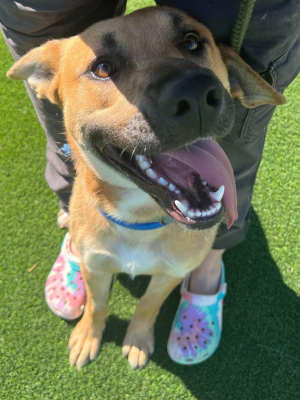
‘Matata’
“Matata” is male shepherd mix with a tan coat.
He has been neutered.
He is dog No. 50176912.

‘Newman’
“Newman” is a 1-year-old male American pit bull terrier mix with a black and white coat.
He has been neutered.
Newman is dog No. 49057809.
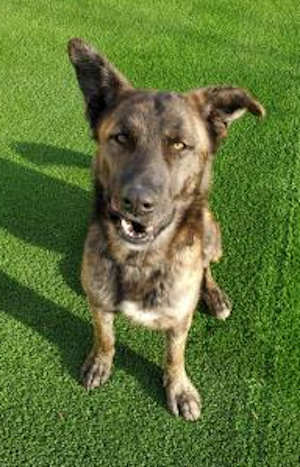
‘Terry’
“Terry” is a handsome male shepherd mix with a short brindle coat.
He gets along with other dogs, including small ones, and enjoys toys. He also likes water, playing fetch and keep away.
Staff said he is now getting some training to help him build confidence.
He is dog No. 48443693.

‘Ziggy’
“Ziggy” is a male American pit bull terrier mix with a short gray and white coat.
He has been neutered.
Ziggy is dog No. 50146247
Email Elizabeth Larson at
The birds were collected by the U.S. Fish and Wildlife Service on July 5 during a mortality event at the Sacramento National Wildlife Refuge Complex and submitted to the U.S. Geological Survey’s National Wildlife Health Center for preliminary testing.
On July 13, the U.S. Department of Agriculture’s (USDA) National Veterinary Services Laboratories confirmed the detection of avian influenza H5N1 in two Canada geese and one American white pelican and notified the California Department of Fish and Wildlife’s Wildlife Health Laboratory.
These are the first detections of avian influenza H5N1 in wild birds in California. Although avian influenza viruses naturally circulate among waterbirds, the strain of H5N1 currently in circulation in the U.S. and Canada has been causing illness and death in a higher diversity of wild bird species than during previous avian influenza outbreaks. The virus also remains highly contagious for domestic poultry.
Currently, there are no confirmed cases of avian influenza in domestic poultry in California.
According to data compiled by the USDA, avian influenza H5N1 has been detected in at least 1,825 individual wild birds in 42 states and the District of Columbia since January 2022. Additionally, infection has been confirmed in 386 commercial and backyard domestic poultry and mixed-species flocks in 37 states. Prior to its detection in North America, avian influenza H5N1 activity had been on the rise across Europe since October 2021.
Avian predators and scavengers may be exposed to avian influenza viruses when feeding on infected waterbirds. Infection with avian influenza viruses among songbirds, including many common backyard birds, appears to be rare.
However, feeding and providing water to wild birds is discouraged, especially in the vicinity of backyard poultry or other captive birds such as ducks, geese, pigeons, doves and parrots. Increased concentration of wild birds at feeders and bird baths may lead to fecal contamination of the local environment, which may aid in disease transmission.
Wild birds should be excluded from entering enclosures for domestic and pet birds, and food and water should not be shared between wild birds and domestic or pet birds.
CDFW’s Wildlife Health Laboratory, in coordination with partners, is continuing to monitor wild bird populations for signs of illness and investigating mortality events. The public may report dead wild birds using CDFW’s mortality reporting form. For guidance on orphaned or injured live wild birds, please contact your nearest wildlife rehabilitation center. Be advised that some wildlife rehabilitation centers may have restrictions on the wildlife species they will admit.
An informational flyer addressing frequently asked questions is available on CDFW’s website.
Currently, the Centers for Disease Control considers the transmission risk of avian influenza to people to be low, but recommends taking basic protective measures (i.e., wearing gloves and face masks and handwashing) if contact with wild birds or domestic poultry cannot be avoided.
Practicing biosecurity is the most effective way to keep domestic poultry and pet birds healthy. Please visit the California Department of Food and Agriculture, or CDFA, and USDA websites for biosecurity information. Sick and dead poultry may be reported to the CDFA hotline at 1 866-922-2473.