 How to resolve AdBlock issue?
News
Scientists from NASA’s OSIRIS-REx mission recently learned that surface regeneration happens a lot quicker on asteroids than on Earth.
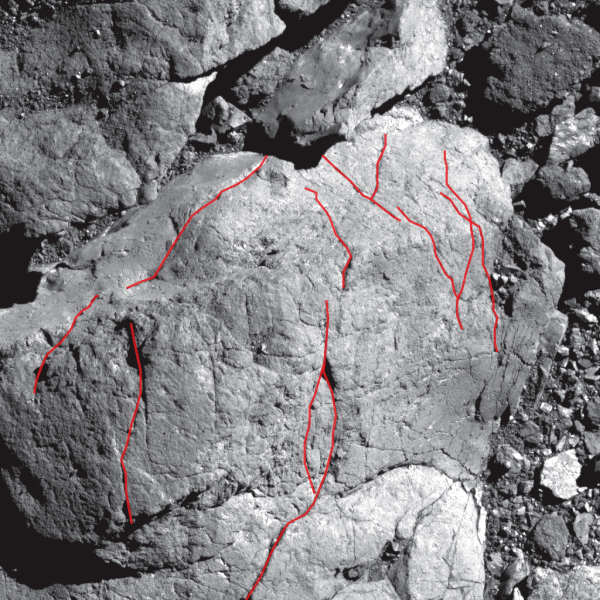
By analyzing rock fractures on asteroid Bennu from high-resolution images taken by the OSIRIS-REx spacecraft, the team discovered that the Sun’s heat fractures rocks on Bennu in just 10,000 to 100,000 years.
This information will help scientists estimate how long it takes boulders on asteroids like Bennu to break down into smaller particles, which may either eject into space or stay on the asteroid’s surface.
Tens of thousands of years might sound pretty slow, but “we thought surface regeneration on asteroids took a few millions of years,” said Marco Delbo, senior scientist at Université Côte d'Azur, CNRS, Observatoire de la Côte d'Azur, Laboratoire Lagrange, Nice, France, and lead author of a paper published June 2022 in Nature Geoscience. “We were surprised to learn that the aging and weathering process on asteroids happens so quickly, geologically speaking.”
Although landslides, volcanoes, and earthquakes can change the surface suddenly on Earth, usually changes are gradual. Water, wind, and temperature changes slowly break down rock layers, creating new surfaces over millions of years.
For example, if you were to hike into the Grand Canyon, you would see distinct rock layers; the top layers tend to be the youngest rocks, dating around 270 million years old, and the layers at the bottom of the canyon are the oldest, about 1.8 billion years old.
According to the U.S. National Park Service, the Colorado River has been carving down rocks in the Grand Canyon for 5 million to 6 million years.
Rapid temperature changes on Bennu create internal stress that fractures and breaks down rocks, similar to how a cold glass breaks under hot water. The Sun rises every 4.3 hours on Bennu. At the equator, daytime highs can reach almost 260 F (about 127 C), and nighttime lows plummet to nearly minus 10 F (about minus 23 C).
OSIRIS-REx scientists spotted cracks in the rocks in spacecraft images from the first surveys of the asteroid. The fractures seemed to point in the same direction, “a distinct signature that temperature shocks between the day and the night could be the cause,” said Delbo.
Delbo and his colleagues measured the length and angles of more than 1,500 fractures in OSIRIS-REx images by hand: some shorter than a tennis racket, others longer than a tennis court. They found the fractures predominantly align in the northwest-southeast direction, indicating they were caused by the Sun, which is shown here to be the primary force changing Bennu’s landscape.
“If landslides or impacts were moving boulders faster than the boulders were cracking, the fractures would point in random directions,” said Delbo.
The scientists used a computer model and their fracture measurements to calculate the 10,000 to 100,000-year timeframe for thermal fractures to propagate and split rocks.
“The thermal fractures on Bennu are quite similar to what we find on Earth and on Mars in terms of how they form,” said Christophe Matonti, a co-author of the paper at Université Côte d’Azur, CNRS, Observatoire de la Côte d’Azur, Géoazur, Sophia-Antipolis, Valbonne, France. “It is fascinating to see that they can exist and are similar in very ‘exotic’ physical conditions [low gravity, no atmosphere], even compared to Mars.”
“Keep in mind, the topography of Bennu is young, but the rocks on the asteroids are still billions of years old and hold valuable information about the beginning of the solar system,” said Jason Dworkin, OSIRIS-REx project scientist at NASA’s Goddard Space Flight Center in Greenbelt, Maryland.
OSIRIS-REx (Origins, Spectral Interpretation, Resource Identification, Security-Regolith Explorer) will return a sample from Bennu to Earth on Sept. 24, 2023. “We will be able to learn more details about the age of the surface when we are able to directly study the sample,” said Dworkin.
Goddard provides overall mission management, systems engineering, and the safety and mission assurance for OSIRIS-REx. Dante Lauretta of the University of Arizona, Tucson, is the principal investigator. The university leads the science team and the mission's science observation planning and data processing. Lockheed Martin Space in Littleton, Colorado, built the spacecraft and provides flight operations.
Goddard and KinetX Aerospace are responsible for navigating the OSIRIS-REx spacecraft. OSIRIS-REx is the third mission in NASA's New Frontiers Program, managed by NASA's Marshall Space Flight Center in Huntsville, Alabama, for the agency's Science Mission Directorate Washington.
Rani C. Gran works for NASA's Goddard Space Flight Center in Greenbelt, Maryland.
Sutter Lakeside closed its birth center on Tuesday afternoon at 4 p.m. due to having no available obstetrician to deliver babies, as Lake County News has reported.
At that point, the hospital went on “diversion” and began directing expectant mothers to other hospitals around the region.
The hospital said it anticipates resolving the situation to be resolved by 7 a.m. Wednesday, July 27, and that it is “actively working with community resources to help patients access appropriate care and to facilitate transfers to other hospitals as necessary.”
The California Nurses Association — whose members are in ongoing negotiations with Sutter Health and conducted an informational picket earlier this year over issues including safety and staffing — weighed in on the situation, calling on Sutter “to immediately provide the community with a comprehensive plan to ensure safe, stable and consistent obstetric services.”
The union accused Sutter Health of putting profits over patients, noting, “Sutter management has relied on just two obstetric providers, throughout two years of pandemic instability, despite repeated warnings from Registered Nurses and providers.”
The closure of the Sutter Lakeside Birth Center left only one place to deliver in Lake County — Adventist Health Clear Lake.
“We are prepared and ready to accept birthing mothers who are being diverted,” Kim Lewis, spokesperson for Adventist Health Clear Lake, told Lake County News on Thursday.
Lewis said Sutter had reached out to Adventist regarding its action, “and we are working closely with them and have a plan in place.”
In addition to Adventist Health Clear Lake, Sutter Lakeside is reportedly directing patients to Kaiser Santa Rosa, Queen of the Valley in Napa and Santa Rosa Memorial Hospital.
On Thursday, Adventist Health Ukiah Valley contacted Lake County News to report that it also is welcoming birth center patients that are being diverted from Sutter Lakeside.
County officials reported on Thursday that they also are working with Sutter Lakeside to address the matter.
“County of Lake Health Services was made aware of this before its occurrence and has been supporting Sutter Lakeside where possible,” Dwight Coddington, spokesman for the Lake County Health Services Department, told Lake County News in a Thursday email.
Coddington said that if a patient does require an obstetrician they will be referred to Sutter in Santa Rosa, and that other providers — such as Adventist Hospital and the regional hospitals where patients are being referred — aren’t being impacted due to Sutter Lakeside’s obstetrics bypass.
The California Nurses Association told Lake County News that it is “deeply concerned for the patients and families of Lake County as well as adjacent Napa and Mendocino counties with the alarming news that Sutter Lakeside Hospital has failed to secure stable obstetric services resulting in temporary closure or ‘diversion’ of its perinatal services.”
Noting that the rural hospital provides vital health care services, including perinatal services to Lake, Napa and Mendocino County families, the union said, “This temporary closure or ‘diversion’ adds significant time and travel to a journey that can and often does cause significant risk to the well-being of the expectant mother and baby.”
Email Elizabeth Larson at
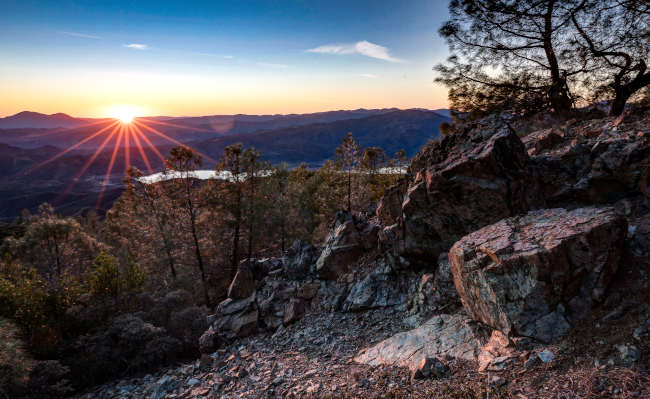
The effort to expand the Berryessa Snow Mountain National Monument continues to move ahead in Congress.
On Thursday, the U.S. Senate Committee on Energy & Natural Resources passed the Berryessa Snow Mountain National Monument Expansion Act (S. 4080) with unanimous and bipartisan support.
The bill, introduced by Sen. Alex Padilla (D-CA) with Sen. Dianne Feinstein as co-sponsor, is a companion to H.R. 6366, introduced by Congressman John Garamendi.
Advocates and the Yocha Dehe Wintun Nation are thrilled this legislation, which would permanently protect a unique Northern California landscape, has received bipartisan support in the Senate.
“Glad to see my bill to expand the existing Berryessa Snow National Monument and give Tribal governments a seat at the table to better manage and care for these sacred Tribal lands move forward today,” said Sen. Padilla. “The sacred lands within and around the Berryessa Snow Mountain National Monument are central to thousands of years of tribal origin stories. It is our duty to protect the abundant natural resources and the rich history on Molok Luyuk for today’s children and for future generations, and I look forward to working to ensure we see this bill to fruition.”
The legislation would add an adjacent 3,925 acres to the current Monument, support tribal co-management, and change the name of the additional wildlands from “Walker Ridge” to Molok Luyuk — Patwin for “Condor Ridge” — a name the Yocha Dehe Wintun Nation provided.
“Molok Luyuk is home to both profound natural beauty and deep cultural significance. It is a special place, so it's fitting that California’s tribes and the U.S. government create a special relationship to protect it,” said Yocha Dehe Wintun Nation Chairman Anthony Roberts. “We commend Senator Padilla and Senator Feinstein for their work on this bill.”
In 2015, President Obama designated Berryessa Snow Mountain National Monument with Congressman Mike Thompson (D-CA05) who introduced the original bill.
The monument, along with the proposed Molok Luyuk addition, is culturally significant to local Native American tribes and notable for its varied habitats and wildlife, including imperiled animals. The legislation would not impact privately owned, state, tribal, or non-federal land in any way.
“Molok Luyuk is a special landscape of fascinating geology, rich biodiversity, profound cultural significance, and beautiful views. This place is worthy of the permanent protection that Sen. Alex Padilla and Representative John Garamendi have proposed," said Sierra Club Redwood Chapter Chair Victoria Brandon.
Molok Luyuk includes public land adjacent to the existing monument that is administered by the Bureau of Land Management.
The ridge is home to great biodiversity including over 30 species of rare plants, ancient blue oak woodlands, rugged rock outcrops, wildflower meadows, and extensive stands of McNab cypress. The area also provides wildlife connectivity for many species including deer, mountain lions, and black bear.
“This markup is an important milestone following decades of advocacy,” California Native Plant Society Conservation Program Director Nick Jensen said. “The bipartisan support for this legislation is a marvelous sign that we are on a strong path toward permanently protecting a region that is biologically precious and of great significance to Native American communities. We thank Sen. Padilla for his exceptional leadership in expanding Berryessa Snow Mountain National Monument and honoring the area’s profound significance to our tribal partners.”
The Berryessa Snow Mountain National Monument Expansion Act would provide much-needed, lasting protection for the land along with the requirement for a Monument Management Plan within one year.
The legislation also calls for cooperative management with tribes or tribal partners in the development of the management plan and subsequent management decisions.The land is of tremendous present-day cultural and religious importance to the Yocha Dehe Wintun Nation, and includes sites central to their origin stories. The cooperative management provision would help safeguard this one-of-a-kind area in partnership with local Indigenous tribes.
"Molok Luyuk is a rare gem. It is filled with wildlife, rare plants, and indigenous treasures that local residents have long appreciated. We are excited to see this legislation progress through the Senate and thankful to the leadership of senators Padilla and Feinstein,” said Sandra Schubert, executive director of Tuleyome. “We are grateful they have supported the effort to protect Molok Luyuk from current and future threats while respecting Tribal stewardship over the lands.”
The bill would also increase recreational access to world-class nature and outdoor activities for locals and visitors. Popular recreation activities on these lands include hiking, sightseeing, mountain biking, camping, horseback riding, and off highway vehicle use on designated routes. Incorporating the area into the existing monument would improve land management, bring additional resources for trail construction and maintenance, help improve public access, and protect sensitive wildlife and prime habitat areas.
This will also help ensure equitable access to the outdoors in a county where 22% of residents identify as Hispanic or Latino.
“We admire Sen. Alex Padilla for being a reliable champion for public lands since taking office,” said Ryan Henson, Senior Policy Director for CalWild. “We are thrilled to see the bill to protect Molok Luyuk pass this milestone in Congress. This place is a public treasure and deserves permanent protection and improved management.”
The expanded monument also would mark an important step toward helping the state of California and the Biden Administration meet the critical goal of protecting 30 percent of U.S. lands and waters by the year 2030, added Elyane Stefanick, California Program Director for the Conservation Lands Foundation, in reference to California’s 30x30 Initiative and the federal America the Beautiful call-to-action.
The City of Clearlake Animal Association also is seeking fosters for the animals waiting to be adopted.
Call the Clearlake Animal Control shelter at 707-273-9440, or email
Visit Clearlake Animal Control on Facebook or on the city’s website.
The following dogs are available for adoption. The newest addition is at the top.

‘Tiramisu’
“Tiramisu” is a female Alaskan husky mix with a short brown and cream coat.
She is dog No. 49652833.

‘Andy’
“Andy” is a male American pit bull mix with a short gray and white coat.
He is dog No. 48995415.

‘Bear’
“Bear” is a male Labrador retriever-American pit bull mix with a short charcoal and fawn coat.
He has been neutered.
He is dog No. 48443153.

‘Betsy’
“Betsy” is a female American pit bull mix with a short white coat.
She has been spayed.
She is dog No. 50236145.

‘Big Phil’
“Big Phil” is a 13-year-old male American pit bull terrier mix with a blue coat.
He has been neutered.
He is dog No. 49951647.

‘Bluey’
“Bluey” is a male retriever mix with a short black coat.
He has been neutered.
He is dog No. 50552999.

‘Bro’
“Bro” is a male terrier mix with a short tan coat.
He has been neutered.
Bro is dog No. 50262527.

‘Colt’
“Colt” is a male Rhodesian Ridgeback mix with a short rust and black coat.
He has been neutered.
He is dog No. 49812106.

‘Hakuna’
“Hakuna” is a male shepherd mix with a tan coat.
He has been neutered.
He is dog No. 50176912.

‘Hondo’
“Hondo” is a male Alaskan husky mix with a buff coat.
He has been neutered.
He’s dog No. 50227693.

‘Kubota’
“Kubota” is a male German shepherd mix with a short tan and black coat.
He has been neutered.
Kubota is dog No. 50184421.

‘Matata’
“Matata” is male shepherd mix with a tan coat.
He has been neutered.
He is dog No. 50176912.

‘Newman’
“Newman” is a 1-year-old male American pit bull terrier mix with a black and white coat.
He has been neutered.
Newman is dog No. 49057809.

‘Precious’
“Precious” is a female terrier mix with a short tan and black coat.
She has been spayed.
She is dog No. 50467529.

‘Sadie’
“Sadie” is a female German shepherd mix with a black and tan coat.
She has been spayed.
She is dog No. 49802563.

‘Taz’
“Taz” is a male Labrador retriever mix with a short black coat and white markings.
He has been neutered.
He is dog No. 50467817.

‘Terry’
“Terry” is a handsome male shepherd mix with a short brindle coat.
He gets along with other dogs, including small ones, and enjoys toys. He also likes water, playing fetch and keep away.
Staff said he is now getting some training to help him build confidence.
He is dog No. 48443693.

‘Ziggy’
“Ziggy” is a male American pit bull terrier mix with a short gray and white coat.
He has been neutered.
Ziggy is dog No. 50146247
Email Elizabeth Larson at
When politicians talk about reaching “net zero” emissions, they’re often counting on trees or technology that can pull carbon dioxide out of the air. What they don’t mention is just how much these proposals or geoengineering would cost to allow the world to continue burning fossil fuels.
There are many proposals for removing carbon dioxide, but most make differences only at the edges, and carbon dioxide concentrations in the atmosphere have continued to increase relentlessly, even through the pandemic.
I’ve been working on climate change for over four decades. Let’s take a minute to come to grips with some of the rhetoric around climate change and clear the air, so to speak.
What’s causing climate change?
As has been well established now for several decades, the global climate is changing, and that change is caused by human activities.
When fossil fuels are burned for energy or used in transportation, they release carbon dioxide – a greenhouse gas that is the main cause of global heating. Carbon dioxide stays in the atmosphere for centuries. As more carbon dioxide is added, its increasing concentration acts like a blanket, trapping energy near Earth’s surface that would otherwise escape into space.
When the amount of energy arriving from the Sun exceeds the amount of energy radiating back into space, the climate heats up. Some of that energy increases temperatures, and some increases evaporation and fuels storms and rains.


Because of these changes in atmospheric composition, the planet has warmed by an estimated 1.1 degrees Celsius (2 F) since about 1880 and is well on the way to 1.5 C (2.7 F), which was highlighted as a goal not to be crossed if possible by the Paris Agreement. With the global heating and gradual increases in temperature have come increases in all kinds of weather and climate extremes, from flooding to drought and heat waves, that cause huge damage, disruption and loss of life.
Studies shows that global carbon dioxide emissions will need to reach net-zero carbon emissions by midcentury to have a chance of limiting warming to even 2 C (3.6 F).
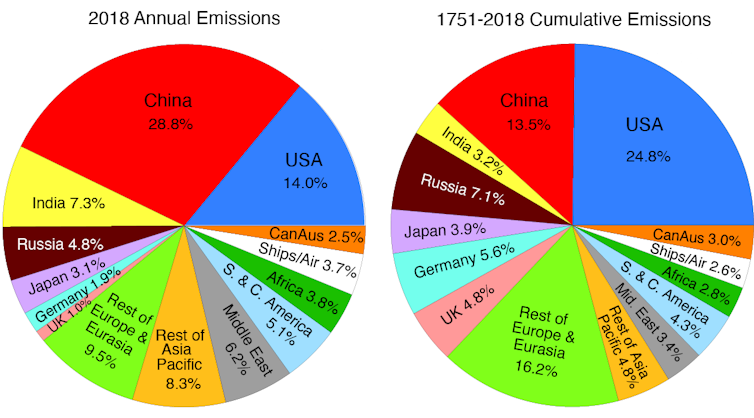
Currently, the main source of carbon dioxide is China. But accumulated emissions matter most, and the United States leads, closely followed by Europe, China and others.
What works to slow climate change?
Modern society needs energy, but it does not have to be from fossil fuels.
Studies show that the most effective way to address the climate change problem is to decarbonize the economies of the world’s nations. This means sharply increasing use of renewable energy – solar and wind cost less than new fossil fuel plants in much of the world today – and the use of electric vehicles.
Unfortunately, this changeover to renewables has been slow, due in large part to the the huge and expensive infrastructure related to fossil fuels, along with the vast amount of dollars that can buy influence with politicians.
What doesn’t work?
Instead of drastically cutting emissions, companies and politicians have grasped at alternatives. These include geoengineering; carbon capture and storage, including “direct air capture”; and planting trees.
Here’s the issue:
Geoengineering often means “solar radiation management,” which aims to emulate a volcano and add particulates to the stratosphere to reflect incoming solar radiation back to space and produce a cooling. It might partially work, but it could have concerning side effects.
The global warming problem is not sunshine, but rather that infrared radiation emitted from Earth is being trapped by greenhouse gases. Between the incoming solar and outgoing radiation is the whole weather and climate system and the hydrological cycle. Sudden changes in these particles or poor distribution could have dramatic effects.
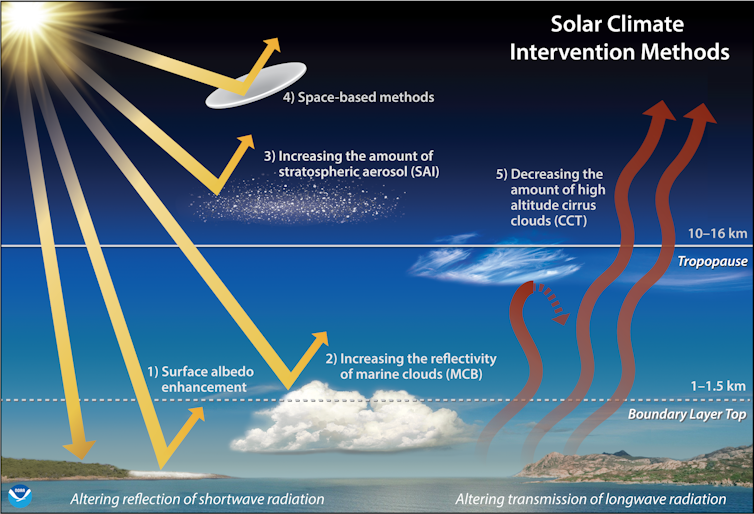
The last major volcanic eruption, of Mt. Pinatubo in 1991, sent enough sulfur dioxide and particulates into the stratosphere that it produced modest cooling, but it also caused a loss of precipitation over land. It cooled the land more than the ocean so that monsoon rains moved offshore, and longer term it slowed the water cycle.
Carbon capture and storage has been researched and tried for well over a decade but has sizable costs. Only about a dozen industrial plants in the U.S. currently capture their carbon emissions, and most of it is used to enhance drilling for oil.
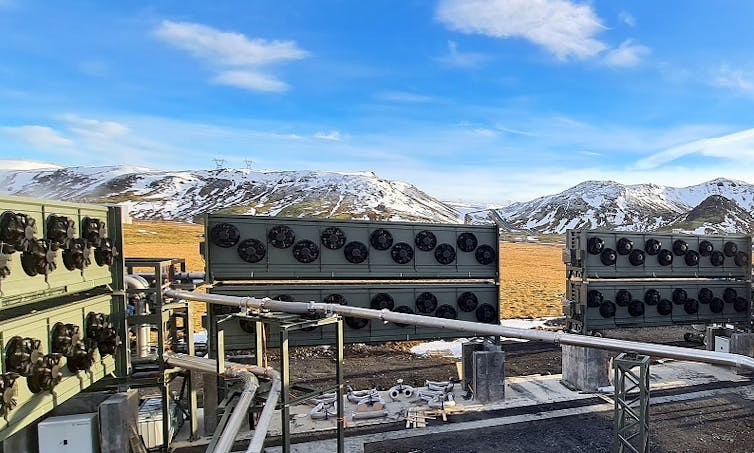
Direct air capture – technology that can pull carbon dioxide out of the air – is being developed in several places. It uses a lot of energy, though, and while that could potentially be dealt with by using renewable energy, it’s still energy intensive.

Planting trees is often embraced as a solution for offsetting corporate greenhouse gas emissions. Trees and vegetation take up carbon dioxide though photosynthesis and produce wood and other plant material. It’s relatively cheap.
But trees aren’t permanent. Leaves, twigs and dead trees decay. Forests burn. Recent studies show that the risks to trees from stress, wildfires, drought and insects as temperatures rise will also be larger than expected.
How much does all this cost?
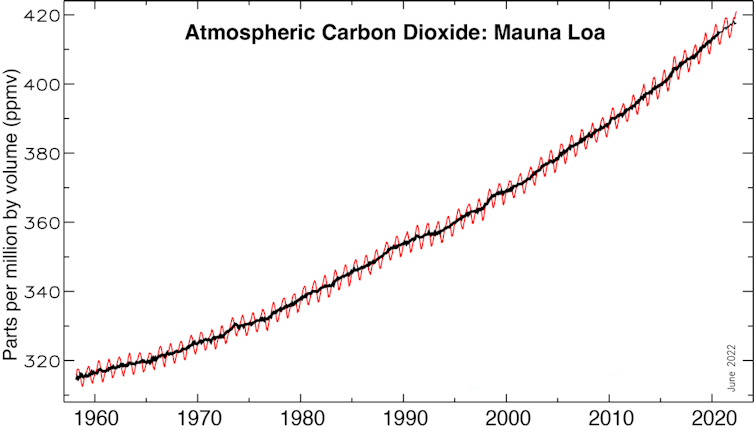
Scientists have been measuring carbon dioxide at Mauna Loa, Hawaii, since 1958 and elsewhere. The average annual increase in carbon dioxide concentration has accelerated, from about 1 part per million by volume per year in the 1960s to 1.5 in the 1990s, to 2.5 in recent years since 2010.
This relentless increase, through the pandemic and in spite of efforts in many countries to cut emissions, shows how enormous the problem is.
Usually carbon removal is discussed in terms of mass, measured in megatons – millions of metric tons – of carbon dioxide per year, not in parts per million of volume. The mass of the atmosphere is about 5.5x10¹⁵ metric tons, but as carbon dioxide (molecular weight 42) is heavier than air (molecular weight about 29), 1 part per million by volume of carbon dioxide is about 7.8 billion metric tons.
According to the World Resources Institute, the range of costs for direct air capture vary between US$250 and $600 per metric ton of carbon dioxide removed today, depending on the technology, energy source and scale of deployment. Even if costs fell to $100 per metric ton, the cost of reducing the atmospheric concentrations of carbon dioxide by 1 part per million is around $780 billion.
Keep in mind that the carbon dioxide concentration in the atmosphere has risen from about 280 parts per million before the industrial era to around 420 today, and it is currently rising at more than 2 parts per million per year.
Tree restoration on one-third to two-thirds of suitable acres is estimated to be able to remove about 7.4 gigatons of carbon dioxide by 2050 without displacing agricultural land, by WRI’s calculations. That would be more than any other pathway. This might sound like a lot, but 7 gigatons of carbon dioxide is 7 billion metric tons, and so this is less than 1 part per million by volume. The cost is estimated to be up to $50 per metric ton. So even with trees, the cost to remove 1 part per million by volume could be as much as $390 billion.
Geoengineering is also expensive.
So for hundreds of billions of dollars, the best prospect with these strategies is a tiny dent of 1 part per million by volume in the carbon dioxide concentration.
This arithmetic highlights the tremendous need to cut emissions. There is no viable workaround.
Kevin Trenberth, Distinguished Scholar, NCAR; Affiliated Faculty, University of Auckland
This article is republished from The Conversation under a Creative Commons license. Read the original article.
In a written statement released to Lake County News on Wednesday evening, Sutter Health said it does not currently have inpatient obstetric service capabilities.
“While we anticipate the situation will be resolved within a week, we are also actively working with community resources to help patients access appropriate care and to facilitate transfers to other hospitals as necessary. Other hospital services, including emergency services, remain open and ready to care for the community,” the statement said.
Sutter Health media relations manager Monique Binkley Smith told Lake County News that the hospital has been on “diversion” since 4 p.m. Tuesday.
Binkley Smith said Sutter was in the process of notifying patients of the situation.
The closure of Sutter Lakeside’s Birth Center leaves only Adventist Health Clear Lake as an available option in Lake County for deliveries.
On Wednesday, the Mother-Wise — The Village Facebook page posted a message stating that the group had been notified by Sutter Lakeside staff that morning that the birth center had closed due to no provider availability.
The group said the hospital reported it would be diverting patients to other hospitals until 7 a.m. Wednesday, July 27.
Hospitals where patients are being diverted included Adventist Health Clare Lake, Kaiser Santa Rosa, Queen of the Valley in Napa and Santa Rosa Memorial Hospital, the group reported.
Expecting parents are urged to contact their obstetricians’ offices to get additional information.
Email Elizabeth Larson at