 How to resolve AdBlock issue?
News
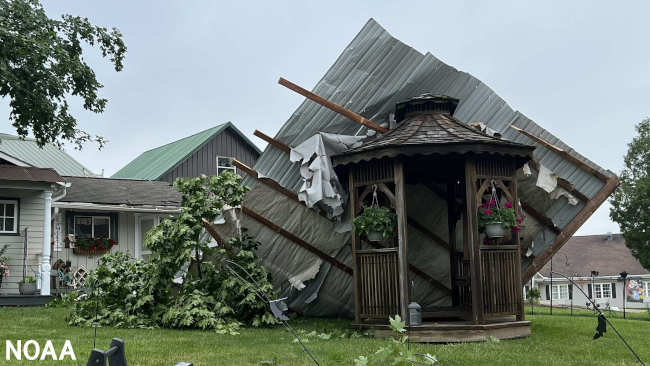
June kicked off a very warm and dry start to meteorological summer for the U.S., according to experts from NOAA’s National Centers for Environmental Information.
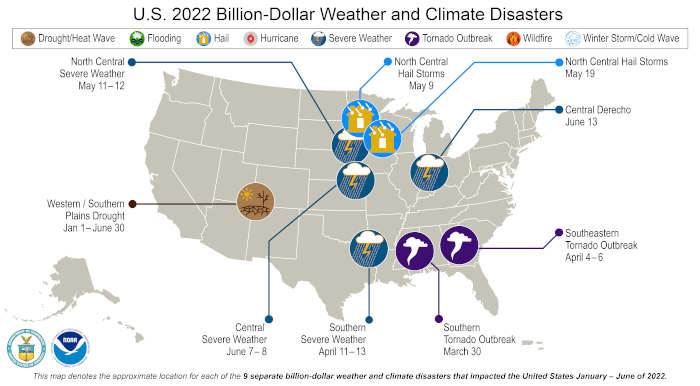
The year so far also brought nine separate billion-dollar weather and climate disasters to the nation — including tornado outbreaks, damaging hail and extreme drought.
Below are more highlights from NOAA's U.S. monthly climate report for June.
Climate by the numbers
June 2022
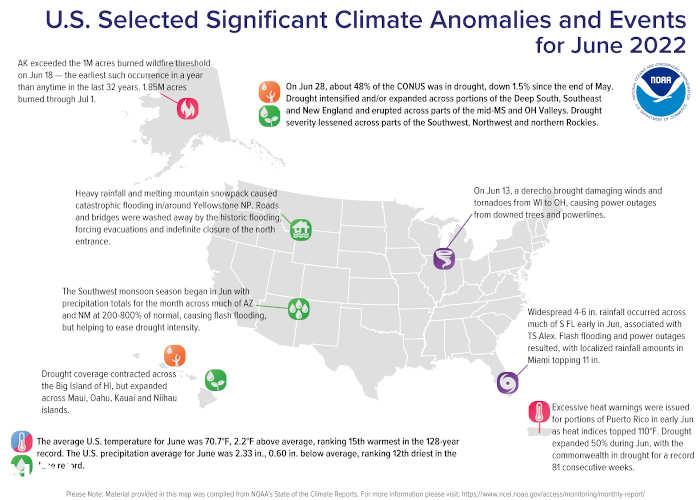
The average June temperature across the contiguous U.S. was 70.7 degrees F (2.2 degrees above average), making it the 15th-warmest June in 128 years.
Above-average warmth dominated much of the nation last month. Florida, Louisiana and Mississippi each had one of their top-10 warmest Junes on record, while Texas saw its fifth warmest on record. Alaska had its ninth-warmest June in the 98-year period of record for the state.
June precipitation across the U.S. was 2.33 inches — 0.60 of an inch below average — tying with 1930 as the 12th-driest June in the historical record.
Despite the below-average precipitation, some states saw a rather wet month. New Mexico had its fifth-wettest June on record, with Washington State and Oregon ranking seventh and eighth wettest, respectively.
Year to date (YTD, January through June 2022)
The YTD average temperature for the contiguous U.S. was 48.7 degrees F, (1.2 degrees above the 20th-century average) ranking in the warmest third of the record. California and Florida both saw their seventh-warmest YTD on record, while South Carolina had its eighth warmest.
The precipitation total was 13.84 inches, 1.47 inches below average, which ranked in the driest third in the January-through-June record. California saw its driest such YTD on record, while Nevada and Utah ranked second and third driest for this six-month period, respectively.
Billion-dollar disasters
There were nine individual billion-dollar weather and climate events across the U.S. during the first six months of 2022, including:
• Three severe weather events.
• Two tornado outbreaks.
• Two hail storms.
• A derecho event.
• A broad drought event.
For this six-month period, the 2022 disaster count ranks fifth highest behind 2017, 2020, 2011 and 2021. With an estimated cost of $2.2 billion, the costliest event so far this year was a severe weather event that occurred across the South between April 11 to 13, 2022.
Since 1980, when NOAA began tracking these events in the U.S., the nation has sustained 332 separate weather and climate disasters where overall damages/costs reached or exceeded $1 billion (based on the Consumer Price Index adjustment to 2022) per event. The total cost of these 332 events exceeds $2.275 trillion.
Other notable climate events from this report
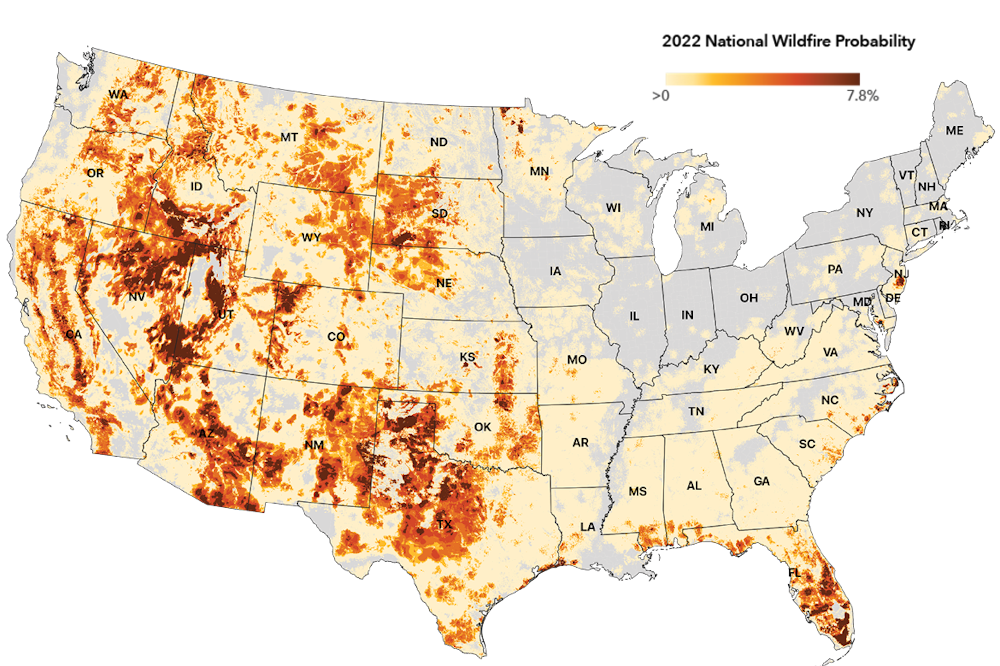
An intense wildfire season continued: June saw large wildfires burning across portions of the South and Southwest, as many others grew rapidly in Alaska. One million acres burned in Alaska by June 18 — the earliest such occurrence in the calendar year in the last 32 years.
By July 1, 1.85 million acres had been consumed, the second-highest June total on record and the seventh-highest acreage burned for any calendar month on record for Alaska. Across all 50 states, more than 3.9 million acres have burned from January 1 through June 30 — nearly 2.3 times the average for this time of year.
Lake Mead hit a record low: In late June the nation’s largest reservoir, Lake Mead, located outside of Las Vegas, Nevada, saw its water level drop close to the dead pool stage — the elevation that prevents water from flowing downstream from the lake’s dam.
On June 30 the water elevation was 1,043.02 feet — the lowest elevation since the 1930s when the lake was first filled.

NASA’s Perseverance Mars rover is conducting its science campaign, taking samples at Jezero Crater’s ancient river delta, but it’s also been busy scouting.
The rover is looking for locations where the planned Mars Sample Return, or MSR, Campaign can land spacecraft and collect sample tubes Perseverance has filled with rock and sediment.
The sites being scouted are under consideration because of their proximity to the delta and to one another, as well as for their relatively flat, lander-friendly terrain.
Mars Sample Return is a historic endeavor that would retrieve and deliver samples of that faraway terrain for intensive study in laboratories on Earth to look for signs of past microscopic life on the Red Planet.
The strategic partnership between NASA and European Space Agency, or ESA, would involve multiple spacecraft, including a rocket that would launch from the surface of Mars.
Engineers planning a Mars landing prefer to work with flatter ground because rocks and an undulating surface are harder to land on. With that in mind, the MSR Entry, Descent, and Landing team is looking for a pancake-flat landing zone with a 200-foot (60-meter) radius.
“The Perseverance team pulled out all the stops for us, because Mars Sample Return has unique needs when it comes to where we operate,” said MSR Program Manager Richard Cook of NASA’s Jet Propulsion Laboratory in Southern California. “Essentially, a dull landing place is good. The flatter and more uninspiring the vista, the better we like it, because while there are a lot of things that need to be done when we arrive to pick up the samples, sightseeing is not one of them.”
The first stage of MSR is already in progress: Perseverance has cored, collected, and sealed nine samples of Mars rock to date. The ninth, collected on July 6, is the first from Jezero Crater’s ancient river delta. The plan is for Perseverance to drop, or cache, sample tubes on the surface to await later retrieval during MSR surface operations.
Choosing an area that lacks large rocks (especially those over 7 1/2 inches, or 19 centimeters, in diameter), sand dunes, and steeply angled terrain would go a long way toward easing the path for an MSR recovery vehicle to efficiently grab tubes before heading to the MSR Sample Retrieval Lander and its Mars Ascent Vehicle.
The MSR team calls the area they’ve been looking at the “landing strip” because – at least from images taken from spacecraft in orbit – it appears to be as flat and long as a runway. But they needed a rover’s-eye-view for a closer look.
“We had been eyeing these locations since before Perseverance’s landing, but imagery from orbit can only tell you so much,” said Al Chen, Mars Sample Return Systems Engineering & Integration manager at JPL. “Now we have some up-close-and-personal shots of the landing strip that indicate we were right on the money. The landing strip will more than likely make our shortlist of potential landing and caching sites for MSR.”
NASA’s Mars Sample Return Campaign promises to revolutionize humanity’s understanding of Mars by bringing scientifically selected samples to Earth for study using the most sophisticated instruments around the world.
The campaign would fulfill a solar system exploration goal, a high priority since the 1970s and in the last three National Academy of Sciences Planetary Decadal Surveys.
This strategic NASA and ESA partnership would be the first mission to return samples from another planet and the first launch from the surface of another planet.
The samples collected by NASA’s Perseverance Mars rover during its exploration of an ancient lakebed are thought to present the best opportunity to reveal clues about the early evolution of Mars, including the potential for past life.
By better understanding the history of Mars, we would improve our understanding of all rocky planets in the solar system, including Earth.
Learn more about the Mars Sample Return Program here.

Those seats are held by Russell Cremer and Dirk Slooten, and both men confirmed to Lake County News on Friday that they intend to seek reelection.
Both Cremer and Slooten served on the Clearlake Planning Commission. Cremer was appointed to fill a vacancy in May 2018 and in November 2018 both men were elected for the first time. Slooten is in his second year as mayor.
Also on the ballot is the city treasurer job, which has been vacant for many years and is filled by staff.
The city reported that the candidate filing period begins on Monday, July 18, at 8 a.m. and closes at 5 p.m. Friday, Aug. 12. That period would be extended to 5 p.m., Wednesday, Aug. 17, for non-incumbents if either Cremer or Slooten didn’t file.
Candidate packets will be available in the Administrative Services/City Clerk’s Office, 14050 Olympic Drive, by appointment only.
Candidates are asked to schedule an appointment time with the clerk to go over the packet disbursal process, which takes one hour.
For more information, contact the Administrative Services/City Clerk’s Office at 707-994-8201, Extension 106, or via email at
Email Elizabeth Larson at
Wildfires in the American West are getting larger, more frequent and more severe. Although efforts are underway to create fire-adapted communities, it’s important to realize that we cannot simply design our way out of wildfire – some communities will need to begin planning a retreat.
Paradise, California, is an example. For decades, this community has worked to reduce dry grasses, brush and forest overgrowth in the surrounding wildlands that could burn. It built firebreaks to prevent fires from spreading, and promoted defensible space around homes.
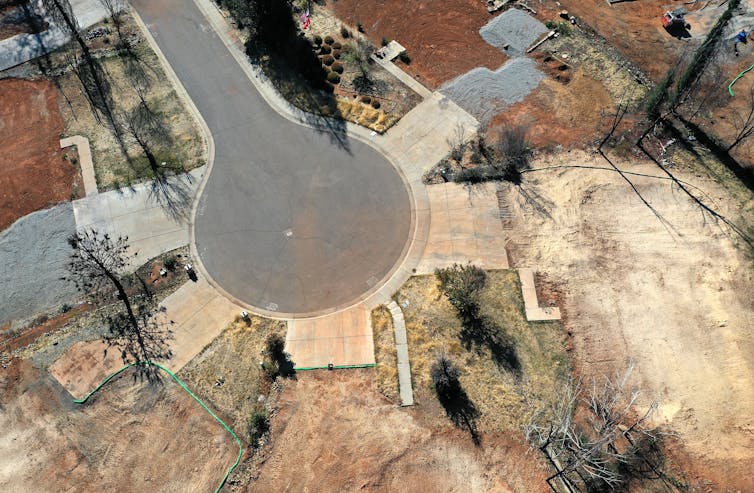
But in 2018, these efforts were not enough. The Camp Fire started from wind-damaged power lines, swept up the ravine and destroyed over 18,800 structures. Eighty-five people died.
Across the America West, thousands of communities like Paradise are at risk. Many, if not most, are in the wildland-urban interface, a zone between undeveloped land and urban areas where both wildfires and unchecked growth are common. From 1990 to 2010, new housing in the wildland-urban interface in the continental U.S. grew by 41%.
Whether in the form of large, master-planned communities or incremental, house-by-house construction, developers have been placing new homes in danger zones.
It has been nearly four years since the Camp Fire, but the population of Paradise is now less than 30% of what it once was. This makes Paradise one of the first documented cases of voluntary retreat in the face of wildfire risk. And while the notion of wildfire retreat is controversial, politically fraught and not yet endorsed by the general public, as experts in urban planning and environmental design, we believe the necessity for retreat will become increasingly unavoidable.
But retreat isn’t only about wholesale moving. Here are four forms of retreat being used to keep people out of harm’s way.
Limiting future development
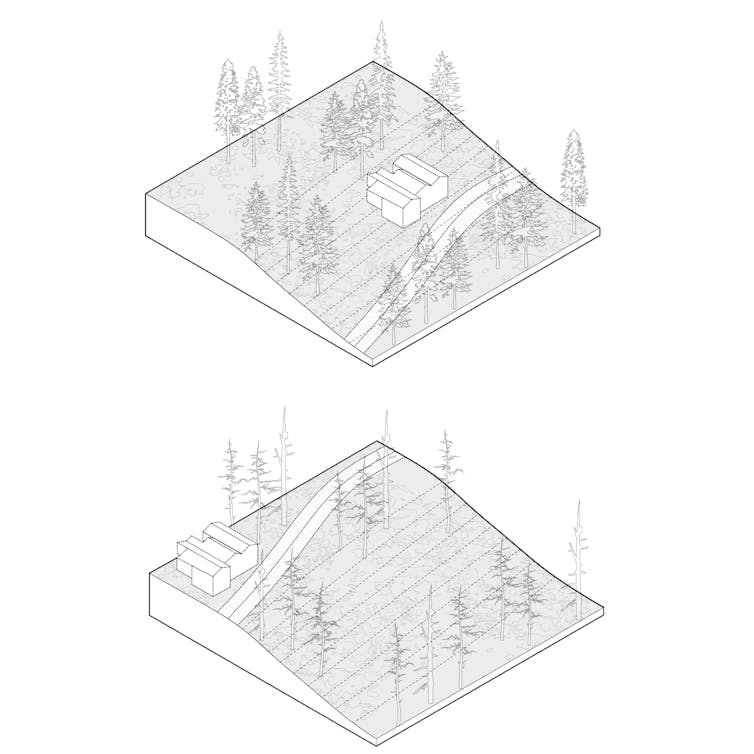
On one end of the wildfire retreat spectrum are development-limiting policies that create stricter standards for new construction. These might be employed in moderate-risk areas or communities disinclined to change.
An example is San Diego’s steep hillside guidelines that restrict construction in areas with significant grade change, as wildfires burn faster uphill. In the guidelines, steep hillsides have a gradient of at least 25% and a vertical elevation of at least 50 feet. In most cases, new buildings cannot encroach into this zone and must be located at least 30 feet from the hillside.
While development-limiting policies like this prevent new construction in some of the most hazardous conditions, they often cannot eliminate fire risk.
Halting new construction
Further along the spectrum are construction-halting measures, which prevent new construction to manage growth in high-risk parts of the wildland-urban interface.
These first two levels of action could both be implemented using basic urban planning tools, starting with county and city general plans and zoning, and subdivision ordinances. For example, Los Angeles County recently updated its general plan to limit new sprawl in wildfire hazard zones. Urban growth boundaries could also be adopted locally, as many suburban communities north of San Francisco have done, or could be mandated by states, as Oregon did in 1973.
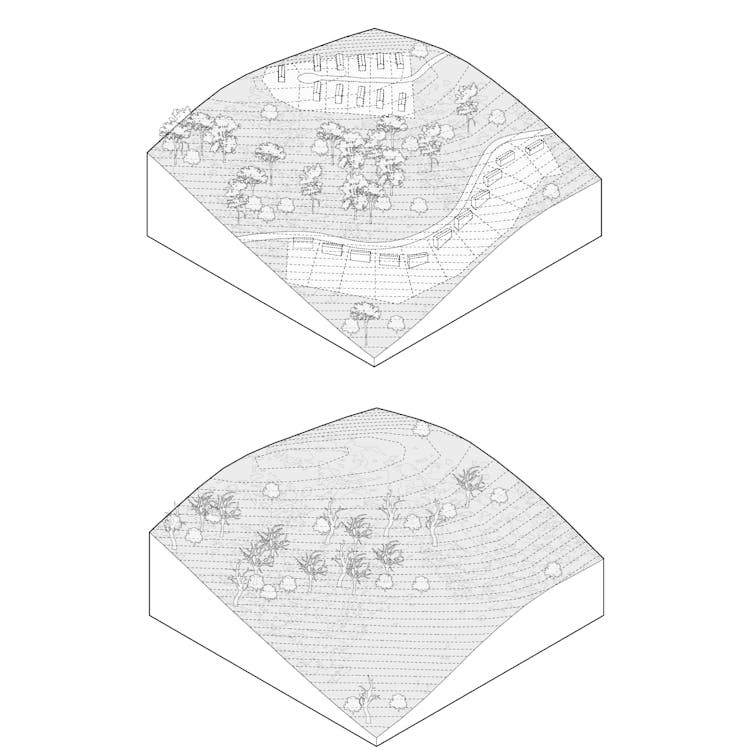
To assist the process, states and the federal government could designate fire-risk areas, similar to Federal Emergency Management Agency flood maps. California already designates zones with three levels of fire risk: moderate, high and very high.
They could also develop fire-prone landscape zoning acts, similar to legislation that has helped limit new development along coasts, on wetlands and along earthquake faults.
Incentives for local governments to adopt these frameworks could be provided through planning and technical assistance grants or preference for infrastructure funding. At the same time, states or federal agencies could refuse funding for local authorities that enable development in severe-risk areas.
In some cases, state officials might turn to the courts to stop county-approved projects to prevent loss of life and property and reduce the costs that taxpayers might pay to maintain and protect at-risk properties
Threehigh-profile projects in California’s wildland-urban interface have been stopped in the courts because their environmental impact reports fail to adequately address the increased wildfire risk that the projects create. (Full disclosure: For a short time in 2018, one of us, Emily Schlickman, worked as a design consultant on one of these – an experience that inspired this article.)
Incentives to encourage people to relocate
In severe risk areas, the technique of “incentivized relocating” could be tested to help people move out of wildfire’s way through programs such as voluntary buyouts. Similar programs have been used after floods.
Local governments would work with FEMA to offer eligible homeowners the pre-disaster value of their home in exchange for not rebuilding. To date, this type of federally backed buyout program has yet to be implemented for wildfire areas, but some vulnerable communities have developed their own.
The city of Paradise created a buyout program funded with nonprofit grant money and donations. However, only 300 acres of patchworked parcels have been acquired, suggesting that stronger incentives and more funding may be required.
Removing government-backed fire insurance plans or instituting variable fire insurance rates based on risk could also encourage people to avoid high-risk areas.
Another potential tool is a “transferable development rights” framework. Under such a framework, developers wishing to build more intensively in lower-risk town centers could purchase development rights from landowners in rural areas where fire-prone land is to be preserved or returned to unbuilt status. The rural landowners are thus compensated for the lost use of their property. These frameworks have been used for growth management purposes in Montgomery County, Maryland, and in Massachusetts and Colorado.
Moving entire communities, wholesale
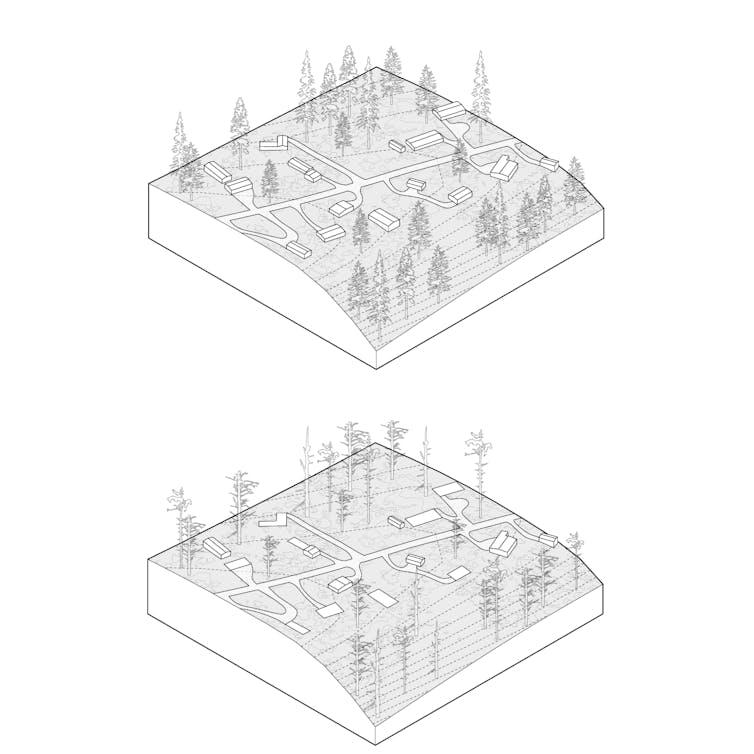
Vulnerable communities may want to relocate but don’t want to leave neighbors and friends. “Wholesale moving” involves managing the entire resettlement of a vulnerable community.
While this technique has yet to be implemented for wildfire-prone areas, there is a long history of its use after catastrophic floods. One place it is currently being used is Isle de Jean Charles, Louisiana, which has lost 98% of its landmass since 1955 because of erosion and sea level rise. In 2016, the community received a federal grant to plan a retreat to higher ground, including the design of a new community center 40 miles north and upland of the island.
This technique, though, has drawbacks – from the complicated logistics and support needed to move an entire community to the time frame needed to develop a resettlement plan to potentially overloading existing communities with those displaced.
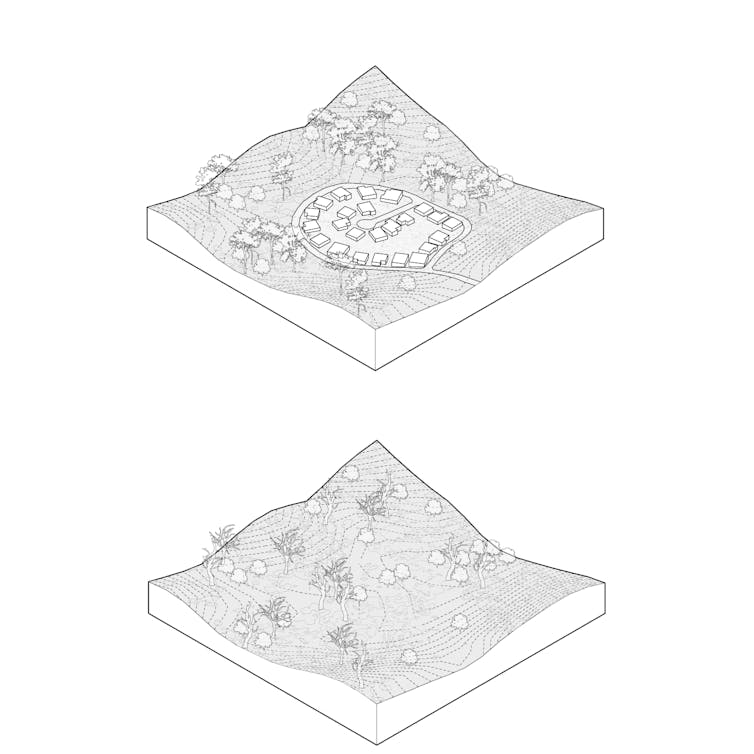
Even with ideal landscape management, wildfire risks to communities will continue to increase, and retreat from the wildland-urban interface will become increasingly necessary. The primary question is whether that retreat will be planned, safe and equitable, or delayed, forced and catastrophic.
Emily E. Schlickman, Assistant Professor of Landscape Architecture and Environmental Design, University of California, Davis; Brett Milligan, Associate Professor of Landscape Architecture and Environmental Design, University of California, Davis, and Stephen M. Wheeler, Professor of Urban Design, Planning, and Sustainability, University of California, Davis
This article is republished from The Conversation under a Creative Commons license. Read the original article.
The bills voted on were the Women’s Health Protection Act (H.R. 8296) and the Ensuring Women’s Right to Reproductive Freedom Act (H.R. 8297).
The bills passed mostly along party lines and are expected not to be able to overcome the 60-vote threshold needed to overcome the Senate’s filibuster.
Rep. Mike Thompson (CA-05), who represents a portion of Lake County in Congress, said he voted to pass both bills.
“When the Supreme Court released their decision in Dobbs v. Jackson Women’s Health Organization, they laid the groundwork for states to criminalize abortion and strip health care away from millions of women,” said Thompson. “The Supreme Court’s dangerous decision turns back the clock and strips rights away from Americans. My granddaughters will now have fewer rights than their grandmother. Access to reproductive care protects the health, well-being, and autonomy of women — that is why action to reverse the Supreme Court’s misguided ruling is imperative.
“Today, I was proud to vote for two bills that will protect the right to reproductive health care and ensure Americans are not penalized for crossing state lines to access health care. I urge my colleagues in the Senate to act on this legislation and deliver protections for women across the country,” he said Friday.
Thompson said access to comprehensive health care must include access to abortion — and the ability to access care should not depend on where you live.
He said the Women’s Health Protection Act restores the right to abortion nationwide ensuring all Americans – regardless of where they live – can make their own decisions about their lives and their futures.
Since the Supreme Court overturned the constitutional right to abortion and reversed nearly 50 years of precedent established in Roe v. Wade, abortion has been banned in at least 10states, with more bans expected soon. These bans force people to travel to other states where abortion care remains legal.
Thompson said the Ensuring Women’s Right to Reproductive Freedom Act “protects Americans from extremist policies and groups by ensuring no person acting under state law can prevent, restrict, impede, or otherwise retaliate against a person traveling across state lines to obtain a lawful abortion.”
Enough trash to fill trash bags lining the entire California coastline twice over. That’s how much trash has been removed in the first year of Gov. Gavin Newsom’s Clean California initiative.
In just the first 12 months since the $1.1 billion multiyear cleanup effort began last July, Clean California has removed 12,700 tons of trash — which would fill enough trash bags to line the California coastline two times — from California’s roadways, funded 231 projects to revitalize underserved communities, and created nearly 1,500 jobs, with thousands more expected in the coming years.
“It’s simple: all Californians deserve clean streets. That’s why we’re cleaning up California like never before in our state’s history,” said Gov. Newsom. “I’m proud of the work we’ve done in just one year to make the Golden State a cleaner, safer place to call home – and we’re just getting started.”
California roadsides have less trash, underserved communities statewide are receiving beautification and safety upgrades, and hundreds more Californians have stable jobs in just the first year of Clean California.
“Clean California is helping communities throughout the state break the destructive cycle of litter and create public spaces we can all take pride in,” said Caltrans Director Tony Tavares. “Thanks to Governor Newsom’s vision, California is cleaner, communities are addressing blight, and hundreds more of our fellow Californians have dependable work. I cannot wait to see what we can accomplish together in Year 2.”
First-year highlights of Clean California include:
Litter cleanup: Caltrans collected more than 756,000 cubic yards (12,700 tons) of litter from the state highway system – which would fill enough trash bags to line the entire California coastline two times. This is a 183 percent increase in litter removal compared to 2020, when Caltrans collected 267,000 cubic yards of trash.
Job creation: Caltrans hired more than 700 new team members as part of Clean California, including 470 maintenance positions to collect litter and remove graffiti. Forty-five of these maintenance workers have already earned promotions within the department. Caltrans also expanded its partnership with the Butte County Office of Education Back 2 Work program, adding 82 crews in counties throughout California. The $127 million contract has already created 760 jobs and will fund more than 4,000 positions that provide income and job training to Californians who have experienced barriers to employment, such as homelessness, addiction and incarceration. Clean California grant-funded projects (see below) are estimated to create another 7,200 jobs.
State beautification projects: 126 beautification projects with a total budget of $312 million are underway to transform and connect communities along the state highway system. Nearly all the projects – 98 percent – will benefit underserved communities. Humboldt County residents and visitors are already enjoying the first completed project, a new parklet along the Humboldt Bay National Wildlife Refuge near State Route 255.
Local grant projects: Nearly $300 million in Clean California grants is funding 105 local projects statewide to remove litter and transform public spaces with community markers and public art in underserved communities.
Adopt-A-Highway Program: Clean California created a $250 monthly volunteer incentive stipend through the Adopt-A-Highway Program, increasing highway adoptions by more than 800 in a matter of months.
Dump day events: Nearly 150 free events throughout the state allowed the public to safely dispose of more than 50,000 cubic yards of litter, including more than 15,400 tires and 4,100 mattresses.
In the coming year, Caltrans looks to continue the momentum by removing 1.2 million cubic yards of trash from the state highway system – 60% more than the first year. For more information, visit www.CleanCA.com.