 How to resolve AdBlock issue?
News
Call Lake County Animal Care and Control at 707-263-0278 or visit the shelter online at http://www.co.lake.ca.us/Government/Directory/Animal_Care_And_Control.htm for information on visiting or adopting.
The following cats at the shelter have been cleared for adoption.

Female domestic shorthair
This female domestic shorthair kitten has a calico coat.
She is in cat room kennel No. 78, ID No. LCAC-A-3461.

‘Dave’
“Dave” is a young male brown tabby with a short coat.
He is in cat room kennel No. 96, ID No. LCAC-A-3299.

Female domestic shorthair
This young female domestic shorthair cat has a gray tabby coat.
She is in cat room kennel No. 120a, ID No. LCAC-A-3575.

Male domestic shorthair
This young male domestic shorthair cat has a black coat.
He is in cat room kennel No. 120b, ID No. LCAC-A-3576.

Male domestic longhair cat
This 2-year-old male domestic longhair cat has a white coat with gray markings.
He is in cat room kennel No. 129, ID No. LCAC-A-3529.
Email Elizabeth Larson at
MIDDLETOWN, Calif. — Anyone who has been to the top of Rabbit Hill in Middletown knows that the small peak, almost in the middle of town, offers views of surrounding mountains that are breathtaking.
It has long been a dream of the Lake County Land Trust, or LCLT, and local citizens to place directional signs at the summit of Rabbit Hill to point out each significant peak in the panoramic 360 degree view of the surrounding mountains, including St. Helena, Cobb and Harbin.
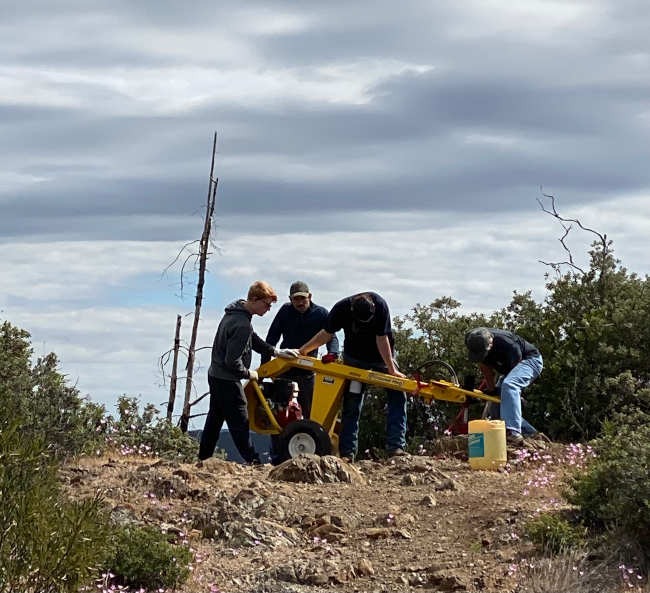
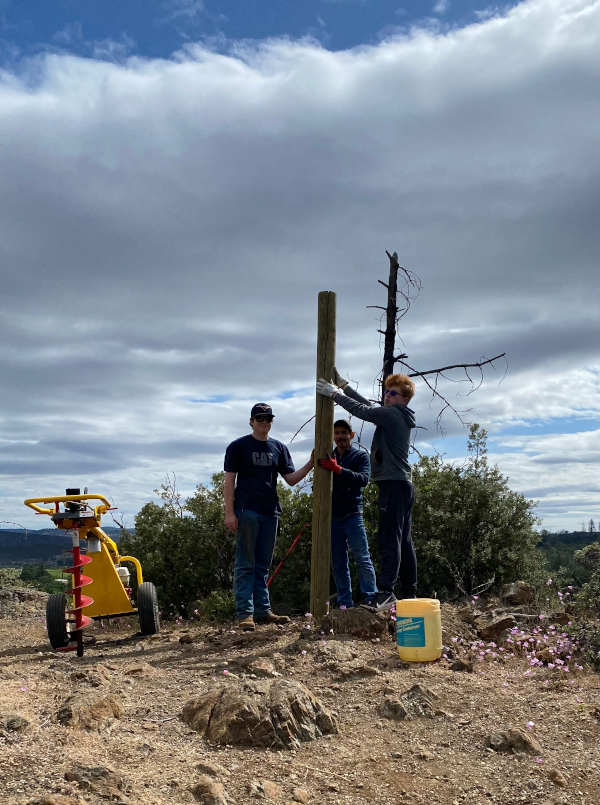
On a recent Saturday morning the signage project was started with the help of Hidden Valley Lake resident Jean Goulart, who has become a volunteer for the LCLT and will be over-seeing the Rabbit Hill Park.
Goulart is a University of California Naturalist and Climate Steward and a new member of the LCLT Stewardship Committee.
She gathered students from Middletown High School to work on the sign project as part of their community service. Meeting Jean were Cade Dubose, Jose Montanez and Evan Johnson.
Lake County Land Trust volunteers, including Middletown’s Gail Wright, Stewardship Committee member Bob Schoenherr and LCLT board member Val Nixon joined in the effort.
Many thanks to Hardester’s Market in Middletown for donating the use of an auger to dig the hole for the post where the directional signs will be mounted. Hardester’s also donated spray paint to paint the concrete picnic table at the top of the hill.

After the pole was placed in cement, the Middletown High students pruned over growth along the path and near the cement picnic table. They removed steel post fencing and did general cleanup of the area. Painting the concrete table was postponed because of wind.
The small nine-acre park was originally donated to the Madrone Audubon Society in Sonoma County by the late Skee and Huck Hamann. The beloved couple lived atop the little hill and hosted many education programs for local school children.
Over 20 years ago Madrone Audubon transferred ownership to the Lake County Land Trust. Since that time the Land Trust has worked with the local Middletown Art Center and Middletown residents to improve and care for the park.
There are now comfortable benches, a picnic table, and art installations. Soon the public will be able to enjoy informative signs.
The park is open to the public and is used by many local residents for exercising and dog walking. Besides its stunning views it features native serpentine vegetation that includes wildflowers, forbes and native grasses.
The Lake County Land Trust, founded in 1994, is a charitable non-profit dedicated to protecting natural habitats, wetlands, and valuable open space in Lake County go to www.lakecountylandtrust.org.
Can an otherwise healthy young woman die from what starts out as something akin to a common cold? The answer is, shockingly, yes, when certain telltale signs of a more serious problem go undetected.
Though many people haven’t even heard of it, sepsis – the body’s extreme response to infection – is the leading killer of hospitalized patients in the United States. Worldwide, sepsis is responsible for 1 in 5 deaths every year. Even among those who survive, many will never be able to return to work, and some won’t be able to return home from the hospital, requiring life support or ongoing critical care.
We are two researchers and critical care doctors at the University of Pittsburgh School of Medicine who are working to change the way scientists and doctors think about sepsis. We are interested in understanding and spreading awareness about how sepsis starts and how it can elude even the most astute physicians.
We are also learning more about how community factors are at play and how a better understanding of the communities we all live in could help everyday people and health care workers alike recognize and stop this deadly disease.
What is sepsis?
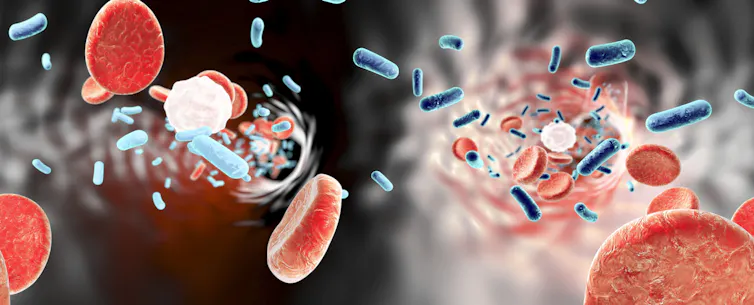
Sepsis is a medical emergency that begins with an infection – perhaps even a mild infection. Upon detecting bacteria or a virus, your body releases a choreographed cascade of chemicals into the bloodstream. This chemical alert beckons an artillery of immune cells that work in concert to fight the bug.
When this system works well, your body clears the infection and you get better. But when the system doesn’t work well, sepsis can ensue.
The onset of sepsis occurs when your immune cells pivot from fighting the infection to fighting your own tissues and organs. This reaction can be similar to an autoimmune response, a condition in which the body’s immune system turns on itself. Many people are familiar with chronic autoimmune diseases such as rheumatoid arthritis or Crohn’s disease, but sometimes this type of autoimmune response can occur even in healthy people.
When sepsis occurs, the immune system can commonly injure the heart, lungs, kidneys or blood cells, among other important body systems. Inflammation in the blood vessels can make them leaky, causing blood flow to the brain and other organs to become severely diminished. When this occurs, a person’s blood pressure may become dangerously low, which is a severe form of sepsis known as septic shock.
Without prompt and proper treatment – and sometimes even despite treatment – sepsis can cause organ damage and even death. Once shock develops, mortality from sepsis is estimated to jump from 10% to as high as 40%.
Sepsis can result from nearly any infection. Most commonly it develops from pneumonia or a urinary tract infection. Severe COVID-19 can also cause sepsis. Often, sepsis patients are seen by a medical professional for infection symptoms in the week preceding sepsis hospitalization. However, predicting which infected patients will go on to develop sepsis is very difficult.
Treatment options
The cornerstones of sepsis treatment are prompt recognition of sepsis symptoms, followed by antibiotics and fluids. But even the most careful and attentive physicians can miss the early signs of sepsis.
This is largely because there is no single test to positively diagnose sepsis. Sepsis symptoms may mimic other life-threatening conditions such as heart attacks, blood clots, bleeding or even an allergic reaction. Patients often display vague and variable symptoms such as weakness, lightheadedness and rapid breathing, making the diagnosis even more challenging.
For example, a young, otherwise healthy person with sepsis due to pneumonia may look much different from an older diabetic who develops sepsis from a smoldering skin infection.
Sepsis patients nearly always require admission to the hospital or even the ICU, and those with severe forms of sepsis often require life support. This may include dialysis or mechanical ventilation to support failing organs. The source of infection needs to be identified and, in some cases, surgically removed. Delaying sepsis treatment by even a few hours can have deadly consequences.
Recognizing sepsis before it’s too late
Differences in sepsis go beyond symptoms. COVID-19 has laid bare that severe illness isn’t a game of chance. Like COVID-19 infection, sepsis susceptibility – and who is most likely to get sick and die – is part of a complex interplay of social influences that include racism, poverty, geography and community dynamics.
Research strongly suggests that certain people are at far higher risk of developing sepsis than others. Much like COVID-19, older people with underlying chronic diseases like obesity and diabetes face a heightened risk for sepsis. Such factors as race, poverty and even driving distance to the hospital may have a significant impact on who survives sepsis.
Most of the work done to improve sepsis detection and treatment has focused on the hospital setting. Doctors, researchers and even government agencies have concentrated their efforts on improving sepsis recognition and treatment once a patient reaches the hospital. Research aimed at understanding an individual’s sepsis risk has focused on personal health history and social and economic factors such as income and race, or community features such as primary care access.
While these approaches have advanced the field’s understanding of sepsis, they have led to little progress in reducing the incidence of sepsis in the U.S.
New approaches to catching a killer
Given what is known about the importance of early sepsis treatment, researchers like us are taking a closer look at the role of communities in improving sepsis detection and understanding sepsis risk.
The early stages of sepsis can evolve rapidly when a patient is at home. Scientists estimate that 87% of sepsis cases start outside the hospital. When a patient does present for care, it’s often in a clinic or emergency medical services setting in the days and even hours preceding sepsis hospitalization. These critical treatment windows may mean the difference between life and death for a sepsis patient.
Alongside researchers based at Kaiser Permanente Northern California, we are now working to advance sepsis care by studying sepsis patient symptoms, community factors, diagnosis and treatment patterns outside the hospital. We are also expanding work to improve sepsis diagnosis among hospitalized patients. This coast-to-coast collaboration will study patients cared for at over 40 hospitals, 30 EMS agencies and a critical mass of ambulatory clinics. We hope that our work will shed light on the early stages of sepsis, including signs that may signal that an infected patient is progressing to sepsis, and explore diagnostic and treatment approaches that could help stop sepsis before it advances too far.
We are also learning a great deal more about the complicated role of community factors like poverty on health outcomes, including sepsis. Using “syndemic theory” – a framework to describe synergistic epidemics that arise from harmful social conditions – we are studying how two co-occurring epidemics, like poverty and asthma, can work together to increase negative health outcomes. Though this framework is only beginning to be used to study acute illness, it has the potential to transform the way we think about sepsis.
Emily Brant, Assistant Professor of Critical Care and Emergency Medicine, University of Pittsburgh Health Sciences and Kristina E. Rudd, Assistant Professor of Critical Care Medicine, University of Pittsburgh Health Sciences
This article is republished from The Conversation under a Creative Commons license. Read the original article.
May was warm and wet across the Lower 48, according to scientists from NOAA’s National Centers for Environmental Information.
The month also wrapped up a warm spring as wildfires continued to burn across the nation.
Below are highlights from NOAA's U.S. monthly climate report for May 2022:
Climate by the numbers
May 2022
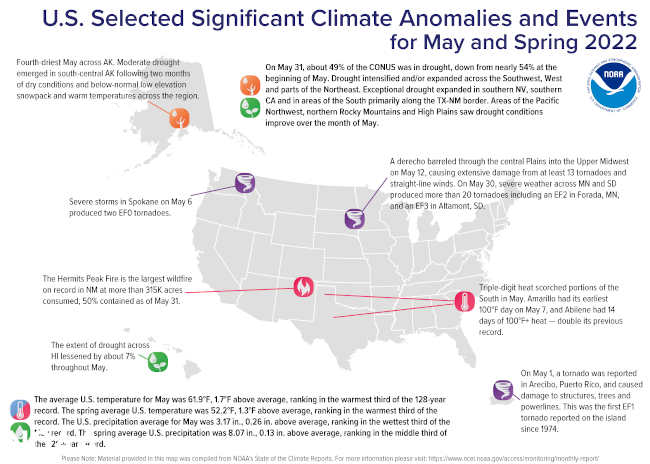
The average May temperature across the contiguous U.S. was 61.9 degrees F (1.7 degrees above the 20th-century average), ranking in the warmest third of the 128-year record.
Temperatures across the Northwest and northern Rockies were below average, with much of the Southwest, Deep South and locations east of the Mississippi River above average. Triple-digit heat scorched portions of the South throughout the month, setting a number of temperature records across Texas. Texas had its second-warmest May on record, while Washington state saw its eighth coldest.
The average precipitation for May was 3.17 inches (0.26 of an inch above average), which ranked in the wettest third of the record.
Precipitation was above average across portions of the Northwest, northern and central Plains, Upper Mississippi Valley, Ohio Valley, eastern Gulf of Mexico and the Appalachians. Precipitation was below average from California to Texas and across portions of the Northeast. A dry month across the Southwest resulted in Arizona seeing its fifth-driest May on record, while above-average precipitation gave Washington state its eighth-wettest May.
Meteorological spring (March through May 2022) | Year to date
The average temperature for the contiguous U.S. during meteorological spring was 52.2 degrees F (1.3 degrees F above average), which ranked in the warmest third of the record. Rhode Island ranked fourth warmest while nine additional states — Arizona, Connecticut, Florida, Maine, Massachusetts, New Hampshire, New Jersey, New Mexico and Texas — ranked among their ten-warmest spring seasons on record.
The spring precipitation total of 8.07 inches (0.13 of an inch above average) placed it in the middle third of the record. North Dakota ranked fourth wettest while New Mexico saw its sixth-driest spring.
The average U.S. temperature for the year to date (YTD, January through May) was 44.3 degrees F, 1.0 degree F above average, ranking in the warmest third of the record.
The first five months of 2022 were also quite dry, with a precipitation total of 11.48 inches, 0.91 of an inch below average, and ranking in the driest third of the record. California saw its driest such YTD on record while Arizona, Nevada and Utah ranked third driest for this five-month period. Meanwhile, North Dakota saw its fourth-wettest YTD.
Other notable highlights from the report
Wildfires roared across the landscape: As of May 31, the largest fire in New Mexico history, the Hermits Peak Fire, had consumed more than 315,000 acres and was 50% contained. Across all 50 states, 1.9 million acres have burned from January 1 through June 2 — more than twice the average for this time of year.
Drought improved overall, with exceptions: According to the May 31 U.S. Drought Monitor reportoffsite link, 49.3% of the contiguous U.S. was in drought, down about 4.5% from the beginning of May. Areas of the Pacific Northwest, northern Rocky Mountains and High Plains saw drought conditions improve over the month of May while drought intensified or expanded across the Southwest, West and parts of the Northeast.
A stormy May with fewer tornadoes: Several rounds of severe weather hit the U.S. during May, producing 196 preliminary tornado reports. This is 71% of the 1991-2010 average for tornadoes for the month of May (276). On May 4, severe storms formed across the central Plains and produced several tornadoes including an EF3 tornado near Lockett, Texas. A line of severe storms, also known as a derecho, barreled across the central Plains into the Upper Midwest on May 12, causing extensive damage from at least 13 tornadoes and straight-line winds.
Dogs available for adoption this week include mixes of Australian shepherd, Chihuahua, chow chow, dachshund, German shepherd, husky, Labrador retriever, pit bull, shepherd and terrier.
Dogs that are adopted from Lake County Animal Care and Control are either neutered or spayed, microchipped and, if old enough, given a rabies shot and county license before being released to their new owner. License fees do not apply to residents of the cities of Lakeport or Clearlake.
The following dogs at the Lake County Animal Care and Control shelter have been cleared for adoption.
Call Lake County Animal Care and Control at 707-263-0278 or visit the shelter online for information on visiting or adopting.

Female pit bull terrier
This 3-year-old female pit bull terrier has a short gray coat.
She is in kennel No. 12, ID No. LCAC-A-3524.

Male shepherd-chow chow
This 2-year-old male shepherd-chow chow mix has a gold coat.
He is in kennel No. 13, ID No. LCAC-A-3573.

‘Heidi’
“Heidi” is a 5-year-old female Australian shepherd with a long tricolor coat.
She is in kennel No. 14, ID No. LCAC-A-3567.

‘Lucky’
“Lucky” is a 3-year-old male Labrador retriever with a short yellow coat.
He is in kennel No. 15, ID No. LCAC-A-3520.

‘Casandra’
“Casandra” is a 3-year-old female pit bull terrier with a short tan coat.
She is in kennel No. 16, ID No. LCAC-A-3479.

Dachshund-Chihuahua mix
This young male dachshund-Chihuahua mix has a short gray and tan coat.
He is in kennel No. 17, ID No. LCAC-A-3508.

‘Rocky’
“Rocky” is a 6-year-old male Chihuahua with a short tan and white coat.
He is in kennel No. 18, ID No. LCAC-A-3478.

Female shepherd mix
This 1-year-old female shepherd mix has a short gray brindle coat.
She is in kennel No. 19, LCAC-A-3342.

Female Labrador retriever mix
This 3-year-old female Labrador retriever mix has a short yellow coat.
She is in kennel No. 20, ID No. LCAC-A-3438.

Male shepherd
This 2-year-old male shepherd mix has a short black and white coat.
He is in kennel No. 22, ID No. LCAC-A-3466.

Female shepherd mix
This young female shepherd mix has a white coat.
She is in kennel No. 23, ID No. LCAC-A-3472.
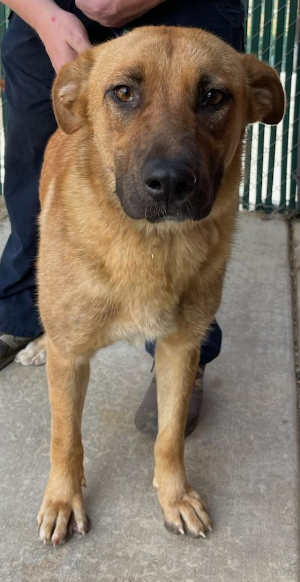
Female German shepherd mix
This 2-year-old female German shepherd mix has a short tan coat.
She is in kennel No. 32, ID No. LCAC-A-3491.

Male husky
This 2-year-old male husky has a gray and white coat.
He is in kennel No. 33, ID No. LCAC-A-3484.

Pit bull terrier
This young female pit bull terrier has a short black and white coat.
She is in kennel No. 34, ID No. LCAC-A-3353.
Email Elizabeth Larson at
Astronomers may have discovered the first free-floating black hole in the Milky Way galaxy, thanks to a technique called gravitational microlensing. With new observations, they hope to find many more 'ghost' stars. (Video by Roxanne Makasdjian and Alan Toth, with microlensing animations from Casey Lam and Sean Terry, UC Berkeley’s Moving Universe Lab, and image data courtesy of the OGLE collaboration)
BERKELEY — If, as astronomers believe, the death of large stars leave behind black holes, there should be hundreds of millions of them scattered throughout the Milky Way galaxy. The problem is, isolated black holes are invisible.
Now, a team led by University of California, Berkeley, astronomers has for the first time discovered what may be a free-floating black hole by observing the brightening of a more distant star as its light was distorted by the object's strong gravitational field — so-called gravitational microlensing.
The team, led by graduate student Casey Lam and Jessica Lu, a UC Berkeley associate professor of astronomy, estimates that the mass of the invisible compact object is between 1.6 and 4.4 times that of the sun.
Because astronomers think that the leftover remnant of a dead star must be heavier than 2.2 solar masses in order to collapse to a black hole, the UC Berkeley researchers caution that the object could be a neutron star instead of a black hole.
Neutron stars are also dense, highly compact objects, but their gravity is balanced by internal neutron pressure, which prevents further collapse to a black hole.
Whether a black hole or a neutron star, the object is the first dark stellar remnant — a stellar “ghost” — discovered wandering through the galaxy unpaired with another star.
"This is the first free-floating black hole or neutron star discovered with gravitational microlensing," Lu said. "With microlensing, we're able to probe these lonely, compact objects and weigh them. I think we have opened a new window onto these dark objects, which can’t be seen any other way."
Determining how many of these compact objects populate the Milky Way galaxy will help astronomers understand the evolution of stars — in particular, how they die — and of our galaxy, and perhaps reveal whether any of the unseen black holes are primordial black holes, which some cosmologists think were produced in large quantities during the Big Bang.
The analysis by Lam, Lu and their international team has been accepted for publication in The Astrophysical Journal Letters.
The analysis includes four other microlensing events that the team concluded were not caused by a black hole, though two were likely caused by a white dwarf or a neutron star. The team also concluded that the likely population of black holes in the galaxy is 200 million — about what most theorists predicted.
Same data, different conclusions
Notably, a competing team from the Space Telescope Science Institute (STScI) in Baltimore analyzed the same microlensing event and claims that the mass of the compact object is closer to 7.1 solar masses and indisputably a black hole. A paper describing the analysis by the STScI team, led by Kailash Sahu, has been accepted for publication in The Astrophysical Journal.
Both teams used the same data: photometric measurements of the distant star's brightening as its light was distorted or "lensed" by the super-compact object, and astrometric measurements of the shifting of the distant star's location in the sky as a result of the gravitational distortion by the lensing object.
The photometric data came from two microlensing surveys: the Optical Gravitational Lensing Experiment, or OGLE, which employs a 1.3-meter telescope in Chile operated by Warsaw University, and the Microlensing Observations in Astrophysics, or MOA, experiment, which is mounted on a 1.8-meter telescope in New Zealand operated by Osaka University. The astrometric data came from NASA’s Hubble Space Telescope. STScI manages the science program for the telescope and conducts its science operations.
Because both microlensing surveys caught the same object, it has two names: MOA-2011-BLG-191 and OGLE-2011-BLG-0462, or OB110462, for short.
While surveys like these discover about 2,000 stars brightened by microlensing each year in the Milky Way galaxy, the addition of astrometric data is what allowed the two teams to determine the mass of the compact object and its distance from Earth. The UC Berkeley-led team estimated that it lies between 2,280 and 6,260 light years (700-1920 parsecs) away, in the direction of the center of the Milky Way Galaxy and near the large bulge that surrounds the galaxy's central massive black hole.
The STScI group estimated that it lies about 5,153 light years (1,580 parsecs) away.
Looking for a needle in a haystack
Lu and Lam first became interested in the object in 2020 after the STScI team tentatively concluded that five microlensing events observed by Hubble — all of which lasted for more than 100 days, and thus could have been black holes — might not be caused by compact objects after all.
Lu, who has been looking for free-floating black holes since 2008, thought the data would help her better estimate their abundance in the galaxy, which has been roughly estimated at between 10 million and 1 billion.
To date, star-sized black holes have been found only as part of binary star systems. Black holes in binaries are seen either in X-rays, produced when material from the star falls onto the black hole, or by recent gravitational wave detectors, which are sensitive to mergers of two or more black holes. But these events are rare.
"Casey and I saw the data and we got really interested. We said, 'Wow, no black holes. That's amazing,' even though there should have been," Lu said. "And so, we started looking at the data. If there were really no black holes in the data, then this wouldn’t match our model for how many black holes there should be in the Milky Way. Something would have to change in our understanding of black holes — either their number or how fast they move or their masses.”
When Lam analyzed the photometry and astrometry for the five microlensing events, she was surprised that one, OB110462, had the characteristics of a compact object: The lensing object seemed dark, and thus not a star; the stellar brightening lasted a long time, nearly 300 days; and the distortion of the background star's position also was long-lasting.
The length of the lensing event was the main tipoff, Lam said. In 2020, she showed that the best way to search for black hole microlenses was to look for very long events. Only 1% of detectable microlensing events are likely to be from black holes, she said, so looking at all events would be like searching for a needle in a haystack. But, Lam calculated, about 40% of microlensing events that last more than 120 days are likely to be black holes.
"How long the brightening event lasts is a hint of how massive the foreground lens bending the light of the background star is," Lam said. "Long events are more likely due to black holes. It's not a guarantee, though, because the duration of the brightening episode not only depends on how massive the foreground lens is, but also on how fast the foreground lens and background star are moving relative to each other. However, by also getting measurements of the apparent position of the background star, we can confirm whether the foreground lens really is a black hole."
According to Lu, the gravitational influence of OB110462 on the light of the background star was amazingly long. It took about one year for the star to brighten to its peak in 2011, then about a year to dim back to normal.
More data will distinguish black hole from neutron star
To confirm that OB110462 was caused by a super-compact object, Lu and Lam asked for more astrometric data from Hubble, some of which arrived last October. That new data showed that the change in position of the star as a result of the gravitational field of the lens is still observable 10 years after the event. Further Hubble observations of the microlens are tentatively scheduled for fall 2022.
Analysis of the new data confirmed that OB110462 was likely a black hole or neutron star.
Lu and Lam suspect that the differing conclusions of the two teams are due to the fact that the astrometric and photometric data give different measures of the relative motions of the foreground and background objects. The astrometric analysis also differs between the two teams. The UC Berkeley-led team argues that it is not yet possible to distinguish whether the object is a black hole or a neutron star, but they hope to resolve the discrepancy with more Hubble data and improved analysis in the future.
"As much as we would like to say it is definitively a black hole, we must report all allowed solutions. This includes both lower mass black holes and possibly even a neutron star," Lu said.
"If you can't believe the light curve, the brightness, then that says something important. If you don't believe the position versus time, that tells you something important," Lam said. "So, if one of them is wrong, we have to understand why. Or the other possibility is that what we measure in both data sets is correct, but our model is incorrect. The photometry and astrometry data arise from the same physical process, which means the brightness and position must be consistent with each other. So, there's something missing there. "
Both teams also estimated the velocity of the super-compact lensing object. The Lu/Lam team found a relatively sedate speed, less than 30 kilometers per second. The STScI team found an unusually large velocity, 45 km/s, which it interpreted as the result of an extra kick that the purported black hole got from the supernova that generated it.
Lu interprets her team's low velocity estimate as potentially supporting a new theory that black holes are not the result of supernovas — the reigning assumption today — but instead come from failed supernovas that don't make a bright splash in the universe or give the resulting black hole a kick.
The work of Lu and Lam is supported by the National Science Foundation (1909641) and the National Aeronautics and Space Administration (NNG16PJ26C, NASA FINESST 80NSSC21K2043).
Robert Sanders writes for the UC Berkeley News Center.