 How to resolve AdBlock issue?
News
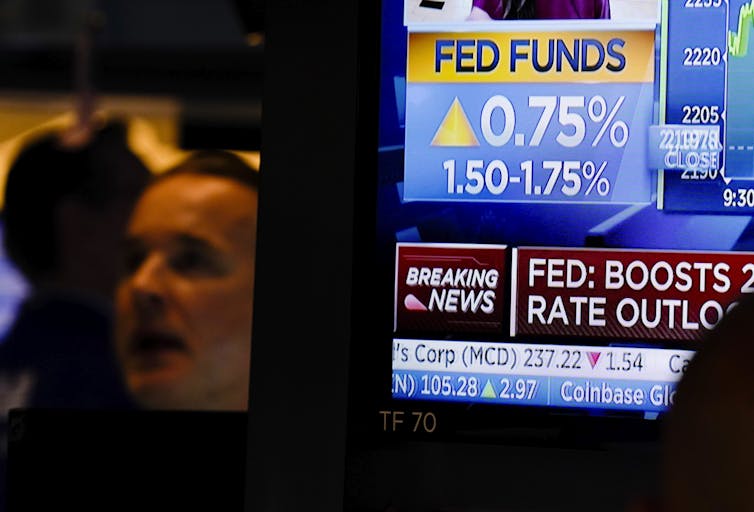
The Federal Reserve on June 15, 2022, lifted interest rates by 0.75 percentage point, the third hike this year and the largest since 1994. The move is aimed at countering the fastest pace of inflation in over 40 years.
Wall Street had been expecting a half-point increase, but the latest consumer prices report released on June 10 prompted the Fed to take a more drastic measure. The big risk, however, is that higher rates will push the economy into a recession, a fear aptly expressed by the recent plunge in the S&P 500 stock index, which is down over 20% from its peak in January, making it a “bear market.”
What does this all mean? We asked Brian Blank, a finance scholar who studies how businesses adapt and handle economic downturns, to explain what the Fed is trying to do, whether it can succeed and what it means for you.
1. What is the Fed doing and why?
The Federal Open Market Committee, the Fed’s policymaking arm, had been pondering how much and how quickly to raise its benchmark interest rate over the coming months to fight inflation. The stakes for the U.S. economy, consumers and businesses are very high.
Only a week ago, the Fed had been expected to raise rates by 0.5 percentage point at the latest meeting. But markets and Wall Street economists began to expect the larger 0.75-point hike after the May consumer price data suggested inflation has been unexpectedly stubborn. Some Wall Street analysts even argued a 1-percentage-point hike was possible.
The prospect of a faster pace of rate hikes due to inflation has prompted financial markets to plunge by over 6% since the June 10 report. Investors worry the Fed may slow the economy too much in its fight to reduce inflation, which if left unchecked also poses serious problems for consumers and companies. A recent poll found that inflation is the biggest problem Americans believe the U.S. is facing right now.
2. What is the Fed trying to achieve?
The Federal Reserve has a dual mandate to maximize employment while keeping prices stable.
Often policymakers must prioritize one or the other. When the economy is weak, inflation is usually subdued and the Fed can focus on keeping rates down to stimulate investment and boost employment. When the economy is strong, unemployment is typically quite low, and that allows the Fed to focus on controlling inflation.
To do this, the Fed sets short-term interest rates, which in turn help it influence long-term rates. For example, when the Fed lifts its target short-term rate, that increases borrowing costs for banks, which in turn pass those higher costs on to consumers and businesses in the form of higher rates on long-term loans for houses and cars.
At the moment, the economy is quite strong, unemployment is low, and the Fed is able to focus primarily on reducing inflation. The problem is, inflation is so high, at an annualized rate of 8.6%, that bringing it down may require the highest interest rates in decades, which could weaken the economy substantially.
And so the Fed is trying to execute a so-called soft landing.
3. What’s a ‘soft landing’ and is it likely?
A soft landing refers to the way that the Fed is attempting to slow inflation – and therefore economic growth – without causing a recession.
In order to stabilize prices while not hurting employment, the Fed expects to increase interest rates very rapidly in the coming months. Including the latest rate hike, the Fed has already lifted rates by 1.5 percentage points this year, putting its benchmark interest rate at a range of 1.5% to 1.75%.
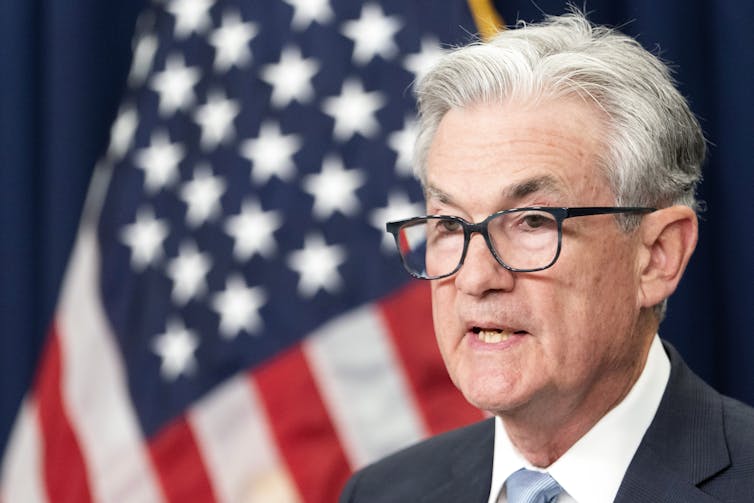
Historically, when the Fed has had to raise rates quickly, economic downturns have been difficult to avoid. Can it manage a soft landing this time? Fed Chair Jerome Powell has insisted that the central bank’s policy tools have become more effective since its last inflation fight in the 1980s, making it possible this time to stick the landing. Many economists and other observers remain uncertain. And a recent survey of economists notes that many anticipate a recession beginning next year.
That said, the economy is still relatively strong, and I’d say the the odds of a recession beginning next year are still probably close to a coin flip.
4. Is there any way to tell what the Fed might do next?
Each time the Federal Open Market Committee meets, it seeks to communicate what it plans to do in the future to help financial markets know what to expect so they aren’t taken by surprise.
One piece of guidance about the future that the committee provides is a series of dots, with each point representing a particular member’s expectation for interest rates at different points in time. This “dot plot” previously indicated that the Fed will raise interest rates to 2% by the end of the year and close to 3% by the end of 2023.
The latest inflation news is forcing it to change its tune. The dot plot now suggests the Fed expects rates to near 3.5% by December – implying several large rate hikes are still in store this year – and almost 4% in 2023 before falling again in 2024.
Long-term interest rates, such as U.S. Treasury yields and mortgage rates, already reflect these rapid changes. Some investors, however, think the Fed may have to move even faster and are forecasting rates approaching 4% by the end of 2022.
5. What does this mean for consumers and the economy?
Interest rates represent the cost of borrowing, so when the Fed raises the target rate, money becomes more expensive to borrow.
First, banks pay more to borrow money, but then they charge individuals and businesses more interest as well, which is why mortgage rates rise accordingly. This is one reason mortgage payments have been rising so rapidly in 2022, even as housing markets and prices start to slow down.
When interest rates are higher, fewer people can afford homes and fewer businesses can afford to invest in a new factory and hire more workers. As a result, higher interest rates can slow down the growth rate of the economy overall, while also curbing inflation.
And this isn’t an issue affecting just Americans. Higher interest rates in the U.S. can have similar impacts on the global economy, whether by driving up their borrowing costs or increasing the value of the dollar, which makes it more expensive to purchase U.S. goods.
But what it ultimately means for consumers and everyone else will depend on whether the pace of inflation slows as much and as quickly as the Fed has been forecasting.
This article was updated to include results of FOMC interest rates announcement.
D. Brian Blank, Assistant Professor of Finance, Mississippi State University
This article is republished from The Conversation under a Creative Commons license. Read the original article.
County Counsel Anita Grant presented to the board the necessary actions to the board regarding the Guenoc Valley Mixed Use Planned Development Project, also known as Maha Guenoc Valley, which the board approved in July and August 2020.
In 2020 the board approved the project’s first phase, which includes 385 residential villas in five subdivisions, five boutique hotels with 127 hotel units and 141 resort residential cottages, 20 campsites, up to 100 workforce housing cohousing units and a host of resort amenities ranging from outdoor entertainment area to a float plane dock and helipads.
That first phase has an estimated 1,415-acre footprint to be dispersed throughout the overall 16,000-acre Guenoc Ranch on Butts Canyon Road in Middletown.
The project area won’t include the 360 acres which contains the Langtry winery and the estate home of the famed British actress, Lillie Langtry.
Two months after the board’s approval, the Center for Biological Diversity and the California Native Plant Society filed suit against the county over a host of environmental concerns with the resort approval, with the California Attorney General’s Office later intervening on behalf of the plaintiffs.
Those filings were in the form of separate petitions for peremptory writ of mandate, which later were later consolidated by the court.
Hearings were held before Lake County Superior Court Judge J. David Markham in the fall and in January Markham issued his ruling, finding that the county had failed to adequately consider wildfire evacuation impacts when approving the resort.
As a result, Markham found the Guenoc project’s environmental impact report did not comply with the California Environmental Quality Act.
Grant explained to the supervisors on Tuesday afternoon that the court concluded that the county's findings with regard to community evacuation routes were “not supported by substantial evidence.”
She added, “The court went on to say, had it not been for that one item, the court would have found in favor of the county.”
Because of what Grant called that “very limited ruling,” the court issued a writ of mandate and judgments in the consolidated cases that require that the approvals the county adopted in connection with the certifications for the project be set aside and vacated — including the certification for the final environmental impact report and the findings relating to impacts to an adopted emergency evacuation plan.
Grant presented to the board a resolution to vacate, set aside and rescind the project’s land use approvals, and three separate ordinances rescinding previous ordinances approved in connection with the project.
She said the county will file a return to the writ of mandate to inform the court that the required actions have been taken.
Grant also noted that the court ordered that it would retain jurisdiction over the proceedings.
The board approved the resolution and three ordinances unanimously, with the ordinances to be advanced to next week’s meeting for the final reading and approval.
While the ruling was a setback, Chris Meredith, a partner in the Guenoc Valley Project, said the project is still a go.
“The county’s consideration of actions to rescind its previous approval of the Guenoc Valley Project is a necessary procedural step to clear the way for further analysis of community evacuation routes, in accordance with the Lake County Superior Court’s ruling,” Meredith said in a Tuesday statement issued to Lake County News.
“We are pleased this process is continuing to advance as planned and we remain focused on working with Lake County officials, community members and leading fire safety experts to continue to chart a path forward for the Guenoc Valley Project that will improve fire safety for the entire region,” Meredith said.
Email Elizabeth Larson at
The council will meet at 5 p.m. Thursday, June 16, in the council chambers at Clearlake City Hall, 14050 Olympic Drive, for a budget workshop before the regular meeting begins at 6 p.m.
The meeting will be broadcast live on the city's YouTube channel or the Lake County PEGTV YouTube Channel. Community members also can participate via Zoom or can attend in person.
The agenda can be found here.
Comments and questions can be submitted in writing for City Council consideration by sending them to City Clerk Melissa Swanson at
To give the council adequate time to review your questions and comments, please submit your written comments before 4 p.m. Thursday, June 16.
At the start of Thursday’s meeting, the council will meet an adoptable dog, and hear presentations from the California Governor’s Office of Emergency Services on the 2021 Cache fire recovery, Water Resources on the Cache fire post-fire monitoring results and the Anderson Marsh Interpretive Association on the planting of valley oak trees at Anderson Marsh.
One of the meeting’s main items of business will be a public hearing on the adoption of the city’s fiscal year 2022-23 budget and the appropriations limit. More details will be available at the meeting.
There also will be a public hearing to consider an 18-month closure of multiple dirt roads in the area of the Cache fire, and Park Street from Sonoma to Oregon.
Under business, staff will ask the council to consider a 10-year contract with North Bay Animal Services for animal care and control services. The annual cost will be $375,000.
In other business, the council will consider a memorandum of understanding between the city of Clearlake and the Clearlake Miscellaneous Employees Association for the period of July 1, 2022 through June 30, 2025, and a memorandum of understanding between the city of Clearlake and the Clearlake Police Officers Association for the period of July 1, 2022, through June 30, 2024.
They also will discuss a lease with Dell Financial Services for Computer workstations for the police department, and ordinance amending the Clearlake Municipal Code relating to traffic and parking regulations and authorization of job descriptions and/or placement into salary schedule for certain administrative positions.
On the meeting's consent agenda — items that are considered routine in nature and usually adopted on a single vote — are warrants; continuation of declaration of local emergency issued on Aug. 23, 2021, and ratified by council action on Sept. 16, 2021; consideration of Resolution No. 2022-36 approving a temporary street closure for the annual Fourth of July Parade and festivities on July 2; amendment to the contract with BPR Consulting Group for building inspection services; authorization of an amendment of contract with Green Valley for a not-to-exceed amount of $135,000 for construction administrative services for the Sulphur Fire Roadway Improvement Project; award of contract for demolition of structure(s) and abatement of property located at 14101 Villa Way; award of contract for demolition of structure(s) and abatement of property located at 14095 Villa Way; continuation of authorization to implement and utilize teleconference accessibility to conduct public meetings pursuant to Assembly Bill 361; continuation of declaration of local emergency issued on Aug. 18, 2021, and ratified by
council action on Aug. 19, 2021; minutes of the May 11 Lake County Vector Control District Board meeting; review of conflict of interest code; authorization of an amendment of budget for the 2021 Measure V Improvement Project in the amount of $104,000.
Email Elizabeth Larson at

LAKE COUNTY, Calif. — A Cobb man pleaded not guilty on Tuesday morning to charges including attempted murder for a shooting that he said was a matter of self-defense in the midst of an early morning fight last week.
Hunter Christian Toles, 23, entered the not guilty plea to charges of attempted murder, assault with a firearm — specifically a shotgun — along with battery causing serious bodily injury, felony child endangerment and numerous special allegations including personally and intentionally discharging a firearm, personal use of a shotgun and inflicting great bodily injury.
He was arrested early June 7 in Cobb following the shooting, which injured a woman, authorities said.
Toles told authorities that he was being beaten up by a larger man and that he used the gun in self-defense. In his booking photo, Toles’ lips appear swollen, cut and bloody.
The District Attorney’s Office complaint names three victims: the woman who was shot, her fiance — the same man who Toles said was assaulting him — and a child who also was in the house where the fight occurred.
Toles is facing separate attempted murder and assault with a firearm charges for both of the adults, with a charge of battery causing serious bodily injury for the woman.
His defense attorney, Tom Quinn, said Toles believes he was acting in self-defense against the man who was “beating the daylights out of him and had choked him out.”
Pellets from one shotgun round that was fired in the heat of the moment hit the woman, who was behind a wall and out of Toles’ view. The fact she was hit is “a circumstance he deeply regrets,” Quinn said of Toles.
In a court appearance last week, Judge Andrew Blum set Toles’ bail at $3,025,000. As a result, Toles remains in custody at the Lake County Jail.
On Tuesday, Toles’ preliminary hearing was set for July 20, said Chief Deputy District Attorney Richard Hinchcliff.
Email Elizabeth Larson at
The committees passed legislation creating a private right of action to limit the spread of illegal assault weapons and ghost guns (SB 1327), as well as a bill restricting advertising of firearms to minors (AB 2571).
The passage of the bills in committee comes at the urging of Newsom and legislative leaders following the May 24 elementary school shooting in Uvalde, Texas that left 19 children and two teachers dead.
“California has led the nation in reforming our laws to protect communities from gun violence,” Newsom said in a Tuesday statement. “This year is no different as we take decisive action to fast-track vital gun safety policies, even as recent federal court decisions threaten to make it more difficult to protect Californians from gun violence. Since the 1990s, our laws have prevented countless shootings and saved hundreds of lives. California isn’t waiting for Congress to act to protect our kids from needless gun violence.”
In February, Senate Majority Leader Emeritus Bob Hertzberg (D-Van Nuys) introduced Senate Bill 1327.
Modeled after Texas’ SB 8, SB 1327 creates a first-in-the-nation private right of action for citizens to use against those who manufacture, distribute, transport, import into California, or sell assault weapons, .50 BMG rifles, ghost guns, or ghost gun kits.
Also in February, Assemblymember Rebecca Bauer-Kahan (D-Orinda) introduced AB 2571.
The bill seeks to restrict firearms marketing geared towards children and youth.
SB 1327 and AB 2571 are part of a package of bills that Newsom committed last month to signing.
Another bill, AB 1621, introduced by Assemblymember Mike A. Gipson (D-Carson), would restrict ghost guns and the parts and kits used to build them. It has cleared several initial readings but a June 9 committee meeting that was to have considered that bill was postponed.
Also part of the package is AB 1594, introduced by Assemblymember Phil Ting (D-San Francisco).
The bill, which would allow governments and victims of gun violence to sue manufacturers and sellers of firearms, also is awaiting another committee hearing, according to the California Legislative Information portal.
Email Elizabeth Larson at
In a unanimous vote, at its June 7 meeting, the council approved a resolution calling for a special municipal election to be held on the annexation Nov. 8. The election will be consolidated with the general election that day.
The city is seeking to annex 50 parcels totaling 137 acres in the area adjacent to South Main Street and Soda Bay Road and east of Highway 29.
On May 18, the Lake Local Agency Formation Commission, or LAFCo, approved a resolution outlining the results of the protest proceeding against the city’s proposed annexation.
Owners of 16 of the 50 parcels protested the annexation, triggering an election. Those protests accounted for 36% of the land valuation; at least a 25% protest total is required.
City Manager Kevin Ingram said that, based on the latest list from the Registrar of Voters Office, there are 17 registered voters living in the annexation area.
He said it was staff’s recommendation to place the annexation on the Nov. 8 municipal ballot, which is the most cost effective and timely option. They also asked for the council to designate Mayor Stacey Mattina to work with staff to develop the argument in favor of the measure for the voter guide.
“This is a little bit of an interesting process,” said Ingram, explaining the work needed to get the election code to work with the Cortese-Knox-Hertzberg Act, which governs annexations.
He said the city will need to notify LAFCo, which will have some additional tasks in the process, including conducting an impartial analysis of the ballot measure.
City Clerk Kelly Buendia recommended that any arguments in favor of or against the measure be due by July 25, with rebuttals due by Aug. 4, the same date the impartial analysis will be due back from LAFCo.
Buendia said the election is estimated to cost between $10,000 and $12,000.
The ballot question will be as follows: “Shall the order adopted on March 30, 2022 by the Local Agency Formation Commission of Lake County ordering the annexation to the City of Lakeport of the territory described in that order and designated "City of Lakeport Annexation to the City of Lakeport (LAFCo file 2019-0006) (South Lakeport Annexation)" be confirmed?”
Justin Ratcliffe, a property owner in the annexation area who has opposed being added to the city, asked how the election outcome would be determined.
City staff said it will be a matter of a majority of votes cast for or against.
Councilman Kenny Parlet said the annexation has been talked about for decades. He called the LAFCo process “a joke” and was exasperated that after years of work and $50,000 in consultants, the decision would come down to 17 voters.
“The system stinks,” he said.
Councilwoman Mireya Turner moved to approve calling the special municipal election, which the council approved 5-0.
Email Elizabeth Larson at