 How to resolve AdBlock issue?
News
NORTH COAST, Calif. — Authorities said they have arrested a Ukiah man for the murder of a Laytonville man last week.
Christopher Franklin Hill, 20, was arrested earlier this week for killing Aaron Joseph Vossler, 18, according to a report from Lt. Andrew Porter of the Mendocino County Sheriff’s Office.
Porter said that on Thursday Mendocino County Sheriff's deputies assigned to the North Sector were dispatched to contact a resident of Laytonville regarding a missing person's report.
The reporting person reported Vossler had been traveling with a friend known only by a nickname. The pair left Laytonville on Sept. 26 in a black Toyota Prius and they were supposed to be traveling to a known address in the city of Ukiah.
Vossler did not return home and the reporting person contacted his friends in an attempt to locate him, Porter said.
Porter said the reporting person learned from one of Vossler's friends that he never arrived at the reported destination in Ukiah and Vossler had not made any recent social media posts, which was unusual.
A missing person's report was taken at that time with the deputies conducting a follow up investigation in an attempt to locate Vossler, according to Porter’s report.
Deputies started to hear rumors that Vossler had possibly been the victim of foul play; however they had a difficult time substantiating any of the information, Porter said.
Porter said sheriff's detectives began to assist the patrol deputies throughout the weekend and on Monday they were able to contact someone who possibly had seen Vossler just before his disappearance.
This person was identified as Hill and he was contacted at a family member's residence in the 8200 block of East Side Road in Potter Valley, Porter said.
While at the location, sheriff's detectives along with a patrol sergeant interviewed Hill and they were able to observe evidence of a possible violent crime in and about Hill's vehicle. Porter said a search warrant was obtained for the residence and Hill's vehicle.
During the search warrant service on Monday, human remains were located in a shallow grave on the property, Porter said.
Porter said Hill was subsequently booked into the Mendocino County Jail on the charge of murder as a result.
The scene was maintained by Sheriff's Office personnel throughout the night until Tuesday morning, Porter said.
Crime scene specialists from the California Department of Justice assisted the Mendocino County Sheriff's Office, Mendocino County Major Crimes Task Force and Investigators from the Mendocino County District Attorney's Office in processing the crime scene, which Porter said included exhuming the human remains from the grave.
Once exhumed, the remains were identified as being Vossler, Porter said.
This investigation is ongoing, and any persons who may have information about this incident are encouraged to contact the Mendocino County Sheriff's Investigative Services Unit by calling the Sheriff's Office Tip line at 707-234-2100 or the WeTip anonymous crime reporting hotline at 1-800-782-7463.
Christopher Franklin Hill, 20, was arrested earlier this week for killing Aaron Joseph Vossler, 18, according to a report from Lt. Andrew Porter of the Mendocino County Sheriff’s Office.
Porter said that on Thursday Mendocino County Sheriff's deputies assigned to the North Sector were dispatched to contact a resident of Laytonville regarding a missing person's report.
The reporting person reported Vossler had been traveling with a friend known only by a nickname. The pair left Laytonville on Sept. 26 in a black Toyota Prius and they were supposed to be traveling to a known address in the city of Ukiah.
Vossler did not return home and the reporting person contacted his friends in an attempt to locate him, Porter said.
Porter said the reporting person learned from one of Vossler's friends that he never arrived at the reported destination in Ukiah and Vossler had not made any recent social media posts, which was unusual.
A missing person's report was taken at that time with the deputies conducting a follow up investigation in an attempt to locate Vossler, according to Porter’s report.
Deputies started to hear rumors that Vossler had possibly been the victim of foul play; however they had a difficult time substantiating any of the information, Porter said.
Porter said sheriff's detectives began to assist the patrol deputies throughout the weekend and on Monday they were able to contact someone who possibly had seen Vossler just before his disappearance.
This person was identified as Hill and he was contacted at a family member's residence in the 8200 block of East Side Road in Potter Valley, Porter said.
While at the location, sheriff's detectives along with a patrol sergeant interviewed Hill and they were able to observe evidence of a possible violent crime in and about Hill's vehicle. Porter said a search warrant was obtained for the residence and Hill's vehicle.
During the search warrant service on Monday, human remains were located in a shallow grave on the property, Porter said.
Porter said Hill was subsequently booked into the Mendocino County Jail on the charge of murder as a result.
The scene was maintained by Sheriff's Office personnel throughout the night until Tuesday morning, Porter said.
Crime scene specialists from the California Department of Justice assisted the Mendocino County Sheriff's Office, Mendocino County Major Crimes Task Force and Investigators from the Mendocino County District Attorney's Office in processing the crime scene, which Porter said included exhuming the human remains from the grave.
Once exhumed, the remains were identified as being Vossler, Porter said.
This investigation is ongoing, and any persons who may have information about this incident are encouraged to contact the Mendocino County Sheriff's Investigative Services Unit by calling the Sheriff's Office Tip line at 707-234-2100 or the WeTip anonymous crime reporting hotline at 1-800-782-7463.
With new figures showing that California’s nation-leading utility assistance programs distributed $1.4 billion to support upwards of 2.2 million struggling households during the pandemic, Gov. Gavin Newsom announced that another $1.4 billion is set to go out before the end of the year to cover overdue utility bills.
The additional $1.4 billion that Gov. Newsom and the Legislature allocated in this year’s budget will be distributed by year’s end to support Californians who are still struggling to pay the bills.
Of that amount, $1.2 billion will address residential electric utility arrearages through the Department of Community Services and Development to mitigate the outstanding debt leading to increased utility rates, and $200 million will address residential water and wastewater arrearages – complementing $116 million in federal funding for water and wastewater arrearages.
“No other state in America did as much for those struggling during the pandemic than California, with tens of billions of dollars for stimulus checks, small business relief, and past-due rent and utility bills to help Californians. We got $1.4 billion out the door to help 2.2 million families with overdue utility bills and we’re sending another $1.4 billion to support those who are still struggling amid rising costs,” said Gov. Newsom.
This is an important part of Gov. Newsom’s financial relief package to help support Californians who are dealing with higher costs right now.
This builds upon last year’s Golden State Stimulus, which distributed $9 billion to millions of California families, and the billions that went to help Californians pay their rent, cover overdue utility bills and support small businesses.
For the utility relief that went out already:
•The Department of Community Services and Development provided assistance for electric and gas utility bills for more than 1.4 million households and commercial customers, distributing $989 million throughout the pandemic.
•The State Water Resources Control Board covered unpaid water bills for more than 800,000 residential and commercial customers, distributing $435 million in just 10 months for debt accrued during the pandemic.
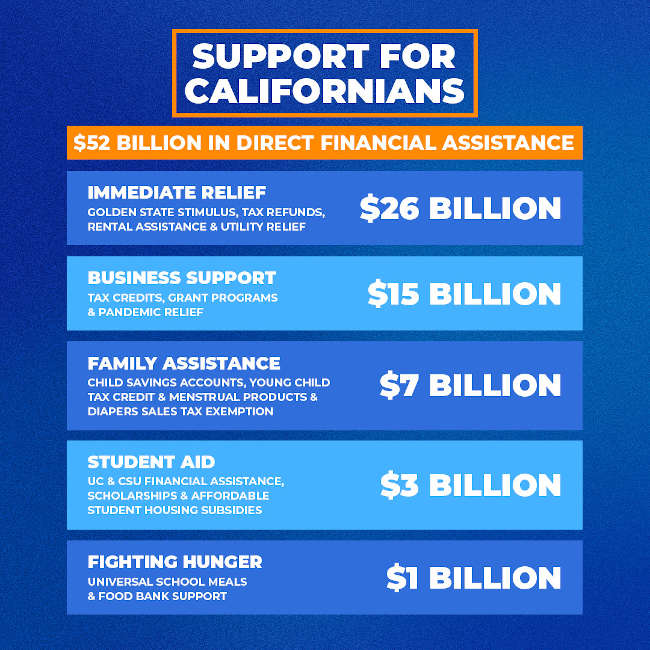
The additional $1.4 billion that Gov. Newsom and the Legislature allocated in this year’s budget will be distributed by year’s end to support Californians who are still struggling to pay the bills.
Of that amount, $1.2 billion will address residential electric utility arrearages through the Department of Community Services and Development to mitigate the outstanding debt leading to increased utility rates, and $200 million will address residential water and wastewater arrearages – complementing $116 million in federal funding for water and wastewater arrearages.
“No other state in America did as much for those struggling during the pandemic than California, with tens of billions of dollars for stimulus checks, small business relief, and past-due rent and utility bills to help Californians. We got $1.4 billion out the door to help 2.2 million families with overdue utility bills and we’re sending another $1.4 billion to support those who are still struggling amid rising costs,” said Gov. Newsom.
This is an important part of Gov. Newsom’s financial relief package to help support Californians who are dealing with higher costs right now.
This builds upon last year’s Golden State Stimulus, which distributed $9 billion to millions of California families, and the billions that went to help Californians pay their rent, cover overdue utility bills and support small businesses.
For the utility relief that went out already:
•The Department of Community Services and Development provided assistance for electric and gas utility bills for more than 1.4 million households and commercial customers, distributing $989 million throughout the pandemic.
•The State Water Resources Control Board covered unpaid water bills for more than 800,000 residential and commercial customers, distributing $435 million in just 10 months for debt accrued during the pandemic.
LAKE COUNTY, Calif. — California could be facing dry conditions this winter thanks to predictions for another La Niña year.
Long-range forecasts from the National Weather Services and AccuWeather show that this is expected to be the third California winter in a row impacted by the La Niña climate phenomena — or, as AccuWeather called it, a “triple dip La Niña.”
A La Niña occurs when water near the equator is cooler than normal. That, in turn, impacts the jet stream — described by the National Weather Service as a narrow band of strong wind in the upper levels of the atmosphere — and so affects overall weather patterns.
That’s in contrast to El Niño, when conditions in the eastern Pacific are unusually warm.
That triple dip La Niña is similar to what California experienced last year, Carl Erikson, senior meteorologist for AccuWeather, told Lake County News in a Monday interview.
In its winter forecast, released last week, AccuWeather noted, “The triple-dip La Niña expected this winter is just the second of its kind in recent history, joining the winter of 2000-2001 as the only winters where the climate phenomenon persisted for so long.”
However, this year’s La Niña may not last the entire winter. “We do expect the La Niña to continue through at least the first half of the winter,” Erikson said, noting there are indications it may begin to weaken in winter’s second half.
What that means for California is that forecasters expect a mild start to the winter, with above-average temperatures and below-average precipitation, which could exacerbate the current drought conditions, he said.
It’s also expected to be a winter with a below-normal snowpack, Erickson said.
Erikson said forecasters are expecting a storm track north of California, in the Pacific Northwest and British Columbia.
There may be more storm activity after the start of the new year.
Erickson said that while the general trend will be for storms further north, during the early part of 2023, there may be more of a southerly storm track that will develop in California. That, in turn, could bring rain and melted snow.
That’s also the best chance for rain to get as far south as Southern California, Erikson said.
Likewise, the National Weather Service’s long-range forecast shows that parts of California, including Lake County, could have above average temperatures and below-average rainfall, but the agency warns that such forecasts are rarely accurate due to their length and so can change.
AccuWeather’s winter forecast reported that another factor could be impacting the coming winter weather — the January eruption of an underwater volcano, Hunga Tonga-Hunga Ha’apai, located 2,200 miles northeast of Sydney, Australia.
That eruption caused water vapor to increase in the stratosphere; that water vapor acts like a blanket that traps warmer air underneath it.
The AccuWeather forecast noted that the eruption “could indirectly help to fortify the polar vortex over the North Pole, preventing it from dipping down across North America,” adding that it’s not yet known if the eruption will have a “a significant impact on the winter forecast or other seasonal forecasts in the future.”
Email Elizabeth Larson atThis email address is being protected from spambots. You need JavaScript enabled to view it. . Follow her on Twitter, @ERLarson, or Lake County News, @LakeCoNews.
Long-range forecasts from the National Weather Services and AccuWeather show that this is expected to be the third California winter in a row impacted by the La Niña climate phenomena — or, as AccuWeather called it, a “triple dip La Niña.”
A La Niña occurs when water near the equator is cooler than normal. That, in turn, impacts the jet stream — described by the National Weather Service as a narrow band of strong wind in the upper levels of the atmosphere — and so affects overall weather patterns.
That’s in contrast to El Niño, when conditions in the eastern Pacific are unusually warm.
That triple dip La Niña is similar to what California experienced last year, Carl Erikson, senior meteorologist for AccuWeather, told Lake County News in a Monday interview.
In its winter forecast, released last week, AccuWeather noted, “The triple-dip La Niña expected this winter is just the second of its kind in recent history, joining the winter of 2000-2001 as the only winters where the climate phenomenon persisted for so long.”
However, this year’s La Niña may not last the entire winter. “We do expect the La Niña to continue through at least the first half of the winter,” Erikson said, noting there are indications it may begin to weaken in winter’s second half.
What that means for California is that forecasters expect a mild start to the winter, with above-average temperatures and below-average precipitation, which could exacerbate the current drought conditions, he said.
It’s also expected to be a winter with a below-normal snowpack, Erickson said.
Erikson said forecasters are expecting a storm track north of California, in the Pacific Northwest and British Columbia.
There may be more storm activity after the start of the new year.
Erickson said that while the general trend will be for storms further north, during the early part of 2023, there may be more of a southerly storm track that will develop in California. That, in turn, could bring rain and melted snow.
That’s also the best chance for rain to get as far south as Southern California, Erikson said.
Likewise, the National Weather Service’s long-range forecast shows that parts of California, including Lake County, could have above average temperatures and below-average rainfall, but the agency warns that such forecasts are rarely accurate due to their length and so can change.
AccuWeather’s winter forecast reported that another factor could be impacting the coming winter weather — the January eruption of an underwater volcano, Hunga Tonga-Hunga Ha’apai, located 2,200 miles northeast of Sydney, Australia.
That eruption caused water vapor to increase in the stratosphere; that water vapor acts like a blanket that traps warmer air underneath it.
The AccuWeather forecast noted that the eruption “could indirectly help to fortify the polar vortex over the North Pole, preventing it from dipping down across North America,” adding that it’s not yet known if the eruption will have a “a significant impact on the winter forecast or other seasonal forecasts in the future.”
Email Elizabeth Larson at
UPPER LAKE, Calif. — Upper Lake’s “Fall Festival” will take place on Saturday, Oct. 8.
The event will take place from 10 a.m. to 4 p.m. on Main Street.
The day starts with the homecoming parade at 10 a.m.
The downtown will be filled with music, food, a beer booth, arts and crafts vendors, and raffle items.
The festival will end with the Upper Lake High School Homecoming Football game at 6 p.m.
Come and support the school and show some community spirit.
For more information, emailThis email address is being protected from spambots. You need JavaScript enabled to view it. or call Katie at Upper Lake Grocery, 707-275-4018.
The event will take place from 10 a.m. to 4 p.m. on Main Street.
The day starts with the homecoming parade at 10 a.m.
The downtown will be filled with music, food, a beer booth, arts and crafts vendors, and raffle items.
The festival will end with the Upper Lake High School Homecoming Football game at 6 p.m.
Come and support the school and show some community spirit.
For more information, email
LAKE COUNTY, Calif. — The East Region Town Hall, or ERTH, will meet on Wednesday, Oct. 5.
The meeting will begin at 4 p.m. at the Moose Lodge, located at 15900 Moose Lodge Lane in Clearlake Oaks.
The meeting can be attended in person or via Zoom; the meeting ID is 935 8339 6020, the pass code is 448228.
On Wednesday, the guest speaker will be Lake County Director of Community Development Director Mireya Turner.
Turner will give updates on the Clearlake Oaks Roadmap Task Force, discuss data tracking system and code enforcement complaint entry improvement and the Cannabis Ordinance Task force.
Holly Harris also will speak about the Environmental Protection Agency’s public outreach on the Sulphur Bank Mine Superfund site.
The agenda also includes the monthly updates on Spring Valley, commercial cannabis cultivation, the consolidated lighting district in Clearlake Oaks, the Lake County geothermal project watchlist, the Northshore Fire Protection District, the John T. Klaus 1994 Trust’s land donation for a new Clearlake Oaks park and they will get a report from Supervisor EJ Crandell.
ERTH’s members are Denise Loustalot, Jim Burton, Tony Morris and Pamela Kicenski.
For more information visit the group’s Facebook page.
The meeting will begin at 4 p.m. at the Moose Lodge, located at 15900 Moose Lodge Lane in Clearlake Oaks.
The meeting can be attended in person or via Zoom; the meeting ID is 935 8339 6020, the pass code is 448228.
On Wednesday, the guest speaker will be Lake County Director of Community Development Director Mireya Turner.
Turner will give updates on the Clearlake Oaks Roadmap Task Force, discuss data tracking system and code enforcement complaint entry improvement and the Cannabis Ordinance Task force.
Holly Harris also will speak about the Environmental Protection Agency’s public outreach on the Sulphur Bank Mine Superfund site.
The agenda also includes the monthly updates on Spring Valley, commercial cannabis cultivation, the consolidated lighting district in Clearlake Oaks, the Lake County geothermal project watchlist, the Northshore Fire Protection District, the John T. Klaus 1994 Trust’s land donation for a new Clearlake Oaks park and they will get a report from Supervisor EJ Crandell.
ERTH’s members are Denise Loustalot, Jim Burton, Tony Morris and Pamela Kicenski.
For more information visit the group’s Facebook page.
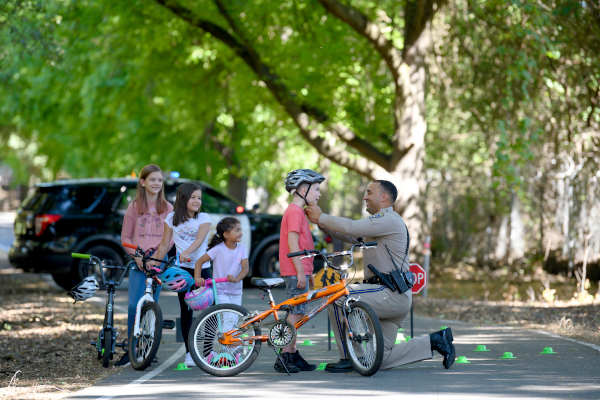
A federal grant is helping the California Highway Patrol increase pedestrian and bicyclist safety throughout the state.
The CHP was awarded $1.2 million in grant funding through the Bicycle and Pedestrian Safety, Education, Enforcement, and Awareness Program, or BESEEN, program.
“The most vulnerable roadway users are pedestrians and bicyclists,” CHP Commissioner Amanda Ray said. “This grant will promote the importance of drivers, bicyclists, and pedestrians looking out for one another so that everyone can safely share the road.”
In California, nearly 20 percent of all traffic-related deaths are pedestrian and bicycle fatalities. In 2020 and 2021 combined, 926 of the 4,651 people killed in crashes throughout CHP jurisdiction were pedestrians and bicyclists.
This grant launches a yearlong effort to educate and enforce traffic safety laws for drivers, bicyclists, and pedestrians through Sept. 30, 2023.
Enforcement patrols will focus on areas with higher bicyclist and pedestrian traffic and crashes. Officers will also conduct public awareness campaigns in communities throughout the state.
In addition, this grant funds bicycle safety training and educational presentations to promote safe and courteous traffic safety behaviors by drivers and bicyclists, as well as safety publications, bicycle helmets, reflective gear, and other vital safety equipment.
October is National Pedestrian Safety Month with National Walk to School Day on Oct. 12, 2022.
CHP officers in plainclothes will work with uniformed officers to monitor crosswalks and areas surrounding schools for motorists who fail to yield the right-of-way or who take unsafe and illegal actions.
Funding for this program was provided by the California Office of Traffic Safety through a grant from the National Highway Traffic Safety Administration.
The mission of the CHP is to provide the highest level of safety, service and security.