 How to resolve AdBlock issue?
News
Marriage confers important rights and obligations on spouses. One of the rights is that of the surviving spouse’s rights in the deceased spouse’s estate.
In California, couples prior to marriage and during marriage can agree that the surviving spouse waive certain inheritance rights in a deceased spouse’s estate (Probate Code sections 141-147).
Upon divorce, a surviving ex-spouse is presumed by California law to have predeceased the former spouse for purposes of inheritance rights.
A waiver in advance of a spouse’s death of surviving spouse’s rights in the deceased spouse’s estate could be agreed-upon by married persons who are dissolving their marriage or who are in (or going into) second marriages and want to protect their own children’s inheritances.
Section 141 of the Probate Code states ten different ten important rights in the deceased spouse’s estate that a surviving spouse may waive, either in whole or in part.
Such spousal rights include the important right to inherit as an heir by intestate succession (if the deceased spouse had no will); the right to inherit as a beneficiary under the deceased spouse’s will executed before the waiver; the right to reside in a probate homestead; the right to a Family allowance for the surviving spouse to live; the right to take the statutory share of an omitted spouse when the deceased spouse’s will does not acknowledge the surviving spouse; and the right to be appointed as the personal representative of the decedent’s estate.
To be valid the waiver must be in writing and be signed by the surviving spouse. The waiver can either be created by an express waiver of “all rights” (such as in a pre or post marital agreement) or by a complete property settlement entered into after or in anticipation of separation or dissolution or annulment of marriage (section 145 Probate Code).
In Brendon Welch, et. al., v. Freeman H. Welch (Second Appellate District, B311507) the court enforced a waiver in marital property agreement that was reached in a mediation conference within a dissolution court proceeding.
Before the court ordered distribution of the property, the family court lost its jurisdiction when the wife died. However, the probate court found that because there was a complete settlement in anticipation of dissolution of marriage the spousal waiver in the agreement was enforceable.
A signed waiver is enforceable against the surviving spouse if the surviving spouse both received fair and reasonable disclosure of the property and financial obligations of the deceased spouse (unless waived after advice of the surviving spouse’s independent counsel) and the surviving spouse was represented by independent counsel. This is to be completely fair to the surviving spouse.
An otherwise unenforceable waiver may sometimes still be enforceable at the discretion of a court. That is, if the court finds that the waiver was fair and reasonable to the surviving spouse’s rights at the time it was signed. Or, if the court finds that the surviving spouse knew (or reasonably should have known) about the property and financial obligations of the deceased spouse; provided, however, that the deceased spouse did not violate his or her spousal duty of the utmost fair dealing with the surviving spouse.
Still, a court in exercising its discretion whether to enforce a waiver, under the exception, must also consider all relevant facts and circumstances surrounding the original signing of the waiver and determine if it would be unconscionable at time of its enforcement.
If it would now be unconscionable at time of enforcement then the court has the following options: Not to the enforce the waiver; not to enforce the unconscionable part of the surviving spouse’s waiver; or partially not enforce the unconscionable part and so avoid the unconscionable result.
The foregoing discussion shows how estate planning and family law intersect at the planning crossroads regarding the surviving spouse’s rights in the deceased spouse’s estate.
The foregoing discussion is not legal advice. Consult a qualified attorney if engaged in such planning.
Dennis A. Fordham, attorney, is a State Bar-Certified Specialist in estate planning, probate and trust law. His office is at 870 S. Main St., Lakeport, Calif. He can be reached at
What's up for October? Evenings with giants, Mars changes course, and meteors from Orion.
Giant planets Jupiter and Saturn are visible throughout the night in October. Early in the evening, you'll find them to the southeast, moving slowly westward with the stars over the course of the night. They form a triangle with bright star Fomalhaut.
When observing this trio, note how the planets shine with a steady light, while the star twinkles. This can be an easy way to know if what you're looking at is a planet or a star.
Mars has been steadily working its way toward the east all year like it usually does, relative to the background stars. But at the end of October, Mars halts this apparent motion, and then appears to reverse course.
Over the next three months, from November to late January, Mars moves toward the west each night. Then near the end of January, it reverses direction again, and continues its eastward journey.
This is what's called the retrograde motion of Mars. It happens about every two years, and it really threw early observers for a loop. That Mars appears to change its direction is an illusion caused by the motions of our planet in its orbit passing by the Red Planet in its orbit.
See, Earth and Mars are on these roughly circular paths around the Sun, like cars on a racetrack, and Earth is on the inner, faster track. About every 26 months, we overtake Mars, which is moving slower in its orbit.
During that period when we're passing Mars, and before we round the bend in our orbit to pull away from it, we see Mars in retrograde, appearing to change direction, even though it's still moving forward in its orbit.
So take note of Mars over the next few months, as it appears to reverse course. Note how its position changes with respect to Betelgeuse, Aldebaran and the Pleiades over the weeks, and you'll be witnessing what was once a source of intense curiosity for astronomers, but which we now know is just a sign of two planets passing in the night.
The Orionid meteor shower is active throughout October and November, and peaks on the night of Oct. 20. It's a moderate shower, usually producing 10-20 meteors per hour at its peak, under clear, dark skies. This year, the Moon will be about 20% full on the peak nights. So it will interfere a bit when it rises a couple of hours before dawn, but shouldn't totally spoil the viewing.
The shower's name comes from the fact that you can trace the paths of its meteors back to an area on the sky near Orion. These meteors are fragments of dust left behind by Comet Halley in a trail that extends along its orbit. They tend to be bright and fast moving, and they often leave persistent trails that can glow in the sky for a few seconds after they streak by.
No special equipment is needed to observe meteor showers. Just make sure you're warm enough, and viewing from a safe, dark spot away from bright lights. Then all you have to do is look up and enjoy the show.
Preston Dyches works for NASA's Jet Propulsion Laboratory.
CLEARLAKE, Calif. — The Clearlake Police Department is investigating the circumstances of a fatal crash on Wednesday morning that claimed the life of a pedestrian.
Police did not release the name of the crash victim, who was only identified as a 78-year-old male Clearlake resident.
The department said that at 6 a.m. Wednesday officers responded to Lakeshore Drive in front of the Veterans Affairs Clinic for a report of a traffic collision involving a vehicle and a pedestrian.
When they arrived, the officers found the collision involved a Kia Rio occupied by one person and a pedestrian.
Based on the preliminary investigation, it appears the pedestrian was walking across Lakeshore Drive in the crosswalk when he was struck by the vehicle, police said.
Police said the pedestrian sustained major injuries and was pronounced deceased at the hospital.
If you witnessed the collision, please contact Officer Nathan Williams by email atThis email address is being protected from spambots. You need JavaScript enabled to view it. or by phone at 707-994-8251.
Police did not release the name of the crash victim, who was only identified as a 78-year-old male Clearlake resident.
The department said that at 6 a.m. Wednesday officers responded to Lakeshore Drive in front of the Veterans Affairs Clinic for a report of a traffic collision involving a vehicle and a pedestrian.
When they arrived, the officers found the collision involved a Kia Rio occupied by one person and a pedestrian.
Based on the preliminary investigation, it appears the pedestrian was walking across Lakeshore Drive in the crosswalk when he was struck by the vehicle, police said.
Police said the pedestrian sustained major injuries and was pronounced deceased at the hospital.
If you witnessed the collision, please contact Officer Nathan Williams by email at
LAKE COUNTY, Calif. — Fifteen years ago the Mendocino College Foundation launched the Adopt A Fifth Grader program, which awards scholarships to fifth grade students in Lake and Mendocino counties.
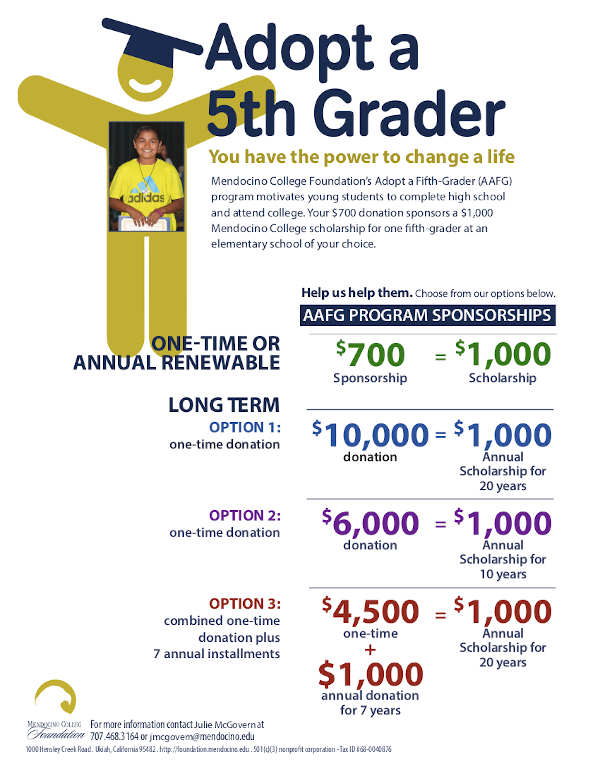
Individual donors, families, service clubs and local businesses donate $700 to “adopt” a fifth grade student; the foundation then invests that money, growing it over seven years to become a $1,000 scholarship upon the student’s graduation from high school.
What started with one student at Hopland Elementary School in 2007 has grown to 817 students across 24 elementary schools in the Mendocino-Lake Community College District as of 2022. That’s $817,000 invested in our community’s youth.
The program is the brainchild of Wade Koeninger and his late wife, Mary Lou.
When Wade Koeninger was a young man growing up in Oklahoma, he and a friend started a lawn mowing business. One of his clients had attended Yale University, and he saw promise in Koeninger, which caused him to nominate him for a scholarship to Yale.
Koeninger received the scholarship and attended Yale and it changed his life. He never forgot the man who made it possible, and became determined to provide the same type of motivation for young students in Hopland, where he and Mary Lou had relocated in 1979.
In 1989 they launched the Koeninger Elementary School Achievement Award by selecting one fifth grade student from Hopland Elementary School.
In 2007 the Koeningers partnered with the Mendocino College Foundation, where they believed the newly-named Adopt A Fifth Grader program would flourish, inspiring and attracting other local philanthropists to join the cause.
And that’s exactly what has happened. To date, more than 230 individual donors throughout Mendocino and Lake Counties have made a contribution to the Adopt A Fifth Grader program.
“Angie and I started with the AAFG program because we wanted to invest in our community’s children and if possible help them succeed in their life choices,” says long-time program donor Tom Herman about his family’s commitment.
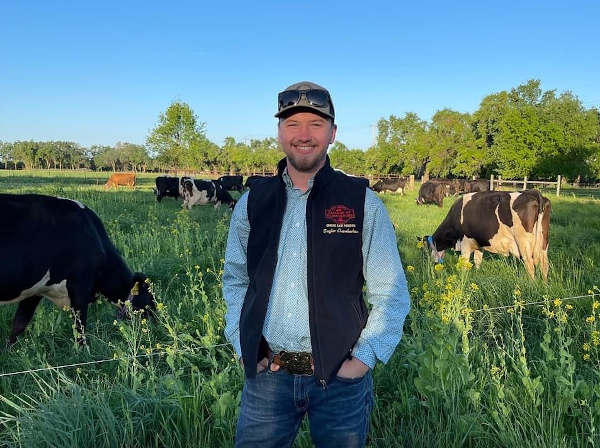
One of the students adopted by the Hermans was Tate Campbell of Laytonville, who received his award as a fifth grader at Laytonville Elementary School in 2012.
Today Campbell is a senior at Chico State majoring in animal science/prevet and has recently applied to veterinarian school. He was able to get AI Certified and is working at the school’s dairy farm.
Remembering back to when he first found out he had been selected, Campbell said, “It meant a lot to me at such a young age, knowing that I had the academic potential for people in my community to believe in me and my ability to achieve a successful future.”
He added, “Programs like this supporting young minds are beneficial to small communities like the ones in Mendocino County. They help children gain confidence in their ability to achieve their educational dreams. Ever since I was young, wanting to be a veterinarian has been my goal. Knowing what I know, that award means a lot to me and has pushed me every day since to achieve my dream.”
Tom Herman was glad to hear of Campbell’s success. “To see that Tate Campbell has chosen to become a veterinarian is, to us as horse and animal lovers, a very special reward for our involvement in the Adopt A Fifth Grader program. Tate, good luck with the next step in your career and when you are a vet, please come back to Mendocino County.”
One local service club that has really gotten behind this investment in our youth is the Rotary Club of Fort Bragg. In 2017 it made a commitment to help “adopt” every fifth grade student at Dana Gray Elementary School. The club matched all donations up to $500 with a $200 Rotary donation to get to the full $700 required for the scholarship.
That first year the club gave a total of $5,000 in matching funds for 25 fifth grade students. Five years later the Fort Bragg Rotary has provided matching funds to adopt 205 Dana Grey fifth graders, an investment of $41,000 directly benefiting local youth.
“We believe in the Adopt A Fifth Grader program’s ability to inspire young people as early as fifth grade to start thinking about and planning for their future,” says current Rotary Club of Fort Bragg President Paul Sweigart. “If we can help our local students stay on track, graduate high school, and hopefully attend Mendocino College or pursue their career goals, it’s good for our community. We all benefit when students achieve success, so Rotary sees this as a solid investment in the future.”
This past spring, as the Mendocino College Foundation Board Members and staff made the rounds to 24 schools in Mendocino and Lake counties, awarding $25 checks and scholarship certificates to all 82 of the adopted fifth graders for 2022, the program came full circle.
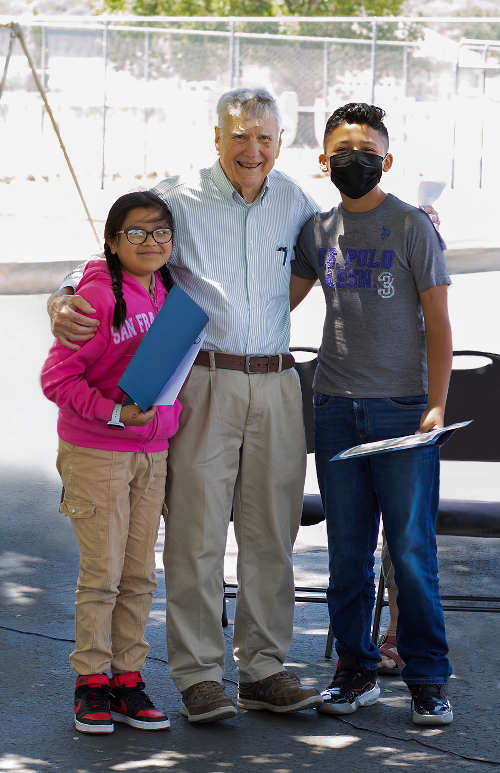
Wade Koeninger was able to attend the end of year ceremony at what was once Hopland Elementary, now brought back to life by dedicated community volunteers as Shanel Valley Academy.
He proudly awarded two Shanel Valley Academy fifth grade students, Leonardo Soto and Jennifer Sanchez, their Adopt A Fifth Grader scholarship certificates.
Earlier this year Koeninger endowed two new perpetual Adopt A Fifth Grader scholarships in honor of two women who were integral to getting the initial Hopland Elementary program off the ground: Gloria Jarrell, former Principal; and Donna Wilsey, former Secretary II.
By honoring these two dedicated women, Wade is ensuring that two fifth-grade students from Shanel Valley are awarded a $1,000 scholarship every year for the next 20 years.
The Koenigers’ premise remains both forward-thinking and simple: plant a seed in a young person’s mind that she or he is college-bound and motivate them to graduate from high school and attend college.
Anyone can help plant a seed to help grow the future of Mendocino and Lake counties by making a contribution to the Adopt A Fifth Grader Fund. Contact Julie McGovern, the executive director of the Mendocino College Foundation at 707-468-3164 or
You can also visit https://foundation.mendocino.edu/donate/ and select the Adopt A Fifth Grader option.
LAKE COUNTY, Calif. — The Lake County Registrar of Voters Office has issued an update on the Nov. 8 General Election, including when ballots will begin to arrive, and information about returning and tracking ballots.
For the Nov. 8 general election, all registered voters will be mailed a vote-by-mail ballot. Mailing of vote-by-mail ballots will begin no later than Oct. 10. Supplemental mailings will follow for newly registered or re-registered voters.
To ensure there are no delays in receiving your ballot in the mail, verify that the Registrar of Voters has your most up-to-date voter information. Visit https://voterstatus.sos.ca.gov/ or call 707-263-2372 to verify both your residential and mailing address.
Is everything correct? If not, you can update your registration by re-registering to vote at registertovote.ca.gov or by calling 707-263-2372 and requesting a voter registration form be mailed to you.
The Registrar of Voters office encourages people to vote safely at home and return your vote-by-mail ballot in one of the following ways:
• Mail your ballot on or before Election Day — no postage required.
• At any official ballot drop box location. Visit the following website at https://caearlyvoting.sos.ca.gov/ or call 707-263-2372 for locations.
• Drop it off at the Lake County Registrar of Voters office or at any polling place location within the state of California.
To track your vote-by-mail ballot, receive your personalized text message, emails or voicemails letting you know when your ballot is mailed, received and counted by the Registrar of Voters Office by subscribing to https://wheresMyBallot.sos.ca.gov.
There will be 22 polling place locations on Election Day for in-person voting. Polling place locations will be staffed for voters to drop off voted ballots or to be issued a replacement ballot from 7 a.m. to 8 p.m.
To vote in-person at your assigned polling place site on Election Day, please call the Registrar of Voters Office for instructions. You will be required to vote a provisional ballot if you are unable to surrender your vote by mail ballot and envelope.
For the Nov. 8 general election, all registered voters will be mailed a vote-by-mail ballot. Mailing of vote-by-mail ballots will begin no later than Oct. 10. Supplemental mailings will follow for newly registered or re-registered voters.
To ensure there are no delays in receiving your ballot in the mail, verify that the Registrar of Voters has your most up-to-date voter information. Visit https://voterstatus.sos.ca.gov/ or call 707-263-2372 to verify both your residential and mailing address.
Is everything correct? If not, you can update your registration by re-registering to vote at registertovote.ca.gov or by calling 707-263-2372 and requesting a voter registration form be mailed to you.
The Registrar of Voters office encourages people to vote safely at home and return your vote-by-mail ballot in one of the following ways:
• Mail your ballot on or before Election Day — no postage required.
• At any official ballot drop box location. Visit the following website at https://caearlyvoting.sos.ca.gov/ or call 707-263-2372 for locations.
• Drop it off at the Lake County Registrar of Voters office or at any polling place location within the state of California.
To track your vote-by-mail ballot, receive your personalized text message, emails or voicemails letting you know when your ballot is mailed, received and counted by the Registrar of Voters Office by subscribing to https://wheresMyBallot.sos.ca.gov.
There will be 22 polling place locations on Election Day for in-person voting. Polling place locations will be staffed for voters to drop off voted ballots or to be issued a replacement ballot from 7 a.m. to 8 p.m.
To vote in-person at your assigned polling place site on Election Day, please call the Registrar of Voters Office for instructions. You will be required to vote a provisional ballot if you are unable to surrender your vote by mail ballot and envelope.
Starting Friday, $9.5 billion in Middle Class Tax Refund payments will begin going out to Californians, with refunds of up to $1,050 that will benefit millions of eligible Californians under the largest such program in state history.
This refund program to get money back in the pockets of Californians builds upon last year’s Golden State Stimulus, which distributed $9 billion to California families, and the billions that went to help folks pay their rent, cover overdue utility bills and support small businesses.
“We know it’s expensive right now, and California is putting money back into your pockets to help. We’re sending out refunds worth over a thousand dollars to help families pay for everything from groceries to gas," said Gov. Newsom.
Payments will range from $400 to $1,050 for couples filing jointly and $200 to $700 for all other individuals depending on their income and whether they claimed a dependent. Refunds are available for ITIN filers, in addition to those who file tax returns with a SSN.
A total of 18 million payments will be distributed, benefiting up to 23 million Californians. An estimated 8 million direct deposits will start arriving in bank accounts from Oct. 7 through Nov. 14, and an estimated 10 million debit cards will be delivered from Oct. 25 through Jan. 15.
Visit this site to determine your eligibility.
“Inflated costs for everyday necessities have forced many to cut corners or make impossible choices, and pain at the pump has been compounded by the return of the commute for many Californians” said State Controller and Franchise Tax Board Chair Betty T. Yee. “As the holidays approach, my team members are thrilled to be able to get these payments into the hands of those who have been struggling, so they can enjoy a measure of relief.”
How much can you receive?
Payment amounts will be based on the CA AGI on your 2020 California state income tax return, as well as your filing status and whether you claimed a dependent. For more information, including a complete breakdown of payment amounts and a tool to estimate your payment, visit the Franchise Tax Board’s Middle Class Tax Refund website at taxrefund.ca.gov.
How you'll receive your payment
Californians will receive their MCTR payment by direct deposit or debit card. Direct deposit payments will be made to eligible taxpayers who e-filed their 2020 CA tax return and received their CA tax refund by direct deposit. In general, other MCTR payments will be issued on debit cards. Debit cards will be mailed to eligible taxpayers in an envelope prominently displaying the following wording: “Not a bill or advertisement. Important information about your Middle Class Tax Refund.” For more information regarding MCTR payments, visit taxrefund.ca.gov.
When you'll receive your payment
Direct deposit MCTR payments for Californians who received Golden State Stimulus, or GSS, I or II are expected to be issued to bank accounts from Oct. 7 through Oct. 25, with the remaining direct deposits occurring between Oct. 28 and Nov. 14. FTB expects about 90% of the MCTR direct deposits to be issued in October.
MCTR debit cards are expected to be mailed between Oct. 25 and Dec. 10 for Californians who received GSS I and II, with the balance mailed by Jan. 15, 2023.
About 95% of all MCTR payments – direct deposit and debit cards combined – are expected to be issued by the end of this year. For more information, including the most recent updates on payment schedules, visit taxrefund.ca.gov.
Debit card information
FTB is working in partnership with Money Network Financial, a Fiserv company, to assist in the distribution of MCTR debit card payments. For more information, including how to activate your card, how to check your balance, and to view images of the MCTR envelope and debit card, visit www.mctrpayment.com.
Help with the Middle Class Tax Refund
For a complete list of requirements and other MCTR information, visit taxrefund.ca.gov or call 800-542-9332.
This refund program to get money back in the pockets of Californians builds upon last year’s Golden State Stimulus, which distributed $9 billion to California families, and the billions that went to help folks pay their rent, cover overdue utility bills and support small businesses.
“We know it’s expensive right now, and California is putting money back into your pockets to help. We’re sending out refunds worth over a thousand dollars to help families pay for everything from groceries to gas," said Gov. Newsom.
Payments will range from $400 to $1,050 for couples filing jointly and $200 to $700 for all other individuals depending on their income and whether they claimed a dependent. Refunds are available for ITIN filers, in addition to those who file tax returns with a SSN.
A total of 18 million payments will be distributed, benefiting up to 23 million Californians. An estimated 8 million direct deposits will start arriving in bank accounts from Oct. 7 through Nov. 14, and an estimated 10 million debit cards will be delivered from Oct. 25 through Jan. 15.
Visit this site to determine your eligibility.
“Inflated costs for everyday necessities have forced many to cut corners or make impossible choices, and pain at the pump has been compounded by the return of the commute for many Californians” said State Controller and Franchise Tax Board Chair Betty T. Yee. “As the holidays approach, my team members are thrilled to be able to get these payments into the hands of those who have been struggling, so they can enjoy a measure of relief.”
How much can you receive?
Payment amounts will be based on the CA AGI on your 2020 California state income tax return, as well as your filing status and whether you claimed a dependent. For more information, including a complete breakdown of payment amounts and a tool to estimate your payment, visit the Franchise Tax Board’s Middle Class Tax Refund website at taxrefund.ca.gov.
How you'll receive your payment
Californians will receive their MCTR payment by direct deposit or debit card. Direct deposit payments will be made to eligible taxpayers who e-filed their 2020 CA tax return and received their CA tax refund by direct deposit. In general, other MCTR payments will be issued on debit cards. Debit cards will be mailed to eligible taxpayers in an envelope prominently displaying the following wording: “Not a bill or advertisement. Important information about your Middle Class Tax Refund.” For more information regarding MCTR payments, visit taxrefund.ca.gov.
When you'll receive your payment
Direct deposit MCTR payments for Californians who received Golden State Stimulus, or GSS, I or II are expected to be issued to bank accounts from Oct. 7 through Oct. 25, with the remaining direct deposits occurring between Oct. 28 and Nov. 14. FTB expects about 90% of the MCTR direct deposits to be issued in October.
MCTR debit cards are expected to be mailed between Oct. 25 and Dec. 10 for Californians who received GSS I and II, with the balance mailed by Jan. 15, 2023.
About 95% of all MCTR payments – direct deposit and debit cards combined – are expected to be issued by the end of this year. For more information, including the most recent updates on payment schedules, visit taxrefund.ca.gov.
Debit card information
FTB is working in partnership with Money Network Financial, a Fiserv company, to assist in the distribution of MCTR debit card payments. For more information, including how to activate your card, how to check your balance, and to view images of the MCTR envelope and debit card, visit www.mctrpayment.com.
Help with the Middle Class Tax Refund
For a complete list of requirements and other MCTR information, visit taxrefund.ca.gov or call 800-542-9332.