 How to resolve AdBlock issue?
News
The county reported that responding to reports of stray and injured animals after normal business hours is not mandated under the law, in most cases, however, Animal Care and Control has attempted to offer “the highest possible level of service” within staffing and resource limitations.
Effective immediately, weekday after-hours calls placed by dialing 707-263-0278 will receive a response the following business day.
An on-call officer will be available during weekend hours through the remainder of October: Friday at 5 p.m. to Monday at 8 a.m., Oct. 14 to 17, 21 to 24, and 28 to 31.
Starting Nov. 1, all after-hours services will be temporarily unavailable, including weekend services.
If stray injured dogs and cats are found after 5 p.m. on weekdays or on weekends, they can still be taken to local veterinarians to receive care.
Lake County Animal Care and Control is in the process of hiring more officers, and on-call services will be reinstated as soon they can be safely provided.
Training of newly-hired officers typically takes five to six months, but the agency’s sincere hope is to accelerate this process, and resume after-hours services within the first quarter of 2023.
Animal Care and Control can be reached at 707-263-0278, Monday through Friday, 8 a.m. to 5 p.m.
During this time of transition, Animal Care and Control’s contracted answering service will still be receiving calls after business hours.
Any calls received will be documented and an officer will respond the next available workday.

The California Highway Patrol will continue to expand lifesaving Spanish-language traffic safety outreach with its second El Protector — Spanish Traffic Education Program, or STEP, grant from the Office of Traffic Safety.
More than a quarter of California’s approximately 15.6 million Hispanic residents speak limited English or solely Spanish.
The El Protector program is designed to help bring traffic safety education directly to the Spanish-speaking population to reduce crashes and save lives.
Spanish-speaking officers will share traffic safety tips on Spanish media outlets and conduct traffic safety presentations with community partners at a variety of venues statewide, such as health fairs, migrant camps, businesses that employ a high number of Spanish-speaking employees and Hispanic/Latino cultural events.
Topics include the importance of seat belts/child safety restraints, the dangers of driving under the influence or being distracted behind the wheel, the primary causes of crashes, defensive driving techniques, teen/parent safe driving, driver’s license requirements, and other educational subjects.
“Making California’s roadways safer is our top priority,” said CHP Commissioner Amanda Ray. “The El Protector program strengthens the CHP’s presence with our partners in California’s Spanish-speaking communities and provides every resident with traffic safety knowledge and resources to reduce crashes and save lives.”
Funding for this program was provided by a grant from the California Office of Traffic Safety, through the National Highway Traffic Safety Administration.
Lake Family Resource Center will host the sixth annual walk on Saturday, Oct. 22, at 5350 Main St. in Kelseyville.
The event will begin at 9 a.m. and will take place, rain or shine, with participants wearing purple as they walk through town.
Lake Family Resource Center Victim Services Program Director Sheri Young said the purpose of the walk is to honor those who survived, to mourn those who have been lost and to join advocates, partners and community members throughout Lake County through visual awareness.
Those suffering as a result of domestic violence and needing help can call or text the community crisis line around the clock, seven days a week, by calling or texting 888-485-7733.
For more information about the Purple Power Walk, call 707-279-0563 or email
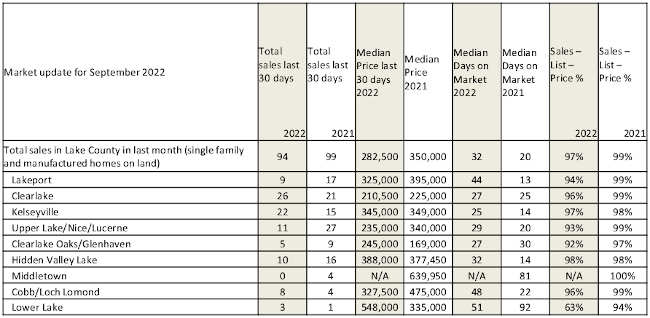
Over the month of September, the total homes sold through the multiple listing service totaled 94, compared to 99 during the same time last year.
The homes sold include traditionally built “stick-built” houses as well as manufactured homes on land.
There were five sales of mobile homes in parks compared to six for the same time last year, and 27 bare land — lots and acreage — sales, compared with 38 for the same time last year.
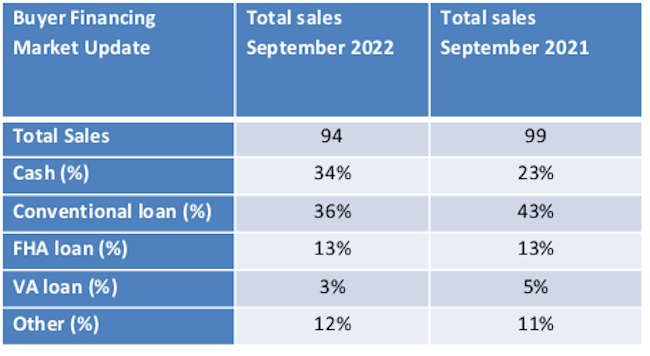
Total percentage of homes bought for all cash in September was 34%, compared to 23% for the same time last year.
Of those, 36% were financed by Fannie Mae or Freddie Mac (“conventional loans”) compared to 55% for the same time last year; 20% were financed by FHA (same as last year this time); and 3% were financed by the VA or CalVet (unchanged from this time last year); 6% had other financing such as private loans or seller financed notes (compared to 9% last year at this time).
There are 416 homes on the market right now. If the rate of sales stays the same at 94 homes sold per month, there are 4.4 months of inventory on the market at the moment compared to 5.2 months of inventory a month ago. That means that if no new homes are brought to the market for sale, in 4.4 months all of these homes would be sold and there would be none available.
Less than six months of inventory is generally considered to be a “sellers’ market” while more than six months of inventory is often called a “buyers’ market.”
The inventory had been growing steadily from March through August, but last month stopped that trend.
Most homes were selling very close to the asking price, at an average of 96% of the asking price.
This is in contrast to other areas, where homes sell for more than the asking price.
The median time on the market last month was 32 days, compared to 20 days for this time last year.
The median sale price of a single family home in Lake County over the last 30 days was $282,500, a drop from last month’s $300,000, and lower than $350,000 during this time period last year.
In the past 30 days, 33% of homes sold had seller concessions for an average of $8,201; a year ago, 24% of homes sold had an average seller concession of $5,991.
A more detailed breakdown by the different areas is below.
Fire Prevention Week this year is Oct. 9 to 15.
This year’s theme brings quick action safety measures front of mind for residents to utilize in the event of a home fire.
Cal Fire urges all residents to incorporate this year’s Fire Prevention Week theme because homes can burn fast. In some instances, you may have as little as two minutes or less to safely escape a home fire once the smoke alarm sounds.
After all, you plan for vacations, holidays, and weekly meals, why not plan to save your life and those around you in the event of a home fire?
“Too many lives are lost in home fires each year in California,” said State Fire Marshal Chief Mike Richwine. “According to a newly-released National Fire Protection Association report, U.S. home fire deaths hit a 14-year high last year, marking the critical importance of Fire Prevention Week and the reminder to plan and practice a home fire escape so that action can be taken when the smoke alarm sounds.”
There are two key factors critical to safely escaping a home fire: early warning from smoke alarms and advance planning.
Accordingly, this year’s Fire Prevention Week concept offers a blueprint to guide you and yours safely and swiftly out of a home fire. Invest a little time now so that you and yours are ready for the fire that won’t wait.
Some action items you can take to equip your home and plan your escape are:
• Make the first Saturday of each month “Smoke Alarm Saturday” - a working smoke alarm will clue you in that there is a fire, and you need to escape.
• Strategically install smoke alarms in every sleeping room, outside each sleeping area, every level of the home and the basement.
• Test the alarms regularly by pressing the test button and change the battery if there’s no sound or the sound is low. If your smoke alarm chirps, change the battery immediately.
• Develop a home fire escape plan and rehearse it with all family members at least twice a year!
• Map the escape route including windows and doors—make sure the route is free of obstacles.
• Predetermine an outside meeting place that’s a safe distance in front of your home.
• Everyone should know the fire department’s emergency number and how to call when they’re safely outside.
For more information about Fire Prevention Week and general fire prevention practices, visit www.fpw.org.
As fall temperatures cool across the U.S., many schools will struggle to ventilate classrooms while also keeping students and teachers comfortable and healthy. Children and teachers spend over six hours a day in classrooms during the school year, often in buildings that are decades old and have inadequate heating, ventilation and air conditioning, or HVAC, systems.
Fall 2022 marks the start of the fourth school year affected by the COVID-19 pandemic, which has spotlighted the importance of indoor air quality in schools. Ideally, all school buildings would have adequate ventilation, filtered air in each classroom and windows that open. Sadly, this is not the case – and indoor air quality in many schools is poor as a result. This is especially problematic in the wake of the U.S. Centers for Disease Control and Prevention’s August 2022 COVID-19 guidance for schools, which scales back other measures for limiting transmission, such as masking, testing and quarantining.
Beyond minimizing COVID-19 transmission, indoor air quality also matters for student academic performance. This is especially important given the learning losses that many children experienced in the first two years of the pandemic. Hot, stuffy classrooms make it harder for students to learn. So do cold classrooms.
Our research focuses on indoor environments and health – an area that has received increased attention during the pandemic, since most COVID-19 transmission occurs through shared air indoors. There is ample evidence that smart investments in school buildings can reduce transmission of infectious disease, while also improving learning and increasing well-being for students, teachers and administrators.
Many school districts have limited resources and buildings in poor condition. Where should they start? Here are some priorities we see for immediate action and longer-term investments that can truly transform the school experience.
Filters and fresh air
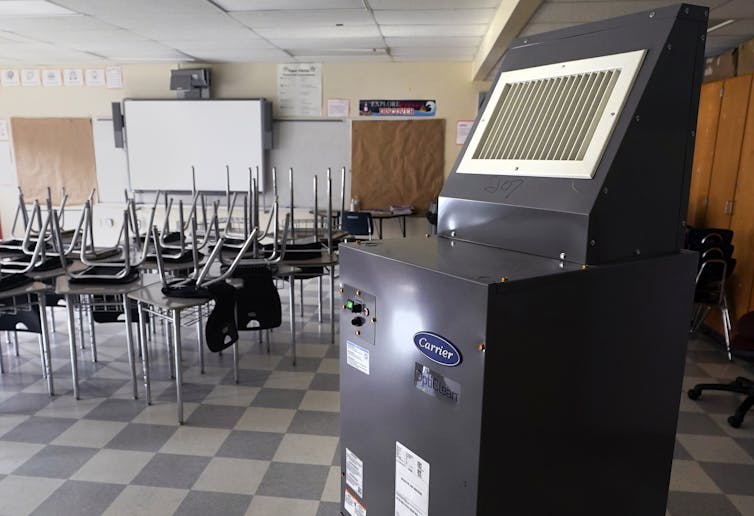
Since the spring of 2020, schools have invested millions of dollars in interventions to reduce COVID-19 transmission, including high-efficiency, free-standing commercial filter units and ventilation upgrades. These actions are a drop in the bucket, given the structural improvements needed in many schools, especially in less wealthy school districts, but they are an important start. And their benefits extend beyond COVID-19, so they should not be discarded.
For example, high-efficiency filters – including commercial units, DIY boxes or filters with ratings of MERV-13 for HVAC systems – capture flu and common cold viruses as well as SARS-CoV-2 virus particles. They also clean the air of pollen particles, mold spores and pollution from car exhaust and industrial operations. And in areas where wildfires are common, filters reduce the concentration of smoke particles inside buildings.
Schools with mechanical ventilation have been able to increase the amount of filtered fresh air that these systems pull indoors. This dilutes all indoor pollutants. For kids and school staff, particularly those with asthma, allergies and sensitivities, this can mean fewer missed days of school, less medication, and fewer asthma attacks and subsequent trips to the hospital.
Improved ventilation can actually increase learning and attention. A 2010 study showed that kids performed better on standardized tests when ventilation rates were higher. Poor ventilation may also affect teachers: A 2016 study found that office workers’ cognitive performance improved when they were exposed to lower carbon dioxide levels, which is a marker of better ventilation. And a 2018 analysis showed that students’ performance on school tests declined on hot days, especially in schools without air conditioning. If you’ve ever felt that it was hard to concentrate in a hot, stuffy room, the science backs you up.
For now, we recommend that schools that have put improvements in place should maintain increased ventilation rates with maximum fresh air, continue to use high-efficiency filters in their HVAC systems and keep free-standing filters running in classrooms. Schools that have not invested in these steps should do so, with states providing funding to lower-resourced districts as needed. The costs of these steps are modest compared with the benefits they provide for health and learning.
Families and staff who want to improve conditions in their schools should focus on providing every classroom with improved ventilation and filtration, including building DIY boxes, if necessary.
Funding for healthier buildings
These near-term solutions can help, but the best way to ensure that schools provide healthy conditions for learning is by investing in healthier buildings.
Funds for this purpose are available now. All U.S. states have received millions of dollars from the American Rescue Plan, enacted in 2021 to address the impact of COVID-19, including Elementary and Secondary Schools Emergency Relief, or ESSER, funds. The Department of Education has disbursed US$122 billion to help schools prevent the spread of COVID-19 and operate safely.
School districts have used this money to address a variety of needs, including staffing, academic support and mental health, but much of it is still available. And only a handful of states have invested in HVAC. According to a review by the independent Brookings Institution, less than 5% of the money from the most recent round of ESSER funds had been spent through the first quarter of 2022.
Another $3 billion was authorized in the recently enacted Inflation Reduction Act for environmental and climate justice block grants. These can be used to upgrade buildings and ventilation systems to reduce indoor air pollution.
School districts may be tempted to put indoor air interventions on the back burner, given widespread perceptions that the pandemic is over and the many other challenges they face. But in our view, other educational interventions will be less effective if kids are frequently absent due to illness or unable to concentrate in the classroom.
We believe it is important for families and staff to understand the benefits that healthy indoor learning environments offer to everyone who spends time in school buildings, and to hold states and school districts accountable for investing now in HVAC improvements for healthier school buildings.
Patricia Fabian, Associate Professor of Environmental Health, Boston University and Jonathan Levy, Professor and Chair, Department of Environmental Health, Boston University
This article is republished from The Conversation under a Creative Commons license. Read the original article.