 How to resolve AdBlock issue?
News

The Federal Reserve’s decision to hold rates steady signals that central bankers believe it is time to hit pause, at least temporarily, on their aggressive campaign to tame runaway inflation.
The latest data, not to mention several other factors, however, suggests it’s time for a full stop.
On June 14, 2023, the Fed chose not to lift rates for the first time in 11 meetings, leaving its target interest rate – a benchmark for borrowing costs across the global economy – at a range of 5% to 5.25%. Over 10 consecutive hikes beginning in March 2022, the Fed had raised rates a whopping 5 percentage points.
“Holding the target range steady at this meeting allows the committee to assess additional information and its implications for monetary policy,” the central bank said in a statement. The Fed indicated it still expects to raise rates two more times by the end of the year.
As an economist who follows the central bank’s actions closely, I believe there’s good reason to think the Fed’s brief hiatus is likely to turn into a permanent vacation.
Inflation is lower than it appears
The fastest rate of inflation since the 1980s is what prompted the Fed to hike interest rates so much. So it makes sense that inflation would be a key indicator of when its job is complete.
The latest consumer price index data, released on June 13, showed core inflation – the Fed’s preferred measure, which excludes volatile food and energy prices – falling to an annual rate of 5.3% in May 2023, the slowest pace since November 2021. That’s down from a peak of 6.6% in September 2022.
While the data shows inflation remains well above the Fed’s target of around 2%, there’s good reason to believe that it will continue to fall regardless of what the Fed does.
Shelter, a measure of the cost of owning or renting a home, is the largest component of the consumer price index, accounting for more than one-third of the total. In its latest report, the Bureau of Labor Statistics reported shelter costs rose 8% from a year ago. After stripping that out, inflation was up just 2.1%.
The thing is, the data reported by the bureau doesn’t reflect the reality of what’s happening in the current housing market.
The Bureau of Labor Statistics relies on a survey that gauges rental prices from 50,000 leases, many of which were signed during the rental bubble in 2021 and 2022. A better measure of current market rents is the Zillow Observed Rent Index. That index suggests rates are declining – rents rose 4.8% year over year in May, aligning with pre-pandemic rates.
Comparing the two measures suggests the official consumer price index data lags behind the market by four to six months. Using current rents would put inflation much closer to where the Fed wants it to be. Jason Furman, former chair of the government’s Council of Economic Advisors, created a modified version of core inflation – which uses a market-based measure of shelter prices – at 2.6%.

The risk of more rate hikes
Moreover, it is likely that further rate hikes will do more harm than good – particularly to the banking sector – and without helping lower inflation below its current trajectory.
Several regional lenders, including Silicon Valley Bank and First Republic, collapsed earlier this year following bank runs. Combined, they had over a half-trillion dollars in assets.
While there were several factors behind the banks’ demise, an important one was the Fed’s aggressive rate hikes, which caused the value of many of their assets to fall. The banks catered to depositors with accounts that exceeded the US$250,000 threshold protected by the Federal Deposit Insurance Corporation. These depositors ran for the hills when they learned about the extent of the bank losses.
This turmoil, in tandem with higher rates, is also cooling business activity. This means the Fed doesn’t need to go as high on rates as it otherwise would have.
Further troubles loom over the banking sector. In recent days, notable figures in the finance industry, such as Goldman Sachs CEO David Solomon and former U.S. Treasury Secretary Larry Summers, have warned that nearly $1.5 trillion in commercial real estate loans will require refinancing over the next three years.
The combination of already high interest rates and low office occupancy rates will likely force banks to absorb hundreds of billions of dollars in loan losses, inevitably putting more banks on the brink of failure.
And if the Fed keeps raising rates, the situation is likely to get a lot worse.
Don’t make the same mistakes
The Fed was behind the curve in 2021 and 2022 in realizing inflation was getting out of control, and it has been historically slow in recognizing the impact of rental rates on inflation.
The June pause in raising rates should give the Fed time to take a break, look at the data and, I hope, realize inflation is closer to its target than it appears.
But if it continues to raise rates, I believe the central bank will be repeating the same mistakes it made in the past.
Ryan Herzog, Associate Professor of Economics, Gonzaga University
This article is republished from The Conversation under a Creative Commons license. Read the original article.

Phosphorus, a key chemical element for many biological processes, has been found in icy grains emitted by the small moon and is likely abundant in its subsurface ocean.
Using data collected by NASA’s Cassini mission, an international team of scientists has discovered phosphorus — an essential chemical element for life — locked inside salt-rich ice grains ejected into space from Enceladus.
The small moon is known to possess a subsurface ocean, and water from that ocean erupts through cracks in Enceladus’ icy crust as geysers at its south pole, creating a plume. The plume then feeds Saturn’s E ring (a faint ring outside of the brighter main rings) with icy particles.
During its mission at the gas giant from 2004 to 2017, Cassini flew through the plume and E ring numerous times. Scientists found that Enceladus’ ice grains contain a rich array of minerals and organic compounds — including the ingredients for amino acids — associated with life as we know it.
Phosphorus, the least abundant of the essential elements necessary for biological processes, hadn’t been detected until now.
The element is a building block for DNA, which forms chromosomes and carries genetic information, and is present in the bones of mammals, cell membranes, and ocean-dwelling plankton.
Phosphorus is also a fundamental part of energy-carrying molecules present in all life on Earth. Life wouldn’t be possible without it.
“We previously found that Enceladus’ ocean is rich in a variety of organic compounds,” said Frank Postberg, a planetary scientist at Freie Universität Berlin, Germany, who led the new study, published on Wednesday, June 14, in the journal Nature. “But now, this new result reveals the clear chemical signature of substantial amounts of phosphorus salts inside icy particles ejected into space by the small moon’s plume. It’s the first time this essential element has been discovered in an ocean beyond Earth.”
Previous analysis of Enceladus’ ice grains revealed concentrations of sodium, potassium, chlorine, and carbonate-containing compounds, and computer modeling suggested the subsurface ocean is of moderate alkalinity – all factors that favor habitable conditions.

Enceladus and beyond
For this latest study, the authors accessed the data through NASA’s Planetary Data System, a long-term archive of digital data products returned from the agency’s planetary missions. The archive is actively managed by planetary scientists to help ensure its usefulness and usability by the worldwide planetary science community.
The authors focused on data collected by Cassini’s Cosmic Dust Analyzer instrument when it sampled icy particles from Enceladus in Saturn’s E ring. Many more ice particles were analyzed when Cassini flew through the E ring than when it went through just the plume, so the scientists were able to examine a much larger number of compositional signals there.
By doing this, they discovered high concentrations of sodium phosphates – molecules of chemically bound sodium, oxygen, hydrogen and phosphorus – inside some of those grains.
Co-authors in Europe and Japan then carried out laboratory experiments to show that Enceladus’ ocean has phosphorus, bound inside different water-soluble forms of phosphate, in concentrations of at least 100 times that of our planet’s oceans. Further geochemical modeling by the team demonstrated that an abundance of phosphate may also be possible in other icy ocean worlds in the outer solar system, particularly those that formed from primordial ice containing carbon dioxide, and where liquid water has easy access to rocks.
“High phosphate concentrations are a result of interactions between carbonate-rich liquid water and rocky minerals on Enceladus’ ocean floor and may also occur on a number of other ocean worlds,” said co-investigator Christopher Glein, a planetary scientist and geochemist at Southwest Research Institute in San Antonio, Texas. “This key ingredient could be abundant enough to potentially support life in Enceladus’ ocean; this is a stunning discovery for astrobiology.”
Although the science team is excited that Enceladus has the building blocks for life, Glein stressed that life has not been found on the moon – or anywhere else in the solar system beyond Earth: “Having the ingredients is necessary, but they may not be sufficient for an extraterrestrial environment to host life. Whether life could have originated in Enceladus’ ocean remains an open question.”
Cassini’s mission came to an end in 2017, with the spacecraft burning up in Saturn’s atmosphere, but the trove of data it collected will continue to be a rich resource for decades to come. When it was launched, Cassini’s mission was to explore Saturn, its rings, and moons. The flagship mission’s array of instruments ended up making discoveries that continue to impact far more than planetary science.
“This latest discovery of phosphorus in Enceladus’ subsurface ocean has set the stage for what the habitability potential might be for the other icy ocean worlds throughout the solar system,” said Linda Spilker, Cassini’s project scientist at NASA’s Jet Propulsion Laboratory in Southern California, who was not involved in the study. “Now that we know so many of the ingredients for life are out there, the question becomes: Is there life beyond Earth, perhaps in our own solar system? I feel that Cassini’s enduring legacy will inspire future missions that might, eventually, answer that very question.”
The Cassini-Huygens mission was a cooperative project of NASA, ESA (European Space Agency), and the Italian Space Agency. JPL, a division of Caltech in Pasadena, California, managed the mission for NASA’s Science Mission Directorate in Washington. JPL designed, developed, and assembled the Cassini orbiter.
For more information about Cassini, visit http://www.nasa.gov/cassini and http://saturn.jpl.nasa.gov.


LAKE COUNTY, Calif. — Nearly two months after he originally was set to have been sentenced for killing his employer, an Occidental man on Thursday morning was given decades in state prison.
Judge J. David Markham handed down to 27-year-old Nova Maye Deperno a sentence of 35 years to life for the August 2021 killing of 63-year-old Ronald Meluso of Lucerne.
During the Thursday hearing, Deperno — who had surprised his attorney before — did so again by insisting, against his attorney’s advice, on giving a statement to the court that attempted to justify his actions. To do that, he claimed childhood hardships and even blamed his victim.
Judge Markham wasn’t impressed by Deperno’s claims, and said he should have listened to his attorney and not spoken at all.
“The guy is a manipulative, dangerous psychopath, I think,” Chief Deputy District Attorney Richard Hinchcliff, who prosecuted Deperno, told Lake County News later on Thursday.
The sentence Markham handed down was the result of a plea agreement reached earlier this year between the District Attorney’s Office and Deperno’s attorney, Kevin Davenport. It gives Deperno 25 years to life for Meluso’s death, with another 10 years for an enhancement for use of a gun in the killing.
Meluso had given Deperno a place to stay and a job in the lead up to the murder, which occurred during a seven-month-long spree of crimes committed by Deperno from July 2020 to February 2021.
During that time, Deperno’s crimes — which involved several victims — included assault with a firearm, vandalism, felony evading of law enforcement, negligent discharge of a firearm due to shooting into a home and threats, including telling victims he was a member of the Mexican and Italian mafias.
In one case, Deperno told a young woman he planned to kill and dismember her, and sell her body parts to the Mexican mafia.
During Thursday’s sentencing hearing, Hinchcliff said Deperno had bragged in texts to friends that he intended to kill Meluso before luring him to a remote area in the hills above Nice and fatally shooting him.
Hinchcliff told Lake County News that a motivation for the crime was that Deperno needed money.
Information the prosecution developed during the investigation was that Meluso was running from Deperno when he was shot and that he was shot in the back.
However, Hinchcliff said they couldn’t prove that as when they found Meluso’s remains five months later, there were just a few bones left.
Deperno was arrested in Occidental on Jan. 13, 2022, after a manhunt and with the help of a SWAT team. The following day, he led authorities to the site near Bartlett Springs where he had left Meluso’s body.
Sentencing originally had been set for April, but at that hearing the proceedings took a bizarre turn when Deperno surprised his own attorney and the prosecution by objecting to a portion of the plea deal involving a lesser charge of assault with a deadly weapon.
That lesser charge, related to Deperno’s having pointed a gun at a young woman’s head, required he receive three years in prison to be served concurrently with the murder case, meaning he wouldn't have any additional time.
However, Deperno claimed at the April hearing that it was a “completely fabricated incident.”
In followup hearings this spring, the District Attorney’s Office agreed to drop that charge with a Harvey waiver and let Deperno instead plead guilty to felony terrorist threats in a different case in order to move forward with the sentencing in the Meluso murder.
Hinchcliff said that updated agreement meant they wouldn’t have to go through a lengthier process of withdrawing the full plea. “It just made sense since we were going to get the exact same sentence.”
Victim remembered in impact statements; Deperno tries to justify actions
An advocate for Lake County Victim-Witness read four victim impact statements from Meluso’s family and friends, recalling him as a generous, kind, compassionate and giving man.
His older brother, John Meluso Jr., said Ronald Meluso’s life ended too soon. At the same time, he said Deperno’s life has been wasted. “Two lives wasted — for what reason?”
Gloria Buxton, his sister-in-law, said Meluso was shot in the back by someone he believed to be his friend.
She said he left behind many who adored him, and his death left a hole in their family, with Meluso having always been the happy one. Buxton said it was still hard to believe he is gone.
Deperno, she added, showed no remorse and is a threat to society.
After the statements, Deperno said he wanted to speak, which Davenport advised him not to do.
Nevertheless, Deperno went forward with making a rambling, repetitious statement that attempted to blame Meluso, claiming that “it’s not that I’m not a compassionate person in a lot of ways.”
Adding, “There’s no point in crying a river,” Deperno said he has lost a lot of people in his life. “I was put through all sorts of things as a child.”
He said he could appreciate that Meluso had done good things for him. “I don’t want to slander Ron,” Deperno said, then proceeded to claim he tried to be kind and “even helpful” to Meluso, and that it wasn’t accepted the way everyone envisioned.
“Am I a violent person? Not really, to be honest,” said Deperno, adding, “The whole situation is heartbreaking at the least.”
Deperno said he hoped something good will come out of it before continuing to claim he was victimized in the process, including making an allegation that Meluso had drugged him.
“My heart goes out to his family. I’m sorry,” said Deperno.
Deperno, the son of a well-known designer and contractor in Sonoma County, added, “It’s not that I don’t care. It’s just that my life has been really hard since I was a young kid.” As a result, he said he doesn’t know what to do other than retaliate.
He ended by saying he feels bad for contributing to violence and that he should have thought through his actions. “Sitting in a cell all day doesn’t agree with me.”
A trail of violence
Hinchcliff went over the charges in the case, including the fact that Deperno pleaded to first-degree murder with premeditation and the use of a firearm in killing Meluso, along with a guilty plea to terrorist threats, leading to the 35-years-to-life sentence.
“The defendant just stated he’s not a violent person. In fact, he’s a very violent person,” said Hinchcliff.
Hinchcliff said the other cases against Deperno were dismissed with a Harvey waiver, which allows them to be considered in sentencing and helps with restitution orders.
Those other cases include a felony vandalism charge from July 2020, in which Deperno used a stick to break two rear windows out of a woman’s vehicle, and another case involving an officer’s attempt at a felony traffic stop that led to a four and a half mile pursuit at speeds of up to 80 miles per hour.
In another case from October 2021, two months after he killed Meluso, Deperno committed assault with a firearm, terrorist threats, child abuse and attempted to dissuade a witness, Hinchcliff said.
A fourth case involved a 16-year-old female who said she was arguing with Deperno at a residence into which he had shot a firearm earlier that night. She said Deperno pointed a gun at the right side of her head and said he could kill her right now.
“This was something we found out about during the murder investigation,” because Deperno had threatened to kill her, cut up her body and sell it to a Mexican cartel, Hinchcliff said.
Still another case, from February 2021 — six months before Meluso’s murder — involved charges of assault with a firearm and terrorist threats, with Deperno threatening an 18-year-old woman with whom he lived at the time.
Hinchcliff said Deperno pointed a Glock handgun at the young woman’s chest and threatened her. She slapped the gun out of his hand, and then he slammed her head into the floor six or seven times.
The young woman fled, only to receive threats from Deperno threatening to kill her, her family and her dogs, Hinchcliff said.
In January of 2021, Deperno showed up at a residence and began yelling at two males because he was angry at one of them for snitching on him about a hit-and-run case in which he was involved. In that incident, Hinchcliff said Deperno claimed to be with the Italian mafia and fired a gun at their residence.
Based on his increasingly violent behavior, Hinchcliff said it was no wonder Deperno ended up committing a murder.
Hinchcliff said Deperno began living with Meluso and working for him. Meluso was last heard from on Aug. 19, 2021, and was reported missing three days later. Investigators found his home had been rummaged through and his prized silver Chevrolet Camaro was missing.
On Aug. 8 of that year, Deperno had started asking people about getting a firearm and said he was going to “whack” a guy who had a silver Camaro. Hinchcliff said it was premeditated, with Deperno having told people he just needed a gun and that it could solve all of the debt he owed.
Afterward, he texted a friend that he “got it done.” On Aug. 26, 2021, he sold Meluso’s Camaro for $6,000.
When Deperno was located, it took a SWAT team to finally apprehend him in Sonoma County on Jan. 13, 2022. The following day, Deperno showed officers where he had left Meluso’s body.
Davenport, for his part — as he continued to tell Deperno not to speak — said Deperno deserved some credit for taking law enforcement to the location of Meluso’s body. “I think that has some meaning.”
He said he wasn’t sure why Deperno committed the crime, and asked for the tens of thousands of dollars in fines, primarily for restitution, to be struck from the judgment.
Hinchcliff said the District Attorney’s Office did take Deperno’s cooperation and his age at the time of the crimes — he was under 26, which gives him youthful offender status and therefore some potential parole benefit in the future — into consideration.
Deperno then began to speak again, saying he confessed, he felt bad and he wasn’t going to be slandered.
He took issue with Hinchcliff’s statements about his criminal history. “If you could have proved those things, then you should have done that,” Deperno said.
He added, “I don’t mind paying for stuff.”
“You said that already. Stop,” said Davenport.
Judge hands down sentence
Judge Markham honored the sentencing agreement for 35 years to life.
With regard to Deperno, “What Mr. Hinchcliff said was absolutely true,” said Markham, noting there is absolutely no question that Deperno is an extremely violent person.
Unless he makes significant changes, Markham said Deperno should spend the rest of his life in prison.
Referring to Buxton’s comments about Deperno not being remorseful, Markham agreed, noting that as the victim impact statements were read, Deperno had a smirk on his face. He later attempted to justify his crimes, only apologizing afterward.
Davenport had noted during the hearing that Deperno could qualify for early release due to being a youthful offender. Markham said that’s correct, but it likely will be decades from now.
Markham said Deperno is solely responsible for ending up in prison. “He’s not going to prison because he had a hard life” or because Meluso did something he didn’t like. Rather, he made the decision to take the life of another human being.
Markham added that Deperno should have listened to Davenport when it came to not speaking in court. “I understand why he gave you that advice. It was probably advice you should have taken.”
He then ordered Deperno to serve the prison term and to pay a $10,000 restitution fine, with a second of that same amount reserved unless parole is revoked. Deperno also will receive 519 days for time already served.
Later on Thursday, Hinchcliff said he had been concerned Deperno would try to derail the sentencing once again, as he had in April. “I was actually kinda surprised that he didn’t, that he didn’t try something else.”
While Deperno has maintained that he’s a nice guy, who likes dogs and cats, making cookies with his girlfriend and painting, he also points guns at people’s heads, Hinchcliff said.
Hinchcliff, who called Deperno a narcissist, said that they could have taken the case to trial, and even if they had gotten 200 years to life, Deperno eventually would have been eligible both for youthful offender and senior offender considerations. As a youthful offender, he will automatically be eligible for a parole hearing after 20 years for the first-degree murder case.
However, if that happens, Hinchcliff said he hopes that the parole board will see the trial record, including Deperno’s comments in court.
“I was real eager for him to be able to say whatever he wanted to say to the judge,” Hinchcliff said, noting everything Deperno said will be put in a transcript of the plea proceeding.
Email Elizabeth Larson at
Because local governments cannot tax federal lands, annual PILT payments help to defray the costs associated with maintaining important community services.
PILT payments are made for tax-exempt federal lands administered by the Department’s bureaus, including the Bureau of Land Management, Bureau of Reclamation, U.S. Fish and Wildlife Service and National Park Service.
In addition, PILT payments cover federal lands administered by the U.S. Forest Service, the U.S. Army Corps of Engineers, and the Utah Reclamation Mitigation and Conservation Commission.
Payments are calculated based on the number of acres of federal land within each county or jurisdiction and the population of that county or jurisdiction.
Lake County, with 386,108 acres of federal land, will receive $1,006,080. It ranked No. 22 statewide for payment amount.
Lake’s neighboring counties, their number of federal acres and payments, are as follows:
• Colusa: 107,507 acres, $292,694.
• Glenn: 228,516 acres, $575,391.
• Mendocino: 311,048 acres, $836,058.
• Napa: 60,471 acres, $190,231.
• Sonoma: 24,308 acres, $76,518.
• Yolo: 31,180 acres, $98,120.
“The Biden-Harris administration is committed to boosting local communities,” said Principal Deputy Assistant Secretary for Policy, Management and Budget Joan Mooney. “PILT payments help local governments carry out vital services, such as firefighting and police protection, construction of public schools and roads, and search-and-rescue operations. We are grateful for our ongoing partnerships with local jurisdictions across the country who help the Interior Department fulfill our mission on behalf of the American public.”
Since PILT payments began in 1977, the Department has distributed nearly $11.4 billion to states, the District of Columbia, Puerto Rico, Guam, and the U.S. Virgin Islands.
The department collects more than $26.3 billion in revenue annually from commercial activities on public lands. A portion of those revenues is shared with states and counties.
The balance is deposited into the U.S. Treasury, which, in turn, pays for a broad array of federal activities, including PILT funding.
Individual payments may vary from year to year as a result of changes in acreage data, which are updated annually by the federal agency administering the land; prior-year federal revenue-sharing payments reported annually by the governor of each state; inflationary adjustments using the Consumer Price Index; and population data, which are updated using information from the U.S. Census Bureau.

CLEARLAKE, Calif. — Clearlake Animal Control has more new adoptable dogs ready for homes this week.
The week’s adoptable dogs include “Daisy,” a 3 and a half year old female border collie mix with a black and white coat.

Also ready for new homes are “Bonnie” and “Clyde,” two Great Pyrenees mixes.
The shelter is located at 6820 Old Highway 53. It’s open from 9 a.m. to 6 p.m. Tuesday through Saturday.
For more information, call the shelter at 707-762-6227, email

This week’s adoptable dogs are featured below.
Email Elizabeth Larson at

At the University of Maryland, Baltimore County’s Special Collections, where I am head curator, we’ve recently completed a major digitization and rehousing project of our collection of over 5,400 photographs made by Lewis Wickes Hine in the early 20th century.
Traveling the country with his camera, Hine captured the often oppressive working conditions of thousands of children – some as young as 3 years old.
As I’ve worked with this collection over the past two years, the social and political implications of Hine’s photographs have been very much on my mind. The patina of these black-and-white photographs suggests a bygone era – an embarrassing past that many Americans might imagine they’ve left behind.
But with numerous reports of child labor violations, many involving immigrants, occurring in the U.S., along with an uptick in state legislation rolling back the legal working age, it’s clear that Hine’s work is as relevant today as it was a century ago.
‘An investigator with a camera’
A sociologist by training, Hine began making photographs in 1903 while working as a teacher at the progressive Ethical Culture School in New York City.
Between 1903 and 1908, he and his students photographed migrants at Ellis Island. Hine believed that the future of the U.S. rested in its identity as an immigrant nation – a position that contrasted with escalating xenophobic fears.
Based on this work, the National Child Labor Committee, which advocated for child labor laws, hired Hine to document the living and working conditions of American children.
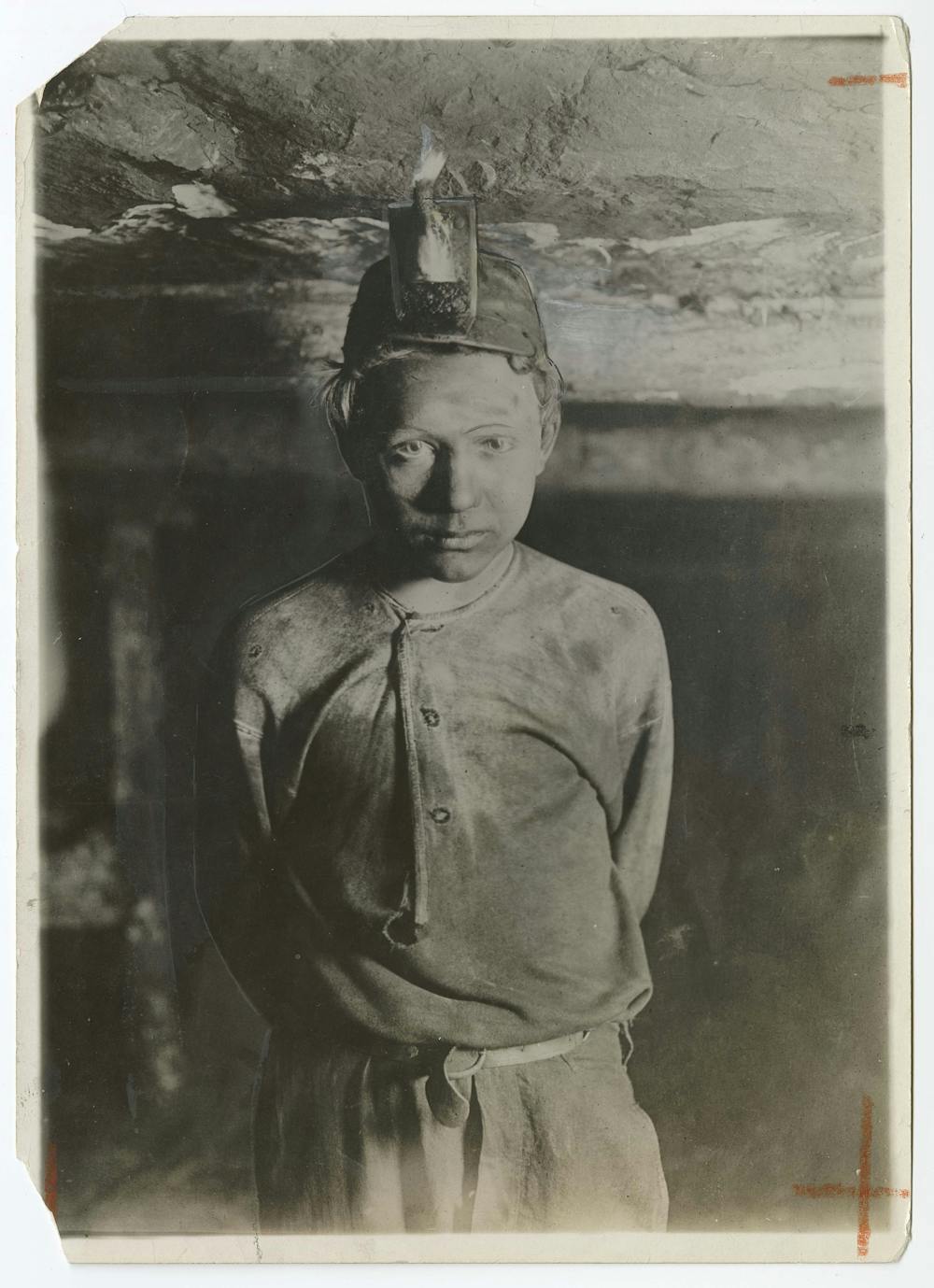
By the late 19th century, several states had passed laws limiting the age of child laborers and establishing maximum working hours. But at the turn of the century, the number of working kids soared – between 1890 and 1910, 18% of children ages 10 to 15 were employed.
In his work for the National Child Labor Committee, Hine journeyed to farms and mills in the industrializing South and the streets and factories of the Northeast. He used a Graflex camera with 5-by-7-inch glass plate negatives and employed flash powder for nighttime and interior shots, hauling upward of 50 pounds of equipment on his slight frame.

To gain entry into factories and other facilities, Hine sometimes disguised himself as a Bible, postcard or insurance salesman. Other times he’d wait outside to catch workers arriving for or departing from their shifts.
Along with photographic records, Hine collected his subjects’ personal stories, including their ages and ethnicities. He documented their working lives, such as their typical hours and any injuries or ailments they incurred as a result of their labor.
Hine, who considered himself “an investigator with a camera,” used this information to create what he termed “photo stories” – combinations of images and text that could be used on posters, in public lectures and in published reports to help the organization advance its mission.


Legislation follows
Hine’s muckraking photographs exemplify the genre of documentary photography, which relies upon the perceived truthfulness of photography to make a case for social change.
The camera serves as an eyewitness to a societal ill, a problem that needs a solution. Hine portrayed his subjects in a direct manner, typically frontally and looking straight into the camera, against the backdrop of the very factories, farmland or cities where they worked.
By capturing details of his sitters’ bare feet, tattered clothes, soiled faces and hands, and diminutive stature against hulking industrial equipment, Hine made a direct statement about the poor conditions and precarity of these children’s lives.
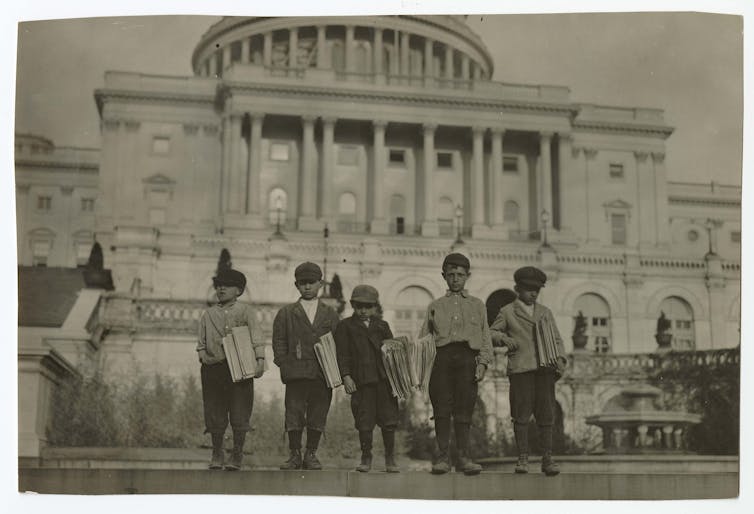
Hine’s photographs made a successful case for child labor reform.
Notably, the National Child Labor Committee’s efforts resulted in Congress establishing the Children’s Bureau in 1912 and passing the Keating-Owen Act in 1916, which limited working hours for children and prohibited the interstate sale of goods produced by child labor.
Although the Supreme Court later ruled it and a subsequent Child Labor Tax Law of 1919 unconstitutional, momentum for enshrining protections for child workers had been created. In 1938, Congress passed the Fair Labor Standards Act, which established restrictions and protections on employing children.
The National Child Labor Committee’s project also included advocacy for the enforcement of existing child labor regulations, a regulatory problem reemerging today as the Department of Labor – the agency tasked with enforcing labor laws – comes under fire for failing to protect child workers.

The ethics of picturing child labor
A recent surge of unaccompanied minors, primarily from Central America, has brought new attention to America’s old problem of child labor and has threatened the very laws Hine and the National Child Labor Committee worked to enact.
Some estimates suggest that one-third of migrants under 18 are working illegally, whether it’s laboring more hours than current laws permit, or working without the proper authorizations. Many of them perform hazardous jobs similar to those of Hine’s subjects: handling dangerous equipment and being exposed to noxious chemicals in factories, slaughterhouses and industrial farms.
While the content of Hine’s photographs remains pertinent to today’s child labor crisis, a key distinction between the subject of Hine’s photographs and working children today is race.
Hine focused his camera almost exclusively on white children who arrived in the country during waves of immigration from Europe during the late-19th and early-20th centuries. As art historian Natalie Zelt argues, Hine’s pictorial treatment of Black children – either ignored or forced to the margins of his images – implied to viewers that the face of childhood in America was, by default, white.
The perceived racial hierarchies of Hine’s era reverberate into the present, where underage migrants of color live and work at the margins of society.

Contemporary reports of child labor violations offer few images to accompany their texts, graphs and statistics. There are legitimate reasons for this. By not including identifying personal information or portraits, news outlets protect a vulnerable population. Ethical guidelines frown upon revealing private details of the lives of children interviewed. And, as Hine’s experience demonstrates, it can be difficult to infiltrate the sites of these labor violations, since they are typically kept secure.
Digital cameras and smartphones offer a workaround. Beginning in 2015, the International Labor Organization urged child laborers in Myanmar to become “young activists” and use their own images and words to create “photo stories” – echoing Hine’s use of the term – that the organization could then disseminate.
Photographs of child labor in foreign countries are far more common than those made in the U.S., which leaves the impression that child labor is someone else’s problem, not ours. Perhaps it’s too hard for Americans to look at this domestic issue square in the eyes.
A similar effect is at work when viewing Hine’s photographs today. While they were originally valued for their immediacy, they can seem to belong to a distant past.
But if Hine’s photographic archive of child laborers is evidence of the power of photography to sway public opinion, does the lack of images in today’s reporting – even if nobly intended – create a disconnect?
Is the public capable of understanding the harmful consequences of lack of labor enforcement when the faces of the people affected are missing from the picture?
Beth Saunders, Curator and Head of Special Collections and Gallery, University of Maryland, Baltimore County
This article is republished from The Conversation under a Creative Commons license. Read the original article.