 How to resolve AdBlock issue?
News

With the ascension of King Charles III to the British throne, some commentators have made much of the fact that the new stamp bearing his image features the king without a crown.
This is a major break with a tradition that began in 1840 with the world’s first postage stamp, the Penny Black, which featured the reigning monarch, Queen Victoria, wearing her crown.

Less discussed is the fact that the living monarch’s image must appear on all British stamps because the monarch embodies the nation itself. This is true even for commemorative stamps that honor historically important persons and events. Whether sharing equal billing with another person or relegated to a corner, the living monarch’s image will always be found on British stamps.

As we discuss in our recent book, “The American Stamp,” when the United States was ready to release its first stamps in 1847, the Post Office returned to the issues that had first been raised in a debate about coins. In 1792, when the U.S. mint was founded, a proposal to feature the heads of living presidents on the nation’s coinage was defeated in Congress by those who argued that to do so would be monarchical. In a republic, they proclaimed, only history, not heredity, could determine who was worthy of lending their likeness to the nation’s money.
It was agreed that only dead or allegorical persons – for example, the Goddess of Liberty – can be depicted on U.S. currencies. The postal service adopted similarly democratic ideals.
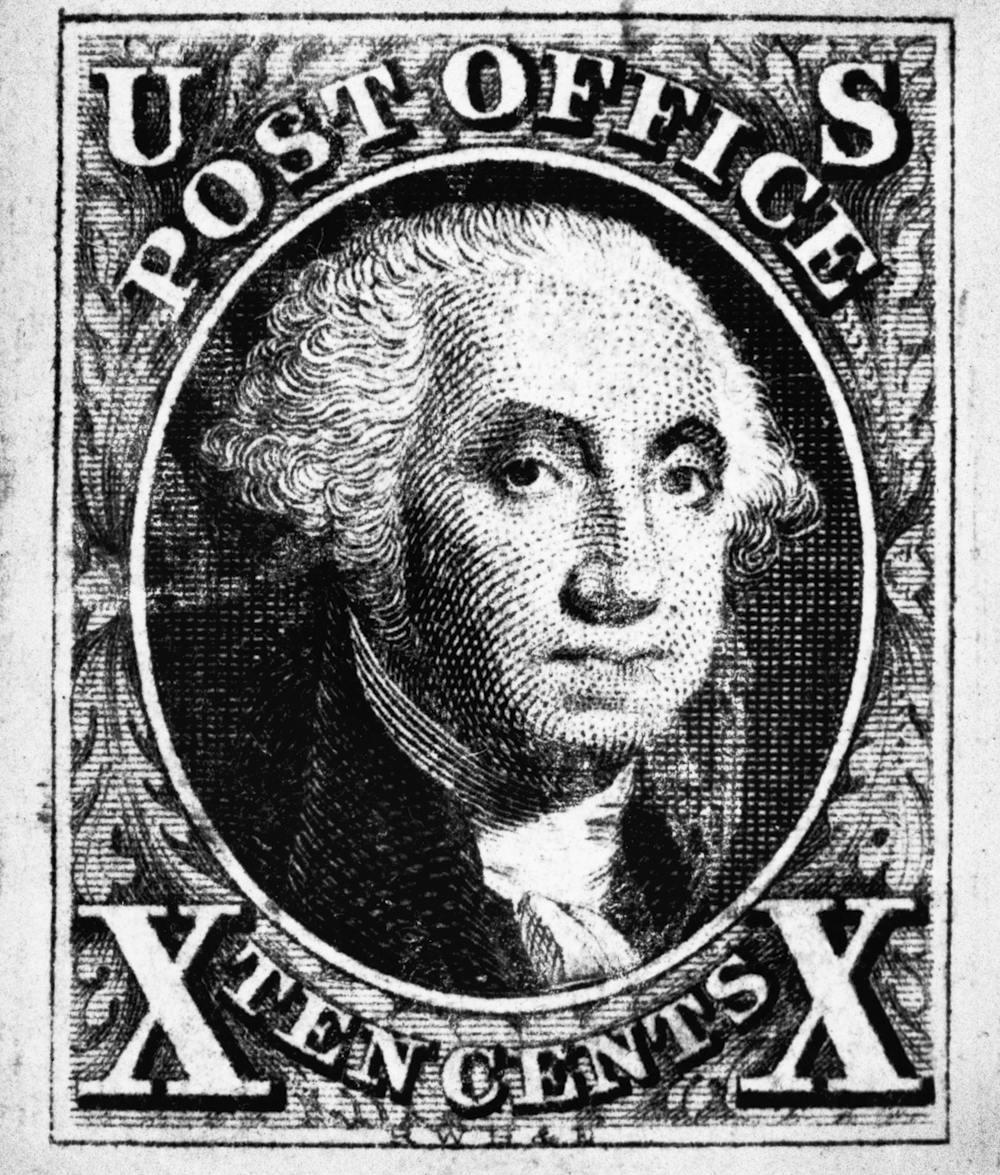
The questions of the day became “Who deserves to be honored on American stamps?” or “What does democracy look like?” The Post Office answered, “like dead heroes” – or, more specifically, like images of deceased white males whom history deemed central to the nation’s founding and growth. The country’s first stamp designs featured Benjamin Franklin and George Washington, who had died in the previous century.
Over the 176 years since that decision was made, American stamps have come to include more and more kinds of people. Indeed, stamps provide a visual history of American thinking about gender and race in a widely disseminated and easily recognizable tiny form.

A tradition codified
That tradition continued for both currency and stamps until 1866, when it became
Why did depicting only the dead on U.S. currencies became a national priority in the year after the end of the Civil War? The answer emerged from : Had living persons been allowed to appear on U.S. coins, stamps and banknotes, it would have been possible to depict U.S. citizens who would go on to become traitors to the nation.
This law has held fast, even as stamps have quickly evolved.

At the end of the 19th century, different types of people began to appear on stamps as American democracy became more inclusive. At first, women were added: Queen Isabella of Spain in 1893 and Martha Washington in 1902. The portrait of a Native American, the Sioux chief Hollow Horn Bear, appeared in 1923. Then an African American, Booker T. Washington, in 1940. In the decades since, persons of other ethnicities and sexual orientations have been honored on stamps. For example, Hispanic labor leader Cesar Chavez appeared in 2003, Arab American diplomat Philip C. Habib in 2006 and gay rights activist Harvey Milk in 2014.
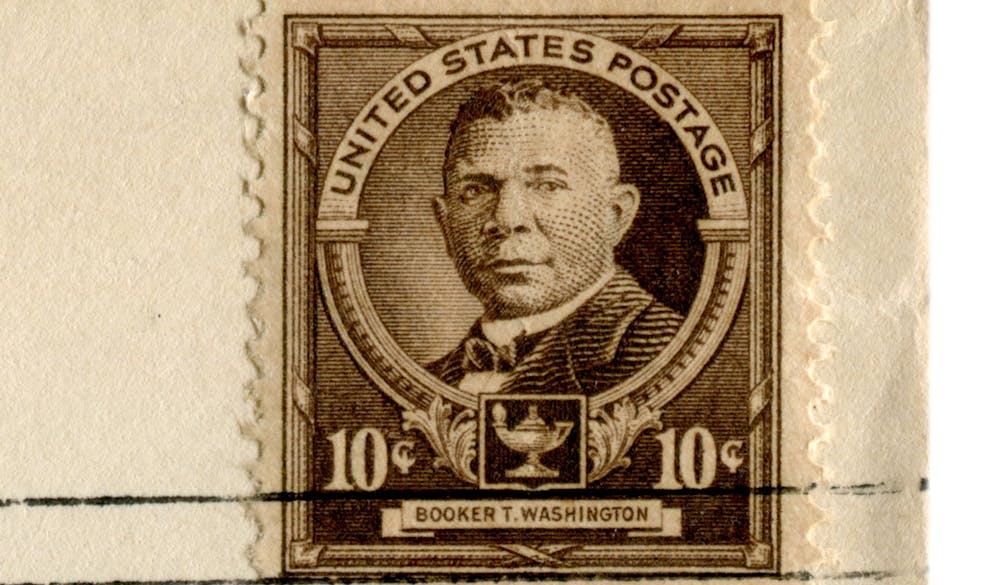
In all these cases, history, not heredity, determined who appeared. The only figures guaranteed a stamp are presidents, who become eligible for this honor one year after their death. The idea remains, though, that unlike King Charles III, they did not ascend to the office of president, but earned it due to their contribution to the democratic ideals of the United States.
The politics of representation
Despite these clear ideals, the question of representation has dogged postal portraits. So it is no surprise that when the Post Office established the Citizen’s Stamp Advisory Committee in 1957 to make recommendations to the postmaster general about future designs for stamps, it decreed that its deliberations be kept secret.
Nonetheless, the current diversity of the cast of characters appearing on U.S. stamps continues to generate criticism. People with pronounced political views of whatever stripe can be unhappy with choices that seem to represent their opponents.
A different critique we develop in our book is that apolitical diversity allows the Postal Service to abdicate the responsibility of illustrating what democracy should look like. If you do not pick a side, we argue, then how can citizens know which behaviors or positions are undemocratic?

Indeed, the pitfalls of the good-people-on-both-sides approach was strikingly illustrated in a 1995 pane of 20 stamps commemorating the Civil War, which included both Abraham Lincoln, the president of the Union, and Jefferson Davis, the president of the Confederacy. Surely the legislators who in 1866 decried the possibility of traitors being featured on federal currencies would be baffled by the choice of Davis.
Which raises a problem: If former President Donald Trump is convicted of violating national security laws and obstructing justice, which principle should prevail: that all presidents be guaranteed a postage stamp? Or that only those persons whom history judges to have been faithful to the nation and its democratic principles can appear on U.S. stamps, coins and bank notes?
It’s too soon to know the answer to these questions. But the controversy over who should represent the United States on stamps and what democracy looks like has been with our nation since 1792. 

Richard Handler, Professor of Anthropology, University of Virginia and Laura Goldblatt, Assistant Professor of English, University of Virginia
This article is republished from The Conversation under a Creative Commons license. Read the original article.

An ongoing trust funded with the assets of a deceased settlor benefits both current and remainder (future) beneficiaries, but at different times and in different ways.
Such a trust restricts what the current (e.g., lifetime) beneficiary receives to ensure that some trust assets remain for the remainder beneficiaries. This is where the dual concepts of “income” and “principal” are relevant.
Consider a trust funded by the assets of a deceased spouse that gives the surviving spouse all the net income for her life and provides for use of the principal, if necessary and at the trustee’s discretion, for the surviving settlor’s, “Health, Education, Maintenance and Support” (aka, “HEMS”).
At the surviving spouse’s death what remains goes to the deceased settlor’s own children. What does that mean and how is it administered?
First, it means that the trustee must categorize the trust’s receipts and expenses between the dual concepts of “income” and “principal” to know what the surviving spouse mandatorily receives as income.
What is “income” and “principal” is established under the trust’s own terms (definitions) and, otherwise by the California’s statutory rules in the Uniform Principal and Income Act (UPIA) in Probate Code sections 16320 - 13375.
What receipts (additions to the trust) are income and principal vary by the type of asset from which a receipt is received by the trustee.
For example, under the UPIA distributions from a retirement plan (e.g., an Individual Retirement Plan or a 401(k)) are allocated ten percent (10%) to income and ninety percent (90%) to principal. This treatment of retirement receipts is often a shock to someone who expected all of the retirement plan receipts to be income.
Receipts of interest and dividends are allocated entirely to income. Receipts of capital gain (proceeds from the sale of appreciated assets) are generally allocated entirely to principal as the profit is an increase in asset value.
Again the foregoing UPIA statutory rules only apply to the extent that the trust itself is silent. The trust may have different rules which apply.
Moreover, the trustee must also allocate disbursements (expenses) between income and principal; first as provided under the terms of the trust and otherwise under UPIA. Allocation of disbursements vary by the type.
For example, under UPIA trustee fees and other expenses of trust administration are allocated fifty percent to income and fifty percent to principal.
Naturally tension may develop between the current beneficiary and the remainder beneficiary over whether the trustee invests assets primarily to generate interest and dividends, which are income, or to grow in value, which is principal.
Unless the trust gives the trustee discretion to favor one beneficiary over another, a trustee must administer a trust impartially. That means the trustee when investing assets and when allocating receipts and expenses between income and principal must follow the rules in the trust and the code.
Nonetheless, the UPIA allows the trustee, in certain limited situations, to make adjustments between principal and income if certain conditions are satisfied (section 16336 Probate Code).
Furthermore, a trustee may sometimes be able to eliminate the complexities and tensions associated with administering a “net income” trust by converting the trust to a much more manageable Unitrust.
With a unitrust, the net income beneficiary receives a certain percentage of the trust’s average year end value as determined for the prior three years. The unitrust distribution percentage is from 3 to 5%.
A unitrust approach may be drafted into the settlor’s trust while the settlor is still alive as part of the estate planning, in which case the unitrust applies from the very start of administering the trust after the settlor’s death.
The foregoing is a brief discussion of the trust principal and income concepts. For legal guidance regarding beneficial rights and trustee duties consult a qualified attorney.
Dennis A. Fordham, attorney, is a State Bar-Certified Specialist in estate planning, probate and trust law. His office is at 870 S. Main St., Lakeport, Calif. He can be reached at

NASA’s MAVEN (Mars Atmosphere and Volatile EvolutioN) mission acquired stunning views of Mars in two ultraviolet images taken at different points along our neighboring planet’s orbit around the Sun.
By viewing the planet in ultraviolet wavelengths, scientists can gain insight into the Martian atmosphere and view surface features in remarkable ways.
MAVEN’s Imaging Ultraviolet Spectrograph (IUVS) instrument obtained these global views of Mars in 2022 and 2023 when the planet was near opposite ends of its elliptical orbit.
The IUVS instrument measures wavelengths between 110 and 340 nanometers, outside the visible spectrum.
To make these wavelengths visible to the human eye and easier to interpret, the images are rendered with the varying brightness levels of three ultraviolet wavelength ranges represented as red, green, and blue.
In this color scheme, atmospheric ozone appears purple, while clouds and hazes appear white or blue. The surface can appear tan or green, depending on how the images have been optimized to increase contrast and show detail.
The first image was taken in July 2022 during the southern hemisphere’s summer season, which occurs when Mars passes close to the Sun.
The summer season is caused by the tilt of the planet’s rotational axis, similar to seasons on Earth. Argyre Basin, one of Mars’ deepest craters, appears at bottom left filled with atmospheric haze (depicted as pale pink).
The deep canyons of Valles Marineris appear at top left filled with clouds (colored tan in this image).
The southern polar ice cap is visible at bottom in white, shrinking from the relative warmth of summer. Southern summer warming and dust storms drive water vapor to very high altitudes, explaining MAVEN’s discovery of enhanced hydrogen loss from Mars at this time of year.
The second image is of Mars’ northern hemisphere and was taken in January 2023 after Mars had passed the farthest point in its orbit from the Sun. The rapidly changing seasons in the north polar region cause an abundance of white clouds. The deep canyons of Valles Marineris can be seen in tan at lower left, along with many craters. Ozone, which appears magenta in this UV view, has built up during the northern winter’s chilly polar nights. It is then destroyed in northern spring by chemical reactions with water vapor, which is restricted to low altitudes of the atmosphere at this time of year.
MAVEN launched in November 2013 and entered Mars’ orbit in September 2014. The mission’s goal is to explore the planet’s upper atmosphere, ionosphere, and interactions with the Sun and solar wind to explore the loss of the Martian atmosphere to space.
Understanding atmospheric loss gives scientists insight into the history of Mars' atmosphere and climate, liquid water, and planetary habitability. The MAVEN team is preparing to celebrate the spacecraft’s 10th year at Mars in September 2024.
MAVEN’s principal investigator is based at the University of California, Berkeley, while NASA’s Goddard Space Flight Center in Greenbelt, Maryland, manages the MAVEN mission. Lockheed Martin Space built the spacecraft and is responsible for mission operations.
NASA’s Jet Propulsion Laboratory in Southern California provides navigation and Deep Space Network support. The Laboratory for Atmospheric and Space Physics at the University of Colorado Boulder is responsible for managing science operations and public outreach and communications.
Willow Reed is MAVEN communications lead for the Laboratory for Atmospheric and Space Physics, University of Colorado Boulder.

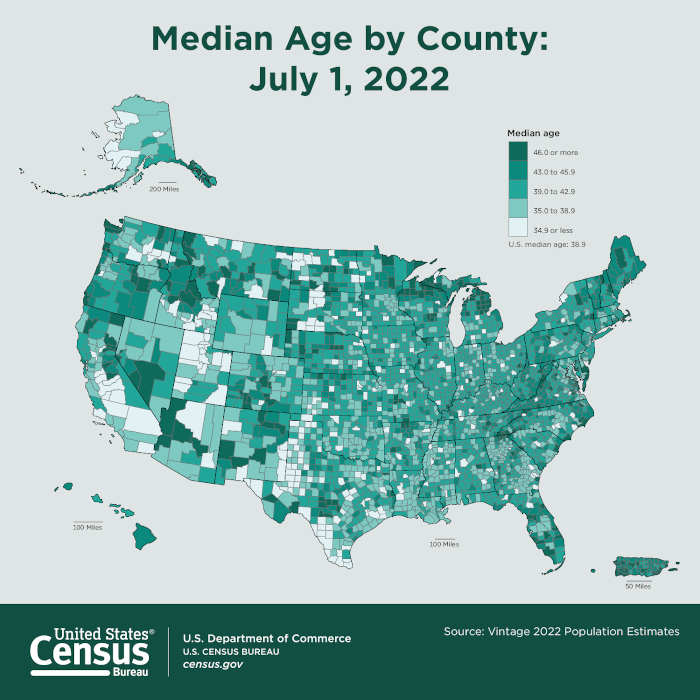
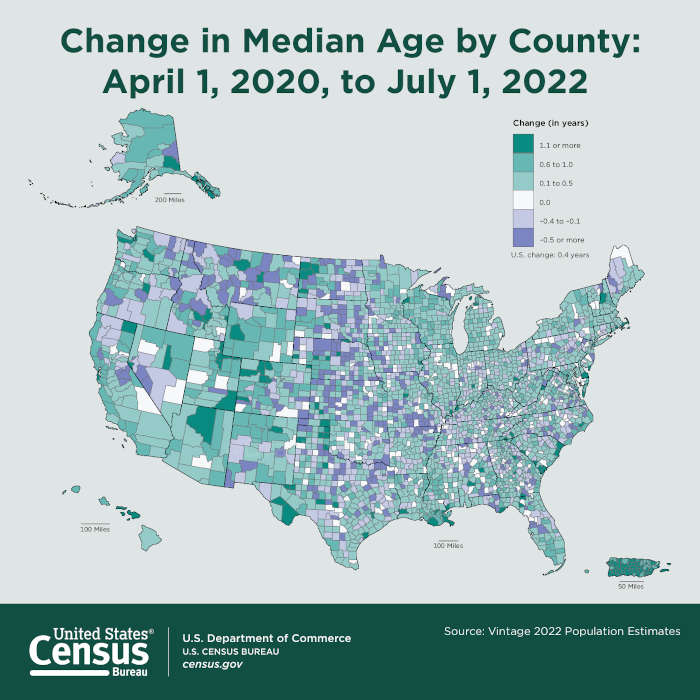
The nation’s median age increased by 0.2 years to 38.9 years between 2021 and 2022, according to Vintage 2022 Population Estimates released this week by the U.S. Census Bureau.
Median age is the age at which half of the population is older and half of the population is younger.
“As the nation’s median age creeps closer to 40, you can really see how the aging of baby boomers, and now their children — sometimes called echo boomers — is impacting the median age. The eldest of the echo boomers have started to reach or exceed the nation’s median age of 38.9,” said Kristie Wilder, a demographer in the Census Bureau’s Population Division. "While natural change nationally has been positive, as there have been more births than deaths, birth rates have gradually declined over the past two decades. Without a rapidly growing young population, the U.S. median age will likely continue its slow but steady rise.”
Lake County was one of five counties in California to show a decrease of 0.5% or more in median age.
The latest data showed that Lake County’s median age range from 39 to 42.9 years.
A third (17) of the states in the country had a median age above 40.0 in 2022, led by Maine with the highest at 44.8, and New Hampshire at 43.3. Utah (31.9), the District of Columbia (34.8), and Texas (35.5) had the lowest median ages in the nation. Hawaii had the largest increase in median age among states, up 0.4 years to 40.7.
No states experienced a decrease in median age. Four states — Alabama (39.4), Maine (44.8), Tennessee (39.1), West Virginia (42.8), and the District of Columbia (34.8) — had no change in their median age from 2021 to 2022.
The median age of the nation’s 3,144 counties or equivalents ranged from 20.9 to 68.1 in 2022. About 75% (2,357) had a median age at or above that of the nation, down from 76% and 2,374 counties in 2021.
Roughly a quarter (787) had a median age below the national median age in 2022, 17 more than in 2021 when 770 counties had median ages under the then 38.7 national median age. Fifty-nine percent (1,846) of U.S. counties experienced an increase in median age between 2021 and 2022, up from 51% or 1,590 counties between 2020 and 2021.
Race and ethnicity facts
The new Census data release included pdated estimates by race and Hispanic origin.
Statistics of particular note include the following.
The White population in the United States was 260,570,291 in 2022, representing an increase of 0.1% or 388,779 people from 2021.
In 2022, California had the largest White population (29,079,926), followed by Texas (23,853,626) and Florida (17,553,268). Florida also had the largest-gaining (321,037) and second fastest-growing (1.9%) White population behind South Carolina, which grew by 2.0% (74,990).
Comprising 15% of the nation’s total population in 2022, the national Black population totaled 50,087,750, up 0.9% from July 2021.
Texas had the largest Black population in 2022, with a total of 4,334,313, an increase of 120,945 (2.9%) from July 2021. Maine had the fastest-growing Black population, expanding by 7.0% (2,412 people) between 2021 and 2022.
The Asian population in the United States was 24,683,008 in 2022, up 577,420 or 2.4% from 2021.
In 2022, California had the largest Asian population (7,242,739), followed by New York (2,085,285) and Texas (1,958,128). California also had the largest-gaining Asian population with an increase of 108,881, while Montana — with an increase of 6.8% (1,276) — had the fastest-growing Asian population.
California was home to four of the top five counties with the largest Asian populations in 2022. Los Angeles County topped the list with an Asian population of 1,711,002, followed by Santa Clara County (830,790) and Orange County (816,274). Alameda County, California, had the fifth largest Asian population at just over 616,000, and Queens County, New York, ranked fourth with an Asian population of 671,358.
The American Indian and Alaska Native population reached 7,274,656 between July 2021 and July 2022, an increase of 93,443 or 1.3%. California had the largest American Indian and Alaska Native population at 1,114,580, followed by Oklahoma (572,435) and Texas (528,255).
Texas also had the largest-gaining American Indian and Alaska Native population, having increased by 15,245 from 2021 to 2022, while the District of Columbia had the nation’s fastest-growing American Indian and Alaska Native population, increasing by 5.0% or 507 residents.
The Native Hawaiian and Other Pacific Islander population rose to 1,759,756, an increase of 1.8% or 31,949 people in 2022.
Hawaii had the largest Native Hawaiian and Other Pacific Islander population (393,837), followed by California (373,173) and Washington (109,115).
The Hispanic population gained over a million residents, reaching 63,664,346 in 2022, an increase of 1.7%.
Among states, California (15,732,180), Texas (12,068,549), and Florida (6,025,030) had the largest Hispanic population, while New York (3,867,076) was the only state to experience a drop (-0.7%, -27,522) in the Hispanic population.
The bill requires the Federal Crop Insurance Corp., or FCIC, to carry out research and implement a crop insurance product that covers losses due to smoke exposure.
“Winegrapes are essential to economies across our country, and states like California, Oregon, and Washington have been disproportionately exposed to wildfires leading to smoke exposure impacting our winegrapes,” said Thompson. “Researching the impact that smoke has on our winegrapes and other crops is essential in advancing solutions that will protect these key economic drivers from future natural disasters. Proud to work with Rep. Newhouse and Sen. Padilla to introduce legislation that strengthens crop insurance for winegrowers and helps fully capture the risks associated with growing in these smoke- and wildfire-prone states.”
“Washington state’s wine industry produces some of the best wine in the nation and we need to keep it that way. Right now, the industry faces billions of dollars in losses from wildfires and smoke exposure. I am proud to co-sponsor this critical legislation that will ensure our wine grape growers and producers get the necessary funding to be resilient and continue to produce high-quality wine,” said Newhouse.
“As climate change intensifies and wildfires become more frequent and extreme, we need to protect winegrape growers and consumers against the damage caused by prolonged smoke exposure. Winegrape growing regions are critical to our economy, especially in California. Growers, vintners, and consumers alike have a stake in the sustainability of winegrowing communities — these bills will help growers make informed decisions about harvesting and selling their crops,” said Padilla.
“Washington state is the second-largest wine producing state in the country, creating thousands of jobs and fueling tourism across the state,” said Senator Murray. “Washington is also seeing an alarming increase in wildfires year after year, which creates a serious smoke exposure problem for winegrape growers across the West Coast. Vineyards in Washington state and all the way down to California need a crop insurance policy for smoke-exposed winegrapes, rather than being forced to rely on ad-hoc disaster assistance from year to year — and that’s what this legislation will provide. I’m proud that research at Washington State University has played a leading role in studying the impacts of smoke exposure, and this bill takes a critical and needed step to protect our state’s vital wine industry.”
"The profound losses experienced by growers due to impacts of wildfire smoke underscore the pressing need for research and have highlighted the necessity for improvements to crop insurance to safeguard growers,” said Natalie Collins, President of the California Association of Winegrape Growers. “We commend Congressman Thompson for recognizing the long-lasting ramifications of wildfires on the winegrape industry, and for prioritizing solutions to ensure a more sustainable future for an industry that serves as a vital economic force," she said.
“The wildfires in 2020 were especially detrimental to our winegrape crop given the timing in the harvest season. Our farmers invest all year in growing the crop and when it cannot be harvested, It can be financially devastating. Crop insurance and support is crucial for the long term preservation of agriculture in these uncertain times,” said Karissa Kruse, President of Sonoma County Winegrowers.
Winegrapes exposed to smoke from wildfires can introduce compounds into the winemaking process that cause smoky, ash-like flavors and result in wines unfit for commercial sale. These off-aromas and flavors become more pronounced over time as wine ages. In 2020 alone, industry sources estimate between 165,000 and 325,000 tons of California winegrapes were lost due to actual or perceived smoke damage, and financial estimate place losses at over $600 million.
The legislation introduced by Reps. Thompson and Newhouse and Senators Padilla and Murray requires research and development of a crop insurance product that provides comprehensive coverage for smoke-impacted winegrape growers, and helps to mitigate future financial losses in these key regions of production.
Thompson represents California’s Fourth Congressional District, which includes all or part of Lake, Napa, Solano, Sonoma and Yolo counties.

CLEARLAKE, Calif. — Clearlake Animal Control has dozens of dogs ready for adoption.
Among the dogs available this week are “Ella,” a female Rottweiler mix with a short black and tan coat.
There also is “Ivy,” a female Labrador retriever mix with a short tan coat.

The shelter is located at 6820 Old Highway 53. It’s open from 9 a.m. to 6 p.m. Tuesday through Saturday.
For more information, call the shelter at 707-762-6227, email
This week’s adoptable dogs are featured below.
Email Elizabeth Larson at