How to resolve AdBlock issue?
Refresh this page
How to resolve AdBlock issue?
Refresh this page
Lake County News,California
  • Home
    • Registration Form
  • News
    • Education
    • Veterans
    • Community
      • Obituaries
      • Letters
      • Commentary
    • Police Logs
    • Business
    • Recreation
    • Health
    • Religion
    • Legals
    • Arts & Life
    • Regional
  • Calendar
  • Contact us
    • FAQs
    • Phones, E-Mail
    • Subscribe
  • Advertise Here
  • Login

News

How pecans went from ignored trees to a holiday staple – the 8,000-year history of America’s only native major nut crop

Pecan pie is a popular holiday treat in the United States. Julie Deshaies/iStock via Getty Images

Pecans have a storied history in the United States. Today, American trees produce hundreds of million of pounds of pecans – 80% of the world’s pecan crop. Most of that crop stays here. Pecans are used to produce pecan milk, butter and oil, but many of the nuts end up in pecan pies.

Throughout history, pecans have been overlooked, poached, cultivated and improved. As they have spread throughout the United States, they have been eaten raw and in recipes. Pecans have grown more popular over the decades, and you will probably encounter them in some form this holiday season.

I’m an extension specialist in Oklahoma, a state consistently ranked fifth in pecan production, behind Georgia, New Mexico, Arizona and Texas. I’ll admit that I am not a fan of the taste of pecans, which leaves more for the squirrels, crows and enthusiastic pecan lovers.

The spread of pecans

The pecan is a nut related to the hickory. Actually, though we call them nuts, pecans are actually a type of fruit called a drupe. Drupes have pits, like the peach and cherry.

Three green, oval-shaped pods on the branch of a tree
Three pecan fruits, which ripen and split open to release pecan nuts, clustered on a pecan tree. IAISI/Moment via Getty Images

The pecan nuts that look like little brown footballs are actually the seed that starts inside the pecan fruit – until the fruit ripens and splits open to release the pecan. They are usually the size of your thumb, and you may need a nutcracker to open them. You can eat them raw or as part of a cooked dish.

The pecan derives its name from the Algonquin “pakani,” which means “a nut too hard to crack by hand.” Rich in fat and easy to transport, pecans traveled with Native Americans throughout what is now the southern United States. They were used for food, medicine and trade as early as 8,000 years ago.

A map of the US with parts of Texas, Louisiana, Oklahoma, Arkansas and Missouri highlighted in green.
Pecans are native to the southern United States. Elbert L. Little Jr. of the U.S. Department of Agriculture, Forest Service

Pecans are native to the southern United States, and while they had previously spread along travel and trade routes, the first documented purposeful planting of a pecan tree was in New York in 1722. Three years later, George Washington’s estate, Mount Vernon, had some planted pecans. Washington loved pecans, and Revolutionary War soldiers said he was constantly eating them.

Meanwhile, no one needed to plant pecans in the South, since they naturally grew along riverbanks and in groves. Pecan trees are alternate bearing: They will have a very large crop one year, followed by one or two very small crops. But because they naturally produced a harvest with no input from farmers, people did not need to actively cultivate them. Locals would harvest nuts for themselves but otherwise ignored the self-sufficient trees.

It wasn’t until the late 1800s that people in the pecan’s native range realized the pecan’s potential worth for income and trade. Harvesting pecans became competitive, and young boys would climb onto precarious tree branches. One girl was lifted by a hot air balloon so she could beat on the upper branches of trees and let them fall to collectors below. Pecan poaching was a problem in natural groves on private property.

Pecan cultivation begins

Even with so obvious a demand, cultivated orchards in the South were still rare into the 1900s. Pecan trees don’t produce nuts for several years after planting, so their future quality is unknown.

Two lines of trees
An orchard of pecan trees. Jon Frederick/iStock via Getty Images

To guarantee quality nuts, farmers began using a technique called grafting; they’d join branches from quality trees to another pecan tree’s trunk. The first attempt at grafting pecans was in 1822, but the attempts weren’t very successful.

Grafting pecans became popular after an enslaved man named Antoine who lived on a Louisiana plantation successfully produced large pecans with tender shells by grafting, around 1846. His pecans became the first widely available improved pecan variety.

A cut tree trunk with two smaller, thiner shoots (from a different type of tree) protruding from it.
Grafting is a technique that involves connecting the branch of one tree to the trunk of another. Orest Lyzhechka/iStock via Getty Images

The variety was named Centennial because it was introduced to the public 30 years later at the Philadelphia Centennial Expedition in 1876, alongside the telephone, Heinz ketchup and the right arm of the Statue of Liberty.

This technique also sped up the production process. To keep pecan quality up and produce consistent annual harvests, today’s pecan growers shake the trees while the nuts are still growing, until about half of the pecans fall off. This reduces the number of nuts so that the tree can put more energy into fewer pecans, which leads to better quality. Shaking also evens out the yield, so that the alternate-bearing characteristic doesn’t create a boom-bust cycle.

US pecan consumption

The French brought praline dessert with them when they immigrated to Louisiana in the early 1700s. A praline is a flat, creamy candy made with nuts, sugar, butter and cream. Their original recipe used almonds, but at the time, the only nut available in America was the pecan, so pecan pralines were born.

Two clusters of nuts and creamy butter on a plate.
Pralines were originally a French dessert, but Americans began making them with pecans. Jupiterimages/The Image Bank via Getty Images

During the Civil War and world wars, Americans consumed pecans in large quantities because they were a protein-packed alternative when meat was expensive and scarce. One ounce of pecans has the same amount of protein as 2 ounces of meat.

After the wars, pecan demand declined, resulting in millions of excess pounds at harvest. One effort to increase demand was a national pecan recipe contest in 1924. Over 21,000 submissions came from over 5,000 cooks, with 800 of them published in a book.

Pecan consumption went up with the inclusion of pecans in commercially prepared foods and the start of the mail-order industry in the 1870s, as pecans can be shipped and stored at room temperature. That characteristic also put them on some Apollo missions. Small amounts of pecans contain many vitamins and minerals. They became commonplace in cereals, which touted their health benefits.

In 1938, the federal government published the pamphlet Nuts and How to Use Them, which touted pecans’ nutritional value and came with recipes. Food writers suggested using pecans as shortening because they are composed mostly of fat.

The government even put a price ceiling on pecans to encourage consumption, but consumers weren’t buying them. The government ended up buying the surplus pecans and integrating them into the National School Lunch Program.

A machine with an arm attached to a tree, and a wheeled cab on the ground.
Today, pecan producers use machines called tree shakers to shake pecans out of the trees. Christine_Kohler/iStock via Getty Images

While you are sitting around the Thanksgiving table this year, you can discuss one of the biggest controversies in the pecan industry: Are they PEE-cans or puh-KAHNS?The Conversation

Shelley Mitchell, Senior Extension Specialist in Horticulture and Landscape Architecture, Oklahoma State University

This article is republished from The Conversation under a Creative Commons license. Read the original article.

Space News: Beyond the habitable zone - Exoplanet atmospheres are the next clue to finding life on planets orbiting distant stars

Some exoplanets, like the one shown in this illustration, may have atmospheres that could make them potentially suitable for life. NASA/JPL-Caltech via AP

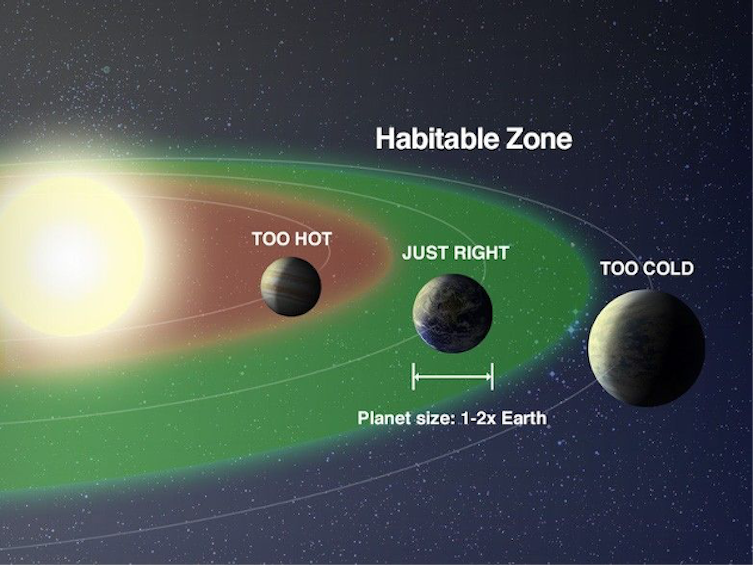
When astronomers search for planets that could host liquid water on their surface, they start by looking at a star’s habitable zone. Water is a key ingredient for life, and on a planet too close to its star, water on its surface may “boil”; too far, and it could freeze. This zone marks the region in between.

But being in this sweet spot doesn’t automatically mean a planet is hospitable to life. Other factors, like whether a planet is geologically active or has processes that regulate gases in its atmosphere, play a role.

The habitable zone provides a useful guide to search for signs of life on exoplanets – planets outside our solar system orbiting other stars. But what’s in these planets’ atmospheres holds the next clue about whether liquid water — and possibly life — exists beyond Earth.

On Earth, the greenhouse effect, caused by gases like carbon dioxide and water vapor, keeps the planet warm enough for liquid water and life as we know it. Without an atmosphere, Earth’s surface temperature would average around zero degrees Fahrenheit (minus 18 degrees Celsius), far below the freezing point of water.

The boundaries of the habitable zone are defined by how much of a “greenhouse effect” is necessary to maintain the surface temperatures that allow for liquid water to persist. It’s a balance between sunlight and atmospheric warming.

Many planetary scientists, including me, are seeking to understand if the processes responsible for regulating Earth’s climate are operating on other habitable zone worlds. We use what we know about Earth’s geology and climate to predict how these processes might appear elsewhere, which is where my geoscience expertise comes in.

A diagram showing three planets orbiting a star: The one closes to the star is labeled 'too hot,' the next is labeled 'just right,' and the farthest is labeled 'too cold.'
Picturing the habitable zone of a solar system analog, with Venus- and Mars-like planets outside of the ‘just right’ temperature zone. NASA

Why the habitable zone?

The habitable zone is a simple and powerful idea, and for good reason. It provides a starting point, directing astronomers to where they might expect to find planets with liquid water, without needing to know every detail about the planet’s atmosphere or history.

Its definition is partially informed by what scientists know about Earth’s rocky neighbors. Mars, which lies just outside the outer edge of the habitable zone, shows clear evidence of ancient rivers and lakes where liquid water once flowed.

Similarly, Venus is currently too close to the Sun to be within the habitable zone. Yet, some geochemical evidence and modeling studies suggest Venus may have had water in its past, though how much and for how long remains uncertain.

These examples show that while the habitable zone is not a perfect predictor of habitability, it provides a useful starting point.

Planetary processes can inform habitability

What the habitable zone doesn’t do is determine whether a planet can sustain habitable conditions over long periods of time. On Earth, a stable climate allowed life to emerge and persist. Liquid water could remain on the surface, giving slow chemical reactions enough time to build the molecules of life and let early ecosystems develop resilience to change, which reinforced habitability.

Life emerged on Earth, but continued to reshape the environments it evolved in, making them more conducive to life.

This stability likely unfolded over hundreds of millions of years, as the planet’s surface, oceans and atmosphere worked together as part of a slow but powerful system to regulate Earth’s temperature.

A key part of this system is how Earth recycles inorganic carbon between the atmosphere, surface and oceans over the course of millions of years. Inorganic carbon refers to carbon bound in atmospheric gases, dissolved in seawater or locked in minerals, rather than biological material. This part of the carbon cycle acts like a natural thermostat. When volcanoes release carbon dioxide into the atmosphere, the carbon dioxide molecules trap heat and warm the planet. As temperatures rise, rain and weathering draw carbon out of the air and store it in rocks and oceans.

If the planet cools, this process slows down, allowing carbon dioxide, a warming greenhouse gas, to build up in the atmosphere again. This part of the carbon cycle has helped Earth recover from past ice ages and avoid runaway warming.

Even as the Sun has gradually brightened, this cycle has contributed to keeping temperatures on Earth within a range where liquid water and life can persist for long spans of time.

Now, scientists are asking whether similar geological processes might operate on other planets, and if so, how they might detect them. For example, if researchers could observe enough rocky planets in their stars’ habitable zones, they could look for a pattern connecting the amount of sunlight a planet receives and how much carbon dioxide is in its atmosphere. Finding such a pattern may hint that the same kind of carbon-cycling process could be operating elsewhere.

The mix of gases in a planet’s atmosphere is shaped by what’s happening on or below its surface. One study shows that measuring atmospheric carbon dioxide in a number of rocky planets could reveal whether their surfaces are broken into a number of moving plates, like Earth’s, or if their crusts are more rigid. On Earth, these shifting plates drive volcanism and rock weathering, which are key to carbon cycling.

A diagram showing a few small planets orbiting a star.
Simulation of what space telescopes, like the Habitable Worlds Observatory, will capture when looking at distant solar systems. STScI, NASA GSFC

Keeping an eye on distant atmospheres

The next step will be toward gaining a population-level perspective of planets in their stars’ habitable zones. By analyzing atmospheric data from many rocky planets, researchers can look for trends that reveal the influence of underlying planetary processes, such as the carbon cycle.

Scientists could then compare these patterns with a planet’s position in the habitable zone. Doing so would allow them to test whether the zone accurately predicts where habitable conditions are possible, or whether some planets maintain conditions suitable for liquid water beyond the zone’s edges.

This kind of approach is especially important given the diversity of exoplanets. Many exoplanets fall into categories that don’t exist in our solar system — such as super Earths and mini Neptunes. Others orbit stars smaller and cooler than the Sun.

The datasets needed to explore and understand this diversity are just on the horizon. NASA’s upcoming Habitable Worlds Observatory will be the first space telescope designed specifically to search for signs of habitability and life on planets orbiting other stars. It will directly image Earth-sized planets around Sun-like stars to study their atmospheres in detail.

NASA’s planned Habitable Worlds Observatory will look for exoplanets that could potentially host life.

Instruments on the observatory will analyze starlight passing through these atmospheres to detect gases like carbon dioxide, methane, water vapor and oxygen. As starlight filters through a planet’s atmosphere, different molecules absorb specific wavelengths of light, leaving behind a chemical fingerprint that reveals which gases are present. These compounds offer insight into the processes shaping these worlds.

The Habitable Worlds Observatory is under active scientific and engineering development, with a potential launch targeted for the 2040s. Combined with today’s telescopes, which are increasingly capable of observing atmospheres of Earth-sized worlds, scientists may soon be able to determine whether the same planetary processes that regulate Earth’s climate are common throughout the galaxy, or uniquely our own.The Conversation

Morgan Underwood, Ph.D. Candidate in Earth, Environmental and Planetary Sciences, Rice University

This article is republished from The Conversation under a Creative Commons license. Read the original article.

Clearlake man arrested twice in one week on multiple firearm-related charges

One of the firearms seized during Eric Pearson’s arrests. Photo courtesy of the Clearlake Police Department.

LAKE COUNTY, Calif. — Police arrested a Clearlake man twice over the course of a week after they said he was found to be illegally in possession of firearms and ammunition.

On Nov. 13, Clearlake Police Officer Seng Yang arrested Eric Pearson, 45, following an investigation into an assault involving a firearm.

During the investigation, Officer Yang learned Pearson had allegedly struck a victim in the head with the handgun during an argument.  

Officer Yang contacted Pearson and located a loaded handgun concealed in Pearson’s waistband. Pearson is prohibited from possessing firearms or ammunition.

Pearson was arrested for a prohibited person in possession of a firearm, prohibited person in possession of ammunition, carrying a loaded firearm in public, carrying a concealed firearm and assault with a deadly weapon.

He was booked into the Lake County Jail and later bailed out on Nov. 18, police said.

The following day, Clearlake Police Det. Chris Kelleher, with assistance from detectives from the Lake County Sheriff’s Office and the Lakeport Police Department, served a search warrant at Pearson’s residence as part of the ongoing investigation. 

During the search, detectives located five additional firearms and ammunition, police said.

Pearson was again arrested for a prohibited person in possession of a firearm and a prohibited person in possession of ammunition. He was booked into the Lake County Jail.

“The Clearlake Police Department is committed to removing illegally possessed and illegal firearms from the community and holding individuals accountable for violent and dangerous behavior,” the agency said.

Anyone with information related to this case is encouraged to contact Officer Yang or Det. Kelleher at 707-994-8251.

Cal Fire graduates record number of company officers

Company Officer Academy Class 25-14 Graduation. Photo courtesy of Cal Fire.


On Friday, Gov. Gavin Newsom announced the graduation of Cal Fire Company Officer Class 25-14, from the Ione Training Center, marking a milestone in Cal Fire’s history, with over 650 new company officers trained in 2025, the most ever.

Cal Fire has successfully trained over 650 new company officers in 2025 with four training centers operating at full capacity. 

The newest, the Atwater Training Center in Merced County, opened in July 2025 to meet growing training demands. Additional facilities are in Redding and Riverside.  

This historic achievement underscores the department's consistent and sustained commitment to developing highly skilled, professional leaders to serve the State of California.

Director/Fire Chief Joe Tyler acknowledged the efforts required to meet this workforce demand during his keynote address.

“This milestone year of training represents our commitment to the future of Cal Fire and the safety of California,” Tyler said. “We recognize the achievement of these 38 students, as well as the dedication of our training staff who maintained exceptionally high standards while sustaining this record-setting pace.”

Cal Fire celebrates the graduation of this final cohort, Company Officer Academy Class 25-14, marking the successful conclusion of the intensive 2025 training season. 

The 38 graduates are now highly trained company officers ready to take on leadership roles across the department.

Top-level department leadership were on hand to see the 38 students graduate, including Director/Fire Chief Joe Tyler, Chief Deputy Director of Operations Anale Burlew, and Cooperative Fire Protection Deputy Director Matthew Sully, alongside numerous Cal Fire Region and Unit Chiefs. Director/Fire Chief Tyler administered the official oath to the graduating class.

Academy rigor and standards

The rigorous 10-week curriculum began with a four-week Firefighter Academy, immediately followed by a six-week Company Officer Academy. The Training Center maintains a high standard of excellence, particularly for those aspiring to achieve Top Academic Honors.

The comprehensive assessment for the class includes a total of 13 examinations: Six written examinations, six manipulative skills examinations and one comprehensive final examination.

Earning top academic distinction is demanding and requires near-perfect performance across the curriculum; a single error — such as one missed question on a written exam or one technical fault, like a "bumped cone" during a manipulative skills test — can disqualify a student from this prestigious recognition.

With all four training centers scheduled to be operating at full capacity, Cal Fire is well-positioned to meet the department's training requirements for 2026 and beyond.

Mendocino College English professor arrested for sex with underage student

NORTH COAST, Calif. — Authorities this week arrested a Mendocino College English professor who they said was having a sexual relationship with an underage female student.

The Ukiah Police Department said Jason Christopher Davis, 54, of Ukiah, was arrested on Thursday after an investigation found he was having sex with a student who was 15 years old.

In September, the Mendocino County Sheriff's Office referred an investigation to the Ukiah Police Department regarding a possible unlawful sexual relationship between a professor at the Mendocino College and an underage female student.

Ukiah Police began an investigation and confirmed that Davis had been in a dating relationship with a student. It was also learned that Davis was the subject of a civil suit in the Superior Court of San Francisco, in which two former students had accused Davis of sexual abuse.

Ukiah Police detectives obtained search warrants for Davis’ residence and electronic devices and confirmed that Davis had been in a sexual dating relationship and cohabitating with a former student who was 15 years old.

Detectives located photographs and videos on Davis’ electronic devices that confirmed that the sexual relationship began when the child was 13 years old.

On Thursday, a Mendocino County Superior Court judge signed an arrest warrant for Davis’ arrest for five felony charges involving sexual abuse of a minor with multiple special allegations based on the age of the victim.  

At approximately 3 p.m. Thursday, Ukiah Police detectives located Davis and took him into custody without incident. 

Davis was transported to the Mendocino County Jail and booked for lewd or lascivious acts with a child under 14 years of age, lewd or lascivious acts with a child under 15 years of age, oral copulation with person under 16 years of age, unlawful sexual intercourse with an under age female and possession of material depicting sexual conduct of a person under 18.  

Mendocino Jail records indicated Davis remained in custody on Saturday, with bail set at $1 million.

The Ukiah Police Department thanked the Mendocino County District Attorney’s Office for its assistance in the investigation.

On Friday, Mendocino College issued the following statement about the case in which it said that Davis has been placed on administrative leave.

The college’s full statement follows.

“Mendocino College is committed to fostering a safe, respectful, and supportive environment for our students, employees, and the broader community. This commitment guides every action we take as an institution.

“On November 20, 2025, Mendocino College was informed that Jason Davis, a faculty member, was taken into custody by the Ukiah Police Department on charges involving unlawful conduct with a minor. Mr. Davis is presumed innocent until proven guilty. While the College cannot discuss personnel matters or share details related to ongoing investigations, we can confirm that Mr. Davis was placed on administrative leave when the initial allegations surfaced. This step was taken in accordance with College policy and reflects our priority to ensure the safety and well-being of our campus community while the College conducts its own internal review.
Mendocino College is fully cooperating with law enforcement as this matter proceeds. Because this is an active legal case, the College will not be providing further comment at this time.”

Estate Planning: Transfers in 2025 prior to restored Medi-Cal asset test

On Jan. 1, 2026, California’s Medi-Cal program restores its prior asset test used to determine eligibility for Medi-Cal benefits, as the rule existed on July 1, 2022.

This means reinstating the associated resource limits, and exemptions and asset counting rules.

This applies to all Medi-Cal recipients except the Medi-Cal recipients enrolled under the Affordable Care Act which uses the applicant’s Modified Adjusted Gross Income (“MAGI Medi-Cal”) to determine eligibility.

Hence in 2026 Medi-Cal’s 30 month look back period and its associated asset transfer Medi-Cal eligibility penalties will resume relevance both to new Medi-Cal applications, to annual renewals and redeterminations of existing Medi-Cal beneficiaries.

Meanwhile, 2025 is a quickly vanishing opportunity for anyone already on Medi-Cal, or expecting to need Medi-Cal, to act proactively by removing any excess assets that may otherwise disqualify them in 2026.

That is, transfers made in 2025 do not count for eligibility purposes after Jan. 1, 2026. Transfers made on and after Jan. 1, 2026, however, may count.

Under the restored asset test, Medi-Cal goes back to July 1, 2022, when there was allowed a cash or asset reserve of $130,000 (in otherwise available and countable non-exempt assets) for an individual, and a reserve of $195,000 for a couple, if both receive Medi-Cal.

An extra $65,000 for each additional dependent family member up to ten dependents is allowed (See Department of Health Care Services, www.dhcs.ca.gov and California Advocates for Nursing Home Reform, www.canhr.org).

Dependent family members include a person’s disabled and minor child at home. The foregoing limits when applied are subject to possible increase on a case by case basis due to a claim and showing of spousal impoverishment.

If the Medi-Cal recipient is in a skilled nursing facility, then that person has a $130,000 resource limit and the at-home / community spouse, who does not receive Medi-Cal, is also allowed a so-called “Community Spouse Resource Allowance” (“CSRA”). The CSRA for 2026 has not yet been established but it is expected to be around $160,000.

That means that the well spouse at home can have up to $160,000 in otherwise countable assets in addition to the institutionalized spouse having up to $130,000 in otherwise countable assets. Again, the CSRA can be enlarged based on spousal impoverishment of the well / stay at home spouse. Alternatively, the well spouse may be entitled to some or all of the institutionalized spouse’s income.

That said, now in 2025, a person with excess assets has a soon vanishing opportunity either to spend down to the 2026 asset limits and/or to gift those assets to a trusted relative or friend. The trusted relative or friend could in turn establish a special needs trust for the same person with such assets.

Besides the personal resource exemption, Medi-Cal beneficiaries still enjoy the longstanding exemptions for a person’s home, ordinary household contents, a car, a burial policy, and retirement plans (subject to rules). So long as a Medi-Cal recipient checks the box that they intend to return home (if they were ever to become well again), the home is an exempt asset for Medi-Cal eligibility.

The soon to be restored Medi-Cal Asset Test rejoins Medi-Cal’s continuing Share of Cost (i.e., income) and estate recovery rules. That is, first, depending on the situation, a person’s income is often required to pay a share of cost for Community Based and Long Term Care Medi-Cal programs.

Moreover, second, since 2017, Medi-Cal Estate recovery is infrequent — and avoidable — as it only applies when a deceased Medi-Cal recipient’s estate is subject to a probate, and then only if there is also no surviving spouse.

Taking any appropriate action now depends on a Medi-Cal recipient seeing a need to do so and acting quickly before Jan. 1, 2026. An agent under a power of attorney might also have the necessary authority, but only if and to the extent that the power of attorney expressly allows for gifting of assets.

The foregoing brief discussion is not legal advice. Consult a qualified estate planning attorney for guidance. 

Dennis A. Fordham, attorney, is a State Bar-Certified Specialist in estate planning, probate and trust law. His office is at 870 S. Main St., Lakeport, Calif. He can be reached at This email address is being protected from spambots. You need JavaScript enabled to view it. and 707-263-3235.
  • 57
  • 58
  • 59
  • 60
  • 61
  • 62
  • 63
  • 64
  • 65
  • 66

Community

  • Lake County Wine Alliance offers sponsor update; beneficiary applications open 

  • Mendocino National Forest announces seasonal hiring for upcoming field season

Public Safety

  • Lakeport Police logs: Thursday, Jan. 15

  • Lakeport Police logs: Wednesday, Jan. 14

Education

  • Woodland Community College receives maximum eight-year reaffirmation of accreditation from ACCJC

  • SNHU announces Fall 2025 President's List

Health

  • California ranks 24th in America’s Health Rankings Annual Report from United Health Foundation

  • Healthy blood donors especially vital during active flu season

Business

  • Two Lake County Mediacom employees earn company’s top service awards

  • Redwood Credit Union launches holiday gift and porch-to-pantry food drives

Obituaries

  • Rufino ‘Ray’ Pato

  • Patty Lee Smith

Opinion & Letters

  • The benefits of music for students

  • How to ease the burden of high electric bills

Veterans

  • CalVet and CSU Long Beach team up to improve data collection related to veteran suicides

  • A ‘Big Step Forward’ for Gulf War Veterans

Recreation

  • Wet weather trail closure in effect on Upper Lake Ranger District

  • Mendocino National Forest seeking public input on OHV grant applications

  • State Parks announces 2026 Anderson Marsh nature walk schedule 

  • BLM lifts seasonal fire restrictions in central California

Religion

  • Kelseyville Presbyterian to host Ash Wednesday service and Lenten dinner Feb. 18

  • Kelseyville Presbyterian Church to hold ‘Longest Night’ service Dec. 21

Arts & Life

  • Auditions announced for original musical ‘Even In Shadow’ set for March 21 and 28

  • ‘The Rip’ action heist; ‘Steal’ grounded in a crime thriller

Government & Politics

  • Lake County Democrats issue endorsements in local races for the June California Primary

  • County negotiates money-saving power purchase agreement

Legals

  • March 3 hearing on ordinance amending code for commercial cannabis uses

  • Feb. 12 public hearing on resolution to establish standards for agricultural roads

How to resolve AdBlock issue?
Refresh this page