 How to resolve AdBlock issue?
News

The California Highway Patrol welcomed 95 of the state’s newest members of law enforcement during a graduation ceremony at the CHP Academy in West Sacramento.
The Friday ceremony is the culmination of more than six months of rigorous training, hard work and commitment.
“During the past six months in the Academy, these men and women forged a foundation of dedication, discipline, and duty,” said CHP Commissioner Sean Duryee. “Congratulations to the newest members of our CHP family. They are not just officers — they are leaders who have chosen to serve and protect the communities that depend on them.”
At the CHP Academy, cadet training starts with nobility in policing, leadership, professionalism and ethics, and cultural diversity. Cadets also receive instruction on mental illness response and crisis intervention techniques.

Training also includes vehicle patrol, crash investigation, first aid, and the apprehension of suspected violators, including those who drive under the influence of alcohol or drugs. In addition, cadets receive training in traffic control, report writing, recovery of stolen vehicles, assisting the motoring public, issuing citations, emergency scene management, and knowledge of various codes, including the California Vehicle Code, Penal Code and Health and Safety Code.
The graduating class of 95 officers, including four women, report for duty on Jan. 15, 2024, to one of the CHP’s 103 Area offices throughout the state.
A new class of more than 100 cadets will begin their 26-weeks of training at the CHP Academy that same day, bringing the total number of cadets in training currently to more than 300.
In June 2022, the CHP launched a multi-year recruitment campaign to recruit and hire 1,000 officers.
If you are interested in an exciting career that offers diversity, challenges, and opportunities, the CHP invites you to apply to become a part of its professional organization.

“The Bipartisan Safer Communities Act is the most significant law enacted in 30 years to keep our country safe from the epidemic of gun violence,” Thompson said Friday. “Today’s announcement by the DOJ proves that this law is working and is keeping firearms out of the hands of people who are a danger to themselves or others. Preventing young people who have a criminal record or have been shown to be dangerous from purchasing a firearm is helping to reduce suicide rates, stop domestic violence, and prevent mass shootings.
He added, “We have a lot more to do to end the scourge of gun violence, but this announcement makes clear that we are moving in the right direction. House Republicans must stop playing political games and work with House Democrats to pass legislation that would help save lives and keep firearms out of the hands of people who are a danger to themselves or others.”
The Bipartisan Safer Communities Act provided enhanced background checks for people under 21.
The law requires an investigative period to review juvenile and mental health records, including checks with state databases and local law enforcement, for buyers under 21 years of age, creating an enhanced, longer background check of up to ten days.
Thompson represents California’s Fourth Congressional District, which includes all or part of Lake, Napa, Solano, Sonoma and Yolo counties.

It’s a familiar start-of-the-year scene. You’ve committed to a healthier lifestyle and are determined that this time is going to be different. Your refrigerator is stocked with fruits and veggies, you’ve tossed out processed foods, and your workout routine is written in pen in your daily planner.
Yet, as you head out one morning, the tantalizing aroma of fresh doughnuts wafts through the air. How can you resist the call of this sugary treat and stick with your healthy choices?
Conventional wisdom, grounded in years of research, suggests that the best way to resist unhealthy choices is to think about the long-term consequences. For example, you could consider how the added sugar from eating too many doughnuts can lead to diabetes and obesity. Thinking about these long-term consequences, the argument goes, should help you avoid indulging right now and better stick to your goals.
However, in our combined 25 years of experience investigating people’s self-control behavior and motivation, we have learned that, in the heat of the moment, people often overlook distant outcomes, diminishing the effectiveness of strategies focused on the long term.
In response, we propose three approaches, backed by recent research, to help you stick to healthier habits.
To resist temptation, think short term
One strategy to avoid indulging is to consider the short-term consequences of unhealthy behavior. We tested this approach in seven studies with over 4,000 participants.
In one study, we invited university students to view one of two public service announcements detailing reasons to avoid energy drinks. One message emphasized long-term costs of drinking high-sugar energy drinks, such as diabetes and obesity. The other stressed short-term costs, such as anxiety and a sugar and caffeine crash.
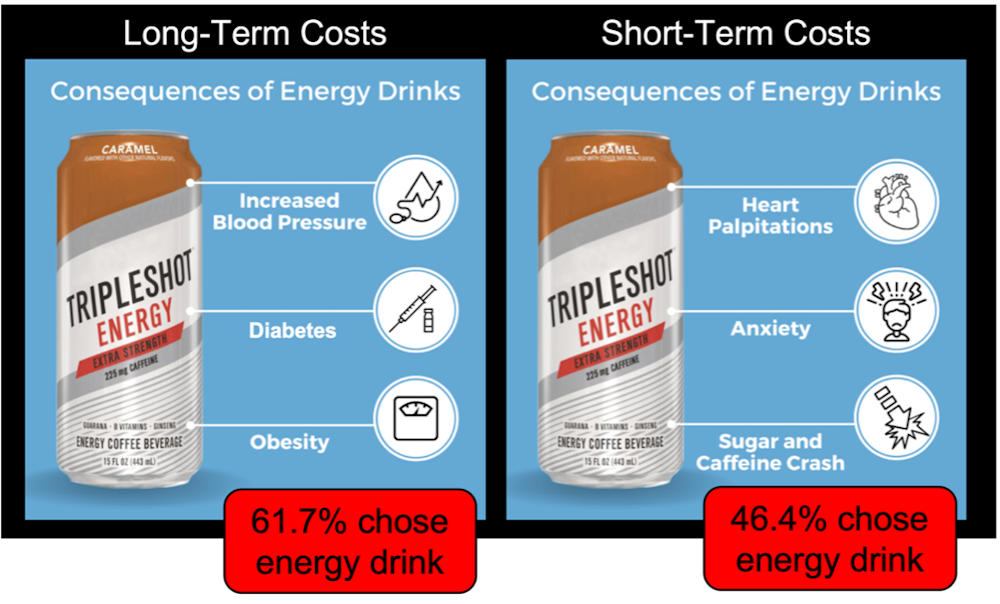
Students then had a choice between receiving an energy drink or another attractive prize. Those who read about the short-term costs were 25% less likely to choose the energy drink than those who read about the long-term costs.
In another study with a similar setup, participants read about either the short-term costs of eating sugar, the long-term costs of eating sugar, or they did not read about any downsides. Everyone then had to choose a delivery of cookies or a tote bag. Those who read about the short-term costs were 30% less likely to choose the cookies than those who read about the long-term costs and 45% less likely than those who didn’t read about any detriments to sugar.
We found that emphasizing short-term costs can also help you avoid other temptations. For alcohol, think about how excessive drinking can lead to poor sleep and hangovers. For fast food, think about how it can make you feel bloated or give you indigestion.
In our studies, immediate effects were a stronger motivator than long-term consequences that could take decades to occur. The takeaway is simple: To avoid indulging, think short term.
Focus on the fun of healthy options
Avoiding unhealthy foods is one thing. On the flip side, can you nudge yourself toward consuming more healthy foods?
Research that one of us (Kaitlin) conducted with behavioral scientist Ayelet Fishbach found that prompting people to focus on the good taste – rather than the health benefits – of foods such as apples and carrots increased consumption in the lab and the real world. These findings were independently replicated in an intervention at five university dining halls that used food labels focused on either tastiness or healthfulness.

This strategy can also promote other healthy behaviors, such as exercise. In one study, Kaitlin asked gymgoers to choose a weightlifting workout from a list of similarly difficult routines. The participants who were instructed to select a fun exercise completed more reps than those told to pick an exercise most useful for their long-term fitness goals.
Immediate rewards that result from pursuing long-term goals improve your experience right now, although they often go unnoticed. For this reason, focusing on the immediate versus delayed benefits of behaviors such as healthy eating and exercise can increase intrinsic motivation, making a behavior feel like its own reward and resulting in the immersed-in-an-activity feeling called “flow.”
Timing the reward sweet spot
Starting healthy behaviors is one important piece of the puzzle; another is sticking with these behaviors over time. One strategy for persistence is to use rewards to stay committed.
Research led by marketing professor Marissa Sharif, along with Kaitlin, involving over 5,000 people across eight experiments found that small, regular rewards were more effective for cultivating long-term commitment to healthy behavior such as exercising and flossing than were large, occasional rewards. Think watching 20 minutes of a guilty pleasure TV show each day you work out, rather than waiting to the end of the week to watch 80 minutes of TV to reward yourself for those four workouts.
But there’s a twist: Rewarding yourself too early may backfire. It seems rewards are most effective when people have to work to unlock them, after which they become regular. In other words, putting in initial effort while not being rewarded, followed by small, continual perks, is the most effective way to structure rewards.

In a study on exercise, Marissa and Kaitlin followed exercisers as they engaged in four initial workouts that came with no rewards. Then a work-to-unlock-rewards group began to receive small, continual rewards for each subsequent workout. They ended up persisting longer and completing more workouts than people in a lump-sum group who received a larger, occasional reward for every four workouts they finished.
A similar effect was evident in a 12-day study on tooth flossing. People in the work-to-unlock-rewards group – three days of flossing without rewards followed by daily rewards – flossed for more days than those who received continual rewards right way. Those who had to commit extra effort to unlock the rewards flossed 15% more days.
These studies suggest people can strategically incorporate rewards – with a short initial period without any rewards – into their routine to help them stick with healthy behaviors over time.
Resistance, enjoyment and persistence
Our research highlights three effective strategies to help you achieve your goals: prioritizing short-term consequences to resist temptation, finding enjoyment in long-term choices, and continually rewarding yourself for sustained persistence.
What’s great about these strategies is that you can adapt them to any personal goal you hold. For instance, if you’re finding it hard to swap social media for a book, consider reflecting on negative short-term consequences of endless scrolling. Or if carving out time for relaxation feels like a challenge, focus on the immediate benefits of engaging in meditative exercises.
By incorporating these evidence-based approaches, you can empower yourself to follow through on your long-term goals.
Kaitlin Woolley, Associate Professor of Marketing, Cornell University and Paul Stillman, Assistant Professor of Marketing, San Diego State University
This article is republished from The Conversation under a Creative Commons license. Read the original article.
What's up for January? Some moderate meteor activity, several great pair-ups of the Moon and planets, and how just four minutes a day can make a big difference in your view of the universe.
The year kicks off with the Quadrantid meteor shower, which peaks after midnight on Jan. 4. Light from the third-quarter moon will brighten the sky on the peak night, causing fainter meteors to be lost from view. But the shower does produce a decent number of bright meteors called fireballs, so it can still be worth your time. If viewing from a dark sky location, you may see 20-25 meteors per hour at the peak.
You can catch a few meteors in the days before or after, as well. In fact, the shower is active through around Jan. 12, so you might catch a fireball in the week after the peak when the Moon has moved out of the predawn sky.
On Jan. 8, in the hour before sunrise, look for brilliant Venus rising with a slim crescent Moon in the southeast. Bright star Arcturus hangs high above them.
The Moon will appear quite close to the red giant star Antares, the fiery red heart of Scorpius, that morning. And for observers in parts of the Western U.S., the Moon will actually occult, or pass in front of, Antares as the pair are rising that morning.
And if you have a view of the horizon, this is also good morning to spot Mercury before the sky brightens. It's quite low, but rises above 10 degrees off the horizon as dawn warms the sky, and it will be shining even brighter than Arcturus.
Next up, the crescent moon visits Saturn on the 13th and 14th. You'll find the pair in the southwest for a couple of hours following sunset both nights. Then the Moon pairs up with Jupiter in the evening on the 17th and 18th.
This is actually a great week to pull out the telescope or binoculars, because as soon as it's fully dark, you can work your way across the sky, starting with Jupiter and its moons, our own Moon, the Pleiades, Aldebaran and the Hyades star cluster, and the Orion Nebula.
One of the things that makes skywatching so interesting is that the sky is always changing. The stars rise in the east and set in the west each night. The Moon gradually waxes and wanes as it goes through its monthly cycle.
And likely you've also noticed that which stars you can see on a given night changes slowly over the course of the year. The bright stars and constellations we see on warm summer nights are not the ones that fill the chilly sky in winter.
This is because the stars rise 4 minutes earlier each day, and it adds up over time. In just 1 week, a given star will rise 28 minutes earlier than it does tonight.
And in one month, the same star will be rising about two hours earlier. So at four minutes per day, or two hours per month, after six months, the stars of summer are rising a full 12 hours earlier than they did back in June, placing them high in the daytime sky. But in their place, the evening sky belongs to the stars of winter.
This slow-motion cycle in the sky plays out annually as Earth moves in its orbit around the Sun. Our view outward into space during the night depends on where Earth is in its orbit.
At one part of the year, our view of space from Earth's night side looks in one direction, and six months later the view is in the opposite direction.
And so our nighttime view of the cosmos changes over the course of the year, because the stars aren't moving, we are! And that change happens at a pace of 4 minutes per day.
Dyches works for NASA's Jet Propulsion Laboratory.
New Mayor David Claffey took the gavel for the first time on Thursday night, leading the meeting, which ran under 45 minutes. Joyce Overton will serve as Claffey’s vice mayor this year.
Claffey started off the meeting with honoring outgoing Mayor Russ Perdock, noting that he believes 2023 was one fo Clearlake’s most successful years.
He also offered a proclamation declaring January 2024 as Human Trafficking Awareness Month. The presentation to the annual Breakfast with Santa volunteers was held over to a future meeting.
The main part of the meeting was approving a series of annual appointments.
Claffey recommended to the council that Overton remain the city representative to the quarterly CalCities Redwood Empire division business meetings — which includes representing the city and voting at the division legislative committee meetings — with himself as the alternate. The council approved that recommendation unanimously.
The council also approved a lengthy list of regular appointments, all of which Claffey suggested keeping the same as in 2023.
However, he said the ad hoc committee to advise on the Burns Valley Sports Complex project was not on the list, and he asked for Council members Russell Cremer and Dirk Slooten to remain on that committee.
City Manager Alan Flora asked for the council to make appointments to two additional committees in partnership with the Elem Indian Colony, which recently reached an agreement with the city for a new travel center. One will be for advising on a community benefit fund and the second will be for the city and tribe to meet quarterly to discuss and work through issues that arise.
Claffey said he and Perdock would sit on those two committees with the tribe.
Flora said there needs to be a lot of energy to deal with water issues and he asked for an ad hoc committee with two council members to work with staff. Claffey, who acknowledged it’s a very important issue, appointed Slooten and Perdock to that committee.
Claffey wanted to appoint two regular members, rather than just one, so the city’s traffic safety committee. His choices were Overton, the current member, and Perdock, the current alternate.
City Clerk Melissa Swanson said that committee was created by adoption of a resolution, so that will need to be brought back for council approve at the next meeting.
Slooten moved to approve Claffey’s appointments, which the council accepted 5-0.
In other news, Flora reported on a new mixed income project near the senior center which is nearing completion and has a temporary certificate of occupancy. He said it has 79 affordable units and one manager’s unit, and already 54 occupant applicants have been approved, with other units in process.
Flora said the move-in date is Jan. 20, and they expect 100% occupancy the following day. A ribbon cutting is expected sometime in February or early March.
In other updates, Flora said the city narrowly missed getting another Clean California grant through Caltrans, an issue he attributed to a mapping algorithm that made it appear that Clearlake is not as economically challenged as it is.
He said the city is preparing for the environmental analysis for the airport development project, with various contracts for the study expected to come to the council at an upcoming meeting.
Flora also said the city hall renovations are nearly complete. In July, city administration and staff moved out of city hall and over to the Lake County Campus of Woodland Community College while the work was underway. The police department remained in place and City Council meetings continued in the chambers.
He said staff was moving back into city hall and was pleased to be back.
Regarding the city’s request to be involved in the Golden State Water Co. rate case, Flora said the California Public Utilities Commission notified the city that the filing has been accepted.
Claffey moved to closed session at 6:42 p.m. in order to hold a confidential discussion with legal counsel to discuss a liability claim filed by June Linet Cejavasquez and two cases of anticipated litigation.
Email Elizabeth Larson at e
The California Highway Patrol will give the public an inside look at its live-in training facility with this month’s release of the new reality series, “Cadets.”
Premiering Jan. 17 on the CHP’s YouTube page, the nine-part docuseries focuses on a cadet class navigating the six-month journey through the CHP Academy on the way to becoming officers.
The release of “Cadets” is part of the CHP’s ongoing, multi-year recruitment campaign to recruit and hire 1,000 officers.
A trailer for the series, produced entirely by CHP staff, is available above.
“‘Cadets’ is not just a series; it’s a testament to the CHP’s commitment to excellence, diversity, and the relentless pursuit of transforming individuals from all walks of life into dedicated officers ready to serve the community,” said CHP Commissioner Sean Duryee. “We are excited to offer a start-to-finish look inside our Academy as future law enforcement officers are brought to life.”
Viewers will “ride along” with nine cadets as they overcome physical and mental adversity throughout the journey to earning their badge and becoming a CHP officer.
The audience will also hear firsthand from the cadets as they speak candidly about their experience.
“By sharing their experiences, in their own words, we hope to inspire more service-minded individuals to follow in their footsteps and join us for a rewarding career in law enforcement,” Duryee added.
If you are interested in an exciting career that offers diversity, challenges and opportunities, the CHP invites you to apply to become a part of its professional organization.