 How to resolve AdBlock issue?
News
Assemblymember James C. Ramos (D-San Bernardino), the first California Native American elected to the legislature, introduced the measure on Thursday.
“This bill builds upon my previous legislation, the California Indian Education Act, approved in 2022,” Ramos said. “For far too long California’s First People and their history have been ignored or misrepresented. Classroom instruction about the Mission and Gold Rush periods fails to include the loss of life, enslavement, starvation, illness and violence inflicted upon California Native American people during those times. These historical omissions from the curriculum are misleading. I look forward to working with my colleagues to pass this bill and get it to the governor’s desk.”
Late last year, a poll released by the Institute of Governmental Studies showed strong support to require California schools to incorporate teaching about Native American tribes’ history and culture. An overwhelming 80% of respondents were in support of a requirement such as AB 1821.
In 2022, Gov. Gavin Newsom signed AB 1703 — the California Indian Education Act — into law. It encourages local educational agencies to create California Indian Education Task Forces to develop curriculum about the history and culture of tribes native or residing in their region. Although AB 1703 was a significant step toward inclusion of native voices, it stopped short of requiring the change in curriculum. AB 1821 would take that extra step.
AB 1821 is sponsored by the Soboba Band of Luiseno Indians.
The bill’s main authors are Assemblymembers Eduardo Garcia (D-Coachella) and Devon Mathis (R-Porterville). Assemblymembers Dr. Joaquin Arambula (D-Fresno), Eloise Gomez Reyes (D-San Bernardino), and Luz Rivas (D-Arleta) and Sen. Bob Archuelta (D-Pico Rivera) are co-authors.
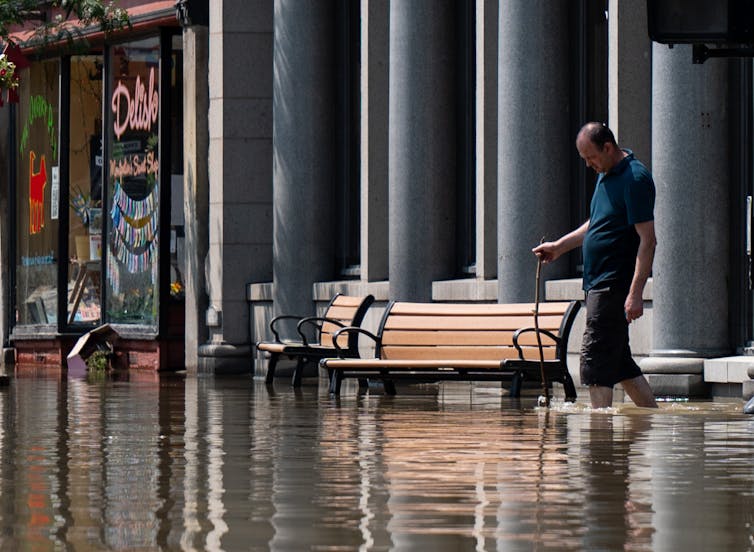
National weather analysts released their 2023 billion-dollar disasters list on Jan. 9, just as 2024 was getting off to a ferocious start. A blizzard was sweeping across across the Plains and Midwest, and the South and East faced flood risks from extreme downpours.
The U.S. set an unwelcome record for weather and climate disasters in 2023, with 28 disasters that exceeded more than US$1 billion in damage each.
While it wasn’t the most expensive year overall – the costliest years included multiple hurricane strikes – it had the highest number of billion-dollar storms, floods, droughts and fires of any year since counting began in 1980, with six more than any other year, accounting for inflation.
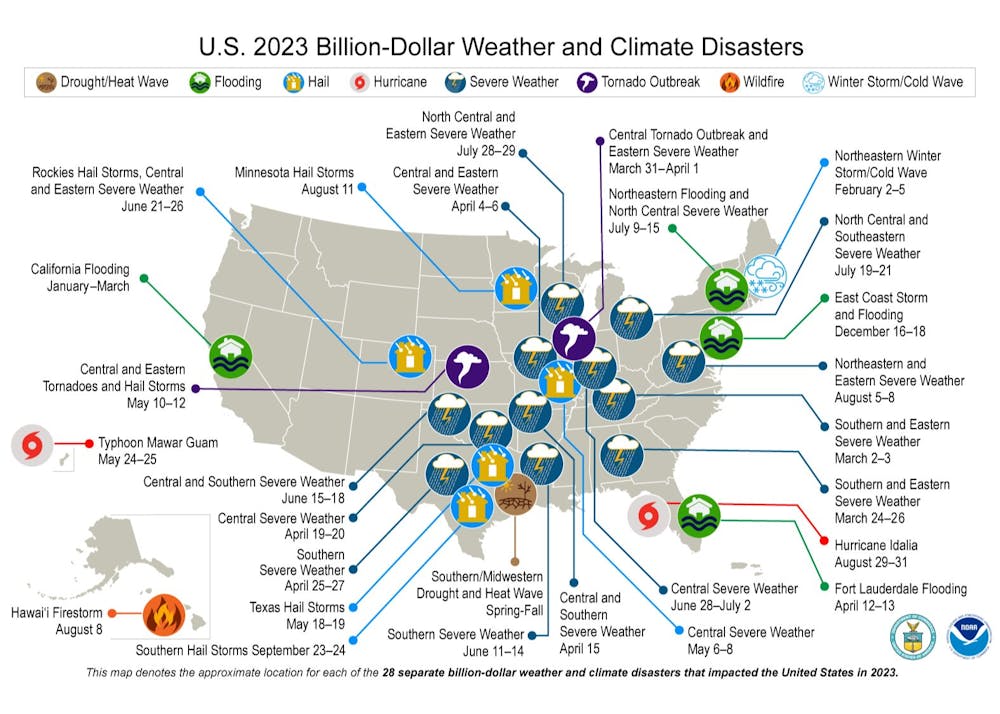
The year’s most expensive disaster started with an unprecedented heat wave that sat over Texas for weeks over the summer and then spread into the South and Midwest, helping fuel a destructive drought. The extreme heat and lack of rain dried up fields, forced ranchers to sell off livestock and restricted commerce on the Mississippi River, causing about US$14.5 billion in damage, according to the National Oceanic and Atmospheric Administration’s conservative estimates.
Extreme dryness in Hawaii contributed to another multi-billion-dollar disaster as it fueled devastating wildfires that destroyed Lahaina, Hawaii, in August.
Other billion-dollar disasters included Hurricane Idalia, which hit Florida in August; floods in the Northeast and California; and nearly two dozen other severe storms across the country. States in a swath from Texas to Ohio were hit by multiple billion-dollar storms.

El Niño played a role in some of these disasters, but at the root of the world’s increasingly frequent extreme heat and weather is global warming. The year 2023 was the hottest on record globally and the fifth warmest in the U.S.
I am an atmospheric scientist who studies the changing climate. Here’s a quick look at what global warming has to do with wildfires, storms and other weather and climate disasters.
Dangerous heat waves and devastating wildfires
When greenhouse gases, such as carbon dioxide from vehicles and power plants, accumulate in the atmosphere, they act like a thermal blanket that warms the planet.
These gases let in high-energy solar radiation while absorbing outgoing low-energy radiation in the form of heat from the Earth. The energy imbalance at the Earth’s surface gradually increases the surface temperature of the land and oceans.
The most direct consequence of this warming is more days with abnormally high temperatures, as large parts of the country saw in 2023.
Phoenix went 30 days with daily high temperatures at 110 F (43.3 C) or higher and recorded its highest minimum nighttime temperature, with temperatures on July 19 never falling below 97 F (36.1 C).
Although heat waves result from weather fluctuations, global warming has raised the baseline, making heat waves more frequent, more intense and longer-lasting.
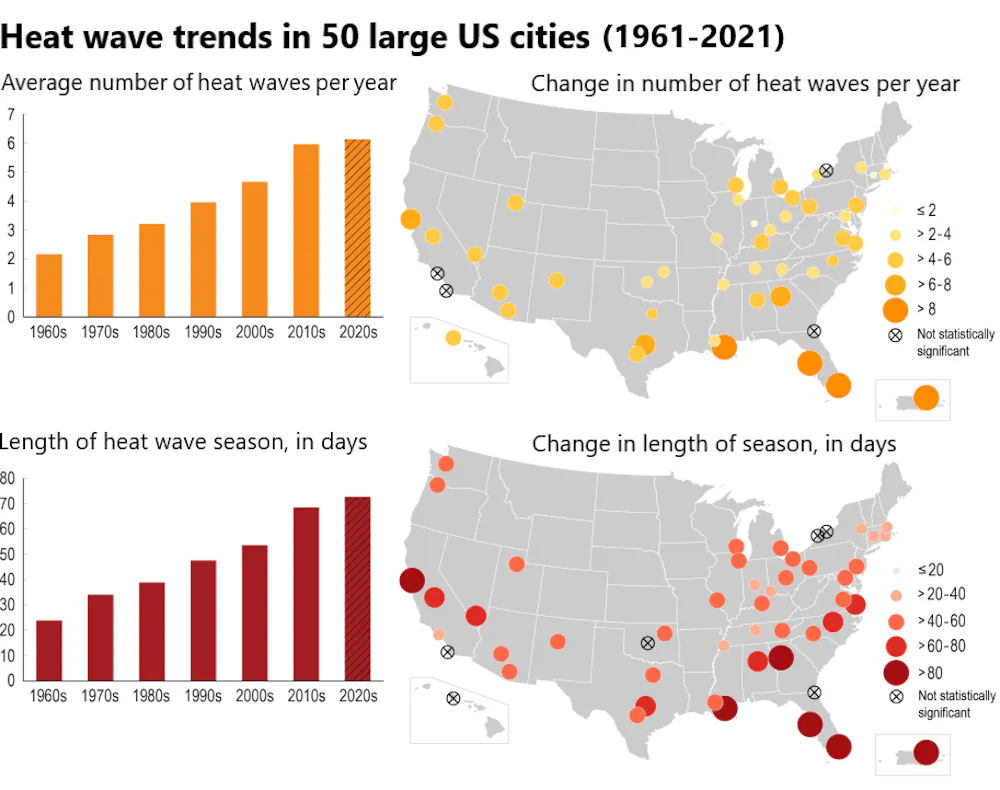
That heat also fuels wildfires.
Increased evaporation removes more moisture from the ground, drying out soil, grasses and other organic material, which creates favorable conditions for wildfires. All it takes is a lightning strike or spark from a power line to start a blaze.
How global warming fuels extreme storms
As more heat is stored as energy in the atmosphere and oceans, it doesn’t just increase the temperature – it can also increase the amount of water vapor in the atmosphere.
When that water vapor condenses to liquid and falls as rain, it releases a large amount of energy. This is called latent heat, and it is the main fuel for all storm systems. When temperatures are higher and the atmosphere has more moisture, that additional energy can fuel stronger, longer-lasting storms.

Tropical storms are similarly fueled by latent heat coming from warm ocean water. That is why they only form when the sea surface temperature reaches a critical level of around 80 F (27 C).
With 90% of the excess heat from global warming being absorbed by the ocean, there has been a significant increase in the global sea surface temperature, including record-breaking levels in 2023.
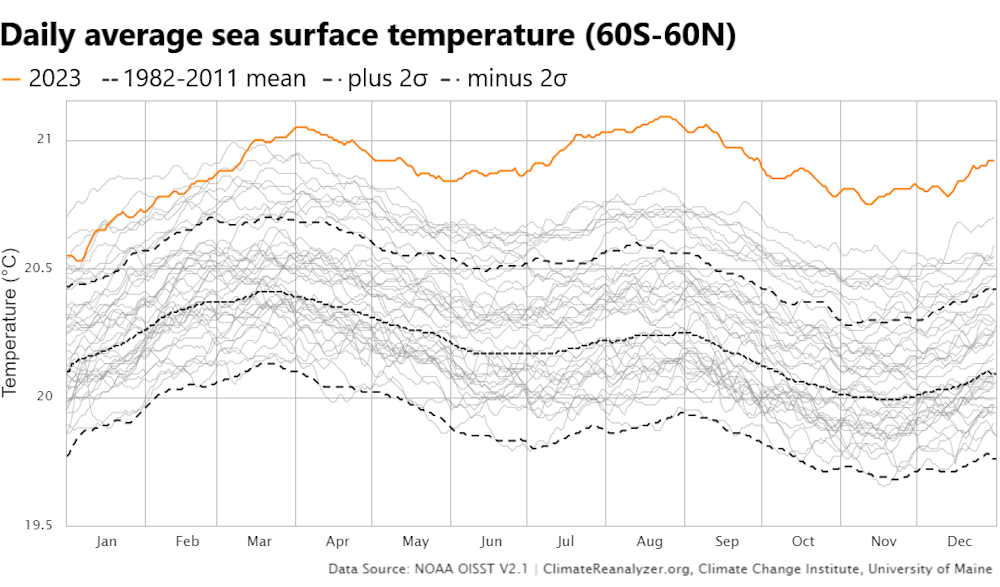
Higher sea surface temperatures can lead to stronger hurricanes, longer hurricane seasons and the faster intensification of tropical storms.
Cold snaps have global warming connections, too
It might seem counterintuitive, but global warming can also contribute to cold snaps in the U.S. That’s because it alters the general circulation of Earth’s atmosphere.
The Earth’s atmosphere is constantly moving in large-scale circulation patterns in the forms of near-surface wind belts, such as the trade winds, and upper-level jet streams. These patterns are caused by the temperature difference between the polar and equatorial regions.
As the Earth warms, the polar regions are heating up more than twice as fast as the equator. This can shift weather patterns, leading to extreme events in unexpected places. Anyone who has experienced a “polar vortex event” knows how it feels when the jet stream dips southward, bringing frigid Arctic air and winter storms, despite the generally warmer winters.
In sum, a warmer world is a more violent world, with the additional heat fueling increasingly more extreme weather events.
This article, originally published Dec. 19, 2023, was updated Jan. 9, 2024, with NOAA’s disasters list.
Shuang-Ye Wu, Professor of Geology and Environmental Geosciences, University of Dayton
This article is republished from The Conversation under a Creative Commons license. Read the original article.
AccuWeather reported that the low temperatures this week are the result of the coldest air of the season dropping down from Canada.
The National Weather Service said that daytime temperatures will hover in the mid-40s to low 50s this week, while at night conditions will drop into the high 30s and low 40s throughout much of the county.
Exceptions are in areas like Cobb and north of Upper Lake, where nighttime temperatures will fall into the high 20s and low 30s.
Beginning later this week, the National Weather Service said another storm system will arrive, bringing with it “significantly more” rain, ranging between 3 to 6 inches along the North Coast and snow above the 3,000 foot elevation mark.
Rainy conditions are forecast to continue through the middle of next week.
The forecast also includes windy conditions through the weekend, with winds of more than 15 miles per hour and gusts of more than 20 miles per hour possible.
The National Weather Service estimates most of Lake County will receive between a half an inch and an inch of rain on Friday and Saturday, while the mountains north of Upper Lake could have as much as 3 inches of rain during that time frame.
Email Elizabeth Larson at
The district said the leak occurred on Monday.
As a result, the State Water Resources Control Board, the Lake County Health Department and the water district advised residents who live at 14278 and 14288 McBride Court, and all addresses on Morine Way, Morine Ranch Road, Tomalee Lane and Lee Court to only use boiled tap water or bottled water for drinking and cooking purposes as a safety precaution to avoid stomach or intestinal illness.
The district said it anticipated resolving the matter within five business days and would inform impacted residents about when their water is safe to drink and no longer needs to be boiled.
Residents in the impacted neighborhoods are instructed to boil all water — at a rolling boil — for one minute and let it cool before using for drinking, brushing teeth and food preparation.
For those unable to boil water, it’s recommended that they use household unscented liquid bleach, using eight drops or ⅛ of a teaspoon of bleach per gallon of water.
For cloudy water, filter it through a clean cloth and use 16 drops, of a quarter of a teaspoon of bleach per gallon of water. Then mix well and let stand for 30 minutes.
Water treated in this manner may taste or smell like chlorine, which means disinfection has occurred.
For those using water disinfection tabs, they should follow the manufacturer’s instructions.
For more information, call the Clearlake Oaks County Water District at 707-998-3322.
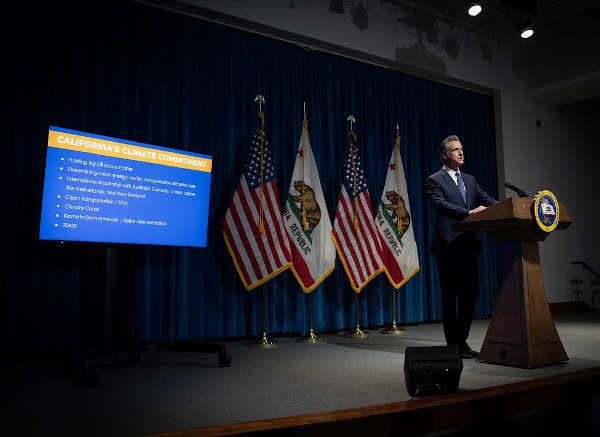
Gov. Gavin Newsom on Wednesday introduced his 2024-25 state budget proposal, which he said is a balanced funding plan that maintains the state’s fiscal stability while preserving key investments for education, public safety, addressing homelessness, mental health care reform, climate action and other priorities.
Newsom’s office said he used some of the “unprecedented budget reserves built up over the years” along with other tools to “responsibly” close a projected $37.86 billion shortfall.
Recognizing increased uncertainty due to a decline in the stock market and federal tax deadline delays, the 2023-24 state budget passed in June set aside record reserves of close to $38 billion to prepare for a potential shortfall.
Despite the downward revision, 2022-23 revenues are estimated to still be 23% higher than pre-pandemic levels. California's GDP remained strong in 2023, and the state’s big three revenues are projected to return to levels consistent with a normal revenue growth trajectory.
“Thanks to the record reserves we have built up and a commitment to fiscal discipline over the years, our state is in a strong position to close this shortfall while protecting key priorities and programs that millions of Californians rely on,” Newsom said. “This balanced budget plan keeps California on firm economic footing while continuing our work to tackle homelessness, keep communities safe, expand access to high-quality education, overhaul behavioral health care and fight climate change. I look forward to partnering with the Legislature to meet this moment with a balanced approach that meets the needs of Californians and safeguards our state’s future.”
Even after the proposed withdrawals, this budget plan reflects $18.4 billion in total budgetary reserves, including $11.1 billion in the Rainy Day Fund.
In addition to addressing the budget shortfall through a balanced package of solutions that avoids deep program cuts, the January budget proposal maintains investments in several of Newsom’s priority issues, including:
TACKLING HOMELESSNESS. Gov. Newsom has advanced a multi-year $15.3 billion plan to address homelessness — more than ever before in state history. This budget proposal maintains billions of dollars for an all-of-the-above approach including $400 million for encampment resolution grants and $1 billion for Homeless Housing, Assistance and Prevention program grants.
KEEPING CALIFORNIANS SAFE. The budget invests $1.1 billion over four years to increase the safety and security of our communities, including $373.5 million to combat organized retail theft; over $230 million for opioid and fentanyl interdiction and enforcement, naloxone distribution, recovery and support services and more; $302 million to enhance community public safety through nonprofit security grants, officer training and more; and $197 million to tackle gun violence.
TRANSFORMING EDUCATION. The budget maintains investments that are critical to improving supports for students, including funding for community schools, universal school meals, expanded learning opportunities, education workforce, and continued implementation of universal transitional kindergarten. Proposition 98 funding for K-12 schools and community colleges is estimated to be $109.1 billion in 2024-25 and per-pupil funding totals $23,519 per pupil when accounting for all funding sources.
MENTAL HEALTH REFORM. California has advanced a major transformation of the state’s behavioral health services system. This budget includes funding to make wellness coaches available to support children and youth behavioral health and maintains $7.6 billion from various funds to implement the Behavioral Health Community-Based Organized Networks of Equitable Care and Treatment (BH-CONNECT) demonstration.
CALIFORNIA’S CLIMATE COMMITMENT. California is advancing a $48.3 billion multi-year commitment, alongside over $10 billion from the Biden-Harris Administration in federal climate funding, to implement its nation-leading initiatives to slash pollution and achieve carbon neutrality by 2045, protect communities from harmful climate impacts, deliver 90% clean electricity by 2035, hold big oil accountable, and more.
Additional details on the January budget proposal can be found at www.ebudget.ca.gov.
“While December’s cash position fell short of Department of Finance Budget Act cash flow estimates for the month by $3 billion, the state still has a strong $88.5 billion in available borrowable resources. Barring any unforeseen circumstances, California still has ample cash in its coffers to pay its bills and meet its financial obligations through the end of the fiscal year,” Cohen said.
“The Legislature and Governor have a difficult task ahead to bring revenues and spending into balance in the year ahead. However, their forethought in building rainy-day reserves in the Budget Stabilization Account has bolstered the state’s cash-on-hand and provided stability in the face of a budgetary deficit,” she added.
December saw California’s total General Fund receipts fall $5.2 billion — or 21.4% — short of estimates for the month, while disbursements were $2.3 billion — or 10.1% lower than estimated.
The state is 22.2% behind forecasts for the fiscal year to date with general fund receipts, $28.2 billion below estimates.
Disbursements were $5.1 billion lower than expected, and 4.2 percent behind estimates for the first six months of the fiscal year.
As the chief fiscal officer of California, Controller Cohen is responsible for accountability and disbursement of the state’s financial resources. The controller has independent auditing authority over government agencies that spend state funds.
She is a member of numerous financing authorities, and fiscal and financial oversight entities including the Franchise Tax Board. She also serves on the boards for the nation’s two largest public pension funds.