 How to resolve AdBlock issue?
News
Over the month of November 2023, a total of 59 single family homes were sold through the multiple listing service, compared to 78 in October and 68 sold a year ago during the month of November 2022.
These include traditionally built “stick-built” houses as well as manufactured homes on land.
There were four sales of mobile homes in parks in November, compared to nine in October and five sold during the month of November 2022.
For bare land (lots and acreage), 25 were sold in November, compared to 24 closed land sales in October and substantially more than the 13 sold during November 2022.
There are 393 “stick built” and manufactured homes on the market right now. If the rate of sales stays the same at 59 homes sold per month, there are currently 6.66 months of inventory on the market at the moment.
That means that if no new homes are brought to the market for sale, in 6.66 months, all of these homes would be sold and there would be no homes available for sale.
Less than six months of inventory is generally considered to be a “sellers’ market” while more than six months of inventory is often called a “buyers’ market.”
The November data is a shift from October, where more than 5.47 months of inventory were available.
Agents continue to report a drop in requests for property tours, with fewer clients writing offers, which is consistent with the national home sales data.
The total percentage of homes bought for all cash in November: 41% (compared to 31% for October and 41% for November 2022); 29% were financed by Fannie Mae or Freddie Mac (“conventional loans”) compared to 32% for October and 35% for the November 2022; 17% were financed by FHA (compared to 23% in October and 13% in November 2022); 4% were financed by the VA or CalVet (compared to 4% in October and compared to 10% for November 2022); 7% had other financing such as private loans, USDA, or seller financed notes (compared to 3% in October, and compared to 0% for November 2022).
None of the closed sales in November were assumable loans that were assumed by the buyer.
The homes in November sold at an average of 96% of the asking price at the time the property went under contract, but an average of 89% when compared to the original asking price when the property first came on the market.
This means that the asking home prices had been reduced from their original list prices on the homes that sold before they actually sold.
In October homes also sold for 96% of the asking price at the time the property went under contract, and 89% of the original asking price.
A year ago in November, homes were selling at 95% of the asking price at the time the property went under contract and also 89% when compared to the original asking price.
The median time on the market in November was 32 days, compared to 36 days in October and 49 days in November 2022.
The median sale price of a single family home in Lake County in November was $269,000, which is lower than the $318,750 median sale price for October and also lower than the median sale price of $287,000 during November 2022.
This would indicate that last month, the lower priced homes were selling in greater numbers to bring the median sale price down compared to October 2023 (and similar to the activity in November 2022).
The median asking price of homes on the market right now is $357,000, which is a drop from October’s $372,000.
In November, 31% of homes sold had seller concessions for an average concession of $11,286; the rate of concessions is lower compared to October 2023’s numbers, when 40% of homes sold had seller concessions with an average concession of $9,069.
In November 2022, 31% of homes sold had an average seller concession of $6,841.
Average concessions were highest for conventional loans in November 2023, with an average concession of $18,000.
VA loans had an average concession of $9,705; FHA loans had an average concession of $5,141.
Cash sales showed an average concession of $433.
Forecasters said an “impressive cyclone” evident along the coast of central Oregon aligned with a plume of subtropical moisture to position an atmospheric river over Northwest California throughout the day Saturday.
“Consistent moderate to heavy rain has pelted the North Coast through the day today. Over the course of only 6 hours, 2 to 4 inches of rain have fallen all along the coast,” the agency reported.
Rainfall totals in inches for the 24-hour period ending at 1 a.m. Sunday in Lake County are as follows:
— Hidden Valley Lake: 0.92.
— Indian Valley Reservoir: 1.04.
— Kelseyville: 0.86.
— Lake Pillsbury: 2.74.
— Lower Lake: 0.43.
— Lyons Valley: 1.39.
— NIce: 1.43.
— Whispering Pines: 1.52.
The forecast expects “mostly calm” weather next week, with more rainfall predicted beginning in the middle of the week.
Temperatures will range from the low to high 50s during the day and the high 30s to low 40s at night, according to the forecast.
Email Elizabeth Larson at
MATH’s annual board election took place at the end of a meeting which also featured a forum for the candidates in the District 1 supervisorial race.
Four candidates ran for a two-year term: incumbent Bill Waite, Nanette DeDonato, 2023 alternate Julia Bono and Lisa Kaplan.
After the candidates spoke the votes were cast and tallied.
DeDonato, Waite and Kaplan won terms, and Bono and Rosemary Cordova accepted roles as alternates.
They will join Chair Monica Rosenthal and Secretary Ken Gonzalez.
The MATH Board will elect officers and report the results back at the February meeting.
Email Elizabeth Larson at
Dogs available for adoption this week include mixes of Alaskan husky, border collie, boxer, bulldog, French bulldog, German shepherd, Great Pyrenees, hound, Labrador retriever, pit bull, Queensland heeler, shepherd and terrier.
Dogs that are adopted from Lake County Animal Care and Control are either neutered or spayed, microchipped and, if old enough, given a rabies shot and county license before being released to their new owner. License fees do not apply to residents of the cities of Lakeport or Clearlake.
Those dogs and the others shown on this page at the Lake County Animal Care and Control shelter have been cleared for adoption.
Call Lake County Animal Care and Control at 707-263-0278 or visit the shelter online for information on visiting or adopting.
The shelter is located at 4949 Helbush in Lakeport.
Email Elizabeth Larson at








































Microplastics are turning up everywhere, from remote mountain tops to deep ocean trenches. They also are in many animals, including humans.
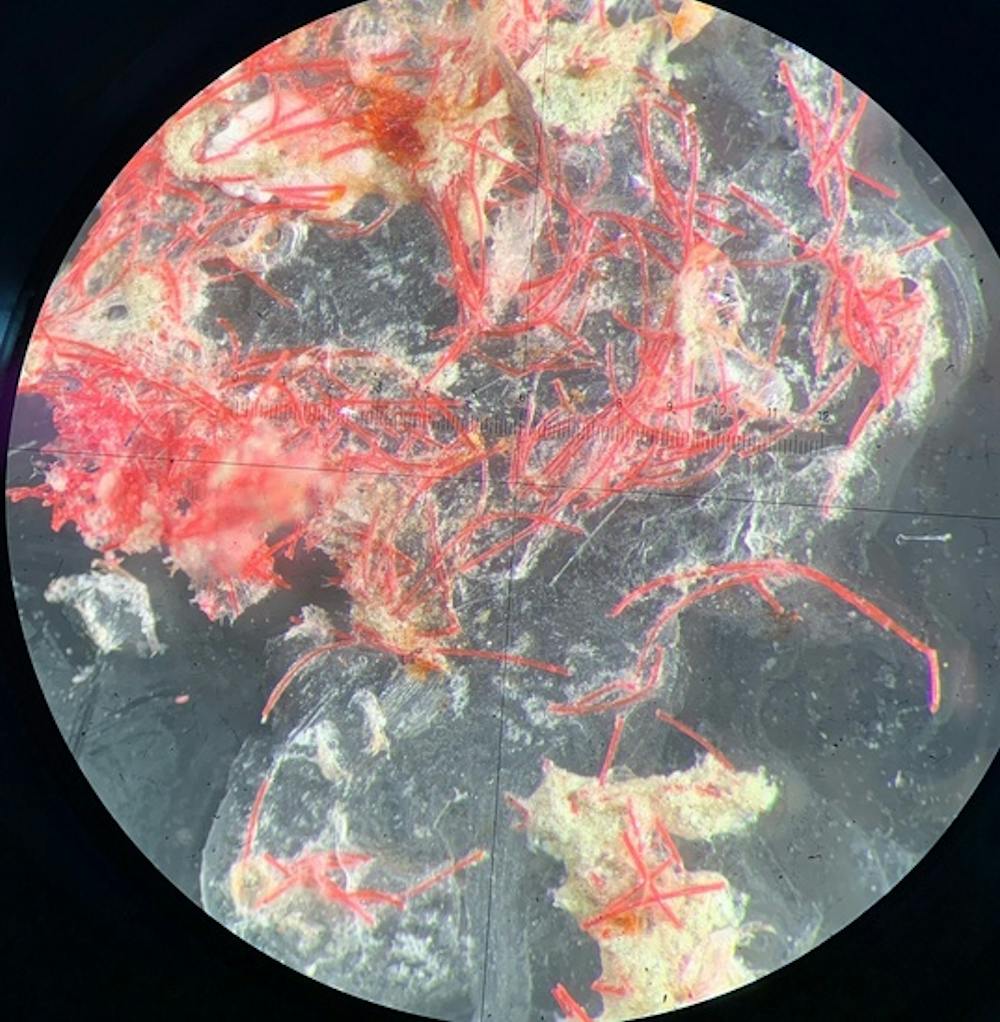
The most common microplastics in the environment are microfibers – plastic fragments shaped like tiny threads or filaments. Microfibers come from many sources, including cigarette butts, fishing nets and ropes, but the biggest source is synthetic fabrics, which constantly shed them.
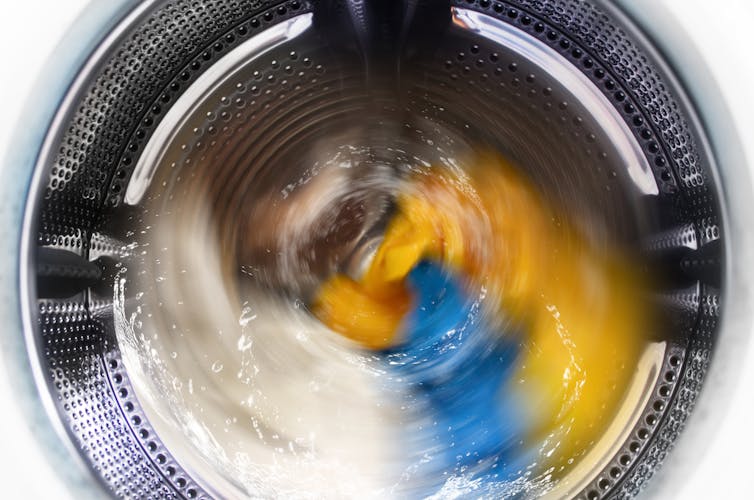
Textiles shed microfibers while they are manufactured, worn and disposed of, but especially when they are washed. A single wash load can release several million microfibers. Many factors affect how many fibers are released, including fabric type, mechanical action, detergents, temperature and the duration of the wash cycle.
My research focuses on coastal ecology and water pollution, including work in New York and New Jersey marshes and estuaries that are heavily affected by human activities. Here are some things to know about reducing microplastic pollution from your washing machine.
From fabric to water and soil
Once garments release microfibers in washing machines, the fibers enter the wastewater stream, which generally goes to a wastewater treatment plant. Advanced treatment plants can remove up to 99% of microfibers from water. But since a single laundry load can produce millions of fibers, treated water discharged from the plant still contains a huge number of them.
Microfibers that are removed during treatment end up in sewage sludge – a mix of solid materials that is processed to remove pathogens. In many cases, treated sewage sludge is applied to soil as a fertilizer. This allows microfibers to enter air and soil, and to be transferred to soil organisms and up the terrestrial food web or taken up by crops.
Microplastics that wash into rivers, lakes and bays can have many harmful effects. They may be consumed by fish and other aquatic animals, affecting their biochemistry, physiology, reproduction, development or behavior. These microplastics contain chemical additives, including substances like phthalates and bisphenol A that can leach out and may have health effects in humans and animals, including effects on the endocrine system.
Textile microfibers also contain additional chemicals that have been shown to be toxic, such as fabric dyes, anti-wrinkle agents and flame retardants. In addition, contaminants that are present in the water, such as metals and pesticides, can stick to microplastic particles, turning them into a veritable cocktail of contaminants that may be transferred into animals that eat them
Washing more sustainably
Not all fabrics shed microfibers at the same rate. A loosely woven fabric that feels fluffy or fuzzy, such as fleece, sheds more than a tightly woven one. While garments made of natural fibers, such as cotton and wool, would appear to be a solution, unfortunately they also shed microfibers that can pick up pollutants in the environment.
Some textile scientists and manufacturers are developing fabrics that shed less than existing ones, thanks to features such as longer fibers and coatings to reduce shedding. Meanwhile, here are some ways to reduce microfiber shedding from your laundry:
-
Do laundry less often. Washing full loads instead of partial loads reduces release of microfibers because garments are exposed to less friction during the wash cycle.
-
Use cold water, which releases fewer microfibers than hot water.
-
Use less detergent, which increases microfiber release.
-
Use a front-loading washing machine, whose tumbling action produces less microfiber release.
-
Dry laundry on a clothesline. Running clothes in dryers releases additional microfibers into the air from the dryer vent.
Several types of products collect microfibers in the washer before they are released with wastewater. Some are laundry bags made of woven monofilament, a single-polyamide filament that does not disintegrate into fibers. Laundry is washed while enclosed in the bag, which traps microfibers that the garments release. A study of one such product, Guppyfriend, found that it collected about one-third of released microfibers.
Another device, the Cora Ball, is a plastic ball with spines topped with soft plastic discs that capture microfibers. It reduces microfibers by about 25% to 30%, but may not be suitable for loose knits because it can snag on threads and damage clothing.

Filter your washwater
Several brands of external filters are available that can be retrofitted onto existing washing machines. External filters can remove up to 90% of microfibers from rinse water. Their average cost is about US$150. Owners need to clean the filters periodically and dispose of the collected microfibers with other solid waste, not down the drain, which would put them back into the wastewater stream.
In a 2021 study, researchers installed washing machine filters in 97 homes in a town in Ontario, Canada, which represented about 10% of the households in the community. They found that this significantly reduced microfibers in treated water from the local treatment plant.
Some companies are now manufacturing washers with built-in microfiber filters. France has enacted a requirement for all new washing machines to be equipped with filters by 2025, and Australia has announced that filters will be required in commercial and residential washers by 2030.
In the U.S., a similar requirement was passed by the California legislature in 2023, but Gov. Gavin Newsom vetoed the bill, saying he was concerned about the cost to consumers. An economic study commissioned by Ocean Conservancy found that filters would increase the price of washing machines by only $14 to $20 per machine. Several states are considering regulations that would require filters in washers.
In my view, requiring manufacturers to add filters that can trap microfibers to washing machines is a reasonable and affordable step that could rapidly reduce the enormous quantities of microfibers in wastewater. The eventual solution will be reengineered textiles, which won’t shed, but it will take some time to develop them and move them into clothing supply chains. In the meantime, filters are the most effective way to tackle the problem.
Judith Weis, Professor Emerita of Biological Sciences, Rutgers University - Newark
This article is republished from The Conversation under a Creative Commons license. Read the original article.
Earth’s average surface temperature in 2023 was the warmest on record, according to an analysis by NASA. Global temperatures last year were around 2.1 degrees Fahrenheit (1.2 degrees Celsius) above the average for NASA’s baseline period (1951-1980), scientists from NASA’s Goddard Institute for Space Studies (GISS) in New York reported.
“NASA and NOAA’s global temperature report confirms what billions of people around the world experienced last year; we are facing a climate crisis,” said NASA Administrator Bill Nelson. “From extreme heat, to wildfires, to rising sea levels, we can see our Earth is changing. There’s still more work to be done, but President Biden and communities across America are taking more action than ever to reduce climate risks and help communities become more resilient – and NASA will continue to use our vantage point of space to bring critical climate data back down to Earth that is understandable and accessible for all people. NASA and the Biden-Harris Administration are working to protect our home planet and its people, for this generation – and the next.”
In 2023, hundreds of millions of people around the world experienced extreme heat, and each month from June through December set a global record for the respective month. July was the hottest month ever recorded. Overall, Earth was about 2.5 degrees Fahrenheit (or about 1.4 degrees Celsius) warmer in 2023 than the late 19th-century average, when modern record-keeping began.
“The exceptional warming that we’re experiencing is not something we’ve seen before in human history,” said Gavin Schmidt, director of GISS. “It’s driven primarily by our fossil fuel emissions, and we’re seeing the impacts in heat waves, intense rainfall, and coastal flooding.”
Though scientists have conclusive evidence that the planet’s long-term warming trend is driven by human activity, they still examine other phenomena that can affect yearly or multi-year changes in climate such as El Niño, aerosols and pollution, and volcanic eruptions.
Typically, the largest source of year-to-year variability is the El Niño – Southern Oscillation ocean climate pattern in the Pacific Ocean. The pattern has two phases – El Niño and La Niña – when sea surface temperatures along the equator switch between warmer, average, and cooler temperatures. From 2020-2022, the Pacific Ocean saw three consecutive La Niña events, which tend to cool global temperatures. In May 2023, the ocean transitioned from La Niña to El Niño, which often coincides with the hottest years on record.
However, the record temperatures in the second half of 2023 occurred before the peak of the current El Niño event. Scientists expect to see the biggest impacts of El Niño in February, March, and April.
Scientists have also investigated possible impacts from the January 2022 eruption of the Hunga Tonga-Hunga Ha’apai undersea volcano, which blasted water vapor and fine particles, or aerosols, into the stratosphere. A recent study found that the volcanic aerosols – by reflecting sunlight away from Earth’s surface – led to an overall slight cooling of less than 0.2 degrees Fahrenheit (or about 0.1 degrees Celsius) in the Southern Hemisphere following the eruption.
“Even with occasional cooling factors like volcanoes or aerosols, we will continue to break records as long as greenhouse gas emissions keep going up,” Schmidt said. “And, unfortunately, we just set a new record for greenhouse gas emissions again this past year.”
“The record-setting year of 2023 underscores the significance of urgent and continued actions to address climate change,” said NASA Deputy Administrator Pam Melroy. “Recent legislation has delivered the U.S. government’s largest-ever climate investment, including billions to strengthen America’s resilience to the increasing impacts of the climate crisis. As an agency focused on studying our changing climate, NASA’s fleet of Earth observing satellites will continue to provide critical data of our home planet at scale to help all people make informed decisions.”
Open science in action
NASA assembles its temperature record using surface air temperature data collected from tens of thousands of meteorological stations, as well as sea surface temperature data acquired by ship- and buoy-based instruments. This data is analyzed using methods that account for the varied spacing of temperature stations around the globe and for urban heating effects that could skew the calculations.
Independent analyses by NOAA and the Hadley Centre (part of the United Kingdom Met Office) concluded the global surface temperatures for 2023 were the highest since modern record-keeping began. These scientists use much of the same temperature data in their analyses but use different methodologies. Although rankings can differ slightly between the records, they are in broad agreement and show the same ongoing long-term warming in recent decades.
Building on a half century of research, observations, and models, the Biden-Harris Administration including NASA and several federal partners recently launched the U.S. Greenhouse Gas Center to make critical climate data readily available to decisionmakers and citizens. The center supports collaboration across U.S. government agencies and the non-profit and private sectors to make air-, ground-, and space-borne data and resources available online.
NASA’s full dataset of global surface temperatures through 2023, as well as details with code of how NASA scientists conducted the analysis, are publicly available from GISS. GISS is a NASA laboratory managed by the Earth Sciences Division of the agency’s Goddard Space Flight Center in Greenbelt, Maryland. The laboratory is affiliated with Columbia University’s Earth Institute and School of Engineering and Applied Science in New York.
For more information on NASA, visit: https://www.nasa.gov.