 How to resolve AdBlock issue?
News
The decision comes as Scott De Leon, Public Works’ longtime director who also heads Water Resources, is planning to retire June 30.
De Leon became Lake County Water Resources director in 2010, and in May 2011 was appointed by the Board of Supervisors as Public Works director. The two departments since then have been joined and separated numerous times, usually as a result of staffing changes.
De Leon said it will be challenging to recruit an individual to be Public Works director, much less one who also has the experience with water resources issues.
That’s why he is recommending the departments be separated and led by two directors.
At the same time, he suggested keeping the Public Works Department’s administrative division in place to provide clerical and fiscal oversight of both departments.
That administrative division, which De Leon said he created after former Water Resources Director David Cowan left in the summer of 2019, has 13 full-time employees allocated, Assistant County Administrative Officer Steve Carter said during the discussion.
De Leon said that the Public Works administrative division is the strongest it’s been in 25 years, and is a “well-oiled machine” with a succession plan in place. To split it to create two separate departments would be detrimental, he added.
Until late last year, Marina Deligiannis had been the deputy director for Water Resources. De Leon said she handled the day-to-day operations of Water Resources; she also had worked on the Middle Creek Restoration Project.
However, she left to take a job out of county and De Leon said that position will now be “upgraded.”
Human Resources Director Pam Samac said the county could begin recruiting as soon as they have salary guidelines. She said she would work with Carter on that question, adding that they need to create a salary to draw the right kind of candidates.
De Leon urged them not to reduce the salary. “You’re going to have a hard enough time recruiting.”
Lake County Human Resources’ webpages do not list the Water Resources director or its annual salary range, but the Water Resources deputy director has a range of $94,812 to $115,248, while the Public Works director’s annual salary is $140,748 to $171,084.
Public Works and Water Resources together have a large number of projects going at any one time, as De Leon acknowledged.
During the meeting, Lake County News asked if De Leon’s succession planning addressed how to handle key projects in the transition.
In addition to the Middle Creek Restoration Project, among those of special concern Lake County News asked about is the long-running project to stop the hillside collapse that has closed Hill Road East near the Lakeside Heights subdivision almost annually since 2013.
There is also the work to find the best alternative to improving the condition of the Middle Creek and Clover Creek diversion levees near Upper Lake, which the studies to date have shown have the potential to fail due to their current condition, which could lead to catastrophic flooding.
Then there is the countywide pavement rehabilitation plan which De Leon presented to the board in April of 2022, which proposed $84 million in road work over five years. That was later changed to 10 years.
De Leon told the board during the initial 2023-24 budget hearings in June that his department planned to deliver a big initial road project in this fiscal year.
Gas tax will be part of the funding mix, but De Leon said at that time that the board needed to think of sales taxes, bonds and other types of funding options because Public Works doesn’t have a confirmed funding source for the pavement rehabilitation project after the first year. Without additional funding sources, De Leon said it will take more than 10 years to do the work.
In response to Lake County News’ questions about those project continuity issues, Board Chair Bruno Sabatier said it will be a “delicate process” to make sure there is a handoff between leadership.
Sabatier added that the board is responsible for ensuring those projects continue and don’t slip through the cracks.
De Leon said Public Works recently entered into a contract with Coastland Engineering for staff augmentation for the inspection and engineering division.
“I don’t have any intentions of just walking away and leaving things without anyone to handle them and just leaving everyone with a bunch of unfinished projects,” De Leon said. “I plan to assist in any way I can with that transition.”
The board reached consensus to split the departments’ leadership, but not the administrative division, as De Leon suggested, and to have Human Resources quickly begin the recruitment process.
Email Elizabeth Larson at
The wreck occurred on Highway 29 near Highland Springs Road, said Sgt. Joel Skeen of the California Highway Patrol’s Clear Lake office.
Skeen said Jennifer Taylor was driving a 2017 Ford Fusion northbound on Highway 29, approaching Highland Springs Road, as George Kieffer was driving his 2005 Ford F-250 westbound in that same area.
He said both vehicles entered the intersection and hit in a broadside collision.
A passenger in the Ford Fusion sustained major injuries and was flown to UC Davis Medical Center, Skeen said.
Both Taylor and Kieffer, as well as a passenger riding with Kieffer, sustained minor injuries and were transported to Sutter Lakeside Hospital, Skeen said.
Skeen said all of the vehicles’ occupants were wearing seat belts and no drugs or alcohol were suspected.
Email Elizabeth Larson at
The governor’s legislative framework calls for the creation of new laws and expanding criminal penalties to crack down on professional thieves — those who profit from stealing goods for resale — bolstering law enforcement’s ability to arrest suspects, creating a new crime addressing organized auto burglary committed to resell stolen property, eliminating the sunset provision for the organized retail crime statute, and exploring increased penalties for high-volume resellers of stolen goods.
“Building on California’s existing laws and record public safety investments, I’m calling for new legislation to expand criminal penalties for those profiting on retail theft and auto burglaries. These laws will make California safer and bolster police and prosecutor tools to arrest and hold professional criminals accountable,” Newsom said.
Proposals within the framework include:
1) CRACKING DOWN ON PROFESSIONAL THIEVES: Creates new penalties targeting those engaged in retail theft to resell, and those that resell the stolen property — increasing felony penalties and prison time.
2) INCREASING ENFORCEMENT TOOLS: Bolsters existing law to ensure police can arrest suspects of retail theft, even if they didn't witness a crime in progress.
3) AGGREGATING THEFT AMOUNTS: Clarifies that the penal code allows law enforcement to combine the value of multiple thefts — even across different victims — to reach the threshold for grand theft.
4) FIGHTING AUTO BURGLARY: Creates new penalties for professional auto burglary, increasing penalties for the possession of items stolen from a vehicle with intent to resell, regardless of whether the vehicle was locked.
5) ELIMINATING ORC SUNSET PROVISION: Eliminates the sunset date for the organized retail crime statute. The law, which has been effectively used by CHP and others in the Organized Retail Crime Task Force, is set to expire on January 1, 2026.
6) INCREASING PENALTIES FOR RESELLERS: Explores strengthening the law to increase penalties for large-scale resellers of stolen goods.
The Tuesday announcement builds on the Governor’s Real Public Safety Plan — which focuses on strengthening local law enforcement response, ensuring perpetrators are held accountable, and getting guns and drugs off our streets.
In 2023, the governor announced the largest-ever investment to combat organized retail crime in California history, an annual 310% increase in proactive operations targeting organized retail crime, and special operations across the state to fight crime and improve public safety.
Since 2019, the state has invested $1.1 billion to fight crime and improve public safety.
California law provides existing robust tools for law enforcement and prosecutors to arrest and charge suspects involved in organized retail crime — including up to three years of jail time for organized retail theft.
The state has the 10th lowest threshold nationally for prosecutors to charge suspects with a felony, $950. Forty other states — including Texas ($2,500), Alabama ($1,500), and Mississippi ($1,000) — require higher dollar amounts for suspects to be charged with a felony.
“California is safer when law enforcement and prosecutors have more tools to arrest suspects and hold them accountable. This framework will close loopholes criminals have exploited and increase felony penalties for smash and grabs, retail theft, and auto burglaries. I look forward to working with the governor and the Legislature to get this done,” said President of the California State Sheriffs’ Association Tulare County Sheriff Mike Boudreaux.
“Organized retail theft is a serious crime that not only costs businesses, retailers, and consumers, but puts workers and the public at risk,” said California Attorney General Rob Bonta. “The California Department of Justice is committed to tackling these crimes head-on. We appreciate the Governor's leadership, and will continue working with his office and our legislative partners to eradicate organized retail crime.”
“While we must always create pathways for restorative justice and redemption, we must also hold people accountable as they violate the rights of others. With the epidemic of retail theft and robberies in our communities, we must provide prosecutors the necessary tools to address a plague of lawlessness that is threatening our very way of life,” said Senate Public Safety Chair Senator Aisha Wahab.

Humans are racing to harness the ocean’s vast potential to power global economic growth. Worldwide, ocean-based industries such as fishing, shipping and energy production generate at least US$1.5 trillion in economic activity each year and support 31 million jobs. This value has been increasing exponentially over the past 50 years and is expected to double by 2030.
Transparency in monitoring this “blue acceleration” is crucial to prevent environmental degradation, overexploitation of fisheries and marine resources, and lawless behavior such as illegal fishing and human trafficking. Open information also will make countries better able to manage vital ocean resources effectively. But the sheer size of the ocean has made tracking industrial activities at a broad scale impractical – until now.
A newly published study in the journal Nature combines satellite images, vessel GPS data and artificial intelligence to reveal human industrial activities across the ocean over a five-year period. Researchers at Global Fishing Watch, a nonprofit organization dedicated to advancing ocean governance through increased transparency of human activity at sea, led this study, in collaboration with me and our colleagues at Duke University, University of California, Santa Barbara and SkyTruth.
We found that a remarkable amount of activity occurs outside of public monitoring systems. Our new map and data provide the most comprehensive public picture available of industrial uses of the ocean.
Operating in the dark
Our research builds on existing technology to provide a much more complete picture than has been available until now.
For example, many vessels carry a device called an automatic identification system, or AIS, that automatically broadcasts the vessel’s identity, position, course and speed. These devices communicate with other AIS devices nearby to improve situational awareness and reduce the chances of vessel collisions at sea. They also transmit to shore-based transponders and satellites, which can be used to monitor vessel traffic and fishing activity.
However, AIS systems have blind spots. Not all vessels are required to use them, certain regions have poor AIS reception, and vessels engaged in illegal activities may disable AIS devices or tamper with location broadcasts. To avoid these problems, some governments require fishing vessels to use proprietary vessel monitoring systems, but the associated vessel location data is usually confidential.
Some offshore structures, such as oil platforms and wind turbines, also use AIS to guide service vessels, monitor nearby vessel traffic and improve navigational safety. However, location data for offshore structures are often incomplete, outdated or kept confidential for bureaucratic or commercial reasons.

Shining a light on activity at sea
We filled these gaps by using artificial intelligence models to identify fishing vessels, nonfishing vessels and fixed infrastructure in 2 million gigabytes of satellite-based radar images and optical images taken across the ocean between 2017 and 2021. We also matched these results to 53 billion AIS vessel position reports to determine which vessels were publicly trackable at the time of the image.
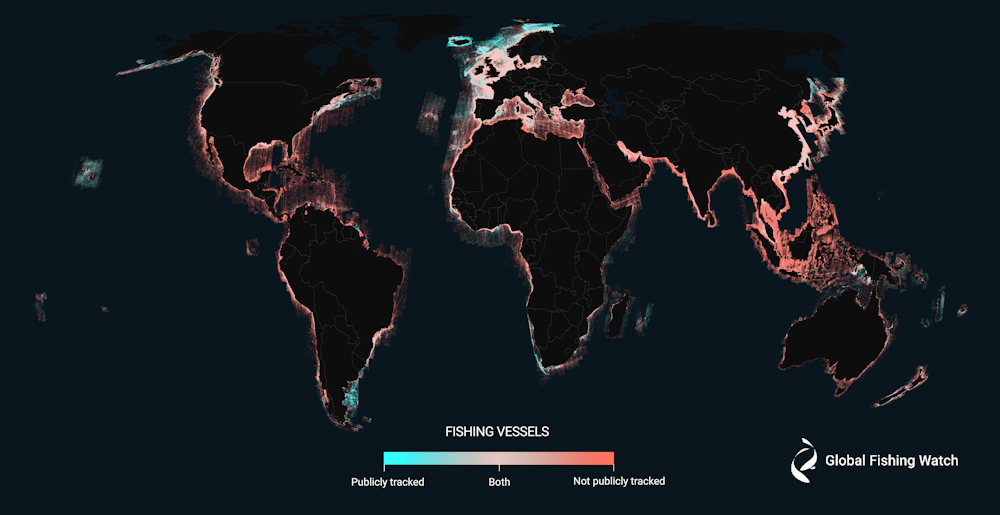
Remarkably, we found that about 75% of the fishing vessels we detected were missing from public AIS monitoring systems, with much of that activity taking place around Africa and South Asia. These previously invisible vessels radically changed our knowledge about the scale, scope and location of fishing activity.
For example, public AIS data wrongly suggests that Asia and Europe have comparable amounts of fishing within their borders. Our mapping reveals that Asia dominates: For every 10 fishing vessels we found on the water, seven were in Asia while only one was in Europe. Similarly, AIS data shows about 10 times more fishing on the European side of the Mediterranean compared with the African side – but our map shows that fishing activity is roughly equal across the two areas.
For other vessels, which are mostly transport- and energy-related, about 25% were missing from public AIS monitoring systems. Many missing vessels were in locations with poor AIS reception, so it is possible that they broadcast their locations but satellites did not pick up the transmission.
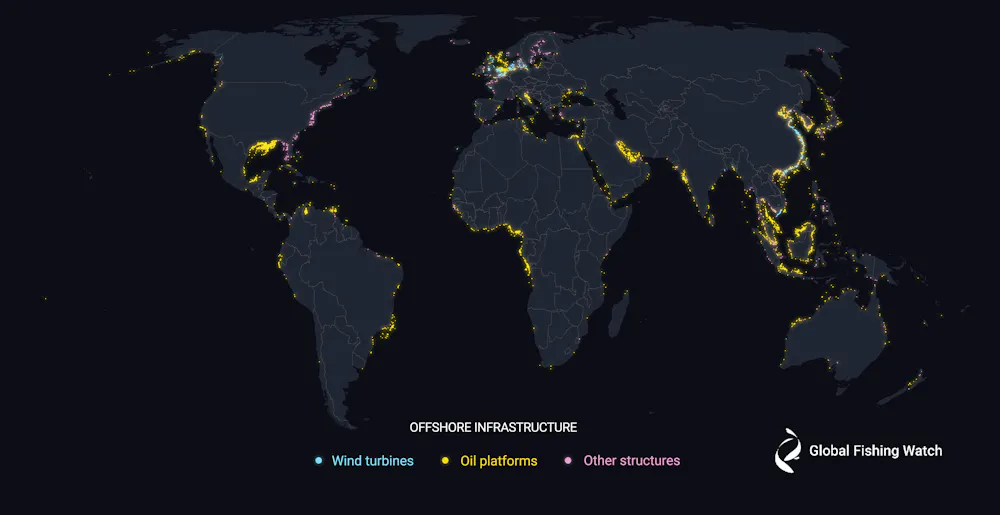
We also identified about 28,000 offshore structures – mostly oil platforms and wind turbines, but also piers, bridges, power lines, aquaculture farms and other human-made structures. Offshore oil infrastructure grew modestly over the five-year period, while the number of wind turbines more than doubled globally, with development mostly confined to northern Europe and China. We estimate that the number of wind turbines in the ocean likely surpassed the number of oil structures by the end of 2020.
Supporting real-world efforts
This data is freely available through the Global Fishing Watch data portal and will be maintained, updated and expanded over time there. We anticipate several areas where the information will be most useful for on-the-ground monitoring:
– Fishing in data-poor regions: Shipboard monitoring systems are too expensive to deploy widely in many places. Fishery managers in developing countries can use our data to monitor pressure on local stocks.
– Illegal, unreported and unregulated fishing: Industrial fishing vessels sometimes operate in places where they should not be, such as small-scale and traditional fishing grounds and marine protected areas. Our data can help enforcement agencies identify illegal activities and target patrol efforts.
– Sanction-busting trade: Our data can shed light on maritime activities that may breach international economic sanctions. For example, United Nations sanctions prohibit North Korea from exporting seafood products or selling its fishing rights to other countries. Previous work found more than 900 undisclosed fishing vessels of Chinese origin in the eastern waters of North Korea, in violation of U.N. sanctions.
We found that the western waters of North Korea had far more undisclosed fishing, likely also of foreign origin. This previously unmapped activity peaked each year in May, when China bans fishing in its own waters, and abruptly fell in 2020 when North Korea closed its borders because of the COVID-19 pandemic.
– Climate change mitigation and adaptation: Our data can help quantify the scale of greenhouse gas emissions from vessel traffic and offshore energy development. This information is important for enforcing climate change mitigation programs, such as the European Union’s emissions trading scheme.
– Offshore energy impacts: Our map shows not only where offshore energy development is happening but also how vessel traffic interacts with wind turbines and oil and gas platforms. This information can shed light on the environmental footprint of building, maintaining and using these structures. It can also help to pinpoint sources of oil spills and other marine pollution.
Healthy oceans underpin human well-being in a myriad of ways. We expect that this research will support evidence-based decision-making and help to make ocean management more fair, effective and sustainable.
Fernando Paolo, senior machine learning engineer at Global Fishing Watch; David Kroodsma, director of research and innovation at Global Fishing Watch; and Patrick Halpin, Professor of Marine Geospatial Ecology at Duke University, contributed to this article.
Jennifer Raynor, Assistant Professor of Natural Resource Economics, University of Wisconsin-Madison
This article is republished from The Conversation under a Creative Commons license. Read the original article.
On Monday, Gov. Gavin Newsom announced the funding of 975 affordable homes as part of those 10 funded projects.
Clearlake CIC, LP received $10 million for the development of Clearlake Apartments, an 80-unit affordable housing project in the city of Clearlake.
The project has been awarded more than $3 million in federal CDBG — Disaster Recovery Multifamily Housing Program funding by the city of Clearlake through the California Department of Housing and Community Development, or HCD.
The project aims to develop 80 units that will be affordable to households with earnings between 30% and 60% area median income.
Additionally, up to 20 units will be reserved for individuals or families with intellectual or developmental disabilities.
The project, located on 15.5-acre property at 15837 18th Ave., also will include a community building, playground and basketball half-court.
The property was part of a land swap completed two years ago between the county and the state. The deal involved Lake County trading the 18th Avenue property to the state for affordable housing and, in return, receiving the former National Guard Armory next to the Lake County Jail in Lakeport.
The armory is being renovated to house the headquarters of the Lake County Sheriff’s Office.
By identifying and utilizing excess state properties, Newsom’s office said California is on track to deliver approximately 5,550 housing units on excess state land, which will help an estimated 13,600 individuals.
“From day one of my administration, we have taken unprecedented action to tackle the housing crisis, one of the most pressing challenges facing our state,” Newsom said in a statement released about the program. “We’re using every available tool, including the conversion of excess state property into affordable housing to build more, faster. Cities and counties should follow the state’s lead and review their own inventory of excess land to catalyze the construction of more affordable housing throughout the state.”
In this funding round, HCD is allocating more than $63 million from the Excess Sites Local Government Matching Grants, or LGMG, program for the development of new affordable housing, Newsom’s office reported.
These investments will, in turn, match more than $80 million in collaborative funding committed by cities, counties, and public housing authorities where the new projects are located, the state said.
“The Excess Sites program allows for a unique collaboration with our local government partners, to build affordable housing on underutilized sites and optimize limited fiscal resources through matching grants,” said HCD Director Gustavo Velasquez. “These sites largely have easy access to transit and proximity to critical amenities, providing Californians with housing stability and connecting them to opportunity.”
Newsom issued an executive order in 2019 calling on HCD and the Department of General Services to address the state’s affordable housing crisis by identifying underutilized state-owned sites for the development of affordable housing, taking into account factors such as proximity to job centers, amenities, and public transit.
Excess sites projects, by virtue of being on state land, are subject to a simpler and more streamlined approval process than projects on locally controlled land. Newsom’s office said this expedites the approval process and avoids the exhaustive maneuvers used by some groups and local officials to prevent projects from moving forward.
To support and accelerate implementation of the governor’s excess sites order, HCD established LGMG to provide grant-based funding to match certain local government funding for selected developers to support predevelopment and development of affordable housing on excess state sites.
Newsom’s office said this collaboration between the state and local governments helps to expedite the delivery of affordable housing across the state to meet the goal of developing 2.5 million new homes by 2030, with one million homes being affordable for lower income levels.
Email Elizabeth Larson at
Overdose Lifeline Inc., in collaboration with the city of Lakeport and the Lakeport Police Department, will host the event from 6 to 8 p.m. Wednesday, Jan. 17, at the Soper Reese Theatre, 275 S. Main St. in Lakeport.
The event is free and open to the public. Dinner and beverages will be provided by the Lakeport Unified School District.
The meeting will be livestreamed on the Lakeport Police Department YouTube channel at this link: https://www.youtube.com/channel/UCplZjUiT1RYGBIyprJbWAlA.
Overdose Lifeline Inc. is a nonprofit leader in addressing the opioid epidemic through harm reduction and educational programming.
Justin Phillips, founder of Overdose Lifeline, Inc., will be present along with staff from Lake County Behavioral Health Services and law enforcement representatives to provide information on substance use disorder services available locally.
A panel will answer questions regarding the opioid crisis and how it affects Lake County residents.
Organizers said Phillips will provide valuable insights on substance use disorder, overdose and harm reduction techniques.
The goal is to provide education and resources to those affected by the opioid crisis in Lake County.
“This multiagency involvement underscores our commitment to addressing not only the immediate concerns regarding substance use in Lake County, but also providing ongoing education and reducing the stigma attached to substance use disorder,” the city said.
During the week leading up to the main event, representatives from Overdose Lifeline Inc. will visit local schools to engage with students and educators.
The presenters and sponsors encourage everyone in the community to attend the event and participate in the collective effort to combat the opioid crisis.
“Together we can make a positive impact on the well-being of our community,” city officials said.
For additional information, contact Lakeport Police Chief Brad Rasmussen at 707-263-5491, Extension 101.