 How to resolve AdBlock issue?
News
The first manual measurement of California’s snowpack took place on Tuesday.
It shows a snowpack that’s a fraction of what it was at this time last year, which is raising concern for water supply and fire risk.
As of Saturday night, the California Department of Water Resources’ statewide snow water content report showed that the snowpack is at 33% of normal.
That breaks down as 37% for the Northern Sierra, 33% for the Central Sierra and 25% for the Southern Sierra.
At this time last year, the Northern Sierra was 145% of normal, the Central Sierra was 188% and the Southern Sierra was at 200%, for a statewide average of 188%.
Kaitlyn Trudeau, a senior research associate in climate science for Climate Central, said there are important differences in conditions to remember when comparing the start of 2024 to the beginning of 2023.
Late 2022 and early 2023 were marked by heavy winter storms — driven by a series of atmospheric rivers — that dropped both heavy rain and snow across Lake County and the region.
Trudeau said during that time there were nine major atmospheric rivers which is what resulted in the big snow amounts in the Sierras.
In Lake County, snow hit particularly hard in late February after still more atmospheric rivers hit.
“Last year was really exceptional, and those storms were just packed with moisture,” she said, adding they also were colder.
Those bigger storms also led to massive flooding in some areas.
Another key difference between this year and last, said Trudeau, is that none of California is now in drought, while at the start of 2023, all of the state was in drought.
This year, the reservoir levels also are a lot higher at the start of the water year. As a result, Trudeau said the state has less pressure for water supply on it this year than last.
The Department of Water Resources is reporting that as of Saturday night, nearly all of the state’s reservoirs are above their historic average for this time of year. On the same date for 2023, reservoir levels were far lower.
Due to El Nino conditions, Trudeau said Lake County and the rest of California can expect more warm storms, and heavier downpours, with more rain and less snow.
Not only will that lead to less of a snowpack, but she said it could contribute to earlier snowmelt.
While last year’s storms lasted well into the spring, Trudeau said forecasters aren’t sure about this year. There is no parade of atmospheric rivers on tap.
“We would really like more snow,” she said, adding she’s not giving up hope that more may arrive this season.
“We probably will see more warmer storms. It’s going to make it harder to have snowpack at the same levels,” she said.
Trudeau said it’s important to think about the long-term, and to plan for the potential for multiple stretches of drought conditions.
Unless greenhouse gas emissions are reduced, Trudeau said there will continue to be increasing impacts from climate change.
“We can’t keep using the past to guide us into the future,” Trudeau said.
She has also focused on fire weather for the last several years, looking at trends over the past 50 years.
In the West, there has been a massive increase in weather with hot, dry conditions, and that sets the stage for extreme fire weather. Trudeau said the changes have led to the Southwest having two more months of fire risk.
Trudeaus said it’s really important that Californians and people in the West don’t let their guards down.
Email Elizabeth Larson at
The forum will be held beginning at 6 p.m. Tuesday, Jan. 16, in the council chambers at Clearlake City Hall, 14050 Olympic Drive.
The District 1 candidates on the ballot for the March 5 presidential primary are Bren Boyd, a chef and proprietor; John Hess, who serves on the Lake County Planning Commission; Sean Millerick, a small-business owner who serves as vice president of the Hidden Valley Lake Community Services District Board; rancher and business owner Helen Owen; and small business owner and winemaker Bryan Pritchard.
All five candidates have confirmed they will participate.
District 1 represents the south county, from Middletown up to a portion of the city of Clearlake. Incumbent Moke Simon is not seeking reelection.
The forum is being presented by the Lower Lake Community Action Group, the city of Clearlake and Lake County News.
Lake County News Editor and Publisher Elizabeth Larson will moderate.
Questions may be submitted ahead of time to
The forum will be broadcast on PEG TV, Channel 8.
The District 1 candidates also will be featured at a forum during the Middletown Area Town Hall meeting at 7 p.m. Thursday, Jan. 11, at the Middletown Senior and Community Center, 21256 Washington St.
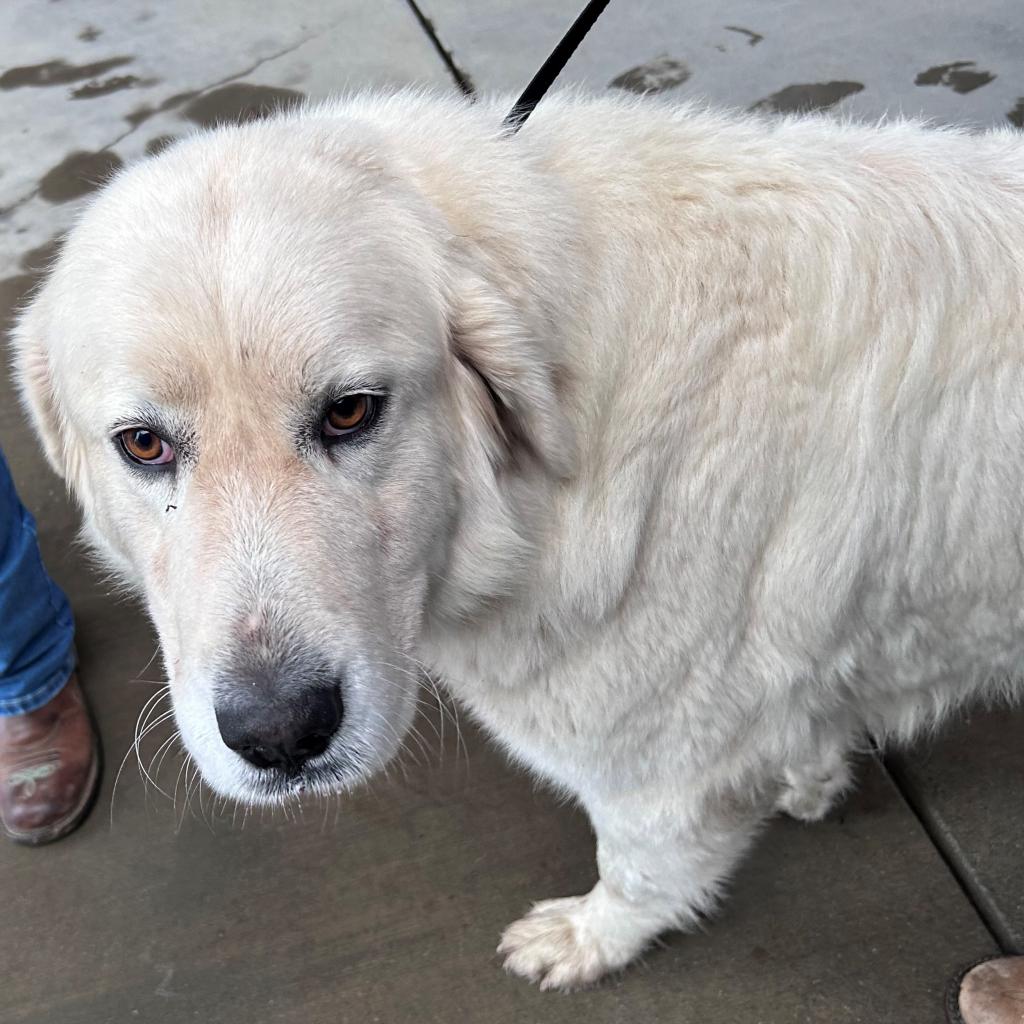
Dogs available for adoption this week include mixes of border collie, boxer, bulldog, German shepherd, Great Pyrenees, hound, Labrador retriever, pit bull, Queensland heeler, shepherd and terrier.
Dogs that are adopted from Lake County Animal Care and Control are either neutered or spayed, microchipped and, if old enough, given a rabies shot and county license before being released to their new owner. License fees do not apply to residents of the cities of Lakeport or Clearlake.
Those dogs and the others shown on this page at the Lake County Animal Care and Control shelter have been cleared for adoption.
Call Lake County Animal Care and Control at 707-263-0278 or visit the shelter online for information on visiting or adopting.
The shelter is located at 4949 Helbush in Lakeport.
Email Elizabeth Larson at



















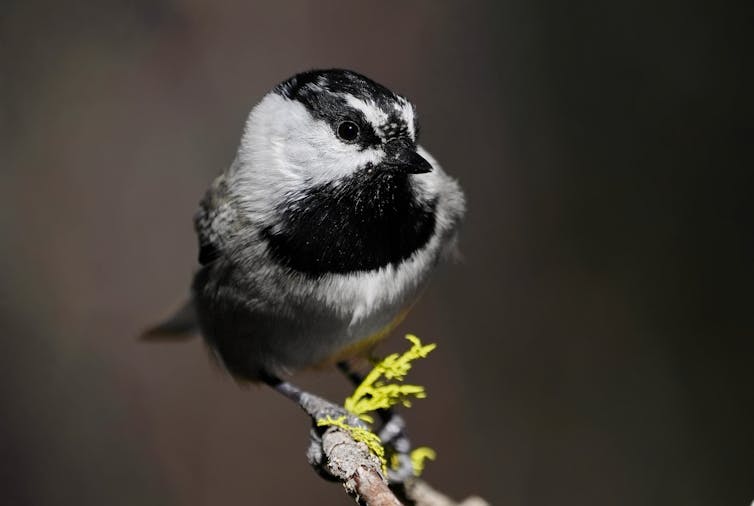
Wet snow pelts my face and pulls against my skis as I climb above 8,000 feet in the Sierra Nevada of eastern California, tugging a sled loaded with batteries, bolts, wire and 40 pounds of sunflower seeds critical to our mountain chickadee research.
As we reach the remote research site, I duck under a tarp and open a laptop. A chorus of identification numbers are shouted back and forth as fellow behavioral ecologist Vladimir Pravosudov and I program “smart” bird feeders for an upcoming experiment.
I have spent the past six years monitoring a population of mountain chickadees here, tracking their life cycles and, importantly, their memory, working in a system Pravosudov established in 2013. The long, consistent record from this research site has allowed us to observe how chickadees survive in extreme winter snowfall and to identify ecological patterns and changes.
In recent history, intense winters are often followed by drought years here in the Sierra Nevada and in much of the U.S. West. This teeter-totter pattern has been identified as one of the unexpected symptoms of climate change, and its impact on the chickadees is providing an early warning of the disruptions ahead for the dynamics within these coniferous forest ecosystems.
Our research shows that a mountain chickadee facing deep snow is, to borrow a cliche, like a canary in a coal mine – its survivability tells us about the challenges ahead.
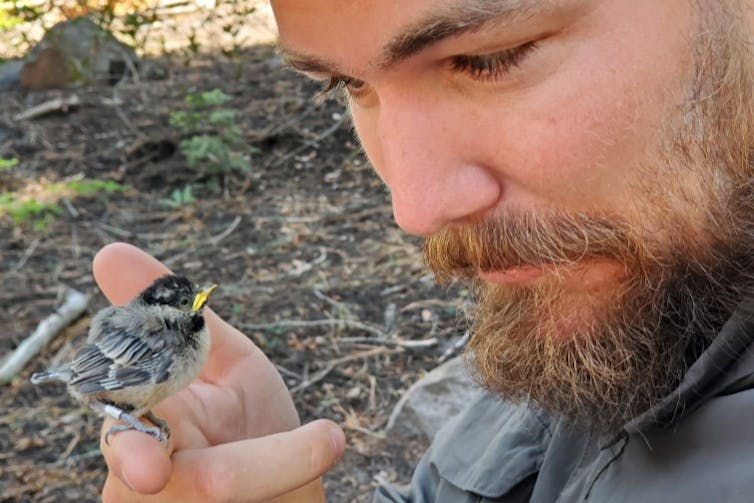
The extraordinary memory of a chickadee
As Pravosudov calls out the next identification number, and as my legs slowly get colder and wetter, a charming and chipper “DEE DEE DEE” chimes down from a nearby tree. How is it that a bird weighing barely more than a few sheets of paper is more comfortable in this storm than I am?
The answer comes down to the chickadees’ incredible spatial cognitive abilities.
Cognition is the processes by which animals acquire, process, store and act on information from their environment. It is critical to many species but is often subtle and difficult to measure in nonhuman animals.
Chickadees are food-storing specialists that hide tens of thousands of individual food items throughout the forest under edges of tree bark, or even between pine needles, each fall. Then, they use their specialized spatial memory to retrieve those food caches in the months to come.
Conditions in the high Sierras can be harsh, and if chickadees can’t remember where their food is, they die.
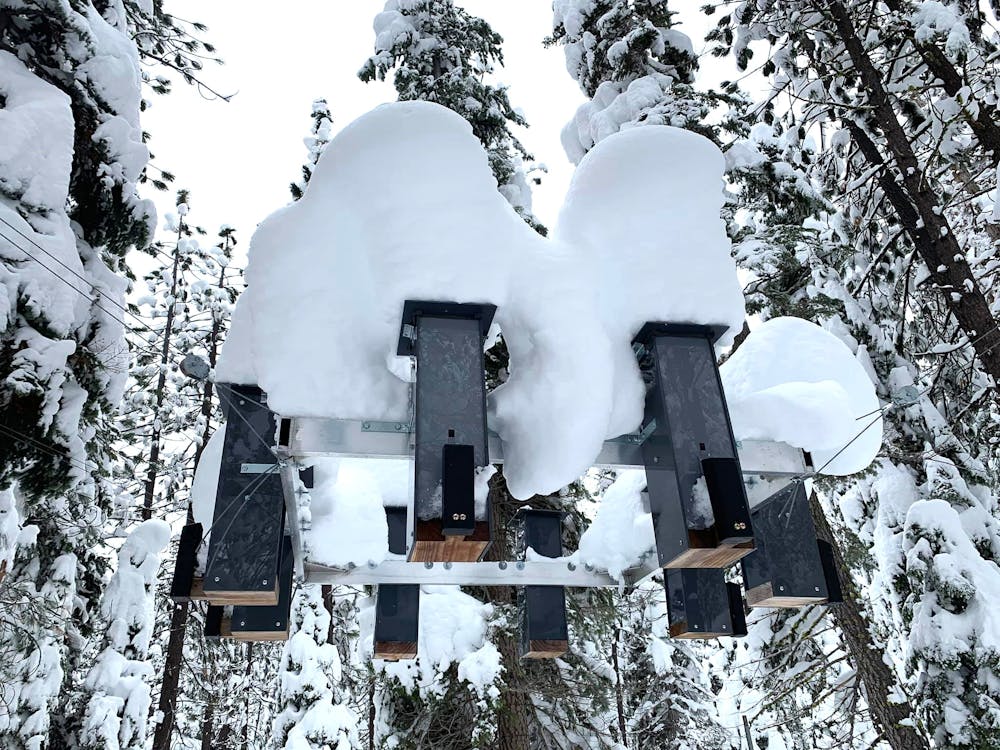
We measure the spatial memory of chickadees using a classic associative learning task but in a very atypical location. To do this, we hang a circular array of eight feeders equipped with radio-frequency identification and filled with seed in several locations across our field site. Birds are tagged with “keys” – transponder tags in leg bands that contain individual identification numbers and allow them to open the doors of their assigned feeders to get a food reward.
The setup allows us to measure the spatial memory performance of individual chickadees, because they have to remember which feeder their key enables them to open. Over eight years, our findings demonstrate that chickadees with better spatial memory ability are more likely to survive in the high mountains than those with worse memories.
However, chickadees may be facing increasing challenges that will shape their future in the high mountains. In 2017, a year with record-breaking snow levels, adult chickadees showed the lowest probability of survival ever measured at our site. This exceptionally extreme winter came with recurrent storms containing cold weather and high winds, making it difficult for even the memory savvy chickadees to forage and survive.
Nevertheless, triumphant populations have persisted in high-elevation mountain environments, but their future is becoming uncertain.
What’s the problem?
“It’s weather whiplash,” says Adrian Harpold, a mountain ecohydrologist. Harpold works to understand variations in climate patterns within forest environments, and one of his field sites lies alongside our chickadee research site.
The Sierra Nevada and other mountain ranges in western North America have been experiencing more extreme snow years and drought years, amplified by climate change. Extreme snow linked to global warming might seem counterintuitive, but it’s basic physics. Warmer air can hold more moisture – about 7% more for every degree Celsius (every 1.8 degrees Fahrenheit) that temperatures rise. This can result in heavier snowfall when storms strike.
In 2023’s record winter, over 17 feet (5 meters) of snow covered the landscape that our chickadees were using every day. In fact, these intense storms and cold temperatures not only made it difficult for birds to survive the winter but made it almost impossible for them to breed the next summer: 46% of chickadee nests at our higher elevation site failed to produce any offspring. This was likely due to the deep snow that prevented them from finding emerging insects to feed nestlings or even reaching nesting sites at all until July.
The cascading harms from too much snow
Even in years of tremendous snowfall, chickadees can still use their finely honed spatial memories to recover food. However, severe storms can shorten their survival odds. And if they do survive the winter, their nesting sites – tree cavities – may be buried under feet of snow in the spring.
It doesn’t matter how smart you are if you can’t reach your nest.
Extreme snow oscillations also affect insects that are critical for feeding chickadee chicks. Limited resources lead to smaller chickadee offspring that are less likely to survive high in the mountains.
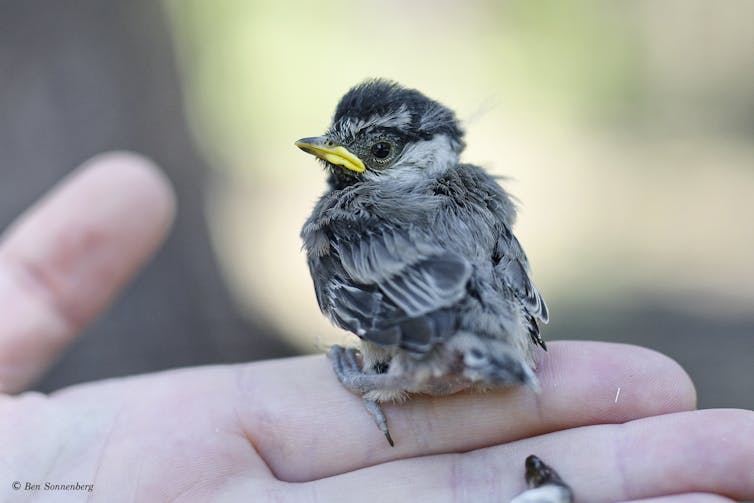
Snow cover is good for overwintering insects in most cases, as it provides an insulating blanket that saves them from dying during those freezing months. However, if the snow persists too long into the summer, insects can run out of energy and die before they can emerge, or emerge after chickadees really need them. Drought years also can drive insect population decline.
Extremes at both ends of the spectrum are making it harder for chickadees to thrive, and more and more we are seeing oscillations between these extremes.
These compounded effects mean that in some years chickadees simply don’t successfully nest at all. This leads to a decline in chickadee populations in years with worse whiplash – drought followed by high snow on repeat – especially at high elevations. This is especially concerning, as many mountain-dwelling avian species are forecasted to move up in elevation to escape warming temperatures, which may turn out to be hazardous.
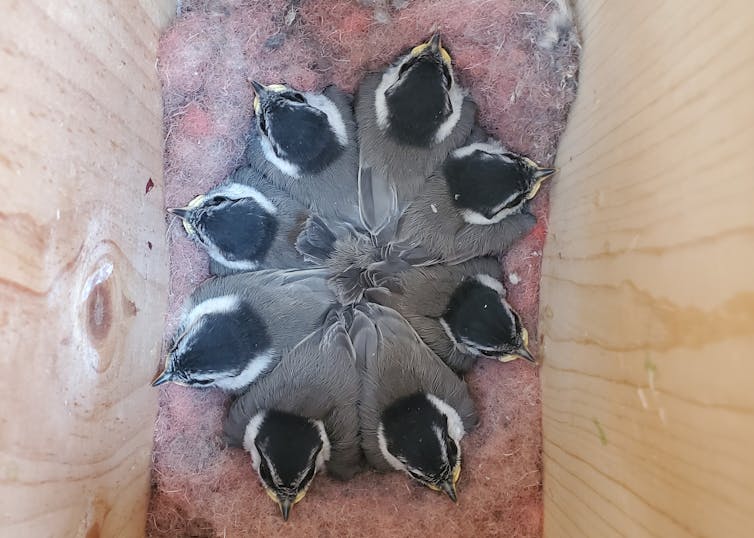
Lessons for the future
Chickadees may be portrayed as radiating tranquil beauty on holiday cards, but realistically, these loud, round ruffians are tough survivors of harsh winter environments in northern latitudes.
Our long-term research following these chickadees provides a unique window into the relationships between winter snow, chickadee populations and the biological community around them, such as coniferous forests and insect populations.
These relationships illustrate that climate change is a more complicated story than just the temperature climb – and that its whiplash and cascading effects can destabilize ecosystems.
Benjamin Sonnenberg, Ph.D. Candidate in Ecology, Evolution and Conservation Biology, University of Nevada, Reno
This article is republished from The Conversation under a Creative Commons license. Read the original article.
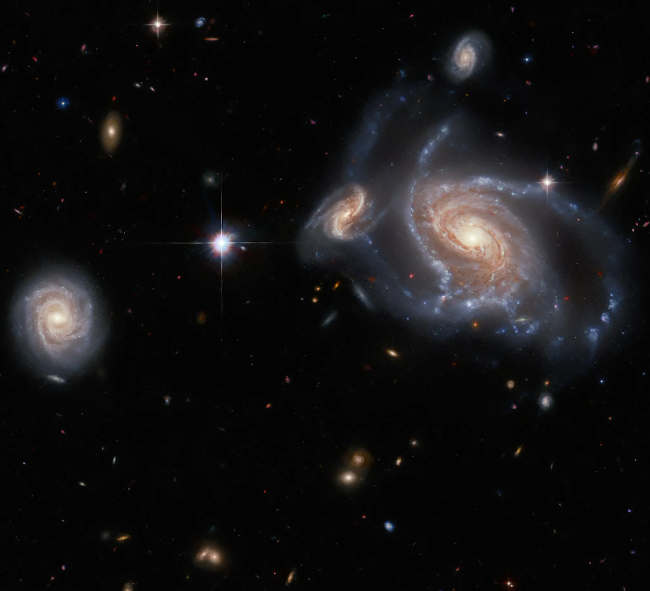
This image from the NASA/ESA Hubble Space Telescope features a richness of spiral galaxies: the large, prominent spiral galaxy on the right side of the image is NGC 1356; the two apparently smaller spiral galaxies flanking it are LEDA 467699 (above it) and LEDA 95415 (very close at its left) respectively; and finally, IC 1947 sits along the left side of the image.
This image is a really interesting example of how challenging it can be to tell whether two galaxies are actually close together, or just seem to be from our perspective here on Earth.
A quick glance at this image would likely lead you to think that NGC 1356, LEDA 467699, and LEDA 95415 were all close companions, while IC 1947 was more remote.
However, we have to remember that two-dimensional images such as this one only give an indication of angular separation: that is, how objects are spread across the sphere of the night sky. What they cannot represent is the distance objects are from Earth.
For instance, while NGC 1356 and LEDA 95415 appear to be so close that they must surely be interacting, the former is about 550 million light-years from Earth and the latter is roughly 840 million light-years away, so there is nearly a whopping 300 million light-year separation between them.
That also means that LEDA 95415 is likely nowhere near as much smaller than NGC 1356 as it appears to be.
On the other hand, while NGC 1356 and IC 1947 seem to be separated by a relative gulf in this image, IC 1947 is only about 500 million light-years from Earth.
The angular distance apparent between them in this image only works out to less than 400,000 light-years, so they are actually much closer neighbors in three-dimensional space than NGC 1356 and LEDA 95415.
For most districts, winter break ended on Friday, with classes to begin next week.
The exception is Kelseyville Unified, which returned to class on Wednesday.
In Lakeport, where classes begin on Monday, the Lakeport Police Department is asking drivers to use caution when traveling in, on and around the Lakeport Unified campus.
“With winter weather ahead please remember to give yourself extra time to reach your destination safely. Officers will be in the area during the first few weeks conducting education and enforcement,” the department reported.