How to resolve AdBlock issue?
Refresh this page
How to resolve AdBlock issue?
Refresh this page
Lake County News,California
  • Home
    • Registration Form
  • News
    • Education
    • Veterans
    • Community
      • Obituaries
      • Letters
      • Commentary
    • Police Logs
    • Business
    • Recreation
    • Health
    • Religion
    • Legals
    • Arts & Life
    • Regional
  • Calendar
  • Contact us
    • FAQs
    • Phones, E-Mail
    • Subscribe
  • Advertise Here
  • Login

News

Community Development Department borrows $390,000 from county amid budget deficit

LAKE COUNTY, Calif. — Less than two months after the Board of Supervisors adopted a “balanced” final budget for the new fiscal year, the Lake County Community Development Department reported a budget deficit and requested a $390,000 loan from the county to pay employee salaries for the next three months.

The department’s Building Division “has realized a significant drop in building permits,” Mireya Turner, director of Community Development Department, or CDD, said at the Board of Supervisors meeting on Nov. 18. 

Although the word “deficit” was not said aloud during the meeting, the staff memo stated the division is “currently operating under a budget deficit.”

The CDD brought the loan request to the board two weeks prior to the payroll deadline where the department would not be able to meet without financial aid. 

Despite having serious doubts in the department’s ability to pay back, the supervisors voted unanimously to approve the loan request, with Board Chair Eddie Crandell absent. 

From July 1 to Nov. 18 — over more than four months of the fiscal year — the CDD Building Division generated $571,565 in permit and service fees. That amounts to just 65.8% of its projected year-to-date revenue of $868,280, leaving it short of covering its $658,425 in expenses to date, including salaries and other expenses. 

“We’re just barely in the black as we speak,” said CDD Deputy Administrator Shannon Walker-Smith. “So we’re looking for this loan to ensure that we can cover salaries over the next three months.”

Turner said that the department is still busy with smaller permits, “not so much with the larger ones.”

According to a table provided to supervisors during the meeting — and not beforehand — the Building Division’s originally budgeted revenue for the fiscal year was $2,149,147. The division now anticipates a 20% reduction, lowering projected annual revenue to $1,714,695 and creating a shortfall of $434,452. 

The amount of loan requested from the board was $390,000. 

While the table does not include any projected adjustments to projected expenses, the CDD staff presenters reported that they had already restricted spending.

“We are pretty much on a spending freeze now, except anything that is dire as we work towards our mid-year adjustment,” said Walker-Smith. 

Still, staff said they expect revenue to pick up in the coming months.

“We do anticipate a return to historic norms of permitting in the future, and are confident that we will be able to repay this loan within the fiscal year,” Turner said. 

Historically, the Building Division generated $1,798,176 in revenue in 2022-23, $1,966,876 in 2023-24 and $2,048,229 in 2024-25. The current fiscal year’s adjusted projection is now below the 2022-23 level. 

Loan payback plan in doubt, strict oversight on CDD finance expected

While the resolution authorizing the loan requires a full payback by Jun. 30, 2026, none of the supervisors seemed to believe in the viability of that plan. 

Supervisor Bruno Sabatier said he has “grave concerns” about a repayment plan that depends on future permit revenues.

He brought up the fact that the county is not supposed to “make money off” the rates on county services. 

“Your plan to pay back is based on services that have yet to be provided,” said Sabatier. “How are you going to pay back services already rendered with new services that should only pay for the services that are rendered?”

He continued: “Yes, there's always a little bit of fluff involved in our fees to ensure that it pays for the time that staff spends. But to pay back almost $400,000 off the backs of other services — it doesn't sit well with me.”

Supervisor Helen Owen said she was also “worried about the legalities of the collection,” echoing Sabatier’s concerns. Turner said she did not share those concerns. 

“Historically, when we do have more permit fees than we have expenses, we've been able to feed funding into reserves. So I'm not concerned as much. I'm not really understanding the legality issue,” Turner said.

The Building Division’s reserve was $78,033 in the 2025-26 final budget, which had already been used.

“The reserves were at an excessive level and so we had been sort of moving them down,” Turner said of the reserve amount. “We just weren't counting on this collection of criteria that have led us to this point.”

Assistant County Administrative Officer Stephen Carter said that the division does not need the board’s approval to use reserves. But by the end of the fiscal year, the division must have at least the reserve amount in cash to balance the books. 

Carter said the division is “technically negative $40,000” because of insufficient cash flow.

“I think it's a learning moment, not for the department, but for us,” Sabatier said following Carter’s explanation. “There has to be some flags that if we meet a certain criteria of going down towards being in negatives, that we have to take certain actions before this.”

Despite the concerns, it became clear the supervisors had no practical alternative but to approve the loan.

“Obviously we have to do something; We’ve got to make payroll,” Supervisor Brad Rasmussen said while he didn’t think loan repayment by Jun. 30 was realistic. 

Supervisor Jessica Pyska agreed on the necessity to provide the loan. “But I don’t see how we’re going to get paid back,” she said, asking the County Administrative Office for oversight measures on the CDD department finance. 

Deputy County Administrative Officer Casey Moreno proposed that the County Administrative Office have “full signature authority” over the CDD — not only the Building Division — for all of their budgets until the loan is fully paid back. Moreno also suggested having monthly or bimonthly budget meetings with the CDD “in order to get them back on track.”

“We probably all agree that there needs to be some pretty rigid oversight going forward,” said Pyska.

Sabatier said he was concerned that approving the loan will not solve the problem. “So I would like to have a better plan to ensure that we can make you solvent, and also make sure that it gets paid back,” he told CDD staff during the meeting.

On top of the unanimous approval of the loan, the board will further discuss the department’s budget matters, repayment plans and oversight procedures at the board meeting on Dec. 9. 

“I feel the need for a more robust plan than what's in front of us,” Sabatier said.

This was not the only internal loan that the county has issued recently. 

On Jun. 17, the board approved authorizing a $2 million loan to Behavioral Health requiring repayment within 90 days — a deadline the department ultimately missed. 

County documents showed that it was due to cash flow constraints tied to the Medi-Cal intergovernmental transfer process and timing of reimbursements. 

On Sep. 16, Behavioral Health Director Elise Jones requested a 180-day extension for their repayment. The board approved it 4-1 with Sabatier the sole dissenting vote. 

A ‘perfectly balanced’ county budget in question

At the county’s budget hearing on Jun. 25, Moreno called the recommended 2025-26 budget “perfectly balanced.”

Three months later on Sep. 23 when the Board of Supervisors adopted the final recommended budget, no adjustments were made to the Building Division’s estimated revenues under its Budget Unit 2602 for building and safety. 

By Nov. 14 — less than two months after supervisors approved the final budget — the division reported a significant revenue drop and a budget deficit, despite restricting spending.

At the November meeting, Turner told the supervisors that the decline in permitting revenues occurred in 2024 and that recoveries began in 2025. 

The timeline of how and when the deficit emerged seemed unclear: When did the drops in permitting revenue actually occur? How has the deficit developed in the department and when did the CDD discover that the department was operating in a deficit? What made a “balanced” budget into a deficit in less than two months? 

Lake County News asked the county for comments on the current CDD deficit against the “perfectly balanced” county budget.

“Permit revenues have lagged anticipated levels,” Chief Deputy County Administrative Officer Matthew Rothstein, the administrative office’s spokesperson, said in an email on Nov. 21. “While signs of decreased revenues had previously been observed, the magnitude of the concern came into greater focus very recently, and appropriate responsive action was initiated.”

He said the standard county budget process calls for revenue projections to be revisited at mid-year and that the approved final budget was “balanced.”

“This action in anticipation of mid-year reflects the urgency of the situation,” Rothstein said. “And mid-year budget adjustments will be proposed in consideration of any divergence from projections.” 

Lake County News also asked for the specific months when revenue declined and when signs of recovery began. 

This question was not answered, and the county’s response did not make clear when the deficit occurred.

Lake County News reached out with the same question again, emphasizing the doubt on why earlier revenue declines — in 2024 as Turner mentioned — did not result in any budget adjustments before the final budget was adopted. 

“No further responsive documents are available at this time,” Rothstein said. 

Inconsistent narrative on impact of salary increases 

While the county did not provide Lake County News with specifics on when revenue drops and the deficit occurred, what happened between the end of September and mid-November that turned a “balanced” final budget into a deficit remains unknown. 

What is known is that a multi-million-dollar raise for county staff took effect in July.

On June 17, the Board of Supervisors approved four-year contracts with nine employee groups, resulting in approximately $5,278,704 in raises. 

Supervisor Sabatier cast the lone dissenting vote on each of the nine votes. He said that as a result of those raises, the budget wouldn’t be balanced as of July 1, meaning the county already was $5 million in the hole as the new fiscal year started.

At that time, Sabatier said the county has to figure out how to tighten budgets to be more realistic, noting they have been “fluffed.”

Both Turner and Walker-Smith of the CDD brought up the impact of increased salaries on their budgeting and the need for a loan. 

“We are requesting this temporary loan because the increase in wages has made it necessary to address this prior to the mid-year budget,” Turner said. 

At the same time, “our salaries overall have not exceeded what we expected at this point,” Walker-Smith said. 

The staff memo said that the division had only spent 78% of its year-to-date projected expenses on salaries.

Still the raises are playing a part in the department’s budgeting, although vaguely mentioned. 

“We do recognize that we're looking at probably a revenue shortfall for this fiscal year overall,” Walker-Smith said. “And we anticipated that with the salary increases that we would have to make a significant adjustment at mid-year.”

In the response to Lake County News, however, Rothstein said the CDD’s need for the loan “reflects revenues that fell short of projections, and not effects of salary increases.”

“Appropriate fiscal and contingency planning were undertaken prior to the board’s approval of salary increases, and mid-year adjustments will be made,” Rothstein said. “Given the late juncture at which agreements were reached and ratified by employee groups, this need of budgetary adjustments is expected.”

Rothstein also confirmed that “no other departments are currently operating or projected to run into deficit at this time.”

Email staff reporter Lingzi Chen at This email address is being protected from spambots. You need JavaScript enabled to view it.. 

Clearlake Police Department relaunches explorer program

CLEARLAKE, Calif. — The Clearlake Police Department is relaunching its explorer program for young people interested in a career in law enforcement.

The program is now recruiting young people ages 14 to 20 interested in exploring a career in public safety, and who would like to become leaders and learn new skills.

The Police Explorer Program introduces youth to real-world law enforcement training and community service. 

Participants build confidence, leadership and teamwork through hands-on experiences.

Explorers will learn basic patrol and investigative skills; participate in scenario-based training; assist officers at community events; develop confidence, discipline and communication; and work closely with Clearlake Police mentors and officers.

One of the program’s advisors, Officer Virgil Ellis, began his own journey in high school as a police explorer. The department said Ellis’ firsthand experience shows how far this program can take those who participate in it.

Program participants will meet once a month.

There is no cost to apply, and the program is open to youth in Clearlake and surrounding areas.

For more information or to apply, contact Officer Ellis at 707-994-8251, Extension 508, or email This email address is being protected from spambots. You need JavaScript enabled to view it..  

State announces investigation into major voice service providers, offers update on robocall enforcement efforts

California Attorney General Rob Bonta on Wednesday announced Phase 2 of Operation Robocall Roundup, a multistate, bipartisan effort by the Anti-Robocall Litigation Task Force to crack down on robocalls around the country. 

As part of this phase, Attorney General Bonta and 51 attorneys general have sent warning letters to four of the largest voice service providers in the U.S., demanding they immediately take action to stop illegal robocalls from being routed through their networks. 

In August, Attorney General Bonta and the Task Force commenced Phase 1 of Operation Robocall, sending warning letters to 37 smaller voice providers that were allowing suspected illegal robocalls onto the U.S. telephone network — an effort that has already delivered results. Phase 2 targets companies with far larger footprints in the U.S. telecom ecosystem. 

As larger providers, these companies have a heightened responsibility to decline call traffic from known and repeat bad actors, Bonta’s office said.

Despite extensive industry traceback notices and years of documented warnings, these four providers continue to route suspected illegal robocalls onto the network and into American homes. 

“Robocalls disrupt our lives and bombard us with never ending voicemails — for many Californians, robocalls are a daily, if not an hourly, source of frustration. These calls aren’t just annoying, in many cases they are illegal and a vehicle for harmful scams that can result in real financial losses for consumers. This is a nationwide problem, and we need nationwide solutions,” said Bonta.

“I am proud to continue in this national, bipartisan effort to protect consumers from unwanted robocalls by launching Phase 2 of Operation Robocall Roundup,” Bonta said Wednesday. “The four companies targeted today are continuing to transmit millions of suspected illegal robocalls. My office is committed to protecting Californians and tackling illegal robocalls that plague our phones, disrupt our days, and threaten our wallets.” 

The four providers targeted in Wednesday’s operation have been directed to stop transmitting suspected illegal robocalls across their network.

By disregarding notices and warnings meant to protect consumers, these companies have allowed robocalls onto their phone networks and have then passed these calls on to other downstream providers until they reach the phones of Californians, Bonta’s office reported.

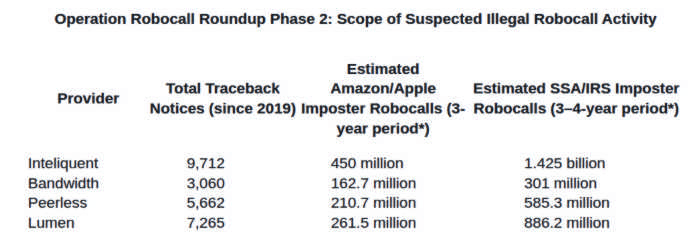
The chart below includes data points illustrating the suspected illegal robocall activity of each of the four service providers targeted today, including the estimated number of Social Security Administration, or SSA, and Internal Revenue Service imposter calls which these companies allowed on their networks.

Operation Robocall Phase 1 results

After sending warning letters to 37 companies in August, the Task Force saw rapid, measurable changes:

• 13 companies were removed from the FCC’s Robocall Mitigation Database, meaning no provider in the United States may accept their call traffic.
• 19 companies stopped appearing in any traceback results, indicating they ceased routing suspected illegal robocalls.
• At least four providers terminated high-risk customer accounts identified as transmitting illegal traffic.

The Anti-Robocall Multistate Litigation Task Force of 51 bipartisan attorneys general investigates and takes legal action against those responsible for routing significant volumes of illegal robocall traffic into and across the United States.

Bonta’s office said he is committed to enforcing consumer protections in the state of California and speaking out for consumer protections nationwide, including working to stop illegal robocalls.

In April, Bonta put nine companies on notice for submitting illegal robocall traffic. And in March, he submitted an amicus brief in support of a FCC rule which would have limited unwanted robocalls and robotexts by closing a loophole that bad-acting lead generators try to use to trick a consumer into “consenting” to calls from potentially thousands of companies.

As part of the effort to combat illegal robocall traffic Attorney General Bonta has: 

• Sent warning letters to four telecom companies for transmitting suspected illegal robocall traffic on their networks — including robocalls that impersonated government officials or involved scams.
• Submitted a comment letter to the FCC in support of its proposed rules to protect consumers by increasing the effectiveness of the FCC’s Robocall Mitigation Database.
• Sent a warning letter to a telecom company responsible for transmitting suspected illegal robocall traffic, including robocalls that impersonated government officials. 
• Sent a warning letter to a company that allegedly sent New Hampshire residents scam election robocalls during the New Hampshire primary election. 
• Filed a comment letter to the FCC related to the potential impact of emerging artificial intelligence technology on efforts to protect consumers from illegal robocalls or robotexts. 

Additionally, the California Department of Justice is involved in ongoing litigation against Avid Telecom for allegedly initiating and facilitating billions of unlawful robocalls that included Social Security Administration scams, Medicare scams and employment scams.

FDA claims on COVID-19 vaccine safety are unsupported by reliable data – and could severely hinder vaccine access

The FDA has provided no evidence that children died because of receiving a COVID-19 vaccine. Anchiy/E+ via Getty Images

The Food and Drug Administration is seeking to drastically change procedures for testing vaccine safety and approving vaccines, based on unproven claims that mRNA-based COVID-19 vaccines caused the death of at least 10 children.

The agency detailed its plans in a memo released to staff on Nov. 28, 2025, which was obtained by several news outlets and published by The Washington Post.

Citing an internal, unpublished review, the memo, written by the agency’s top vaccine regulator, Vinay Prasad, attributes the children’s deaths to myocarditis, an inflammation of the heart muscle. And it says the deaths were reported to the Vaccine Adverse Event Reporting System, or VAERS, but provides no evidence that the vaccines caused the deaths.

The death of children due to an unsafe vaccine is a serious allegation. I am a pediatric cardiologist who has studied the link between COVID-19 vaccines and heart-related side effects such as myocarditis in children. To my knowledge, studies to date have shown such side effects are rare, and severe outcomes even more so. However, I am open to new evidence that could change my mind.

But without sufficient justification and solid evidence, restricting access to an approved vaccine and changing well-established procedures for testing vaccines would carry serious consequences. These moves would limit access for patients, create roadblocks for companies and worsen distrust in vaccines and public health.

In my view, it’s important for people reading about these FDA actions to understand how the evidence on a vaccine’s safety is generally assessed.

Determining cause of death

The FDA memo claims that the deaths of these children were directly related to receiving a COVID-19 immunization.

From my perspective as a clinician, it is awful that any child should die from a routine vaccination.

However, health professionals like me owe it to the public to uphold the highest possible standards in investigating why these deaths occurred. If the FDA has evidence demonstrating something that national health agencies worldwide have missed – widespread child deaths due to myocarditis caused by the COVID-19 vaccine – I don’t doubt that even the most pro-vaccine physician will listen. So far, however, no such evidence has been presented.

While a death logged in VAERS is a starting point, on its own it is insufficient to conclude whether a vaccine caused the death or other medical causes were to blame.

To demonstrate a causal link, FDA staff and physicians must align the VAERS report with physicians’ assessments of the patient, as well as data from other sources for monitoring vaccine safety. These include PRISM, which logs insurance claims data, and the Vaccine Safety Datalink, which tracks safety signals in electronic medical records.

It’s known that most deaths logged only in VAERS of children who recently received vaccines have been incorrectly attributed to the vaccines – either by accident or in some cases on purpose by anti-vaccine activists.

Heart-related side effects of COVID-19 vaccines

In his Substack and Twitter accounts, Prasad has said that he believes the rate of severe cardiac side effects after COVID-19 vaccination is severely underestimated and that the vaccines should be restricted far more than they currently are.

In a July 2025 presentation, Prasad quoted a risk of 27 cases per million of myocarditis in young men who received the COVID-19 vaccine. A 2024 review suggested that number was a bit lower – about 20 cases out of 1 million people. But that same study found that unvaccinated people had greater risk of heart problems after a COVID-19 infection than vaccinated people. In a different study, people who got myocarditis after a COVID-19 vaccination developed fewer complications than people who got myocarditis after a COVID-19 infection.

Existing vaccine safety infrastructure in the U.S. successfully identifies dangers posed by vaccines – and did so during the COVID-19 pandemic. Today, most COVID-19 vaccines in the U.S. rely on mRNA technology. But as vaccines were first emerging during the COVID-19 pandemic, two pharmaceutical companies, Janssen and AstraZeneca, rolled out a vaccine that used a different technology, called a viral vector. This type of vaccine had a very rare but genuine safety problem that was detected.

A report in VAERS is at most a first step to determining whether a vaccine caused harm.

VAERS, the Vaccine Safety Datalink, clinical investigators in the U.S. and their European counterparts detected that these vaccines did turn out to cause blood clotting. In April 2021, the FDA formally recommended pausing their use, and they were later pulled from the market.

Death due to myocarditis from COVID-19 vaccination is exceedingly rare. Demonstrating that it occurred requires proof that the person had myocarditis, evidence that no other reasonable cause of death was present, and the absence of any additional cause of myocarditis. These factors cannot be determined from VAERS data, however – and to date, the FDA has presented no other relevant data.

A problematic vision for future vaccine approvals

Currently, vaccines are tested both by seeing how well they prevent disease and by how well they generate antibodies, which are the molecules that help your body fight viruses and bacteria.

Some vaccines, such as the COVID-19 vaccine and the influenza vaccine, need to be updated based on new strains. The FDA generally approves these updates based on how well the new versions generate antibodies. Since the previous generation of vaccines was already shown to prevent infection, if the new version can generate antibodies like the previous one, researchers assume its ability to prevent infection is comparable too. Later studies can then test how well the vaccines prevent severe disease and hospitalization.

The FDA memo says this approach is insufficient and instead argues for replacing such studies with many more placebo-controlled trials – not just for COVID-19 vaccines but also for widely used influenza and pneumonia vaccines.

That may seem reasonable theoretically. In practice, however, it is not realistic.

Today’s influenza vaccines must be changed every season to reflect mutations to the virus. If the FDA were to require new placebo-controlled trials every year, the vaccine being tested would become obsolete by the time it is approved. This would be a massive waste of time and resources.

A pharmacy with a sign advertising flu shots
Influenza vaccines must be updated for every flu season. Jacob Wackerhausen/iStock via Getty Images Plus

Also, detecting vaccine-related myocarditis at the low rate at which it occurs would have required clinical trials many times larger than the ones that were done to approve COVID-19 mRNA vaccines. This would have cost at least millions of dollars more, and the delay in rolling out vaccines would have also cost lives.

Placebo-controlled trials would require comparing people who receive the updated vaccine with people who remain unvaccinated. When an older version of the vaccine is already available, this means purposefully asking people to forgo that vaccine and risk infection for the sake of the trial, a practice that is widely considered unethical. Current scientific practice is that only a brand-new vaccine may be compared against placebo.

While suspected vaccine deaths should absolutely be investigated, stopping a vaccine for insufficient reasons can lead to a significant drop in public confidence. That’s why it’s essential to thoroughly and transparently investigate any claims that a vaccine causes harm.

Vaccine vs illness

To accurately gauge a vaccine’s risks, it is also crucial to compare its side effects with the effects of the illness it prevents.

For COVID-19, data consistently shows that the disease is clearly more dangerous. From Aug. 1, 2021, to July 31, 2022, more than 800 children in the U.S. died due to COVID-19, but very few deaths from COVID-19 vaccines in children have been been verified worldwide. What’s more, the disease causes many more heart-related side effects than the vaccine does.

Meanwhile, extensive evidence shows that COVID-19 vaccination reduces the risk of hospitalization by more than 70% and the risk of severe illness in adolescent children by 79%. Studies also show it dramatically reduces their risk of developing long COVID, a condition in which symptoms such as extreme fatigue or weakness persist more than three months after a COVID-19 infection.

Reporting only the vaccines’ risks, and not their benefits, shows just a small part of the picture.The Conversation

Frank Han, Assistant Professor of Pediatric Cardiology, University of Illinois Chicago

This article is republished from The Conversation under a Creative Commons license. Read the original article.

Cobb man arrested for Tuesday evening stabbing

LAKE COUNTY, Calif. — The Lake County Sheriff’s Office said it has arrested a Cobb man for stabbing another man during a fight on Tuesday evening.

David Clark, 42, was taken into custody for the incident, according to Lauren Berlinn, the sheriff’s public information office.

At 6:30 p.m. Tuesday, sheriff’s deputies responded to a report of a stabbing in the Middletown area, Berlinn said.

Berlinn said the initial information incorrectly indicated that the incident may have occurred at Middletown High School. 

However, deputies quickly confirmed this was not the case. The incident did not occur on school grounds and was not associated with any school activities, Berlinn said.

At the time deputies arrived, Berlinn said the injured individual was located across the street at a nearby gas station, where he was waiting for medical assistance.

“This was an isolated incident, and there is no ongoing threat to students, school staff or the broader community,” Berlinn’s report said.

Berlinn said the investigation determined that the stabbing occurred earlier at Trailside Park in Middletown. 

Witnesses reported that Clark and another adult male were involved in a physical altercation at the park, during which Clark stabbed the victim.

After the incident, the victim left the park and drove to the gas station, where he was evaluated by paramedics before being transported to an out-of-county hospital for treatment, Berlinn said.

Deputies later located Clark at his residence, where he was taken into custody without incident, according to Berlinn’s report.

Berlinn said deputies arrested Clark on charges related to attempted murder and assault with a deadly weapon.

Elections office certifies final election results; Lake County votes against Prop 50 in narrow margin

LAKE COUNTY, Calif. — The Lake County Registrar of Voters Office said Tuesday that it has certified the final election results for the special November statewide election to decide on Proposition 50.

Prop 50 implements a plan for congressional redistricting that’s expected to result in several additional seats for Democrats in Congress. It is a response to a redistricting action taken in Texas to bolster Republican seats.

Statewide, Prop 50 won with 64.4%, or 7,452,222 yes votes, to 35.6%, or 4,116,452 no votes, according to the Secretary of State’s Office.

In Lake County, while the measure had led after the initial count, it ultimately lost locally on a slim margin, with the no votes only leading by 49 ballots.

Lake County’s final count was no votes with 50.1%, or 10,399 ballots, to 49.9%, or 10,350 ballots for those voting yes.

Overall, Lake County’s voter turnout for the special election was 53.71%. Approximately 20,763 of the 38,660 registered voters participated. 

The Registrar’s Office said the election results will be presented to the Lake County Board of Supervisors at its Dec. 9 meeting, at which time the board is expected to accept the certified results.

The Secretary of State’s Office plans to certify the statewide results on Dec. 12.

Email Elizabeth Larson at This email address is being protected from spambots. You need JavaScript enabled to view it.. Follow her on Twitter, @ERLarson, and on Bluesky, @erlarson.bsky.social. Find Lake County News on the following platforms: Facebook, @LakeCoNews; X, @LakeCoNews; Threads, @lakeconews, and on Bluesky, @lakeconews.bsky.social. 

  • 49
  • 50
  • 51
  • 52
  • 53
  • 54
  • 55
  • 56
  • 57
  • 58

Community

  • Lake County Wine Alliance offers sponsor update; beneficiary applications open 

  • Mendocino National Forest announces seasonal hiring for upcoming field season

Public Safety

  • Lakeport Police logs: Thursday, Jan. 15

  • Lakeport Police logs: Wednesday, Jan. 14

Education

  • Woodland Community College receives maximum eight-year reaffirmation of accreditation from ACCJC

  • SNHU announces Fall 2025 President's List

Health

  • California ranks 24th in America’s Health Rankings Annual Report from United Health Foundation

  • Healthy blood donors especially vital during active flu season

Business

  • Two Lake County Mediacom employees earn company’s top service awards

  • Redwood Credit Union launches holiday gift and porch-to-pantry food drives

Obituaries

  • Rufino ‘Ray’ Pato

  • Patty Lee Smith

Opinion & Letters

  • The benefits of music for students

  • How to ease the burden of high electric bills

Veterans

  • CalVet and CSU Long Beach team up to improve data collection related to veteran suicides

  • A ‘Big Step Forward’ for Gulf War Veterans

Recreation

  • Wet weather trail closure in effect on Upper Lake Ranger District

  • Mendocino National Forest seeking public input on OHV grant applications

  • State Parks announces 2026 Anderson Marsh nature walk schedule 

  • BLM lifts seasonal fire restrictions in central California

Religion

  • Kelseyville Presbyterian to host Ash Wednesday service and Lenten dinner Feb. 18

  • Kelseyville Presbyterian Church to hold ‘Longest Night’ service Dec. 21

Arts & Life

  • Auditions announced for original musical ‘Even In Shadow’ set for March 21 and 28

  • ‘The Rip’ action heist; ‘Steal’ grounded in a crime thriller

Government & Politics

  • Lake County Democrats issue endorsements in local races for the June California Primary

  • County negotiates money-saving power purchase agreement

Legals

  • March 3 hearing on ordinance amending code for commercial cannabis uses

  • Feb. 12 public hearing on resolution to establish standards for agricultural roads

How to resolve AdBlock issue?
Refresh this page