How to resolve AdBlock issue?
Refresh this page
How to resolve AdBlock issue?
Refresh this page
Lake County News,California
  • Home
    • Registration Form
  • News
    • Education
    • Veterans
    • Community
      • Obituaries
      • Letters
      • Commentary
    • Police Logs
    • Business
    • Recreation
    • Health
    • Religion
    • Legals
    • Arts & Life
    • Regional
  • Calendar
  • Contact us
    • FAQs
    • Phones, E-Mail
    • Subscribe
  • Advertise Here
  • Login

News

Proof that immigrants fuel the US economy is found in the billions they send back home


Migrant workers pick strawberries during harvest south of San Francisco, Calif. Visions of America/Joe Sohm/Universal Images Group via Getty Images

Donald Trump has vowed to deport millions of immigrants if he is elected to a second term, claiming that, among other things, foreign-born workers take jobs from others. His running mate JD Vance has echoed those anti-immigrant views.

Researchers, however, generally agree that massive deportations would hurt the U.S. economy, perhaps even triggering a recession.

Social scientists and analysts tend to concur that immigration — both documented and undocumented — spurs economic growth. But it is almost impossible to calculate directly how much immigrants contribute to the economy. That’s because we don’t know the earnings of every immigrant worker in the United States.

We do, however, have a good idea of how much they send back to their home countries – more than US$81 billion in 2022, according to the World Bank. And we can use this figure to indirectly calculate the total economic value of immigrant labor in the U.S.

Economic contributions are likely underestimated

I conducted a study with researchers at the Center for Latin American and Latino Studies and the Immigration Lab at American University to quantify how much immigrants contribute to the U.S. economy based on their remittances, or money sent back home.

Several studies indicate that remittances constitute 17.5% of immigrants’ income.

Given that, we estimate that the immigrants who remitted in 2022 had take-home wages of over $466 billion. Assuming their take-home wages are around 21% of the economic value of what they produce for the businesses they work for – like workers in similar entry-level jobs in restaurants and construction – then immigrants added a total of $2.2 trillion to the U.S. economy yearly.

That is about 8% of the gross domestic product of the United States and close to the entire GDP of Canada in 2022 – the world’s ninth-largest economy.

Immigration strengthens the US

Beyond its sheer value, this figure tells us something important about immigrant labor: The main beneficiaries of immigrant labor are the U.S. economy and society.

The $81 billion that immigrants sent home in 2022 is a tiny fraction of their total economic value of $2.2 trillion. The vast majority of immigrant wages and productivity – 96% – stayed in the United States.

Remittances from the U.S. represent a substantial income source for the people who receive them. But they do not represent a siphoning of U.S. dollars, as Trump has implied when he called remittances “welfare” for people in other countries and suggested taxing them to pay for the construction of a border wall.

The economic contributions of U.S. immigrants are likely to be even more substantial than what we calculate.

For one thing, the World Bank’s estimate of immigrant remittances is probably an undercount, since many immigrants send money abroad with people traveling to their home countries.

In prior research, my colleagues and I have also found that some groups of immigrants are less likely to remit than others.

One is white-collar professionals – immigrants with careers in banking, science, technology and education, for example. Unlike many undocumented immigrants, white-collar professionals typically have visas that allow them to bring their families with them, so they do not need to send money abroad to cover their household expenses back home.

Immigrants who have been working in the country for decades and have more family in the country also tend to send remittances less often.

Both of these groups have higher earnings, and their specialized contributions are not included in our $2.2 trillion estimate.

A business owner stocks her grocery store.
A Somali business owner stocks her store in Lewiston, Maine. Tom Williams/CQ Roll Call

Additionally, our estimates do not account for the economic growth stimulated by immigrants when they spend money in the U.S., creating demand, generating jobs and starting businesses that hire immigrants and locals.

For example, we calculate the contributions of Salvadoran immigrants and their children alone added roughly $223 billion to the U.S. economy in 2023. That’s about 1% of the country’s entire GDP.

Considering that the U.S. economy grew by about 2% in 2022 and 2023, that’s a substantial sum.

These figures are a reminder that the financial success of the U.S. relies on immigrants and their labor.The Conversation

Ernesto Castañeda, Professor, American University

This article is republished from The Conversation under a Creative Commons license. Read the original article.


Historic Lakeport curfew bell given new monument in downtown

The new Lakeport curfew bell monument in Xabatin Park in Lakeport, California, on Wednesday, Oct. 23, 2024. Photo by Elizabeth Larson/Lake County News.

LAKEPORT, Calif. — Members of the Lakeport Rotary joined with local officials and other community members on Wednesday evening to celebrate the completion of a new monument in Xabatin Park honoring the city’s recently rediscovered historic curfew bell.

The curfew or “hooligan” bell, flanked by new concrete benches and an interpretive sign, now sits near the park’s entrance and faces Clear Lake and Mount Konocti.

Lakeport Rotarian Mark Lipps, the club’s past president, took on the project, which he estimated cost about $25,000.

The bell originally was installed in a pyramid-shaped bell tower which was erected in 1896 in the northwest corner of Courthouse Square, five blocks from the new monument.

That bell tower was removed by 1918, the same year that the Carnegie Library a few blocks away was built.

After its removal, the bell was placed in storage and largely forgotten.

Jim Kennedy, the city of Lakeport’s Public Works superintendent, found the bell sitting on a pallet in a storage yard at the Lake County Fairgrounds.

Lipps said it was Kennedy who suggested the bell get a new powder coating treatment, which it now has, giving it a deep brown patina.

From left, Coleen Lee of the Lake County Chamber of Commerce; Lakeport Rotary President Pam Harpster; Rotarian Faith Hornby; Lakeport City Council member Stacey Mattina; past Lakeport Rotary President Mark Lipps; Lakeport City Council member Brandon Disney; Lakeport Mayor Michael Froio; and interim Lake County Chamber Chief Executive Officer Greg Folsom at the ribbon cutting for the new curfew bell monument at Xabatin Park in Lakeport, California, on Wednesday, Oct. 23, 2024. Photo by Elizabeth Larson/Lake County News.


Lipps offered thanks to several community partners who assisted Rotary in the project, including Clearlake Redi-MIx, for donating the concrete; businesswoman and Rotarian Jennifer Strong, who he said donated to cover the frame for the bell built by Davis Fabrication; the Lake County Arts Council, for acting as fiscal sponsor for donations; and the Lake County Genealogical Society and Lake County Historical Society for research help.

He also thanked the Lakeport City Council, which gave its seal of approval to the project in June. Mayor Michael Froio, and council members Brandon Disney and Stacey Mattina were on hand for the celebration, along with City Manager Kevin Ingram and City Clerk/Administrative Services Director Kelly Buendia.

The benches include Lakeport Rotary Club plaques, one of which includes the “Four Way Test” of the things Rotarians think, say or do: Is it the truth? Is it fair to all concerned? Will it build goodwill and better friendships? Will it be beneficial to all concerned?

“We’re making history today,” said current Rotary President Pam Harpster.

There are other historical projects the club is planning as it nears its 100th anniversary on May 5, Harpster said, including placing a time capsule at the park.

“This is just the beginning of some very cool things we’re doing in this park,” Harpster said.

Faith Hornby, who will be the next Lakeport Rotary president, said she’s excited to keep traditions alive and have new ones.

Rotarians took a few turns ringing the bell, as did some children visiting the scene with their parents.

The bell’s sound is strong and sharp, and can be heard across the park.

Email Elizabeth Larson at This email address is being protected from spambots. You need JavaScript enabled to view it.. Follow her on Twitter, @ERLarson, or Lake County News, @LakeCoNews.

Members of the Lakeport Rotary Club and the Lakeport City Council at the dedication of the new curfew bell monument at Xabatin Park in Lakeport, California, on Wednesday, Oct. 23, 2024. Photo by Elizabeth Larson/Lake County News.

CHP enhances outreach to Hispanic/Latino communities with continued grant funding

The California Highway Patrol is strengthening its commitment to traffic safety education in Spanish-speaking communities, thanks to continued support from the California Office of Traffic Safety.

For the fourth time, the CHP has received the El Protector grant, which will further its mission to provide critical traffic safety information to Spanish-speaking populations throughout California.

This initiative underscores the CHP’s dedication to ensuring the safety of all who travel on the state’s roads.

California takes pride in its diversity, with the Hispanic/Latino community representing the largest ethnic group in the state, currently 15.6 million.

“Our primary goal is to improve safety on California’s roads,” said CHP Commissioner Sean Duryee. “The El Protector program allows us to strengthen our relationships with California’s Spanish-speaking communities by providing crucial traffic safety tools and information that can reduce crashes and save lives.”

The El Protector program is essential for bringing critical traffic safety education to the communities.

The program aims to reduce crashes and save lives by making traffic safety knowledge more accessible and ensuring all educational materials are available in Spanish.

Spanish-speaking CHP officers will lead these efforts by sharing safety tips via Spanish-language media and conducting presentations alongside community partners.

These presentations will be held at key locations across the state, including health fairs, migrant camps, businesses with large numbers of Spanish-speaking employees, and Hispanic/Latino cultural events.

The presentations cover a wide range of topics including seat belt and child safety restraint use, the dangers of impaired or distracted driving, defensive driving techniques, and crash prevention strategies.

Other subjects include safe driving practices for teens and parents, driver’s license requirements, and other CHP educational programs.

Funding for this program was provided by a grant from the California Office of Traffic Safety through the National Highway Traffic Safety Administration.

Women are at a higher risk of dying from heart disease − in part because doctors don’t take major sex and gender differences into account


Rates of heart disease and cardiac events in women are often underestimated. eternalcreative/iStock via Getty Images

A simple difference in the genetic code – two X chromosomes versus one X chromosome and one Y chromosome – can lead to major differences in heart disease. It turns out that these genetic differences influence more than just sex organs and sex assigned at birth – they fundamentally alter the way cardiovascular disease develops and presents.

While sex influences the mechanisms behind how cardiovascular disease develops, gender plays a role in how health care providers recognize and manage it. Sex refers to biological characteristics such as genetics, hormones, anatomy and physiology, while gender refers to social, psychological and cultural constructs. Women are more likely to die after a first heart attack or stroke than men. Women are also more likely to have additional or different heart attack symptoms that go beyond chest pain, such as nausea, jaw pain, dizziness and fatigue. It is often difficult to fully disentangle the influences of sex on cardiovascular disease outcomes versus the influences of gender.

While women who haven’t entered menopause have a lower risk of cardiovascular disease than men, their cardiovascular risk accelerates dramatically after menopause. In addition, if a woman has Type 2 diabetes, her risk of heart attack accelerates to be equivalent to that of men, even if the woman with diabetes has not yet gone through menopause. Further data is needed to better understand differences in cardiovascular disease risk among nonbinary and transgender patients.

Despite these differences, one key thing is the same: Heart attack, stroke and other forms of cardiovascular disease are the leading cause of death for all people, regardless of sex or gender.

We are researchers who study women’s health and the way cardiovascular disease develops and presents differently in women and men. Our work has identified a crucial need to update medical guidelines with more sex-specific approaches to diagnosis and treatment in order to improve health outcomes for all.

Gender differences in heart disease

The reasons behind sex and gender differences in cardiovascular disease are not completely known. Nor are the distinct biological effects of sex, such as hormonal and genetic factors, versus gender, such as social, cultural and psychological factors, clearly differentiated.

What researchers do know is that the accumulated evidence of what good heart care should look like for women compared with men has as many holes in it as Swiss cheese. Medical evidence for treating cardiovascular disease often comes from trials that excluded women, since women for the most part weren’t included in scientific research until the NIH Revitalization Act of 1993. For example, current guidelines to treat cardiovascular risk factors such as high blood pressure are based primarily on data from men. This is despite evidence that differences in the way that cardiovascular disease develops leads women to experience cardiovascular disease differently.

Clinician holding stethoscope against a patient's chest
Gender biases in health care influence the kind of tests and attention that women receive. FG Trade Latin/E+ via Getty Images

In addition to sex differences, implicit gender biases among providers and gendered social norms among patients lead clinicians to underestimate the risk of cardiac events in women compared with men. These biases play a role in why women are more likely than men to die from cardiac events. For example, for patients with symptoms that are borderline for cardiovascular disease, clinicians tend to be more aggressive in ordering artery imaging for men than for women. One study linked this tendency to order less aggressive tests for women partly to a gender bias that men are more open than women to taking risks.

In a study of about 3,000 patients with a recent heart attack, women were less likely than men to think that their heart attack symptoms were due to a heart condition. Additionally, most women do not know that cardiovascular disease is the No. 1 cause of death among women. Overall, women’s misperceptions of their own risk may hold them back from getting a doctor to check out possible symptoms of a heart attack or stroke.

These issues are further exacerbated for women of color. Lack of access to health care and additional challenges drive health disparities among underrepresented racial and ethnic minority populations.

Sex difference in heart disease

Cardiovascular disease physically looks different for women and men, specifically in the plaque buildup on artery walls that contributes to illness.

Women have fewer cholesterol crystals and fewer calcium deposits in their artery plaque than men do. Physiological differences in the smallest blood vessels feeding the heart also play a role in cardiovascular outcomes.

Women are more likely than men to have cardiovascular disease that presents as multiple narrowed arteries that are not fully “clogged,” resulting in chest pain because blood flow can’t ratchet up enough to meet higher oxygen demands with exercise, much like a low-flow showerhead. When chest pain presents in this way, doctors call this condition ischemia and no obstructive coronary arteries. In comparison, men are more likely to have a “clogged” artery in a concentrated area that can be opened up with a stent or with cardiac bypass surgery. Options for multiple narrowed arteries have lagged behind treatment options for typical “clogged” arteries, which puts women at a disadvantage.

In addition, in the early stages of a heart attack, the levels of blood markers that indicate damage to the heart are lower in women than in men. This can lead to more missed diagnoses of coronary artery disease in women compared with men.

The reasons for these differences are not fully clear. Some potential factors include differences in artery plaque composition that make men’s plaque more likely to rupture or burst and women’s plaque more likely to erode. Women also have lower heart mass and smaller arteries than men even after taking body size into consideration.

Reducing sex disparities

Too often, women with symptoms of cardiovascular disease are sent away from doctor’s offices because of gender biases that “women don’t get heart disease.”

Considering how symptoms of cardiovascular disease vary by sex and gender could help doctors better care for all patients.

One way that the rubber is meeting the road is with regard to better approaches to diagnosing heart attacks for women and men. Specifically, when diagnosing heart attacks, using sex-specific cutoffs for blood tests that measure heart damage – called high-sensitivity troponin tests – can improve their accuracy, decreasing missed diagnoses, or false negatives, in women while also decreasing overdiagnoses, or false positives, in men.

Our research laboratory’s leaders, collaborators and other internationally recognized research colleagues – some of whom partner with our Ludeman Family Center for Women’s Health Research on the University of Colorado Anschutz Medical Campus – will continue this important work to close this gap between the sexes in health care. Research in this field is critical to shine a light on ways clinicians can better address sex-specific symptoms and to bring forward more tailored treatments.

The Biden administration’s recent executive order to advance women’s health research is paving the way for research to go beyond just understanding what causes sex differences in cardiovascular disease. Developing and testing right-sized approaches to care for each patient can help achieve better health for all.The Conversation

Amy Huebschmann, Professor of Medicine, University of Colorado Anschutz Medical Campus and Judith Regensteiner, Professor of Medicine, University of Colorado Anschutz Medical Campus

This article is republished from The Conversation under a Creative Commons license. Read the original article.

State attorney general announces $7.5 million settlement with Walmart for illegal disposal of hazardous waste and medical waste

California Attorney General Rob Bonta has announced a settlement with Walmart, resolving allegations that the retail corporation unlawfully disposed of hazardous waste and medical waste from their facilities statewide to municipal landfills.

As part of the settlement, Walmart will be required to pay $7.5 million in penalties and costs and comply with injunctive terms.

Attorney General Bonta is joined by the California Department of Toxic Substances Control, or DTSC, and the district attorneys of Alameda, Fresno, Monterey, Orange, Riverside, Sacramento, San Bernardino, San Diego, San Joaquin, Solano, Tulare and Yolo counties in the settlement, which also names Lake County’s Walmart, located in Clearlake.

“Walmart’s illegal disposal of hazardous and medical waste not only violated California laws, but, if left unchecked, posed a threat to human health and the environment. As a result of this investigation and lawsuit, Walmart has taken significant steps to prevent such disposals from happening in the future. This settlement will ensure that Walmart takes the necessary steps to ensure that its hazardous waste is handled and disposed of as required by law,” said Attorney General Bonta. “At the California Department of Justice, we will continue to hold any entity accountable for violating our environmental laws. I’m grateful to the Department of Toxic Substances Control and district attorneys statewide for their partnership in reaching this important settlement.”

“This settlement is the result of DTSC’s strict enforcement of hazardous waste laws designed to protect public health and the environment,” said Katherine M. Butler, MPH, director of DTSC. “Holding Walmart accountable for this violation of improper hazardous waste disposal sends a clear message: all corporations must adhere to the environmental laws that protect Californians, without exception. This settlement emphasizes the strength of our law enforcement partnerships across all levels of government and DTSC’s commitment to holding any and all violators responsible.”

“With this settlement, Walmart has demonstrated its understanding of the critical importance of environmental responsibility by taking meaningful steps to address concerns and ensure compliance with state standards,” said San Joaquin County District Attorney Ron Freitas. “We value their efforts in not only maintaining a cleaner, safer environment for our community but also in continuing to be a strong partner with our office in the fight against retail theft. Together, we are making strides in safeguarding both the environment and the people of San Joaquin County.”

“The unlawful disposing of hazardous and medical waste creates an environmental hazard and public health threat,” said Sacramento County District Attorney Thien Ho. “This case is another example of how the District Attorney’s Office and the Attorney General’s Office can work together to protect our environment and ensure that environmental laws are followed.

“The mismanagement of hazardous wastes can result in fires and injuries — this judgment will help to ensure that retail businesses have appropriate policies and procedures in place to protect the safety of their employees, waste management staff, and the public,” said Monterey County District Attorney Jeannine M. Pacioni.

“Large corporations must be held accountable when they do not follow the law and put the health and safety of Alameda County residents at risk,” said Alameda County District Attorney Pamela Price. “I commend my office’s Consumer Justice Bureau’s active involvement in this investigation which helped bring this settlement forward and holds Walmart to account.”

“The protection of the health and safety of the people of our community and the environment are top priorities for our office. The illegal disposal and mismanagement of hazardous waste by employees pose serious risks to the environment, public health, and worker safety,” said Orange County District Attorney Todd Spitzer. “We will continue to work with our prosecution partners around the state to protect the public by holding businesses such as Walmart accountable for its violations of environmental law.”

“This settlement brings accountability that helps to protect our environment from toxic waste,” said District Attorney Summer Stephan. “These types of investigations and settlements are a reminder to corporations that they have a responsibility to be a good steward to our environment.”

The settlement is the result of over 70 waste audits conducted by the district attorneys' offices statewide and DTSC from 2015 through 2021.

During those audits, the district attorneys' offices reviewed the contents of waste that Walmart had sent from its facilities to municipal landfills and found thousands of containers of toxic aerosols and liquid wastes including spray paints, rust removers, bleach, pesticides, and medical waste, such as over-the-counter drugs.

The unlawful disposals are alleged to violate the Hazardous Waste Control Law, Medical Waste Management Act, and Unfair Competition Law.

The settlement resolves the allegations above and requires Walmart to pay $7,500,000 in civil penalties and costs.

The settlement also imposes injunctive terms, which require Walmart to hire an independent, third-party auditor to conduct three annual rounds of waste audits at its facilities throughout California during the next four years.

Walmart’s auditor must use specific requirements set forth in the settlement to ensure that the waste is thoroughly and accurately reviewed and characterized, and the audit results must be shared with the Attorney General’s Office, the Department of Toxic Substances Control, and the district attorneys involved in this settlement.

Supervisors appoint new Animal Care and Control director

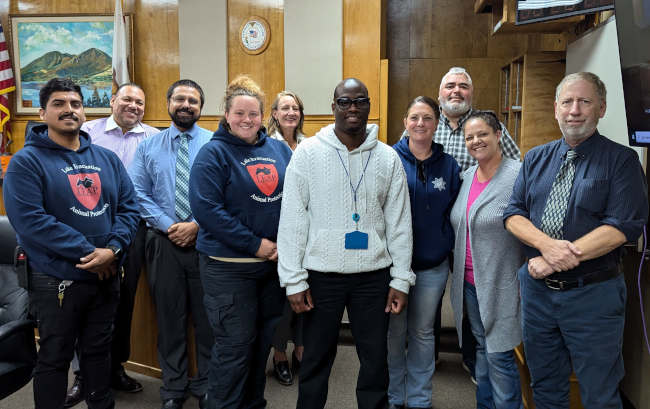
Gregory Wilkins, center, the newly appointed Lake County Animal Care and Control director with members of the Lake County Board of Supervisors on Tuesday, Oct. 22, 2024, the day his hire was announced. Photo courtesy of the county of Lake.

LAKE COUNTY, Calif. — On Tuesday, the Lake County Board of Supervisors appointed a new director for Animal Care and Control.

Gregory Wilkins was hired for the position after final closed session interviews during the board’s regular meeting.

The county reported that Wilkins’ hire was the result of a nationwide recruiting effort.

His appointment is retroactive to Monday, Oct. 21.

Wilkins succeeds Jonathan Armas, who held the Animal Care and Control director job beginning in March 2019.

Armas’ tenure ended in the summer, without a public explanation from the county.

On June 11, the board voted unanimously to appoint County Administrative Officer Susan Parker as the interim Animal Care and Control director.

The board began holding interviews for the director’s job in closed session on Aug. 6, according to meeting records.

Animal Care and Control has had other issues over the past year, including staffing shortages that caused a cutback on services and mounting complaints over neglect and abuse cases involving horses.

Since 2012, Wilkins has served in a variety of animal care-focused capacities across six states, working his way from veterinary and kennel technician roles to high responsibility shelter and program management positions.

Wilkins most recently served as shelter manager for Animal Services in Dallas, Texas. He joined that agency in August 2023, leading the major metropolitan city government’s animal care and behavior efforts while supervising a 45-employee team, the county reported.

During the seven years before his time in Dallas, Wilkins held leadership positions including four years as shelter manager for Escambia County, Florida; manager and shelter operation manager of Hillsborough County, Florida, Pet Resources; and manager of lifesaving programs for Best Friends Animal Society in Northwest Arkansas.

“These progressively responsible assignments brought significant opportunity to build knowledge and experience supportive of Wilkins’ goal to lead an animal welfare organization,” the county of Lake reported in Wilkins’ hiring announcement.

“"This important appointment provides our Animal Care and Control department the foundation to move forward in serving our communities,” said Board of Supervisors Chair Bruno Sabatier. “Our Board is confident Gregory Wilkins has the skills and experience to effectively manage the full breadth of Animal Care and Control’s services, including our veterinary clinic. His strong passion for animal welfare is well demonstrated, and we look forward to his leadership in the department. We are very pleased Director Wilkins has chosen Lake County to continue his career; he is joining a developing team that mirrors his dedication to continual growth and providing the best possible services."

“The Board of Supervisors’ trust means a lot,” said Wilkins. “Lake County is a beautiful place, and it has already become clear to me residents care deeply about the well-being of their animals. I am really excited to get to know everyone, and help build on the strengths that are already here in Lake County’s communities. I am very happy to be here!”
  • 335
  • 336
  • 337
  • 338
  • 339
  • 340
  • 341
  • 342
  • 343
  • 344

Community

  • Lake County Wine Alliance offers sponsor update; beneficiary applications open 

  • Mendocino National Forest announces seasonal hiring for upcoming field season

Public Safety

  • Lakeport Police logs: Thursday, Jan. 15

  • Lakeport Police logs: Wednesday, Jan. 14

Education

  • Woodland Community College receives maximum eight-year reaffirmation of accreditation from ACCJC

  • SNHU announces Fall 2025 President's List

Health

  • California ranks 24th in America’s Health Rankings Annual Report from United Health Foundation

  • Healthy blood donors especially vital during active flu season

Business

  • Two Lake County Mediacom employees earn company’s top service awards

  • Redwood Credit Union launches holiday gift and porch-to-pantry food drives

Obituaries

  • Rufino ‘Ray’ Pato

  • Patty Lee Smith

Opinion & Letters

  • The benefits of music for students

  • How to ease the burden of high electric bills

Veterans

  • CalVet and CSU Long Beach team up to improve data collection related to veteran suicides

  • A ‘Big Step Forward’ for Gulf War Veterans

Recreation

  • Wet weather trail closure in effect on Upper Lake Ranger District

  • Mendocino National Forest seeking public input on OHV grant applications

  • State Parks announces 2026 Anderson Marsh nature walk schedule 

  • BLM lifts seasonal fire restrictions in central California

Religion

  • Kelseyville Presbyterian to host Ash Wednesday service and Lenten dinner Feb. 18

  • Kelseyville Presbyterian Church to hold ‘Longest Night’ service Dec. 21

Arts & Life

  • Auditions announced for original musical ‘Even In Shadow’ set for March 21 and 28

  • ‘The Rip’ action heist; ‘Steal’ grounded in a crime thriller

Government & Politics

  • Lake County Democrats issue endorsements in local races for the June California Primary

  • County negotiates money-saving power purchase agreement

Legals

  • March 3 hearing on ordinance amending code for commercial cannabis uses

  • Feb. 12 public hearing on resolution to establish standards for agricultural roads

How to resolve AdBlock issue?
Refresh this page