How to resolve AdBlock issue?
Refresh this page
How to resolve AdBlock issue?
Refresh this page
Lake County News,California
  • Home
    • Registration Form
  • News
    • Education
    • Veterans
    • Community
      • Obituaries
      • Letters
      • Commentary
    • Police Logs
    • Business
    • Recreation
    • Health
    • Religion
    • Legals
    • Arts & Life
    • Regional
  • Calendar
  • Contact us
    • FAQs
    • Phones, E-Mail
    • Subscribe
  • Advertise Here
  • Login

News

Cal Fire Sonoma-Lake-Napa Unit lifts burn permit suspension

LAKE COUNTY, Calif. — Effective Friday, Nov. 1, at 8 a.m., the burn permit suspension for the State Responsibility Area in the counties of Colusa, Lake, Napa, Solano, Sonoma and Yolo will be lifted.

Cal Fire Sonoma-Lake-Napa Unit Chief Matt Ryan is formally canceling the burn permit suspension and advises that those possessing current and valid agriculture and residential burn permits can now resume burning on permissible burn days.

Agriculture burns must be inspected by Cal Fire prior to burning until the end of the peak fire season.

Inspections may be required for burns other than agriculture burns. This can be verified by contacting your local air quality management district.

Cooler temperatures, higher humidity and the chance of winter weather have helped to begin to diminish the threat of wildfire.

Property owners and residents are asked to use caution while conducting debris or agriculture burns, follow all guidelines provided and maintain control of the fire at all times.

Individuals can be held civilly and/or criminally liable for allowing a fire to escape their control and/or burn onto neighboring property.

Residents wishing to burn must verify it is a permissive burn day prior to burning. Contact the Lake County Air Quality Management District at 707-994-4444 to ensure it is a permissive burn day.

Pile burning requirements

• Only dry, natural vegetative material such as leaves, pine needles and tree trimmings may be burned.
• The burning of trash, painted wood or other debris is not allowed.
• Do NOT burn on windy days.
• Piles should be no larger than four feet in diameter and in height. You can add to the pile as it burns down.
• Clear a 10-foot diameter down to bare soil around your piles.
• Have a shovel and a water source nearby.
• An adult is required to be in attendance at the fire at all times.

Safe residential pile burning of forest residue by landowners is a crucial tool in reducing fire hazards.

State, federal and local land management and fire agencies will also be utilizing this same window of opportunity to conduct prescribed burns aimed at improving forest health and resiliency on private and public lands.

For more information on burning, visit the Cal Fire website at www.fire.ca.gov.

Invasive bat fungus confirmed in five California counties

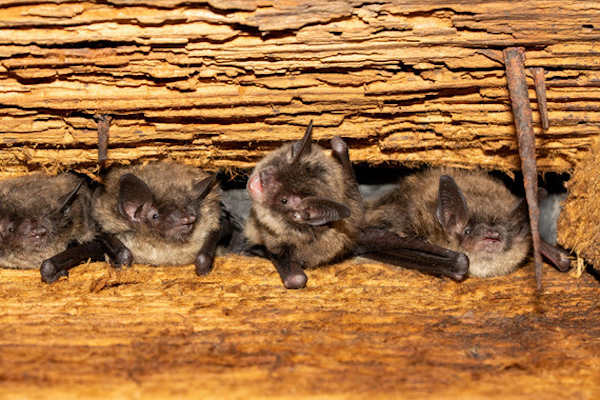
Little brown bats (Myotis lucifugus) roosting in building rafters. Photo courtesy of the California Department of Fish and Wildlife.

The fungus that causes white-nose syndrome in bats has been detected in several counties across California this year, although bats with visible signs of the disease have yet to be observed in the state.

White-nose syndrome has killed millions of bats across North America and decimated entire colonies.

Hibernating bats like little brown myotis, Yuma myotis and cave myotis are especially vulnerable.

While white-nose syndrome is often fatal to hibernating bats, it does not infect humans, pets, livestock or other wildlife.

White-nose syndrome develops when the fungus Pseudogymnoascus destructans invades the skin cells of bats, resulting in damage to delicate wing membranes.

The infection typically appears as white fuzz on the faces of infected bats, giving the syndrome its name.

Bats with white-nose syndrome often end winter hibernation early, when water and insect prey resources are scarce, causing them to deplete their fat reserves and become dehydrated. As a result, infected bats often perish.

In 2023, the California Department of Fish and Wildlife, or CDFW, first confirmed the definitive presence of the fungus in a bat roost in Humboldt County.

In 2024, the fungus was also confirmed to be present in Sutter, Placer, Amador and Inyo counties.

Inconclusive laboratory results suggest the fungus may also be present in Trinity, Siskiyou, Shasta, Plumas, Alpine, San Diego, and San Bernardino counties.

Additional results are still pending for several other counties around the state.

The fungus has been detected on several bat species in California, including the little brown myotis, Yuma myotis, long-legged myotis, big brown bat, Mexican free-tailed bat and Western red bat.

This is the first time a Western red bat has been reported with presence of the fungus. The positive sample was returned from a female bat captured on May 9, 2024, in Sutter County.

Both Western and Eastern red bats occur in California and can be difficult to differentiate, so CDFW used genetic sequencing to confirm this individual as Western red bat (Lasiurus frantzii, previously recognized as L. blossevillii).

While white-nose syndrome has not yet been observed in any bat in California, the presence of the fungal pathogen suggests the disease could manifest in California’s bats within the next few years. Such progression has been observed in other states, as the fungus and disease have been spreading across North America since discovery in 2006.

The fungus was first detected on the West Coast in 2016 when it was discovered on a bat in King County, Wash.

While the fungus is primarily spread from contact between bats, humans can unintentionally spread it as well. People can carry fungal spores on clothing, shoes or recreation equipment that has come into contact with the fungus at bat roosts.

To learn more about limiting the spread of white-nose syndrome, see the National White-nose Syndrome Decontamination Protocol, which was updated in March 2024.

Biologists with CDFW, the National Park Service and U.S. Fish and Wildlife Service have been sampling California’s bats for the presence of the fungus and clinical signs of white-nose syndrome since 2016 in support of national surveillance efforts led by the U.S. Geological Survey National Wildlife Health Center.

When bats at monitoring sites emerge from hibernation each spring, biologists swab their faces and wings to test for the fungus. Swabs are analyzed by the USGS National Wildlife Health Center and the Pathogen and Microbiome Institute at Northern Arizona University.

Sustained efforts to monitor bat populations will be critical to understanding and managing this devastating disease. CDFW and its partners will continue conducting white-nose syndrome surveillance and bat population monitoring across the state to assess potential impacts of the disease and inform research and management actions.

The U.S. Fish and Wildlife Service leads the collaborative national response effort for white-nose syndrome through which scientists are continuing to develop and test innovative tools to manage the disease.

California is home to 25 species of bats. A single bat can eat thousands of insects each night. California’s bats keep insect populations in check, benefiting rural, suburban and urban communities as well as a wide variety of natural landscapes that range from forests to deserts to grasslands.

The pest control services that bats provide also protect crops and benefit California’s agricultural economy — the largest in the nation. Across the country, bats contribute approximately $3.7 billion worth of insect pest control for farmers each year and their guano can be used as fertilizer to improve soil health. Robust bat populations are vital to a healthy environment and economy.

CDFW urges people to not handle wildlife, especially dead wildlife or individuals that appear sick. If you find sick or dead bats, or notice bats acting strangely, please report your sighting. Bats flying or roosting outside during the winter is an example of noteworthy behavior that can sometimes, but not always, be associated with white-nose syndrome.

You can help watch for white-nose syndrome in California by reporting bat sightings to CDFW here.

For more information about white-nose syndrome, visit https://www.whitenosesyndrome.org/.

Lake County sees improved employment rate in September

LAKE COUNTY, Calif. — Lake County’s unemployment saw a decrease in September, at the same time as the state jobless rate remained flat and the national rate improved.

The Employment Development Department, or EDD, said Lake County had a 5.5% unemployment rate in September, down from 6.1% in August. The county’s September 2023 rate was 5.2%.

In California as a whole, unemployment remained at 5.3% in September, the EDD said. The state’s September 2023 rate was 4.9%.

Nationally, the jobless rate in September was 4.1%, compared to 4.2% in August and 3.8% in September 2023, according to the US Bureau of Labor Statistics.

In Lake County in September, there were 1,600 unemployed people, down from 1,760 in August, according to the EDD data.

The EDD said the number of Californians employed in September was 18,364,700, an increase of 2,100 persons from August’s total of 18,362,600 and up 6,300 from the employment total in September 2023.

At the same time, the number of unemployed Californians was 1,031,800 in September, an increase of 11,400 over the month and up 64,100 in comparison to September 2023.

Since May 2020, California has gained 3,164,200 jobs, which averages 59,702 jobs per month. The state’s job market expansion entered 53 months in September 2024, the EDD said.

In September, seven of California's 11 industry sectors gained jobs. The EDD said the largest increase in private education and health services, up 9,600 jobs, led by gains in health care and social assistance.

The government category added 3,800 jobs, showing above average strength in state governmental educational services as the new school year kicked off.

While leisure and hospitality posted the largest month-over reduction, down 4,400, with the most losses — 3,700 — in arts, entertainment and recreation, it retained a strong year-over gain of 22,700 jobs.

Lake County ranked No. 37 for its September rate, the EDD reported.

Lake’s neighboring county jobless rates and ranks were: Colusa, 8.2%, No. 56; Glenn, 5.8%, No. 41; Mendocino, 4.7%, No. 19; Napa, 3.9%, No. 6; Sonoma, 4%, No. 7; and Yolo, 4.9%, No. 24.

In related data that the EDD said figures into the state’s unemployment rate, there were 359,420 people certifying for Unemployment Insurance benefits during the September 2024 sample week. That compares to 382,640 people in August and 368,452 people in September 2023.

Concurrently, the EDD said 38,084 initial claims were processed in the September 2024 sample week, which was a month-over decrease of 939 claims from August as well as a year-over increase of 221 claims from September 2023.

Email Elizabeth Larson at This email address is being protected from spambots. You need JavaScript enabled to view it.. Follow her on Twitter, @ERLarson, or Lake County News, @LakeCoNews.

U.S. Winter Outlook predicts warmer and drier South, wetter north

A slowly-developing La Nina is favored to influence conditions for the upcoming winter across most of the country, according to NOAA’s U.S. Winter Outlook released by the Climate Prediction Center, a division of NOAA’s National Weather Service.

This outlook is for December 2024 through February 2025 and contains information on likely conditions throughout the country for temperature, precipitation and drought.

This winter, NOAA predicts wetter-than-average conditions for the entire northern tier of the continental U.S., particularly in the Pacific Northwest and the Great Lakes region, along with northern and western Alaska.

Meanwhile, drier-than-average conditions are expected from the Four Corners region of the Southwest to the Southeast, Gulf Coast and lower mid-Atlantic states.

“In September, we announced a $100 million investment into NOAA’s high-performance computer system to advance research on weather, climate and ocean predictions because understanding our climate system is essential for making longer-term predictions like the Winter Seasonal Outlook, which provides vital information for many of our partners and the public,” said Michael Morgan, Ph.D., NOAA’s assistant secretary of commerce for observation and prediction. “We continue to innovate in this space, developing new ways to share winter forecast information with the public.”

“This winter, an emerging La Nina is anticipated to influence the upcoming winter patterns, especially our precipitation predictions,” said Jon Gottschalck, chief of the Operational Prediction Branch of the Climate Prediction Center.

La Nina conditions are expected to develop later this fall and typically lead to a more northerly storm track during the winter months, leaving the southern tier of the country warmer and drier.

As a result, NOAA forecasters, in collaboration with the National Integrated Drought Information System, or NIDIS, expect drought conditions to persist and worsen across the central and southern Plains of the U.S.

“Unfortunately, after a brief period in the spring of 2024 with minimal drought conditions across the country, more than a quarter of the land mass in the continental U.S. is currently in at least a moderate drought,” said Brad Pugh, operational drought lead with NOAA’s Climate Prediction Center. “And the winter precipitation outlook does not bode well for widespread relief.”

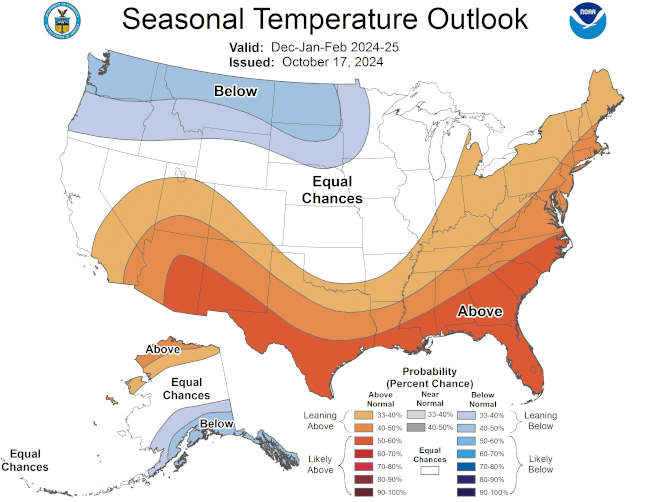
The 2024-2025 U.S. Winter Outlook map for temperature shows the greatest chances for cooler-than-average conditions in the Pacific Northwest of the U.S. Image credit: NOAA.


Temperature

• Warmer-than-average temperatures are favored from the southern tier of the U.S. to the eastern Great Lakes, eastern seaboard, New England and northern Alaska. These probabilities are strongest along the Gulf Coast and for most of Texas.
• Below-average temperatures are most likely in southern Alaska, with below-average temperatures slightly favored from the Pacific Northwest to the northern High Plains.
• The remaining areas have equal chances of below-, near-, or above-average seasonal mean temperatures.

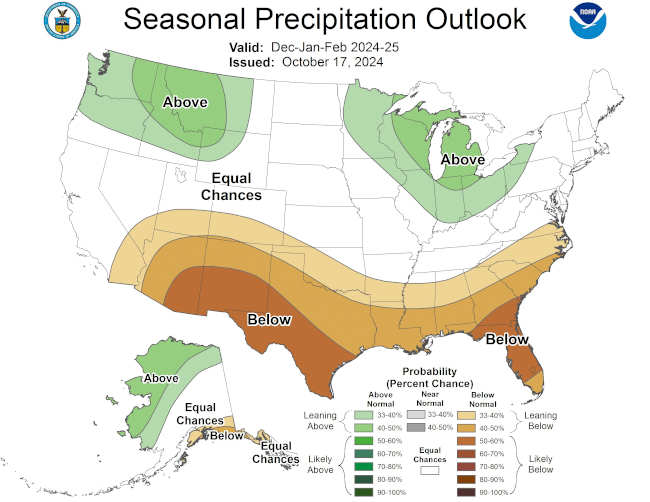
The 2024-2025 U.S. Winter Outlook map for precipitation shows wetter-than-average conditions are most likely across the Great Lakes region of the U.S.. Drier-than-average conditions are forecast for parts of the U.S. Gulf Coast. Image credit: NOAA.

Precipitation

• Wetter-than-average conditions are most likely in the Great Lakes states, and above-average precipitation is also favored in northern and western Alaska, the Pacific Northwest and across the northern tier of the U.S. These probabilities are strongest in portions of Ohio, Indiana and Kentucky.
• The greatest likelihood for drier-than-average conditions are in states bordering the Gulf of Mexico, as well as in Texas and southern New Mexico.
• Much of California, the central Plains states and the I-95 corridor from Boston to Washington, D.C., have equal chances of below-average, near-average or above-average seasonal total precipitation.

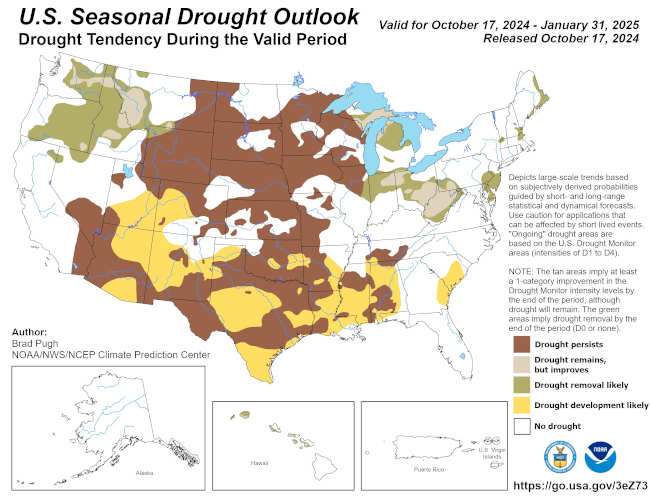
The U.S. Drought Outlook map for November 2024 through January 2025 predicts drought improvement in the Ohio River Valley and the northern Rockies. Drought is likely to persist in portions of the Great Plains and the Midwest. Drought development is expected from the Four Corners region to the western Gulf coast. Image credit: NOAA.


Drought

• Widespread moderate to extreme drought continues across much of the Great Plains and in portions of the Rocky Mountains, especially farther south.
• Drought conditions are expected to improve or end in the Ohio River Valley, the Great Lakes region and portions of the northwestern U.S., including eastern Washington and Oregon and northern and central Idaho.
• Drought conditions are expected to persist across the Great Plains.
• Drought is likely to develop or worsen across portions of the Southwest and Gulf Coast.

Purrfect Pals: Young cats and kittens

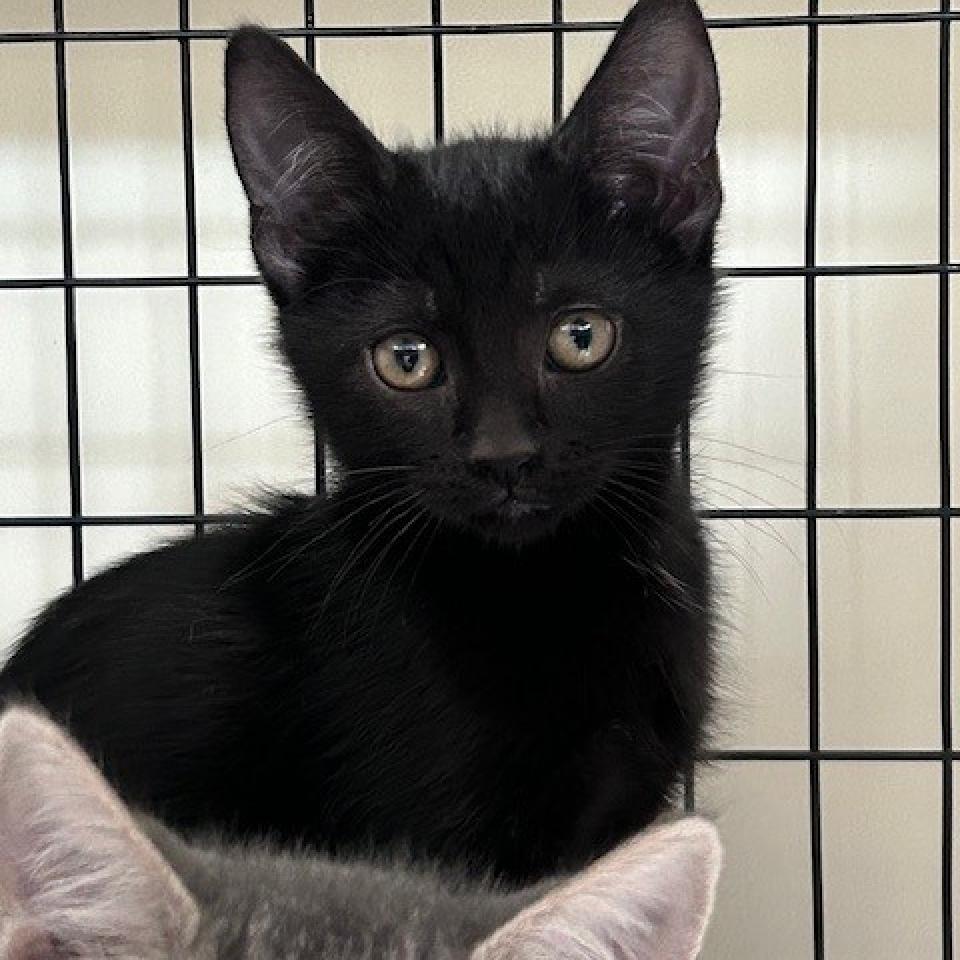
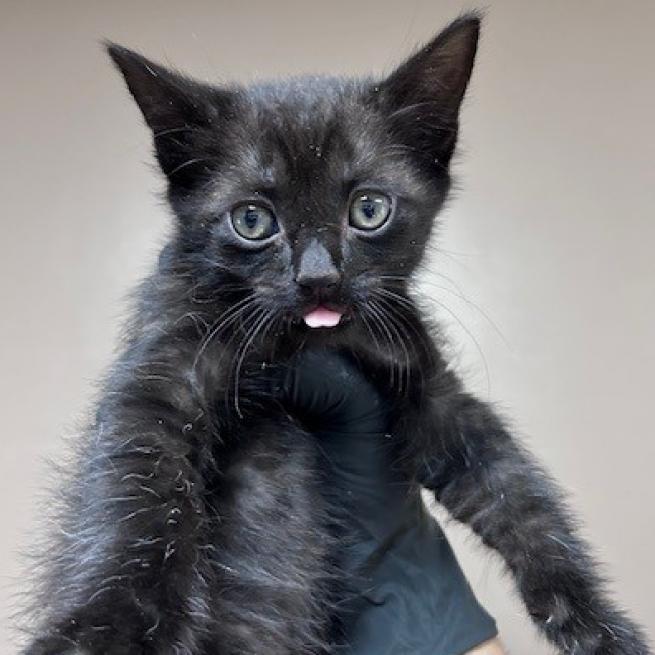
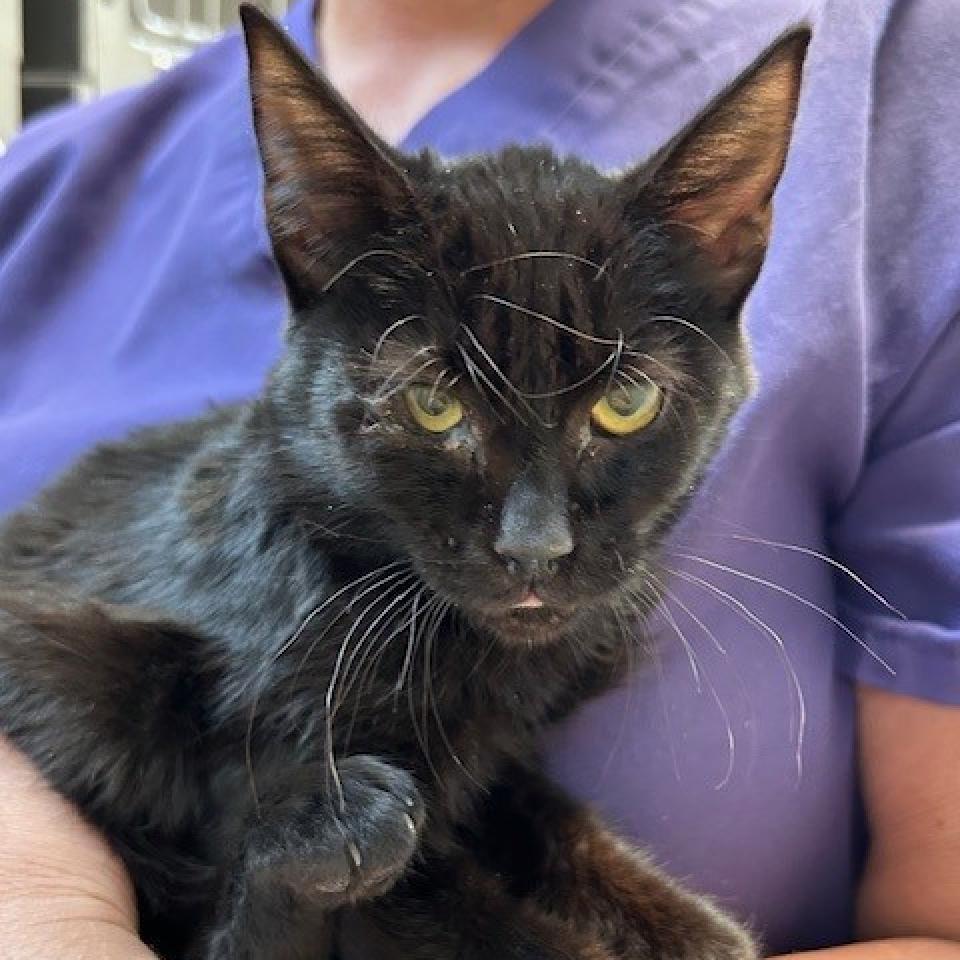
LAKE COUNTY, Calif. — As kitten season winds down, Lake County Animal Care and Control still has many young cats and kittens waiting to be adopted.

The cats at the shelter that are shown on this page have been cleared for adoption.

Call Lake County Animal Care and Control at 707-263-0278 or visit the shelter online for information on visiting or adopting.

The shelter is located at 4949 Helbush in Lakeport.

Email Elizabeth Larson at This email address is being protected from spambots. You need JavaScript enabled to view it.. Follow her on Twitter, @ERLarson, or Lake County News, @LakeCoNews.


A#70a(green collar)'s preview photo
A#70a(green collar)

A#70b(yellow collar)'s preview photo
A#70b(yellow collar)

A#70c's preview photo
A#70c

A#70d's preview photo
A#70d

A#106a's preview photo
A#106a

A#55's preview photo
A#55

A#146b's preview photo
A#146b

A#146a's preview photo
A#146a


A#52a's preview photo
A#52a


Why is Halloween spending growing when Americans are supposedly cutting back?


Of course you can buy an evil clown at Home Depot. Frederic J. Brown/AFP/Getty Images

Halloween was once a time of both tricks and treats. Lately, Halloween has become one big treat for businesses, with consumers spending an estimated US$11.6 billion on this one-night holiday. That’s roughly the same amount of money as Americans spend on children’s books each year.

This massive amount of spending is puzzling, given the media is filled with stories about the economic hardships many families face.

As a business school professor who has written previously about Halloween, I was curious why Halloween spending is just below all-time highs at the same time many people report high levels of economic angst.

Americans spend billions every Halloween

The best data on Halloween spending comes each year from the National Retail Federation, which surveys Americans about their shopping plans just before the holiday. It found that U.S. consumers will spend over $11 billion this year, which is about half the amount spent annually on dental care for children under age 17.

The most recent survey also shows that about three out of four Americans will celebrate in some fashion. Because not everyone observes the holiday, the federation calculates that the typical person celebrating will spend $104 on Halloween.

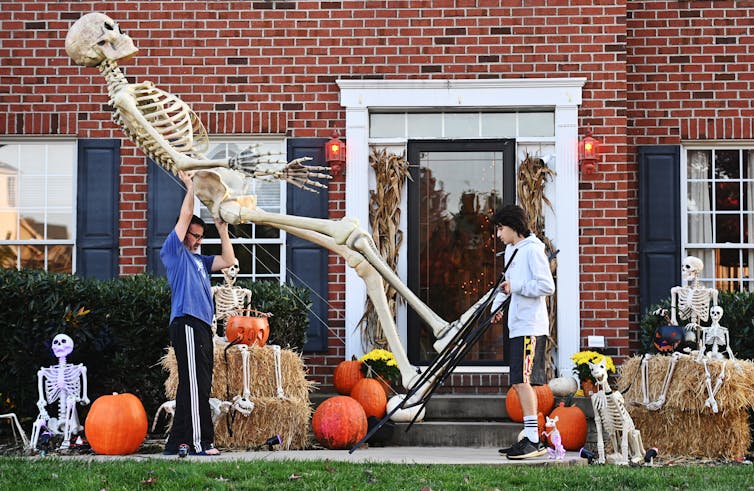
A father and son are photographed outside their home, carrying a 12-foot decorative skeleton from Home Depot.
Twelve-foot skeletons don’t come cheap. Marvin Joseph/The Washington Post via Getty Images

The federation breaks down spending into four categories. About one-third of spending will be on costumes for children, adults and pets. Another third will be spent on decorations like giant skeletons. About a final third is spent on candy, and the remaining sliver is spent on greeting cards.

Back in 2005, the federation estimated the holiday would generate only $3.3 billion of spending. This means Halloween spending has grown dramatically, by about three and a half times, in just two decades, or about double if we are adjusting for inflation.

Unmasking the causes of rising Halloween spending

What has driven Halloween spending skyward? Some of the growth is due to inflation, which has increased prices by about 65% over the past two decades. Some of the growth is due to more people living in the U.S. In 2005, the U.S. had about 290 million people, while today the figure is closing in on 340 million.

While these two factors explain some of the growth, they don’t explain it all.

To understand more, I looked at some government data:

The U.S. tracks what the typical family spends on a wide variety of products and services to measure the cost of living. Spending each year is monitored via the Consumer Expenditure Survey. This survey has publicly provided data on annual candy spending since 2013, when it found the typical family spent $88 a year on candy.

The latest figures for 2023 show U.S. families have developed a very sweet tooth: Candy spending by the typical family is now at $164, which means candy outlays have almost doubled from a bit over a decade ago.

While this increase in candy consumption undoubtedly boosts spending at Halloween, it also has a downside. The American Dental Association has shown a dramatic increase in spending at the dentist office, as many people make emergency dentist visits as teeth get cracked on candy.

Spending on costumes has also soared.

In 2005, the best estimate was that $1.2 billion would be spent on just dressing up, while this year the figure is $3.8 billion.

Why so much? Costumes used to be just for children, but today many adults are dressing up. About 1 in 5 adults say they will be wearing a costume for Halloween. Beyond costumes for people, Americans spend millions of dollars on costumes for their pets.

The National Retail Federation has not tracked my favorite Halloween category, pumpkin sales, but the U.S. Department of Agriculture has. When I was young, each family in my neighborhood typically had one pumpkin on their doorstep. Now, I routinely see houses with many – both in my old neighborhood and my new one, which is a few miles away in another part of Boston.

It seems it’s not just my neighbors who are buying more gourds. In 2005, the USDA calculated that there were about four and a half pounds of pumpkins for sale for every person just before the holiday. In 2023, the amount had risen to almost six pounds per person. This means there are about 50% more pumpkins available for carving and for making pies.

While polls suggest many Americans are feeling financially fragile, the data indicates it isn’t having much impact on Halloween spending. After all, over the past two decades, Halloween has become an ever-bigger commercial holiday.

Halloween can be scary, but it doesn’t have to be scary for your finances. If you are struggling financially this year, before buying on credit giant candy bars that only get half-eaten, or cute pet costumes most animals probably don’t want to wear, think about maybe cutting back.The Conversation

Jay L. Zagorsky, Associate Professor of Markets, Public Policy and Law, Boston University

This article is republished from The Conversation under a Creative Commons license. Read the original article.

  • 332
  • 333
  • 334
  • 335
  • 336
  • 337
  • 338
  • 339
  • 340
  • 341

Community

  • Lake County Wine Alliance offers sponsor update; beneficiary applications open 

  • Mendocino National Forest announces seasonal hiring for upcoming field season

Public Safety

  • Lakeport Police logs: Thursday, Jan. 15

  • Lakeport Police logs: Wednesday, Jan. 14

Education

  • Woodland Community College receives maximum eight-year reaffirmation of accreditation from ACCJC

  • SNHU announces Fall 2025 President's List

Health

  • California ranks 24th in America’s Health Rankings Annual Report from United Health Foundation

  • Healthy blood donors especially vital during active flu season

Business

  • Two Lake County Mediacom employees earn company’s top service awards

  • Redwood Credit Union launches holiday gift and porch-to-pantry food drives

Obituaries

  • Rufino ‘Ray’ Pato

  • Patty Lee Smith

Opinion & Letters

  • The benefits of music for students

  • How to ease the burden of high electric bills

Veterans

  • CalVet and CSU Long Beach team up to improve data collection related to veteran suicides

  • A ‘Big Step Forward’ for Gulf War Veterans

Recreation

  • Wet weather trail closure in effect on Upper Lake Ranger District

  • Mendocino National Forest seeking public input on OHV grant applications

  • State Parks announces 2026 Anderson Marsh nature walk schedule 

  • BLM lifts seasonal fire restrictions in central California

Religion

  • Kelseyville Presbyterian to host Ash Wednesday service and Lenten dinner Feb. 18

  • Kelseyville Presbyterian Church to hold ‘Longest Night’ service Dec. 21

Arts & Life

  • Auditions announced for original musical ‘Even In Shadow’ set for March 21 and 28

  • ‘The Rip’ action heist; ‘Steal’ grounded in a crime thriller

Government & Politics

  • Lake County Democrats issue endorsements in local races for the June California Primary

  • County negotiates money-saving power purchase agreement

Legals

  • March 3 hearing on ordinance amending code for commercial cannabis uses

  • Feb. 12 public hearing on resolution to establish standards for agricultural roads

How to resolve AdBlock issue?

Refresh this page