How to resolve AdBlock issue?
Refresh this page
How to resolve AdBlock issue?
Refresh this page
Lake County News,California
  • Home
    • Registration Form
  • News
    • Education
    • Veterans
    • Community
      • Obituaries
      • Letters
      • Commentary
    • Police Logs
    • Business
    • Recreation
    • Health
    • Religion
    • Legals
    • Arts & Life
    • Regional
  • Calendar
  • Contact us
    • FAQs
    • Phones, E-Mail
    • Subscribe
  • Advertise Here
  • Login

News

Millions of people across the US use well water, but very few test it often enough to make sure it’s safe


Serious water contaminants such as nitrate may not have any detectable taste or odor. Willie B. Thomas/Digital Vision via Getty Images

About 23 million U.S. households depend on private wells as their primary drinking water source. These homeowners are entirely responsible for ensuring that the water from their wells is safe for human consumption.

Multiple studies show that, at best, half of private well owners are testing with any frequency, and very few households test once or more yearly, as public health officials recommend. Even in Iowa, which has some of the strongest state-level policies for protecting private well users, state funds for free private water quality testing regularly go unspent.

Is the water these households are drinking safe? There’s not much systematic evidence, but the risks may be large.

The U.S. Environmental Protection Agency still relies on a 15-year-old study showing that among 2,000 households, 1 in 5 households’ well water contained at least one contaminant at levels above the thresholds that public water systems must meet. While other researchers have studied this issue, most rely on limited data or data collected over decades to draw conclusions.

I’m an economist studying energy and agriculture issues. In a recent study, I worked with colleagues at Iowa State University, the University of Massachusetts Amherst and Cornell University to understand drinking water-related behaviors and perceptions of households that use private wells. We focused on rural Iowa, where runoff from agricultural production regularly contaminates public and private drinking water sources.

Diagram of a private well showing the aquifer below the home and pipes connecting the well to an indoor tank.
Basic components of a private water well. EPA

We found that few households followed public health guidance on testing their well water, but a simple intervention – sending them basic information about drinking water hazards and easy-to-use testing materials – increased testing rates. The burden of dealing with contamination, however, falls largely on individual households.

Nitrate risks

We focused on nitrate, one of the main well water pollutants in rural areas. Major sources include chemical fertilizers, animal waste and human sewage.

Drinking water that contains nitrate can harm human health. Using contaminated water to prepare infant formula can cause “blue baby syndrome,” a condition in which infants’ hands and lips turn bluish because nitrate interferes with oxygen transport in the babies’ blood. Severe cases can cause lethargy, seizures and even death. The EPA limits nitrate levels in public water systems to 10 milligrams per liter to prevent this effect.

Studies have also found that for people of all ages, drinking water with low nitrate concentrations over long periods of time is strongly associated with chronic health diseases, including colorectal cancer and thyroid disease, as well as neural tube defects in developing fetuses.

Nitrate pollution is pervasive across the continental U.S. Fortunately, it is relatively easy to determine whether water contains unsafe nitrate concentrations. Test strips, similar to those used in swimming pools, are cheap and readily available.
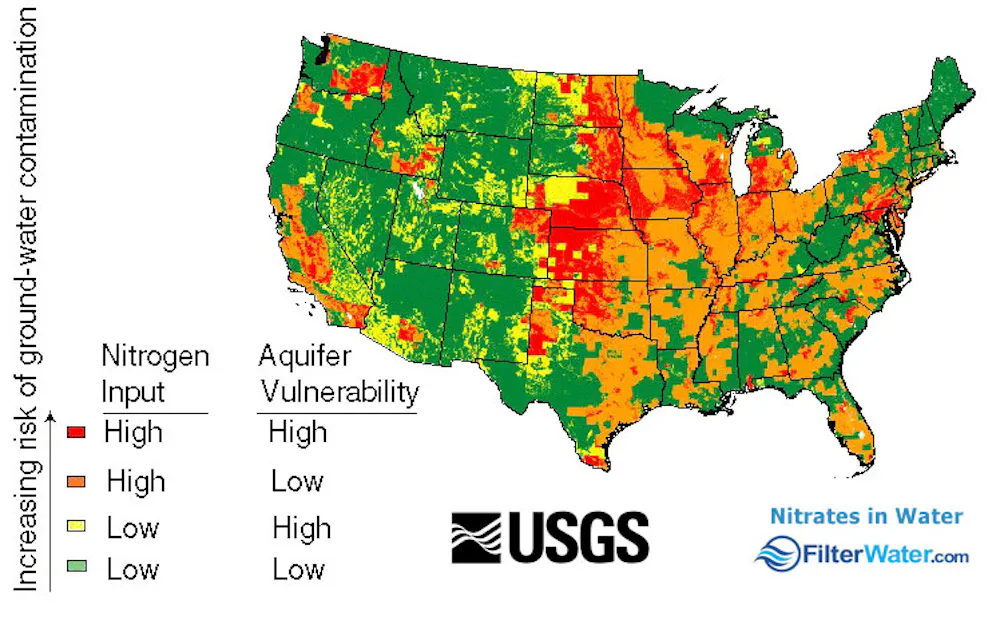
US map showing high risk of nitrate contamination in drinking water in the Midwest and central Plains
Heavily agricultural areas are vulnerable to nitrate pollution in water, especially where aquifers are shallow. Areas at the highest risk of nitrate contamination in shallow groundwater generally have high nitrogen inputs to the land, well-drained soils and high ratios of croplands to woodlands. USGS

The water’s fine … or not

Mailing lists of households with private wells are hard to come by, so for our study we digitized over 22,000 addresses using maps from 14 Iowa counties. We targeted counties where public water systems had struggled to meet EPA safety standards for nitrate in drinking water, and where private wells that had been tested over the past 20 years showed nitrate concentrations at concerning levels.

We received responses from over half of the households we surveyed. Of those, just over 8,100 (37%) used private wells.

Map of Iowa with dots showing state findings for nitrate levels in private wells.
Nitrate measurements in domestic wells in Iowa from 2002 to 2022, from the Iowa Department of Natural Resources public water-testing program. Counties targeted in Lade et al.’s 2024 review are highlighted in red. Lade et al., 2024, CC BY-ND

Although the Centers for Disease Control and Prevention recommends testing annually for nitrate, just 9% of these households had tested their water quality in the past year.

More concerning, 40% of this group used their wells for drinking water, had not tested it in the past year, and did not filter the water or use other sources such as bottled water. They were drinking straight from the tap without knowing whether their water was safe.

Our survey also showed that, despite living in high-risk areas, 77% of households classified their well water quality as “good” or “great.” This may be driven by a “not in my backyard” mentality. Households in our survey were more likely to agree with the statement that nitrate is a problem in the state of Iowa than to perceive nitrates as a problem in their local area.

Climate change is likely to worsen nitrate contamination in well water. In regions including the Great Lakes basin, increases in heavy rainfall are projected to carry rising amounts of nutrients from farmlands into waterways and groundwater.

Nitrate contamination is often thought of as a rural problem, but in California it also has shown up in urban areas.

Providing information and tools helps

To see whether education and access to testing materials could change views about well water, we sent a mailer containing a nitrate test strip, information about risks associated with nitrate in drinking water, and contact information for a free water quality testing program run by the state of Iowa to a random 50% of respondents from our first survey. We then resurveyed all households, whether or not they received the mailer.

Over 40% of households that received test strips reported that they had tested their water, compared with 24% of those that did not receive the mailer. The number of respondents who reported using Iowa’s free testing program also increased, from 10% to 13%, a small but statistically meaningful impact.

Less encouragingly, households that received the mailer were no more likely to report filtering or avoiding their water than those that did not receive the mailer.


Households bear the burden

Our results show that lack of information makes people less likely to test their well water for nitrate or other contaminants. At least for nitrate, helping households overcome this barrier is cheap. We asked respondents about their willingness to pay for the program and found that the average household was willing to pay as much as US$13 for a program that would cost the state roughly $5 to implement.

However, we could not determine whether our outreach decreased households’ exposure to contaminated drinking water. It’s also not clear whether people would be as willing to test their well water in states such as Wisconsin or Oregon, where testing would cost them up to a few hundred dollars.

As of 2024, just 24 states offered well water testing kits for at least one contaminant that were free or cost $100 or less. And while most states offer information about well water safety, some simply post a brochure online.

The upshot is that rural households are bearing the costs associated with unsafe well water, either through health care burdens or spending for treatment and testing. Policymakers have been slow to address the main source of this problem: nitrate pollution from agriculture.

In one exception, state agencies in southeastern Minnesota are providing free well water quality testing and offering a few households filtration systems in cases where their wells are laden with nitrate from local agricultural sources. However, this effort began only after environmental advocates petitioned the EPA.

If state and federal agencies tracked more systematically the costs to households of dealing with contaminated water, the scale of the burden would be clearer. Government agencies could use this information in cost-benefit assessments of conservation programs.

On a broader scale, I agree with experts who have called for rethinking agricultural policies that encourage expanding crops associated with high nutrient pollution, such as corn. More restoration of wetlands and prairies, which filter nutrients from surface water, could also help. Finally, while the Environmental Protection Agency can’t force well owners to test or treat their water, it could provide better support for households when pollutants turn up in their drinking water.The Conversation

Gabriel Lade, Associate Professor of Economics, Macalester College

This article is republished from The Conversation under a Creative Commons license. Read the original article.

$2.5 million grant provides vital funding to reduce teen-impaired driving in California

In an ongoing effort to reduce the number of crashes caused by impaired drivers in California, the California Highway Patrol is partnering with the California Office of Traffic Safety on a yearlong campaign of education efforts.

The $2.5 million grant-funded “Teen Impaired Driving Education VI,” or TIDE, campaign runs through Sept. 30, 2025.

Motor vehicle crashes are a leading cause of death for teens, and almost a third of young drivers killed in fatal crashes were impaired.

Based on provisional data, there were 851 crashes involving impaired drivers aged 14 to 19 years old, resulting in 28 deaths and 1,305 injuries within CHP jurisdiction between October 2022 through September 2023.

Each one of these injuries and deaths represents a preventable tragedy and underscores the continued need to focus efforts on reducing impaired driving.

The CHP will focus on a comprehensive approach that combines law enforcement with education and prevention programs, such as the Every 15 Minutes (E15M) program.

The E15M program is an eye-opening and emotional educational program that prompts teenagers to strongly consider their decisions regarding impaired driving.

“Protecting our young drivers is one of the most critical steps we can take to ensure the safety of California’s communities,” said CHP Commissioner Sean Duryee. “Programs that educate teens on the dangers of impaired driving not only save lives but also foster lifelong habits of responsibility and safe driving.”

The E15M program targets high school juniors and seniors, inspiring them to think deeply about driving, personal safety, making responsible and mature decisions, and the implications of alcohol consumption. It focuses on how their choices resonate with their family, friends, community, and others.

The CHP provides mini-grants to schools and organizations to implement the E15M program.

For additional information regarding the E15M Program or to apply for a grant, please have the school or organization contact their local CHP public information officer. In Lake County, call the Clear Lake Area office at 707-279-0103.

Funding for this program was provided by a grant from the California Office of Traffic Safety through the National Highway Traffic Safety Administration.

Space News: NASA wants to send humans to Mars in the 2030s − a crewed mission could unlock some of the red planet’s geologic mysteries


Mars’ craters come from ancient collisions during the formation of the solar system. NASA/JPL-Caltech/Cornell University/Arizona State University via AP

NASA plans to send humans on a scientific round trip to Mars potentially as early as 2035. The trip will take about six to seven months each way and will cover up to 250 million miles (402 million kilometers) each way. The astronauts may spend as many as 500 days on the planet’s surface before returning to Earth.

NASA’s Artemis program plans to return humans to the Moon this decade to practice and prepare for a Mars mission as early as the 2030s. While NASA has several reasons for pursuing such an ambitious mission, the biggest is scientific exploration and discovery.

I’m an atmospheric scientist and former NASA researcher involved in establishing the scientific questions a Mars mission would investigate. There are lots of mysteries to investigate on the red planet, including why Mars looks the way it does today, and whether it has ever hosted life, past or present.

Mars, a dusty reddish planet, floating in space.
Studying Mars can tell researchers more about the formation of the solar system. J. Bell/NASA via AP

Mars geology

Mars is an intriguing planet from a geological and atmospheric perspective. It formed with the rest of the solar system about 4.6 billion years ago. Around 3.8 billion years ago, the same time that life formed on Earth, early Mars was very Earth-like. It had abundant liquid water on its surface in the form of oceans, lakes and rivers and possessed a denser atmosphere.

While Mars’ surface is totally devoid of liquid water today, scientists have spotted evidence of those past lakes, rivers and even an ocean coastline on its surface. Its north and south poles are covered in frozen water, with a thin veneer of frozen carbon dioxide. At the south pole during the summer, the carbon dioxide veneer disappears, leaving the frozen water exposed.

Today, Mars’ atmosphere is very thin and about 95% carbon dioxide. It’s filled with atmospheric dust from the surface, which gives the atmosphere of Mars its characteristic reddish color.

Scientists know quite a bit about the planet’s surface from sending robotic missions, but there are still many interesting geologic features to investigate more closely. These features could tell researchers more about the solar system’s formation.

The northern and southern hemispheres of Mars look very different. About one-third of the surface of Mars – mostly in its northern hemisphere – is 2 to 4 miles (3.2-6.4 kilometers) lower in elevation, called the northern lowlands. The northern lowlands have a few large craters but are relatively smooth. The southern two-thirds of the planet, called the southern highlands, has lots of very old craters.

Mars also has the largest volcanoes that scientists have observed in the solar system. Its surface is peppered with deep craters from asteroid and meteor impacts that occurred during the early history of Mars. Sending astronauts to study these features can help researchers understand how and when major events happened during the early history of Mars.

Mars’ volcanoes tower over any of the highest mountains on Earth.

Asking the right questions

NASA formed a panel called the Human Exploration of Mars Science Analysis Group to plan the future mission. I co-chaired the panel, with NASA scientist James B. Garvin, to develop and assess the key scientific questions about Mars. We wanted to figure out which research questions required a human mission to address, rather than cheaper robotic missions.

The panel came up with recommendations for several important scientific questions for human investigation on Mars.

One question asks whether there’s life on the planet today. Remember, life on Earth formed about 3.8 billion years ago, when Earth and Mars were similar-looking planets that both had abundant liquid water and Mars had a denser atmosphere.

Another question asks what sort of environmental changes led Mars to lose the widespread, plentiful liquid water on its surface, as well as some of its atmosphere.

These questions, alongside other recommendations from the panel, made it into NASA’s architectural plan for sending humans to Mars.

How do you get to Mars?

To send people to Mars and return them safely to Earth, NASA has developed a new, very powerful launch vehicle called the Space Launch System and a new human carrier spacecraft called Orion.

To prepare and train astronauts for living on and exploring Mars, NASA established a new program to return humans to the Moon, called the Artemis program.

In mythology, Artemis was Apollo’s twin sister. The Artemis astronauts will live and work on the Moon for months at a time to prepare for living and working on Mars.

The Artemis program plans to return humans to the Moon, in anticipation of eventually sending humans to Mars.

The Space Launch System and Orion successfully launched on Nov. 16, 2022, as part of the Artemis I mission. It made the Artemis program’s first uncrewed flight to the Moon, and once there, Orion orbited the Moon for six days, getting as close as 80 miles (129 kilometers) above the surface.

Artemis I splashed back down to Earth on Dec. 11, 2022, after its 1.4 million-mile (2.2 million-kilometer) maiden journey.

Artemis III, the first mission to return humans to the lunar surface, is scheduled for 2026. The Artemis astronauts will land at the Moon’s south pole, where scientists believe there may be large deposits of subsurface water in the form of ice that astronauts could mine, melt, purify and drink. The Artemis astronauts will set up habitats on the surface of the Moon and spend several months exploring the lunar surface.

Since the Moon is a mere 240,000 miles (386,000 km) from Earth, it will act as a training ground for the future human exploration of Mars. While a Mars mission is still many years out, the Artemis program will help NASA develop the capabilities it needs to explore the red planet.The Conversation

Joel S. Levine, Research Professor, Department of Applied Science, William & Mary

This article is republished from The Conversation under a Creative Commons license. Read the original article.

Appellate court orders new environmental impact report for Guenoc Valley project

LAKE COUNTY, Calif. — The effort to build an ultra-luxury resort and residential community outside of Middletown has hit another significant obstacle in the form of an appellate court decision that is ordering a new environmental study for the project.

On Wednesday, the California First District Appellate Court ruled that a new environmental impact report, or EIR, for the Guenoc Valley Mixed-Use Development Project — also known as Maha Guenoc Valley — must be prepared because in the previous document the county of Lake didn’t disclose the project’s wildfire ignition risks.

“This groundbreaking decision affirms that local governments and developers must publicly disclose how harmful it is to put a new community in a wildfire zone,” said Peter J. Broderick, an attorney in the Center for Biological Diversity’s Urban Wildlands program. “This is the first time a California appeals court has set aside an environmental review because the agency failed to look at wildfire ignition risk. This ruling is a clear signal to those who continue to push for building low-density development in California’s wildfire-prone areas.”

What’s next for the project itself wasn’t made clear this week.

“We are reviewing today’s decision,” said Kevin Case, a development partner for the Guenoc Valley Project, in a written statement released to Lake County News on Wednesday. “We remain committed to setting the benchmark for best-in-class fire-safe development under the oversight of Lake County and in collaboration with leading fire-safety experts and members of the local community.”

The justices unanimously faulted the county of Lake’s analysis of the project. The county “presents no industry standard modeling tools, no methodology or analysis for its conclusory findings, nor any other discussion of how the Wildfire Plan” — the wildfire prevention plan for the project — “proposes to address the existing baseline conditions other than the Project design proposal itself. This is insufficient,” the ruling explained.

The ruling went on to say that failure to separately identify and analyze the significant impacts of the fire risk to the project area and its baseline existing conditions before proposing mitigation measures violates the California Environmental Quality Act, or CEQA.

The appellate court heard the case on Sept. 24.

At the time of that September hearing, Case said, “The Guenoc Valley Project’s design has undergone years of extensive environmental review by state and local officials. Since day one, our mission has been to establish a new standard for responsible, sustainable and fire-safe community development.”

The court had 90 days to render the decision but issued it on Wednesday, in 29 days.

The Center for Biological Diversity has argued that placing homes in fire-prone areas leads to more ignitions, citing studies that have shown that about 95% of California’s wildfires are caused by human sources.

Broderick said pushing “low density sprawl” into the wildland urban interface puts new and existing residents of an area at risk.

The organization pointed out that the site where the Guenoc Valley project is planned has a long history of wildfires and was actually on fire when the center filed its lawsuit. At that time, the LNU Lightning Complex was burning across the south county.

The property also hosts oak woodlands habitat for sensitive species like golden eagles, foothill yellow-legged frogs and western pond turtles, and it serves as an important wildlife corridor for the region, the center reported.

Background on the case

Lotusland Investment Holdings, headed up by Chinese developer Yiming Xu, proposed the resort and residential development on 16,000 acres near Middletown.

When the Board of Supervisors approved the first phase of the project in July 2020, it included included 385 residential villas in five subdivisions; five boutique hotels with 127 hotel units and 141 resort residential cottages; 20 campsites; up to 100 workforce housing cohousing units; an outdoor entertainment area, spa and wellness amenities, sports fields, equestrian areas, a new golf course and practice facility, camping area and commercial and retail facilities; agricultural production and support facilities; essential accessory facilities, including back of house facilities; 50 temporary workforce hotel units; emergency response and fire center; a float plane dock; and helipads.

A lawsuit filed two months later by the Center for Biological Diversity and the California Native Plant Society, with the California Attorney General’s Office intervening in support of them, led to a fall 2021 trial in Lake County Superior Court before Judge J. David Markham.

In January 2022, Markham handed down his decision, finding that the county’s EIR on the project was insufficient due to its conclusions that community fire evacuation routes were “less than significant.”

In particular, Markham found that the EIR reached that conclusion using opinions of traffic engineers, law enforcement and fire personnel that he said “were not based on any identifiable facts,” and therefore were not legally insufficient to be considered as “substantial evidence” under CEQA.

As a result, Markham ordered the county to rescind the project approvals because the EIR omitted disclosure and analysis of the project’s impacts on wildfire evacuation and public safety.

The Center for Biological Diversity said no one appealed that determination, although it did appeal the trial court’s ruling on several other issues.

In July, the county of Lake released the notice of availability for the new draft partially revised environmental impact report, or DPREIR, for the project, as Lake County News has reported.

At that time, the developer team said that modifications included moving 25 building sites within the equestrian center area and 39 building sites within the northeastern portion of the project site further from the wildland/urban interface; a new emergency route was added; reconfiguring the roadway plan so that there are no dead-end, non-looped road segments that exceed one mile in length; improving areas along the roadways with hardscape; removal of the camping area in the northern portion of the property; funding and staffing commitments for the onsite emergency response center; and renewable energy commitments and greenhouse gas reduction measures that did not change the development footprint.

That new environmental document issued in July was a result of Markham’s ruling.

A look at the appellate ruling

The Center for Biological Diversity said the First Appellate District ruling goes further than Markham’s: It determined that the county failed to assess how the project would worsen existing wildfire risks.

In the ruling, the justices didn’t find for the center on other aspects of its suit, including issues with greenhouse gas emissions and carbon credits, the allegation that the transportation demand management plan was inadequate or whether the county provided enough information regarding an off-site well’s impact on the Middletown aquifer.

The court also noted, “We are unpersuaded,” in response to the center’s contention that the EIR rejected a less environmentally impactful alternative for the project “as infeasible without the properly supported findings that CEQA requires.”

The justices ultimately reversed Markham’s decision that the EIR adequately disclosed the project’s impact on increasing the area’s existing wildfire risks, but affirmed it in all other respects.

The case is now being sent back to the trial court, “which shall issue an order granting the Petitioners’ petition for a writ of mandate vacating the County’s certification of the EIR and approval of the project,” the ruling said.

As to how the project might, or might not move forward, “It’s really in the county’s hands now, what they are going to do next,” said Broderick.

“We believe it’s incumbent on the county to take a hard look at the true costs of this project,” which include the costs of developing in a wildfire-prone region, he said.

Broderick said the center believes that if the public knows the true costs of developing such a project, “there will be much less enthusiasm for proposing and approving harmful developments like this.”

Email Elizabeth Larson at This email address is being protected from spambots. You need JavaScript enabled to view it. . Follow her on Twitter, @ERLarson, or Lake County News, @LakeCoNews.

102324 Guenoc Valley project appellate decision by LakeCoNews on Scribd

Sen. Dodd returns from Ukraine, urges action

Sen. Bill Dodd, D-Napa, and others at the Lviv military cemetery in Lviv, Ukraine. Courtesy photo.

Sen. Bill Dodd, D-Napa, has returned from a weeklong diplomatic trip to Lviv, Ukraine where he met with Lviv officials about the ongoing struggle against Russian aggression and toured key facilities including a military hospital and the Superhuman Center, which provides prosthetic limbs to many of the tens of thousands of military veterans and civilians injured in the war.

“The resilience, determination and resolve of the Ukrainian people is incredible,” said Sen. Dodd. “We have so much in common, especially our love of freedom and democracy, so it is essential that we stand with them as they fight for their continued independence. I come away from my visit with a renewed sense of urgency to help Ukraine as it recovers from the destructive violence, as well as admiration for their strength and ingenuity. California can play a big role in the healing, and I urge friends and colleagues to consider how they might pitch in.”

Sen. Dodd, who previously represented Lake County in the State Assembly, traveled to Lviv in western Ukraine during the week of Oct. 14, meeting with Lviv Gov. Maksym Kozytskyy, who is an appointee of Ukraine’s President Volodymyr Zelenskyy.

Lviv Gov. Maksym Kozytskyy and Sen. Bill Dodd, D-Napa, in Lviv, Ukraine. Courtesy photo.

Together, they spoke with representatives from the Lviv legislature and education leaders about forging cultural and economic ties between California and the region.

Their meeting came in advance of the Rebuild Ukraine trade summit Nov. 11 to 15 in Poland.

The California Governor’s Office of Business and Economic Development will lead a delegation of the state’s public and private sector groups working to support economic recovery. Economic and business-to-business relationships will boost both economies.

“We must take concrete steps such as investing in and supporting Ukrainian business and technology that will sustain the country’s recovery,” Dodd said. “We must also strengthen partnerships between our universities and research institutions. There’s so much we can do to help and doing so will also enrich our state as well, so it is a win-win.”

Dodd toured numerous Lviv facilities including a military hospital, where he talked to wounded veterans, and a military cemetery opened in 2022 where more than 800 soldiers from Lviv have been buried.

Sen. Melissa Hurtado, Gov. Kozytskyy and Sen. Bill Dodd, D-Napa, in Lviv, Ukraine. Courtesy photo.

He was especially moved during a tour of the Superhuman Center, which is helping meet the needs of the 50,000 Ukrainians facing amputations due to the war.

“It’s a stark reminder of the tragedy that has unfolded here over the past few years,” Dodd said. “In an otherwise beautiful country, there are literally daily funerals for those killed in the war.”

In addition, Dodd visited Lviv region infrastructure that was hit by Russian missiles earlier this year, as well as the Ukrainian Catholic University, where he spoke with the country’s emerging leaders in a graduate-level public administration seminar.

Dodd also watched demonstrations of cutting-edge technology including the use of drones.

Now, Sen. Dodd is urging Californians to get involved by supporting a Ukraine charity of their choice. A link to the nonprofit Superhuman Center is here: https://superhumans.com/en/.

Sen. Dodd’s trip followed his own Ukraine-related initiative, Senate Concurrent Resolution 96, unanimously approved by the Legislature in April, establishing a sister-state relationship with the Lviv region.

Following its passage, Sen. Dodd honored a delegation of Ukrainian government officials on the Senate floor. In Sen. Dodd’s district, the Sonoma Sister City Association has long been a sister city with Kaniv, Ukraine, and since the outbreak of war has raised nearly $200,000 and sent a fully stocked ambulance to support Kaniv.

Sen. Dodd’s trip was funded without the use of taxpayer dollars.

Dodd represents the Third Senate District, which includes all or portions of Napa, Yolo, Sonoma, Solano, Sacramento and Contra Costa counties.

Sen. Melissa Hurtado and Sen. Bill Dodd, D-Napa, at the Lviv cemetery in Lviv, Ukraine. Courtesy photo.

Clearlake Animal Control: ‘Oreo’ and the dogs

“Oreo.” Photo courtesy of Clearlake Animal Control.

CLEARLAKE, Calif. — Clearlake Animal Control has many new puppies amongst its older dogs waiting for homes this week.

The shelter has 48 adoptable dogs listed on its website.

This week’s adult dogs include “Oreo,” a sweet and snuggly 4-year-old male mixed breed with a beige and white coat.

The shelter is located at 6820 Old Highway 53. It’s open from 9 a.m. to 6 p.m. Tuesday through Saturday.

For more information, call the shelter at 707-762-6227, email This email address is being protected from spambots. You need JavaScript enabled to view it., visit Clearlake Animal Control on Facebook or on the city’s website.

This week’s adoptable dogs are featured below.

Email Elizabeth Larson at This email address is being protected from spambots. You need JavaScript enabled to view it.. Follow her on Twitter, @ERLarson, or Lake County News, @LakeCoNews.


  • 334
  • 335
  • 336
  • 337
  • 338
  • 339
  • 340
  • 341
  • 342
  • 343

Community

  • Lake County Wine Alliance offers sponsor update; beneficiary applications open 

  • Mendocino National Forest announces seasonal hiring for upcoming field season

Public Safety

  • Lakeport Police logs: Thursday, Jan. 15

  • Lakeport Police logs: Wednesday, Jan. 14

Education

  • Woodland Community College receives maximum eight-year reaffirmation of accreditation from ACCJC

  • SNHU announces Fall 2025 President's List

Health

  • California ranks 24th in America’s Health Rankings Annual Report from United Health Foundation

  • Healthy blood donors especially vital during active flu season

Business

  • Two Lake County Mediacom employees earn company’s top service awards

  • Redwood Credit Union launches holiday gift and porch-to-pantry food drives

Obituaries

  • Rufino ‘Ray’ Pato

  • Patty Lee Smith

Opinion & Letters

  • The benefits of music for students

  • How to ease the burden of high electric bills

Veterans

  • CalVet and CSU Long Beach team up to improve data collection related to veteran suicides

  • A ‘Big Step Forward’ for Gulf War Veterans

Recreation

  • Wet weather trail closure in effect on Upper Lake Ranger District

  • Mendocino National Forest seeking public input on OHV grant applications

  • State Parks announces 2026 Anderson Marsh nature walk schedule 

  • BLM lifts seasonal fire restrictions in central California

Religion

  • Kelseyville Presbyterian to host Ash Wednesday service and Lenten dinner Feb. 18

  • Kelseyville Presbyterian Church to hold ‘Longest Night’ service Dec. 21

Arts & Life

  • Auditions announced for original musical ‘Even In Shadow’ set for March 21 and 28

  • ‘The Rip’ action heist; ‘Steal’ grounded in a crime thriller

Government & Politics

  • Lake County Democrats issue endorsements in local races for the June California Primary

  • County negotiates money-saving power purchase agreement

Legals

  • March 3 hearing on ordinance amending code for commercial cannabis uses

  • Feb. 12 public hearing on resolution to establish standards for agricultural roads

How to resolve AdBlock issue?
Refresh this page