How to resolve AdBlock issue?
Refresh this page
How to resolve AdBlock issue?
Refresh this page
Lake County News,California
  • Home
    • Registration Form
  • News
    • Education
    • Veterans
    • Community
      • Obituaries
      • Letters
      • Commentary
    • Police Logs
    • Business
    • Recreation
    • Health
    • Religion
    • Legals
    • Arts & Life
    • Regional
  • Calendar
  • Contact us
    • FAQs
    • Phones, E-Mail
    • Subscribe
  • Advertise Here
  • Login

News

CHP receives $2 million federal grant to crack down on dangerous sideshows and street racing in California

The California Highway Patrol has received $2 million in federal funding that will expand its major crackdown on dangerous sideshows and street racing statewide, holding participants and organizers accountable for reckless driving behaviors.

Federal funding for the Sideshow, Takeover, Racing, Education, and Enforcement Taskforce, or STREET III, grant comes after the CHP received $5.5 million in state funding to combat illegal street racing and sideshow activities, resulting in a 40% decrease in illegal sideshow incidents from 2021 to 2022.

The STREET III grant aims to reduce the number of fatal and injury traffic crashes attributed to reckless driving, street racing, and sideshows.

The CHP will implement a public awareness campaign to tackle these unlawful activities and conduct specialized enforcement operations such as excessive speeding behaviors where motorists are traveling more than 100 miles per hour on state highways.

Last year, CHP officers participating in specialized speed enforcement operations from January 2023 to July 2024 issued over 30,000 citations to motorists exceeding 100 miles per hour.

“Sideshows and street takeovers are reckless, criminal activities that endanger our communities and make streets less safe,” said Gov. Gavin Newsom. “We have seen too many people killed or hurt at these illegal events. California will continue to ramp up our efforts to crack down on sideshows. For anyone considering attending a sideshow: know that not only do you risk getting hurt at these events, but you also risk the potential loss of your vehicle.”

Since February, the CHP has made 1,125 arrests, seized 110 illegal guns, and recovered more than 2,000 stolen vehicles in Alameda County and the East Bay alone.

Last month, Gov. Newsom signed four bills into law that impose stricter penalties and strengthen law enforcement’s ability to combat sideshows and street takeovers.

“The CHP’s top priority is the safety of our communities. This new grant allows us to strengthen our efforts in addressing the growing issues of sideshows and illegal street racing, which endanger lives and disrupt neighborhoods,” said CHP Commissioner Sean Duryee. “By increasing patrols, deploying advanced technology, and partnering with local organizations, we are committed to making our roads safer and holding those responsible for reckless driving accountable.”

Alongside allied agencies, the CHP established task forces to tackle the challenges posed by street racing and sideshows.

In addition, social media initiatives have been introduced to enhance public awareness regarding the dangers associated with aggressive driving behaviors, including illegal street racing and sideshows.

The STREET III grant allows for a campaign starting this month through Sept. 30, 2025.

Funding for this program was provided by a grant from the California Office of Traffic Safety through the National Highway Traffic Safety Administration.

For an estimated 4 million people with felony convictions, restoring their right to vote is complicated – and varies state by state


Desmond Meade, right, registers to vote in Florida on Jan. 8, 2019. after completing his sentence on a federal conviction. Phelan M. Ebenhack for The Washington Post via Getty Images

People who are convicted of felonies might think they can’t vote.

Even in California, where they do have the right to vote, people convicted of felonies cite cases in Florida and Texas where people with felonies who have completed their sentences have been arrested and sentenced to prison for trying to vote illegally.

It’s almost an article of faith that a person loses their right to vote once they have been convicted.

But that’s not universally true.

Since 1997, 26 states and Washington have passed reforms that have expanded voting eligibility to over 2 million people with felony convictions.

The reforms reflect the growing recognition by some politicians that felony disenfranchisement laws often excluded people from voting long after they served their sentences. Rooted in historical racism that restricted access to the ballot box, these laws are at odds with the idea that punishment should end after someone completes their sentence.

But with these reforms comes a new challenge – ensuring that people who have the right to vote are aware that they can.

Different states, different laws

A popular assumption among the general public, and even among those convicted of felonies, is that they can’t vote for life.

During our research, we conducted interviews and focus groups with 137 people, as well as text message conversations with over 1,800 people across five states (California, Michigan, Ohio, Pennsylvania and Texas). Delia, a 40-year-old Hispanic woman in Texas, explained: “It’s very confusing on purpose. The majority of people that I know, who get booked in and are going to jail, one of the biggest things is, you can’t ever vote again. Right. And so, that’s what I believed.”

Laws on felony disenfranchisement vary by state]. In some instances, people with convictions can still vote while they are serving time in Maine, Vermont and Washington, D.C.
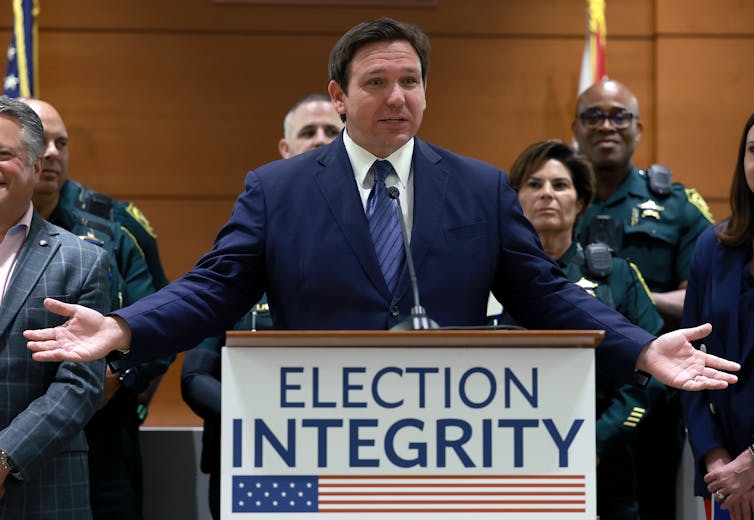
A white man dressed in a business suit stands with outstretched arms behind a lectern that has a sign bearing the words Election Integrity.
Florida Gov. Ron DeSantis announced on Oct. 18, 2022, that the state’s new Office of Election Crimes and Security was in the process of arresting 20 individuals for voter fraud. Joe Raedle/Getty Images

According to the National Conference of State Legislatures, those convicted of felonies have their rights automatically restored in 23 states when released from prison. But in 10 other states, those convicted of certain felonies can lose rights indefinitely or require a governor’s pardon for voting rights to be restored.

Making matters even more confusing is that state laws make different distinctions on who can and cannot vote. In some cases, the distinctions are based on whether the conviction was a felony or misdemeanor.

Other states distinguish between the timing of the end of imprisonment, parole or probation – and whether all fines and fees have been paid.

The Florida eligibility question

In 2018, for example, Florida voters approved a ballot initiative that “restores the voting rights of Floridians with felony convictions after they complete all terms of their sentence including parole or probation.”

Known as Amendment 4, the measure excluded people who committed murder or a felony sex offense.

But before the measure went into effect, a legal dispute arose over the definition of what it meant to complete a sentence. In 2019, Florida’s Republican-controlled Legislature passed a law that required payment of outstanding fees and fines before a person convicted of a felony conviction could regain their voting rights.

Though the American Civil Liberties Union challenged the constitutionality of the law in court, a federal appellate court backed the Republican lawmakers.

As a result, an estimated 730,000 Floridians who have completed their sentences remain disenfranchised.

Extending voting rights

Over the past nearly 30 years, many states have moved to make it easier for those convicted of felonies to regain their voting rights, starting in 1997 in Texas, where lawmakers eliminated a two-year waiting period before a person convicted of a felony regained their right to vote.

As a result, the number of people with felonies who had lost their right to vote dropped from a high of 6.1 million in 2016 to an estimated 4 million in this election, according to the Sentencing Project. During the U.S. presidential election in 2020, that number was 5.2 million.

So far in 2024 alone, officials in three states have tinkered with their laws on voter eligibility requirements for people convicted of felonies.

In Virginia, lawmakers approved on April 5 a new law that allows registered voters who are imprisoned while awaiting trial or have been convicted of a misdemeanor to vote by absentee ballot.

A month later, in May, Oklahoma lawmakers clarified their existing laws by passing a measure that allows people convicted of felonies to vote under certain conditions, such as receiving a pardon or a reduction of their felony conviction to a lesser misdemeanor.

Though passed by state lawmakers in April 2024, the Nebraska Supreme Court ruled on Oct. 16 that the new law could take effect. The law eliminates the two-year waiting period following the completion of a prison sentence before voting rights could be restored.

Increasing voter turnout

Numerous studies of those with felony convictions have shown that they believe the voting process is unclear and confusing.

In our study of voting behavior of people with convictions, we interviewed Raymond, a 49-year-old Black man in Michigan. When asked about the process of registering to vote, he told us: “I ain’t going to say scary, but it was unfamiliar. It can be overwhelming for people who don’t want to do it. You don’t know where to go, you don’t know who to really vote for.”

To get the word out to newly eligible voters, community organizations across the U.S. have launched grassroots operations to inform people with convictions of their voting rights and help guide them through the registration process.

As part of that effort, community organizations such as Alliance for Safety and Justice and TimeDone are working with academic researchers to further understand how different methods of outreach can increase voter turnout among people with felony convictions.

With many people newly eligible to vote in their first presidential election this year, I believe providing them with accurate information about voting and their state’s felony voting laws is critical to ensuring that the idea of a second chance includes the right to vote.The Conversation

Naomi F. Sugie, Associate Professor of Sociology, University of California, Los Angeles

This article is republished from The Conversation under a Creative Commons license. Read the original article.

South Main Street paving project underway in Lakeport

LAKEPORT, Calif. — Over the next few months Lakeport residents and visitors will see new paving improvements along South Main Street.

The city of Lakeport reported that the South Main Street paving project is now in full swing.

It follows the completion in September of the South Main Street Sidewalk Project, which focused on filling in missing sidewalk gaps and included significant Americans with Disabilities Act upgrades to enhance pedestrian accessibility along the corridor.

The paving project will cover the stretch from First Street to Lakeport Boulevard. It will resurface the roadway and introduce several pedestrian enhancements, including the installation of rectangular rapid flashing beacons, improved pavement markings and new striping.

The city said crews are actively working to prepare the roadway for repaving, focusing on South Main Street from Lakeport Boulevard to First Street.

Crews are conducting essential preparation, including adjusting utilities, smoothing the road surface and completing preliminary groundwork to ensure the highest paving quality, the city reported.

To meet specific temperature requirements, a leveling layer will be applied during daytime hours. The city said full paving work will follow.

The city anticipates completing the entire project by the end of the year.

The paving project aims to enhance road quality, improve safety and support Lakeport’s infrastructure, officials said.

The city thanked residents and businesses for their patience and support throughout the project.

For more information, contact the Public Works Department at 707-263-3578.

Winter season management coming to Boggs Mountain State Forest

COBB, Calif. — The Cal Fire Sonoma-Lake-Napa Unit announced Wednesday that the Boggs Mountain Demonstration State Forest will begin the annual process of winter season management effective Friday, Nov. 1.

The forest will remain open for day use only from sunrise to sunset beginning on Nov. 1.

Forest roads are subject to temporary closures pending wet weather conditions. Off highway vehicles, or OHVs, and off-roading are strictly prohibited.

Forest staff will be committed to unit tasks in the winter months, including prescribed burning on the forest.

Do not approach fires while burning operations are being conducted and avoid the area if sensitive to smoke.

Cal Fire encourages forest visitors to plan ahead before arriving, avoid recreating during inclement weather and respect signage in place for public safety.

Call the Boggs Mountain Demonstration State Forest office at 707-928-4378 for more information or visit the forest online.

Governor issues executive order tackling rising electric bills

On Wednesday, Gov. Gavin Newsom signed an executive order designed to reduce electric costs for Californians.

The governor’s action encourages electric bill relief while maintaining the state’s commitment to achieving carbon neutrality and 100% clean electricity by 2045.

The action comes as millions of Californians received an average credit of $71 on their October electric bills from the California Climate Credit, provided by the state’s Cap-and-Trade program.

“We’re taking action to address rising electricity costs and save consumers money on their bills. California is proving that we can address affordability concerns as we continue our world-leading efforts to combat the climate crisis,” said Newsom.

Tackling rising electricity costs

While California has been successful in keeping electric bills lower than many other states on average thanks to decades of work advancing energy efficiency standards, Californians have seen their electric bills rising in recent years.

A major driver has been critical utility wildfire mitigation efforts that have accelerated to match the pace of the climate crisis, as well as several programs added over time.

The governor’s executive order addresses both of these cost drivers by zeroing in on some programs that could be inflating customer bills and evaluating utility wildfire mitigation expenses for potential administrative savings.

The Governor’s executive order:

Encourages electric bill relief. The executive order asks the California Public Utilities Commission (CPUC) to identify underperforming programs and return any unused energy program funds back to customers receiving electric and gas service from private utilities as one or more credits on their bills.

Maximizes the California Climate Credit. The executive order directs the California Air Resources Board (CARB) to work with the CPUC to determine ways to maximize the California Climate Credit, which is a twice annual credit that shows up on many Californians’ electric and gas bills in the spring and fall and is funded by the state’s Cap-and-Trade program.

Manages and reduces electric costs for the long-term. The executive order asks the CPUC to evaluate electric ratepayer supported programs and costs of regulations and make recommendations on additional ways to save consumers money. It also asks the CPUC to pursue any federal funding available to help lower electricity costs for Californians. Additionally, the executive order directs the California Energy Commission (CEC) to evaluate electric ratepayer-funded programs and identify any potential changes that could save Californians money on their bills.

Smarter wildfire mitigation investments. The executive order directs the Office of Energy Infrastructure Safety, and requests the CPUC, to evaluate utility wildfire safety oversight practices and ensure that utility investments and activities are focused on cost-effective wildfire mitigation measures.

In addition to the governor’s action, earlier this year, the CPUC approved a proposal to reduce the price of residential electricity through a new billing structure authorized by the state Legislature.

This follows actions in recent years such as providing direct relief to customers and using state funds, rather than ratepayer monies, to develop a Strategic Reliability Reserve to maintain electric grid reliability during extreme conditions.

The governor welcomes partnership with the legislature to further additional actions that will address electric bill affordability.

“Californians expect us to take a hard look at their monthly energy and electricity bills and deliver reduced costs and savings for the long-term,” said Assembly Speaker Robert Rivas (D-Salinas). “I support increased oversight efforts, because regulators must ensure energy programs are implemented effectively and responsibly. The governor’s action today is another step forward to lessen households’ total energy burden and lower the cost of living in our state.”

“Rising electricity costs are impacting Californians and their quality of life,” said Senate President pro Tempore Mike McGuire (D-North Coast). “The state, including its regulatory agencies, needs to buckle down and blunt the expanding fiscal impacts on ratepayers. This is an important start by Gov. Newsom, and the Senate plans to double down on this progress in the months ahead.”

Commission on Judicial Performance publicly admonishes Sonoma County judge

NORTH COAST, Calif. — A Sonoma County judge is being disciplined by a state commission for misconduct.

The Commission on Judicial Performance has publicly admonished Judge James G. Bertoli of Sonoma County Superior Court.

The 11-member commission, chaired by Dr. Michael A. Moodian, issued a public admonishment to Judge Bertoli for engaging in improper political activity, improper social media conduct that demeaned the judicial office and improper fundraising.

The commission reported that Judge Bertoli opposed the renaming of the high school he had attended, Analy High School.

Judge Bertoli led protest rallies, made speeches, participated in fundraising, consulted with an attorney on behalf of his high school alumni association and urged people to oppose the renaming of the high school on social media.

The commission said Bertoli’s conduct involved public involvement on one side of an ongoing debate on a controversial social and political issue. That conduct violated the Code of Judicial Ethics and was not protected by the First Amendment.

“While Judge Bertoli was free to privately comment on an issue that he cares deeply about, his
judicial position required his abstention from public political activity,” the commission said.

In connection with his opposition to the change of the name of the high school, Judge Bertoli used Facebook accounts to make derogatory remarks about public officials, engage in rhetoric that inflamed the passions of the community, make profane remarks and speak derisively about those who did not agree with him.

The commission said Bertoli’s misconduct was aggravated by his prior discipline.

In 2021, he received an advisory letter for using his judicial title to promote his band, from 2011 through 2021.

“Judge Bertoli’s misconduct was further aggravated by the number of incidents of misconduct that publicly undermined respect for the judiciary and by Judge Bertoli’s failure to fully appreciate his misconduct,” the commission reported.

The public admonishment can be read below.

Bertoli DO Pub Adm 10-30-24 by LakeCoNews on Scribd

  • 330
  • 331
  • 332
  • 333
  • 334
  • 335
  • 336
  • 337
  • 338
  • 339

Community

  • Lake County Wine Alliance offers sponsor update; beneficiary applications open 

  • Mendocino National Forest announces seasonal hiring for upcoming field season

Public Safety

  • Lakeport Police logs: Thursday, Jan. 15

  • Lakeport Police logs: Wednesday, Jan. 14

Education

  • Woodland Community College receives maximum eight-year reaffirmation of accreditation from ACCJC

  • SNHU announces Fall 2025 President's List

Health

  • California ranks 24th in America’s Health Rankings Annual Report from United Health Foundation

  • Healthy blood donors especially vital during active flu season

Business

  • Two Lake County Mediacom employees earn company’s top service awards

  • Redwood Credit Union launches holiday gift and porch-to-pantry food drives

Obituaries

  • Rufino ‘Ray’ Pato

  • Patty Lee Smith

Opinion & Letters

  • The benefits of music for students

  • How to ease the burden of high electric bills

Veterans

  • CalVet and CSU Long Beach team up to improve data collection related to veteran suicides

  • A ‘Big Step Forward’ for Gulf War Veterans

Recreation

  • Wet weather trail closure in effect on Upper Lake Ranger District

  • Mendocino National Forest seeking public input on OHV grant applications

  • State Parks announces 2026 Anderson Marsh nature walk schedule 

  • BLM lifts seasonal fire restrictions in central California

Religion

  • Kelseyville Presbyterian to host Ash Wednesday service and Lenten dinner Feb. 18

  • Kelseyville Presbyterian Church to hold ‘Longest Night’ service Dec. 21

Arts & Life

  • Auditions announced for original musical ‘Even In Shadow’ set for March 21 and 28

  • ‘The Rip’ action heist; ‘Steal’ grounded in a crime thriller

Government & Politics

  • Lake County Democrats issue endorsements in local races for the June California Primary

  • County negotiates money-saving power purchase agreement

Legals

  • March 3 hearing on ordinance amending code for commercial cannabis uses

  • Feb. 12 public hearing on resolution to establish standards for agricultural roads

How to resolve AdBlock issue?
Refresh this page
