How to resolve AdBlock issue?
Refresh this page
How to resolve AdBlock issue?
Refresh this page
Lake County News,California
  • Home
    • Registration Form
  • News
    • Education
    • Veterans
    • Community
      • Obituaries
      • Letters
      • Commentary
    • Police Logs
    • Business
    • Recreation
    • Health
    • Religion
    • Legals
    • Arts & Life
    • Regional
  • Calendar
  • Contact us
    • FAQs
    • Phones, E-Mail
    • Subscribe
  • Advertise Here
  • Login

News

Estate Planning: Estate planning and the omitted child

Dennis Fordham. Courtesy photo.

A decedent’s child is his or her heir, along with any surviving spouse/registered domestic partner, and as an heir may — or may not — be entitled to a portion of their deceased parent’s estate.

California law does not require a parent to include a child as a beneficiary under the parent’s estate planning.

However, in the absence of effective estate planning (that is, without executing a valid will, trust and death beneficiary forms) a child may be entitled to a portion of the deceased parent’s estate.

Estate planning documents, of course, may alter that situation. An omitted child may then choose to litigate whether they are entitled to a share of the estate.

A disinheritance clause is included in an attorney drafted will and a trust instrument to show the decedent’s intention to exclude any unintended surviving heirs, including children, from inheriting under the decedent’s will or trust.

A general disinheritance provision is legally sufficient to disinherit any heirs, even though the heirs’ names are not specifically mentioned as being disinherited (Rallo v. O’Brien (2020), 52 CA5th 997).

California law, however, does provide certain protections for surviving children who are omitted in a will or trust, but provides for much stronger protection for those omitted children who were born or adopted after the execution (signing) of the will or trust; unless such instrument was later updated after the child’s birth. That is, after born and adopted omitted children are generally entitled, unless an exception applies, to receive a share in the decedent’s estate (section 21620 of the Probate Code).

This is why people are advised to update their estate planning after the birth or adoption of a child to specifically provide for or disinherit such children.

Children who were already alive when the decedent executed their estate planning documents, however, only receive some minimal protection in California. That narrow protection only applies, “… if the decedent failed to provide for a living child solely because the decedent believed the child to be dead or was unaware of the birth, then the child shall receive a share in the estate … (Section 61622 Probate Code).”

Recently, in Carla Montgomery versus Benita Williams, the Fourth Appellate District on Aug. 24, 2024, ruled in a case where the decedent’s will only benefited the decedent’s two children from his two marriages but did not include his four other biological children, including one child, the plaintiff Carla Montgomery, whom the decedent did not even know he had fathered when he signed his will. The court found that Carla had failed to show that her biological father had failed to provide for Carla “solely because …. [the father] was unaware of her birth.”

Even though the will did not include a “Disinheritance Clause,” the court strictly interpreted section 62622.

Looking at the facts, the court held that, “Benjamin’s omission of four known pretermitted children and his naming as beneficiaries only the two children resulting from his marriage shows his intent that only those two children should receive a share of his estate.”

Regardless of whether an omitted child was born before or was born after the decedent executed the testamentary documents, an omitted child will not receive an inheritance if any of the following apply: (1) the decedent’s failure to include the child was intentional and apparent from the testamentary instrument; (2) the decedent left substantially all of their estate to the other parent of the omitted child; and (3) the decedent otherwise provided for the omitted child outside of the estate passing under the testamentary instrument and the decedent’s intention for such other gift(s) to be in lieu of an inheritance under the testamentary instrument is shown by statements of the decedent, evident from the amount of the transfer, or otherwise evident (Section 61621 Probate Code).

The foregoing each requires a facts and circumstances analysis which may lead to litigation.

The foregoing is not legal advice. Anyone confronting the issues addressed should consult with a qualified attorney.

Dennis A. Fordham, attorney, is a State Bar-Certified Specialist in estate planning, probate and trust law. His office is at 870 S. Main St., Lakeport, Calif. He can be reached at This email address is being protected from spambots. You need JavaScript enabled to view it. and 707-263-3235.

Space News: Black hole destroys star, goes after another, NASA missions find

X-ray: NASA/CXC/Queen’s Univ. Belfast/M. Nicholl et al.; Optical/IR: PanSTARRS, NSF/Legacy Survey/SDSS; Illustration: Soheb Mandhai / The Astro Phoenix; Image Processing: NASA/CXC/SAO/N. Wolk.

NASA’s Chandra X-ray Observatory and other telescopes have identified a supermassive black hole that has torn apart one star and is now using that stellar wreckage to pummel another star or smaller black hole, as described in our latest press release.

This research helps connect two cosmic mysteries and provides information about the environment around some of the bigger types of black holes.

This artist’s illustration shows a disk of material (red, orange, and yellow) that was created after a supermassive black hole (depicted on the right) tore apart a star through intense tidal forces. Over the course of a few years, this disk expanded outward until it intersected with another object — either a star or a small black hole — that is also in orbit around the giant black hole. Each time this object crashes into the disk, it sends out a burst of X-rays detected by Chandra. The inset shows Chandra data (purple) and an optical image of the source from Pan-STARRS (red, green, and blue).

In 2019, an optical telescope in California noticed a burst of light that astronomers later categorized as a “tidal disruption event”, or TDE. These are cases where black holes tear stars apart if they get too close through their powerful tidal forces. Astronomers gave this TDE the name of AT2019qiz.

Meanwhile, scientists were also tracking instances of another type of cosmic phenomena occasionally observed across the Universe. These were brief and regular bursts of X-rays that were near supermassive black holes. Astronomers named these events “quasi-periodic eruptions,” or QPEs.

This latest study gives scientists evidence that TDEs and QPEs are likely connected. The researchers think that QPEs arise when an object smashes into the disk left behind after the TDE. While there may be other explanations, the authors of the study propose this is the source of at least some QPEs.

In 2023, astronomers used both Chandra and Hubble to simultaneously study the debris left behind after the tidal disruption had ended. The Chandra data were obtained during three different observations, each separated by about 4 to 5 hours. The total exposure of about 14 hours of Chandra time revealed only a weak signal in the first and last chunk, but a very strong signal in the middle observation.

From there, the researchers used NASA’s Neutron Star Interior Composition Explorer (NICER) to look frequently at AT2019qiz for repeated X-ray bursts. The NICER data showed that AT2019qiz erupts roughly every 48 hours. Observations from NASA’s Neil Gehrels Swift Observatory and India’s AstroSat telescope cemented the finding.

The ultraviolet data from Hubble, obtained at the same time as the Chandra observations, allowed the scientists to determine the size of the disk around the supermassive black hole. They found that the disk had become large enough that if any object was orbiting the black hole and took about a week or less to complete an orbit, it would collide with the disk and cause eruptions.

This result has implications for searching for more quasi-periodic eruptions associated with tidal disruptions. Finding more of these would allow astronomers to measure the prevalence and distances of objects in close orbits around supermassive black holes. Some of these may be excellent targets for the planned future gravitational wave observatories.

The paper describing these results appears in the October 9, 2024 issue of the journal Nature. The first author of the paper is Matt Nicholl (Queen’s University Belfast in Ireland) and the full list of authors can be found in the paper, which is available online at: https://arxiv.org/abs/2409.02181

NASA’s Marshall Space Flight Center manages the Chandra program. The Smithsonian Astrophysical Observatory’s Chandra X-ray Center controls science operations from Cambridge, Massachusetts, and flight operations from Burlington, Massachusetts.

Learn more about the Chandra X-ray Observatory and its mission at https://www.nasa.gov/chandra and https://chandra.si.edu.

Lakeport City Council authorizes police body camera upgrade with a $100,000 contract

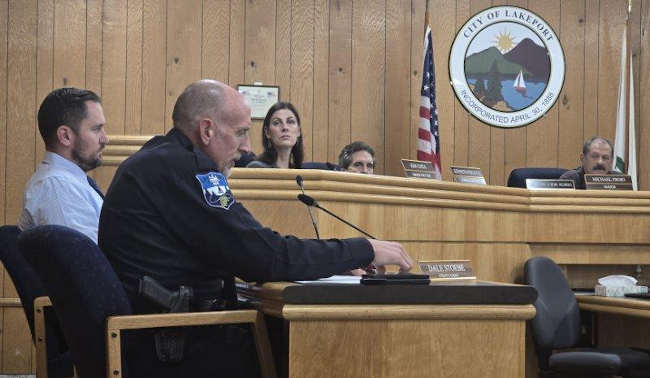
Lakeport Police Chief Dale Stoebe, second from left, presented his request for a new body-worn camera system at the Lakeport City Council meeting on Tuesday, Oct. 15, 2024, and responded to questions on the proposal from Mayor Michael Froio, right. Photo by Lingzi Chen/Lake County News.

LAKEPORT, Calif. — The Lakeport City Council voted unanimously on Tuesday night in favor of the proposal to upgrade the police department’s body-worn camera system with a five-year service contract that will cost about $100,000.

The Lakeport Police Department has been using body-worn and in-car audio/video devices, often referred to as BWC and MAV, respectively, from the company Waterguard as their vendor since 2006.

Motorola Solutions Inc. acquired the company in 2019 and will “no longer support our current system,” Police Chief Dale Stoebe said in his presentation at the council meeting.

While the police department will continue to use the current MAV, it began to review upgrade options on BWC in early 2024.

This week, Stoebe proposed to the city to engage in a five-year service contract with Motorola Solutions Inc. paid in annual installments which will cost a total of $99,892.35 over five years with a first year expense at $27,728.37.

Some of the contract benefits include 12 body-worn cameras with access to evidence library services, wireless transfer hardware, and accidental damage coverage. It also includes a refresh of all BWC devices in the third year and an $8,500 credit for turning in the department’s current Waterguard devices.

The agreement does not include any new mobile audio/video, or MAV, devices — in-car cameras in the police vehicles. MAV units can be purchased separately at about $11,000 each.

Stoebe mentioned another option they had considered but dropped, also from Motorola Solutions Inc. — the city may purchase equipment and services from the company as needed instead of entering a five-year contract. That would cost $103,077.74 for wireless transfer hardware with a year-one service subscription, plus $9,000 for each new body-worn camera.

Stoebe concluded that the five-year service contract option was “the most financially prudent option.”

Stoebe acknowledged that continuing using the current MAV and BWC equipment remains an option to save costs. “However, the lifespan of both the equipment and software is uncertain,” he said, adding that it would present “significant risks” as outdated MAV and BWC systems may result in increased legal, administrative and training costs, reduced public trust and negative impact on prosecution of criminal offenses.

Mayor poses questions about proposed contract, existing equipment

After Stoebe’s presentation, Lakeport Mayor Michael Froio asked if the department’s current MAV devices are still in good shape, out of the context that the proposed contract does not include any new MAV units.

“I believe so,” Stoebe responded, explaining that unlike the MAV that stays in the car, the BWC is the “workhorse” that wears out faster as it’s “exposed to the elements” — the heat and cold, the rains and occasional snows.

“Also they are worn by an officer conducting their work and sometimes they take a fair amount of brutality in that work,” Stoebe added. “That’s why they tend to be the ones that fail first.”

“I have a smile on my face tonight so don’t worry,” Froio said. “I like your approach that you’re looking to reuse as much of the equipment as we can.”

Froio has been a firm proponent of city staff bringing multiple bids for contracts, whether it be for equipment purchases or consulting services.

He then went on to ask why Motorola Solutions Inc. appeared to be the only bid in Stoebe’s presentation. “Should we have in the future looked at other systems?” Froio asked.

“It’s not that we have not looked at other bids,” Stoebe responded.

“We have solicited both Axon and Lenslock for bids for various elements,” Stoebe said of the two other major BWC and MAV makers besides Motorola Solutions Inc.. But those bidding prices were not included in Stoebe’s presentation.

“It’s not an apples-to-apples comparison,” Stoebe said of the technology involved. “There are just a lot of complexities in presenting multiple bids.”

Stoebe also suggested that it’s better to “stay with one platform” for all devices than to have two platforms. Since the current Waterguard MAC integrates easily with Motorola Solutions,

He said that to be the best stewards of the taxpayers money, the city should continue to use the MAV equipment until it fails. Stoebe also implied that it’s best to use the BWC from the same company rather than getting it from a separate vendor.

In response to Froio’s question, Stoebe also mentioned that Axon is the leader in the industry, which is reflected in their high bidding prices — $101,183.58 just for body cameras, another $150,651 for MAVs and they require onboard computers in the police vehicles that will incur extra costs.

“You’re doing a good job,” said Froio.

Stoebe also mentioned that body-worn cameras are standard in California and “definitely a hiring and retention concern.”

The Lakeport Police Department now has 12 officers including the chief, one short of full staff, Stoebe told Lake County News later in a phone call. Two more officers are going to leave the department by the end of the year, he said.

During public comment, Lakeport Police Officers’ Association President Todd Freitas spoke against a “bifurcated system.”

“As somebody that has to respond to quite literal life and death situations, me being able to touch one thing and have all my whole system work is invaluable to having critical decision making,” Freitas said.

Email Lingzi Chen at This email address is being protected from spambots. You need JavaScript enabled to view it..

PG&E moves forward with public safety power shutoff

LAKE COUNTY, Calif. — As winds picked up across Lake County and much of the region, Pacific Gas and Electric on Thursday night proactively cut power to an estimated 20,000 Northern California customers as part of an effort to reduce wildfire danger.

The wind event that prompted the public safety power shutoff entered PG&E’s service area early Thursday afternoon and is expected to exit the area as late as Saturday afternoon.

The company said that it reduced the scope of its power shutoff from nearly 30,000 customers in 33 counties to 20,000 customers in 24 counties due to improving weather conditions.

Originally, 168 Lake County customers were supposed to be included. However, on Thursday, PG&E said that number had grown to 1,088 customers.

The shutoff had been prompted due to a forecast of high winds and low humidity. Conditions improved on Wednesday morning thanks to rainfall in the Northern and Central Sierras.

As a result, PG&E said it removed nine counties and more than 10,000 customers from the scope of this PSPS event. Counties removed from the scope of this event include Alpine, Amador, Calaveras, El Dorado, Nevada, Placer, San Luis Obispo, Sierra, and Tuolumne.

PG&E has opened two community resource centers, at Live Oaks Senior Center, 12502 Foothill Blvd. in Clearlake Oaks, and at Hidden Valley Lake Association, 19305 Donkey Hill Road. They will be open from 8 a.m. to 10 p.m. during the outage. Available resources will include ADA-accessible restrooms and washing stations; blankets, snacks and water; device charging; small medical device charging; seating; and wi-fi.

For a full list of available CRCs, visit this website.

Updates are available at https://pgealerts.alerts.pge.com/psps-updates/.

Email Elizabeth Larson at This email address is being protected from spambots. You need JavaScript enabled to view it.. Follow her on Twitter, @ERLarson, or Lake County News, @LakeCoNews.

CHP encourages teens to stay focused and drive distraction-free

Distracted driving, especially among teens, is a rising concern that demands urgent attention.

To tackle this issue, the California Highway Patrol is launching a yearlong campaign to curb distractions behind the wheel for young drivers.

This initiative coincides with National Teen Driver Safety Week, Oct. 20 to 26, 2024.

Tragically, motor vehicle crashes continue to be the leading cause of death for teens in the United States.

With over 800,000 licensed teenage drivers in California alone, thousands of these young drivers are involved in deadly or injury-causing crashes each year.

From Oct. 1, 2021, through the end of September 2022,195 teenagers were involved in a crash related to inattention.

Supported by a specialized grant, the CHP’s Teen Distracted Driving initiative focuses on fostering safe, attentive driving habits in young drivers, aiming to prevent these teens from becoming another grim statistic.

“Teens face an even greater risk of crashing due to the lethal combination of inexperience and distraction, which can lead to lifelong consequences,” said CHP Commissioner Sean Duryee. “The CHP is committed to raising awareness among teen drivers through a combination of education and enforcement, ensuring they understand the critical importance of giving their full attention to driving.”

Common distractions that affect a person’s driving ability include external visual distractions, interaction with passengers or pets, cellular telephones (hands-free and handheld), eating, smoking, personal grooming, reading, radio, electronic equipment, etc. These secondary tasks reduce the driver’s attention from the primary task of driving.

The Teen Distracted Driving program features an educational component. CHP officers and traffic safety advocates engage in school and community events across the state.

Special enforcement efforts targeting distracted driving will take place during National Teen Driver Safety Week in October and National Distracted Driving Awareness Month in April.

Funding for this program was provided by a grant from the California Office of Traffic Safety through the National Highway Traffic Safety Administration.

Medicare vs. Medicare Advantage: sales pitches are often from biased sources, the choices can be overwhelming and impartial help is not equally available to all


It can take a lot of effort to understand the many different Medicare choices. Halfpoint Images/Moment via Getty Images

The 67 million Americans eligible for Medicare make an important decision every October: Should they make changes in their Medicare health insurance plans for the next calendar year?

The decision is complicated. Medicare has an enormous variety of coverage options, with large and varying implications for people’s health and finances, both as beneficiaries and taxpayers. And the decision is consequential – some choices lock beneficiaries out of traditional Medicare.

Beneficiaries choose an insurance plan when they turn 65 or become eligible based on qualifying chronic conditions or disabilities. After the initial sign-up, most beneficiaries can make changes only during the open enrollment period each fall.

The 2024 open enrollment period, which runs from Oct. 15 to Dec. 7, marks an opportunity to reassess options. Given the complicated nature of Medicare and the scarcity of unbiased advisers, however, finding reliable information and understanding the options available can be challenging.

We are health care policy experts who study Medicare, and even we find it complicated. One of us recently helped a relative enroll in Medicare for the first time. She’s healthy, has access to health insurance through her employer and doesn’t regularly take prescription drugs. Even in this straightforward scenario, the number of choices were overwhelming.

The stakes of these choices are even higher for people managing multiple chronic conditions. There is help available for beneficiaries, but we have found that there is considerable room for improvement – especially in making help available for everyone who needs it.

The choice is complex, especially when you are signing up for the first time and if you are eligible for both Medicare and Medicaid. Insurers often engage in aggressive and sometimes deceptive advertising and outreach through brokers and agents. Choose unbiased resources to guide you through the process, like www.shiphelp.org. Make sure to start before your 65th birthday for initial sign-up, look out for yearly plan changes, and start well before the Dec. 7 deadline for any plan changes.

2 paths with many decisions

Within Medicare, beneficiaries have a choice between two very different programs. They can enroll in either traditional Medicare, which is administered by the government, or one of the Medicare Advantage plans offered by private insurance companies.

Within each program are dozens of further choices.

Traditional Medicare is a nationally uniform cost-sharing plan for medical services that allows people to choose their providers for most types of medical care, usually without prior authorization. Deductibles for 2024 are US$1,632 for hospital costs and $240 for outpatient and medical costs. Patients also have to chip in starting on Day 61 for a hospital stay and Day 21 for a skilled nursing facility stay. This percentage is known as coinsurance. After the yearly deductible, Medicare pays 80% of outpatient and medical costs, leaving the person with a 20% copayment. Traditional Medicare’s basic plan, known as Part A and Part B, also has no out-of-pocket maximum.

Pen, glasses and medicare health insurance card
Traditional Medicare starts with Medicare parts A and B. Bill Oxford/iStock via Getty Images

People enrolled in traditional Medicare can also purchase supplemental coverage from a private insurance company, known as Part D, for drugs. And they can purchase supplemental coverage, known as Medigap, to lower or eliminate their deductibles, coinsurance and copayments, cap costs for Parts A and B, and add an emergency foreign travel benefit.

Part D plans cover prescription drug costs for about $0 to $100 a month. People with lower incomes may get extra financial help by signing up for the Medicare program Part D Extra Help or state-sponsored pharmaceutical assistance programs.

There are 10 standardized Medigap plans, also known as Medicare supplement plans. Depending on the plan, and the person’s gender, location and smoking status, Medigap typically costs from about $30 to $400 a month when a beneficiary first enrolls in Medicare.

The Medicare Advantage program allows private insurers to bundle everything together and offers many enrollment options. Compared with traditional Medicare, Medicare Advantage plans typically offer lower out-of-pocket costs. They often bundle supplemental coverage for hearing, vision and dental, which is not part of traditional Medicare.

But Medicare Advantage plans also limit provider networks, meaning that people who are enrolled in them can see only certain providers without paying extra. In comparison to traditional Medicare, Medicare Advantage enrollees on average go to lower-quality hospitals, nursing facilities, and home health agencies but see higher-quality primary care doctors.

Medicare Advantage plans also often require prior authorization – often for important services such as stays at skilled nursing facilities, home health services and dialysis.

Choice overload

Understanding the tradeoffs between premiums, health care access and out-of-pocket health care costs can be overwhelming.

Graphic of a person flow lines pointing to text boxes on either side that have smaller arrows to more text boxes holding plan choice descriptions.
Turning 65 begins the process of taking one of two major paths, which each have a thicket of health care choices. Rika Kanaoka/USC Schaeffer Center for Health Policy & Economics

Though options vary by county, the typical Medicare beneficiary can choose between as many as 10 Medigap plans and 21 standalone Part D plans, or an average of 43 Medicare Advantage plans. People who are eligible for both Medicare and Medicaid, or have certain chronic conditions, or are in a long-term care facility have additional types of Medicare Advantage plans known as Special Needs Plans to choose among.

Medicare Advantage plans can vary in terms of networks, benefits and use of prior authorization.

Different Medicare Advantage plans have varying and large impacts on enrollee health, including dramatic differences in mortality rates. Researchers found a 16% difference per year between the best and worst Medicare Advantage plans, meaning that for every 100 people in the worst plans who die within a year, they would expect only 84 people to die within that year if all had been enrolled in the best plans instead. They also found plans that cost more had lower mortality rates, but plans that had higher federal quality ratings – known as “star ratings” – did not necessarily have lower mortality rates.

The quality of different Medicare Advantage plans, however, can be difficult for potential enrollees to assess. The federal plan finder website lists available plans and publishes a quality rating of one to five stars for each plan. But in practice, these star ratings don’t necessarily correspond to better enrollee experiences or meaningful differences in quality.

Online provider networks can also contain errors or include providers who are no longer seeing new patients, making it hard for people to choose plans that give them access to the providers they prefer.

While many Medicare Advantage plans boast about their supplemental benefits , such as vision and dental coverage, it’s often difficult to understand how generous this supplemental coverage is. For instance, while most Medicare Advantage plans offer supplemental dental benefits, cost-sharing and coverage can vary. Some plans don’t cover services such as extractions and endodontics, which includes root canals. Most plans that cover these more extensive dental services require some combination of coinsurance, copayments and annual limits.

Even when information is fully available, mistakes are likely.

Part D beneficiaries often fail to accurately evaluate premiums and expected out-of-pocket costs when making their enrollment decisions. Past work suggests that many beneficiaries have difficulty processing the proliferation of options. A person’s relationship with health care providers, financial situation and preferences are key considerations. The consequences of enrolling in one plan or another can be difficult to determine.

The trap: Locked out

At 65, when most beneficiaries first enroll in Medicare, federal regulations guarantee that anyone can get Medigap coverage. During this initial sign-up, beneficiaries can’t be charged a higher premium based on their health.

Older Americans who enroll in a Medicare Advantage plan but then want to switch back to traditional Medicare after more than a year has passed lose that guarantee. This can effectively lock them out of enrolling in supplemental Medigap insurance, making the initial decision a one-way street.

For the initial sign-up, Medigap plans are “guaranteed issue,” meaning the plan must cover preexisting health conditions without a waiting period and must allow anyone to enroll, regardless of health. They also must be “community rated,” meaning that the cost of a plan can’t rise because of age or illness, although it can go up due to other factors such as inflation.

People who enroll in traditional Medicare and a supplemental Medigap plan at 65 can expect to continue paying community-rated premiums as long as they remain enrolled, regardless of what happens to their health.

In most states, however, people who switch from Medicare Advantage to traditional Medicare don’t have as many protections. Most state regulations permit plans to deny coverage, impose waiting periods or charge higher Medigap premiums based on their expected health costs. Only Connecticut, Maine, Massachusetts and New York guarantee that people can get Medigap plans after the initial sign-up period.

Deceptive advertising

Information about Medicare coverage and assistance choosing a plan is available but varies in quality and completeness. Older Americans are bombarded with ads for Medicare Advantage plans that they may not be eligible for and that include misleading statements about benefits.

A November 2022 report from the U.S. Senate Committee on Finance found deceptive and aggressive sales and marketing tactics, including mailed brochures that implied government endorsement, telemarketers who called up to 20 times a day, and salespeople who approached older adults in the grocery store to ask about their insurance coverage.

The Department of Health and Human Services tightened rules for 2024, requiring third-party marketers to include federal resources about Medicare, including the website and toll-free phone number, and limiting the number of contacts from marketers.

Although the government has the authority to review marketing materials, enforcement is partially dependent on whether complaints are filed. Complaints can be filed with the federal government’s Senior Medicare Patrol, a federally funded program that prevents and addresses unethical Medicare activities.

Meanwhile, the number of people enrolled in Medicare Advantage plans has grown rapidly, doubling since 2010 and accounting for more than half of all Medicare beneficiaries by 2023.

Nearly one-third of Medicare beneficiaries seek information from an insurance broker. Brokers sell health insurance plans from multiple companies. However, because they receive payment from plans in exchange for sales, and because they are unlikely to sell every option, a plan recommended by a broker may not meet a person’s needs.

Help is out there − but falls short

An alternative source of information is the federal government. It offers three sources of information to assist people with choosing one of these plans: 1-800-Medicare, medicare.gov and the State Health Insurance Assistance Program, also known as SHIP.

The SHIP program combats misleading Medicare advertising and deceptive brokers by connecting eligible Americans with counselors by phone or in person to help them choose plans. Many people say they prefer meeting in person with a counselor over phone or internet support. SHIP staff say they often help people understand what’s in Medicare Advantage ads and disenroll from plans they were directed to by brokers.

Telephone SHIP services are available nationally, but one of us and our colleagues have found that in-person SHIP services are not available in some areas. We tabulated areas by ZIP code in 27 states and found that although more than half of the locations had a SHIP site within the county, areas without a SHIP site included a larger proportion of people with low incomes.

Virtual services are an option that’s particularly useful in rural areas and for people with limited mobility or little access to transportation, but they require online access. Virtual and in-person services, where both a beneficiary and a counselor can look at the same computer screen, are especially useful for looking through complex coverage options.

We also interviewed SHIP counselors and coordinators from across the U.S.

As one SHIP coordinator noted, many people are not aware of all their coverage options. For instance, one beneficiary told a coordinator, “I’ve been on Medicaid and I’m aging out of Medicaid. And I don’t have a lot of money. And now I have to pay for my insurance?” As it turned out, the beneficiary was eligible for both Medicaid and Medicare because of their income, and so had to pay less than they thought.

The interviews made clear that many people are not aware that Medicare Advantage ads and insurance brokers may be biased. One counselor said, “There’s a lot of backing (beneficiaries) off the ledge, if you will, thanks to those TV commercials.”

Many SHIP staff counselors said they would benefit from additional training on coverage options, including for people who are eligible for both Medicare and Medicaid. The SHIP program relies heavily on volunteers, and there is often greater demand for services than the available volunteers can offer. Additional counselors would help meet needs for complex coverage decisions.

The key to making a good Medicare coverage decision is to use the help available and weigh your costs, access to health providers, current health and medication needs, and also consider how your health and medication needs might change as time goes on.

This article is part of an occasional series examining the U.S. Medicare system.

This story has been updated to remove a graphic that contained incorrect information about SHIP locations, and to correct the date of the open enrollment period.The Conversation

Grace McCormack, Postdoctoral researcher of Health Policy and Economics, University of Southern California and Melissa Garrido, Research Professor, Health Law, Policy & Management, Boston University

This article is republished from The Conversation under a Creative Commons license. Read the original article.

  • 339
  • 340
  • 341
  • 342
  • 343
  • 344
  • 345
  • 346
  • 347
  • 348

Community

  • Lake County Wine Alliance offers sponsor update; beneficiary applications open 

  • Mendocino National Forest announces seasonal hiring for upcoming field season

Public Safety

  • Lakeport Police logs: Thursday, Jan. 15

  • Lakeport Police logs: Wednesday, Jan. 14

Education

  • Woodland Community College receives maximum eight-year reaffirmation of accreditation from ACCJC

  • SNHU announces Fall 2025 President's List

Health

  • California ranks 24th in America’s Health Rankings Annual Report from United Health Foundation

  • Healthy blood donors especially vital during active flu season

Business

  • Two Lake County Mediacom employees earn company’s top service awards

  • Redwood Credit Union launches holiday gift and porch-to-pantry food drives

Obituaries

  • Rufino ‘Ray’ Pato

  • Patty Lee Smith

Opinion & Letters

  • The benefits of music for students

  • How to ease the burden of high electric bills

Veterans

  • CalVet and CSU Long Beach team up to improve data collection related to veteran suicides

  • A ‘Big Step Forward’ for Gulf War Veterans

Recreation

  • Wet weather trail closure in effect on Upper Lake Ranger District

  • Mendocino National Forest seeking public input on OHV grant applications

  • State Parks announces 2026 Anderson Marsh nature walk schedule 

  • BLM lifts seasonal fire restrictions in central California

Religion

  • Kelseyville Presbyterian to host Ash Wednesday service and Lenten dinner Feb. 18

  • Kelseyville Presbyterian Church to hold ‘Longest Night’ service Dec. 21

Arts & Life

  • Auditions announced for original musical ‘Even In Shadow’ set for March 21 and 28

  • ‘The Rip’ action heist; ‘Steal’ grounded in a crime thriller

Government & Politics

  • Lake County Democrats issue endorsements in local races for the June California Primary

  • County negotiates money-saving power purchase agreement

Legals

  • March 3 hearing on ordinance amending code for commercial cannabis uses

  • Feb. 12 public hearing on resolution to establish standards for agricultural roads

How to resolve AdBlock issue?
Refresh this page