 How to resolve AdBlock issue?
News
LAKEPORT, Calif. – A conflict for a defense attorney resulted in a Finley man accused of killing his cousin not entering a plea during a Friday hearing.
Salvador Flores Guzman, 69, made a brief court appearance on Friday afternoon before retired Judge Arnold Rosenfield from Sonoma County.
Salvador Guzman is accused of killing his cousin, 78-year-old Manuel Guzman, last month.
Responding to a report of a man down in the area of Stone Drive in Finley on the night of Feb. 8, sheriff's deputies found Manuel Guzman's body near his pickup, which was damaged. He had been stabbed in the chest and abdomen.
Investigators believe that Manuel Guzman – on the way home from Konocti Vista Casino – was forced off the road by Salvador Guzman, who then fatally stabbed his cousin.
The District Attorney's Office has charged Salvador Guzman with murder and special allegations of inflicting great bodily injury on Manuel Guzman, lying in wait and use of a deadly weapon, a knife; assault with a deadly weapon, a knife, and a special allegation of inflicting great bodily injury on a person age 70 or older; and assault with a deadly weapon, a vehicle.
Salvador Guzman is being held without bail in the Lake County Jail.
Judge Rosenfield has been assigned to hear the case because Manuel Guzman was the relative of a Lake County Superior Court employee, which caused all of the local judges to recuse themselves due to the conflict.
District Attorney Don Anderson is handling the case, and defense attorney Komnith Moth was assigned to represent Salvador Guzman, whose arraignment had been held over from last month in order to give time for Moth to prepare for entering a plea.
However, on Friday, Moth said that – after reading the police report – he believed he had a conflict and said he wouldn't be entering a plea for Guzman. Rather, he asked that the court put the matter over to another date for appointment of new counsel.
Moth said Angela Carter, who heads up the county's defense contract, asked him to have the matter placed on the calendar for Monday in order to give her time to check on available defense attorneys.
Anderson suggested that they could walk across the hallway and ask if any of the defense attorneys were available to take the assignment.
However, Moth said the entire public defender's office may have to declare a conflict in the case, although he did not specify the reason.
Rosenfield scheduled the matter to return to court Tuesday morning, at which time Carter is to appear to speak to which attorney she has ready to take the case or give a reason why they can't appear.
As the six-minute hearing drew to a close, Salvador Guzman said through a court interpreter that he wanted to get his own attorney.
“I have a lot of things to say,” Guzman said.
Carter told Lake County News later on Friday that a contracted attorney is set to take Guzman's case.
Email Elizabeth Larson at

NORTHERN CALIFORNIA – During the summer, most salamanders in the Berryessa Snow Mountain region are deep underground; but in the wet winter months you can find them on the surface, tucked under rocks and branches.
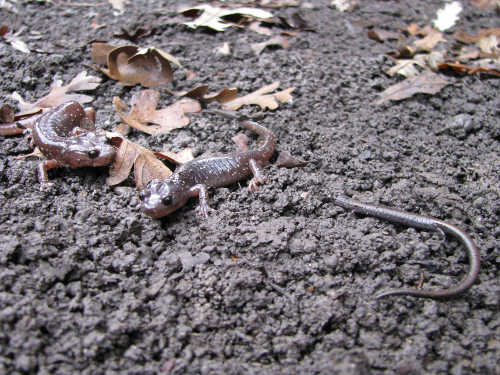
The photos show here feature two species of salamanders, and both of them are adults.
The larger pinkish one is the Arboreal (tree-climbing) salamander, and the skinny gray one (that looks like a tail) is the California Slender salamander.
The Arboreal salamander has a prehensile tail (like some monkeys) with which it can grasp branches or from which it can actually hang.
The California Slender salamander has a long body with very tiny legs and feet. If you don’t look at it carefully, you might think it’s a snake!
Both the Arboreal salamander and the California Slender salamander are found in the family Plethodontidae, called lung-less salamanders.
They do not have lungs, but rather breathe through their skin and the membranes in their mouth. They must remain moist at all times, or else they will die.
Their “permeable” skin (meaning that it has microscopic holes where the air goes in and out of it) makes them very sensitive to environmental pollutants – like the proverbial canary in the coal mine.
If there are poisons or toxins in the soil, or even in the air around Plethodontids, they will die. That’s why I always enjoying finding salamanders in my yard; because I know that the area where they live is healthy for me, too!
These gentle creatures spend their lives eating invertebrates (creatures without a backbone) like worms, mites, spiders and small insects. Larger salamanders like the Arboreal salamander will even eat other salamanders.
Salamanders are in a class of animals called amphibians. This class includes frogs and toads, as well as a very strange underground amphibian called a “caecilian” (pronounced ‘seh-SILL-yun’) – a kind of limbless amphibian which most people will never see in their lifetime because the caecilian lives deep underground.
Any creature that lives mainly in damp, loose soil and under leaf litter, logs, and plant debris, is called “fossorial” – which should not be confused with the word fossil. “Fossorial” comes from the Latin word fossor which means digger.
Scientists who are involved in the study of amphibians and reptiles, (like snakes, lizards or alligators) are termed herpetologists.
If you want to find and study salamanders in more detail, there are some basic rules to which you should adhere:
– First you should probably wear leather gloves when you turn over branches and rocks. There could always be harmful creatures, like poisonous spiders, scorpions, centipedes and snakes under those spots. In fact, the very same habitat which holds salamanders is also favored by spiders, snakes and scorpions.
– When you do grasp a rock or piece of wood to look underneath, do not curl your fingers around the underside where they might be bitten.
– You should also turn up the rock or wood so that it is exposed away from your face, rather than lifting it like a lid toward you.
– Take photos of the salamanders you find, but resist the urge to take them home and keep them as “pets.” It might seem fun to put them in a terrarium, but it will remove their diversity from the gene pool and prevent them from ever returning to the wild because this could introduce disease into the wild population.
– When you go to return a salamander to its home under the rock or wood, carefully lift the salamander away, replace the cover material (rock or wood), and then place the salamander beside the edge of the covering material so that the salamander can crawl back under cover on its own and not be squished.
– As a final point, you want to remember that the good scientific observer always leaves places looking untouched, just the way they found it. We call this the “leave no trace” ethic.
Oh, and keep in mind, too, that it’s very important to wash your hands after handling any salamander.
Their skin hosts a large number of harmful bacteria on it as a defensive mechanism to give them a nasty taste to large animals that might eat them.
If you find any salamanders in your yard, send the photos to Tuleyome to post on their Facebook page!
Tuleyome Tales is a monthly publication of Tuleyome, a nonprofit conservation organization based in Woodland, Calif. For more information about Tuleyome go to www.tuleyome.org . Christina Mann is a local wildlife biologist.

A primitive ocean on Mars held more water than Earth’s Arctic Ocean, and covered a greater portion of the planet’s surface than the Atlantic Ocean does on Earth, according to new results published this week.
An international team of scientists used ESO’s Very Large Telescope, along with instruments at the W. M. Keck Observatory and the NASA Infrared Telescope Facility, to monitor the atmosphere of the planet and map out the properties of the water in different parts of Mars' atmosphere over a six-year period. These new maps are the first of their kind. The results appear online in the journal Science.
About four billion years ago, the young planet would have had enough water to cover its entire surface in a liquid layer about 140 meters deep, but it is more likely that the liquid would have pooled to form an ocean occupying almost half of Mars’ northern hemisphere, and in some regions reaching depths greater than 1.6 kilometers.
“Our study provides a solid estimate of how much water Mars once had, by determining how much water was lost to space,” said Geronimo Villanueva, a scientist working at NASA’s Goddard Space Flight Center in Greenbelt, Maryland, USA, and lead author of the new paper. “With this work, we can better understand the history of water on Mars.”
The new estimate is based on detailed observations of two slightly different forms of water in Mars' atmosphere.
One is the familiar form of water, made with two hydrogen atoms and one oxygen, H2O. The other is HDO, or semi-heavy water, a naturally occurring variation in which one hydrogen atom is replaced by a heavier form, called deuterium.
As the deuterated form is heavier than normal water, it is less easily lost into space through evaporation. So, the greater the water loss from the planet, the greater the ratio of HDO to H2O in the water that remains.
The researchers distinguished the chemical signatures of the two types of water using ESO’s Very Large Telescope in Chile, along with instruments at the W. M. Keck Observatory and the NASA Infrared Telescope Facility in Hawaii.
By comparing the ratio of HDO to H2O, scientists can measure by how much the fraction of HDO has increased and thus determine how much water has escaped into space. This in turn allows the amount of water on Mars at earlier times to be estimated.
In the study, the team mapped the distribution of H2O and HDO repeatedly over nearly six Earth years – equal to about three Mars years – producing global snapshots of each, as well as their ratio. The maps reveal seasonal changes and microclimates, even though modern Mars is essentially a desert.
Ulli Kaeufl of ESO, who was responsible for building one of the instruments used in this study and is a co-author of the new paper, added: “I am again overwhelmed by how much power there is in remote sensing on other planets using astronomical telescopes: we found an ancient ocean more than 100 million kilometers away!”
The team was especially interested in regions near the north and south poles, because the polar ice caps are the planet’s largest known reservoir of water.
The water stored there is thought to document the evolution of Mars’ water from the wet Noachian period, which ended about 3.7 billion years ago, to the present.
The new results show that atmospheric water in the near-polar region was enriched in HDO by a factor of seven relative to Earth’s ocean water, implying that water in Mars’ permanent ice caps is enriched eight-fold.
Mars must have lost a volume of water 6.5 times larger than the present polar caps to provide such a high level of enrichment. The volume of Mars’ early ocean must have been at least 20 million cubic kilometers.
Based on the surface of Mars today, a likely location for this water would be the Northern Plains, which have long been considered a good candidate because of their low-lying ground.
An ancient ocean there would have covered 19 percent of the planet’s surface – by comparison, the Atlantic Ocean occupies 17 percent of the Earth’s surface.
“With Mars losing that much water, the planet was very likely wet for a longer period of time than previously thought, suggesting the planet might have been habitable for longer,” said Michael Mumma, a senior scientist at Goddard and the second author on the paper.
It is possible that Mars once had even more water, some of which may have been deposited below the surface.
Because the new maps reveal microclimates and changes in the atmospheric water content over time, they may also prove to be useful in the continuing search for underground water.

UPPER LAKE, Calif. – A campaign by the Upper Lake High School Boosters Club is containing to gain momentum – and funds – in its goal of installing lights for outdoor sports at the school.
“The Lights of Love” program is chaired by Ron Raetz. He and wife Patricia are both former teachers and longtime supporters of Upper Lake High School.
The program had raised $115,000 as of the start of February, bringing in another $15,000 during its seventh annual fundraiser on Feb. 14, Ron Raetz said.
The effort also has received from Robinson Rancheria Resort and Casino a donation of 47 lights which are surplus from a parking lot light project at Robinson five years ago, Raetz said.
Raetz said the project is moving forward at the same time as there are changes for the Upper Lake High School football team, which is to begin competing in eight-man – rather than 11-man – football for the first time.
It was a decision that was thrust upon the school by enrollment numbers, which have declined in the most recent years. Raetz said high school enrollment has dropped to the 200 range.
Last season the Cougars could field only 12 players for an 11-man team.
“We just got massacred,” Raetz said. “We only scored two touchdowns all year. You can’t get players anymore because everybody’s leaving California.”
But eight-man football has gained a modicum of popularity as the game form played by the professional Arena Football League.
The Upper Lake High School District, which stretches from Blue Lakes to Lucerne, has a good friend in Joanne Breton, owner-proprietor of Judy’s Junction restaurant and a member of the Upper Lake Union Elementary School Board.
Her staff at the restaurant contributed the labor for the “Lights of Love” Valentine’s Day fundraising dinner.
“Upper Lake is a well-rounded community, but there are not enough activities for kids here,” Breton said regarding her involvement. “The high school field is the only one (in Lake County) that doesn’t have lights. We should be in support of the kids with Friday night lights for Friday night games.”
Even with contributions from the outside community, getting those lights mounted and working won’t be easy.
“It’s not like St. Helena,” said Raetz. “We don’t get any major donations for raffles. In the last two years we had some nice cash gifts (for the fundraising program) from a student who graduated here but wants to remain anonymous. His dad, who passed away a long time ago, had a lot to do with our new gym.
“Yes, we have all those lights,” he added. “But when you do something for public schools in California you have to overplan it, and overbuild it and that costs the taxpayers money.”
Some preliminary planning was made cost-effectively by hiring the same contractors who installed solar panels at the school to use their horizontal drilling technique to install a conduit from the scoreboard to the power panel. The process cost $5,700.
Another $4,800 was spent, Raetz said, to have Reese Engineering drill core samples to learn the requirements for footings that will be needed to have the 80-foot steel light poles erected.
The light poles, said Raetz, will cost an overall $35,000.
A question that needs an answer is where the lights will be positioned and will their footings need to be 24 or 28 feet deep.
More questions await regarding the massive power system needed to light an athletic field.
Raetz said that Tom Powers of Lake County Electric has the fixtures needed and Brian Paul from Paul Engineering is bringing all the electric planning together.
“ … But we still have to have an architect and a structural engineer,” he said.
“The planning has been kind of hush-hush because before we can do anything somebody from the state has to take a look at it,” he added.
Looking for financial aid from the state for the project, Raetz said, would be an exercise of futility.
“The school’s gotta come up with something somewhere,” he added. “The state won’t do a damn thing for us.”
For more information about the effort or how to help, call Ron Raetz at 707-275-2824.
Email John Lindblom at [email protected] .
LOWER LAKE, Calif. – As part of its continuing effort to reduce the rate of crashes involving young drivers, the California Highway Patrol's Clear Lake Area office will host its next “Start Smart” class on Wednesday, March 11.
The free traffic safety training for newly licensed and teenage drivers and their parents/guardians will take place from 6 to 8 p.m. in the Lower Lake High School Library, located at 9430 Lake St.
The leading cause of death for Americans between the ages of 15 to 20 years old is motor vehicle collisions, according to the National Highway Traffic Safety Administration, and the CHP's goal is to reduce the death rate among young drivers as the result of these collisions.
The CHP’s Start Smart program is aimed at helping newly licensed and future licensed teenage drivers understand the critical responsibilities of driving and to understand that accidents happen, but collisions are 100 percent preventable.
The program is designed to provide an interactive safe driving awareness class which will illustrate how poor choices behind the wheel of a car can affect the lives of numerous people.
Start Smart also focuses on responsibilities of newly licensed drivers, responsibilities of parents/guardians and collision avoidance techniques.
“The CHP is committed to mitigating traffic collisions involving young, inexperienced drivers, because they are preventable,” said Lt. Hector Paredes, commander of the CHP's Clear Lake Area office. “Start Smart is an excellent program that promotes safe driving for young new drivers.”
Space is limited for this class. For more information or reservations, call Officer Kory Reynolds at the CHP's Kelseyville office, 707-279-0103.
LAKEPORT, Calif. – Wildfire? Flood? Injury? What do you do when an emergency occurs and you are an animal owner?
What do you do if you’re out hiking or riding on a remote trail and you get lost or injured?
Emergency preparedness, disaster planning, animal welfare, and biosecurity and quarantining will be topics presented at a public safety expo hosted by the Lake County Horse Council on Sunday, March 29.
The expo will be held from noon to 4 p.m. at Rancho de la Fuente, 2290 Soda Bay Road in Lakeport.
This is a free community event focused on horse and animal owners but will benefit anyone who wants to be prepared in the event of an emergency.
Presenters include Lake Evacuation and Animal Protection, Cal Fire, Lake County Search and Rescue, Lake County Office of Emergency Services and UC Davis College of Agriculture and Environmental Sciences.
A Lake County Horse Council members’ meeting will follow this event. Community members can join or renew their memberships.
Community members are invited to bring ideas and a potluck snack item to share.
For more information, contact Kim Riley at