 How to resolve AdBlock issue?
News
LAKEPORT, Calif. – The Lakeport Planning Commission will meet this week with one main business item relating to a fence variance.
The commission will meet beginning at 5 p.m. Wednesday, March 11, in the council chambers at Lakeport City Hall, 225 Park St.
The main item of business for the Wednesday meeting is Robert Culbertson's application for approval of fencing in excess of the 3-foot height limitation within the front yard setback area of a rental property located at 270 15th St.
The staff report said the application indicates that the property's tenants have “expressed concerns about the traffic noise and the lack of privacy from adjoining North High Street.”
The tenant also owns a large dog which needs a boundary fence to prevent it from escaping. That led to the fence's construction.
Staff is proposing approving the proposed fencing subject to conditions including removing 7 lineal feet of the fence to improve visibility, keeping shrubs at a maximum height of 36 inches and maintaining the fencing in good condition.
The commission also will approve its Jan. 14 meeting minutes and schedule its next meeting for Wednesday, April 8.
Email Elizabeth Larson at
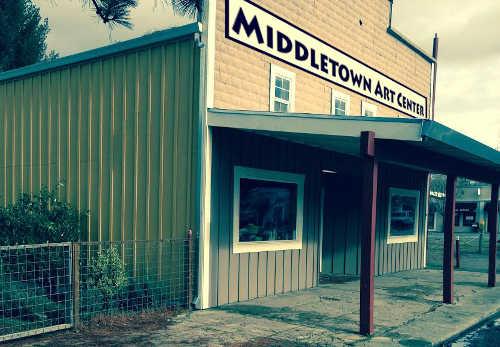
MIDDLETOWN, Calif. – For their first work of art, founders of a new art center in Middletown are seeking to bring 300 artists, artisans, art lovers and the aesthetically minded in Lake County together in their center’s first year of operation.
The drive for members already is taking place, with an artists’ premiere and reception planned for 5:30 to 8 p.m. Saturday, March 28, at the new center, a renovated building at the corner of highways 29 and 175.
The reception will feature the work of the center’s “Founding Five.”
As you read this, work is under way toward converting a 2,400-square-foot space that for a short time was a secondhand book store (and earlier a gymnasium) into a building dedicated to art with multiple exhibition spaces and classrooms.
The conversion is headed by Lisa Kaplan, who earlier was lead designer for the Lake County International Charter School in Middletown.
As one of the art center founders, she is filling the role of director of education and outreach.
The other four artist-founders are John Hanses, director of the treasury; Renata Jaworska, technical director; and Francesco Calisco and Sariah Reeser.
In addition, Kristina Della Valle is the gallery specialist and director of operations and marketing.
The group is in the process of renovating the exhibition salon and office space, and is asking for artists, art lovers, collectors, students of the arts, friends and family to come together to help them get the project off the ground.
“It’s not just artists; it’s also community members who will be participating in classes,” said Kaplan.
“We estimate our membership will be about 300 for the first year. The artists will be invited with the possibility of participating in art shows. We won’t refuse any members. If you want to be a member you can be a member. We are expecting to reach out to a broad variety of community members of all ages,” said Kaplan.
“It’s important to note that we would like to provide a place for youth and young adults,” she said. “At the same time, we are trying to appeal to the global market so we are interested in artists who have a name globally. We want to become a county destination. “
There are more immediate objectives, such as completing a segment of the center in time for the grand opening.
A section containing two classrooms will not be finished, but the classrooms are expected to open sometime in April.
Then there is the matter of raising the money needed to run the center.
“There’s a lot of parts to this,” said Hanses. “We’ll probably start with as little as $7,500.”
The initial funding, expected to be in the $27,000 to $30,000 range, will cover the center’s initial six-month budget.
“It will give us a finished gallery, classroom space advertising, all our supplies and finish the walls and air conditioning and heating,” said Hanses.
While the March 28 opening will display the artwork of founding members throughout the center, more importantly, said Della Valle, it will be a showcase to encourage artists from the community and other artists to participate in shows at the center.
“I think people would be surprised by how many artists we have in Lake County,” she said. “For example, we just started our fundraising campaign and had 41 people contributing. At least half of them are artists.”
To maintain a high standard of art, exhibitions will be juried. But the center is accepting two- and three-dimensional mixed media, functional art and small works.
Anyone interested can call 707-809-5398 or visit www.middletownartcenter.org for guidelines for membership and submissions.
The center will offer professional feedback and guidance on composition.
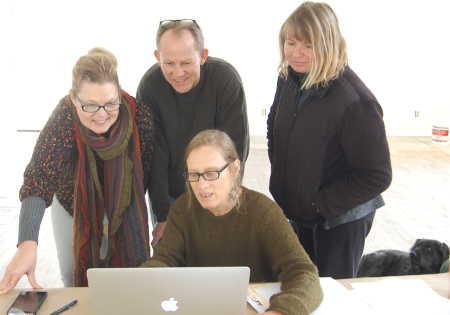
“Basically, what we’re doing is saying, to come and teach. The community wants to learn. Come and teach with us,” said Kaplan, who is one of the teachers.
Della Valle said that there will be six shows, each of six weeks' duration, at the center this year.
Already, she added, works have been submitted for a show that opens in May themed “Innovative Approaches To Landscape.”
“There will be some dedicated solo or duet shows a little later in the year,” Della Valle said.
In its early existence the center’s lifeblood will be sales, new memberships, the aforementioned crowd funding and other forms of community support. A proposed $15,000 grant is in the works.
“The $7,000 we’ve already raised does not include the cost of the paint,” Kaplan added.
Incidentally, the paint – 30 gallons for the walls and six gallons of varnish for the floors – was donated by Mario Richner, while Stephen Hebert donated paint and labor.
“Our fundraising campaign is for $10,000,” Kaplan said. “We encourage all community members to donate $10 or $20 or all that they can. If everybody donates a little bit it becomes $10,000.”
For those wishing to donate to the center, there are several options.
Visit http://www.middletownartcenter.org and click on the donation button at the right-hand side of the page in order to access PayPal.
Checks can be written to EcoArts of Lake County with “MAC” in the memo line and mailed to EcoArts, P.O. Box 1616, Middletown, CA 95461.
An online fundraiser also is available https://www.indiegogo.com/projects/help-fund-middletown-art-center .
To keep updated on the Middletown Art Center's progress, visit its Facebook page at https://www.facebook.com/middletownartcenter .
Email John Lindblom at
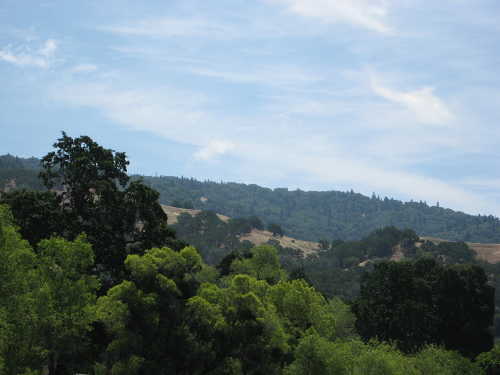
LAKE COUNTY, Calif. – We live in a unique place, called the Putah-Cache bioregion.
The dictionary states that a bioregion is “an area constituting a natural ecological community with characteristic flora, fauna, and environmental conditions and bounded by natural rather than artificial borders.”
The Putah-Cache bioregion contains a variety of habitats: Riparian, grasslands, oak woodlands and fast-disappearing wetlands.
Set like a jewel near the north section is Clear Lake, one of the oldest freshwater lakes in the world.
On the edge of the lake shores is Anderson Marsh State Historic Park.
If you visit the county of Lake's Web site, http://parks.lakecountyca.gov/ , you will see that we here in Lake County are blessed with about 30 parks. Those are the places to discover the diversity mentioned above.
The landscape in Lake County tells many stories for those who care to listen. Archaeological evidence suggests many rich cultures once lived in this Eden.
Early California impressionist artists have depicted parts of California in mythologically and spiritually robust paintings.
There are many scientific accounts outlining the need for us to pay attention to earth’s biota. Human demands on our possession of the earth have resulted in a great loss of animal and plant species.
You may hear others ask why is there a need to worry about certain plants or creatures which inhabit our backyard.
The truth is, there are more than 100 California animal species threatened with extinction due to their habitat destruction.
These diminutive creatures can often be indicators of an area's general environmental health.
We depend on earth’s bounty to feed us, just as our ancestors did, but many of us have lost the essential connection of earth’s hypnotic poetry; the earth’s enduring regeneration that is as sustaining to the soul as food is to our bodies.
Although Euro-Americans changed the Native people’s lifeways and landscape forever, there still remains dramatic landscape ripe with its mantle of rolling hills and life-giving waterways.
It is imperative that artists, folklorists, anthropologists, writers and philosophers – in other words, all of us – to remain keepers of this corner of the world, our delicate bioregion, which nurtures all of us.
It is more important than ever, now, in the 21st century to pay heed to this incomparable area known as the Putah-Cache Watershed.
Kathleen Scavone, M.A., is an educator, potter, writer and author of “Anderson Marsh State Historic Park: A Walking History, Prehistory, Flora, and Fauna Tour of a California State Park” and “Native Americans of Lake County.” She also writes for NASA and JPL as one of their “Solar System Ambassadors.” She was selected “Lake County Teacher of the Year, 1998-99” by the Lake County Office of Education, and chosen as one of 10 state finalists the same year by the California Department of Education.
LAKE COUNTY, Calif. – Looking for a big dog to take on hikes and trips around the county and beyond? Or a little canine pal to hang out on the couch?
Lake County Animal Care and Control has a large selection of dogs this week to fit all kinds of lifestyles.
Dogs available for adoption include mixes of Chihuahua, dachshund, Doberman Pinscher, Labrador Retriever, pit bull, Rhodesian Ridgeback, Shar Pei, shepherd and terrier.
Low adoption fees are offered for some of the dogs.
Dogs that are adopted from Lake County Animal Care and Control are either neutered or spayed, microchipped and, if old enough, given a rabies shot and county license before being released to their new owner. License fees do not apply to residents of the cities of Lakeport or Clearlake.
If you're looking for a new companion, visit the shelter. There are many great pets hoping you'll choose them.
In addition to the animals featured here, all adoptable animals in Lake County can be seen here: http://bit.ly/Z6xHMb .
The following dogs at the Lake County Animal Care and Control shelter have been cleared for adoption (additional dogs on the animal control Web site not listed are still “on hold”).
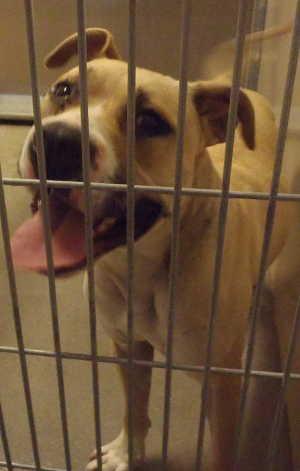
Female pit bull terrier
This female pit bull terrier mix has a short tan and white coat.
She's in kennel No. 34, ID No. 1862.
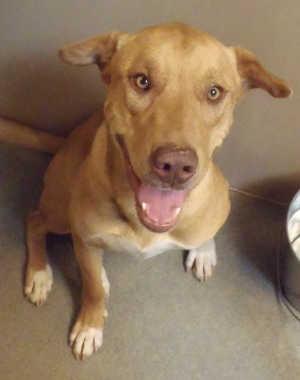
'Mel'
“Mel” is a 1-year-old male Doberman Pinscher-Shar Pei mix, with a short brown and white coat, and stunning green eyes, who is looking for an active family or individual to give him a new home.
If you want a dog that loves to be by your side 24/7, Mel would be perfect for you.
Shelter staff doesn't recommend him for a home with cats. Those with dogs wanting to adopt Mel should submit an application and bring their dogs in for an introduction.
He's in kennel No. 33a, ID No. 1718.
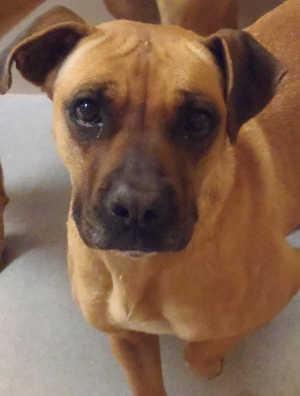
Rhodesian Ridgeback mix
This male Rhodesian Ridgeback mix came in with his sister, and is also 4 years old.
Shelter staff says he gets along well with cats; his tail wagged as he watched them play.
Anyone who is interested in adopting him and who has dogs already is asked to submit an application and introduce bring their dogs in for an introduction.
He is slightly shy but with some training he could be a wonderful addition to your family or for an individual.
He's in kennel No. 32b, ID No. 1762.
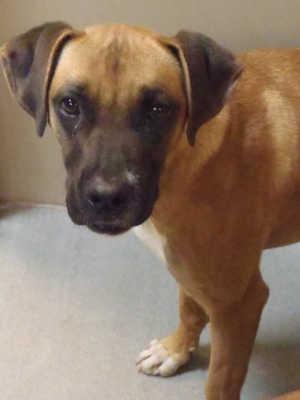
Rhodesian Ridgeback mix
This female Rhodesian Ridgeback mix, along with her brother, came in as a stray from the Hendricks Road area in Lakeport.
She is 4 years old, weighs 54.5 pounds, and has a short brown coat and black markings.
Shelter staff said she is mellow, very sweet and a little shy, but warms up once she's had a chance to get to know a person.
She is heartworm positive so she will need treatment. Call for a quote for medications.
She's in kennel No. 32a, ID No. 1757.
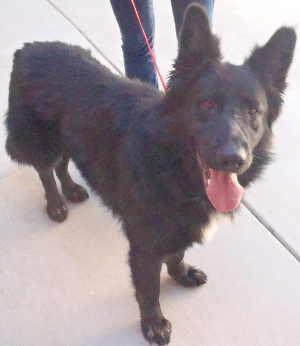
Male shepherd mix
This male shepherd mix has a medium-length black coat.
He's in kennel No. 30, ID No. 1861.
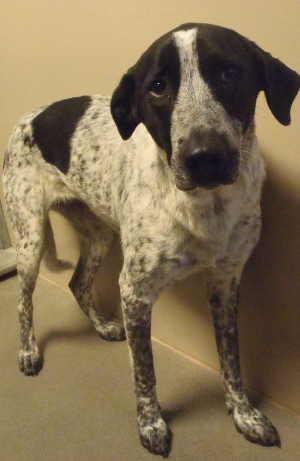
Female cattle dog mix
This female cattle dog mix has a short black and white coat.
She's in kennel No. 28, ID No. 1888.
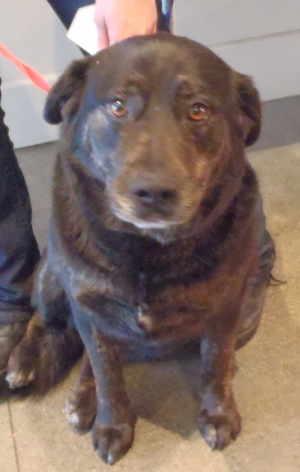
'Roxie'
“Roxie” is a female Labrador Retriever mix who came into the shelter along with Max.
She is 4 years old, weighs 69 pounds and already is spayed, so she is available for a low adoption fee.
Roxie also is leash trained and knows basic commands, and has beautiful big brown eyes.
Roxie is in kennel No. 16, ID No. 1771.
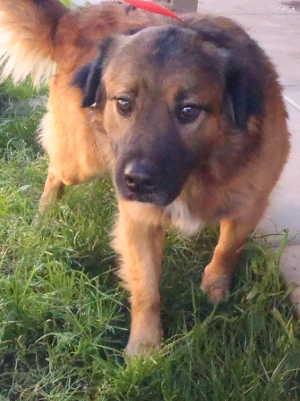
'Max'
“Max” is a male Labrador Retriever-German Shepherd mix.
He is 3 years old, weighs nearly 60 pounds and has a medium sable and black coat.
Shelter staff said he is well trained: Max knows his commands and is leash trained.
He is looking for a family to be a part of or an individual who will love him.
He's in kennel No. 15, ID No. 1770.
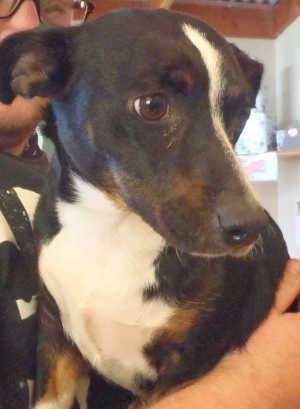
Female terrier mix
This female terrier mix is 4 years old, and has a short tricolor coat.
Shelter staff said she weighs 24 pounds, is very sweet and calm.
She walks great on a leash, does not bark much and is looking for a loving home.
Find her in kennel No. 14, ID No. 1855.

Chihuahua mix
This female Chihuahua mix has a short white coat with brown markings.
She is in kennel No. 13, ID No. 1851.
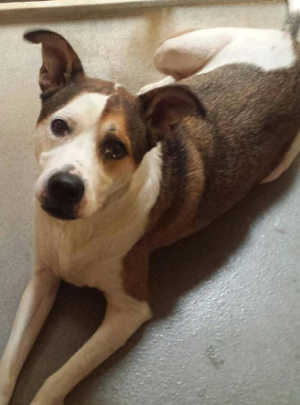
'Casper'
“Casper” is a male cattle dog mix with a short, tricolor coat.
He's in kennel No. 10, ID No. 1843.
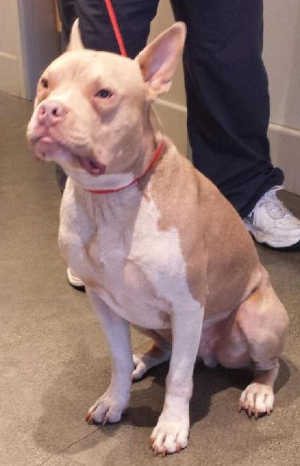
'Copper'
“Copper” is a young male pit bull terrier mix.
He has a short red and white coat, and already has been neutered, so he has a low adoption fee.
Copper is in kennel No. 8, ID No. 1738.
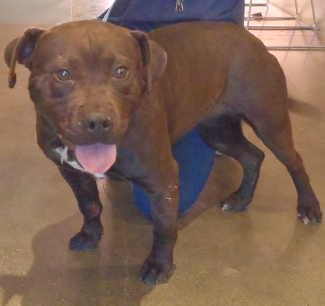
Pit bull terrier mix
This female pit bull terrier mix has a short brown coat.
She's in kennel No. 6, ID No. 1901.
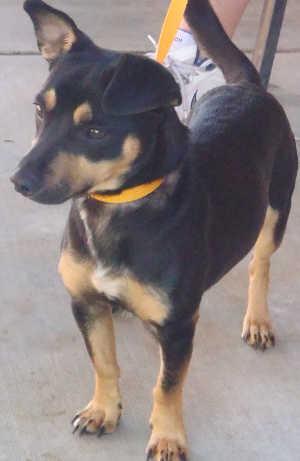
'Buck'
“Buck” is a male terrier and dachshund mix.
He has a short black and tan coat, with some white markings.
He's in kennel No. 4, ID No. 835.
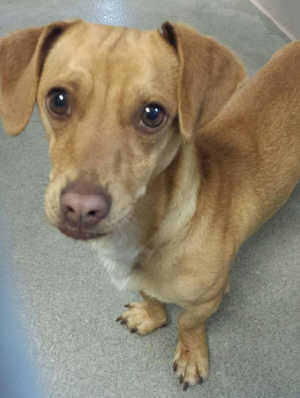
Dachshund-Chihuahua mix
This male dachshund-Chihuahua mix has a short tan coat and brown eyes.
He's in kennel No. 3, ID No. 1844.
To fill out an adoption application online visit http://www.co.lake.ca.us/Government/Directory/Animal_Care_And_Control/Adopt/Dog___Cat_Adoption_Application.htm .
Lake County Animal Care and Control is located at 4949 Helbush in Lakeport, next to the Hill Road Correctional Facility.
Office hours are Monday through Friday, 11 a.m. to 5 p.m., and 11 a.m. to 3 p.m., Saturday. The shelter is open from 11 a.m. to 4 p.m. Monday through Friday and on Saturday from 11 a.m. to 3 p.m.
Visit the shelter online at http://www.co.lake.ca.us/Government/Directory/Animal_Care_And_Control.htm .
For more information call Lake County Animal Care and Control at 707-263-0278.
Email Elizabeth Larson at
Over the past several decades, astronomers have come to realize that the sky is filled with magnifying glasses that allow the study of very distant and faint objects barely visible with even the largest telescopes.
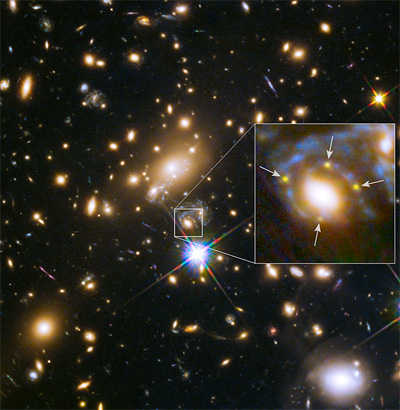
A University of California, Berkeley, astronomer has now found that one of these lenses – a massive galaxy within a cluster of galaxies that are gravitationally bending and magnifying light – has created four separate images of a distant supernova.
The so-called “Einstein cross” will allow a unique study of a distant supernova and the distribution of dark matter in the lensing galaxy and cluster.
“Basically, we get to see the supernova four times and measure the time delays between its arrival in the different images, hopefully learning something about the supernova and the kind of star it exploded from, as well as about the gravitational lenses,” said UC Berkeley postdoctoral scholar Patrick Kelly, who discovered the supernova while looking through infrared images taken Nov. 10, 2014, by the Hubble Space Telescope. “That will be neat.”
Kelly is a member of the Grism Lens-Amplified Survey from Space (GLASS) team led by Tommaso Treu at UCLA, which has worked in collaboration with the FrontierSN team organized by Steve Rodney at Johns Hopkins University to search for distant supernovae.
“It's a wonderful discovery,” said Alex Filippenko, a UC Berkeley professor of astronomy and a member of Kelly’s team. “We've been searching for a strongly lensed supernova for 50 years, and now we've found one. Besides being really cool, it should provide a lot of astrophysically important information.”
One bonus is that, given the peculiar nature of gravitational lensing, astronomers can tune in for a supernova replay within the next five years.
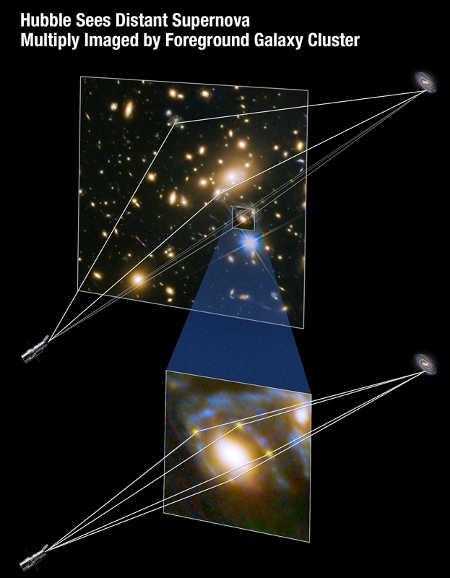
This is because light can take various paths around and through a gravitational lens, arriving at Earth at different times.
Computer modeling of this lensing cluster shows that the researchers missed opportunities to see the exploding star 50 years ago and again 10 years ago, but images of the explosion will likely repeat again in a few years.
“The longer the path length, or the stronger the gravitational field through which the light moves, the greater the time delay,” noted Filippenko.
Kelly is first author of a paper reporting the supernova appearing this week in a special March 6 issue of Science magazine to mark the centenary of Albert Einstein’s General Theory of Relativity.
Kelly, Filippenko and their collaborators have dubbed the distant supernova SN Refsdal in honor of Sjur Refsdal, the late Norwegian astrophysicist and pioneer of gravitational lensing studies.
It is located about 9.3 billion light years away (redshift = 1.5), near the edge of the observable universe, while the lensing galaxy is about 5 billion light years (redshift = 0.5) from Earth.
Einstein cross
Einstein’s General Theory of Relativity predicts that dense concentrations of mass in the universe will bend light like a lens, magnifying objects behind the mass when seen from Earth.
The first gravitational lens was discovered in 1979. Today, lensing provides a new window into the extremely faint universe shortly after its birth 13.8 billion years ago.
“These gravitational lenses are like a natural magnifying glass. It’s like having a much bigger telescope,” Kelly said. “We can get magnifications of up to 100 times by looking through these galaxy clusters.”
When light from a background object passes by a mass, such as an individual galaxy or a cluster of galaxies, the light is bent.
When the path of the light is far from the mass, or if the mass is not especially large, “weak lensing” will occur, barely distorting the background object.
When the background object is almost exactly behind the mass, however, “strong lensing” can smear extended objects (like galaxies) into an “Einstein ring” surrounding the lensing galaxy or cluster of galaxies.
Strong lensing of small, point-like objects, on the other hand, often produces multiple images – an Einstein cross – arrayed around the lens.
“We have seen many distant quasars appear as Einstein crosses, but this is the first time a supernova has been observed in this way,” Filippenko said. “This short-lived object was discovered only because Pat Kelly very carefully examined the HST data and noticed a peculiar pattern. Luck comes to those who are prepared to receive it.”
The galaxy that is splitting the light from the supernova into an Einstein cross is part of a large cluster, called MACS J1149.6+2223, that has been known for more than 10 years.
In 2009, astronomers reported that the cluster created the largest known image of a spiral galaxy ever seen through a gravitational lens.
The new supernova is located in one of that galaxy’s spiral arms, which also appears in multiple images around the foreground lensing cluster. The supernova, however, is split into four images by a red elliptical galaxy within the cluster.
“We get strong lensing by a red galaxy, but that galaxy is part of a cluster of galaxies, which is magnifying it more. So we have a double lensing system,” Kelly said.
Looking for transients
After Kelly discovered the lensed supernova Nov. 10 while looking for interesting and very distant supernova explosions, he and the team examined earlier Hubble Space Telescope images and saw it as early as Nov. 3, though it was very faint.
So far, the Hubble Space Telescope has taken several dozen images of it using the Wide Field Camera 3 Infrared camera as part of the Grism survey.
Astronomers using the Hubble Space Telescope plan to get even more images and spectra as the telescope focuses for the next six months on that area of sky.
“By luck, we have been able to follow it very closely in all four images, getting data every two to three days,” he said.
Kelly hopes that measuring the time delays between the phases of the supernova in the four images will enable constraints on the foreground mass distribution and on the expansion and geometry of the universe.
If the spectrum identifies it as a Type Ia supernova, which is known to have a relatively standard brightness, it may be possible to put even stronger limits on both the matter distribution and cosmological parameters.
UC Berkeley co-authors of the paper, in addition to Kelly and Filippenko, are postdoctoral scholars Melissa Graham and Bradley Tucker. Other contributing authors are Steven A. Rodney, Tommaso Treu, Ryan J. Foley, Gabriel Brammer, Kasper B. Schmidt, Adi Zitrin, Alessandro Sonnenfeld, Louis-Gregory Strolger, Or Graur, Saurabh W. Jha, Adam G. Riess, Marusa Bradac, Benjamin J. Weiner, Daniel Scolnic, Matthew A. Malkan, Anja von der Linden, Michele Trenti, Jens Hjorth, Raphael Gavazzi, Adriano Fontana, Julian C. Merten, Curtis McCully, Tucker Jones, Marc Postman, Alan Dressler, Brandon Patel and S. Bradley Cenko.
The UC Berkeley work was supported by the Christopher R. Redlich Fund, the TABASGO Foundation and the National Science Foundation (grant AST-1211916).
Robert Sanders writes for the UC Berkeley News Center.
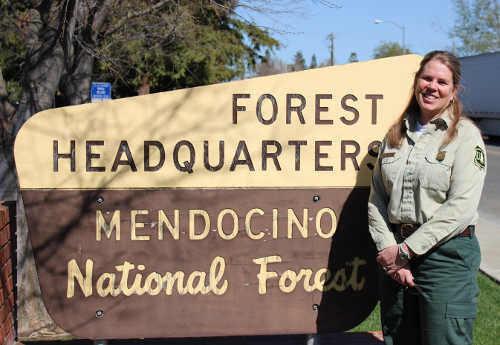
MENDOCINO NATIONAL FOREST, Calif. – Ann Carlson has been recently selected as the 22nd forest supervisor for the Mendocino National Forest.
Carlson, the second woman to be named a supervisor for the forest – the first was her predecessor, Sherry Tune – is scheduled to arrive on the forest April 6.
Currently Carlson is the Eagle Lake District Ranger on the Lassen National Forest in Susanville, Calif.
“I feel very fortunate to be selected for this position and look forward to meeting new people and providing leadership for the Mendocino National Forest,” Carlson said.
A series of public open houses to meet Carlson are being planned later this spring.
Carlson has a bachelor’s degree in aquatic ecosystems assessment and management from Western Washington University at Bellingham and a master’s degree in aquatic ecology from Utah State University at Logan.
She began her career as a fish biologist on the Tahoe National Forest in 1989. While there, Carlson built partnerships with local groups to provide aquatic restoration opportunities, environmental education and improved fishing.
In 2003 Carlson served as northern regional aquatic ecologist in Missoula, Mont., a position she held until her selection as Eagle Lake District Ranger in 2011.
Carlson completed temporary assignments as a district ranger in South Dakota and as a deputy forest supervisor on the Boise National Forest in Idaho before starting on the Lassen National Forest.
“I have spent the past four years learning the ropes of being a district ranger and preparing to be a forest supervisor. I couldn’t be happier starting this new adventure,” Carlson said.
Carlson is very active and enjoys traveling and outdoor activities including biking, running, cross-country skiing, fly fishing and hiking.
“I’m looking forward to exploring not only the Mendocino National Forest, but also the surrounding communities and learning more about the area,” Carlson said.
She also is excited about the move to the area with her fiancé and is looking forward to local adventures.
Carlson’s daughter Tess shares her love of the outdoors and travel and is currently living in Wyoming.