 How to resolve AdBlock issue?
News

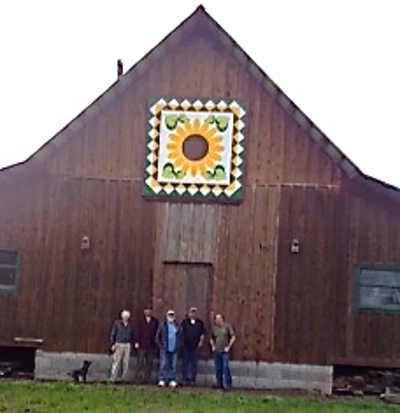
LAKEPORT, Calif. – The 69th quilt block on the Lake County Quilt Trail is titled “Sunflower.”
It has been installed on the north side of Carol and Bob Prather’s barn at 2345 Park Drive, Lakeport, en route to Lakeside County Park.
It can be viewed from Elizabeth Drive, which is a left turn off of St. Francis Drive in Corinthian Bay.
The Prather barn was designed and built in 1999 by Bob Prather with help from various family members.
It was built from lumber that Bob Prather milled from trees harvested off of his property in
Lock Lomond.
Carol Prather is an avid, lifelong quilter who has followed the Quilt Trail project from the beginning.
She was one of the quilters involved in making the last opportunity quilt which benefited Tango
Mike.
In her lifetime, Carol Prather has made many, many very beautiful quilts – large and small.
The happy sunflower quilt block theme was chosen by Carol Prather because she loves sunflowers. Perhaps there will be a field of sunflowers growing near the quilt block this summer.
The Lake County Quilt Trail is an agricultural and tourism project designed to promote community pride.
The 8-foot by 8-foot quilt block was drawn and painted by the Lake County Quilt Trail team, a group of dedicated quilters, graphic artists, painters, writers, carpenters, and a videographer.
For more information about the Lake County Quilt Trail visit www.lakecountyquilttrail.com or https://www.facebook.com/pages/Lake-County-Quilt-Trail/187014251326163 .
The California Community Colleges Board of Governors gave final approval on Monday for 12 community colleges to participate in a landmark pilot program that allows them to offer bachelor’s degrees in fields such as respiratory therapy, dental hygiene and aerospace manufacturing technology.
“This is an appropriate expansion of our mission designed to meet the needs of an economy that is requiring more workers with four-year degrees,” said Geoffrey L. Baum, president of the Board of Governors. “We have consulted closely with the leadership of the California State University system throughout this process and are pleased to approve these innovative pilot programs that will provide students with affordable degree options in fields that have demonstrated job growth.”
Initial approval was granted in January, pending additional evaluation of the proposals by the California Community Colleges Chancellor’s Office and further consultation with California State University and the University of California.
The bachelor’s degree programs receiving final approval are:
• Airframe manufacturing technology, Antelope Valley College;
• Industrial automation, Bakersfield College;
• Mortuary science, Cypress College;
• Equine industry, Feather River College;
• Dental hygiene (2), Foothill College and West Los Angeles College;
• Bio-manufacturing, Mira Costa College;
• Respiratory care (2), Modesto Junior College and Skyline College;
• Health information management, Mesa College;
• Occupational studies, Santa Ana College;
• Health information management, Shasta College.
“After undergoing additional review by our office, these bachelor’s degree programs are set to gear up and enroll students who are looking for affordable options to earn four-year degrees. We’re excited to expand higher education opportunities in our system and help fuel California’s economy,” said Chancellor Brice W. Harris.
Bachelor’s degree proposals in interaction design at Santa Monica College and automotive technology at Rio Hondo College received initial approval but will require further conversations related to duplication with the California State University before final consideration later this spring.
A bachelor’s degree program in emergency services and allied health systems was approved in January but has since been withdrawn by Crafton Hills Community College.
The board action is in response to legislation sponsored by Sen. Marty Block (D-San Diego) and signed by the governor last year that allows up to 15 districts to establish a pilot baccalaureate degree program at one of their colleges in a field of study not offered by the California State University or University of California.
Lower-division coursework would cost $46 per unit and upper-division coursework would cost an additional $84 per unit under the new program, with an estimated total cost of about $10,000 to obtain a bachelor’s degree.
The college districts selected for the pilot program were chosen from 34 applications. A team comprised of Chancellor’s Office staff, a member of the business and workforce community, and community college administrators, faculty and staff from districts that did not apply to host a program reviewed the applications.
Considerations for selecting a district included geographic distribution of the pilot programs, diversity of pilot programs, ability of the district to establish a rigorous program in their proposed field and that the proposed program will meet an unaddressed local or statewide workforce need.
Under the law the four-year degree programs must be up and running by at least the 2017-18 academic year, however, districts may start their programs by the fall 2015 semester. Districts must also seek approval from the Accrediting Commission for Community and Junior Colleges to start a program.
The legislation sunsets after the 2022-23 school year, after which the Legislature and governor may renew it pending two Legislative Analyst’s Office reviews of the pilot program- one in 2018 and another in 2022.
The law was enacted to assist the state in meeting the need for individuals in high demand technical disciplines which are increasingly requiring baccalaureate degrees and to increase college participation rates and improve workforce training opportunities for local residents who are unable to relocate because of family or work commitments.
The California Community Colleges is the largest system of higher education in the nation composed of 72 districts and 112 colleges serving 2.1 million students per year.
For more information about the community colleges, please visit http://californiacommunitycolleges.cccco.edu/ , https://www.facebook.com/CACommColleges or https://twitter.com/CalCommColleges .
NORTHERN CALIFORNIA – A fatal Monday morning shooting near Yountville led to a pursuit with law enforcement and the apparent suicide of the suspect.
Capt. Doug Pike of the Napa County Sheriff's Office said deputies were dispatched to a report of a shooting in the 6100 block of Solano Avenue, south of Yountville, shortly before noon on Monday.
As the deputies arrived on scene, they observed two male subjects – one of whom was armed – in a vineyard, Pike said.
On the deputies' approach, the armed individual – a male in his late 40s – ran to a black SUV, which was parked nearby, and fled the scene, according to Pike.
Pike said that while one of the deputies pursued the black SUV, the other deputy went to the victim to render aid.
He said the victim – also a male in his late 40s – was found to be suffering from at least one gunshot wound to the head and was pronounced dead at the scene.
Meanwhile, the deputy who was pursuing the SUV was joined by other sheriff’s deputies, officers from the Napa Police Department and a helicopter from the California Highway Patrol, Pike said.
The armed suspect fled northbound on Highway 29 to Oakville and then west on Oakville Grade toward Sonoma County, Pike said.
The pursuit ended near the Napa/Sonoma county line on private property off Wall Road, where Pike said the suspect vehicle was located in a heavily wooded area.
Fearing the suspect may be armed with a high-powered weapon and on foot in the area, authorities established a large perimeter and SWAT teams from both the Napa County Sheriff’s Office and Napa Police Department were requested, Pike said.
At the same time, Pike said the sheriff’s office sent out a Nixle alert asking residents in the area to lock their doors and report any suspicious activity in the area.
Upon arrival of the SWAT teams, officers approached the SUV and found the suspect dead from an apparent self-inflicted gunshot wound, Pike said.
Pike said the names of the deceased will not be released until after notification to next of kin.
The Napa County Major Crimes Investigation Team – which Pike said is comprised of members from the Napa Sheriff’s Office, Napa Police Department, Calistoga Police Department and the Napa County District Attorney’s Office – is investigating the homicide.
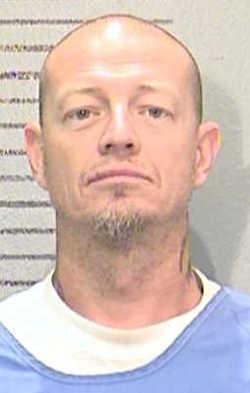
LOWER LAKE, Calif. – An inmate who walked away from Konocti Conservation Camp on Friday has been taken into custody.
James Bellino, 37, a minimum-security inmate from the California Correctional Center, had last been seen on Friday evening and later found to be missing during a nighttime count, according to the California Department of Corrections and Rehabilitation, or CDCR.
Bellino's disappearance resulted in a multiagency search in Lake County, state officials reported.
Then, on Sunday evening, members of the Special Service Unit and Fugitive Apprehension Team apprehended Bellino in Los Angeles, CDCR said in a Sunday night report.
The agency said further details surrounding the arrest were not available late Sunday.
Bellino – who had been assigned to an inmate firefighting crew at Konocti Conservation Camp – had been committed to the CDCR on Sept. 13, 2013, from Kern County for a second strike offense of inflicting corporal injury on a spouse or cohabitant, and criminal threat to cause great bodily injury or death, officials said.
He previously had been scheduled for release in July 2016, according to CDCR.
CDCR said Bellino will be transported back to the California Correctional Center in Susanville and will not be eligible to be rehoused in a conservation camp.
LAKE COUNTY, Calif. – Three gray tabbies are waiting for adoption at Lake County Animal Care and Control this week.
The cats are all females with short coats. One is an adult, two are older kittens.
In addition to spaying or neutering, cats that are adopted from Lake County Animal Care and Control are microchipped before being released to their new owner. License fees do not apply to residents of the cities of Lakeport or Clearlake.
If you're looking for a new companion, visit the shelter. There are many great pets there, hoping you'll choose them.
In addition to the animals featured here, all adoptable animals in Lake County can be seen here: http://bit.ly/Z6xHMb .
The following cats at the Lake County Animal Care and Control shelter have been cleared for adoption (other cats pictured on the animal control Web site that are not listed here are still “on hold”).

Female domestic short hair mix
This young female domestic short hair mix has a gray tabby coat.
She's in cat room kennel No. 21a, ID No. 1904.

Female domestic short hair mix
This young female domestic short hair mix has a gray tabby coat.
She's in cat room kennel No. 21b, ID No. 1905.
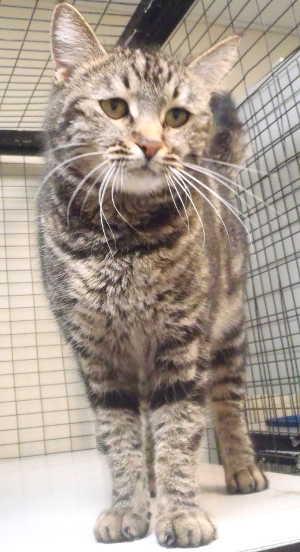
Female domestic short hair mix
This adult female domestic short hair mix has a gray tabby coat.
She's in cat room kennel No. 66, ID No. 1852.
Adoptable cats also can be seen at http://www.co.lake.ca.us/Government/Directory/Animal_Care_And_Control/Adopt/Cats_and_Kittens.htm or at www.petfinder.com .
Please note: Cats listed at the shelter's Web page that are said to be “on hold” are not yet cleared for adoption.
To fill out an adoption application online visit http://www.co.lake.ca.us/Government/Directory/Animal_Care_And_Control/Adopt/Dog___Cat_Adoption_Application.htm .
Lake County Animal Care and Control is located at 4949 Helbush in Lakeport, next to the Hill Road Correctional Facility.
Office hours are Monday through Friday, 11 a.m. to 5 p.m., and 11 a.m. to 3 p.m., Saturday. The shelter is open from 11 a.m. to 4 p.m. Monday through Friday and on Saturday from 11 a.m. to 3 p.m.
Visit the shelter online at http://www.co.lake.ca.us/Government/Directory/Animal_Care_And_Control.htm .
For more information call Lake County Animal Care and Control at 707-263-0278.
Email Elizabeth Larson at
LAKEPORT, Calif. – Community leaders and economic development practitioners from Lake and Mendocino counties gathered on Feb. 27 at the Mendocino College Lake Center for a strategic planning session.
Leaders from the county of Lake, the two cities of Clearlake and Lakeport, educators, workforce developers, lenders and representatives from local agencies and organizations were among the more than 30 people who participated in the half-day discussion.
Margaret Silveira, city manager of Lakeport, presented opening remarks and welcomed the attendees, followed by Rebecca Southwick, manager of the new Lake County Tourism Ambassador program, and Steve Hixenbaugh, interim dean of the Lake Center.
Kelly Cox, retired county administrative officer, provided background information about the Lake County Regional Economic Development Committee, highlighting activities and accomplishments since its inception over two years ago.
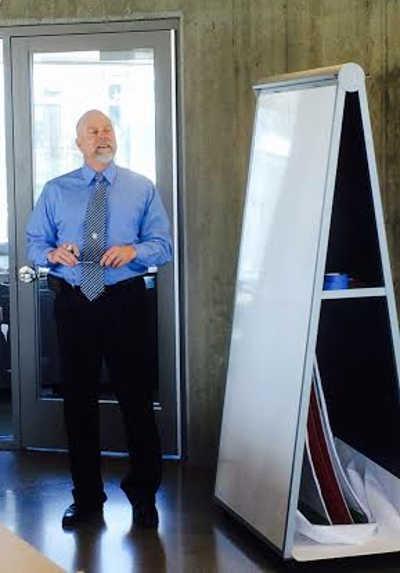
Larry Cope, director of the Tuolumne County Economic Development Authority, was the facilitator and principal speaker during the retreat.
Cope has an extensive professional involvement in rural economic development and presented various organizational structures for the group to consider. These options included the need to address governance and financing.
Based on his experience, Cope emphasized that consolidation and regionalization of economic development in a rural area like Lake County results in cost savings and increased effectiveness.
He applauded the efforts of the Regional Economic Development Committee in fostering a cooperative working relationship on economic development matters between the governments of the two cities and the county.
These efforts have included Workforce Lake, the Lake County Office of Education, the community colleges and Marymount California University, along with the chambers of commerce, the two hospitals, tribal representatives and other business organizations.
An exercise devoted to Lake County’s strengths/weaknesses/opportunities/threats (SWOT) with regard to economic development demonstrated a strong majority in the areas identified by the group as strengths and opportunities.
Michelle Scully, executive director of Marymount’s Lakeside campus in Lucerne, expressed her endorsement of the SWOT analysis.
“Lake County has so many incredible and unique assets that can foster economic growth while preserving the rural environment we love and strive to protect. Working cooperatively and in partnership with one another creates some truly amazing opportunities,” Scully said.
The committee meets monthly and will continue its review of organizational structure options while developing an action plan for facilitating economic growth, increased employment and investment opportunities in Lake County.
More information about the work of the all-volunteer Regional Economic Development Committee may be obtained by emailing Wilda Shock,