 How to resolve AdBlock issue?
News

LAKE COUNTY, Calif. – While not strictly related to astronomy, the ides of March is a phrase often heard and worth defining.
The ides of March occurs on March 15 – the same date as this month’s star chart.
It originated in the Roman Empire. The Roman calendar did not count days sequentially from the first through the last day of the month.
Instead, the Romans counted backward from three fixed points in the month: The nones (fifth or seventh), the ides (13th or 15th) and the kalends (first of following month).
The ides was marked by religious observances.
It was the date – March 15, 44 BC – that Julius Caesar was assassinated, hence the phrase, “Beware the ides of March” coined by Shakespeare.

March skies are dominated by the planet Jupiter. It appears as the brightest object in the sky. Look to the south to find it.
Jupiter is the largest planet in our solar system. It’s 11 times the size of Earth.
This behemoth has 67 moons and counting, thanks to its powerful gravitational field.
Directly overhead is the constellation Gemini, the twins. Gemini is the Latin word for “twin.”
Two bright stars, Castor and Pollux, mark the head of each twin by the same name.
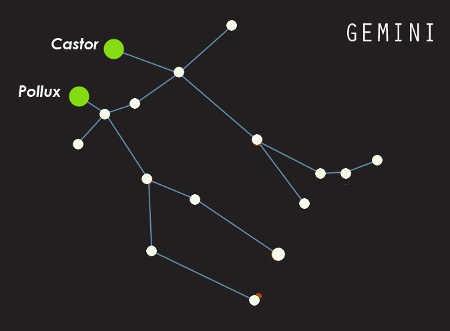
In Greek mythology the twins were the sons of Zeus.
Finally, on Thursday, March 5, there will be a full moon.
As you gaze at the moon, consider:
– The dark areas are called maria, Latin for “sea.” Before the invention of the telescope, astronomers believed there were oceans on the moon.
– A full moon appears largest when close to the horizon. This is due to how our eyes and brain interprets what it sees.
John Zimmerman is a resident of Lake County and has been an amateur astronomer for more than 50 years. For more information about astronomy and local resources, visit his Web site at www.lakecountyskies.com .

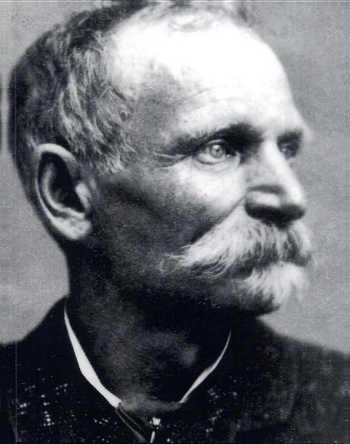
LAKE COUNTY, Calif. – This is the chronicle of the infamous stagecoach bandit, Black Bart, who beset Wells Fargo and Co. with 28 documented robberies from 1875 to 1883.
The robberies took place in the mountains of California, two of which involved Lake County routes.
Black Bart also was known as Charles E. Boles, or Bolton.
Born in New York state, he served in the American Civil War.
After residing in San Francisco for several years he took up stagecoach robbing.
He lived a dual existence – one of a gentleman who sported fine duds, a diamond stick-pin and gold watch – and that of a shotgun-toting robber.
He always operated with an unloaded shotgun and never robbed stagecoach passengers or drivers.
During one of his robberies he yelled out, “If he dares shoot, give him a volley.”
His shotgun was trained on the stagecoach driver who surveyed the scene and found what looked to be a gang, with several gun barrels poking out of the bushes.
The driver begged for his life and complied with Black Bart’s request for the strongbox.
Later they found that there was no gang, and there were no guns – merely strategically placed sticks made to look like a menacing group of outlaws. In the strongbox was a poem.
Following is a poem found during one of his robberies:
“Here I lay me down to sleep
To wait the coming morrow
Perhaps success perhaps defeat
And everlasting sorrow
Let come what will, I’ll try it on
My condition can’t be worse,
But if there’s money in the box,
It’s munny in my purse.
Black Bart, the P o 8”
One of Black Bart’s robberies occurred on Nov. 23, 1882. This was the Lakeport-Cloverdale run.
As per his routine, he ordered the driver, Dick Crawford, and his passengers off the stage. Next, he had them unhook the horses and lead them up the road.
He waited until they were out of sight, then he pried open the metal express box and perused the contents.
It isn’t clear how much he got, as the rich and rewarding days of the Gold Rush were over. By this time, coin and currency were scarce as postal money orders became the norm.
Another robbery occurred on the Lakeport-Cloverdale run on April 12, 1883, when he garnered only $32.50 for his efforts.
He was captured in 1883 by Sheriff Tom Cunningham of San Joaquin County, who had been investigating his robberies.
Black Bart’s nemesis, Wells Fargo detective James B. Hume, relentlessly pursued Black Bart, which led to the arrest.
When Black Bart held up the stage from Sonora to Milton on Nov. 3, 1883, Sheriff Cunningham found a handkerchief.
They traced it to a laundry in San Francisco, as it was marked “FX07,” Bart’s laundry.
He served a little over four years in San Quentin Prison, then was not to be heard from again.
Kathleen Scavone, M.A., is an educator, potter, writer and author of “Anderson Marsh State Historic Park: A Walking History, Prehistory, Flora, and Fauna Tour of a California State Park” and “Native Americans of Lake County.” She also writes for NASA and JPL as one of their “Solar System Ambassadors.” She was selected “Lake County Teacher of the Year, 1998-99” by the Lake County Office of Education, and chosen as one of 10 state finalists the same year by the California Department of Education.
LAKE COUNTY, Calif. – It's a full house at Lake County Animal Care and Control this week, with dogs of all kinds needing homes.
Dogs available this week are mixes of cattle dog, Chihuahua, dachshund, Doberman, English Bulldog, German Shepherd, Labrador Retriever, pit bull, Rhodesian Ridgeback, Shar Pei, shepherd and terrier.
Some of the dogs are available for low adoption fees.
Dogs that are adopted from Lake County Animal Care and Control are either neutered or spayed, microchipped and, if old enough, given a rabies shot and county license before being released to their new owner. License fees do not apply to residents of the cities of Lakeport or Clearlake.
If you're looking for a new companion, visit the shelter. There are many great pets hoping you'll choose them.
In addition to the animals featured here, all adoptable animals in Lake County can be seen here: http://bit.ly/Z6xHMb .
The following dogs at the Lake County Animal Care and Control shelter have been cleared for adoption (additional dogs on the animal control Web site not listed are still “on hold”).

Dachshund-Chihuahua mix
This male dachshund-Chihuahua mix has a short tan coat and brown eyes.
He's in kennel No. 3, ID No. 1844.
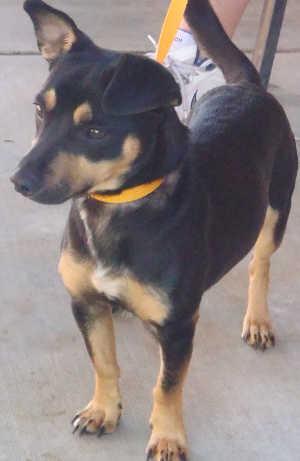
'Buck'
“Buck” is a male terrier and dachshund mix.
He has a short black and tan coat, with some white markings.
He's in kennel No. 4, ID No. 835.
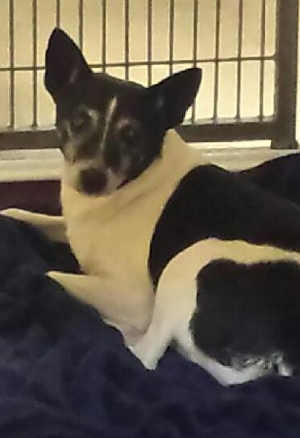
'Rascal'
“Rascal” is a male terrier mix with a short multicolored coat.
He's in kennel No. 5, ID No. 1832.
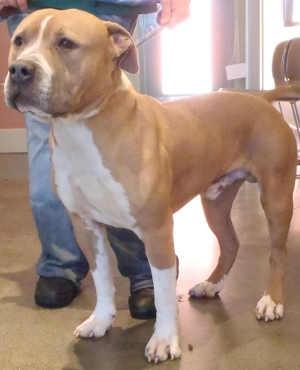
'Butters'
“Butters” is a handsome male pit bull terrier mix has a short tan and white coat.
He is about 2 years old and weighs 70 pounds. He was found in the Kelseyville area as a stray.
Shelter staff said he loves people and can't wait to be in a new home.
He's in kennel No. 6, ID No. 1664.
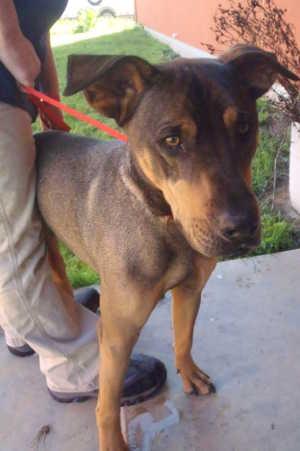
'Dunkin'
“Dunkin” is a 2-year-old Shar Pei and shepherd mix with a short, uniquely colored coat.
He weighs about 70 pounds and is looking for a home with lots of room to run and play and time for training and encouragement.
Dunkin is house broken and ready to be with an active family or individual. He's available for a low adoption fee.
Find him in kennel No. 7, ID No. 1823.
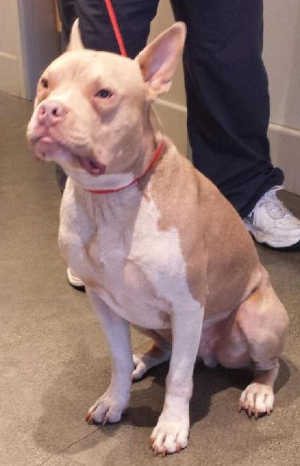
'Copper'
“Copper” is a young male pit bull terrier mix.
He has a short red and white coat, and already has been neutered, so he has a low adoption fee.
Copper is in kennel No. 8, ID No. 1738.
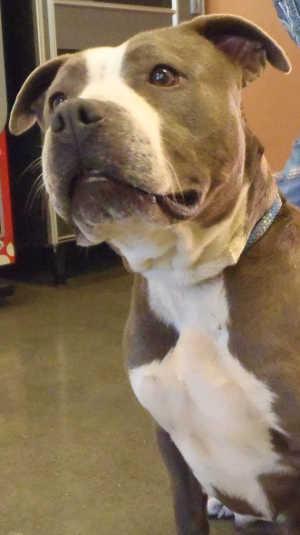
'BeBe'
“BeBe” is a female pit bull terrier mix has a pretty face and a short gray and white coat.
She's 2 years old and weighs 53 pounds.
Found as a stay with “Butters,” she is friendly loves to play with other dogs, male or female. Shelter staff doesn't recommend her for a home with cats, but she has no food guarding issues.
She's in kennel No. 9, ID No. 1663.
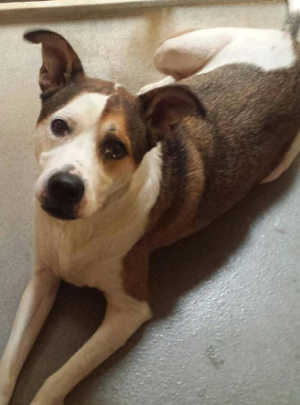
'Casper'
“Casper” is a male cattle dog mix with a short, tricolor coat.
He's in kennel No. 10, ID No. 1843.
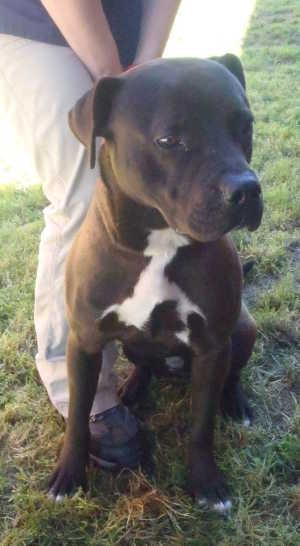
'Ceasar'
“Ceasar” is a male boxer-pit bull mix found on Highway 29 in the Kelseyville area.
Shelter staff said he is about 1 year old and weighs 70 pounds. He has a sweet personality, enjoys playing and being with people.
Ceasar could be a great running companion for an active individual or family member.
He's in kennel No. 11, ID No. 1824.
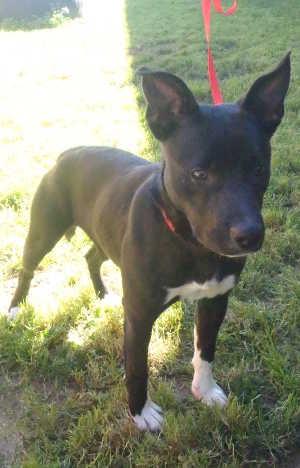
'Shiloh'
“Shiloh” is a 7-month-old shepherd-pit bull mix.
He weighs 37 pounds, and is small enough to curl up on the couch with you.
He's looking for someone willing to give him the time and love he deserves. Shelter staff said Shiloh needs a family or individual with extra time to play with him and train this young pup.
Shiloh is in kennel No. 12, ID No. 1808.

Chihuahua mix
This female Chihuahua mix has a short white coat with brown markings.
She is in kennel No. 13, ID No. 1851.
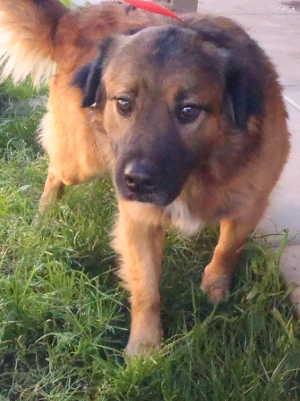
'Max'
“Max” is a male Labrador Retriever-German Shepherd mix.
He is 3 years old, weighs nearly 60 pounds and has a medium sable and black coat.
Shelter staff said he is well trained: Max knows his commands and is leash trained.
He is looking for a family to be a part of or an individual who will love him.
He's in kennel No. 15, ID No. 1770.
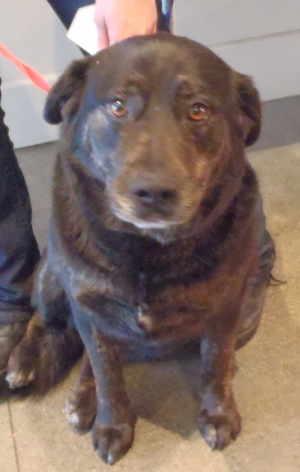
'Roxie'
“Roxie” is a female Labrador Retriever mix who came into the shelter along with Max.
She is 4 years old, weighs 69 pounds and already is spayed, so she is available for a low adoption fee.
Roxie also is leash trained and knows basic commands, and has beautiful big brown eyes.
Roxie is in kennel No. 16, ID No. 1771.
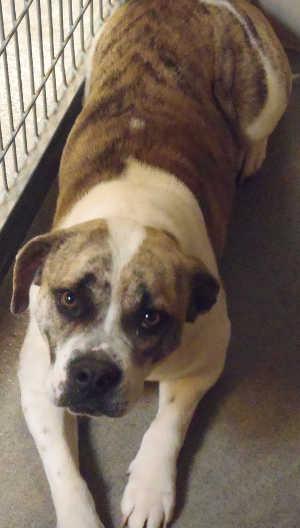
'Rosie'
“Rosie” is a 2-year-old female English Bulldog mix with white and brown brindle markings on a short coat.
She weighs 45 pounds and has no aggression issues toward other dogs.
Rosie loves people and is looking for the right home to come a long.
She's in kennel No. 31, ID No. 1734.
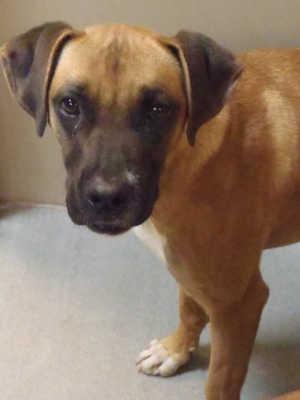
Rhodesian Ridgeback mix
This female Rhodesian Ridgeback mix, along with her brother, came in as a stray from the Hendricks Road area in Lakeport.
She is 4 years old, weighs 54.5 pounds, and has a short brown coat and black markings.
Shelter staff said she is mellow, very sweet and a little shy, but warms up once she's had a chance to get to know a person.
She is heartworm positive so she will need treatment. Call for a quote for medications.
She's in kennel No. 32a, ID No. 1757.
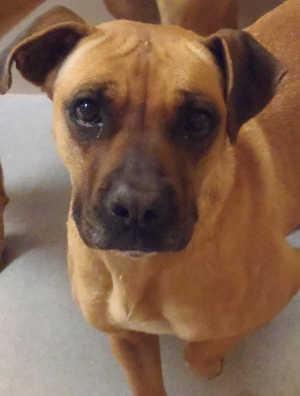
Rhodesian Ridgeback mix
This male Rhodesian Ridgeback mix came in with his sister, and is also 4 years old.
Shelter staff says he gets along well with cats; his tail wagged as he watched them play.
Anyone who is interested in adopting him and who has dogs already is asked to submit an application and introduce bring their dogs in for an introduction.
He is slightly shy but with some training he could be a wonderful addition to your family or for an individual.
He's in kennel No. 32b, ID No. 1762.
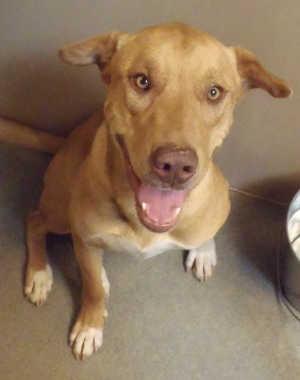
'Mel'
“Mel” is a 1-year-old male Doberman Pinscher-Shar Pei mix, with a short brown and white coat, and stunning green eyes, who is looking for an active family or individual to give him a new home.
If you want a dog that loves to be by your side 24/7, Mel would be perfect for you.
Shelter staff doesn't recommend him for a home with cats. Those with dogs wanting to adopt Mel should submit an application and bring their dogs in for an introduction.
He's in kennel No. 33a, ID No. 1718.
To fill out an adoption application online visit http://www.co.lake.ca.us/Government/Directory/Animal_Care_And_Control/Adopt/Dog___Cat_Adoption_Application.htm .
Lake County Animal Care and Control is located at 4949 Helbush in Lakeport, next to the Hill Road Correctional Facility.
Office hours are Monday through Friday, 11 a.m. to 5 p.m., and 11 a.m. to 3 p.m., Saturday. The shelter is open from 11 a.m. to 4 p.m. Monday through Friday and on Saturday from 11 a.m. to 3 p.m.
Visit the shelter online at http://www.co.lake.ca.us/Government/Directory/Animal_Care_And_Control.htm .
For more information call Lake County Animal Care and Control at 707-263-0278.
Email Elizabeth Larson at

Cruising through the asteroid belt, NASA Dawn spacecraft is approaching dwarf planet Ceres, and some puzzling features are coming into focus.
“We expected to be surprised by Ceres,” said Chris Russell, principal investigator of the Dawn mission, based at UCLA. “We did not expect to be this puzzled.”
The camera on Dawn can now see Ceres more clearly than any previous image taken of the dwarf planet, revealing craters and mysterious bright spots.
“We already knew from the Hubble Space Telescope that there were bright regions on Ceres,” said Russell. “However, those images of the bright spots, taken more than 180 million miles away, appear to be large.”
At close-range, Dawn's camera is revealing something different.
“As Dawn has come closer to Ceres, the bright spots have become brighter and smaller. Indeed, they are much brighter than the surrounding landscape and still unresolved in our images. The point of origin must be very small,” Russell said.
“Another way to express this is with fractals. Most of the planetary surfaces we see are cratered in a random pattern. When you get closer, just as with fractals, the surface looks the same regardless of scale,” he continued.
“However, the bright spot is telling us that there is a phenomenon that acts on a very small scale and NOT at the larger scale of the cratering,” Russell said. “And since I don't have a clue what this is I am puzzled.”
The view is about to improve even more.
Dawn will be gently captured into orbit around Ceres on March 6, beginning a mission to map, explore and understand the dwarf planet.
By the time Dawn is in its lowest altitude orbit at the end of this year, its pictures will be well over 800 times better than Hubble's.
“Even though Ceres is in the asteroid belt, it is entirely unlike asteroids,” said Dawn's mission director, chief engineer and lead blogger Marc Rayman.
With an equatorial diameter of about 605 miles, Ceres has a surface area 38 percent of that of the continental United States, or four times the area of Texas, writes Rayman in his blog.
Its size, nearly spherical shape and other factors have led astronomers to classify it as a dwarf planet.
Moreover, it is the largest body between the sun and Pluto (another dwarf planet) that has never been visited by a spacecraft.
“Earth is about to be introduced to a fascinating new world,” said Rayman.
Bright spots could be just the beginning of the surprises in store.
Dr. Tony Phillips works for the National Aeronautics and Space Administration.
LOWER LAKE, Calif. – A heritage oak tree on the grounds of the Lower Lake Schoolhouse Museum was removed on Friday due to its diseased condition, and the operation brought to light an artifact of the museum's history.
The blue oak which stood at the corner of the museum property on Main and Mill street, has been in a declining condition for several years, according to county officials.
As a result, the county hired Northcoast Tree Care to take it down. A crane was needed to lift it over the museum's wrought iron fence.
Northcoast's staff estimated the tree was 70 feet high and 4 feet in diameter.
Lake County Museum Assistant Curator Tony Pierucci said much of the tree was rotted out, which was making it a challenge to try to do a tree ring analysis and estimate its age.
Pierucci said he would approximate the age of the tree to at least 50 years prior to the construction of the schoolhouse in 1877.
0
One way on estimating the age came in the form of an artifact that was discovered when the tree was taken down on Friday.
The artifact in question was a large bar that had been pounded through the tree decades ago.
Pierucci said they knew of the existence of the bar and wanted to try to salvage it, but were surprised at how much the tree had grown around it.
He said as much as half of the tree's growth has occurred since the bar was hammered into it. They also discovered that it had a large ring at one end.
“We were just really surprised at that,” he said.
The bar was used as a hitch for the children who attended the school or for the visitors who came to attend events in the upstairs auditorium, Pierucci explained.
“It was basically the parking lot of the building,” he added.
Pierucci said he's not yet sure of what's to be done with the bulk of the tree's remains; he said that's a decision that's up to county officials and the tree removal service.
However, a portion of the tree containing the bar is to be preserved, he said.
Pierucci said they need to debug the wood first as part of the work to maintain it. Then, it will be placed on display in the museum.
So while the tree no longer stands at the corner of the museum grounds, it will still keep a place of honor at the museum.
“It's a beautiful thing,” said Pierucci.
John Jensen contributed to this report.
Email Elizabeth Larson at
COBB, Calif. – What started out as a control burn in the Cobb area jumped its lines on Friday afternoon, burning nearly an acre before firefighters put it out.
The fire, in the area of Loch Lomond and Shenandoah roads, was first reported shortly after 2 p.m., according to scanner reports.
Fire dispatch stated that a passerby called the fire in to the Boggs Mountain Cal Fire station, reporting that the fire was climbing up a tree.
Firefighters initially had trouble accessing it, but once on scene found that it was burning with a slow rate of spread in heavy fuel, radio reports indicated.
Cal Fire Battalion Chief Greg Bertelli reported over the air that the fire was contained at approximately 3:47 p.m.
Bertelli told Lake County News that the fire burned eight-tenths of an acre.
He said two Cal Fire engines and a unit from South Lake County Fire responded, along with two hand crews.
After the fire – which burned in heavy vegetation – was contained, it required extensive mop up, he said.
There had been a small amount of rain on Boggs Mountain on Friday morning, but Bertelli said it had been spotty. There also was wind, which continued to dry out vegetation and makes firefighting conditions more challenging.
Even with rain this month, “Those heavier fuels are still pretty dry,” Bertelli said.
Bertelli urged community members to continue to use extreme caution in the winter time when conducting control burns.
“The old rules that we used to go by – that we could burn whatever we wanted in the winter time – it just doesn't apply any more,” he said.
Email Elizabeth Larson at