The cover of the first issue of the National Geographic Magazine. Photograph courtesy of the National Geographic Society. Author’s note: I've truly enjoyed sharing with you readers all the interesting and varied stories from our past. However, my career as a public historian is taking me in another direction one that will not afford me as much leisure time to write. This is my final "This Week in History." I hope you enjoy it.
I have no doubt that some magazines survive solely on the subscriptions made from doctors and dentists. I think you would be hard pressed to find a copy of Time magazine or Good Housekeeping outside the confines of a waiting room.
But then again, maybe I just don’t pay attention to magazines. I’ve never been an aficionado of that particular media – and who can blame me? I once bought a subscription to The Economist. Within two months of receiving the weekly magazine, I was drowning in issues – they were scattered on my kitchen counter, stuffed between the cushions of my couch and piling high on my bedroom nightstand. It’s as if the damn things duplicated themselves.
Within six months I was finding issues I swear I had never seen before, let alone read. It’s been a year since my subscription lapsed and I am still finding issues in the oddest places (why did I bring the magazine to my cubicle at work?).
If for no other reason than the wanton waste of all that paper, I’ve sworn off the things. I’ll find my news in more environmentally friendly formats, thank you very much.
Those thick tomes are crammed with photographs and articles that transport readers to the most exotic places in the world, and introduces them to people of all walks of life. You can easily spot these magazines among the piles in the waiting room; just look for the iconic gold border on the front cover.
I’ve never picked up an issue of the magazine that I didn’t find engrossing. Even though we’re inundated with images every second of the day, the photographs published in the magazine are somehow more arresting, more real than the ones found online or TV.
The stories, too, are somehow fresh and always just detailed enough to satiate the appetite without gorging the reader with information. National Geographic has hit the right mix of educated, detailed reporting with easily digestible stories and engaging eye candy.
But it wasn’t always so. In fact, when the first National Geographic issue was published in 1888, it was met with a lukewarm response at best.
The National Geographic Society itself had only been established nine months before on Jan. 27 in Washington D.C. On that day, 33 men from throughout the country convened to create an institution for “the increase and diffusion of geographical knowledge.”
Americans were discovering a sudden interest in the natural beauty of the great outdoors. The opening of the west and the discovery of such awe-inspiring natural resources as the Grand Canyon had sparked this newfound interest.
The growth of American capitalism and the arrival of the country on the international stage expanded the scope of that interest. More and more Americans were interested in the world around them, not just in their own backyard.
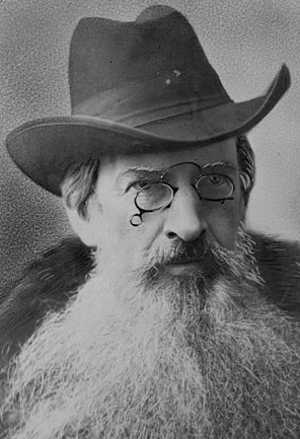
The National Geographic Society’s first president philanthropist and lawyer, Gardiner Greene Hubbard on a trip to Russia, circa 1875. Photo by Otto Renard. Forms part of the Gilbert H. Grosvenor Collection of Photographs of the Alexander Graham Bell Family, Library of Congress Prints and Photographs Division Washington, D.C. 20540 USA http://hdl.loc.gov/loc.pnp/pp.print .
The 33 men who met that day in 1888 came from a variety of backgrounds. There were financiers from Wall Street; professors fresh from university lecture halls; explorers still dusty from their latest trek and, of course, geographers. Recognizing the difficulty of establishing a national organization with such a universal scope, the National Geographic Society elected as its first president philanthropist and lawyer Gardiner Greene Hubbard.
Hubbard was an interesting character. Although a career lawyer (he became a justice of the Massachusetts State Supreme Court), his more interesting pursuits involved working to establish the Bell Telephone Co. with his soon-to-be son-in-law Alexander Graham Bell. He also helped finance Edison’s phonograph company and, later, Bell’s competing company, Volta Phonograph Co., which would later evolved into Columbia Records.
It was likely his long history of successful financing ventures that led the NGS to elect him president. Although Greene was successful in nurturing the infant organization in its earliest years, the organization’s publication, National Geographic magazine, was never able to flourish under his reign.
All of this changed when Gilbert H. Grosvenor became editor. Within a few years of taking over editorship of the magazine in 1899, Grosvenor increased circulation from 1,000 to more than two million.
By axing the overly technical articles and redoing the format entirely, he turned the magazine into the popular magazine it is today – at least he started it on that path.
With the revenue made from magazine subscriptions, the NGS was able to fund explorations around the world, including early trail-blazing explorations of the north and south poles. More than a hundred years later, the National Geographic Society continues to fund research projects.
It also keeps publishing its famous magazine – one that is worth subscribing to, inevitable clutter be damned.
Antone Pierucci is curator of history at the Riverside County Park and Open Space District and a freelance writer whose work has been featured in such magazines as Archaeology and Wild West as well as regional California newspapers.
LAKEPORT, Calif. – At the end of each quarter during 2018, the First 5 Lake Commission honored local Children’s Champions who went above and beyond to make sure that the community’s youngest citizens were protected, nurtured and prioritized.
What happens in the first five years lays the foundation for the rest of a child’s life. It is a time period when experiences can irreversibly affect how the brain develops – for better or for worse.
Nurturing care and attention from a loving parent or caregiver are critical, and this year’s Children’s Champions are all people who, in a variety of ways, stepped up to make sure that parents and caregivers had everything they needed to nurture their young children well.
The First 5 Lake Children’s Champion for the fourth quarter of 2018 is Dr. Barbara Gardner. Dr. Gardner is a local pediatrician who embraces the importance of early literacy and because of this, she reached out to the (former) Adventist Health Ukiah Valley president, Gwen Matthews, asking for support in launching the Reach Out and Read program.
Matthews agreed, and AH-Ukiah Valley now invests $20,000 per year to sponsor the participation of each of their five pediatricians in the program.
With 91 percent of children under age 6 attending routine pediatric visits at least once a year, pediatricians, family medicine doctors and nurse practitioners have consistent, repeat access to families with children in the early years, when it counts.
With this in mind, through Reach Out and Read, Dr. Gardner introduces a beautiful new book at the beginning of each well-child visit in her Lakeport office – engaging and calming the child and parent, providing positive literacy messages, and building stronger connections with the family.
She encourages parents to read aloud daily to their infants, toddlers and preschoolers, as a simple and effective way of fostering nurturing, language-rich family interactions that support brain development and provide a foundation for success.
At the end of the program, every child has a home-library of books, each given with Dr. Gardner’s advice to parents that they are their child's first and most important teacher.
Dr. Gardner has also been a consistent advocate in registering children for Imagination Library and Bloom, both free programs provided by Lake County Office of Education and partially funded by a grant from First 5 Lake.
The First 5 Lake Commissioners are honored to have brought the 2018 Children’s Champions and their efforts to the attention of our Lake County friends and neighbors.
The full list of 2018 Children’s Champions is:
– Christopher Veach and Barbara Green, Lake County Libraries; – Jeff Smith, former District 2 Supervisor; – Kari Donley, Adventist Health Clear Lake; – The QRIS Team at Lake County Office of Education (Angel Coppa, April Straight and Angela Cuellar-Marroquin); – Ana Santana, Wendy Gattoni, and Tanya Biassoti, LCOE’s Healthy Start Program; – Mary Prather, Easter Seals Bay Area; – Brandy Perry, North Coast Opportunities Inc.; – David and Denice Solgat, foster and adoptive parents; – Sarah Fuchs and Pam Inman, Lower Lake High School; – Jacqui Joyce, child care provider; – Natalie Baker, community volunteer; – Jordan O’Halloran, Lake Family Resource Center; – Dr. Barbara Gardner, Adventist Health Ukiah Valley, Lakeport Office.
Members of the community are encouraged to nominate worthy 2019 Champions for Children in Lake County by filling out a nomination form at www.firstfivelake.org/childrens-champions.php . New champions will continue to be selected and honored each quarter.
Using funds derived from CA Proposition 10’s voter-mandated tax on tobacco products, the First 5 Lake County Commission funds programs and services that benefit the health and development of young children and educate parents, grandparents, caregivers and teachers about the critical role they play during a child’s first five years.
Since its inception in 2000, First 5 Lake has supported thousands of families with programs and services designed to help Lake County children grow up healthy and ready to succeed in school and life.
Current First 5 Lake Commissioners are Pam Klier, Denise Pomeroy, Brock Falkenberg, Tina Scott, Crystal Markytan, Susan Jen, Carly Swatosh and Allison Panella.
LAKE COUNTY, Calif. – Lake County Animal Care and Control has many big and little dogs waiting for their new homes this week.
Dogs available for adoption this week include mixes of beagle, Chihuahua, German Shepherd, Labrador Retriever, pit bull, shepherd and terrier.
Dogs that are adopted from Lake County Animal Care and Control are either neutered or spayed, microchipped and, if old enough, given a rabies shot and county license before being released to their new owner. License fees do not apply to residents of the cities of Lakeport or Clearlake.
If you're looking for a new companion, visit the shelter. There are many great pets hoping you'll choose them.
The following dogs at the Lake County Animal Care and Control shelter have been cleared for adoption (additional dogs on the animal control Web site not listed are still “on hold”).
This male Chihuahua-terrier mix is in kennel No. 2, ID No. 11661. Photo courtesy of Lake County Animal Care and Control. Male Chihuahua-terrier
This male Chihuahua-terrier mix has a short brown coat.
He’s in kennel No. 2, ID No. 11661.
This male Chihuahua is in kennel No. 3, ID No. 11665. Photo courtesy of Lake County Animal Care and Control. Male Chihuahua
This male Chihuahua has a short brown and tan coat.
He already has been neutered.
He’s in kennel No. 3, ID No. 11665.
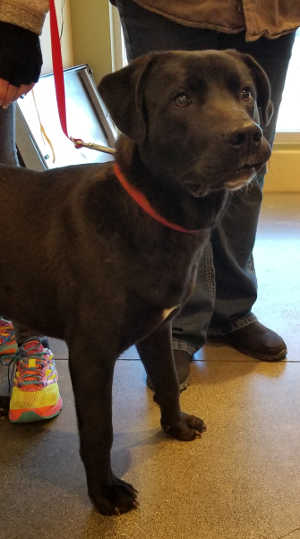
This male Labrador Retriever is in kennel No. 4, ID No. 11688. Photo courtesy of Lake County Animal Care and Control. Male Labrador Retriever
This male Labrador Retriever has a medium-length black coat.
He’s in kennel No. 4, ID No. 11688.
This female shepherd mix is in kennel No. 6, ID No. 11689. Photo courtesy of Lake County Animal Care and Control. Female shepherd mix
This female shepherd mix has a medium-length red and white coat.
She’s in kennel No. 6, ID No. 11689.
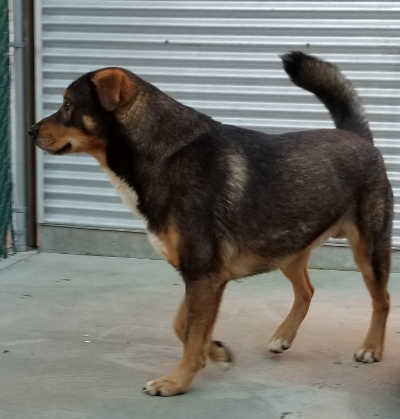
This female shepherd is in kennel No. 7a, ID No. 11602. Photo courtesy of Lake County Animal Care and Control. Female shepherd
This female shepherd has a medium-length black and brown coat.
She’s in kennel No. 7a, ID No. 11602.
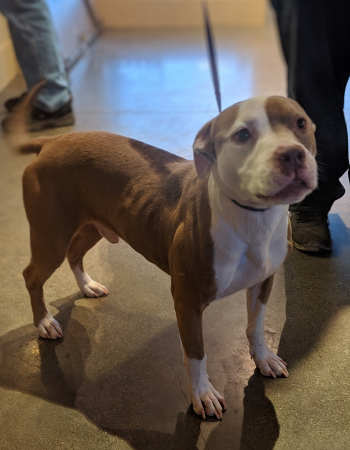
This male pit bull terrier is in kennel No. 8, ID No. 11686. Photo courtesy of Lake County Animal Care and Control. Male pit bull terrier
This male pit bull terrier has a short brown and brindle coat.
He’s in kennel No. 8, ID No. 11686.
This female shepherd is in kennel No. 10, ID No. 11685. Photo courtesy of Lake County Animal Care and Control. Female shepherd
This female shepherd has a medium-length black and tan coat.
She’s in kennel No. 10, ID No. 11685.
“Truely” is a female pit bull in kennel No. 15, ID No. 11645. Photo courtesy of Lake County Animal Care and Control. ‘Truely’
“Truely” is a female pit bull with a short white and tan coat.
She’s in kennel No. 15, ID No. 11645.
This female shepherd is in kennel No. 18, ID No. 11641. Photo courtesy of Lake County Animal Care and Control. Female shepherd
This female shepherd has a short black and tan coat.
Shelter staff said she is good with other dogs.
She’s in kennel No. 18, ID No. 11641.
“Marley” is a male terrier in kennel No. 19, ID No. 11697. Photo courtesy of Lake County Animal Care and Control. ‘Marley’
“Marley” is a male terrier with a short black and brown coat.
He already has been neutered.
He’s in kennel No. 19, ID No. 11697.
“Tank” is a male pit bull terrier in kennel No. 21, ID No. 7002. Photo courtesy of Lake County Animal Care and Control. ‘Tank’
“Tank” is a male pit bull terrier with a short brown brindle coat.
He already has been neutered.
He’s in kennel No. 21, ID No. 7002.
This male terrier mix is in kennel No. 23, ID No. 11694. Photo courtesy of Lake County Animal Care and Control. Male terrier
This male terrier mix has a short tricolor coat.
He’s in kennel No. 23, ID No. 11694.
“Smokey” is a male pit bull terrier in kennel No. 28a, ID No. 11646. Photo courtesy of Lake County Animal Care and Control. ‘Smokey’
“Smokey” is a male pit bull terrier with a short fawn and white coat.
He already has been neutered.
He’s in kennel No. 28, ID No. 11646.
This male German Shepherd is in kennel No. 33, ID No. 11564. Photo courtesy of Lake County Animal Care and Control. Male German Shepherd
This male German Shepherd has a medium-length tricolor coat.
He’s in kennel No. 33, ID No. 11564.
This male German Shepherd is in kennel No. 34, ID No. 11605. Photo courtesy of Lake County Animal Care and Control. Male German Shepherd
This male German Shepherd as a medium-length black and tan coat.
He has been neutered.
He’s in kennel No. 34, ID No. 11605.
Lake County Animal Care and Control is located at 4949 Helbush in Lakeport, next to the Hill Road Correctional Facility.
Office hours are Monday through Friday, 11 a.m. to 5 p.m., and 11 a.m. to 3 p.m., Saturday. The shelter is open from 11 a.m. to 4 p.m. Monday through Friday and on Saturday from 11 a.m. to 3 p.m.
For more information call Lake County Animal Care and Control at 707-263-0278.
Email Elizabeth Larson at This email address is being protected from spambots. You need JavaScript enabled to view it.. Follow her on Twitter, @ERLarson, or Lake County News, @LakeCoNews.
Hummingbirds have bills well adapted to sipping nectar, but in some species, the males have evolved weaponized bills that seem to sacrifice sipping prowess for fighting prowess. (Video by Stephen McNally and Roxanne Makasdjian; footage by Kristiina Hurme, Finca Colibrí Gorriazul, Colombia.)
BERKELEY, Calif. – Most hummingbirds have bills and tongues exquisitely designed to slip inside a flower, lap up nectar and squeeze every last drop of precious sugar water from their tongue to fuel their frenetic lifestyle.
But in the tropics of South America, University of California, Berkeley, scientists are finding that some male hummers have traded efficient feeding for bills that are better at stabbing and plucking other hummingbirds as they fend off rivals for food and mates.
The males’ weaponized bills are good not only for pulling feathers and pinching skin, but also wrestling their rivals away from prime feeding spots.
Using high-speed video cameras, the researchers have for the first time captured hummingbird fencing and feeding strategies in slow motion to document the various ways the birds use their bills to fight and the trade-offs they accept when choosing fighting over feeding prowess.
“We understand hummingbirds’ lives as being all about drinking efficiently from flowers, but then suddenly we see these weird morphologies – stiff bills, hooks and serrations like teeth – that don't make any sense in terms of nectar collection efficiency,” said Alejandro Rico-Guevara, a Miller Postdoctoral Fellow at UC Berkeley and the lead scientist on the project. “Looking at these bizarre bill tips, you would never expect that they’re from a hummingbird or that they would be useful to squeeze the tongue.”
Straighter bills are better for poking, which may explain why in some species females have curved bills to sip inside the curved bells of flowers but the males’ beaks are less curved. This has sometimes forced the males to feed on different flowers than the females, ones more adapted to a straighter beak.
“It is all about feeding efficiency in flowers versus proficiency in fighting,” he said.
Rico-Guevara acknowledged that hummingbirds have long been known as fierce fighters – they even attack hawks, owls and other birds if they perceive a threat – but the fights happen so fast that scientists haven’t been able to see the actual outcome.
“Because it happens so fast and they fly away, you can't track them,” he said. “But also, people haven't actually looked at the details of the beaks. We are making connections between how feisty they are, the beak morphology behind that and what that implies for their competitiveness.”
Rico-Guevara is the lead author of a paper describing how the shape of the bill affects hummingbird feeding and fighting strategies in the January 2019 issue of the journal Integrative Organismal Biology.
Nectar fuels their lives
Rico-Guevara has been photographing and videotaping hummingbirds for more than a decade, often in the lush forests of his native Colombia, to understand how they have adapted to specialized niches.
Some hummers, for example, feed on only one type of flower, a result of the flower and bird having evolved together. In some cases, a bird’s beak won’t fit in any other flower, while that flower’s feeding tube is shaped so that no other birds’ beak can slide in to get the nectar efficiently.
This relationship provides a secure source of food – nectar – for the bird and a guaranteed pollinator for the plant.
In the new paper, Rico-Guevara describes what he has discovered to date about the exquisite beak design that most hummingbirds, including North American hummers, have evolved for feeding, and the unique features of hummingbirds’ forked tongues.
He has shown, for instance, that their tongues are able to change shape quickly without an internal muscle, allowing them to pump and trap nectar without spending any additional energy: another stunning example of their efficiency, he said.
“Extracting nectar is what fuels their lives,” he said. As a result, they have developed “very flexible bills with very soft edges, soft, blunt bill tips that are concave, like a couple of spoons, that perfectly match the tongue to squeeze out the last drop of nectar. All of these traits make a good seal between the tongue tips that actually enhances the efficiency of nectar extraction.”
Yet in the tropics, including Colombia, Brazil, Peru and Costa Rica, males of many species don’t fit this picture. Instead, they have stiff bills with a hard, conical, dagger-like tip, often hooked, plus rear-facing serrations like the teeth of a comb. High-speed video shows that the stiff, hard-tipped bill is ideal for poking other birds, while the hooked tip and serrations are a perfect way to snatch a feather or two. The males’ wings are also adapted to be more aerodynamic – for in-flight fights – than are female wings.
The weaponized bills of these males are unsuited to efficient nectar sipping, however, Rico-Guevara said, though he does not yet have data on how much less efficient their bills are because of these types of serrations and a hooked tip.
The evolution of these unusual bills in tropical hummingbirds appears to be a result of increased competition. Elsewhere in the Americas, three or four hummingbird species may compete with one another in a given habitat; in the tropics, there could be 15.
“We have discovered that these traits may be related to a different kind of strategy: instead of feeding on a particular flower shape very well, some birds try to exclude everybody from a patch of flowers, even though they can't feed as well on them as hummingbirds without bill weapons,” Rico-Guevara said. “If you are good enough at keeping your competitors away, then it doesn't matter how well you use the resources in the flowers you are defending, you have them all to yourself.”
Not all fighters use their bills to protect their food. Others use their bills primarily to out-fence males competing for females at gathering places called leks.
“A lek is like a singles bar, a place where many males get together and sing, sing, sing all the time,” Rico-Guevara said. “The females go to these small spaces in the forest and pick a male to mate with. If you can get a seat at that bar, it is going to give you the opportunity to reproduce. So they don't fight for access to resources, like in the territorial species, but they actually fight for an opportunity to reproduce. And in the brief moments when there is no fighting, they go to feed on different flowers.”
He and his colleagues are continuing to study the adaptations that accompany hummingbirds’ feeding and mating strategies in Colombia and elsewhere in Latin America, including why females and many other males, who also occasionally fight one another, have not weaponized their bills.
Co-authors of the new paper are Margaret Rubega of the University of Connecticut at Storrs, UC Berkeley integrative biology professor Robert Dudley and visiting scholar Kristiina Hurme. The work was supported by the Miller Institute for Basic Research in Science.
Robert Sanders writes for the UC Berkeley News Center.
A team of scientists has, for the first time, used a single, cohesive computer model to simulate the entire life cycle of a solar flare: from the buildup of energy thousands of kilometers below the solar surface, to the emergence of tangled magnetic field lines, to the explosive release of energy in a brilliant flash.
The accomplishment, detailed in the journal Nature Astronomy, sets the stage for future solar models to realistically simulate the Sun's own weather as it unfolds in real time, including the appearance of roiling sunspots, which sometimes produce flares and coronal mass ejections.
These eruptions can have widespread impacts on Earth, from disrupting power grids and communications networks, to damaging satellites and endangering astronauts.
Scientists at the National Center for Atmospheric Research, or NCAR, and the Lockheed Martin Solar and Astrophysics Laboratory led the research.
The comprehensive new simulation captures the formation of a solar flare in a more realistic way than previous efforts, and it includes the spectrum of light emissions known to be associated with flares.
"This work allows us to provide an explanation for why flares look like the way they do, not just at a single wavelength, but in visible wavelengths, in ultraviolet and extreme ultraviolet wavelengths, and in X-rays," said Mark Cheung, a staff physicist at Lockheed Martin Solar and Astrophysics Laboratory and a visiting scholar at Stanford University. "We are explaining the many colors of solar flares."
The research was funded largely by NASA and by the National Science Foundation (NSF), which is NCAR's sponsor.
Bridging the scales
For the new study, the scientists had to build a solar model that could stretch across multiple regions of the Sun, capturing the complex and unique physical behavior of each one.
The resulting model begins in the upper part of the convection zone — about 10,000 kilometers below the Sun's surface — rises through the solar surface, and pushes out 40,000 kilometers into the solar atmosphere, known as the corona. The differences in gas density, pressure, and other characteristics of the Sun represented across the model are vast.
To successfully simulate a solar flare from emergence to energy release, the scientists needed to add detailed equations to the model that could allow each region to contribute to the solar flare evolution in a realistic way. But they also had to be careful not to make the model so complicated that it would no longer be practical to run with available supercomputing resources.
"We have a model that covers a big range of physical conditions, which makes it very challenging," said NCAR scientist Matthias Rempel. "This kind of realism requires innovative solutions."
To address the challenges, Rempel borrowed a mathematical technique historically used by researchers studying the magnetospheres of Earth and other planets.
The technique, which allowed the scientists to compress the difference in time scales between the layers without losing accuracy, enabled the research team to create a model that was both realistic and computationally efficient.
The next step was to set up a scenario on the simulated Sun. In previous research using less complex models, scientists have needed to initiate the models nearly at the moment when the flare would erupt to be able to get a flare to form at all.
In the new study, the team wanted to see if their model could generate a flare on its own. They started by setting up a scenario with conditions inspired by a particularly active sunspot observed in March 2014.
The actual sunspot spawned dozens of flares during the time it was visible, including one very powerful X-class and three moderately powerful M-class flares.
The scientists did not try to mimic the 2014 sunspot accurately; instead they roughly approximated the same solar ingredients that were present at the time — and that were so effective at producing flares.
Then they let the model go, watching to see if it would generate a flare on its own.
"Our model was able to capture the entire process, from the buildup of energy to emergence at the surface to rising into the corona, energizing the corona, and then getting to the point when the energy is released in a solar flare," Rempel said.
Now that the model has shown it is capable of realistically simulating a flare's entire life cycle, the scientists are going to test it with real-world observations of the Sun and see if it can successfully simulate what actually occurs on the solar surface.
"This was a stand-alone simulation that was inspired by observed data," Rempel said. "The next step is to directly input observed data into the model and let it drive what's happening. It's an important way to validate the model, and the model can also help us better understand what it is we're observing on the Sun."
LAKEPORT, Calif. – A veteran Lake County prosecutor has been selected as the next Lake County Superior Court commissioner.
The Lake County Superior Court chose John Langan, who will begin presiding in the Clearlake Courthouse on Feb. 19, according to Court Executive Officer Krista LeVier.
“It is a once-in-a-lifetime opportunity for me, and I am very grateful for the trust that the Superior Court has placed in me,” Langan told Lake County News on Friday. “It is an honor and a tremendous responsibility.”
Langan is succeeding Commissioner Douglas Thiele, who is retiring.
Langan graduated from University of San Francisco School of Law and has nearly 18 years experience with Lake County District Attorney’s Office.
In his new role, Langan will handle Department of Child Support Services, traffic, small claims, unlawful detainer and collaborative court calendars.
“Mr. Langan has extensive courtroom experience in criminal law which will assist greatly in his traffic assignment. That experience as well as his intellect, even temperament and ability to efficiently handle a busy court calendar will make him an asset to the Lake County Superior Court,” said Lake County Superior Court Presiding Judge Michael Lunas.
Court commissioners are not judges but have similar powers in certain cases. They are appointed by judges and carry out judicial functions as directed by the court. In some cases, they also can act as judges temporarily.
Email Elizabeth Larson at This email address is being protected from spambots. You need JavaScript enabled to view it.. Follow her on Twitter, @ERLarson, or Lake County News, @LakeCoNews.
 How to resolve AdBlock issue?