 How to resolve AdBlock issue?
News
Assemblymember Cecilia Aguiar-Curry (D-Winters) has introduced Assembly Joint Resolution 4 with coauthors Senators Bill Dodd (D-Napa) and Mike McGuire (D-Healdsburg), and Assemblymembers Jim Wood (D-Santa Rosa), Marc Levine (D-Marin), and Tim Grayson (D-Concord).
This bill puts California’s Legislature on record demanding U.S. Congressional passage of, and a Presidential signature on House Resolution 8, the “Bipartisan Background Checks Act.”
Introduced by Congressman Mike Thompson (D-St. Helena), who also serves as the Gun Violence Task Force Chairman, H.R. 8 requires uniform and universal background checks on all gun purchases and transfers.
The law would obligate unlicensed gun sellers to perform background checks on gun purchasers and transferees by requiring them to utilize licensed dealers to sell and transfer firearms.
This would include a carefully formulated definition that details the exception of guns purchased in the context of gifts to family members, hunting, target shooting, and self-defense.
“I will do everything I can to help support Congressman Thompson’s efforts. As a state legislator, a joint resolution is the formal way for California’s Legislature to demand federal action, and that is why I introduced AJR 4,” said Aguiar-Curry. “Horrific violence by sick people has become a daily event in our society, and I simply cannot understand why Congress has not acted to pass such a measure which closes the avenue by which criminals and the mentally ill can bypass checks on their ability to obtain weapons, especially ones meant for no other purpose than to kill people. I applaud the Congressman’s leadership.”
Current federal law includes a loophole that allows unlicensed firearm dealers to sell at gun shows, online, and in person without performing background checks on purchasers. This is a significant omission, as gun offenders overwhelmingly obtain their guns without a background check through private sales.
With the enactment of H.R. 8, newly established safeguards would require “all firearms purchases to use the National Instant Criminal Background Check System.”
Additionally, H.R. 8 would protect against the possibility of buyers bypassing the requirement of background checks by employing the excuse that they are “borrowing the gun for an open-ended amount of time.”
Congressman Thompson said of the introduction of AJR 4, “Background checks help save lives right away and the vast majority of Americans support expanding them to keep our communities safe. That’s why I introduced H.R. 8, the Bipartisan Background Checks Act of 2019 to take action right away to help prevent gun violence. I am honored to have the support of our local legislators, led by Assemblymember Aguiar-Curry, and look forward to working with them as we continue our fight to help prevent gun violence.”
The bipartisan group of federal coauthors to this federal legislation shows that confronting gun violence and protecting our communities is important to both sides of the political aisle. Legislators from across the United States agree that enacting a comprehensive background check requirement is a critical component of reasonable and effective gun safety laws.
While there is no one law that can put an end to mass shootings or gun violence, when background checks are used they help keep guns out of the hands of people we agree should not have them.
By passing AJR 4, California as a state will join in formal support of H.R. 8 becoming law. The California legislative coauthors to AJR 4 also commented in support of the bill upon introduction.
“Universal background checks are an absolute must in this era of unacceptable gun violence,” Sen. Bill Dodd said. “There is no reason to allow someone who may be intent on doing harm to bypass this critical screening. As a longtime hunter, I wholeheartedly support Congressman Thompson’s much-needed measure.”
“Congressman Thompson has been relentless in his leadership on common sense gun reform. America will be a safer country because of his efforts to establish comprehensive background checks,” Sen. Mike McGuire said. “California stands firmly behind this bipartisan legislation that will save lives from senseless gun violence.”
“Increasing gun violence, especially by those with known mental health issues, needs our immediate action,” said Assemblymember Jim Wood. “And it needs to happen at the federal level. I’m proud to co-author this resolution to support the requirement that unlicensed gun sellers take responsibility for who is buying their guns by facilitating sales through a licensed gun seller,” added Wood.
“California has led the nation in passing common-sense laws to protect our children and loved ones from gun violence, and I think it is far past time for Congress to join us in this fight,” said Assemblymember Tim Grayson. “I want to thank Congressman Thompson for his dedication to the issue and urge my colleagues to join me in supporting his efforts to make our communities safer.”
Assemblymember Marc Levine declared, “This resolution highlights a dangerous loophole in federal law regarding background checks for gun purchases and transfers and the pressing need to close that loophole with the swift passage of H.R. 8. I urge all my colleagues to support this bipartisan effort.”
“This is not about keeping guns away from law-abiding people, hunters, recreational shooters, or people seeking to defend their homes, businesses, and properties,” said Aguiar-Curry. “Any attempt to characterize this as an assault on the 2nd Amendment is aiding and abetting criminals’ unchecked access to firearms being used on our nation’s innocent bystanders and children.”
AJR 4 has been introduced and is pending referral to its first Assembly policy committee for a hearing.
Aguiar-Curry represents the Fourth Assembly District, which includes all of Lake and Napa Counties, parts of Colusa, Solano and Sonoma counties, and all of Yolo County except West Sacramento.
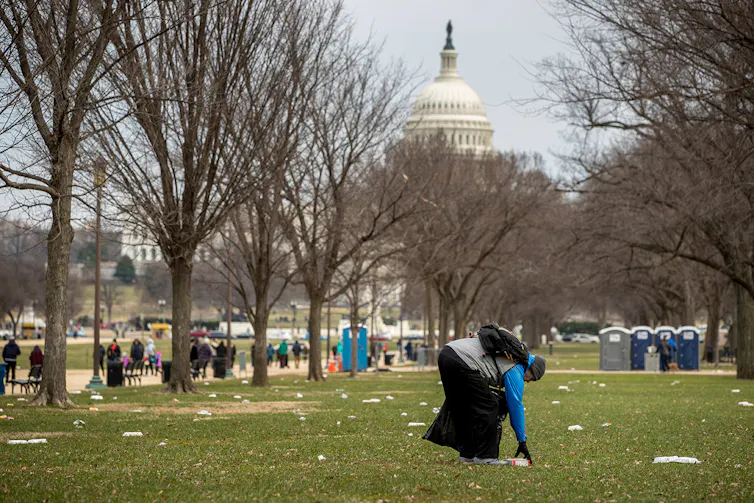 One of the more visible impacts of the shutdown is garbage piling up in parks. AP Photo/Andrew Harnik
Andrew J. Hoffman, University of Michigan and Ellen Hughes-Cromwick, University of Michigan
As the United States endures the longest shutdown in its history, Americans are getting a taste of life without government.
The absence of some services are clearly visible, such as a buildup of trash at national parks or longer lines at airport security checkpoints. Others, like those felt primarily by businesses, are less noticeable but arguably more important, such as an inability to get a small business loan or limited service from the IRS, Securities and Exchange Commission and other key agencies.
Collectively they show that government matters. But once the shutdown ends and the memories of the pain and discomfort it caused begin to fade, the visceral reminder Americans got of this message may fade with it.
As scholars of business and policy, we believe it’s essential that Americans not forget. In fact, the shutdown provides a good opportunity to reflect on the government’s vital role in the free market and find a better balance between regulation and business.
How the shutdown is affecting business
The partial shutdown, in its fifth week, has left about 800,000 government employees either furloughed or working without pay, affecting more than 10 agencies.
This has resulted in the slowing or halting of a great deal of activity, including food safety inspections, initial public offerings on the stock market and the approval of new craft beers.
And these costs are felt by citizens as the risks grow to their food, the environment and other things. Economists warn that long-term impacts could also undermine confidence as businesses, consumers and investors lose faith in political leaders’ ability to make constructive policies.
The White House’s own economists estimate that every week of shutdown reduces growth by 0.13 percentage point, meaning the economy has already taken a hit of half a percent. If it goes for another week, total costs could exceed US$6 billion, which is more than what the president is demanding for his border wall.
And yet Americans won’t even know the actual impact because many of the government workers whose job it is to collect and measure economic activity have been sent home.
 The shutdown has meant the Alcohol and Tobacco Tax and Trade Bureau can’t approve new beer labels. AP Photo/Carrie Antlfinger
Hamilton and public goods
While the shutdown crystallizes what the absence of government feels like, the debate over its proper role in business is as old as the American Republic.
For example, Alexander Hamilton, the nation’s first Treasury secretary, wrote eloquently about the need for the government to get involved in markets, specifically through the establishment of a national bank. He called it a key public institution that “facilitates and extends the operations of commerce among individuals. Industry is increased, commodities are multiplied, agriculture and manufacturers flourish: and herein consists the true wealth and prosperity of a state.”
Beyond a central bank, “public goods” often require the protection of a set of laws. Examples include the environment, national defense, national parks, consumer protection and advanced research that helps seed inventions and create the industries of our future.
Author Michael Lewis, in his book “The Fifth Risk,” details many of the important yet little-noticed functions that government agencies handle better than private industry, such as the protection of food safety or the oversight of spent nuclear resources. Further, he shows how a functioning economy depends on civil servants using the best data and science available to provide vital services to all Americans.
To offer just one example of the federal government’s positive role in fostering innovation, its creation of the Defense Advanced Research Projects Agency in 1957 gave us the internet, GPS, stealth aircraft and countless other technologies used in non-defense sectors today.
On the flip side, the absence of proper regulation can lead to serious economic and personal damage, as we saw during the global financial crisis a decade ago. And only government – through regulatory agencies and smartly designed laws – is in a position to prevent another crisis. Indeed, fears are growing that another one may be on the horizon as a result of Wall Street excesses or financial bubbles in housing or debt.
The point is that in all these cases, the question is not about “no government” but about how much, what kind and which level (state or federal).
Americans’ evolving views
It’s good news in our opinion that Americans seem to be increasingly abandoning the view that government should stay out of business and the market. And more are embracing an expanded role.
In 2011, half of Americans polled by Gallup said there’s “too much” regulation. The latest survey, taken in late 2018, found that just 39 percent felt that way – the lowest in a decade – with a growing share saying that the balance is “just right.”
This comes at a time when the Trump administration is boasting about the number of regulations it has eliminated. Yet these surveys suggest Americans don’t simply want fewer regulations, they want better ones.
Even more encouraging in our view is a Cato survey from 2017 that found that large majorities of Americans “believe regulations, at least in the past, have produced positive benefits” and that “regulations can help make businesses more responsive to people’s needs.”
One area where people see a value in government regulation is the financial sector, which is seen as rapacious and in need of more monitoring.
And 1 in 4 Americans surveyed by Gallup said there’s “too little” regulation, a figure that hasn’t changed much in recent years. This suggests that a notable number of Americans don’t trust the private sector and think that government is necessary to curb market excess and other problems.
Toward a better balance
But instead of a debate over the right balance for government, American politicians and others have denigrated government as “the problem” or, more recently, “the swamp.” The terms are meant to say that government is alternatively inept, obstructive or corrupt.
They do this to take advantage of the still too widespread view that government has no role in markets and that regulation represents an unwarranted intrusion on business. This is a misperception that dismays both of us, motivating the very article you are reading.
While there certainly are problems with special interest influence in government and bureaucratic inefficiency, the enterprise as a whole remains central to the operation of capitalism and the markets. After all, capitalism is a set of institutions designed by government in concert with business and civil society.
As National Affairs editor Yuval Levin points out, even Adam Smith, the Scottish economist who wrote the foundational texts on capitalism, argued that “the rules of the market are not self-legislating or naturally obvious.” Rather, Smith said, the market is a public institution that requires rules imposed on it.
So we believe it is time to return to the basics and launch a new effort at reinventing government to improve how the various branches and levels interact with each other and the market.
At the same time, it’s important to provide more public education on what government does, and why, and solicit feedback from citizens on how to do it better – including at the ballot box.
Andrew J. Hoffman, Holcim (US) Professor at the Ross School of Business and School of Environment and Sustainability, University of Michigan and Ellen Hughes-Cromwick, Senior Economist and Associate Director of Social Science and Policy, University of Michigan Energy Institute, University of Michigan
This article is republished from The Conversation under a Creative Commons license. Read the original article.
Judge J. David Markham rejected the plea agreement in which 28-year-old Krystina Marie Pickersgill had entered a guilty plea in the fall and refused to sentence her, saying it was too lenient and could set a precedent going forward.
Deputy District Attorney Daniel Flesch, who appeared on behalf of the prosecution, said the agreement had been worked out with former District Attorney Don Anderson, who left office last month after two terms, and Pickersgill’s defense attorney, George Boisseau of Santa Rosa.
Boisseau did not return a call from Lake County News seeking comment.
Pickersgill and her husband, Sam Massette, 37, were arrested in June after a two-month-long investigation by the District Attorney’s Office revealed that the couple had been selling local girls into prostitution in the Bay Area, as Lake County News has reported.
In October, Pickersgill pleaded guilty to one count of human trafficking after reaching the agreement with Anderson, who personally prosecuted the case.
The agreement called for Pickersgill to receive three years of probation, credit for the four months previously served and strict mental health treatment. If she failed to complete the probation terms, she faced up to 12 years in prison.
When the agreement was announced in October, Anderson – at that time in the midst of an unsuccessful bid for a Lake County Superior Court judge’s seat – faced heavy criticism from community members who felt the deal was too lenient.
Anderson said he pursued the settlement because Pickersgill was on medication for mental health issues at the time she met Massette, and that he believed Massette had taken her off of her medication then coerced her into prostituting for him. He said initially Pickersgill was a victim of human trafficking herself before she became a willing participant.
Authorities said the couple recruited high school girls and then took them to the Bay Area, where they were coerced and threatened to perform acts of prostitution.
“The situation was as egregious as they come,” said Flesch. However, he said Pickersgill’s culpability was in question.
Massette reached a plea agreement later in the fall with Anderson and in December was sentenced to the upper term of 20 years for two counts of human trafficking for the purposes of prostitution and two counts of pimping women in prostitution, and ordered to register as a sex offender for life.
With credits and time served, Massette is expected to serve about nine years in prison, which caused some of his victims to write the court to ask that plea deal be rejected.
Judge Michael Lunas, however, went forward with Massette’s sentencing. He acknowledged the serious nature of the case and pointed to what appeared to be Massette’s refusal to take responsibility in a letter to the court. However, he didn’t wish to second-guess the District Attorney’s Office or start the proceedings over again.
On Tuesday, Judge Markham took the opposite approach when he refused to accept the plea. He said that, if this case didn’t deserve prison he didn’t know what did. He also pointed out that there were multiple young victims whose lives will never be the same.
“The court was adamant that they were not going to accept the plea,” Flesch said.
Flesch said he was not challenging the court’s ruling. “On its face, I understand completely what the court had to say, however, I’m not clear as to whether the court was aware of the extenuating circumstances beyond what was stated in the probation report.”
The mitigating factors included in the report included Pickersgill’s lack of a prior record and the fact that she may have been suffering from a mental condition which significantly reduced culpability.
Regarding that second factor, Flesch said Boisseau, Pickersgill’s attorney, also argued that point, with Judge Markham countering that Pickersgill had set up dates for the trafficked girls. The defense, in turn, argued that Pickersgill only did that because Massette had power over her.
Boisseau argued that Pickersgill – who wept during the court proceeding – is a different person and now wants to attend school.
Markham also raised concern about future precedent, specifically, anyone who is eligible for probation like Pickersgill automatically getting it rather than having to serve time behind bars, Flesch said.
As a result of the plea agreement being rejected, Pickersgill exercised her right to withdraw her October guilty plea, Flesch said.
Flesch said the case now essentially starts all over, and reverts to the charges contained in a first amended complaint filed in June, which included human trafficking, pimping and pandering, procuring for prostitution, and conspiring for the purposes of human trafficking, pimping and prostitution.
Conviction on all of those charges carries a prison sentence in excess of 40 years, Flesch said.
Judge Markham set Pickersgill’s preliminary hearing for March 27.
Flesch said he is not yet sure if he will be assigned to continue to cover the case.
Email Elizabeth Larson at
As of Jan. 9, the first full month, they have served 44 individuals. Fourteen of their guests are women and 30 are men. The youngest is 23 and so far the eldest is 66.
Eight have self-identified as veterans. All eight veterans have asked for assistance with additional referrals.
Twenty-two other guests have also asked for referral assistance.
The center has received three guests direct discharged from local hospitals and several guests with mental health barriers.
In the first month they have helped four guests obtain California identification cards. They also have helped two guests obtain medical appointments and medication refills.
They found part-time temporary work for one guest so far and are working to connect two guests with family in other states. Four guests have asked for help in obtaining a primary care physician.
The longest any of our guests have lived in Lake County is 50 years. Fifty percent of the guests have lived in Lake County for more than 10 years, 61 percent have lived here for five years or longer with the average residency in Lake County being 14.2 years.
The number of guests on any single night has ranged from 3 to 14. The center can accommodate up to 24. Center staff has a variety of theories as to why they numbers have not reached capacity and they anticipate a clearer picture will take shape as a result of the 2019 Lake County Continuum of Care for the Homeless Point In Time Count, which took place on Tuesday.
The center has 37 volunteers actively serving at Hope Harbor, with others behind the scenes, plus four interns and four employees. Among these 45 men and women, seven have self-disclosed that one reason they serve at Hope Harbor Warming Center is because they have been homeless before and this is a way to give back.
One aspect of hospitality and community building is that guests, volunteers and employees all eat dinner together. Each night they have served between 10 and 25 meals.
Partner agencies include: Worldwide Healing Hands and the Lake County Health Department, which provided basic medical checks for guests as well as free flu shots; Project Restoration, which supports the internship program and two hospitals: Adventist Health Clear Lake and Sutter Lakeside Hospital, which have each committed to funding assistance.
Kelseyville United Methodist Church is the center’s fiscal sponsor, managing payroll, donations and taxes.
Lake Transit is providing bus passes to and from the warming center to any location within Lake County.
New Hope Fellowship is this season’s host and while they have more than a dozen churches participating in one way or another, New Hope has the single largest number of volunteers from any one church or agency.
Four restaurants provide food on a regular basis: Park Place, O’Meara’s, Judy’s Junction and Rosie’s Catering.
Center staff also reported that they have received word that for the first time they will receive a Continuum of Care grant allocation in April.
April is the end of the center’s season and the grant will help with the year round work and startup funds for next year.
The center is currently running under budget but it also is running lower on funding than they have been at this point in previous years.
Center staff reported that they need approximately $25,000 to be adequately funded through the end of April.
Donations can be sent to Kelseyville UMC at P.O. Box 446, Kelseyville CA 95451 with Hope Harbor on the memo line.
For more information on Hope Harbor Warming Center please call Director Michael Kimbell-Auth at 707-533-0522.

LOWER LAKE, Calif. – The Lower Lake Washington DC Club has plans for a summer trip to the East Coast and is raising funds to make it possible.
The club will hold an all-you-can-eat pizza fundraiser on Wednesday, Jan. 23, from 5 to 8 p.m. at Stonefire Pizza in Clearlake.
These 24 students are fundraising for a weeklong trip to Washington DC, Boston and New York City in June.
This whirlwind trip will include seeing national monuments, living history and a Broadway play.
Presale tickets to the Wednesday dinner are $8 and can be purchased by members of the Lower Lake Washington DC Club. At the door, tickets are $10.
The next fundraiser planned for the Lower Lake Washington DC Club will be a “Paint, Sip and Treats” fundraiser Feb. 2 at the Brick Hall in Lower Lake.
This event will include a family photo board paint project, wine tasting and sweet treats. Tickets are available through the Small Town Ceramics Facebook page.
All proceeds of both fundraisers will be split between the members to offset the cost of the trip.
If you have any questions, wish to purchase tickets or donate to the club, please contact the club advisor, Holly Lucchesi, at 707-994-6471, Extension 2723.
Joined by state and local leaders as well as childhood development experts, Gov. Newsom praised the students at the facility who are working to develop job skills and start careers through apprenticeship and coding programs, as well as the staff who are helping youth address the behaviors that brought them to DJJ. He lifted up the programs as models for what the future of juvenile justice in California should look like.
“Today is the beginning of the end of juvenile imprisonment as we know it,” said Gov. Newsom. “Juvenile justice should be about helping kids imagine and pursue new lives – not jumpstarting the revolving door of the criminal justice system. The system should be helping these kids unpack trauma and adverse experiences many have suffered. And like all youth in California, those in our juvenile justice system should have the chance to get an education and develop skills that will allow them to succeed in our economy."
Gov. Newsom’s juvenile justice reform proposals are part of his broader “California for All” agenda – all of which are based on his belief that the California Dream should be accessible to everyone, not just the privileged few.
The governor proposed $2 million in his budget to provide matching funds for a California/AmeriCorps federal grant, which will support 40 half-time AmeriCorps members in organizations assisting youth released from the Division of Juvenile Justice.
His budget also includes more than $100 million for screenings for adverse childhood experiences and early childhood trauma, and developmental screenings – early interventions that help keep kids out of the criminal justice system.
Joining Governor Newsom on his visit to O.H. Close Youth Correctional Facility was Stockton Mayor Michael Tubbs, a leading advocate in the state for criminal justice reform, and Dr. Nadine Burke Harris, incoming California Surgeon General.
Dr. Burke Harris, an expert in pediatric medicine, has dedicated her professional career to understanding the link between adverse childhood experiences and toxic stress in youth. She will help lead the Newsom Administration's efforts to raise awareness around these issues in communities across the state and advocate for early interventions that can help transform young people's futures.