CLEARLAKE, Calif. – The community is invited to the third annual Unity Day Celebration in Clearlake on Monday.
The event will take place from 11 a.m. to 1 p.m. at the Clearlake United Methodist Church, 14521 Pearl Ave.
Praises of Zion Baptist Church and the Clearlake United Methodist Church are hosting Unity Day, a celebration in honor of the legacy of Dr. Martin Luther King Jr.
“For we are all created equal and should come together as a community to end prejudice and inequality for all people regardless of ethnicity, gender identification, economic status, education level or social status,” organizers said.
There will be speeches, musical presentations, poems, and other activities to celebrate the messages of unity and peace in our community.
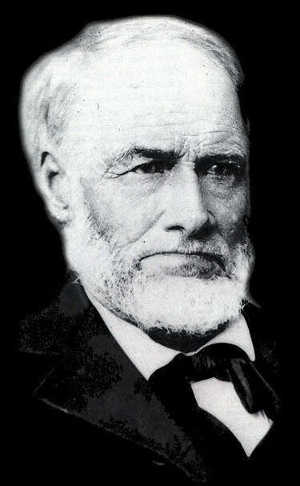
James Marshall. Public domain image via Wikimedia Commons. Some people just seem to have all the luck.
James Marshall wasn’t one of them. Never had been, either.
If these things can be said to have a beginning, and aren’t just deeply imbedded in a person at birth, James Marshall’s bad luck began when his father died.
James was in his early 20s, a fragile time in a young man’s life, when the decisions he makes have ramifications for his future prosperity and happiness. When other young men were starting out on their own, with a clean slate, James suddenly found himself the proud owner of a heap of debt from his dearly departed father.
With few alternatives available to him, James did what every down-on-his-luck young man did – he set out west.
“West” at that time was Ohio and the other Midwestern states. Over the next few years, James Marshall saw a little bit of all of them. For a time, his luck appeared to have changed when he built a nice homestead on a small plot of land on the Missouri River. He planted corn, built fence posts and even had a respectable little home. To complete this picture of domestic bliss, James fell in love. His paramour was aptly named – I’m not kidding you – Missouri Green.
But, Bad Fortune was not going to let her favorite victim get away that easily. In no time at all, James contracted an illness that most doctors at the time called the “fever and ague,” but that is more commonly known today as malaria.
The illness sapped him of his strength, blurred his vision and – most painful of all – robbed him of his dearest Missouri Green. She didn’t die; she just fell in love with a doctor (probably the same one treating our poor James).
Despondent at love lost and at the recommendation from a doctor that he travel to more arid climates, James headed even farther west.
In the spring of 1845, our lovelorn hero arrived in the Willamette Valley, hoping to finally rid himself of his broken heart and the damp air of the Missouri bottomlands. We don’t know if he succeeded in getting rid of the first, but the weather in Oregon made it impossible to escape the second.
So, James headed south, where he heard the weather was more amenable to those suffering from the fever and ague. After a difficult journey over the Siskiyou Mountains, James Marshall arrived at the doorstep of Sutter’s Fort in the Sacramento Valley.
By now, James probably looked like a stray dog that hadn’t eaten a proper meal his whole life. Lucky for him, he was in Mexican California – a land almost bereft of skilled labor. Beggars can’t be choosers, as the saying goes, and so the proprietor of the fort – John Sutter himself – had no choice but to welcome the new arrival as a potential source of labor.
Having recovered some of his strength from the ague, James showed his new benefactor that he was at least skilled enough to handle most ordinary tasks required of a frontier settlement. Happy with the results, John Sutter helped James arrange a mortgage to purchase two leagues of land nearby. Settling into his new homestead, James began growing a herd of cattle to augment what income he received from Sutter. And so, James’ luck looked to be turning.
Looks can be deceiving.
In no time at all, a war broke out between the land of his birth and the country of his current residence. Struck by a surprising amount of patriotism, James joined up to fight for America against Mexico and soon found himself a private in Captain Fremont’s little army.
Over the next several months, he learned the monotony of most war: lots of walking and little fighting. In March of 1847, James was discharged in San Diego, and faced a long haul to get back to his home along the Sacramento.
When he finally got back to Sutter’s Fort, he found that in his absence, someone had stolen his cattle, which were more valuable than the land he owned. Without the cattle, he wasn’t able to make his mortgage payments and – you guessed it – James Marshall lost his land.
Finding himself back at square one, he turned once more to the only source of good luck in his life: John Sutter. As it turned out, Mr. Sutter had plans to build a sawmill somewhere along the American River in hopes of capitalizing on the potential wave of settlement following California’s entrance into the United States.
James agreed to scout out a location for such a mill and, when found, to oversee the construction of it.
On Jan. 24, 1848, James Marshall’s luck looked like it had finally turned. Early that morning, while walking out of his cabin in preparation for the day’s work, a few sparkles along the riverbed caught his eye.
Curious, this man who had for so long suffered the attentions of Bad Fortune, bent down and picked up the key to his potential future prosperity – GOLD! And so started the California Gold Rush.
If some people are just born lucky, then the opposite must also be true. James Marshall is case in point. Because even being the very person to kick off the greatest rush for gold in world history wasn’t enough to shake Bad Fortune from his trail.
After his initial discovery, James joined the rest of humanity and set up a gold mining claim, hoping to strike it rich. He did not. In fact, he dumped all his worldly possessions into the scheme. The result, as you can by now imagine, was no surprise.
James Marshall died in 1885 penniless and, but for the pension the state of California had given him in recognition of his role in the Gold Rush, nearly homeless. Some people just seem to have all the luck.
Antone Pierucci is curator of history at the Riverside County Park and Open Space District and a freelance writer whose work has been featured in such magazines as Archaeology and Wild West as well as regional California newspapers.
James Marshall’s cabin in Coloma, Calif. Photo courtesy of Swampyank at en.wikipedia [CC BY-SA 3.0 (https://creativecommons.org/licenses/by-sa/3.0)].
LAKE COUNTY, Calif. – Lake County Animal Care and Control has another eclectic mix of dogs needing homes in its kennels this week.
Dogs available for adoption this week include mixes of Australian Shepherd, beagle, boxer, bullmastiff, German Shepherd, husky, Labrador Retriever, pit bull, shepherd and terrier.
Dogs that are adopted from Lake County Animal Care and Control are either neutered or spayed, microchipped and, if old enough, given a rabies shot and county license before being released to their new owner. License fees do not apply to residents of the cities of Lakeport or Clearlake.
If you're looking for a new companion, visit the shelter. There are many great pets hoping you'll choose them.
The following dogs at the Lake County Animal Care and Control shelter have been cleared for adoption (additional dogs on the animal control Web site not listed are still “on hold”).
This male Australian Shepherd is in kennel No. 5, ID No. 11639. Photo courtesy of Lake County Animal Care and Control. Male Australian Shepherd
This male Australian Shepherd has a medium-length brown coat.
He’s in kennel No. 5, ID No. 11639.
This female shepherd is in kennel No. 7a, ID No. 11602. Photo courtesy of Lake County Animal Care and Control. Female shepherd
This female shepherd has a medium-length black and brown coat.
She’s in kennel No. 7a, ID No. 11602.
This female chocolate Labrador Retriever is in kennel No. 12, ID No. 11644. Photo courtesy of Lake County Animal Care and Control. Female chocolate Labrador Retriever
This female chocolate Labrador Retriever has a short coat.
She already has been spayed and shelter staff said she’s good with other dogs.
She’s in kennel No. 12, ID No. 11644.
“Dino” is a male pit bull in kennel No. 14, ID No. 11647. Photo courtesy of Lake County Animal Care and Control. ‘Dino’
“Dino” is a male pit bull with a short blue coat.
He’s in kennel No. 14, ID No. 11647.
“Truely” is a female pit bull in kennel No. 15, ID No. 11645. Photo courtesy of Lake County Animal Care and Control. ‘Truely’
“Truely” is a female pit bull with a short white and tan coat.
She’s in kennel No. 15, ID No. 11645.
This male boxer-pit bull terrier is in kennel No. 17, ID No. 11614. Photo courtesy of Lake County Animal Care and Control. Male boxer-pit bull
This male boxer-pit bull terrier has a short black and white coat.
He already has been neutered.
He’s in kennel No. 17, ID No. 11614.
“Tank” is a male pit bull terrier in kennel No. 21, ID No. 7002. Photo courtesy of Lake County Animal Care and Control. ‘Tank’
“Tank” is a male pit bull terrier with a short brown brindle coat.
He already has been neutered.
He’s in kennel No. 21, ID No. 7002.
This male bullmastiff is in kennel No. 25, ID No. 11656. Photo courtesy of Lake County Animal Care and Control. Male bullmastiff
This male bullmastiff has a short brindle coat.
He already has been neutered.
Shelter staff said he is great with other dogs but needs leash manners.
He’s in kennel No. 25, ID No. 11656.
“Graham” is a male yellow Labrador Retriever in kennel No. 26, ID No. 11653. Photo courtesy of Lake County Animal Care and Control. ‘Graham’
“Graham” is a male yellow Labrador Retriever.
Shelter staff said he is great with other dogs.
He’s in kennel No. 26, ID No. 11653.
“Bella” is a young female beagle-terrier mix in kennel No. 27, ID No. 11648. Photo courtesy of Lake County Animal Care and Control. ‘Bella’
“Bella” is a young female beagle-terrier mix with a medium-length black and brown coat.
She already has been spayed.
Shelter staff said she is good with other dogs, but needs training and socialization with new people. She’s not recommended for a home with young children.
Bella is in kennel No. 27, ID No. 11648.
“Smokey” is a male pit bull terrier in kennel No. 28a, ID No. 11646. Photo courtesy of Lake County Animal Care and Control. ‘Smokey’
“Smokey” is a male pit bull terrier with a short fawn and white coat.
He already has been neutered.
He’s in kennel No. 28a, ID No. 11646.
“Kaiah” is a female husky in kennel No. 30, ID No. 11622. Photo courtesy of Lake County Animal Care and Control. ‘Kaiah’
“Kaiah” is a female husky with a medium-length black and white coat.
She already has been spayed.
She’s in kennel No. 30, ID No. 11622.
This young male shepherd is in kennel No. 32, ID No. 11655. Photo courtesy of Lake County Animal Care and Control. Male shepherd
This young male shepherd has a short tan coat.
He already has been neutered.
He’s in kennel No. 32, ID No. 11655.
This male German Shepherd is in kennel No. 33, ID No. 11564. Photo courtesy of Lake County Animal Care and Control. Male German Shepherd
This male German Shepherd has a medium-length tricolor coat.
He’s in kennel No. 33, ID No. 11564.
This male German Shepherd is in kennel No. 34, ID No. 11605. Photo courtesy of Lake County Animal Care and Control. Male German Shepherd
This male German Shepherd as a medium-length black and tan coat.
He has been neutered.
He’s in kennel No. 34, ID No. 11605.
Lake County Animal Care and Control is located at 4949 Helbush in Lakeport, next to the Hill Road Correctional Facility.
Office hours are Monday through Friday, 11 a.m. to 5 p.m., and 11 a.m. to 3 p.m., Saturday. The shelter is open from 11 a.m. to 4 p.m. Monday through Friday and on Saturday from 11 a.m. to 3 p.m.
For more information call Lake County Animal Care and Control at 707-263-0278.
Email Elizabeth Larson at This email address is being protected from spambots. You need JavaScript enabled to view it.. Follow her on Twitter, @ERLarson, or Lake County News, @LakeCoNews.
Artist's concept of the Cassini spacecraft shown against a real image of Saturn and its rings. Courtesy of NASA/JPL-Caltech. One of the last acts of NASA’s Cassini spacecraft before its death plunge into Saturn’s hydrogen and helium atmosphere was to coast between the planet and its rings and let them tug it around, essentially acting as a gravity probe.
Precise measurements of Cassini’s final trajectory have now allowed scientists to make the first accurate estimate of the amount of material in the planet’s rings, weighing them based on the strength of their gravitational pull.
That estimate – about 40 percent of the mass of Saturn’s moon Mimas, which itself is 2,000 times smaller than Earth’s moon – tells them that the rings are relatively recent, having originated less than 100 million years ago and perhaps as recently as 10 million years ago.
Their young age puts to rest a long-running argument among planetary scientists. Some thought that the rings formed along with the planet 4.5 billion years ago from icy debris remaining in orbit after the formation of the solar system.
Others thought the rings were very young and that Saturn had, at some point, captured an object from the Kuiper belt or a comet and gradually reduced it to orbiting rubble.
The new mass estimate is based on a measurement of how much the flight path of Cassini was deflected by the gravity of the rings when the spacecraft flew between the planet and the rings on its final set of orbits in September 2017.
Initially, however, the deflection did not match predictions based on models of the planet and rings. Only when the team accounted for strong flowing winds very deep in Saturn's atmosphere – something impossible to observe from space – did the measurements make sense, allowing them to calculate the mass of the rings.
“The first time I looked at the data I didn't believe it, because I trusted our models and it took a while to sink in that there was some effect that changed the gravity field that we had not considered,” said Burkhard Militzer, a professor of earth and planetary science at the University of California, Berkeley, who models planetary interiors. “That turned out to be massive flows in the atmosphere at least 9,000 kilometers deep around the equatorial region. We thought preliminarily that these clouds were like clouds on Earth, which are confined to a thin layer and contain almost no mass. But on Saturn they are really massive.”
They also calculated that the surface clouds at Saturn’s equator rotate 4 percent faster than the layer 9,000 kilometers (about 6,000 miles) deep. That deeper layer takes 9 minutes longer to rotate than do the cloud tops at the equator, which go around the planet once every 10 hours, 33 minutes.
"The discovery of deeply rotating layers is a surprising revelation about the internal structure of the planet," said Cassini project scientist Linda Spilker of NASA’s Jet Propulsion Laboratory in Pasadena, California. "The question is what causes the more rapidly rotating part of the atmosphere to go so deep and what does that tell us about Saturn’s interior."
Militzer also was able to calculate that the rocky core of the planet must be between 15 and 18 times the mass of Earth, which is similar to earlier estimates.
The team, led by Luciano Iess at the Sapienza University of Rome, Italy, reported their results today in the journal Science.
Did rings come from icy comet?
Earlier estimates of the mass of Saturn’s rings – between one-half and one-third the mass of Mimas – came from studying the density waves that travel around the rocky, icy rings.
These waves are caused by the planet’s 62 satellites, including Mimas, which creates the so-called Cassini division between the two largest rings, A and B.
Mimas is smooth and round, 246 kilometers in diameter. It has a big impact crater that makes it resemble the Death Star from the Star Wars movies.
“People didn't trust the wave measurements because there might be particles in the rings that are massive but are not participating in the waves,” Militzer said. “We always suspected there was some hidden mass that we could not see in the waves.”
Luckily, as Cassini approached the end of its life, NASA programmed it to perform 22 dives between the planet and the rings to probe Saturn's gravity field. Earth-based radio telescopes measured the spacecraft’s velocity to within a fraction of a millimeter per second.
The new ring mass value is in the range of earlier estimates and allows the researchers to determine their age.
These age calculations, led by Philip Nicholson of Cornell University and Iess, built on a connection that scientists had previously made between the mass of the rings and their age. Lower mass points to a younger age, because the rings are initially made of ice and are bright but over time become contaminated and darkened by interplanetary debris.
“These measurements were only possible because Cassini flew so close to the surface in its final hours,” Militzer said. “It was a classic, spectacular way to end the mission.”
Other co-authors are Sean Wahl of UC Berkeley, Y. Kaspi and E. Galanti of the Weizmann Institute of Science in Rehovot, Israel, D. Durante, P. Racioppa and M.J. Mariani of Sapienza University, A. Anabtawi of JPL, W. Hubbard of the University of Arizona, Tucson, and P. Tortora and M. Zannoni of the University of Bologna in Italy.
Robert Sanders writes for the UC Berkeley News Center.
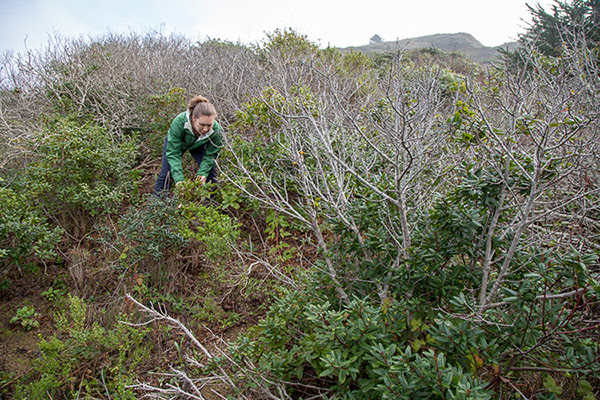
Laura Sims, a postdoctoral researcher in UC Berkeley’s College of Natural Resources, collects samples of native coffeeberry that has been killed by the pathogen Phytophthora crassamura in a restoration site in San Mateo County. University of California Agriculture and Natural Resources photo by William Suckow. BERKELEY, Calif. – In 2014, plant biologists with the California Department of Agriculture reported an alarming discovery: native wildflowers and herbs, grown in nurseries and then planted in ecological restoration sites around California, were infected with Phytophthora tentaculata, a deadly exotic plant pathogen that causes root and stem rot.
While ecologists have long been wary of exotic plant pathogens borne on imported ornamental plants, this was the first time in California that these microorganisms had been found in native plants used in restoration efforts.
Their presence in restoration sites raised the frightening possibility that ecological restoration, rather than returning disturbed sites to their natural beauty, may actually be introducing deadly plant pathogens, such as those related to Sudden Oak Death, into the wild.
New work by a UC Berkeley team in the College of Natural Resources shows for the first time just how widespread and deadly the threat of pathogens from restoration nurseries may be.
The team surveyed five native plant nurseries in Northern California and found that four harbored exotic, or non-native, Phytophthora pathogens.
Strains of the pathogens from native plant nurseries were shown to be at times more aggressive than strains found in the wild, and some of them are rapidly developing resistance to the fungicides that can be used to control them, the researchers found.
Working with restoration nurseries around the state, the researchers showed that new management techniques, coupled with new methods for detecting pathogens, can help these nurseries limit the spread of exotic pathogens.
“Some of these restoration projects cost tens of millions of dollars, but of course their actual value is much higher, because of the wealth of services healthy natural ecosystems provide, including supporting animal and plant biodiversity, providing good water and air quality, and enjoyable recreation sites,” said Matteo Garbelotto, cooperative extension specialist and adjunct professor of environmental science, policy and management at UC Berkeley.
“Such services are highly diminished in ecosystems affected by exotic plant diseases, while water runoff and erosion, the establishment of exotic plants and animals, and even hotter wildfires may increase in conjunction with disease outbreaks in natural ecosystems,” Garbelotto said.
Pathogens evolve to outwit fungicides
Bacteria that make humans sick are constantly evolving to resist the antibiotics designed to fight them, and resistance to fungicides has been documented in microbes causing diseases in agricultural plants.
Garbelotto and his team wanted to know if the widespread use of fungicides in in native and ornamental plant nurseries could also accelerate the development of fungicide-resistance in plant pathogens.
Their research was spurred in part by their discovery of a new strain of the Sudden Oak Death pathogen in Oregon forests that is highly tolerant of a fungicide commonly known as phosphite, one of the main weapons used against plant parasites in the wild because its application does not cause any known negative environmental side effects.
Together with a group of New Zealand researchers, they decided to study fungicide resistance of Phytophthora – a genus of plant pathogens that can case lethal cankers and root rot – to two important fungicides, including phosphite.
The researchers gathered numerous samples of Phytophthora from 11 species present both in forests and plant nurseries. They then tested the sensitivity to phosphite of multiple individuals per species.
While most of the species tested were overall still sensitive to phosphite, strains of four species were able to resist the effects of the chemical, the researchers report in PLOS ONE. These include Phytophthora ramorum, the parasite behind Sudden Oak Death in North America and Sudden Larch Death in Europe, and Phytophthora crassamura, a species first discovered recently by the same UC Berkeley researchers in native plant nurseries and restoration sites in California.
Some strains within each of these four species, although genetically almost identical to strains still susceptible to phosphite, were resistant to it. The presence of chemical tolerance or chemical sensitivity when comparing nearly genetically identical strains suggests that the development of resistance occurred relatively recently, perhaps in response to the widespread use of phosphites in native and ornamental nurseries, Garbelotto said.
“These pathogens can be literally flooded with these chemicals in plant production facilities, and at the beginning of the study, we hypothesized that in such predicaments these pathogens would be forced to evolve resistance” Garbelotto said. “Indeed, our hypothesis was correct, and we found that some of them evolved the ability to tolerate exposure to phosphite.”
While phosphite can still help to spur a plant’s immune system, this may not be enough to quell the spread of the disease, Garbelotto said.
“By pressuring these pathogens to evolve resistance to phosphites, we are effectively taking out phosphite as a potential tool to manage these disease outbreaks,” Garbelotto said. “Furthermore, the ability to quickly develop tolerance to a fungicide may be an indication these pathogens can adapt quickly to new environments. Thus, they may become formidable invasive organisms, infesting larger swaths of natural areas and causing significant disease and mortality of essential native flora.”
A widespread – but reparable – problem
Since the first discovery of Phytophthora in California restoration sites, research by the UC Berkeley team and others have traced the deaths of wild trees and plants back to strains of the pathogen originating in native plant nurseries, rather than strains already found in the wild.
However, few studies have documented just how prevalent the problem is.
In a recent study published in the journal Plant Pathology, UC Berkeley researchers examined 203 individual plants across five restoration nurseries in California and found that 55 of the plants were infected with Phytophthora.
“We were able to prove that this is a widespread problem in California,” Garbelotto said. “Most of the stock that they used is infested, and the levels were very high. For some species more than 50 percent of the plants we tested were infected.”
The team then worked with the infected nurseries to implement new best management practices to try to limit the spread of disease without the use of phosphite or of other fungicides. These simple guidelines, which included more careful management of water runoff and soil to reduce cross contamination, reduced the prevalence of disease to nearly zero a year after implementation.
“We were able to prove that after a year of following the guidelines, those facilities were clear of pathogens, and other facilities that did not follow the guidelines still had the pathogens,” Garbelotto said. “As a result of these findings, people are now putting a lot of money and effort into making sure that the plants are clean, by following similar guidelines and by making sure that no fungicides are used to avoid the development of resistance.”
Co-authors on the PLOS ONE study are Shannon Hunter of the University of Waikato in New Zealand and Nari Williams, Rebecca McDougal and Peter Scott of Forest Protection in New Zealand. Co-authors on the Plant Pathology study are L. Sims of UC Berkeley and S. Tjosvold and D. Chambers of the University of California Cooperative Extension.
This research was supported by the Endemic and Invasive Pests and Diseases Strategic Initiative of the University of California, Agriculture and Natural Resources; and by the San Francisco Public Utilities Commission in collaboration with the U.S. Forest Service (Region 5).
 How to resolve AdBlock issue?