 How to resolve AdBlock issue?
News
The kennels also have many dogs that need to be reunited with their owners. To find the lost/found pet section, click here.
The following dogs are ready for adoption.

‘Bernard’
“Bernard” is a male Staffordshire Bull Terrier mix with a short brindle and white coat.
He already has been neutered.
He is No. 280.

‘Blue’
“Blue” is a male Staffordshire Bull Terrier with a short blue and white coat.
He is No. 2420.

‘Buddy’
“Buddy” is a male Labrador Retriever mix with a short black coat with white markings.
He is No. 2332.

‘Cadbury’
“Cadbury” is a female Staffordshire Bull Terrier mix with a smooth medium-length beige coat.
She is No. 1215.

‘Frank’
“Frank” is a male American Staffordshire Terrier mix with a short black and white coat.
He is No. 2345.

‘Hamilton’
“Hamilton” is a male German Shepherd with a medium-length brown and black coat.
He is No. 2177.

‘Melonie’
“Melonie” is a female American Pit Bull Terrier mix with a short red and white coat.
She is No. 2428.

‘Mira’
“Mira” is a female Queensland Heeler mix with a short red and white coat.
She is No. 2412.

‘Panther’
“Panther” is a female Staffordshire Bull Terrier mix with a short black and white coat.
She is No. 2418.

‘Sturgill’
“Sturgill” is a male Labrador Retriever mix with a medium-length yellow coat.
He is No. 2460.

‘Tyson’
“Tyson” is a male American Staffordshire terrier mix with a medium-length gray and white coat.
He is No. 1863.

‘Wiley’
“Wiley” is a male German Shepherd mix with a medium-length black and brindle coat.
He is dog No. 2451.

‘Wynn’
“Wynn” is a male American Staffordshire Terrier with a short brindle coat.
Staff said he is a lovely fellow who has been at the shelter for several months.. He loves affection and is available for adoption or through the foster to adopt program.
He’s believed to be about 6 to 7 years old.
He is No. 969.
Clearlake Animal Control’s shelter is located at 6820 Old Highway 53, off Airport Road.
Hours of operation area noon to 4 p.m. Tuesday through Saturday. The shelter is closed Sundays, Mondays and major holidays; the shelter offers appointments on the days it’s closed to accommodate people.
Call the Clearlake Animal Control shelter at 707-273-9440, or email
Visit Clearlake Animal Control on Facebook or at the city’s Web site.
Email Elizabeth Larson at
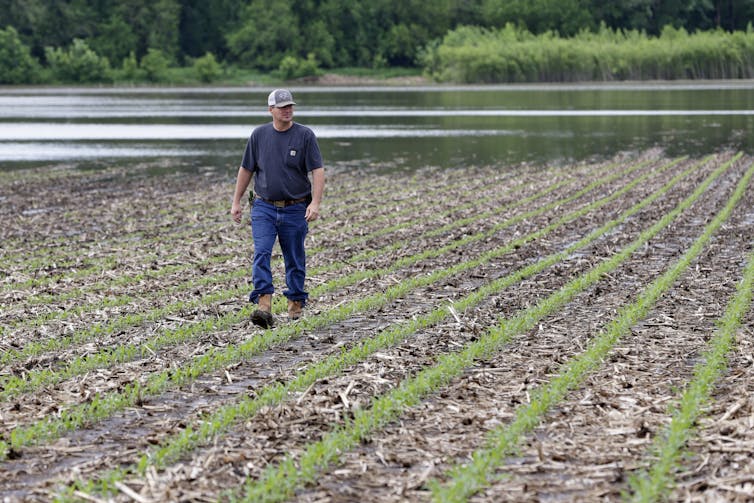
These are difficult times in farm country. Historic spring rains – 600% above average in some places – inundated fields and homes. The U.S. Department of Agriculture predicts that this year’s corn and soybean crops will be the smallest in four years, due partly to delayed planting.
Even before the floods, farm bankruptcies were already at a 10-year high. In 2018 less than half of U.S. growers made any income from their farms, and median farm income dipped to negative $1,553 – that is, a net loss.
At the same time, the Intergovernmental Panel on Climate Change estimates that about 12 years remain to rein in global greenhouse gas emissions enough to limit global warming to 1.5 degrees Celsius above pre-industrial levels. Beyond this point, scientists predict significantly higher risks of drought, floods and extreme heat.
And a landmark UN report released in May warns that roughly 1 million species are now threatened with extinction. This includes pollinators that provide US$235 billion to $577 billion in annual global crop value.
As scholars who study agroecology, agrarian change and food politics, we believe U.S. agriculture needs to make a systemwide shift that cuts carbon emissions, reduces vulnerability to climate chaos and prioritizes economic justice. We call this process a just transition – an idea often invoked to describe moving workers from shrinking industries like coal mining into more viable fields.
But it also applies to modern agriculture, an industry which in our view is dying – not because it isn’t producing enough, but because it is contributing to climate change and exacerbating rural problems, from income inequality to the opioid crisis.
Reconstructing rural America and dealing with climate change are both part of this process. Two elements are essential: agriculture based in principles of ecology, and economic policies that end overproduction of cheap food and reestablish fair prices for farmers.
Climate solutions on the farm
Agriculture generates about 9% of U.S. greenhouse gas emissions from sources that include synthetic fertilizers and intensive livestock operations. These emissions can be significantly curbed through adopting methods of agroecology, a science that applies principles of ecology to designing sustainable food systems.
Agroecological practices include replacing fossil-fuel-based inputs like fertilizer with a range of diverse plants, animals, fungi, insects and soil organisms. By mimicking ecological interactions, biodiversity produces both food and renewable ecosystem services, such as soil nutrient cycling and carbon sequestration.
Cover crops are a good example. Farmers grow cover crops like legumes, rye and alfalfa to reduce soil erosion, improve water retention and add nitrogen to the soil, thereby curbing fertilizer use. When these crops decay, they store carbon – typically about 1 to 1.5 tons of carbon dioxide per 2.47 acres per year.
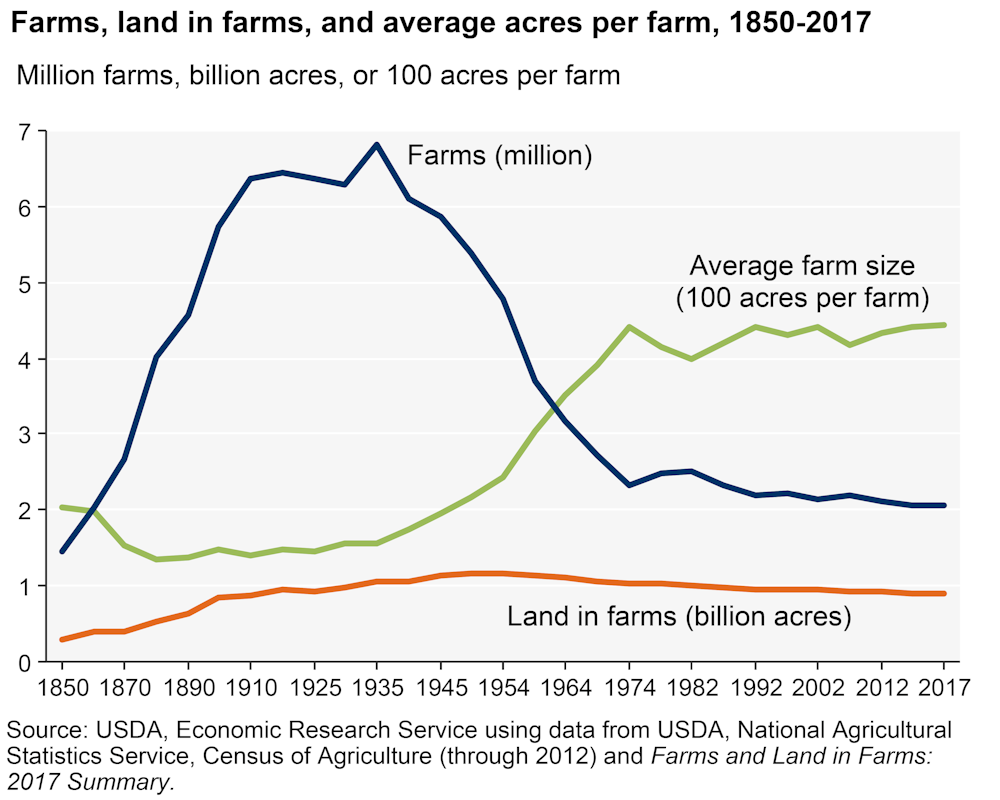
Cover crop acreage has surged in recent years, from 10.3 million acres in 2012 to 15.4 million acres in 2017. But this is a tiny fraction of the roughly 900 million acres of farmed land in the U.S.
Another strategy is switching from row crops to agroforestry, which combines trees, livestock and crops in a single field. This approach can increase soil carbon storage by up to 34%. And moving animals from large-scale livestock farms back onto crop farms can turn waste into nutrient inputs.
Unfortunately, many U.S. farmers are stuck in industrial production. A 2016 study by an international expert panel identified eight key “lock-ins,” or mechanisms, that reinforce the large-scale model. They include consumer expectations of cheap food, export-oriented trade, and most importantly, concentration of power in the global food and agricultural sector.
Because these lock-ins create a deeply entrenched system, revitalizing rural America and decarbonizing agriculture require addressing systemwide issues of politics and power. We believe a strong starting point is connecting ecological practices to economic policy, especially price parity – the principle that farmers ought to be fairly compensated, in line with their production costs.
Economic justice on the farm
If the concept of parity sounds quaint, that’s because it is. Farmers first achieved something like parity in 1910-1914, just before America entered World War I. During the war U.S. agriculture prospered, financing flowed and land speculation was rampant.
Those bubbles burst with the end of the war. As crop prices fell below the cost of production, farmers began going broke in a prelude to the Great Depression. Unsurprisingly, they tried to produce more food to get out of debt, even as prices collapsed.
President Franklin Roosevelt’s New Deal included programs that directed public investments to rural communities and restored “parity.” The federal government established price floors, bought up surplus commodities and stored them in reserve. It also paid farmers to reduce production of basic crops, and established programs to prevent destructive farming practices that had contributed to the Dust Bowl.

These policies provided much-needed relief for indebted farmers. In the “parity years,” from 1941 to 1953, the floor price was set at 90% of parity, and the prices farmers received averaged 100% of parity. As a result, purchasers of commodities paid the actual production costs.
But after World War II, agribusiness interests systematically dismantled the supply management system. They included global grain trading companies Archer Daniels Midland and Cargill and the American Farm Bureau Federation, which serves primarily large-scale farmers.
These organizations found support from federal officials, particularly Earl Butz, who served as secretary of agriculture from 1971 to 1976. Butz believed strongly in free markets and viewed federal policy as a lever to maximize output instead of constraining it. Under his watch, prices were allowed to fall – benefiting corporate purchasers – and parity was replaced by federal payments to supplement farmers’ incomes.
The resulting lock-in to this economic model progressively strengthened in the following decades, creating what many scientific assessments now recognize as a global food system that is unsustainable for farmers, eaters and the planet.
A new New Deal for agriculture
Today the idea of restoring parity and reducing corporate power in agriculture is resurging. Several 2020 Democratic presidential candidates have included it in their agriculture positions and legislation. Think tanks are proposing to empower family farms. Dairy delegates to the regulation-averse Wisconsin Farm Bureau Foundation voted in December 2018 to discuss supply management.
Along with other scholars, we have urged Congress to use the proposed Green New Deal to promote a just transition in agriculture. We see this as an opportunity to restore wealth to rural America in all of its diversity – particularly to communities of color who have been systematically excluded for decades from benefits available to white farmers.
This year’s biblical floods in the Midwest make any kind of farming look daunting. However, we believe that if policymakers can envision a contemporary version of ideas in the original New Deal, a climate-friendly and socially just American agriculture is within reach.
[ Like what you’ve read? Want more? Sign up for The Conversation’s daily newsletter. ]



Maywa Montenegro, UC President's Postdoctoral Fellow, University of California, Davis; Annie Shattuck, Ph.D Candidate, University of California, Berkeley, and Joshua Sbicca, Assistant Professor of Sociology, Colorado State University
This article is republished from The Conversation under a Creative Commons license. Read the original article.
Supervisor Bruno Sabatier and Moke Simon, and County Administrative Officer Carol Huchingson were appointed to an ad hoc committee earlier this year to work with Treasurer-Tax Collector Barbara Ringen to resolve concerns raised both by Huchingson’s office and board members starting last year.
On Tuesday they reported to the board and intended to ask the supervisors to accept a proposed retirement date Ringen had given them in writing after they asked her to resign.
On June 14, Ringen – who has been a county employee for three decades – sent an email to Sabatier and Simon, announcing her intention to retire Jan. 10, well ahead of the end of her term, which will be completed on Jan. 1, 2023.
Part of Tuesday’s discussion also touched on AB 632, legislation signed last month by the governor that will allow Lake County to consolidate its auditor-controller and treasurer tax-collector’s offices.
Despite the scheduled discussion of that resignation date, a last-minute change threw off the ad hoc committee’s calculations.
Specifically, Sabatier said he spoke to Ringen on Monday and that she had indicated she wouldn’t resign as of January, but was looking at a July 2020 date.
During the course of Tuesday’s meeting, Ringen would go further, refusing to commit to giving the board a specific resignation date by the end of the 2019-20 fiscal year, which ends July 31, and pointing to ongoing challenges, including having only half of her staff positions filled.
It also was revealed during the meeting that should Ringen resign, choosing her successor wouldn’t be a matter for a special election but would be up to the Board of Supervisors, according to County Counsel Anita Grant.
Ringen herself originally arrived at the job by board appointment in 2013 when her predecessor left to take another job. She’s since been elected twice.
The operations of the Treasurer-Tax Collector’s Office have been the subject of board discussions beginning in September, as Lake County News has reported.
Issues raised by the board and the County Administrative Office previously and which Sabatier discussed again on Tuesday have included performance concerns such as lack of consistent tax default sales, transient occupancy tax and property tax checks not being deposited in a timely manner, lack of transparency when it comes to the county’s investment practices and status, and issues of customer service coming to supervisors directly from constituents.
Sabatier said the board had been waiting patiently for a report from Ringen’s department, which they didn’t get. When the report didn’t come through, Board Chair Tina Scott formed an ad hoc committee, with Sabatier and Simon appointed to it, to work with Ringen’s office.
Sabatier said this year no tax auction was held, there have been more complaints about property tax and TOT checks, customer service and transparency.
Due to the continuing issues with the Treasurer-Tax Collector’s Office, which Sabatier said is one of the three key financial offices in the county, the ad hoc committee offered that Ringen resign so they could find a replacement, deal with the issues and alleviate concerns in the midst of a fiscal crisis.
On June 15, the ad hoc committee received an email from Ringen, which can be seen below, in which she said she expected to resign in January 2020.
“I am very committed to addressing your concerns, and will continue to work hard towards resolving these concerns. It has been a difficult decision to make, but it is my intension to retire from service as Treasurer-Tax Collector effective January 10, 2020,” Ringen wrote.
In that email, Ringen said that, beginning this month, she would “arrange to be available on a regular but limited basis to ensure a successful transition.”
Sabatier said the ad hoc committee wanted to get the matter to the board as soon as possible so it could begin the search for a new treasurer-tax collector as soon as possible.
He highlighted Ringen’s 30 years of service to the county, noting she has been polite and kind throughout their conversations, and that she had stepped up to fill the job when her predecessor left.
Sabatier said when he met with Ringen on Monday, she was looking at changing her retirement date so she could finish up the fiscal year.
Simon also thanked Ringen for her long term service. “This is a tough discussion and decision.”
Supervisor Rob Brown also thanked Ringen for her efforts, adding, “This cannabis debacle that the board thrust upon her” didn’t help with staffing challenges. “There are a lot of underlying issues that added to the problems in that office.”
Brown said he wasn’t sure what they were going to do about the matter at Tuesday’s meeting. “I know there’s a road that somebody's planning on driving us down and I’m not really comfortable with it at this point, and that’s combining the two offices.”
He added, “I think there’s a real issue with that,” including the loss of oversight.
Brown said the county has a comfort level with the auditor-controller, referring to Cathy Saderlund, who has held that job since 2011. However, he said Saderlund isn’t always going to fill that office, and noting that he wasn’t speaking for her, he said such a consolidation action could be a reason for Saderlund to leave.
Brown said he wanted them to get input from Saderlund. “I really want to know she thinks, candidly. I’m not sure exactly where to have that conversation. But it has not occurred.”
He said the treasurer-tax collector, auditor-controller and assessor-controller’s offices are elected for a reason, so that voters can decide who holds the job.
Simon said there have been some honest discussions involving the ad hoc committee, and that they had talked to Saderlund. “Ultimately it is up to the board and ultimately it is up to Barbara.”
Huchingson said a transition team and plan haven’t been put in place yet to address the possible consolidation of the auditor-controller and treasurer-tax collector’s offices. She said meetings with auditor-controller have taken place, but no formal steps toward any transition have been taken because this discussion at the board level needed to be had first.
Ringen explains challenges, won’t give firm date for resignation
Ringen, who was invited to speak, said she originally decided to retire in January but soon came to the realization that the date didn’t give adequate time for training and moving in a new direction. As a result, she decided to postpone it until the end of the fiscal year.
However, she said the final date ultimately depended on the training and transition, and so she could give no specific date, noting it’s a work in progress.
“We’re still struggling with staffing,” which is at 50 percent, Ringen said, reporting that another employee resigned last month.
In the last year and a half her office has had 17 recruitments, only two of which were successful, Ringen said.
“It’s impossible to do the day-to-day operations successfully with 50 percent staff,” both on the treasury and tax collector sides, Ringen said.
For tax collector staff, Ringen said it takes three to five years to become an effective employee and learn the process.
Regarding the complaints about her office, she said they get a lot of them – many are unfounded – and that’s the nature of the business.
“I do want the department to move forward in a positive manner,” she said, noting she has worked for the county for 30 years and is proud to serve taxpayers.
Sabatier said the ad hoc committee had the conversation with Ringen about her resignation because they were not seeing what they wanted. He said they had received calls from a school district about not receiving payments and from the Tourism Improvement District about not getting its revenue. A tax default property auction also hasn’t taken place.
“We’re hitting some of those roadblocks,” he said.
Regarding Ringen’s resignation date, “To leave it open-ended to me does not fix the problem that we know that we have,” Sabatier said.
Brown said Ringen’s staffing problems fall back on the board. “We need to do everything we can to increase those staffing levels.”
When the sheriff came to the board about having a 15 to 20 percent vacancy rate, Brown said the board gave pay increases to staff, they didn’t ask the sheriff to resign. “Let’s commit to do the same thing with other departments that are struggling and having the same problems in order to resolve those issues. This falls back on us, ultimately.”
Sabatier asked Ringen, flat out, if she would agree to put July 31, 2020, as her resignation date
“No, I do not,” said Ringen.
Simon said the board was having the discussion because “an email came in response to a question we asked you,” namely, that she would resign.
“A date would be nice, obviously,” he said.
Despite Ringen refusing to give a firm date, Simon later would move to accept Ringen’s intended resignation and establish a transition team for the anticipated resignation by the end of the fiscal year. The board voted 4-1 – with Brown voting no.
The board also received a brief informational update on AB 632 from County Administrative Office staffers Matthew Rothstein and Patrick Sullivan.
The governor signed the bill on July 9. It gives the county the flexibility to combine the auditor-controller and treasurer-tax collector’s offices.
“That’s part of why we haven’t had more robust conversations of all the details of what this may look like,” said Rothstein.
Lake County also has the clerk’s office consolidated with the auditor-controller, which was authorized by county ordinance in October 1993. To bring the offices into alignment, Rothstein said the board also would need to break up those two offices, also by ordinance, which would take effect at the end of an elected term. The next election for those offices is November 2022.
Rothstein said the two department heads would be important contributors to the overall evaluation of a consolidation, with Saderlund already having said she is willing to be involved.
Sullivan said the board’s options for what to do with the county clerk’s office would be consolidating it with the assessor, with the recorder or having it as a standalone department. He said they are limited on what they can consider based on state law.
Huchingson said there really is no option to act under AB 632 until the end of the terms of the current officials, which run for another three and a half years left on their terms. She said the time to look at it is two to two and a half years from now, to allow for planning.
Email Elizabeth Larson at
061419 Lake County Treasurer-Tax Collector resignation email by LakeCoNews on Scribd
The “1,000 Hands to Protect Lake County Homes,” the brainchild of District 5 Supervisor Rob Brown, is set to take place from 6 to 10 a.m. Saturday, Aug. 17.
Brown said he’s hoping to get 500 volunteers to help clear vegetation in the area, which is particularly vulnerable to wildland fire.
Plans for the event include six worksites in the Soda Bay corridor, beginning at the intersection of Highway 281 and Tenino Way in the Clear Lake Riviera.
Work sites will be marked A through F; volunteers can go straight to the worksite of their choosing, and crew leaders will provide direction and important safety information.
Maps of the sites can be found at http://www.lakecountyca.gov/1000Hands/ .
The southbound lane of Soda Bay Road, from Riviera Heights Drive to Point Lakeview Road, will be closed for the hours of the project, in order to allow volunteers to safely work and park. The county apologizes for any inconvenience.
Volunteers are asked to bring nylon-stringed weed eaters, hand tools, loppers, pruners, shovels and rakes.
They should wear hats, sunscreen, long-sleeved shirts, long pants and gloves that can be comfortably worn in warm weather
Water and gloves for those who do not own them will be provided.
Kelseyville Fire Protection District also will patrol and attend to medical needs.
Prior to starting work, all participants must sign a volunteer services agreement, which can be found at http://www.lakecountyca.gov/1000HandsAgreement/ and returned, by email, to
As a special incentive, anyone interested in participating in the fire extinguisher giveaway the following morning, Sunday, Aug. 18, at Riviera Elementary School, can receive a voucher and be first in line to get a fire extinguisher by participating in the 1,000 Hands effort.
For more information, call Supervisor Brown at 707-349-2628 or email
The Meadowbrook Area Pavement Rehabilitation Project is set to begin on Monday, Aug. 12, and is expected to continue through the end of October, the city reported.
Expect traffic delays in the area under flagged control. There will be hard traffic closures intermittently from 8 a.m. to 5 p.m. The city reported that these closures are necessary for the grinding and paving operations to be expedited. Notification of closures will be sent directly
to area residents.
The Meadowbrook Area project will be the last major paving project of this construction season, with a chip seal project to begin sometime in September, the city reported.
The city said gravel road grading and maintenance and pothole patching and crack sealing of many streets will continue.
“There are many areas of the city with roads needing attention and the community’s support of Measure V is generating needed funds to dramatically improve our public streets,” said City Manager Flora.

NORTHERN CALIFORNIA – The man wanted for the murder of his ex-girlfriend in January 2018 has been taken into custody.
The year-and-a-half-long manhunt for Salvador Vaca Garcia Jr. ended this week when he was arrested in Mexico, according to Colusa Police Department Police Chief Joshua Fitch.
Colusa resident Karen Garcia was reported by her family as missing on Jan. 9, 2018, just two days after her sister and four others were killed in a crash on Interstate 5 in Yolo County. Authorities said the initial report was taken by the Williams Police Department.
Karen Garcia and her vehicle were last seen in Colusa on Jan. 8, 2018, at approximately noon.
Fitch said Karen Garcia and her vehicle were subsequently entered into the missing person’s database as the investigation continued.
A joint investigation was initiated with the Colusa Police Department, Williams Police Department, Colusa County District Attorney’s Office and the Colusa County Sheriff’s Office. Fitch said that during the investigation a search warrant was served at Karen Garcia’s residence located on the 400 block of Oak Street in Colusa.
Fitch said evidence found during the search warrant revealed a homicide.
On Jan. 14, 2018, at approximately 3:45 p.m. investigators received information that Karen Garcia’s vehicle was located in a parking lot in Woodland. Her vehicle and body were recovered at the scene, Fitch said.
Salvador Garcia, Karen Garcia’s ex-boyfriend, was identified as a suspect in the homicide and a warrant was issued for his arrest, Fitch said.
Fitch said Salvador Garcia disappeared and the U.S. Marshals Service reached out to local law enforcement to provide their services. Since this time, the U.S. Marshals Service has been working diligently to locate him.
Several agencies including local law enforcement as well as the Riverside Police Department, Sacramento County District Attorney Office, government of Mexico Fiscalia General de Jalisco-Grupo De Ordenes y Apprensiones and the Instituto Nacional de Migracion have assisted the Marshals with the investigation.
As a result of that work, Fitch said Salvador Garcia was located in Guadalajara, Jalisco, Mexico, and taken into custody.
On Sunday, the U.S. Marshals Service turned their custody of Salvador Garcia Jr. over to members of the Colusa County Task Force to be booked into the Colusa County Jail, Fitch reported.
“The law enforcement agencies of Colusa County would like to give thanks to the U.S. Marshals Service for their assistance as well as to all who helped throughout this over a yearlong investigation,” Fitch said.