 How to resolve AdBlock issue?
News
Dogs available for adoption this week include mixes of boxer, Cane Corso mastiff, Chihuahua, husky, mastiff and pit bull.
Dogs that are adopted from Lake County Animal Care and Control are either neutered or spayed, microchipped and, if old enough, given a rabies shot and county license before being released to their new owner. License fees do not apply to residents of the cities of Lakeport or Clearlake.
If you're looking for a new companion, visit the shelter. There are many great pets hoping you'll choose them.
The following dogs at the Lake County Animal Care and Control shelter have been cleared for adoption (additional dogs on the animal control Web site not listed are still “on hold”).
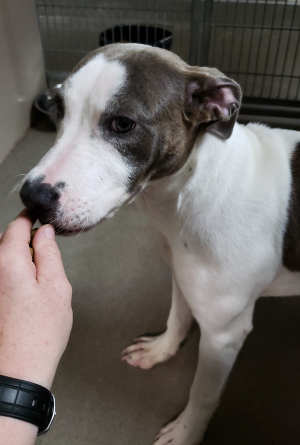
Female pit bull
This female pit bull has a short white and brindle coat.
She is in kennel No. 5, ID No. 12601.
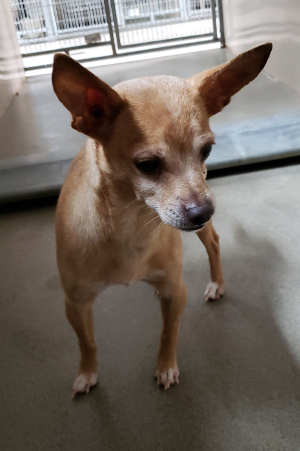
Male Chihuahua
This male Chihuahua has a short tan coat.
He’s in kennel No. 13, ID No. 12583.
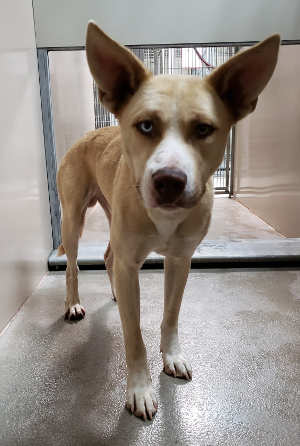
Male husky
This male husky has a short tan coat and blue eyes.
He is in kennel No. 15, ID No. 12628.
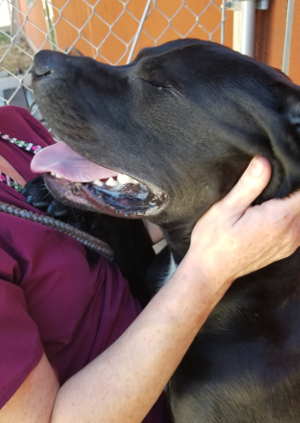
‘Rocky’
“Rocky” is a male pit bull-mastiff with a short black coat.
Shelter staff said he does well with others, and is a sweet and loving dog.
He’s in kennel No. 21, ID No. 12515.
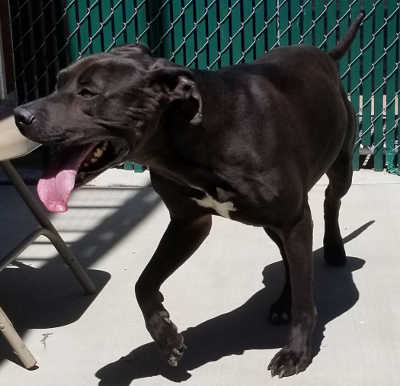
‘Cash’
“Cash” is a male pit bull terrier mix with a short black and white coat.
Shelter staff said Cash does well with others, loves people and walks well on a leash.
He has been neutered.
He’s in kennel No. 27, ID No. 12413.
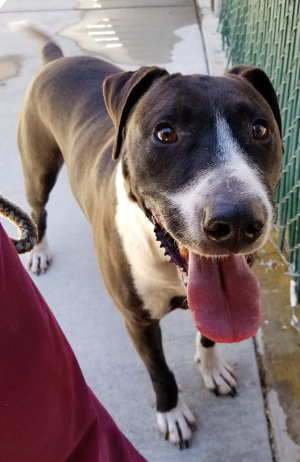
‘Chucky’
“Chucky” is a male pit bull terrier with a short black and white coat.
He already has been neutered.
He’s in kennel No. 29, ID No. 12523.
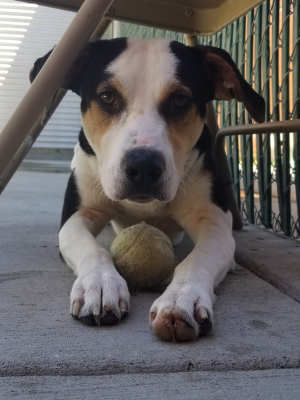
‘Buddy’
“Buddy” is a male pit bull terrier mix with a short tricolor coat.
He’s in kennel No. 31, ID No. 12508.
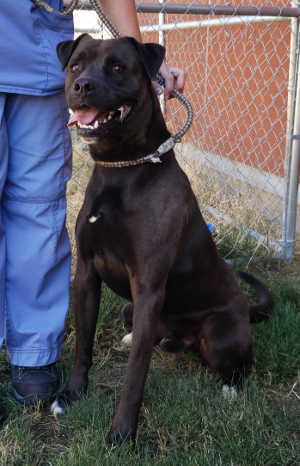
Male boxer
This male boxer has a short black coat.
He’s in kennel No. 32, ID No. 12512.
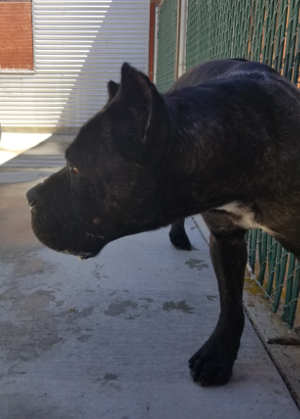
‘Bear’
“Bear” is a male Cane Corso mastiff with a short brown coat.
He is in kennel No. 34, ID No. 11456.
Lake County Animal Care and Control is located at 4949 Helbush in Lakeport, next to the Hill Road Correctional Facility.
Office hours are Monday through Friday, 11 a.m. to 5 p.m., and 11 a.m. to 3 p.m., Saturday. The shelter is open from 11 a.m. to 4 p.m., Monday through Friday and on Saturday from 11 a.m. to 3 p.m.
Visit the shelter online at http://www.co.lake.ca.us/Government/Directory/Animal_Care_And_Control.htm .
For more information call Lake County Animal Care and Control at 707-263-0278.
Email Elizabeth Larson at
A piping hot planet discovered by NASA’s Transiting Exoplanet Survey Satellite, or TESS, has pointed the way to additional worlds orbiting the same star, one of which is located in the star’s habitable zone. If made of rock, this planet may be around twice Earth’s size.
The new worlds orbit a star named GJ 357, an M-type dwarf about one-third the Sun’s mass and size and about 40 percent cooler that our star. The system is located 31 light-years away in the constellation Hydra.
In February, TESS cameras caught the star dimming slightly every 3.9 days, revealing the presence of a transiting exoplanet – a world beyond our solar system – that passes across the face of its star during every orbit and briefly dims the star’s light.
“In a way, these planets were hiding in measurements made at numerous observatories over many years,” said Rafael Luque, a doctoral student at the Institute of Astrophysics of the Canary Islands, or IAC, on Tenerife who led the discovery team. “It took TESS to point us to an interesting star where we could uncover them.”
The transits TESS observed belong to GJ 357 b, a planet about 22% larger than Earth. It orbits 11 times closer to its star than Mercury does our Sun. This gives it an equilibrium temperature – calculated without accounting for the additional warming effects of a possible atmosphere – of around 490 degrees Fahrenheit (254 degrees Celsius).
“We describe GJ 357 b as a ‘hot Earth,’” explains co-author Enric Pallé, an astrophysicist at the IAC and Luque’s doctoral supervisor. “Although it cannot host life, it is noteworthy as the third-nearest transiting exoplanet known to date and one of the best rocky planets we have for measuring the composition of any atmosphere it may possess.”
But while researchers were looking at ground-based data to confirm the existence of the hot Earth, they uncovered two additional worlds. The farthest-known planet, named GJ 357 d, is especially intriguing.
“GJ 357 d is located within the outer edge of its star’s habitable zone, where it receives about the same amount of stellar energy from its star as Mars does from the Sun,” said co-author Diana Kossakowski at the Max Planck Institute for Astronomy in Heidelberg, Germany. “If the planet has a dense atmosphere, which will take future studies to determine, it could trap enough heat to warm the planet and allow liquid water on its surface.”
Without an atmosphere, it has an equilibrium temperature of -64 F (-53 C), which would make the planet seem more glacial than habitable. The planet weighs at least 6.1 times Earth’s mass, and orbits the star every 55.7 days at a range about 20% of Earth’s distance from the Sun. The planet’s size and composition are unknown, but a rocky world with this mass would range from about one to two times Earth’s size.
Even through TESS monitored the star for about a month, Luque’s team predicts any transit would have occurred outside the TESS observing window.
GJ 357 c, the middle planet, has a mass at least 3.4 times Earth’s, orbits the star every 9.1 days at a distance a bit more than twice that of the transiting planet, and has an equilibrium temperature around 260 F (127 C). TESS did not observe transits from this planet, which suggests its orbit is slightly tilted – perhaps by less than 1 degree – relative to the hot Earth’s orbit, so it never passes across the star from our perspective.
To confirm the presence of GJ 357 b and discover its neighbors, Luque and his colleagues turned to existing ground-based measurements of the star’s radial velocity, or the speed of its motion along our line of sight.
An orbiting planet produces a gravitational tug on its star, which results in a small reflex motion that astronomers can detect through tiny color changes in the starlight.
Astronomers have searched for planets around bright stars using radial velocity data for decades, and they often make these lengthy, precise observations publicly available for use by other astronomers.
Luque’s team examined ground-based data stretching back to 1998 from the European Southern Observatory and the Las Campanas Observatory in Chile, the W.M. Keck Observatory in Hawaii, and the Calar Alto Observatory in Spain, among many others.
A paper describing the findings was published on Wednesday, July 31, in the journal Astronomy & Astrophysics and is available online.
TESS is a NASA Astrophysics Explorer mission led and operated by MIT in Cambridge, Massachusetts, and managed by NASA's Goddard Space Flight Center. Additional partners include Northrop Grumman, based in Falls Church, Virginia; NASA’s Ames Research Center in California’s Silicon Valley; the Harvard-Smithsonian Center for Astrophysics in Cambridge, Massachusetts; MIT’s Lincoln Laboratory; and the Space Telescope Science Institute in Baltimore. More than a dozen universities, research institutes and observatories worldwide are participants in the mission.
Francis Reddy works for NASA’s Goddard Space Flight Center in Greenbelt, Maryland.

CLEARLAKE Calif. – The Clearlake Police Department has arrested a woman for animal cruelty after she left her dog in the heat without shelter or water, with the animal so sick as a result that it had to be euthanized.
Champagne Delsie Leubner, 24, was arrested on Friday, police reported.
The investigation into the case began on July 23. On that day, Clearlake Animal Control Officer John Moretz was dispatched at about 2:30 p.m. to a call regarding a dog that was tied out in direct sun with no water.
When Moretz arrived at the scene, police said he was pointed in the direction of the dog in a backyard tied to a stationary object, completely entangled in its cable, no access to water and directly in the sun.
Weather records for July 23 show that temperatures hovered in the low to mid 90s.
Seeing the condition the dog was in, suffering severe heatstroke, Moretz entered the backyard to free the dog and rush it to a veterinary office, police said.
However, due to the severity of the heatstroke – police said the dog’s body temperature was so high that it was unreadable by a thermometer – and the fact that the dog was completely unresponsive, it was decided to humanely euthanize the dog based on the veterinarian’s recommendation.
Based on pictures posted online, the dog was large and white, with black markings on its face. It was similar in looks to an American bulldog or Great Dane mix.
Police said Moretz's subsequent investigation led to a warrant for the arrest of Leubner being issued by the Lake County District Attorney's Office.
On Friday, Clearlake Police Officer Shane Audiss spotted Leubner at the Mobil gas station on Lakeshore Drive and she was taken into custody.
Leubner was booked into the Lake County Jail on Friday evening, with bail set at $35,000, according to her booking sheet, which also lists her as unemployed.
She is tentatively scheduled to be arraigned in Lake County Superior Court on Monday, based on jail records.
Jail booking records show Leubner has previous arrests, in 2017 for possession of drugs and paraphernalia and in 2018 on a bench warrant.
Police and Animal Control officials reminded city residents that with temperatures now regularly topping the 100-degree mark, “It is imperative that you are taking every necessary precaution to keep your animals and yourself safe from the heat.”

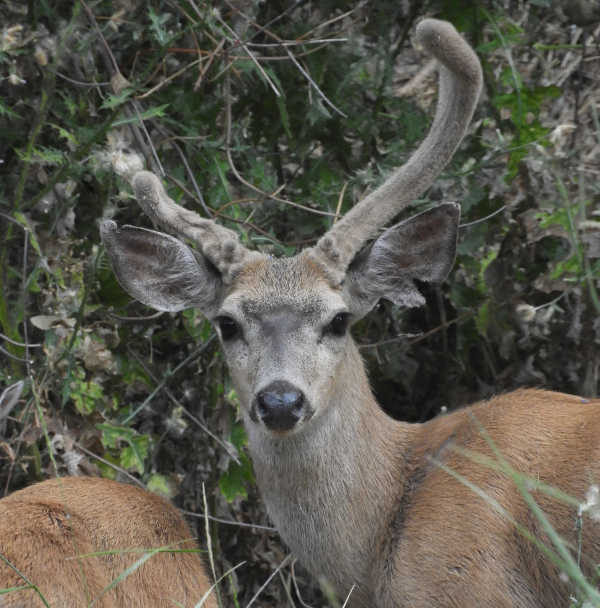
NORTHERN CALIFORNIA – Right now, you’re probably seeing a lot of our male regional Columbian Black-Tailed deer (Odocoileus hemionus columbianus) walking around in their “velvet,” that fuzzy material that covers their antlers while they grow.
Diet and disease both play a part in how robust the antlers are, but other factors can intervene and cause the antlers to come out wonky: stunted, mismatched or completely misshapen.
To understand how and why that might happen, you need to know a little bit about how the antlers develop.
Antlers grow from a specific connection point on the skull called a pedicle. What’s interesting about this antler-launch-point is that each deer’s pedicles have a pattern on them that is unique to that individual deer, like a fingerprint.
So, if you know what the pattern on the pedicle looks like, you can match it to the pattern on the base-end of the shed antlers later on in the year and know precisely which deer shed those antlers.
In black-tailed deer, hormonal changes in the summer months that herald the oncoming rut (breeding season) trigger the pedicles to start growing a new set of antlers.
At first, the antlers look fuzzy and have rounded tips. This is the “velvet” stage. The velvety-looking structures you see growing from the pedicles are actually antler material in its pre-calcified state and are made up of a concentrated network of cells, nerves blood vessels. During this stage, each antler can grow at the rate of a half-inch per day!
While they’re growing, the fuzz-covered antlers are extremely sensitive to touch and feel hot in your hand. Once the underlying structure of the antler calcifies, everything cools off and the outer layer of fuzz is shed revealing the sharp-tipped hard bone antler underneath it.
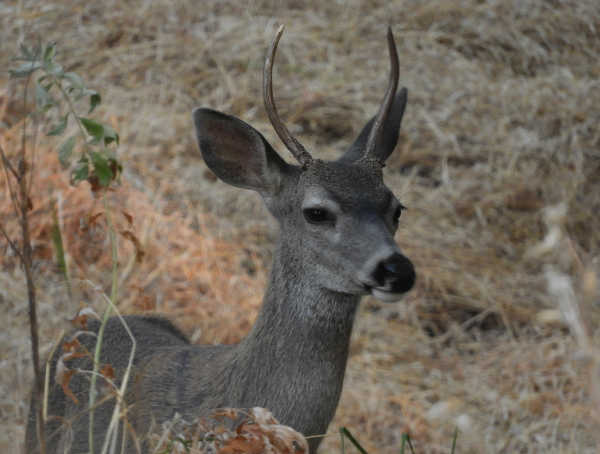
Although they’re made of bone, antlers aren’t permanent structures. In fact, black-tailed deer grow and shed their antlers every year, adding an extra tine (the pointy bit) to their rack every time the antlers are regrown. The first antler that sprouts has a single tine, and male deer sporting these lone tines are referred to as “spike bucks.”
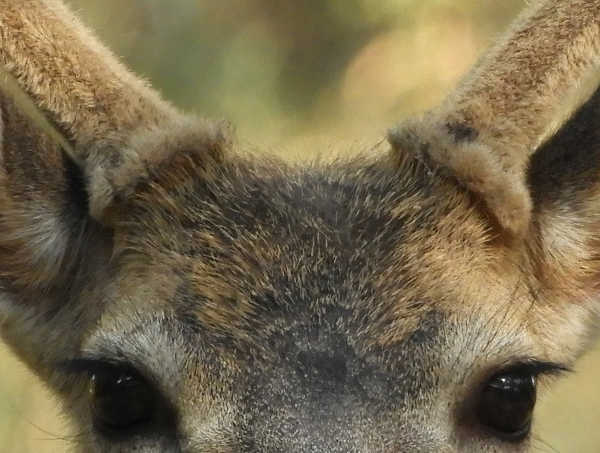
It takes about two years, though, before the pedicle is strong enough to support the antlers, so the deer you see out there with antlers are actually older than the number of tines on their racks. Spike bucks can actually be up to 3 years old.
Trying to guess the age of any black-tailed deer by the tines on its antlers alone can be made even more difficult by the fact that intervening factors can cause the antlers to come out stunted or stubby, bent into odd contortions, or completely mismatched.
Distortions in the growth of the antlers can be caused, for example, if the pedicle on the skull is cracked or damaged, or the antler itself is broken while in the velvet stage. Whether or not the distortion caused by these injuries is permanent depends on when the damage occurs and how severe it was.
Let’s say an antler is broken during its velvet stage this year. The distortion that break caused will be visible in the hardened antler for the duration of this breeding season. But when the breeding season is over, and the antlers are shed and start to regrow next year, that distortion will no longer appear. If the pedicle, that anchor point from which the antlers grow, itself is damaged, however, distortions to the antlers can appear every year for the rest of the deer’s life.
Another factor that can affect antler growth comes in the form of what biologists call “systemic influence”, which loosely means that what happens to one part of an animal’s body can have a direct impact on an entirely different system in the same animal’s body.
In the case of black-tailed deer, this influence can be seen when antler deformations appear as a result of damage to the nerves in the deer’s hind legs. Usually, but not always, the deformed antler will appear on the side opposite of the leg that suffered the nerve damage. So, nerve damage in the right hind leg may show up, through systemic influence, as a deformed left antler.
See? There’s a lot more to antlers than you might have realized. Just for fun, get out there and check out the deer in your area. How many wonky antlers can you find?
Mary K. Hanson is a Certified California Naturalist, author and nature photographer, living with terminal cancer. She developed and helps to teach the naturalist program at Tuleyome, a 501(c)(3) nonprofit conservation organization based in Woodland. For more information, see their website at http://tuleyome.org/.
Harry William Miller, 70, of Anchor Bay was sentenced on Friday in Mendocino County Superior Court for attempted voluntary manslaughter in the March 2018 shooting of his neighbor, Paul Palestrini, and felony assault with a firearm on Palestrini’s wife, Desiree, along with special enhancements related to use of a firearm, the Mendocino County District Attorney’s Office said.
According to reports from the Mendocino County Sheriff’s Office and Mendocino County District Attorney’s Office, on the afternoon of March 26, 2018, there was an altercation regarding an easement on a shared driveway – specifically, a small gravel pile on the shared roadway – between Miller and Paul Palestrini in the 35000 block of South Highway 1 in Anchor Bay.
Authorities said that during the dispute Miller produced a firearm and shot Palestrini, without provocation, in the stomach at point blank range. Palestrini in turn hit Miller with a shovel while defending himself.
After shooting Paul Palestrini, Miller fired four shots at Desiree Palestrini, but missed, authorities said.
Both Paul Palestrini and Miller suffered significant injuries and had to be flown by air ambulances to Sonoma County for treatment.
In June, Miller entered a guilty plea for attempted voluntary manslaughter for shooting Paul Palestrini, and also admitted a sentencing enhancement that he personally used a firearm in the commission of the attempted killing, the District Attorney’s Office said.
At the same time, authorities said Miller pleaded guilty to felony assault with a firearm on Desiree Palestrini, and admitted a sentencing enhancement under that count that he personally used a firearm in the commission of that separate offense.
On Friday, the District Attorney’s Office said Judge John Behnke found there was no provocation or other cause to have justified or mitigated Miller from shooting point blank at Paul Palestrini and firing four shots at Desiree Palestrini.
Judge Behnke also found that the evidence supported the district attorney's argument that the defendant succeeded in killing Paul Palestrini but that medical teams were able to use their collective skills and experience to bring him back to life multiple times.
Behnke denied Miller’s application for probation as contrary to the interests of justice and instead sentenced Miller, who recently had been living in Santa Rosa, to 11 years, 10 months in the California Department of Corrections and Rehabilitation, authorities said.
At the conclusion of Friday’s extended proceedings – the lengthy sentencing hearing carried over from the morning session into the afternoon – authorities said Miller was handcuffed and taken into custody, and then escorted by deputies from the courthouse to the jail for later transportation to the California Department of Corrections and Rehabilitation.
Both convictions are felonies and, in concert with the two personal use sentencing enhancements, are legally characterized by the California Penal Code as violent crimes.
Because of that characterization, the District Attorney’s Office said any good or work time credits Miller may attempt to earn in state prison will be limited to no more than 15 percent of the defendant's total sentence. In other words, Miller will not be eligible for parole under current law until he has served just over 10 years.
Susan Mary Miller, the defendant's wife, was previously convicted by a separate jury of being a felony accessory to the violent crimes of her husband. The District Attorney’s Office said she was given permission to observe Friday’s proceedings in Behnke’s courtroom after agreeing to later surrender herself at the Mendocino County Jail to begin serving her own 10-month jail sentence.
Mendocino County District Attorney David Eyster prosecuted the Miller case. The law enforcement agencies that gathered the necessary evidence supporting the convictions were the Mendocino County Sheriff's Office and the District Attorney's own Bureau of Investigations. Eyster offered special thanks to the Stutchman Forensic Laboratory of Napa for its exceptional forensic analysis and work on this case.
The District Attorney has expressed gratitude to all the medical professionals – from the medical care providers in Gualala to the emergency life flight helicopter team to the surgeons, nurses, and medical staff at Santa Rosa Memorial Hospital – for their combined and exceptional work to save Paul Palestrini's life. Eyster cited medical providers in Fort Bragg who provided important after care services.
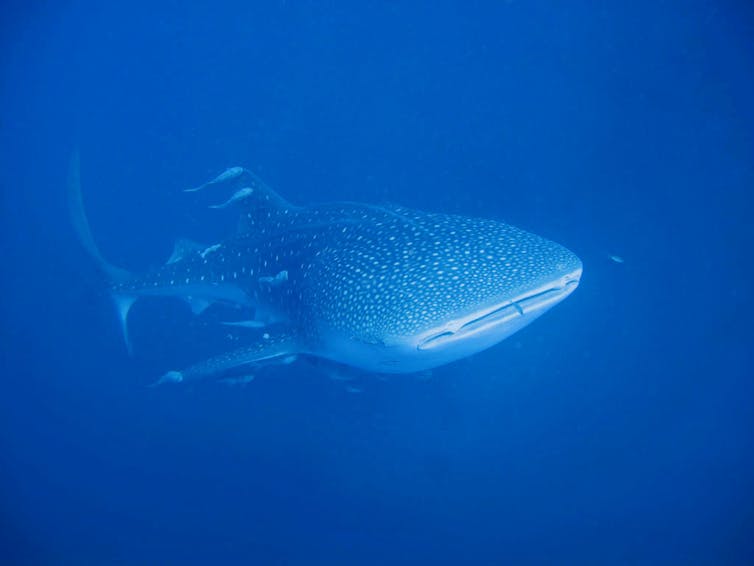
Sharks elicit outsized fear, even though the risk of a shark bite is infinitesimally small. As a marine biologist and director of the Florida Program for Shark Research, I oversee the International Shark Attack File – a global record of reported shark bites that has been maintained continuously since 1958.
We are careful to emphasize how rare shark bites are: You are 30 times more likely to be struck by lightning than be bitten by a shark. You are more likely to die while taking a selfie, or be bitten by a New Yorker. In anticipation of the anxiety that’s typically generated by the Discovery Channel’s Shark Week programming, here are a few things about sharks that are often overlooked.
A big, diverse family
Not all sharks are the same. Only a dozen or so of the roughly 520 shark species pose any risk to people. Even the three species that account for almost all shark bite fatalities – the white shark (Carcharodon carcharias), tiger shark (Galeocerdo cuvier) and bull shark (Carcharhinus leucas) – are behaviorally and evolutionarily very different from one another.
The tiger shark and bull shark are genetically as different from each other as a dog is from a rabbit. And both of these species are about as different from a white shark as a dog is from a kangaroo. The evolutionary lineages leading to the two groups split 170 million years ago, during the age of dinosaurs and before the origin of birds, and 110 million years before the origin of primates.
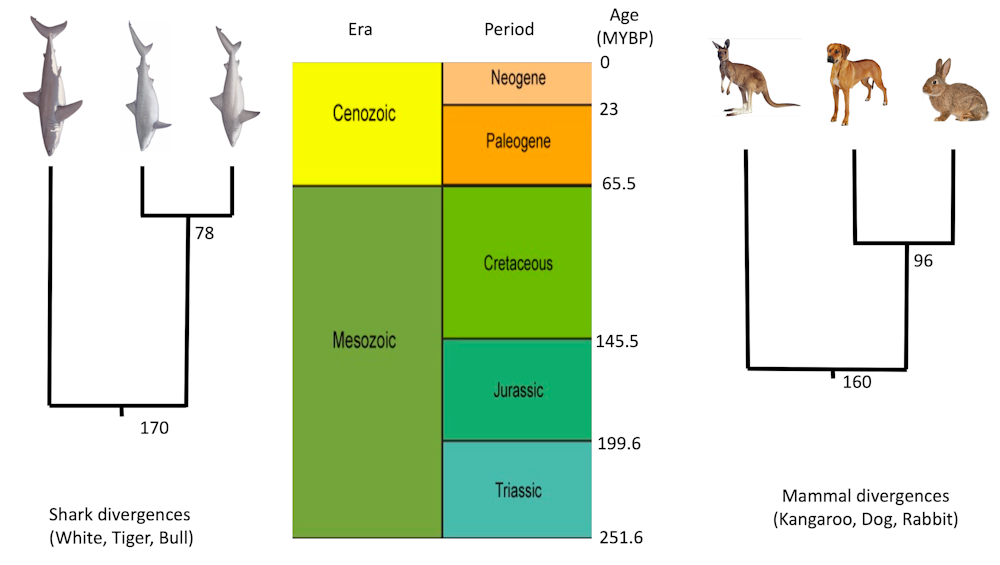
Yet many people assume all sharks are alike and equally likely to bite humans. Consider the term “shark attack,” which is scientifically equivalent to “mammal attack.” Nobody would equate dog bites with hamster bites, but this is exactly what we do when it comes to sharks.
So, when a reporter calls me about a fatality caused by a white shark off Cape Cod and asks my advice for beachgoers in North Carolina, it’s essentially like asking, “A man was killed by a dog on Cape Cod. What precautions should people take when dealing with kangaroos in North Carolina?”
Know your species
Understanding local species’ behavior and life habits is one of the best ways to stay safe. For example, almost all shark bites that occur off Cape Cod are by white sharks, which are a large, primarily cold-water species that spend most of their time in isolation feeding on fishes. But they also aggregate near seal colonies that provide a reliable food source at certain times of the year.
Shark bites in the Carolinas are by warm-water species like bull sharks, tiger sharks and blacktips (Carcharhinus limbatus). Each species is associated with particular habitats and dietary preferences.
Blacktips, which we suspect are responsible for most relatively minor bites on humans in the southeastern United States, feed on schooling bait fishes like menhaden. In contrast, bull sharks are equally at home in fresh water and salt water, and are often found near estuaries. Their bites are more severe than those of blacktips, as they are larger, more powerful, bolder and more tenacious. Several fatalities have been ascribed to bull sharks.
Tiger sharks are also large, and are responsible for a significant fraction of fatalities, particularly off the coast of volcanic islands like Hawaii and Reunion. They are tropical animals that often venture into shallow water frequented by swimmers and surfers.
Humans are not targets
Sharks do not “hunt” humans. Data from the International Shark Attack File compiled over the past 60 years show a tight association between shark bites and the number of people in the water. In other words, shark bites are a simple function of the probability of encountering a shark.
This underscores the fact that shark bites are almost always cases of mistaken identity. If sharks actively hunted people, there would be many more bites, since humans make very easy targets when they swim in sharks’ natural habitats.
Local conditions can also affect the risk of an attack. Encounters are more likely when sharks venture closer to shore, into areas where people are swimming. They may do this because they are following bait fishes or seals upon which they prey.
This means we can use environmental variables such as temperature, tide or weather conditions to better predict movement of bait fish toward the shoreline, which in turn will predict the presence of sharks. Over the next few years, the Florida Program for Shark Research will work with colleagues at other universities to monitor onshore and offshore movements of tagged sharks and their association with environmental variables so that we can improve our understanding of what conditions bring sharks close to shore.
More to know
There still is much to learn about sharks, especially the 500 or so species that have never been implicated in a bite on humans. One example is the tiny deep sea pocket shark, which has a strange pouch behind its pectoral fins.
Only two specimens of this type of shark have ever been caught – one off the coast of Chile 30 years ago, and another more recently in the Gulf of Mexico. We’re not sure about the function of the pouch, but suspect it stores luminous fluid that is released to distract would-be predators – much as its close relative, the tail light shark, releases luminous fluid from a gland on its underside near its vent.
Sharks range in form from the bizarre goblin shark (Mitsukurina owstoni), most commonly encountered in Japan, to the gentle filter-feeding whale shark (Rhincodon typus). Although whale sharks are the largest fishes in the world, we have yet to locate their nursery grounds, which are likely teeming with thousands of foot-long pups. Some deepwater sharks are primarily known from submersibles, such as the giant sixgill shark, which feeds mainly on carrion but probably also preys on other animals in the deep sea.
Sharks seem familiar to almost all of us, but we know precious little about them. Our current understanding of their biology barely scratches the surface. The little we do know suggests they are profoundly different from other vertebrate animals. They’ve had 400 million years of independent evolution to adapt to their environments, and it’s reasonable to expect they may be hiding more than a few tricks up their gills.

Gavin Naylor, Director, Florida Program for Shark Research, University of Florida
This article is republished from The Conversation under a Creative Commons license. Read the original article.