How to resolve AdBlock issue?
News

LAKE COUNTY, Calif. – County and tribal officials are reporting that new testing at sites around Clear Lake have revealed half a dozen areas with cyanobacteria levels that trigger health warnings.
Water monitoring is regularly done by the Big Valley Band of Pomo Indians and Elem Indian Colony, a valuable service that helps facilitate safe lake use.
The most recent results reflect testing largely conducted July 22, and six areas of Clear Lake demonstrated concerning levels of blue-green algae, also known as cyanobacteria.
Testing results from July 22 and July 26 showed a “danger” level triggering warnings at 20 micrograms per liter, or µg/L, in the following areas:
– Austin Park Beach/AP01 with a lab result of 48 µg/L-danger zone (red).
– Redbud Park/RED01 with preliminary testing for microcystin with Abraxis strips on July 26 due to changing lake conditions indicating a level of over 30 µg/L - danger zone (red). Lab results from testing on July 22 had shown a result of 1.0 µg/L (in the caution zone); however, lake conditions changed quickly.
– Cache Creek Shady Acres/SHADY01 with preliminary testing using Abraxis strips on July 26 due to changing lake conditions indicating a level of over 30 µg/L - danger zone (red).
– Lily Cove/LC01 with preliminary testing using Abraxis strips on July 26 due to changing lake conditions indicating a level of over 30 µg/L - danger zone (red). This site was requested to be tested by a community member due to changing lake conditions, and is not yet a regular sampling site.
– Jago Bay/JB with a result of 4.7 µg/L - caution zone (yellow).
– Buckingham Park/BP with a lab result of 2.4 µg/L - caution zone (yellow).
Clear Lake is a large and biologically rich natural lake, and offers many opportunities for aquatic recreation.
Understanding the dynamic nature of water quality, and what signs to look for when recreating, can help ensure residents and visitors safely enjoy our County’s defining feature.
Lake County Public Health urges boaters and recreational users to avoid direct contact with or use of waters containing cyanobacteria in Lake County.
The recommendation is based on the potential health risks from cyanobacteria, which is currently blooming at varying levels in the Lower Arm of Clear Lake.
Cyanobacteria can pose health risks, particularly to children and pets. Officials urge people to choose safe activities when visiting natural bodies of water, particularly where blooms are visible.
It is strongly recommended that people and their pets avoid contact with water and avoid swallowing lake water in an algae bloom area.
For current cyanotoxin lab results, please visit the Big Valley Band of Pomo Indians cyanotoxin monitoring Web site at https://www.bvrancheria.com/clearlakecyanotoxins .
For more information and resources, visit the county’s cyanobacteria pages: http://www.lakecountyca.gov/cyanobacteria/ and http://www.lakecountyca.gov/cyanohealth/ .
KELSEYVILLE, Calif. – With another wildfire season now under way, a Lake County supervisor is asking community members to come out and volunteer part of a Saturday to reduce fire risks.
Supervisor Rob Brown put out the call this week as part of the “1,000 Hands to Protect Lake County Homes” effort.
Lake County residents are well aware that disaster events affecting one of our communities have the potential to impact all of us.
Brown said that’s why community members must take every reasonable proactive measures to harden homes, neighborhoods and roadways against the threat of wildfire.
“I am asking for around 500 volunteers to donate at least part of Saturday, Aug. 17, to clean up hazardous vegetation along county roadside in the Soda Bay corridor, from the end of Highway 281 to Soda Bay, including areas of the Black Forest,” Brown said.
Most wildfires are caused by roadside vegetation, and this is one of the areas of the county at the greatest risk, Brown said. “We need to act now to protect all county residents.”
If you have one hour to give, two hours or four, your help is needed, and crews will be working from 6 to 10 a.m.
Bring your hand tools: loppers, pruners, shovels and rakes. Bring your nylon-stringed weed eaters as well.
Whether you live in the immediate area or not, Brown invites you to join him, Lake County’s Department of Public Works, Lake County Waste Solutions, California Highway Patrol, Kelseyville Fire Protection District, Kelseyville Unified School District, Kelseyville Sunrise Rotary and the Homeowners Associations of Riviera Heights, Riviera West, Clear Lake Riviera and Buckingham, in acting to reduce the risk of a major wildfire event in Lake County.
“One thousand hands can make a powerful difference for 12,000 County residents living along this corridor, the 65,000 residents of Lake County, and all of those in the region affected by air quality and other consequences whenever a major wildfire occurs,” Brown said.
Volunteers can sign up by completing the volunteer services agreement. Copies are available from the County Administrative Office, Human Resources Office and Department of Public Works, and the form is posted online.
Brown said participants will meet at Riviera Elementary School, 10505 Fairway Drive in Kelseyville. Copies of the volunteer services agreement will also be available there.
All volunteers are encouraged to dress appropriately, with hats, sunscreen, long-sleeved shirts, long pants, and gloves that can be comfortably worn in warm weather.
Water will be provided, and they are also expecting to provide gloves for those who do not own them.
Please also note, the southbound lane of Soda Bay Road, from Riviera Heights Drive to Point Lakeview Road, will be closed for the hours of the project, in order to allow volunteers to safely work and park. The county apologizes for any inconvenience.
Brown invites those with questions to call him at 707-349-2628 or emailThis email address is being protected from spambots. You need JavaScript enabled to view it. .
Supervisor Rob Brown put out the call this week as part of the “1,000 Hands to Protect Lake County Homes” effort.
Lake County residents are well aware that disaster events affecting one of our communities have the potential to impact all of us.
Brown said that’s why community members must take every reasonable proactive measures to harden homes, neighborhoods and roadways against the threat of wildfire.
“I am asking for around 500 volunteers to donate at least part of Saturday, Aug. 17, to clean up hazardous vegetation along county roadside in the Soda Bay corridor, from the end of Highway 281 to Soda Bay, including areas of the Black Forest,” Brown said.
Most wildfires are caused by roadside vegetation, and this is one of the areas of the county at the greatest risk, Brown said. “We need to act now to protect all county residents.”
If you have one hour to give, two hours or four, your help is needed, and crews will be working from 6 to 10 a.m.
Bring your hand tools: loppers, pruners, shovels and rakes. Bring your nylon-stringed weed eaters as well.
Whether you live in the immediate area or not, Brown invites you to join him, Lake County’s Department of Public Works, Lake County Waste Solutions, California Highway Patrol, Kelseyville Fire Protection District, Kelseyville Unified School District, Kelseyville Sunrise Rotary and the Homeowners Associations of Riviera Heights, Riviera West, Clear Lake Riviera and Buckingham, in acting to reduce the risk of a major wildfire event in Lake County.
“One thousand hands can make a powerful difference for 12,000 County residents living along this corridor, the 65,000 residents of Lake County, and all of those in the region affected by air quality and other consequences whenever a major wildfire occurs,” Brown said.
Volunteers can sign up by completing the volunteer services agreement. Copies are available from the County Administrative Office, Human Resources Office and Department of Public Works, and the form is posted online.
Brown said participants will meet at Riviera Elementary School, 10505 Fairway Drive in Kelseyville. Copies of the volunteer services agreement will also be available there.
All volunteers are encouraged to dress appropriately, with hats, sunscreen, long-sleeved shirts, long pants, and gloves that can be comfortably worn in warm weather.
Water will be provided, and they are also expecting to provide gloves for those who do not own them.
Please also note, the southbound lane of Soda Bay Road, from Riviera Heights Drive to Point Lakeview Road, will be closed for the hours of the project, in order to allow volunteers to safely work and park. The county apologizes for any inconvenience.
Brown invites those with questions to call him at 707-349-2628 or email

CLEARLAKE, Calif. – A Clearlake Police officer arrested two men on drugs and weapons charges on Monday afternoon following a traffic stop.
Police said Roger Daniel Vigil, 56, Clearlake, and Eugene Walker, 52, Sacramento, were taken into custody.
At about 4:30 p.m. Monday Officer Chris Kelleher was patrolling the area of Snook Avenue near Hillcrest Avenue when he stopped a vehicle for various traffic violations, police said.
The agency said Officer Kelleher contacted Vigil, who was the driver, with Walker riding in the front passenger seat.
During the traffic stop, police said Officer Kelleher located seven 12-gauge Winchester shotgun shells on Vigil, who is a convicted felon and is prohibited from possessing them.
Police said that during a search of the vehicle, Officer Kelleher located a 12-gauge Mossberg shotgun on the backseat. He also found a bag of suspected methamphetamine on the front passenger floorboard of the vehicle.
Vigil was arrested on probable cause for numerous felony firearm and drug violations. He remained in custody on Tuesday, with bail set at $50,000. He is scheduled for arraignment on Wednesday.
Walker was arrested on probable cause for a drug violation. By Tuesday he had posted bail and been released, based on jail records.


Spotted owl populations are in decline all along the West Coast, and as climate change increases the risk of wildfires in the region, these iconic animals face the real threat of losing even more of their forest habitat.
Rather than attempting to preserve the owl’s remaining habitat exactly as is, wildfire management – through prescribed burning and restoration thinning – could help save the species, argues a new paper by fire ecologists and wildlife biologists and appearing in the journal Frontiers in Ecology and the Environment.
The paper compares the plight of the owl with that of another iconic threatened species, the red-cockaded woodpecker, which has made significant comebacks in recent years – thanks, in part, to active forest management in the Southern pine forests that the woodpecker calls home.
Though the habitat needs of the two birds are different, both occupy forests that once harbored frequent blazes before fire suppression became the norm.
“In the South, the Endangered Species Act has been used as a vehicle to empower forest restoration through prescribed burning and restoration thinning, and the outcome for the red-cockaded woodpecker has been positive and enduring,” said Scott Stephens, a professor of environmental science, policy and management at the University of California, Berkeley, and lead author on the study.
“In the West, it's just totally the opposite,” Stephens added. “Even though both places physically have strong connections to frequent fire, the feeling here is that the best thing to do is to try to protect what we have and not allow the return of frequent fire – but that's really difficult when you have unbridled fires just ripping through the landscape.”
A tale of two birds
Spotted owls make their homes in the dense forests of the Western and Southwestern U.S., feeding on flying squirrels and woodrats and nesting in broken-off treetops or tree hollows.
Red-cockaded woodpeckers, meanwhile, reside in pine stands in the Southeastern U.S., provisioning nests from nest boxes or hollowed-out cavities in living pine trees and eating insects pried from under tree bark.
Development and logging have robbed both species of much of their former habitat, and their populations have both taken a hit: Partners in Flight estimates the global breeding population of spotted owls to be at 15,000 individuals.
What habitat remains is now largely protected under the Endangered Species Act – but when it comes to fire and forest management, the act has been interpreted in dramatically different ways in the two regions, said paper co-author Leda Kobziar, associate clinical professor of wildland fire science at the University of Idaho.
“In the South, the act is interpreted to support active management through forest thinning and prescribed burning, and in the West, it is interpreted to exclude most fires and active management from protected areas surrounding spotted owl nests,” Kobziar said.
One critical difference is the degree to which active management in red-cockaded woodpecker habitat provides complementary benefits. “In the South, active management is known to reduce wildfire hazards, and it benefits local economies, along with a host of other fire-dependent species. In the West, those complementary benefits are less well-defined,” Kobziar said.
Another part of the reason for the discrepancy is perceived differences in the habitat preferences of the two birds, Kobziar explained.
Red-cockaded woodpeckers live in more open, mature pine forests that result when low-intensity natural or prescribed burns limit the development of a forest midstory, where woodpecker predators take cover.
Meanwhile, spotted owls generally prefer the dense, multi-layered forests that grow when fire is excluded.
However, suppressing all fires in order to encourage growth of these dense canopies also creates conditions that are ripe for large, severe wildfires that can take out not just the smaller trees, but entire forests, obliterating swaths of owl habitat in the process.
The 2014 King fire, for example, tore through regions of the Eldorado National Forest that were home to a long-term study of the California spotted owl and caused the bird’s largest population decline in the 23-year history of the study.
“A key question to be asking is: Where would owl habitats be with more characteristic fire regimes, and could we tailor landscape conditions where these habitats are less vulnerable and more supportive of today’s wildfires?” said co-author Paul Hessburg, a research landscape ecologist with the U.S. Forest Service Pacific Northwest Research Station.
The solution would mean, “essentially creating less habitat in order to have more in the long run,” he said.
Fighting fire with fire
Before European settlement, many small to medium sized wildfires burned through the forests of the Southeastern and Western U.S., sparked by lightning or intentionally lit by native peoples to produce food, clear land or drive game.
These fires would gobble up the dead wood, seedlings and saplings that made up the forest understory, while leaving taller, older trees standing and marked with fire scars recorded in their growth rings that fire ecologists use to track the frequency of historical fires.
In the mountainous landscape of the West, these fires didn’t strike uniformly everywhere, to the potential benefit of the owls, Hessburg said.
“If I took you back in the way-back machine 200 years ago, you would have seen that fire regimes in the Cascade Mountains differed very much by topographic setting,” Hessburg said. “Ridgetops and south slopes would often get pounded with lightning and fires, and so tree cover would be sparse. But in shaded and cool valley bottoms and north slopes, you would see complex layered forests, and some of these would have been incredible owl habitats.”
Targeted restoration thinning and prescribed burning on ridgetops and dry southern slopes where fire used to be a frequent visitor, while leaving valley bottoms and northern slopes to develop into complex forest, could be a way to discourage large wildfires from ripping through vast landscapes, while maintaining owl habitat in a more fire-protected context.
New evidence also hints that owls may not be so dependent on dense understory canopies as once thought, the paper noted.
Recent findings indicate that other aspects of forest structure, particularly the presence of large, old, tall trees, may be more important to the owls.
These findings hint that prescribed burning and restoration thinning to reduce the size and severity of wildfires may not be damaging to owl habitat, even in the short term.
“We're treating the habitat as if we know precisely what habitat characteristics are preferred. It might be that these birds are tolerant of a broader range of characteristics that would enable things like fuels reduction to protect them from high-intensity wildfires,” Kobziar said.
“The South has melded fire and rare species management in a holistic way, but in the West, we're doing one or the other – (in) most places (where) we do forest restoration, we are trying to avoid owls,” Stephens said. “But the King Fire showed that owls and their habitats are vulnerable to large wildfires. More restoration thinning and prescribed burning could help us keep the habitat that we have now, modify it and actually make it more sustainable in the future.”
Other co-authors on the study include Brandon M. Collins of UC Berkeley; Raymond Davis, Joseph Ganey, James M. Guldin, Serra Hoagland, John J. Keane, Warren Montague, Malcolm North and Thomas A. Spies of the U.S. Department of Agriculture Forest Service; Peter Z. Fulé of Northern Arizona University; William Gaines of the Washington Conservation Science Institute; Kevin Hiers of the Tall Timbers Research Station; Ronald E. Masters of the University of Wisconsin-Stevens Point and Ann E. McKellar of Environment and Climate Change Canada.
Kara Manke writes for the UC Berkeley News Center.

LAKE COUNTY, Calif. – A Clearlake woman has been taken into custody for setting a Sunday morning fire in Lucerne.
Kristina Loraine Doll, 25, is charged in the case, according to Bruce Lang, a fire prevention specialist for Cal Fire.
Shortly before 11 a.m. Sunday Cal Fire and Northshore Fire responded to a vegetation fire at Highway 20 and Rancho Vista Road in Lucerne, Lang said.
Lang said fire personnel quickly extinguished the 10-foot by 10-foot spot, measuring approximately one-tenth of an acre.
About an hour later, just after noon, Cal Fire law enforcement officers arrested Doll on a felony charge of burning of a forest as a result of malicious arson, Lang said. Cal Fire was assisted by the California Highway Patrol.
Doll, whose profession is listed on her booking sheet as unemployed, was booked into the Lake County Jail about half an hour after her Sunday afternoon arrest, with bail set at $50,000.
She remained in custody on Tuesday, the same day she was scheduled for arraignment in Lake County Superior Court, according to booking records.
Jail records show that Doll has had previous arrests for obstructing officers and disorderly conduct involving alcohol.
Doll’s arrest was the second for arson local authorities reported making over the weekend.
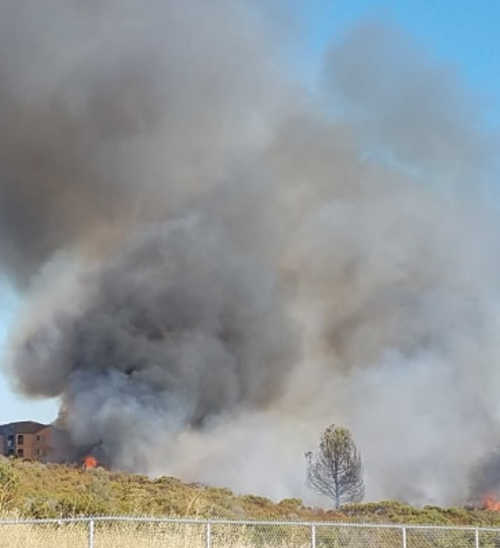
On Saturday, the Clearlake Police Department arrested Adam Joseph Miller, 28, of Clearlake for a fire on Dam Road Saturday evening that threatened the Cache Creek Apartment complex, as Lake County News has reported.

CLEARLAKE, Calif. – The Clearlake Police Department has identified the man arrested on Saturday after witnesses said he set a fire that burned near a Clearlake shopping center and apartment complex.
Adam Joseph Miller, 28, of Clearlake was arrested shortly before 8 p.m. Saturday, about two hours after the fire was first reported, authorities reported.
At 5:40 p.m. Saturday, Clearlake Police officers responded with firefighters to the field behind Cache Creek Apartments, and near the Tractor Supply and Big 5 Sporting Goods stores, for a grass fire, as Lake County News has reported.
Upon their arrival, the officers, assisted by California Highway Patrol officers, evacuated Buildings C and D at the apartments, police said.
While attending to evacuations, officers also received information regarding a suspect who possibly started the fire, according to the Clearlake police report.
Based on the investigation, police said Miller was identified as the subject responsible for setting the fire.
One of the witnesses, whose campsite was burned down, saw Miller after he had initially left the area, gave chase and confronted him while having a bystander contact the police. Authorities said several officers arrived and took custody of Miller.
Based on statements obtained during the investigation so far, police believe that Miller intentionally set the fire.
Miller was booked into the Lake County Jail on suspicion of arson, with bail set at $100,000, according to booking records. He remained in custody on Tuesday.
His booking sheet shows he is scheduled for a Tuesday arraignment in Lake County Superior Court.
Police said the investigation is ongoing and includes investigators from the Lake County Fire Protection District and Cal Fire.
Anyone with additional information regarding this incident is asked to contact Arson Investigator Brice Trask with Lake County Fire at 707-994-2170.