 How to resolve AdBlock issue?
News
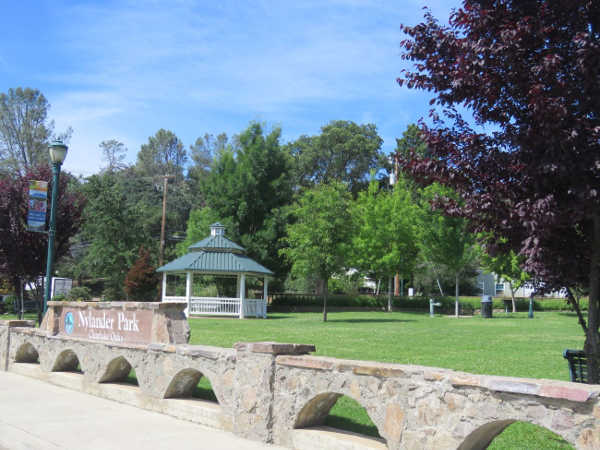
CLEARLAKE OAKS, Calif. – If you're out and about around the lake there are two mini-parks in Clearlake Oaks where you can picnic, fish or simply bird-watch – Clarks Island and Nylander Park. Both provide a shady respite from a busy day.
According to the Konocti Regional Trails Web site, Clarks Island, which in 1.48 acres, is located off of Highway 20 and was purchased by the county of Lake/Redevelopment Agency in 2007 with the idea of an all-encompassing plan for environmental sustainability, Native American flora, interpretive panels and more.
As reported in the Lake County News in 2010, a unique plan to help the native tule reeds proliferate was undertaken by volunteers at this site.
Surprisingly enough, a company called Floating Islands West undertook the venture to launch a 150-foot manmade island made of thousands of recycled plastic bottles, and was set into place with two large anchors and held thriving tule reeds.
The idea behind the floating island concept is that there is an opportunity to restore habitat, filter out nitrates, phosphates and other detrimental pollutants from waterways, while also controlling erosion of lake and stream banks. There have been lengthy efforts to obtain grants and other funding for this pilot project to sustain our waters.
River otters and a wide variety of avian species can be spotted here. Although I don't see the otter on this particular day, there are coots and white egrets in the water.

While observing a mallard family at Clarks Island I watch as they deftly glide about the lake dining on flora. Then, dragonflies appear out of the corner of my eye – those messengers of summer have emerged from their aquatic, brown nymph period to consume hundreds of mosquitoes each day.
Nearby, across the highway from Clarks island is lovely Nylander Park, which celebrated its completion in 2008.
As the Lake County News reported then, the land upon which the park sits was purchased from Red and White Market owner Gary Nylander, hence, the park's name.
Although it is only one acre in size, it sports a relaxing atmosphere with its 40 trees that include crepe myrtles, Chinese pistache, gingko biloba, flowering plums and more. Its tables, benches and barbeques all beckon you to spend time upon its cool, greensward.
As previously reported by Elizabeth Larson, the area that the park rests on was once the location of the town's post office, barber shop and other downtown shops.
At the park dedication in 2008, Nylander spoke of his grandmother, Cora Nylander, who passed away at age 104, having arrived in Clearlake Oaks with her husband 75 years ago, when they ran the grocery store for 50 years. the park now has a display of ceramic tiles which honor those who assisted in making the park a reality.
Kathleen Scavone, M.A., is a retired educator, potter, freelance writer and author of “Anderson Marsh State Historic Park: A Walking History, Prehistory, Flora, and Fauna Tour of a California State Park” and “Native Americans of Lake County.”


On July 4 and 5, two major earthquakes, followed by several thousand smaller ones, struck Southern California. Their size and the damage they caused captured attention around the country.
What tends to get much less notice from the public is what can be done to prevent catastrophic damage from big quakes.
Had the epicenter of these latest large California earthquakes been closer to downtown Los Angeles, tens of thousands of apartment buildings could have been damaged or collapsed. Consequently, structural engineers are calling on legislators to prepare for and prevent earthquake damage by crafting new and improved building codes. Restricting where developers can put up new skyscrapers, or requiring that new residential buildings be designed to withstand high-magnitude earthquakes, could ultimately save structures and lives.
For the most part, though, there’s just not that much general demand for preventative policies. Why?
Might low awareness about earthquake risks help explain why the public doesn’t demand policies aimed at mitigating the loss of life and property in the event of a major earthquake? Andrew Rohrman, a civil engineer, and I, a political scientist, teamed up to investigate this question.

Politicians give people what they want
For an example of inconsistent and inadequate earthquake preparedness regulations, look at San Francisco. While the city has strict laws on the books to prevent damage to hospitals and schools, regulations regarding its 160 skyscrapers are significantly more lax. A 50-story tower in downtown San Francisco has the same building strength requirements as a structure with only five stories.
Although scientists can’t precisely predict when and where earthquakes will strike, a 2014 U.S. Geological Survey report suggested there’s a 72% chance that an earthquake of 6.7 magnitude or greater will hit the Bay Area within the next 25 years. If the epicenter of an earthquake of that size strikes close to downtown San Francisco, as was the case in the city’s catastrophic 1906 earthquake, liquefaction – that is, the destabilization of soil – could threaten the structural integrity of dozens of large buildings.
Why are San Francisco’s disaster prevention policies so weak? The answer could be due to low public demand. Policymakers have an electoral incentive to institute changes that are important to the public since voters can get rid of politicians who don’t respond to their policy preferences. Absent that demand, legislators may avoid pursuing this type of action as other issues take precedence.
Researchers have found that Americans don’t prioritize local policies aimed at earthquake disaster prevention. That holds true even for those living in areas where earthquakes are relatively common. Although there is some evidence that Americans reward politicians who allocate funds to respond to natural disasters after they occur, there’s just not much support for policies to prevent damage and loss of life in the first place.
So, why isn’t the public demanding more from their policymakers to mitigate the risks posed by major earthquakes? Our research set out to answer this question.
Recognizing real risks increases policy support
The low demand for preventative policies in the U.S. could stem from the fact that many Americans, even those who regularly experience earthquakes, inaccurately assess the likelihood that they’ll experience a big one.
For example, surveys of Southern California residents suggest that people incorrectly perceive themselves as being at fairly modest risk of experiencing a major earthquake. Others have documented high levels of public misinformation about earthquake risks and predictability – such as the idea that odd animal behavior can signal an impending earthquake.
To study how risk perceptions might shape public policy support, we surveyed 855 Americans who reside in California, Oregon, Washington, Alaska or Hawaii.
We asked people to tell us what they thought the probability was, on a 0 to 100 scale, that a “major earthquake causing catastrophic damage” will occur where they live within the next 20 years. This was their perceived earthquake risk score.
Then we looked at a measure developed by seismologists to determine the objective probability of a major earthquake – known as “peak ground acceleration” – based on the zip code of each respondent. That way we could compare their perceived probability with the actual risk.
Additionally, we asked respondents how much they support or oppose implementing stricter building code requirements, investing in public awareness campaigns about earthquake preparedness and restricting where private developers can build large buildings. These responses on a seven-point scale, from 1 (strongly oppose) to 7 (strongly support), gave us a measure of support for preventative public policy.
We found only a modest relationship between objective earthquake risk (peak ground acceleration) and perceptions of earthquake risk. Although people who live in highly at-risk zip codes tend to feel more at risk than people living in less at-risk areas, it wasn’t by much. Alarmingly, we found that people living in some of the most at-risk zip codes in the country, like those in and surrounding the Bay Area, perceived their risk as being virtually the same as those living in areas where large earthquakes are highly unlikely, as in northeastern Oregon and Washington.
Critically, though, people who live in highly at-risk areas, and who accurately recognize that they are at risk, express significantly higher levels of policy support than people who live in at-risk areas and inaccurately assess their risk. These individuals also tend to express significantly higher levels of support than people who live in comparatively lower risk areas.

A job for improved science communication
Our research has important implications for public policy. By showing that people who recognize they live in at-risk areas are, in fact, more supportive of policy efforts to mitigate earthquake damages, we think the public certainly has the potential to push lawmakers toward preventative policy action.
Unfortunately, our research suggests that many Americans living in at-risk areas may hold risk perceptions that are not in line with reality. This finding underscores how important it is for local governments and science communicators to try to communicate earthquake risks to people living in hazardous areas.
Scientists and engineers know how to build cities in ways that would minimize the damage from a major quake. But for the public to demand policies that would help preempt, rather than simply respond to, seismic disasters, they need a clear understanding of the risks they face.
Matt Motta, Assistant Professor of Political Science, Oklahoma State University
This article is republished from The Conversation under a Creative Commons license. Read the original article.
Dogs available for adoption this week include mixes of boxer, Cane Corso mastiff, Chihuahua, Labrador Retriever, mastiff, miniature pinscher, pit bull, Rhodesian Ridgeback, spaniel and wirehaired terrier.
Dogs that are adopted from Lake County Animal Care and Control are either neutered or spayed, microchipped and, if old enough, given a rabies shot and county license before being released to their new owner. License fees do not apply to residents of the cities of Lakeport or Clearlake.
If you're looking for a new companion, visit the shelter. There are many great pets hoping you'll choose them.
The following dogs at the Lake County Animal Care and Control shelter have been cleared for adoption (additional dogs on the animal control Web site not listed are still “on hold”).

Male Rhodesian Ridgeback-pit bull terrier
This male Rhodesian Ridgeback-pit bull terrier puppy has a short tan and white coat.
He is in kennel No. 3, ID No. 12607.

Male Rhodesian Ridgeback-pit bull terrier
This male Rhodesian Ridgeback-pit bull terrier has a short tan and black coat.
He is in kennel No. 4, ID No. 12603.
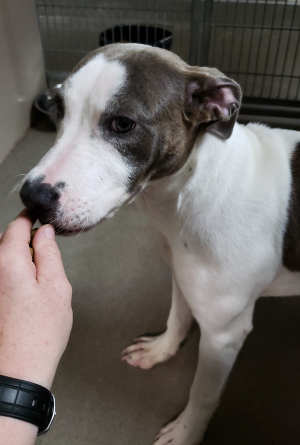
Female pit bull
This female pit bull has a short white and brindle coat.
She is in kennel No. 5, ID No. 12601.

Female miniature pinscher
This female miniature pinscher has a short tan and white coat.
She has been spayed.
She is in kennel No. 6, ID No. 12611.

Male wirehaired terrier
This male wirehaired terrier has a short black and tan coat.
He is in kennel No. 8, ID No. 12622.

Male Chihuahua
This male Chihuahua has a short tan coat.
He’s in kennel No. 13, ID No. 12583.

‘Sadie’
“Sadie” is a female spaniel with a long black coat.
She already has been spayed.
She’s in kennel No. 18, ID No. 12542.

‘Rocky’
“Rocky” is a male pit bull-mastiff with a short black coat.
Shelter staff said he does well with others, and is a sweet and loving dog.
He’s in kennel No. 21, ID No. 12515.

‘Roxy’
“Roxy” is a female pit bull with a short black and white coat.
Shelter staff said she is a very submissive and loving dog.
She’s in kennel No. 22, ID No. 12516.

Male pit bull terrier
This male pit bull terrier has a short brown coat.
He is in kennel No. 25, ID No. 12613.

‘Cash’
“Cash” is a male pit bull terrier mix with a short black and white coat.
Shelter staff said Cash does well with others, loves people and walks well on a leash.
He has been neutered.
He’s in kennel No. 27, ID No. 12413.

‘Buddy’
“Buddy” is a male pit bull terrier mix with a short tricolor coat.
He’s in kennel No. 31, ID No. 12508.
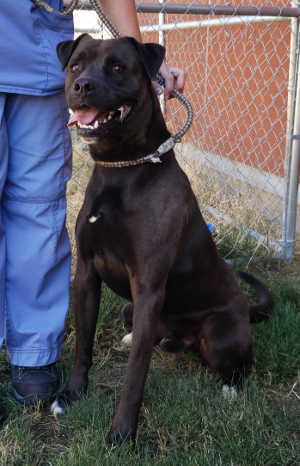
Male boxer
This male boxer has a short black coat.
He’s in kennel No. 32, ID No. 12512.
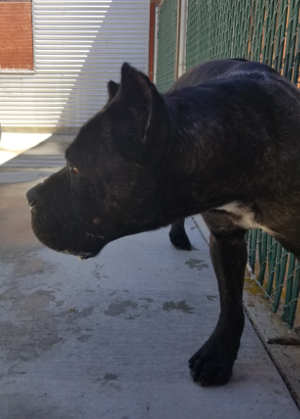
‘Bear’
“Bear” is a male Cane Corso mastiff with a short brown coat.
He is in kennel No. 34, ID No. 11456.
Lake County Animal Care and Control is located at 4949 Helbush in Lakeport, next to the Hill Road Correctional Facility.
Office hours are Monday through Friday, 11 a.m. to 5 p.m., and 11 a.m. to 3 p.m., Saturday. The shelter is open from 11 a.m. to 4 p.m., Monday through Friday and on Saturday from 11 a.m. to 3 p.m.
Visit the shelter online at http://www.co.lake.ca.us/Government/Directory/Animal_Care_And_Control.htm.
For more information call Lake County Animal Care and Control at 707-263-0278.
Email Elizabeth Larson at
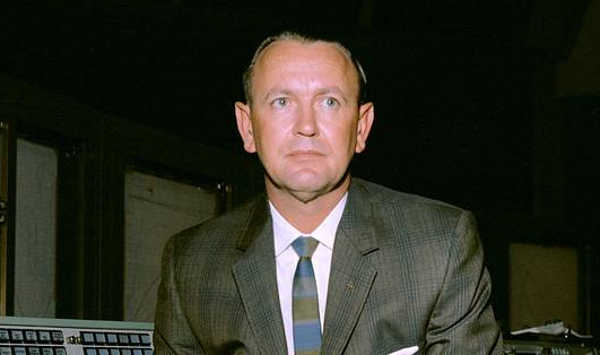
“Scientists say there is no life on the moon. I look at the moon today, see the faces from NASA, industry, science and academe who brilliantly sent Americans to that place, and I know differently. The people of Mercury, Gemini, and Apollo are blossoms on the moon. Their spirits will live there forever. I was part of the crowd, then part of leadership that opened space travel to human beings. We threw a narrow flash of light across our nation’s history. I was there at the best of times.” – Chris Kraft in "Flight: My Life in Mission Control"
Christopher C. Kraft, Jr., who died July 22, 2019, created the concept of NASA's Mission Control and developed its organization, operational procedures and culture, then made it a critical element of the success of the nation's human spaceflight programs.
“America has truly lost a national treasure today with the passing of one of NASA’s earliest pioneers – flight director Chris Kraft," NASA Administrator Jim Bridenstine said in a statement. "We send our deepest condolences to the Kraft family.”
Bridenstine continued, “Chris was one of the core team members that helped our nation put humans in space and on the Moon, and his legacy is immeasurable. Chris’ engineering talents were put to work for our nation at the National Advisory Committee for Aeronautics, before NASA even existed, but it was his legendary work to establish mission control as we know it for the earliest crewed space flights that perhaps most strongly advanced our journey of discovery. From that home base, America’s achievements in space were heard across the globe, and our astronauts in space were anchored to home even as they accomplished unprecedented feats."
Kraft – whose full name was Christopher Columbus Kraft – joined the NASA Space Task Group in November 1958 as NASA's first flight director, with responsibilities that immersed him in mission procedures and challenging operational issues.
He personally invented the mission planning and control processes required for crewed space missions, in areas as diverse as go/no-go decisions, space-to-ground communications, space tracking, real-time problem solving and crew recovery.
During the Apollo program, Kraft became the Director of Flight Operations at MSC, responsible for overall human spaceflight mission planning, training and execution.
His leadership in this critical area continued through the Apollo 12 mission in 1969, at which time he became deputy director of the center. He served as the center director from January 1972 until his retirement in August 1982, playing a vital role in the success of the final Apollo missions, the Skylab crewed space station, the Apollo-Soyuz Test Project and the first flights of the space shuttle.
Kraft was born Feb. 28, 1924 in Phoebus, Virginia, now a part of Hampton, Va. There he attended high school and developed strong interests in non-aeronautical topics such as baseball, and drum and bugle corps. Unlike many of his aerospace peers later in his career, he wasn't interested in airplanes.
After high school, he wanted to attend college, but didn't know where or what he should study. He chose Virginia Polytechnic Institute (VPI, now Virginia Tech) and enrolled in mechanical engineering in 1941. He credits his experiences in the military Corps of Cadets at the institute for the foundation of his leadership training that would later characterize his personality in his NASA career.
By 1942, the VPI campus was being depleted of students because of the war effort, and Kraft patriotically decided to join the Navy as an aviation cadet.
Unfortunately, his right hand had been severely burned when he was 3 years old, and he was declared unfit for military service. Ironically, his old hand injuries did not hamper his athletic prowess – he played catcher on the VPI baseball team.
A professor in the engineering department was an enthusiastic airplane devotee and passed his interest on to young Kraft. An elective course in basic aerodynamics inspired him to major in aeronautical engineering. In 1944, he graduated with one of the first degrees in that field awarded by the Institute.
Kraft was familiar with the work of the federal National Advisory Commitee on Aeronautics – NASA's predecessor agency – at Langley, which was located only about 7 miles from his home. However, he felt that Langley was too close to home, and accepted a job offer from Chance Vought in Connecticut – with a back-up offer from the NACA also in hand. After experiencing first-day bureaucratic frustration at Vought, he opted to accept his back-up offer.
So, in January 1945, he returned to Virginia to join the staff of the Langley Memorial Aeronautical Laboratory. Kraft was assigned to the Flight Research Division under the leadership of Robert Gilruth and Hewitt Phillips, men he held in awe.
He contributed to many critical programs that had been conceived by Gilruth, including evaluations of the flying qualities of aircraft, and free-fall model tests to measure transonic and supersonic aerodynamics.
He served as project engineer on flying-qualities investigations of the P-51H, an advanced version of the famous Mustang. He also conducted analytical work on gust alleviation, and directed a pioneering study of potentially dangerous wake turbulence caused by trailing vortices.
With the advent of the jet age of the 1950s, he was assigned as project engineer on flight tests of the Navy's high-priority Vought F8U Crusader, which was exhibiting numerous birthing problems in its earliest versions.
The problems uncovered by Langley flight tests included unacceptable g-force control behavior during maneuvers, which was determined to result from unintentional pivoting of the unique movable wing used by the configuration.
Working with Langley test pilot Jack Reeder, Kraft identified the structural source of the problem, and took on the unpleasant job of telling the Navy that its new first-line aircraft was potentially dangerous.
His warnings were heeded by Navy management, resulting in grounding of the F8U fleet, much to the chagrin of many operators of the new aircraft. He then encountered one of the most contentious members of the Navy's Bureau of Aeronautics, who questioned the Langley results and doubted the conclusions drawn by the NACA.
That Marine Major was named John Glenn.
Following a detailed examination of the Langley study results with Kraft and Reeder, and interviews with Navy pilots who flew the aircraft, Glenn was convinced and became a believer.
The F8U was subsequently redesigned, as recommended by Kraft and his associates at Langley, and served the nation as an outstanding fighter during the Vietnam War.
Since his retirement from NASA, Kraft has consulted for numerous companies including IBM and Rockwell International, served as a Director-at-Large of the Houston Chamber of Commerce, and as a member of the Board of Visitors at Virginia Tech.
In 2001, he published an autobiography entitled "Flight: My Life in Mission Control." His book is a detailed discussion of his life through the end of the Apollo program, and was a New York Times bestseller.
He has received numerous awards and honors for his work. These include the NASA Outstanding Leadership Medal; four NASA Distinguished Service Medals; the Distinguished Alumnus Citation from Virginia Tech, in 1965; the Distinguished Citizen Award, given by the City of Hampton, Virginia, in 1966; the John J. Montgomery Award, in 1963; the Goddard Memorial Trophy, awarded by the National Space Club, in 1979; and the John F. Kennedy Astronautics Award for 1996. In 1999, he was presented the Rotary National Award for Space Achievement for which he was cited as "A driving force in the U.S. human space-flight program from its beginnings to the Space Shuttle era, a man whose accomplishments have become legendary."
In 2006, NASA honored Christopher C. Kraft, Jr., for his key involvement in America's space programs with the Ambassador of Exploration Award, given to astronauts and other key individuals who participated in the Mercury, Gemini, and Apollo space programs, for realizing America's vision of space exploration from 1961 to 1972.
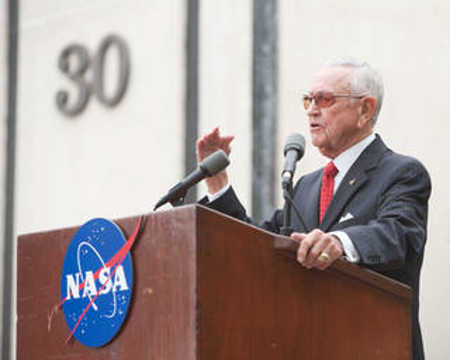
On April 4, 2011, NASA named its Building 30 Mission Control Center at the Johnson Space Center in his honor, in recognition of his service to the nation and its space programs. The Christopher C. Kraft, Jr., Mission Control Center has now operated for 50 years in support of space missions. At the naming ceremony, Flight Director Glynn Lunney commented "The Control Center today…is a reflection of Chris Kraft."
Chris Kraft married his high school sweetheart, Betty Anne Turnbull, in 1950. They have a son and a daughter, Gordon and Kristi-Anne.
THIS STORY HAS BEEN UPDATED.
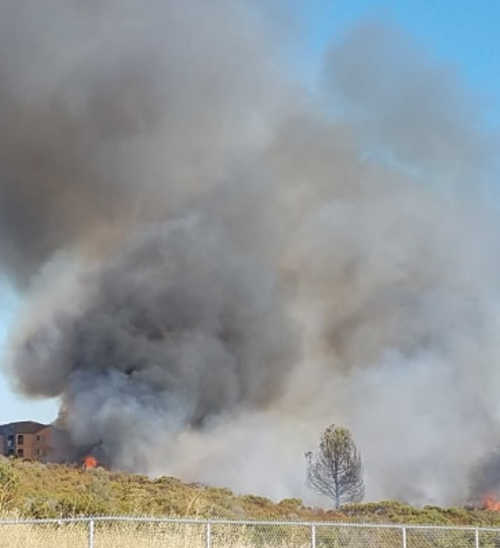
CLEARLAKE, Calif. – Firefighters are working to stop a wildland fire near the Clearlake Walmart that has led to immediate evacuation of a nearby apartment complex.
The fire on Dam Road, near Walmart and behind Tractor Supply Co. and Big 5 Sporting Goods, was dispatched just before 5:45 p.m. Saturday.
Incident command’s initial estimate of fire size was 2 to 3 acres with a rapid rate of spread in heavy brush, with an east wind on it. Immediate evacuation of the nearby Cache Creek Apartments was ordered.
The fire is reported to be spotting and moving toward the apartment complex’s C and D buildings.
Authorities also were dispatched to look for a male subject that reporting parties said may have been responsible for setting the fire.
Helicopters and tankers are making drops on the fire as people are being moved out of the area.
A witness reported that the fire appears to be burning in the area of a homeless camp and hasn’t yet reached the apartments.
The last size estimate at about 6:10 p.m. put the fire at between four and five acres.
Shortly afterward, incident command received a report of a spot off Boyles and Eighth avenues, but firefighters said they couldn’t find a spot fire there.
Law enforcement is working to clear traffic at the shopping center, where cars are getting blocked in and preventing fire traffic, according to radio reports.
The Clearlake Police Department sent out a Nixle alert asking people to avoid the area of Highway 53 and Dam Road to Lake Street.
Incident command said forward progress stopped as of just before 6:40 p.m. At that point, the size was estimated to be holding between three and four acres.
The evacuation order had been lifted for buildings A, B and C at Cache Creek Apartments as of 8:15 p.m. The order for building D residents was lifted about 20 minutes later, officials said.
Lake County Fire and Cal Fire are in unified command on the incident.
More information will be posted as it becomes available.
Email Elizabeth Larson at
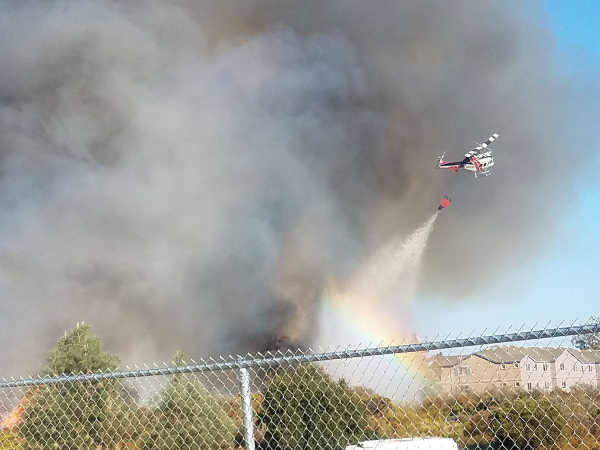
Firefighters were first dispatched to the blaze in the 4700 block of West 40th Avenue at Arnold Avenue in Clearlake at 2:45 a.m. Saturday, according to radio reports.
The first units on scene found a fully involved structure with multiple other nearby homes threatened, power lines down with high tension lines burning and read to fall, based on scene reports.
Witnesses reported that the house on fire was a large A-frame at the corner of W. 40th and Arnold avenues, which later was confirmed by the address given by incident command.
Three people were reported to have burn injuries, firefighters reported.
Lake County Fire Protection District requested engines from Cal Fire respond to assist.
Pacific Gas and Electric also was asked to come to the scene, as firefighters reported difficulty accessing the site due to the downed or burning power lines.
Shortly after 3 a.m., the Clearlake Police Department issued a Nixle alert directing people to evacuate the nearby areas on W. 40th Avenue and Hillcrest from Carrol Avenue to Lasky Avenue, and to avoid the area.
Incident command reported that the burning structure was very large and all units were in defensive mode, attempting to protect surrounding structures until they could contain the fire.
Just after 3:30 a.m., Clearlake Police issued another alert, directing people to stay away from the area between West 40th Avenue from Old Highway 53 to Hillcrest Avenue while fire crews worked in the area.
Police reported at about 3:45 a.m. that the fire was knocked down, but that people should continue to avoid the area.
Incident command said just after 4 a.m. that mop up was anticipated to take six hours.
Several units were released at about 4:45 a.m., with some units remaining at the site to work on mop up.
Additional details will be published as they become available.
Email Elizabeth Larson at