 How to resolve AdBlock issue?
News

How can a planet be "hotter than hot?" The answer is when heavy metals are detected escaping from the planet's atmosphere, instead of condensing into clouds.
Observations by NASA's Hubble Space Telescope reveal magnesium and iron gas streaming from the strange world outside our solar system known as WASP-121b.
The observations represent the first time that so-called "heavy metals" – elements heavier than hydrogen and helium – have been spotted escaping from a hot Jupiter, a large, gaseous exoplanet very close to its star.
Normally, hot Jupiter-sized planets are still cool enough inside to condense heavier elements such as magnesium and iron into clouds.
But that's not the case with WASP-121b, which is orbiting so dangerously close to its star that its upper atmosphere reaches a blazing 4,600 degrees Fahrenheit.
The temperature in WASP-121b's upper atmosphere is about 10 times greater than that of any known planetary atmosphere. The WASP-121 system resides about 900 light-years from Earth.
"Heavy metals have been seen in other hot Jupiters before, but only in the lower atmosphere," explained lead researcher David Sing of the Johns Hopkins University in Baltimore, Maryland. "So you don't know if they are escaping or not. With WASP-121b, we see magnesium and iron gas so far away from the planet that they're not gravitationally bound."
Ultraviolet light from the host star, which is brighter and hotter than the Sun, heats the upper atmosphere and helps lead to its escape.
In addition, the escaping magnesium and iron gas may contribute to the temperature spike, Sing said. "These metals will make the atmosphere more opaque in the ultraviolet, which could be contributing to the heating of the upper atmosphere," he explained.
The sizzling planet is so close to its star that it is on the cusp of being ripped apart by the star's gravity. This hugging distance means that the planet is football shaped due to gravitational tidal forces.
"We picked this planet because it is so extreme," Sing said. "We thought we had a chance of seeing heavier elements escaping. It's so hot and so favorable to observe, it's the best shot at finding the presence of heavy metals. We were mainly looking for magnesium, but there have been hints of iron in the atmospheres of other exoplanets. It was a surprise, though, to see it so clearly in the data and at such great altitudes so far away from the planet. The heavy metals are escaping partly because the planet is so big and puffy that its gravity is relatively weak. This is a planet being actively stripped of its atmosphere."
The researchers used the observatory's Space Telescope Imaging Spectrograph to search in ultraviolet light for the spectral signatures of magnesium and iron imprinted on starlight filtering through WASP-121b's atmosphere as the planet passed in front of, or transited, the face of its home star.
This exoplanet is also a perfect target for NASA's upcoming James Webb Space Telescope to search in infrared light for water and carbon dioxide, which can be detected at longer, redder wavelengths. The combination of Hubble and Webb observations would give astronomers a more complete inventory of the chemical elements that make up the planet's atmosphere.
The WASP-121b study is part of the Panchromatic Comparative Exoplanet Treasury (PanCET) survey, a Hubble program to look at 20 exoplanets, ranging in size from super-Earths (several times Earth's mass) to Jupiters (which are over 100 times Earth's mass), in the first large-scale ultraviolet, visible, and infrared comparative study of distant worlds.
The observations of WASP-121b add to the developing story of how planets lose their primordial atmospheres. When planets form, they gather an atmosphere containing gas from the disk in which the planet and star formed. These atmospheres consist mostly of the primordial, lighter-weight gases hydrogen and helium, the most plentiful elements in the universe. This atmosphere dissipates as a planet moves closer to its star.
"The hot Jupiters are mostly made of hydrogen, and Hubble is very sensitive to hydrogen, so we know these planets can lose the gas relatively easily," Sing said. "But in the case of WASP-121b, the hydrogen and helium gas is outflowing, almost like a river, and is dragging these metals with them. It's a very efficient mechanism for mass loss."
The results will appear online today in The Astronomical Journal.
The Hubble Space Telescope is a project of international cooperation between NASA and ESA (European Space Agency). NASA's Goddard Space Flight Center in Greenbelt, Maryland, manages the telescope. The Space Telescope Science Institute (STScI) in Baltimore, Maryland, conducts Hubble science operations. STScI is operated for NASA by the Association of Universities for Research in Astronomy in Washington, D.C.

LAKEPORT, Calif. – The Lakeport Police Department is investigating two new break-ins that occurred at city businesses, the latest in a string of burglaries reported in recent weeks.
Just after 10 p.m. Wednesday Lakeport Police officers responded to Classic Auto Body for a report of a burglary.
Police officers learned during the investigation that a subject had made entry into the business through a side door. Inside of the business officers located several tools suspected to have been used in the commission of the crime. It is unknown at this time if the suspect stole anything from the business, police said.
Then, shortly after 8 a.m. Thursday, officers responded to West Lake Auto Center for a report of a burglary, according to police.
Police said a subject had cut the lock to the chain of the front parking lot and then continued to the locked and gated back parking lot where they made entry into a garage where keys to the vehicles in the back lot were stored.
It was determined that the burglar then stole approximately 30 keys from the garage as well as various tools.
The subject then used the stolen keys to steal a silver 2012 Chevy Cruz LT – license plate 6SSZ964 – similar to the one pictured above. The police department said officers collected various items of evidence on scene that are suspected of being used in the commission of the burglary.
Police suspect that these two burglary incidents are related.
If you locate the stolen vehicle please call your local police department or dial 911. Do not confront any potential suspects who may be associated with or occupying the vehicle.
The Wednesday and Thursday break-ins are the latest in a series of burglaries and thefts the Lakeport Police Department has responded to in recent weeks.
The Lakeport Police Department urges community members to report suspicious activity, persons and vehicles, and to remember to lock doors to vehicles and buildings to help prevent the occurrence of theft and burglary.
Police are asking for the public’s assistance in coming forward with any information that will lead to the identification of a suspect.
Anyone with information is encouraged to contact Lakeport Police Officer Jonathon Reynolds at 707-263-5491, Extension 121, by sending a private message on our Facebook page @LakeportPolice, or by sending us an anonymous message through Nixle on your cellular telephone by texting the words TIP LAKEPORT followed by your message to 888777.
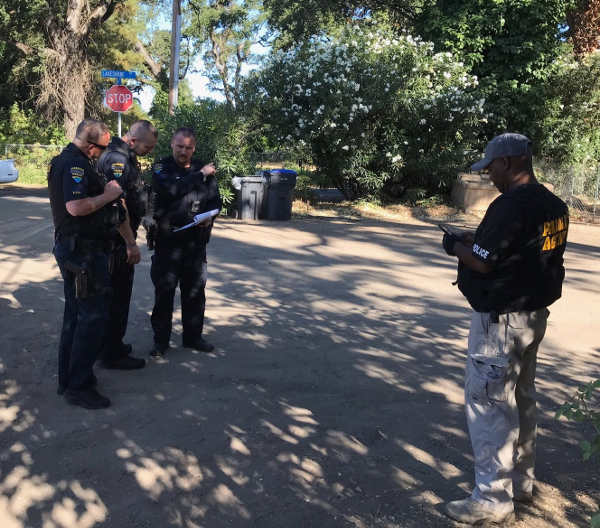
CLEARLAKE, Calif. – Authorities this week conducted a special enforcement sweep in Clearlake that netted 10 arrests.
On Wednesday, the Clearlake Police Department, California Department of Corrections and Rehabilitation Parole and Lake County Probation conducted the operation across the city.
The Clearlake Police Department said the operation included 27 specific locations of subjects known to be on active state parole, post release community supervision or PRCS, or probation.
Out of those locations, police said 10 subjects were arrested, including five felony and five misdemeanor arrests.
The charges included parole violations, PRCS violations, probation violations, possession of narcotics, possession of controlled substance paraphernalia, possession of nitrous oxide, active warrants and unlawful entry in a red-tagged residence.
At the locations where subjects were not arrested, police said compliance checks were conducted to confirm addresses and that the specific terms and conditions of the parole or probation status were being adhered to. The operation ended with proactive traffic enforcement.
Police said these special enforcement operations supplement their day-to-day efforts to make Clearlake a cleaner, safer city.
The kennels also have many dogs that need to be reunited with their owners. To find the lost/found pet section, click here.
The following dogs are ready for adoption.

‘Bernard’
“Bernard” is a male Staffordshire Bull Terrier mix with a short brindle and white coat.
He already has been neutered.
He is No. 280.

‘Blue’
“Blue” is a male Staffordshire Bull Terrier with a short blue and white coat.
He is No. 2420.

‘Buddy’
“Buddy” is a male Labrador Retriever mix with a short black coat with white markings.
He is No. 2332.

‘Cadbury’
“Cadbury” is a female Staffordshire Bull Terrier mix with a smooth medium-length beige coat.
She is No. 1215.

‘Casanova’
“Casanova” is a male German Shepherd mix with a short blond and gray coat.
He is No. 2457.

‘Frank’
“Frank” is a male American Staffordshire Terrier mix with a short black and white coat.
He is No. 2345.

‘Hamilton’
“Hamilton” is a male German Shepherd with a medium-length brown and black coat.
He is No. 2177.

‘Marley’
“Marley” is a male Labrador Retriever mix with a short tan coat.
He is No. 2430.

‘Melonie’
“Melonie” is a female American Pit Bull Terrier mix with a short red and white coat.
She is No. 2428.

‘Mira’
“Mira” is a female Queensland Heeler mix with a short red and white coat.
She is No. 2412.

‘Panther’
“Panther” is a female Staffordshire Bull Terrier mix with a short black and white coat.
She is No. 2418.

‘Snowflake’
“Snowflake” is a male Chihuahua with a white coat.
He is No. 1864.

‘Sturgill’
“Sturgill” is a male Labrador Retriever mix with a medium-length yellow coat.
He is No. 2460.

‘Tyson’
“Tyson” is a male American Staffordshire terrier mix with a medium-length gray and white coat.
He is No. 1863.

‘Wiley’
“Wiley” is a male German Shepherd mix with a medium-length black and brindle coat.
He is dog No. 2451.

‘Wynn’
“Wynn” is a male American Staffordshire Terrier with a short brindle coat.
Staff said he is a lovely fellow who has been at the shelter for several months.. He loves affection and is available for adoption or through the foster to adopt program.
He’s believed to be about 6 to 7 years old.
He is No. 969.
Clearlake Animal Control’s shelter is located at 6820 Old Highway 53, off Airport Road.
Hours of operation area noon to 4 p.m. Tuesday through Saturday. The shelter is closed Sundays, Mondays and major holidays; the shelter offers appointments on the days it’s closed to accommodate people.
Call the Clearlake Animal Control shelter at 707-273-9440, or email
Visit Clearlake Animal Control on Facebook or at the city’s Web site.
Email Elizabeth Larson at

The devastating health effects of the opioid epidemic have been well documented, with over 700,000 overdose deaths and millions more affected.
And Americans are learning more every day about the role drug companies and distributors played in flooding towns and cities across the country with pain pills.
We know comparatively less, however, about the financial costs of the crisis. Several studies have emerged in recent years that estimate the national economic costs of the epidemic at anywhere from US$53 billion to $79 billion in a single year.
But given that states have led the charge in suing opioid makers with the aim of recovering some of their own costs, we wanted to know more specifically how the crisis has hurt their budgets. This is critical to understanding what they can recover from their lawsuits.
So we led a team of 20 researchers at Penn State in a series of studies that looked at the various ways state budgets have borne the burden of the opioid crisis. The result is the first comprehensive tally of state opioid costs.
The high cost of overdoses and treatment
The most prominent – and largest – costs are those related to medical care.
Although prior studies have estimated the medical costs of opioid misuse, none has provided a comprehensive accounting of costs to states’ Medicaid programs. These costs include those related to overdoses, treatment for opioid-related conditions and other care they may receive due to resulting health consequences such as hepatitis C and HIV.
Our team crunched the data from 17 states’ Medicaid claims databases and then extrapolated the data to make national-level estimates. We estimate that overall, state Medicaid programs spent at least $72 billion due to opioid misuse from 1999 to 2013, the most recent year with available data.
Based on an estimate of Medicaid costs of $8.4 billion in 2013, we estimate states likely spent an additional $40 billion since then, bringing the total bill to at least $112 billion.
Lower employment, less tax revenue
In addition to effects on health care use, opioid misuse can also lead to significant declines in employment, which in turn can then rob states of expected tax revenue.
Using an online tax simulator and an existing study on the effect of individuals leaving the workforce due to opioid misuse, we were able to estimate how much tax revenue states may have lost.
We estimate that states may have lost nearly $12 billion in tax revenue from 2000 to 2016 due to the effect of opioid misuse on individuals’ ability to work. Ongoing costs are about about $700 million a year, bringing an estimated total through 2018 to over $13 billion.
There are other costs to states associated with a share of the population being unable to work, such as rising eligibility for cash assistance, nutrition programs, state-funded health insurance and other safety net programs.
While we do not have good data available to provide estimates, moving forward these will be important costs for states to consider.
Criminal justice costs
Criminal justice is another important component of opioid-related costs to states.
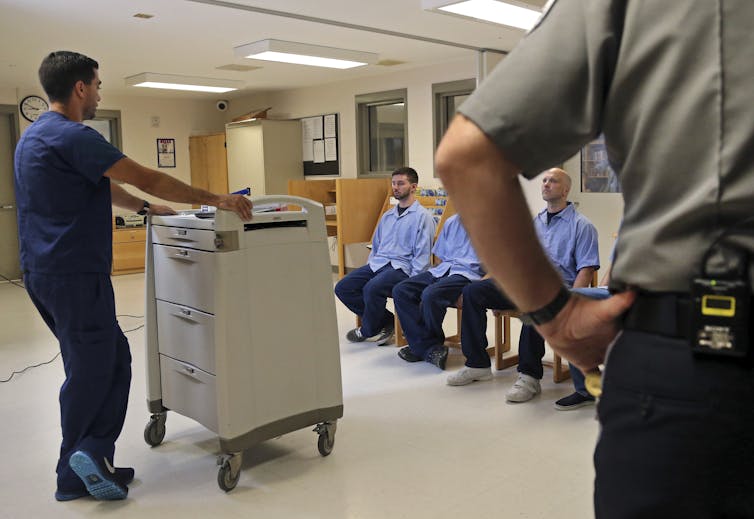
To date, many cost studies have focused on how those in prison or jail may be unable to work. Yet states and local municipalities spend considerable resources on arrests, courts and corrections that result from opioid misuse.
While several studies have attempted to estimate these costs, none have comprehensively examined the full set of opioid-related criminal justice costs at the state level. Due to the difficulty of obtaining reliable data, our team focused on Pennsylvania. We estimate that, from 2007 to 2016, the opioid crisis cost the criminal justice system in the state $526 million.
These figures are highly variable from year to year and among all the states, making it very difficult to come up with a comprehensive, nationwide estimate. Given that Pennsylvania has both a large population and has been hit unusually hard by the opioid crisis, costs in Pennsylvania are likely higher than average.
However, the Pennsylvania estimates demonstrate the costs are high and are likely to veer well into the billions of dollars nationwide.

Caring for children
While much of the attention has focused on those misusing opioids, one of the populations hardest hit by opioid misuse is children.
Opioid misuse has been shown to lead to increased interventions from state welfare and child protection agencies. While data remain limited, our team used a modeling approach to show that opioid misuse may be associated with $2.8 billion in costs to the child welfare system across all states from 2011 to 2016.
Additionally, babies born to mothers who were using opioids prenatally may be born with withdrawal symptoms – namely, neonatal abstinence syndrome – that require significant care. The effects of neonatal abstinence syndrome, and the related costs, may continue for a long time as affected children may require significant special education resources.
Data in this area are inherently difficult to identify in each state. However, we found that for a cohort of children born with neonatal abstinence syndrome in Pennsylvania in 2015, additional costs to provide special education services might have been about $8.3 million. A very rough estimate of the nationwide costs would be in the ballpark of at least $50 million per year.
Tip of the iceberg
Collectively our studies tallied about $85 billion in estimated financial costs to state budgets during the periods identified in each one. After extrapolating that to cover costs through 2018, we think the total comes to at least about $130 billion, with an ongoing bill of $6 billion to $10 billion every year.
While these figures might be lower than some other estimates that either include broader economic costs or fail to account for variations from year to year, the bottom line is that our data show states are bearing a very high financial burden in this crisis.
Our estimates also provide a benchmark states can use in litigation as they seek to recoup these costs to help cover the ongoing expenses associated with containing and ending the epidemic – and hint at why so many opioid manufacturers are mulling bankruptcy.
Yet our analysis is just the tip of the iceberg, as it covers only costs to state governments and excludes the broader economic costs of the crisis. Individuals and their families have also suffered enormously and are likely bearing even greater costs – both financial and emotional.
Joel Segel, Assistant Professor of Health Policy and Administration, Pennsylvania State University; Douglas L. Leslie, Professor of Public Health Sciences and Psychiatry, Pennsylvania State University; Gary Zajac, Managing Director of the Criminal Justice Research Center, Pennsylvania State University; Max Crowley, Assistant Professor of Human Development and Family Studies, Pennsylvania State University, and Paul L. Morgan, Eberly Fellow, Professor Education and Demography, and Director of the Center for Educational Disparities Research, Pennsylvania State University
This article is republished from The Conversation under a Creative Commons license. Read the original article.
The call came in from the security department at the Santa Rosa Plaza at about 5:38 p.m., according to the Sonoma County Sheriff’s Office report.
The sheriff’s office said security officers told the Santa Rosa Police Department that a man stole items from a store and when a security officer attempted to stop him, the man pulled a knife and attempted to stab his face. The man fled the mall north on Morgan Street.
A nearby sheriff’s deputy received the “be on the lookout” announcement and contacted a man who matched the description of the suspect on Nine Street at Morgan Street near the mall, authorities said.
The sheriff’s office said the deputy stopped his patrol car and the man walked by the deputy, refusing commands to stop. The deputy gave warnings and deployed his Taser which had no effect on the man.
As the deputy tried to get in front of the man to stop him from walking away, the man retreated backwards and ran to the deputy’s patrol car and entered the driver’s seat, authorities said.
An altercation ensued as the man pulled the door shut while brandishing a knife towards the deputy as the deputy tried to open the door. Authorities said the deputy shot his service weapon at the man, striking him at least three times.
The sheriff’s office said the man was treated for his injuries at the scene. He was then transported to a local hospital by ambulance and remains there with significant but what are reported to be non-life threatening injuries.
Based on the countywide policy governing police shootings, the Sonoma County Sheriff’s Office invoked the protocol and the Santa Rosa Police Department and the Sonoma County District Attorney’s Office will be investigating the shooting.