 How to resolve AdBlock issue?
News

There are various ways you can inherit from a decedent’s estate: As a beneficiary under a will or trust, as a designated death beneficiary (i.e., insurance policies, retirement plans, etc.), as an heir or as a surviving joint tenant.
All ways, however, require that you must first survive the decedent.
Sometimes the persons involved either die simultaneously, i.e., too close in time to determine clearly who survived the other, or die very close in time to each other. This typically occurs in accident scenarios.
How does California law handle such scenarios? The answer depends.
Did the decedent have estate planning documents? If so, then what does the decedent’s will or trust say? With married couples, their will(s) or trust(s) may provide that either one spouse or neither spouse is presumed to have survived the other.
If the decedent was married, any community property owned by the deceased spouse (other than in a trust) is distributed as if each spouse had survived the other spouse, unless it can be proven by clear and convincing evidence that either spouse survived the other.
Similarly with assets owned as joint tenancy with right of survivorship, the estate of each deceased joint tenant receives an equal share of the asset, unless it can be proven by clear and convincing evidence that a joint tenant survived the other.
A different rule applies to any assets that pass by way of intestacy, i.e., where the decedent died without a will. That is, when it can be established by clear and convincing evidence that one person survived another person but the period of time is less than 120 hours (5 full days), then California law presumes that each such person survived the other.
For example, consider a parent who dies intestate, is survived by two children, but one child dies only four days after the parent’s death, i.e., less than 120 hours. California law presumes that the deceased child did not survive the mother. Accordingly, the sole surviving child estate receives the entire parent’s intestate estate.
A beneficiary who survives long enough to inherit, however, might still die before he or she had received complete distribution of his or her inheritance.
Accordingly, a trust may provide for distributions to alternative beneficiaries. Otherwise, without such planning, the undistributed inheritance becomes part of the deceased beneficiary’s estate, where it passes accordingly to the beneficiary’s will or according to intestacy (to the heirs). This possibility is one reason why everyone needs a will even if they have a trust.
A probate of the beneficiary’s estate may also be required as a result of the undistributed inheritance. No probate is required if the beneficiary’s estate passes entirely to his or her surviving spouse or if it has a gross value under $150,000.
An interesting real world example involves a married couple whose death certificates say they each died on the same day. They owned a residence as community property by right of survivorship worth less than $300,000. As a result, each deceased spouse’s estate was under $150,000 in total gross value and no probate was required.
The legal and factual analysis associated with the distribution of a decedent’s estate varies from case to case. Anyone confronting the above issues should consult a licensed California lawyer before reaching any conclusions.
Dennis A. Fordham, attorney, is a State Bar-Certified Specialist in estate planning, probate and trust law. His office is at 870 S. Main St., Lakeport, Calif. He can be reached at
August 1972, as NASA scientist Ian Richardson remembers it, was hot. In Surrey, England, where he grew up, the fields were brown and dry, and people tried to stay indoors — out of the Sun, televisions on.
But for several days that month, his TV picture kept breaking up. “Do not adjust your set,” he recalls the BBC announcing. “Heat isn’t causing the interference. It’s sunspots.”
The same sunspots that disrupted the television signals led to enormous solar flares — powerful bursts of energy from the Sun — Aug. 4-7 that year.
Between the Apollo 16 and 17 missions, the solar eruptions were a near miss for lunar explorers. Had they been in orbit or on the Moon’s surface, they could have experienced high levels of radiation sparked by the eruptions.
Today, the Apollo-era flares serve as a reminder of the threat of radiation exposure to technology and astronauts in space. Understanding and predicting solar eruptions is crucial for safe space exploration.
Almost 50 years since those 1972 storms, the data, technology and resources available to NASA have improved, enabling advancements towards space weather forecasts and astronaut protection — key to NASA’s Artemis program to return astronauts to the Moon.
Space isn’t empty
Today, Richardson is a scientist at NASA’s Goddard Space Flight Center in Greenbelt, Maryland. He studies high-energy particles that burst from the Sun in the wake of giant solar eruptions.
In addition to flares, huge clouds — called coronal mass ejections — containing a billion tons of solar material occasionally blast from the solar surface. Increasingly, scientists think coronal mass ejections play a dominant role in driving the Sun’s most powerful radiation: solar energetic particles, or SEPs.
SEPs are almost all protons, flung at such high speeds that some reach Earth, 93 million miles away, in less than an hour. “When a high-speed boat goes through water, you can see the wave ahead of it,” Richardson said. “The shock waves ahead of fast coronal mass ejections accelerate particles before them.”
Radiation is energy packaged in electromagnetic waves or carried by particles. The energy is handed off when the wave or particle runs into something else, like an astronaut or spacecraft component. SEPs are dangerous because they pass right through skin, shedding energy and fragmenting cells or DNA on their way. This damage can increase risk for cancer later in life, or in extreme cases, cause acute radiation sickness in the short-term.
On Earth, humans are safe from this harm. Earth’s protective magnetic bubble, called the magnetosphere, deflects most solar particles. The atmosphere also quells any particles that do make it through. The International Space Station cruises through low-Earth orbit, within Earth’s protection, and the station’s hull helps shield crew members from radiation too.
But beyond Earth’s magnetic reach, human explorers can face the harsh radiation of space.
“The danger of radiation is always present, whether you’re in orbit, in transit, or on a planetary surface,” said Ruthan Lewis, a Goddard architect and engineer for NASA’s human spaceflight program. “From mitigation techniques to protection and enclosures, we’re considering this in every environment astronauts will be in.”
Space lifeguards
In a room filled with expansive computer screens and blinking lights at NASA’s Johnson Space Center in Houston, scientists work daily shifts to monitor space weather conditions for astronauts on the space station. Known as space environment officers, they’re the lifeguards of space: Instead of tidal waves and rip currents, they keep watch for the ebb and flow of space radiation.
Each day, the scientists — who are part of Johnson’s Space Radiation Analysis Group — check the space weather forecast from the National Oceanic and Atmospheric Administration’s Space Weather Prediction Center. They alert mission control of potential solar activity. If solar energetic particles are ramping up and the space station happens to be passing outside Earth’s magnetic protection, they might recommend postponing activities that require leaving the safety of the station. Anywhere astronauts go, the group will keep watch over their space environment.
During a future Artemis mission, if a solar radiation squall were to occur while astronauts are beyond Earth’s magnetic bubble, they might tell the crew to build a temporary shelter. “Our strategy in space is to make use of whatever mass is available,” Johnson scientist Kerry Lee said. “We’re redistributing mass to fill in areas that are thinly shielded and getting crew members closer to the heavily shielded areas.”
The more mass between the crew and radiation, the more likely that dangerous particles will deposit their energy before reaching the crew. On the Moon, astronauts could pile lunar soil, or regolith, over their shelters, taking advantage of their environment’s natural shielding materials. But where spacecraft design is concerned, relying on sheer bulk for protection soon grows expensive, since more mass requires more fuel to launch.
The Johnson team works on developing shielding methods without adding more material. “It’s unlikely that we’re going to be able to fly dedicated radiation-shielding mass,” Lee said. “Every item you fly will have to be multi-purpose.”
For the Orion spacecraft, they’ve designed a plan for astronauts to build a temporary shelter with existing materials on hand, including storage units already on board or food and water supplies. If the Sun erupted with another storm as strong as the Apollo era’s, the Orion crew would be safe and sound.
Other teams across NASA are meeting the radiation challenge with creative solutions, developing technology such as wearable vests and devices that add mass, and electrically charged surfaces that deflect radiation.
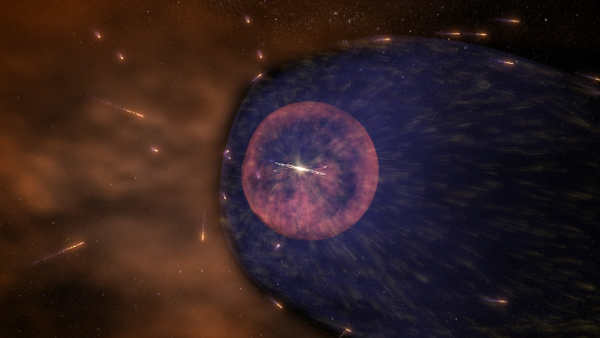
Here come the sun’s energetic particles
Protecting astronauts from solar energetic particle storms requires knowing when such a storm will occur. But the particle flurries are fickle and difficult to predict. The nature of the sun’s turbulent eruptions is not yet perfectly understood.
“Ideally, you could look at an active region on the sun, see how it’s evolving, and try to predict when it’s going to erupt,” Richardson said. “The problem is, even if you could forecast flares and coronal mass ejections, only a small fraction actually spawn the particles that are hazardous to astronauts.”
A close-up of the sun during a solar flare shows a seahorse-shaped, orange region lighting up against boiling red.
And, if SEPs do come, it’s hard to predict where they will go. Magnetic field lines are a highway for the charged particles, but as the Sun rotates, the roadways spiral. Some particles are knocked off-road by kinks in the field lines. As a result, they may spread far and wide through the solar system, in a vast, nebulous cloud.
“We still have a long way to go to get to the same position as weather forecasting on Earth,” said Yari Collado-Vega, a scientist at the Community Coordinated Modeling Center, or CCMC, which is housed at Goddard. The CCMC is a multi-partnership agency dedicated to space weather modeling and research. “This has to do with the fact that we just don’t have as many data sets on the Sun.”
Models to predict when SEPs will arrive are in the early stages of development. One uses the arrival of lighter and faster electrons to forecast the torrent of heavier protons that follow, which are more dangerous.
Scientists depend on NASA’s heliophysics missions to advance their space weather forecasting models. It helps to have spacecraft at different vantage points between the Sun and Earth. Launched in 2018, NASA’s Parker Solar Probe is flying closer to the Sun than any spacecraft before it. The spacecraft will track SEPs near their origins — key to solving how solar eruptions accelerate particles.
Timing is a factor too. The Sun swings through 11-year cycles of high and low activity. During solar maximum, the Sun is freckled with sunspots, regions of high magnetic tension that are ripe for eruption. During solar minimum, when there are little to no sunspots, eruptions are rare.
While scientists continue to improve their models, NASA’s heliophysics spacecraft do currently provide the observations that NASA needs to give astronauts an “all-clear” — the okay to conduct mission activity. If there are no active sunspots on the Sun, they can reliably say there won’t be a solar squall.
Radiation from next-door galaxies
A second kind of space radiation travels even farther than solar energetic particles. Galactic cosmic rays — particles from long-gone, exploded stars elsewhere in the Milky Way — constantly bombard the solar system at near-light speeds. If solar energetic particles are a sudden downpour, galactic cosmic rays are more like a steady drizzle. But a drizzle can be a nuisance too.
Cosmic rays tend to be more powerful than even the most energetic solar particles. The same spacecraft that would shield a crew from solar energetic particles would not be able to keep cosmic rays at bay, so cosmic rays are a serious concern, especially for long-duration missions like the journey to Mars, which will take six to 10 months each way.
While SEPs are tricky to predict, galactic cosmic rays come at a steady rate. In one second, some 90 cosmic rays strike a pocket of space the size of a golf ball. (Meanwhile, during an SEP shower, there could be 1,000 more particles ripping through that golf-ball-sized space.) This rate helps determine radiation limits and mission durations — NASA’s leading strategy to limiting cosmic ray exposure. NASA tracks astronauts’ individual doses to ensure they don’t breach lifetime limits.
Cosmic rays are comprised of heavy elements like helium, oxygen or iron. The hefty particles knock apart atoms when they collide with something, whether an astronaut or the thick metal walls of a spacecraft. The impact sets off a shower of more particles called secondary radiation — adding to the health concern of cosmic rays.
Cosmic ray exposure is also related to the solar cycle. In the relative calm of solar minimum, cosmic rays easily infiltrate the Sun’s magnetic field. But during solar maximum, the Sun’s magnetic bubble strengthens with increased solar activity, turning away some of the galactic visitors who come knocking.
Destination: Moon, then Mars
Going to the Moon will help NASA collect crucial data and develop the necessary tools and strategies to one day safely send human explorers to Mars. The journey to Mars will take much longer than a trip to the Moon, and crew members will face much more radiation exposure. And, unlike Earth, Mars has no magnetic field to divert radiation.
“One of the reasons we’re going to the Moon is in preparation for Mars,” Lewis said. Sustained lunar exploration will help determine whether we have the technology needed to protect astronauts on longer-term space travel. “We’ve done a lot of simulations. Now we’re going to start cutting metal.”
Lina Tran works for NASA’s Goddard Space Flight Center, Greenbelt, Md.
KELSEYVILLE, Calif. – Authorities said early Friday afternoon that Riviera West and Riviera Heights residents who evacuated on Thursday due to the Golf fire can now return home.
Lt. Rich Ward of the Lake County Sheriff’s Office told Lake County News just after 1 p.m. Friday that the all-clear had been given for repopulation of the two communities, where dozens of homes had been threatened after the Golf fire began burning up the face of Mount Konocti on Thursday afternoon.
The fire on Friday afternoon remained at an estimated 33 acres, with containment at 30 percent, according to Cal Fire.
The fire’s close proximity caused the sheriff’s office to place Riviera West under evacuation order on Thursday afternoon, with an evacuation warning issued shortly afterward for Riviera Heights.
Power had been shut off to the Riviera West subdivision on Thursday, and Pacific Gas and Electric reported that the power to all 260 customers was restored earlier Friday afternoon, ahead of the repopulation.
With the evacuation order lifted for Riviera West, the evacuation warning for nearby Riviera Heights also was lifted early Friday afternoon, Ward said.
Ward said Soda Bay Road will remain closed from Little Borax Road to Crystal Drive for emergency personnel in the area. However, other road closures in the area have been lifted.
The Lake County Sheriff’s Office asked area residents to do the following when they return home:
– Be alert for downed power lines and other hazards.
– Check propane tanks, regulators and lines before turning gas on if it has been turned off.
– Check water lines before turning them back on if they previously were shut off.
– Check your residence carefully for hidden embers or smoldering fires.
– Check pilot lights.
– Be cognizant of emergency traffic and first responders in the immediate area.
Email Elizabeth Larson atThis email address is being protected from spambots. You need JavaScript enabled to view it. . Follow her on Twitter, @ERLarson, or Lake County News, @LakeCoNews.
Lt. Rich Ward of the Lake County Sheriff’s Office told Lake County News just after 1 p.m. Friday that the all-clear had been given for repopulation of the two communities, where dozens of homes had been threatened after the Golf fire began burning up the face of Mount Konocti on Thursday afternoon.
The fire on Friday afternoon remained at an estimated 33 acres, with containment at 30 percent, according to Cal Fire.
The fire’s close proximity caused the sheriff’s office to place Riviera West under evacuation order on Thursday afternoon, with an evacuation warning issued shortly afterward for Riviera Heights.
Power had been shut off to the Riviera West subdivision on Thursday, and Pacific Gas and Electric reported that the power to all 260 customers was restored earlier Friday afternoon, ahead of the repopulation.
With the evacuation order lifted for Riviera West, the evacuation warning for nearby Riviera Heights also was lifted early Friday afternoon, Ward said.
Ward said Soda Bay Road will remain closed from Little Borax Road to Crystal Drive for emergency personnel in the area. However, other road closures in the area have been lifted.
The Lake County Sheriff’s Office asked area residents to do the following when they return home:
– Be alert for downed power lines and other hazards.
– Check propane tanks, regulators and lines before turning gas on if it has been turned off.
– Check water lines before turning them back on if they previously were shut off.
– Check your residence carefully for hidden embers or smoldering fires.
– Check pilot lights.
– Be cognizant of emergency traffic and first responders in the immediate area.
Email Elizabeth Larson at
KELSEYVILLE, Calif. – Firefighters are continuing to work to fully contain a fire on Mount Konocti while authorities prepare to let residents of an evacuated area return home.
The latest report on the Golf fire in Kelseyville, released Friday morning, put the incident’s size up to 33 acres, with containment remaining at 30 percent, according to Cal Fire.
Cal Fire said it anticipates the fire will be contained later on Friday.
The fire began just before 1 p.m. Thursday on Soda Bay Road and Golf Drive. Cal Fire said the cause remains under investigation.
Despite the fire threatening an estimated 40 homes – prompting mandatory evacuations in Riviera West and an evacuation advisory in Riviera Heights – no structures have been damaged or destroyed, Cal Fire said.
Cal Fire said crews made good progress through the night despite the steep terrain, heavy timber and thick brush. Crews are advancing and strengthening containment lines continues throughout the day on Friday.
Resources on the incident were rolled back on Friday to 15 engines, three water tenders, three helicopters, five hand crews, two dozers and 155 firefighting personnel, based on Cal Fire’s report.
Riviera West remained under mandatory evacuation overnight, with officials reporting that residents are expected to be allowed to go home late on Friday afternoon. An evacuation shelter was opened for residents at Kelseyville High School.
During the height of the fire fight on Thursday, the power lines to Riviera West had been deenergized, as Lake County News has reported.
PG&E spokeswoman Deanna Contreras told Lake County News that, due to the proximity of the fire to PG&E electric infrastructure, fire officials had requested the company deenergize a section of line for the safety of firefighters and the surrounding community. She emphasized that it wasn’t a public safety power shutoff.
“Power to approximately 260 customers was affected yesterday afternoon,” Contreras said.
Before turning the power back on, PG&E spent Friday conducting an inspection of the area. Contreras said it was expected that power would be back on to the area by 12:30 p.m. Friday.
The Riviera Heights community is under an evacuation advisory, also still in effect until later Friday afternoon, officials said.
The Lake County Sheriff’s Office asked area residents to do the following when repopulation occurs:
– Be alert for downed power lines and other hazards.
– Check propane tanks, regulators and lines before turning gas on if it has been turned off.
– Check water lines before turning them back on if they previously were shut off.
– Check your residence carefully for hidden embers or smoldering fires.
– Check pilot lights.
– Be cognizant of emergency traffic and first responders in the immediate area.
Lt. Rich Ward said road closures are remaining in place until Friday afternoon depending on the need for fire personnel, resources, equipment and PG&E personnel.
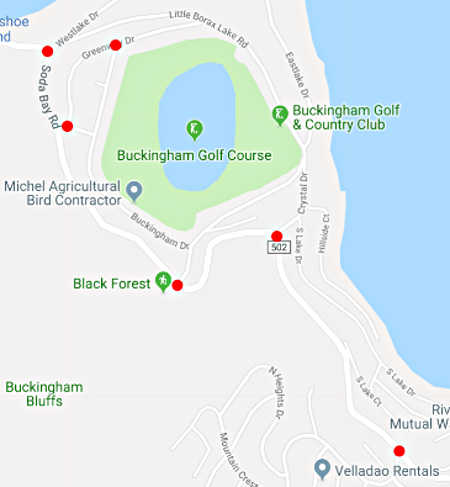
Closures are as follows (and are shown in the map above):
– Soda Bay Road at Riviera West Drive;
– Crystal Drive at Soda Bay Road;
– Soda Bay Road at Little Borax Lake Road;
– Greenway Drive at Little Borax Lake Road;
– Golf Drive at Greenway Drive;
– Madrone Drive at Soda Bay Road.
Soda Bay Road closure will be reevaluated Friday afternoon, Ward said.
Ward said Buckingham residents will only be allowed access via north Soda Bay Road through the community of Soda Bay into Buckingham.
Rivera West residents will only be allowed access via Highway 281 from the Clear Lake Riviera community side, he said.
Only emergency personnel and equipment will be allowed access between the communities of Buckingham and Riviera West, according to Ward.
Email Elizabeth Larson at
KELSEYVILLE, Calif. – While firefighters continued to work overnight to contain a wildland fire on the side of Mount Konocti, an evacuation order and an evacuation warning remained in effect for nearby subdivisions.
The Golf fire, first reported at about 1 p.m. Thursday, began in the area of Soda Bay Road and Golf Road, as Lake County News has reported.
By nightfall, the fire – which had two branches consisting of a main fire and a large spot fire – had burned a total of 19 acres and was 30-percent contained, according to Cal Fire, which battled the incident along with firefighters from fire agencies all around Lake County.
Cal Fire said the fire continues to threaten an estimated 40 homes.
As a result, on Thursday night, the Lake County Sheriff’s Office said that an evacuation order for the Riviera West subdivision that was triggered earlier in the day was remaining in effect overnight.
At the same time, the sheriff’s office said it also was keeping in effect overnight an evacuation warning for the nearby Riviera Heights community.
An evacuation shelter was set up on Thursday at Kelseyville High School and the sheriff’s office said it would remain open through the night.
The fire also had necessitated road closures in the area, which the sheriff’s office said late Thursday remained in effect.
Those road closures are as follows:
– Soda Bay Road at Riviera West Drive;
– Crystal Drive at Soda Bay Road;
– Soda Bay Road at Little Borax Lake Road;
– Greenway Drive at Little Borax Lake Road;
– Golf Drive at Greenway Drive;
– Madrone Drive at Soda Bay Road.
Residents of the Buckingham subdivision – which was not evacuated – are able to access their homes via Soda Bay Road from Kelseyville, officials said.
The sheriff’s office said it expected to issue an update on conditions at 10 a.m. Friday.
Email Elizabeth Larson atThis email address is being protected from spambots. You need JavaScript enabled to view it. . Follow her on Twitter, @ERLarson, or Lake County News, @LakeCoNews.
The Golf fire, first reported at about 1 p.m. Thursday, began in the area of Soda Bay Road and Golf Road, as Lake County News has reported.
By nightfall, the fire – which had two branches consisting of a main fire and a large spot fire – had burned a total of 19 acres and was 30-percent contained, according to Cal Fire, which battled the incident along with firefighters from fire agencies all around Lake County.
Cal Fire said the fire continues to threaten an estimated 40 homes.
As a result, on Thursday night, the Lake County Sheriff’s Office said that an evacuation order for the Riviera West subdivision that was triggered earlier in the day was remaining in effect overnight.
At the same time, the sheriff’s office said it also was keeping in effect overnight an evacuation warning for the nearby Riviera Heights community.
An evacuation shelter was set up on Thursday at Kelseyville High School and the sheriff’s office said it would remain open through the night.
The fire also had necessitated road closures in the area, which the sheriff’s office said late Thursday remained in effect.
Those road closures are as follows:
– Soda Bay Road at Riviera West Drive;
– Crystal Drive at Soda Bay Road;
– Soda Bay Road at Little Borax Lake Road;
– Greenway Drive at Little Borax Lake Road;
– Golf Drive at Greenway Drive;
– Madrone Drive at Soda Bay Road.
Residents of the Buckingham subdivision – which was not evacuated – are able to access their homes via Soda Bay Road from Kelseyville, officials said.
The sheriff’s office said it expected to issue an update on conditions at 10 a.m. Friday.
Email Elizabeth Larson at
LAKE COUNTY, Calif. – A low pressure system set to arrive over Northern California is keeping temperatures around the region below normal for the season and bringing the possibility of thunderstorms this weekend.
The National Weather Service said the low pressure system is expected to push onto the California coast on Friday before moving across Northern California on Saturday.
As a result of that pressure anomaly, maximum temperatures are forecast to be 5 to 11 degrees below normal on Friday and 6 to 20 degrees below normal on Saturday before warming up again on Sunday and reaching above normal temperatures next week, the National Weather Service reported.
The system also is bringing with it a chance of showers and thunderstorms over the coastal foothills, the Shasta mountains and the northern Sacramento Valley on Friday and Saturday, based on the forecast.
The specific Lake County forecast calls for daytime highs on Friday in the low 80s and nighttime temperatures ranging from the high 40s into the low 50s.
Those cooler Friday night temperatures are forecast to be combined with winds up as high as 14 miles per hour, with gusts into the low 20s.
Winds of up to 10 miles per hour are forecast during the daytime on Saturday, based on the forecast.
The National Weather Service also is predicting a 20-percent chance of rain and thunderstorms on Saturday, with temperatures into the high 70s.
Conditions on Saturday night are forecast to hover in the low to mid 50s, with winds up to 11 miles per hour, forecasters said.
On Sunday, the forecast calls for temperatures in the high 80s during the day and high 50s at night, before rising into the 90s during the day during the first part of the new week.
Email Elizabeth Larson atThis email address is being protected from spambots. You need JavaScript enabled to view it. . Follow her on Twitter, @ERLarson, or Lake County News, @LakeCoNews.
The National Weather Service said the low pressure system is expected to push onto the California coast on Friday before moving across Northern California on Saturday.
As a result of that pressure anomaly, maximum temperatures are forecast to be 5 to 11 degrees below normal on Friday and 6 to 20 degrees below normal on Saturday before warming up again on Sunday and reaching above normal temperatures next week, the National Weather Service reported.
The system also is bringing with it a chance of showers and thunderstorms over the coastal foothills, the Shasta mountains and the northern Sacramento Valley on Friday and Saturday, based on the forecast.
The specific Lake County forecast calls for daytime highs on Friday in the low 80s and nighttime temperatures ranging from the high 40s into the low 50s.
Those cooler Friday night temperatures are forecast to be combined with winds up as high as 14 miles per hour, with gusts into the low 20s.
Winds of up to 10 miles per hour are forecast during the daytime on Saturday, based on the forecast.
The National Weather Service also is predicting a 20-percent chance of rain and thunderstorms on Saturday, with temperatures into the high 70s.
Conditions on Saturday night are forecast to hover in the low to mid 50s, with winds up to 11 miles per hour, forecasters said.
On Sunday, the forecast calls for temperatures in the high 80s during the day and high 50s at night, before rising into the 90s during the day during the first part of the new week.
Email Elizabeth Larson at