 How to resolve AdBlock issue?
News
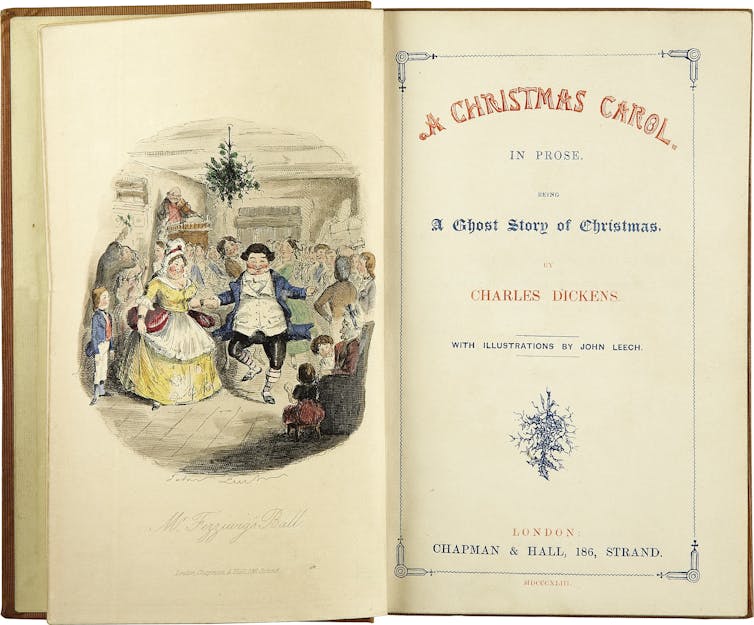
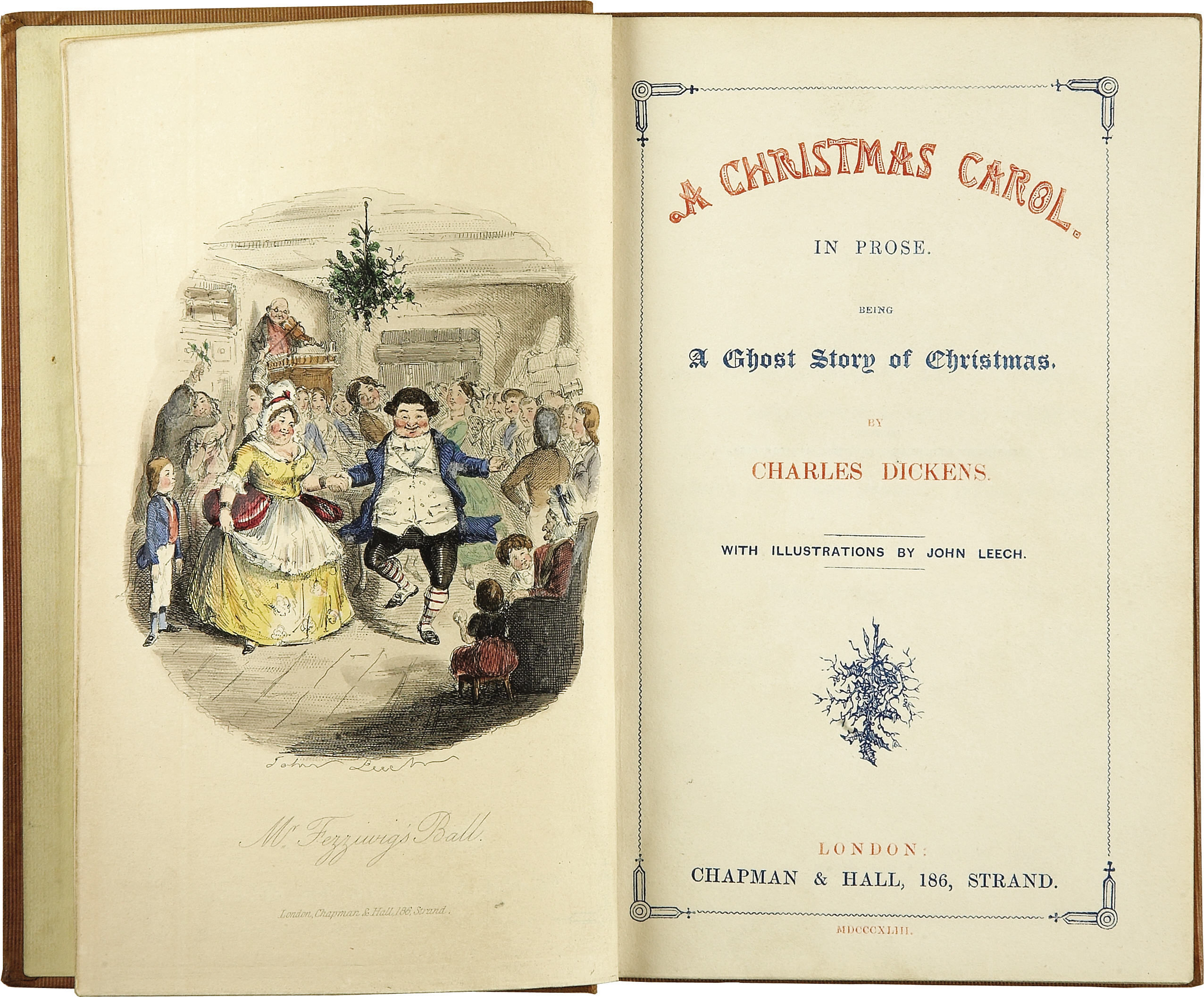
Though today regarded as the literary titan of the Victorian age, in late 1843 the 31-year-old Charles Dickens worried that his popularity was fading. His latest novel was not selling well, his finances were strained and his wife was pregnant with their fifth child.
Dickens had recently visited the industrial city of Manchester, an experience that left him deeply moved by the plight of the poor. He understood their circumstances on a personal level – as a boy, Dickens had been humiliated when his father was forced into debtors’ prison.
Initially intending to voice his concerns about the poor as a pamphleteer, Dickens instead crafted a story about the redemption of an old miser, believing that it would garner more public attention and support.
Today that story remains perhaps Dickens’ most celebrated work, A Christmas Carol. Adapted in many forms, it has never been out of print. I take students in my course on philanthropy to see a stage production of the work each Christmas season.
Three ghosts, three lessons
The story begins on Christmas Eve. The “grasping, scraping, clutching, covetous old sinner” Ebenezer Scrooge is toiling in his office, where he turns away two fundraisers seeking to provide for the poor, rudely rebuffs his nephew Fred’s invitation to Christmas dinner and berates his underpaid clerk, Bob Cratchit, for expecting to get Christmas Day off with pay.
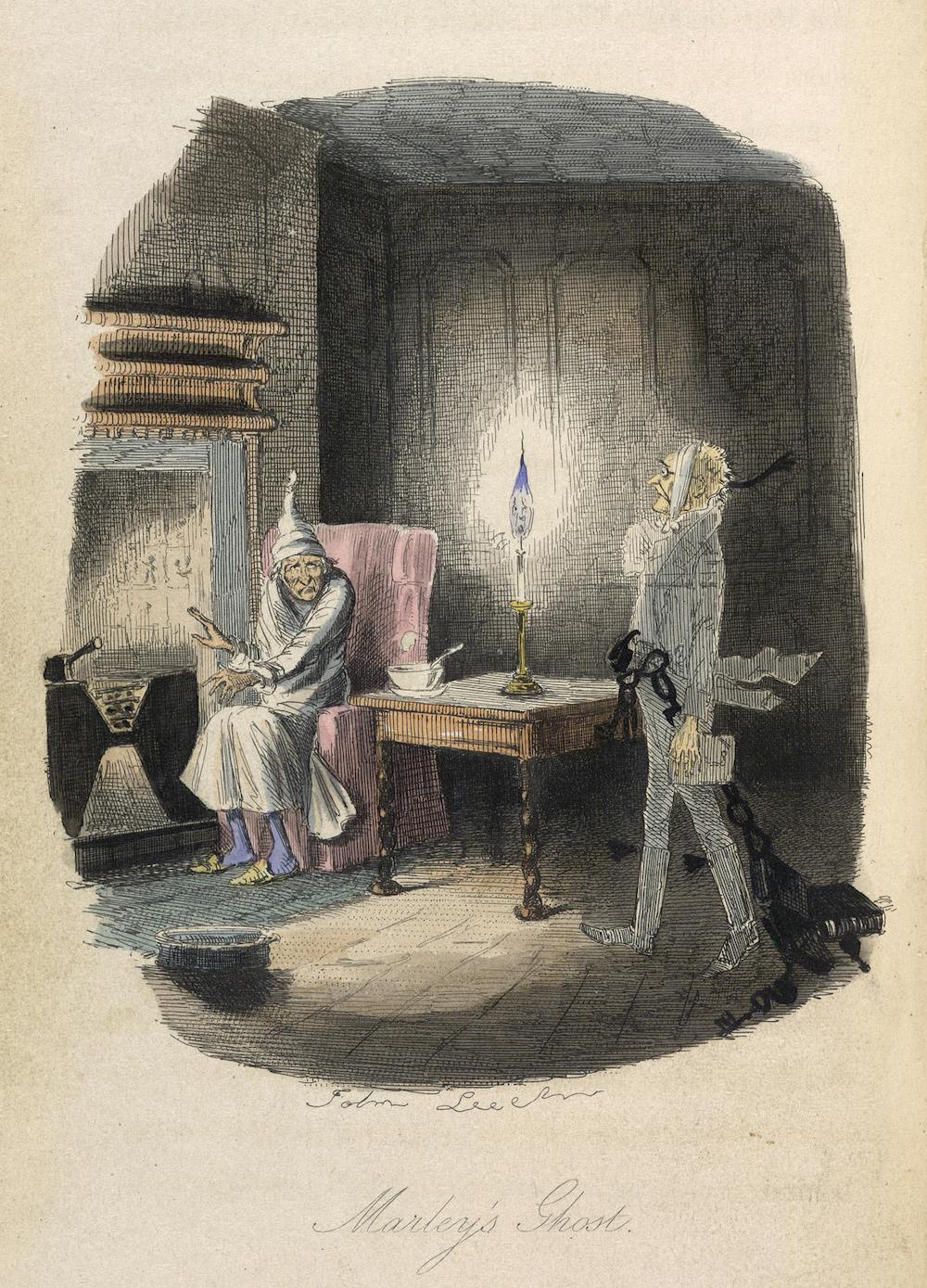
At home that night, Scrooge is visited by the ghost of his partner Jacob Marley, who “died seven years ago, this very night.” Now wandering the earth dragging heavy chains forged by his own avarice, Marley warns Scrooge that he will meet the same fate if he does not listen to the three spirits who will visit him during the night.
The first of the spirits, the Ghost of Christmas Past, takes Scrooge to scenes from his earlier life, where he is reminded that he was once a kinder and gentler person.
At his old school, he reexperiences what it is like to be lonely at the holidays until he is rescued by his sister. He then visits the holiday party of his employer, Mr Fezziwig, who despite modest means embodies the spirit of celebration.
He then sees his younger self with his fiancée Belle, to whom he intended to devote the rest of his life, until he was gradually overmastered by the love of money. Belle eventually breaks their engagement and marries another man, whose large and happy family Christmas the ghost takes Scrooge to witness.
The Ghost of Christmas Present whisks Scrooge to celebrations of Christmas in different settings throughout the land. They then travel to the home of Fred, who valiantly defends his uncle against criticism, choosing to pity rather than condemn him. Then Scrooge finds himself at the modest holiday feast of the Cratchit family, where he meets Tiny Tim, their ailing youngest child, and learns that unless the course of events changes, this will be the boy’s last Christmas. Finally, the ghost shows Scrooge two starving children, Ignorance and Want, mocking Scrooge’s expressions of concern with his own words from earlier in the day, “Are there no prisons? Are there no workhouses?”
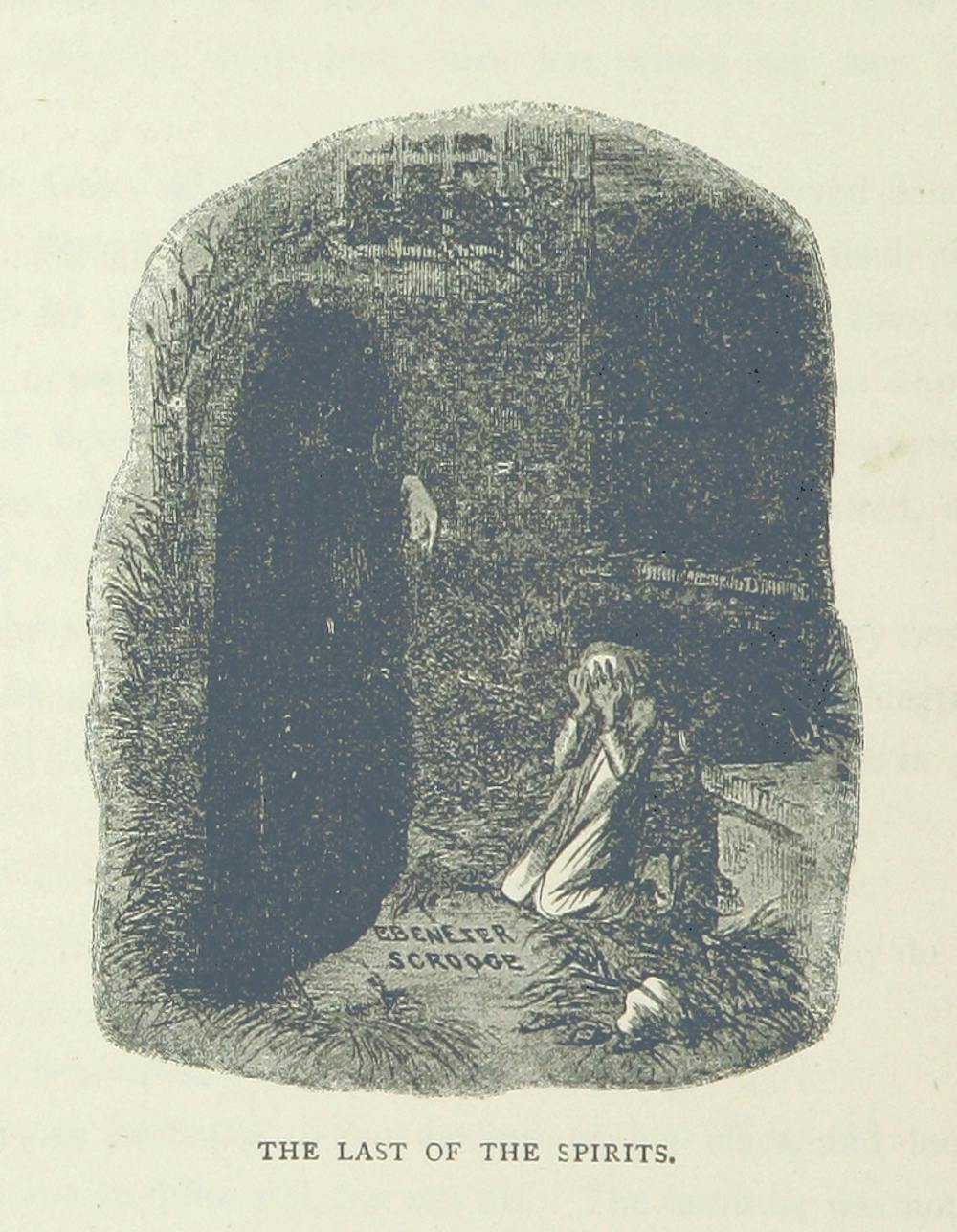
The ghost of Christmas Yet to Come transports Scrooge to the holiday one year later, where he witnesses the reactions of various people to the recent death of a “wretched man.” A businessman states that he will attend the funeral only if a lunch is provided, and various people sell stolen items from the dead man’s estate to a fence. The only people who feel any emotion at his passing are debtors who now have more time to repay their loans. After returning to the Cratchit home, where Scrooge sees the family mourning the passing of Tiny Tim, he is taken to a neglected grave, where to his horror, he sees the name Ebenezer Scrooge.
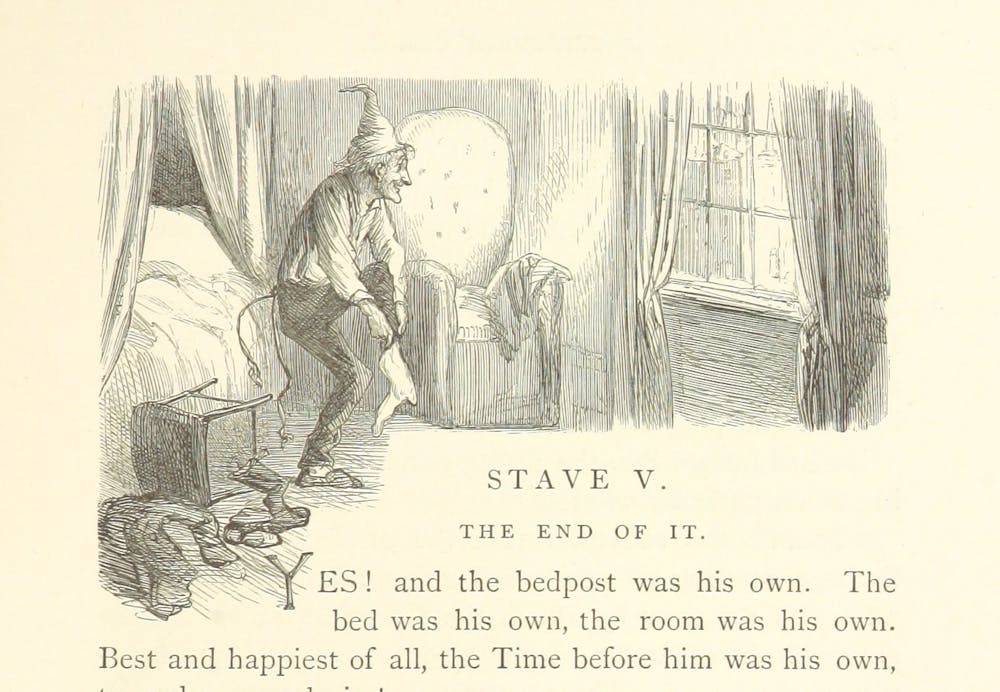
Awakening on Christmas morning, Scrooge realizes there is still time to act. He sends a prize turkey to the Cratchits, gives Bob a raise and becomes a “second father” to Tiny Tim. Once a miserable old miser from whose heart “no steel had ever struck out generous fire,” Scrooge becomes “as a good a friend, as good a master, and as good a man, as the good old city knew.” Some laughed at the alteration in him, but he was happy to let them laugh, “and it was always said of him, that he knew how to keep Christmas well, if any man alive possessed the knowledge. May that be truly said of us, and all of us. And so, as Tiny Tim observed, God bless us, every one!”
The wonder of an open heart
A Christmas Carol is a tale of redemption. Scrooge is blessed by a series of spiritual visitations that enable him to obey the Socratic injunction, “Know yourself,” from multiple different spatial and temporal points of view.
Having glimpsed in so short a time the course of his whole life, Scrooge is able, for the first time, to perceive its true trajectory. He realizes that, despite his growing wealth, his greed is alienating everyone around him, making him a boon to no man and a curse to many. Hoping against hope to write a different final chapter, Scrooge embarks on a new life.
In attempting to capture a new spirit of Christmas, Dickens reminds us of the power of the past and the future to change the way we see the present. In confronting Scrooge with the stark contrast between the spirit of generosity in his youth and the isolated, desolate circumstances of his death, Dickens invites readers to contemplate our own life trajectories and begin redrafting our own eulogies while there is still a chance to make changes. Perhaps we, like Scrooge, can rediscover the wonder of an open heart, recognizing that warmth and vitality lie not in the accumulation of wealth but in the dedication of time, talent and treasure to others.
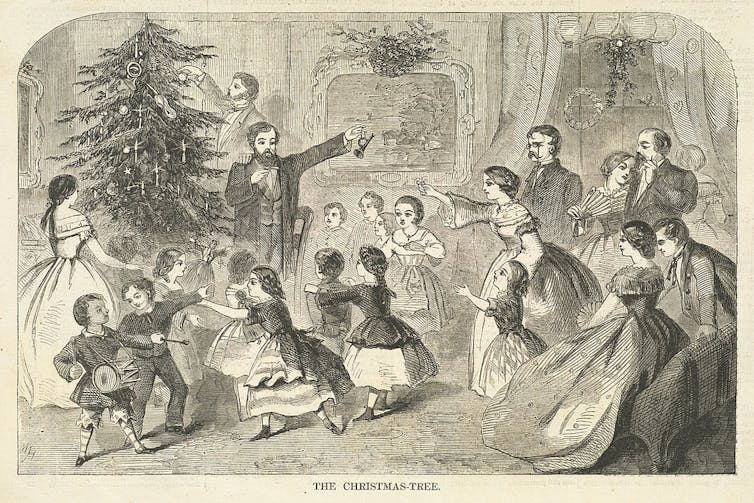

Some historians credit Dickens with helping to establish many of the patterns that mark the contemporary observance of Christmas. Some two centuries before, Oliver Cromwell had attempted to refocus the holiday away from elaborate celebrations to a time of strict piety and prayer.
In Dickens’ hands, however, Christmas is restored to a time for gathering with family, celebrating the spirit of generosity, and feasting. Above all, the Christmas season is an opportunity to tune in to a higher frequency and to lend our voices to the chorus chanting one of the oldest and best tunes of all – the song of love’s redemptive power.
Richard Gunderman, Chancellor's Professor of Medicine, Liberal Arts, and Philanthropy, Indiana University
This article is republished from The Conversation under a Creative Commons license. Read the original article.
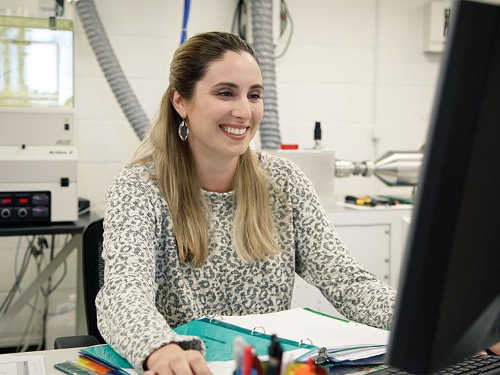
Joanna Clark has been interested in geology ever since she was a child.
Today, the University of Houston doctoral student is turning that curiosity into a career and getting noticed by NASA, which awarded her a $285,000 grant to develop a technique that could one day be used to better understand past climate conditions on Mars.
"We hope to have samples from Mars one day and when we do, we need to be ready to evaluate them. This could help give us a better understanding of how the planet has changed over millions of years," said Clark, who is studying the geochemistry of Mars.
For now, Clark's research will focus on creating silica minerals in the laboratory to discover how they form in subzero temperatures, such as those on Mars. Silica minerals, including quartz, are commonly found in Earth surface sediment, but silica was also detected in rocks and sediment on Mars by NASA's Curiosity Rover.
The initial experiments have begun. "I am working on how to get the silica out of solution as a solid with all the right chemistry. Once I am able to do that, I will take the solid and analyze it for oxygen isotopes," explained Clark, who has done previous studies on cryogenic opal-A, which is silica that forms in brine veins between growing water ice crystals.
Tom Lapen, Clark's research advisor and chair of the Department of Earth and Atmospheric Sciences in the UH College of Natural Sciences and Mathematics, said silica might be able to preserve the conditions under which it actually precipitated, or became a solid, from a liquid. In other words, silica found on Mars is a potential source of past climate information.
Lapen and Clark are working with Zach Sharp, who runs the Center for Stable Isotopes at the University of New Mexico. Sharp developed the analytical technique and Clark will build upon it by investigating silica samples formed below zero degrees Celsius.
"Joanna is competing with some of the best scientists in the country. Most of them are professors and researchers who have been doing this a long time," said Lapen, referring to Clark's NASA grant. "It indicates that the community views this project on really high merits and if successfully accomplished, it could have a big impact."
Other project collaborators are Henry Chafetz, UH professor of geology and Elizabeth Rampe, an exploration mission scientist in the Astromaterials Research and Exploration Science Division at the Johnson Space Center.
The California Highway Patrol’s Ukiah Area office identified the crash victim as Janice Kespohl, 80.
The CHP said the collision occurred at 5:30 p.m. Wednesday on Highway 20, west of Eastside Potter Valley Road.
Kespohl was driving her 2017 Hyundai westbound on Highway 20 within the No. 2 lane, as Cielo Alavezos, 24, of Ukiah was driving her 2014 Toyota SUV in the No. 1 lane, also westbound, approaching Kespohl from the rear, according to the report.
The CHP said that, based on the investigation so far, it appears that Kespohl attempted to make a u-turn from the No. 2 lane directly in front of Alavezos.
As a result, the front of Alavezos’ Toyota hit the left side of Kespohl’s Hyundai, with both vehicles coming to rest within the westbound traffic lanes, the CHP said.
Reports from the scene indicated the highway’s westbound lanes were shut down due to the wreck, with Caltrans called to help with traffic control.
The CHP said Kespohl – who radio traffic said was trapped in her vehicle – succumbed to her injuries at the scene.
The report from the CHP did not indicate that Alavezos was injured.
Both women were wearing their seat belts, the CHP reported.
As of the time of the CHP’s update on the crash, the agency said it hadn’t determined whether drugs or alcohol were factors in the collision.
The CHP said the wreck remains under investigation.
Email Elizabeth Larson at
The goal of the CHP is to ensure the safe passage of each and every motorist by targeting roads where there is a high frequency of intoxicated or unlicensed drivers.
A sobriety/driver license checkpoint is a proven effective tool for achieving this goal and is designed to augment existing patrol operations.
Vehicles will be checked for drivers who are under the influence of alcohol or drugs, or driving unlicensed.
The CHP said the objective is to send a clear message to those individuals that consider driving and mixing alcohol or drugs, or driving when unlicensed, that you will be caught and your vehicle will be towed away.
Funding for this program was provided from a grant from the California Office of Traffic Safety through the National Highway Traffic Safety Administration.
Over the course of the last several months, the city of Clearlake, led by City Manager Alan Flora, has sought to get Treasurer-Tax Collector Barbara Ringen to increase the sales of tax defaulted properties, a key task Flora said she’s failed to do.
In a special meeting in November, the Clearlake City Council approved sending letters to the Board of Supervisors, the Lake County Grand Jury and state officials seeking recourse that includes investigations into Ringen’s performance, as Lake County News has reported.
At the Lakeport City Council’s meeting on Dec. 17, its last of the year, council members considered a request from Flora to join in support of getting the property sales increased.
Lakeport City Manager Margaret Silveira said Flora brought the issues to the city’s attention.
A list provided to Flora by the assistant treasurer-tax collector shows that 3,652 properties of 14,191 properties in Clearlake are delinquent on their taxes. In Lakeport, there are 1,334 delinquent properties with 414 eligible for tax sale, Silveira reported.
She said the total defaulted amount of property tax countywide is about $18.3 million. “That's a huge impact in the county and the city,” said Silveira, adding that not only is it a huge loss of funding and revenues but it creates blight.
Silveira said it is a big issue for Lakeport but an even bigger issue for Clearlake and the county of Lake.
Councilwoman Stacey Mattina asked if the county has given a reason why it hasn’t done more sales.
“I think there's just a lot of excuses,” said Flora.
He said the county is intending to have a tax sale in March of up to 300 properties. No tax sale was held this year; one had initially been scheduled but canceled.
Over the last 11 years, there have been seven tax sales; over the last five years, there have been two, Flora said.
Even having a sale of 300 properties is not addressing the problem, said Flora, adding that between 500 to 700 properties a year are going into default.
Flora said Riverside County had a similar problem 10 years ago. Once officials there started regularly doing tax sales, more people paid their taxes.
Tax default is a real big problem in Clearlake, where Flora said nearly 25 percent of all properties are delinquent on their taxes. It contributes to blight, hinders investment and impacts special districts like fire departments.
While the county has to make up the 1 percent of property tax that is delinquent and owed to the cities and other agencies, it’s not required to do the same for the assessments implemented by fire and other special districts, he explained, adding he hasn’t analyzed how significant of a problem that is.
Flora said that property tax default has the greatest financial impact on the county itself.
In his 11 years in Lake County, Flora said he's never been involved in an issue in which more community members and organizations have contacted him to thank him for finally addressing the situation.
Flora and Clearlake Police Chief Andrew White went to the Board of Supervisors in September to ask for action to be taken. Mayor George Spurr asked Flora what action the board took.
At that time, Ringen said she intended to sell 300 properties in March, based on what has been budgeted. Flora said they told the board they didn’t think that was enough and they requested that they be allowed to submit priority properties.
Flora said he put together a list of 166 such priority properties and submitted them to Ringen’s office, which subsequently informed him that approximately 15 of those would be added to the tax sale list.
It was at that point that Flora said they lost patience, and moved forward with asking for the grand jury, the California Controller’s Office, the California Treasurer’s Office and the Board of Equalization to start investigations into Ringen’s actions.
Flora alleged that Ringen has been negligent of her statutory obligations.
During the discussion, Spurr noted that the last county tax sale took place in March 2018. Flora said 100 to 150 properties were sold at that time.
Silveira wondered if the county can contract to get the properties sold. Flora said he thinks there are a number of options, and that’s one of them.
He said the letter the city of Clearlake sent to the Board of Supervisors presented a number of ideas that haven’t previously been explored.
Councilman Kenny Parlet said the situation showed an “epic” amount of irresponsibility that is costing everyone in Lake County money, and setting a tone to encourage blight and crime. He said he had no idea this was happening.
During public comment, Lakeport resident Michael Green said it wasn’t fair to attack a department head without them being there, adding that Clearlake has done a good job of “stirring the pot.”
Green said doing tax defaulted property sales is not Ringen’s only duty, noting she also has to collect taxes. He said accusing someone of negligence and willful omission of their duties borders on slander.
The situation, Green said, is decades in the making, and it’s not in Ringen’s or the county’s capacity to fix it. He said there are other options they can consider, adding that he didn’t think they were asking the right question.
Councilwoman Mireya Turner suggested approving the letter to the Board of Supervisors Flora was requesting with focus on providing Ringen’s office with the resources needed to have a second tax sale in 2020, to enter into an agreement with the city of Clearlake for reduction of fees and penalties for eligible properties, pursue options to facilitate regular tax sales, and provide additional support to facilitate annual tax sales that address the backlog of defaulted properties and meet the statutory requirements.
The council approved the amended letter 5-0.
Email Elizabeth Larson at
Hors d’oeuvres and music kick off the event at 4:30 p.m., dinner is served at 6 p.m. and a live auction follows.
Middletown Rotary President Belinda Joy describes the club’s Gala as, “An evening of great fun and friendship with a big purpose.”
Kathey Crothers has been the organization’s fundraising chair for several years and served as the Middletown Club’s President last year.
“Our club of dedicated volunteers makes this event bigger and better every year. The results are truly amazing. Our Gala is the ‘big heart’ of our fundraising goals and we can’t do it without you,” said Crothers.
The funds received support “service above self” projects that empower youth, support our senior citizens, benefit our communities and support worthy international projects.
The club’s fundraising efforts have provided dictionaries and friendship benches to elementary schools, funding for High School scholarship programs, fire prevention and recovery assistance in addition to supporting the ‘Meals on Wheels’ food program at our local senior center.
“With your help, Rotary volunteers can continue to provide a variety of services for our youth and our seniors and offer support for our entire community,” said Joy.
The event is co-sponsored by Adventist Health Clear Lake Hospital and Clearlake Grocery Outlet.
To purchase Gala event tickets, which are $60 each, or to inquire about table sponsorship, or if you or your organization would like to become an event sponsor, donate a silent auction item or contribute to the live auction, call 707-355-0393 or email
For further information about the Gala or the Rotary Club of Middletown, contact Belinda Joy at