 How to resolve AdBlock issue?
News
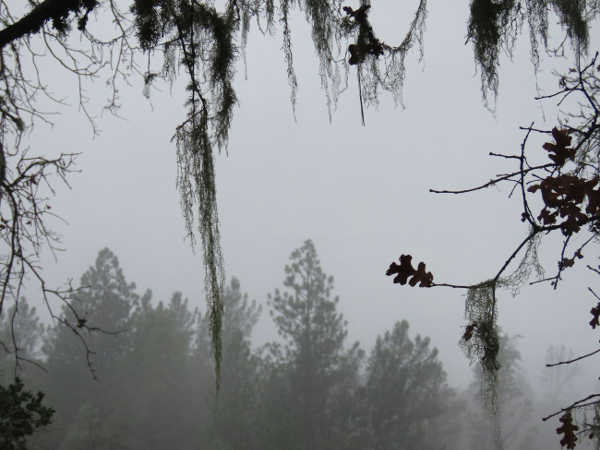
LAKE COUNTY, Calif. – Taking a walk on a foggy morning is like pushing the mute button.
The surroundings are cloaked in a mysterious vapor that renders the environment nearly silent.
You can imagine that you're strolling in a black and white photograph from your childhood. (That is, if you're old enough to remember those pinking-sheared edge pictures of your past.)
Or, you can imagine that you're meandering in a black and white film noir setting in a misty bog. The damp fingers of Spanish moss drape down from the oaks, lending the proper ambiance for a fog-walk, and a deer is rendered nearly white in the mirage-like surroundings.
Fog, a well-designed hydration system in Lake County can take several forms. For example, the “bridal veil” fog that drapes itself elegantly over the mountains like a grand lady wrapped in a stole.
We have valley fog here during the winter months. Valley fog, called “tule fog” in the Central Valley is formed when the valley cools after sundown in otherwise clear weather conditions. Then, when the temperature reaches dew point, fog forms, lasting only until the new day's sun-rays dissipate it.
The coastal regions receive sea fog, or haar, which is born from sea-spray and salt crystals in the atmosphere.
Our state's redwood forests depend on moisture from fog-drip. Those giants receive nearly 40 percent of their water supplies from fog.
The damp sea coat of fog in the Redwood Empire still keeps many secrets from science, however fog has been one of the numerous research stations utilized within the Pepperwood Preserve outside of Santa Rosa, in the Mayacamas Mountains that we share, via the US Geological Survey and the Pacific Coastal Fog Team.
Unfortunately, the preserve has been caught in fires for the past two years, so they are hard at work rebuilding some of the areas that were devastated.
Their fog-cycle research stations link to the coast where fog banks can envelop California's coasts from one hundred-yards in width up to over one hundred miles. Their sensitive technology can determine the type and amounts of moisture received at any given time.
There are other forms of fog in nature, such as ice fog, hail fog, frontal fog, advection fog and more.
Fog has played an important part in some historical events such as when Gen. George Washington used fog to mask his troops from the British Army and escape, or on the beaches of Normandy during World War II when fog played havoc with visibility.
The incomparable combinations of weather that we live within derive from the delicate balance of forces in mystifying nature, creating one more reason to love Lake County.
Kathleen Scavone, M.A., is a retired educator, potter, freelance writer and author of “Anderson Marsh State Historic Park: A Walking History, Prehistory, Flora, and Fauna Tour of a California State Park” and “Native Americans of Lake County.”
The climate breakdown continues. Over the past year, The Conversation has covered fires in the Amazon, melting glaciers in the Andes and Greenland, record CO₂ emissions, and temperatures so hot they’re pushing the human body to its thermal limits. Even the big UN climate talks were largely disappointing.
But climate researchers have not given up hope. We asked a few Conversation authors to highlight some more positive stories from 2019.
Costa Rica offers us a viable climate future
Heather Alberro, associate lecturer in political ecology, Nottingham Trent University
After decades of climate talks, including the recent COP25 in Madrid, emissions have only continued to rise. Indeed, a recent UN report noted that a fivefold increase in current national climate change mitigation efforts would be needed to meet the 1.5℃ limit on warming by 2030. With the radical transformations needed in our global transport, housing, agricultural and energy systems in order to help mitigate looming climate and ecological breakdown, it can be easy to lose hope.
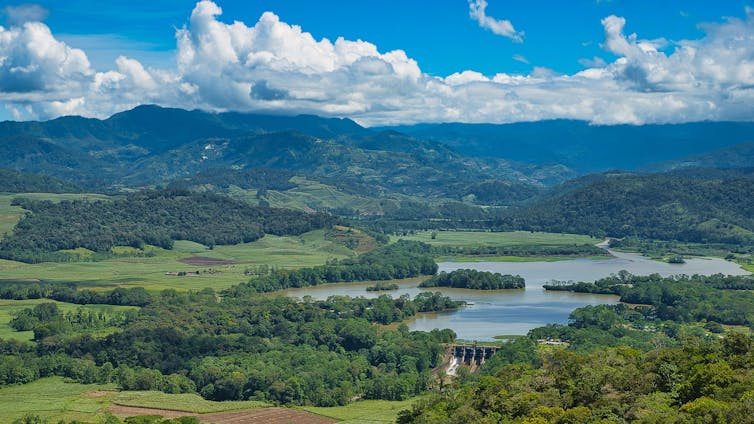
However, countries like Costa Rica offer us promising examples of the “possible”. The Central American nation has implemented a refreshingly ambitious plan to completely decarbonise its economy by 2050. In the lead-up to this, last year with its economy still growing at 3%, Costa Rica was able to derive 98% of its electricity from renewable sources. Such an example demonstrates that with sufficient political will, it is possible to meet the daunting challenges ahead.
Financial investors are cooling on fossil fuels
Richard Hodgkins, senior lecturer in physical geography, Loughborough University
Movements such as 350.org have long argued for fossil fuel divestment, but they have recently been joined by institutional investors such as Climate Action 100+, which is using the influence of its US$35 trillion of managed funds, arguing that minimising climate breakdown risks and maximising renewables’ growth opportunities are a fiduciary duty.
Moody’s credit-rating agency recently flagged ExxonMobil for falling revenues despite rising expenditure, noting: “The negative outlook also reflects the emerging threat to oil and gas companies’ profitability […] from growing efforts by many nations to mitigate the impacts of climate change through tax and regulatory policies.”
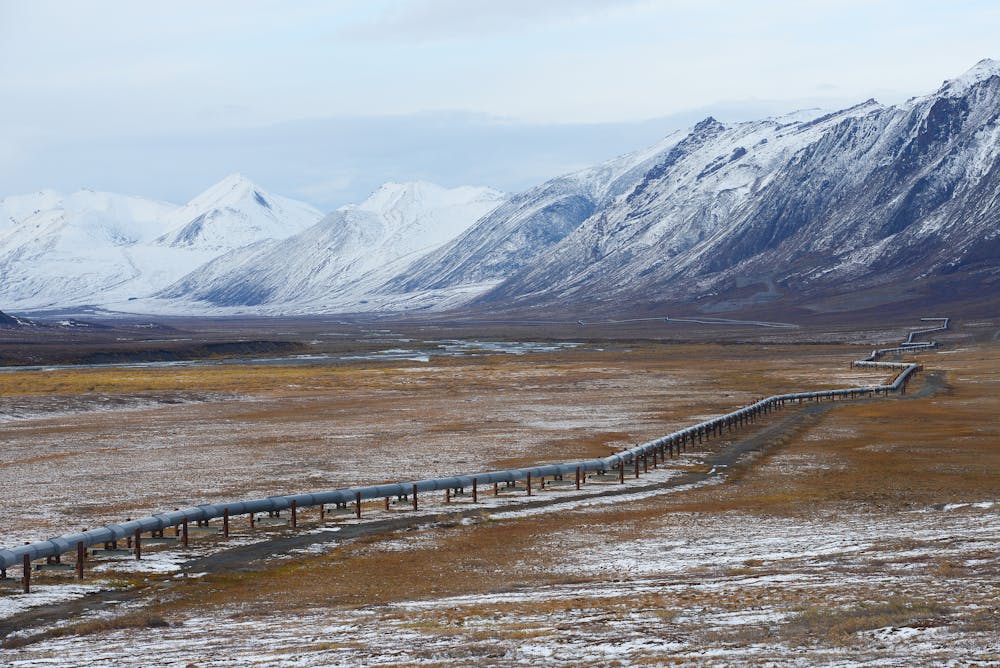
A more adverse financial environment for fossil fuel companies reduces the likelihood of new development in business frontier regions such as the Arctic, and indeed, major investment bank Goldman Sachs has declared that it “will decline any financing transaction that directly supports new upstream Arctic oil exploration or development”.
We are getting much better at forecasting disaster
Hannah Cloke, professor of hydrology, University of Reading
In March and April 2019, two enormous tropical cyclones hit the south-east coast of Africa, killing more than 600 people and leaving nearly 2 million people in desperate need of emergency aid.
There isn’t much that is positive about that, and there’s nothing new about cyclones. But this time scientists were able to provide the first early warning of the impending flood disaster by linking together accurate medium-range forecasts of the cyclone with the best ever simulations of flood risk. This meant that the UK government, for example, set about working with aid agencies in the region to start delivering emergency supplies to the area that would flood, all before Cyclone Kenneth had even gathered pace in the Indian Ocean.
We know that the risk of dangerous floods is increasing as the climate continues to change. Even with ambitious action to reduce greenhouse gases, we must deal with the impact of a warmer more chaotic world. We will have to continue using the best available science to prepare ourselves for whatever is likely to come over the horizon.
Local authorities across the world are declaring a ‘climate emergency’
Marc Hudson, researcher in sustainable consumption, University of Manchester
More than 1,200 local authorities around the world declared a “climate emergency” in 2019. I think there are two obvious dangers: first, it invites authoritarian responses (stop breeding! Stop criticising our plans for geoengineering!). And second, an “emergency” declaration may simply be a greenwash followed by business-as-usual.
In Manchester, where I live and research, the City Council is greenwashing. A nice declaration in July was followed by more flights for staff (to places just a few hours away by train), and further car parks and roads. The deadline for a “bring zero-carbon date forward?” report has been ignored.
But these civic declarations have also kicked off a wave of civic activism, as campaigners have found city councils easier to hold to account than national governments. I’m part of an activist group called “Climate Emergency Manchester” – we inform citizens and lobby councillors. We’ve assessed progress so far, based on Freedom of Information Act requests, and produced a “what could be done?” report. As the council falls further behind on its promises, we will be stepping up our activity, trying to pressure it to do the right thing.
Radical climate policy goes mainstream
Dénes Csala, lecturer in energy system dynamics, Lancaster University
Before the 2019 UK general election, I compared the Conservative and Labour election manifestos, from a climate and energy perspective. Although the party with the clearly weaker plan won eventually, I am still stubborn enough to be hopeful with regard to the future of political action on climate change.
For the first time, in a major economy, a leading party’s manifesto had at its core climate action, transport electrification and full energy system decarbonisation, all on a timescale compatible with IPCC directives to avoid catastrophic climate change. This means the discussion that has been cooking at the highest levels since the 2015 Paris Agreement has started to boil down into tangible policies.
Young people are on the march!
Mark Maslin, professor of earth system science, UCL
In 2019, public awareness of climate change rose sharply, driven by the schools strikes, Extinction Rebellion, high impact IPCC reports, improved media coverage, a BBC One climate change documentary and the UK and other governments declaring a climate emergency. Two recent polls suggest that over 75% of Americans accept humans have caused climate change.
Empowerment of the first truly globalised generation has catalysed this new urgency. Young people can access knowledge at the click of a button. They know climate change science is real and see through the deniers’ lies because this generation does not access traditional media – in fact, they bypass it.
The awareness and concern regarding climate change will continue to grow. Next year will be an even bigger year as the UK will chair the UN climate change negotiations in Glasgow – and expectation are running high.
Heather Alberro, Associate Lecturer/PhD Candidate in Political Ecology, Nottingham Trent University; Dénes Csala, Lecturer in Energy Storage Systems Dynamics, Lancaster University; Hannah Cloke, Professor of Hydrology, University of Reading; Marc Hudson, Researcher in Sustainable Consumption, University of Manchester; Mark Maslin, Professor of Earth System Science, UCL, and Richard Hodgkins, Senior Lecturer in Physical Geography, Loughborough University
This article is republished from The Conversation under a Creative Commons license. Read the original article.
Dogs available for adoption this week include mixes of bluetick coonhound, German Shepherd, pit bull, Rhodesian Ridgeback, Shiba Inu and treeing walker coonhound.
Dogs that are adopted from Lake County Animal Care and Control are either neutered or spayed, microchipped and, if old enough, given a rabies shot and county license before being released to their new owner. License fees do not apply to residents of the cities of Lakeport or Clearlake.
If you're looking for a new companion, visit the shelter. There are many great pets hoping you'll choose them.
The following dogs at the Lake County Animal Care and Control shelter have been cleared for adoption (additional dogs on the animal control Web site not listed are still “on hold”).

Male Labrador Retriever
The male Labrador Retriever mix has a short brown and white coat.
He is in kennel No. 4, ID No. 13360.

Female German Shepherd
This female German Shepherd has a medium-length black and brown coat.
She’s in kennel No. 8, ID No. 13352.

Male pit bull terrier
This male pit bull terrier has a short blue and white coat.
He is in kennel No. 10, ID No. 13345.
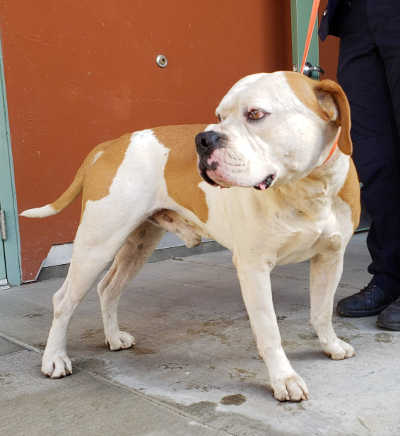
‘Mo’
“Mo” is a male pit bull terrier mix with a short white and gold coat.
He has been neutered.
He’s in kennel No. 11, ID No. 13300.

Female Shiba Inu
This female Shiba Inu has a medium-length black and tan coat.
She is in kennel No. 12a, ID No. 13362.

Male Shiba Inu
This male Shiba Inu has a medium-length tan coat.
He is in kennel No. 12b, ID No. 13372.

‘Patsy’
“Patsy” is a female treeing walker coonhound/bluetick coonhound mix with a short tricolor coat.
She is in kennel No. 20, ID No. 13290.
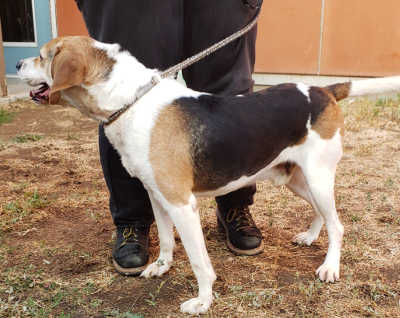
‘Max’
“Max” is a male bluetick coonhound-treeing walker coonhound with a short tricolor coat.
He is in kennel No. 25, ID No. 13289.
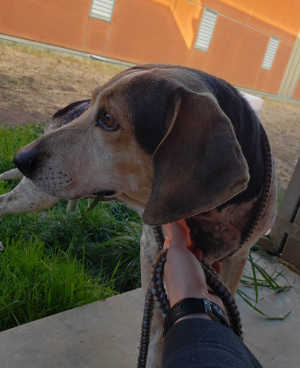
‘Daisey’
“Daisey” is a female treeing walker coonhound/bluetick coonhound mix with a short tricolor coat.
She is in kennel No. 29, ID No. 13291.

‘Goofy’
“Goofy” is a young male Rhodesian Ridgeback with a short tan and black coat.
Shelter staff said this boy is great with other dogs, although he is high energy and would benefit from obedience training. He would love to go jogging everyday, he is very food motivated and willing to learn new things.
Goofy has been at the shelter since Nov. 5. He was originally taken from someone in Upper Lake and found on the highway in Clearlake. If anyone has any information on his owner please contact the shelter.
He’s in kennel No. 33, ID No. 13210.
Lake County Animal Care and Control is located at 4949 Helbush in Lakeport, next to the Hill Road Correctional Facility.
Office hours are Monday through Friday, 11 a.m. to 5 p.m., and 11 a.m. to 3 p.m., Saturday. The shelter is open from 11 a.m. to 4 p.m., Monday through Friday and on Saturday from 11 a.m. to 3 p.m.
Visit the shelter online at http://www.co.lake.ca.us/Government/Directory/Animal_Care_And_Control.htm.
For more information call Lake County Animal Care and Control at 707-263-0278.
Email Elizabeth Larson at

The image above from NASA's Spitzer Space Telescope shows the Perseus Molecular Cloud, a massive collection of gas and dust that stretches over 500 light-years across.
Home to an abundance of young stars, it has drawn the attention of astronomers for decades.
Spitzer's Multiband Imaging Photometer, or MIPS, instrument took this image during Spitzer's "cold mission," which ran from the spacecraft's launch in 2003 until 2009, when the space telescope exhausted its supply of liquid helium coolant. (This marked the beginning of Spitzer's "warm mission.") Infrared light can't be seen by the human eye, but warm objects, from human bodies to interstellar dust clouds, emit infrared light.
Infrared radiation from warm dust generates much of the glow seen here from the Perseus Molecular Cloud. Clusters of stars, such as the bright spot near the left side of the image, generate even more infrared light and illuminate the surrounding clouds like the Sun lighting up a cloudy sky at sunset.
Much of the dust seen here emits little to no visible light (in fact, the dust blocks visible light) and is therefore revealed most clearly with infrared observatories like Spitzer.
On the right side of the image is a bright clump of young stars known as NGC 1333, which Spitzer has observed multiple times. It is located about 1,000 light-years from Earth.
That sounds far, but it is close compared to the size of our galaxy, which is about 100,000 light-years across. NGC 1333's proximity and strong infrared emissions made it visible to astronomers using some of the earliest infrared instruments.
In fact, some of its stars were first observed in the mid-1980s with the Infrared Astronomical Survey (IRAS), a joint mission between NASA, the United Kingdom and the Netherlands. The first infrared satellite telescope, it observed the sky in infrared wavelengths blocked by Earth's atmosphere, providing the first-ever view of the universe in those wavelengths.
More than 1,200 peer-reviewed research papers have been written about NGC 1333, and it has been studied in other wavelengths of light, including by the Hubble Space Telescope, which detects mostly visible light, and the Chandra X-Ray Observatory.
Many young stars in the cluster are sending massive outflows of material — the same material that forms the star – into space. As the material is ejected, it is heated up and smashes into the surrounding interstellar medium.
These factors cause the jets to radiate brightly, and they can be seen in close-up studies of the region. This has provided astronomers with a clear glimpse of how stars go from a sometimes-turbulent adolescence into calmer adulthood.

An evolving mystery
Other clusters of stars seen below NGC 1333 in this image have posed a fascinating mystery for astronomers: They appear to contain stellar infants, adolescents and adults. Such a closely packed mixture of ages is extremely odd, according to Luisa Rebull, an astrophysicist at NASA's Infrared Science Archive at Caltech-IPAC who has studied NGC 1333 and some of the clusters below it.
Although many stellar siblings may form together in tight clusters, stars are always moving, and as they grow older they tend to move farther and farther apart.
Finding such a closely packed mixture of apparent ages doesn't fit with current ideas about how stars evolve.
"This region is telling astronomers that there's something we don't understand about star formation," said Rebull. The puzzle presented by this region is one thing that keeps astronomers coming back to it. "It's one of my favorite regions to study," she added.
Since IRAS's early observations, the region has come into clearer focus, a process that is common in astronomy, said Rebull. New instruments bring more sensitivity and new techniques, and the story becomes clearer with each new generation of observatories.
On Jan. 30, 2020, NASA will decommission the Spitzer Space Telescope, but its legacy has paved the way for upcoming observatories, including the James Webb Space Telescope, which will also observe infrared light.
The Spitzer-MIPS data used for this image is at the infrared wavelength of 24 microns. Small gaps along the edges of this image not observed by Spitzer were filled in using 22-micron data from NASA's Wide-Field Infrared Survey Explorer (WISE).
To learn more about Spitzer and how it studies the infrared universe, check out the Spitzer 360 VR experience, now available on the NASA Spitzer channel on YouTube: http://bit.ly/SpitzerVR.
More information about Spitzer is available at https://www.nasa.gov/mission_pages/spitzer/main.

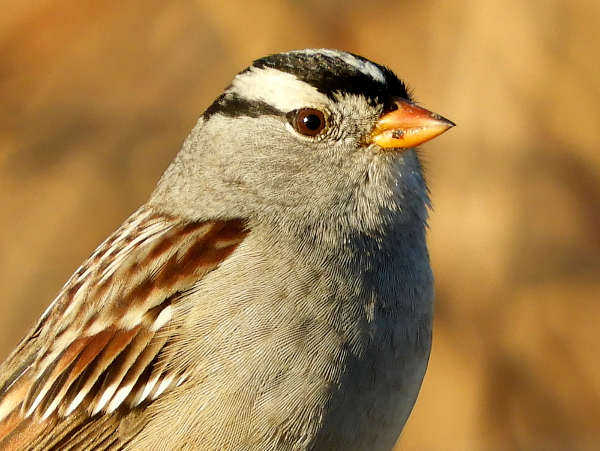
NORTHERN CALIFORNIA – Along with the waterfowl migrating into and through the region now, we’re also seeing an influx of songbirds and sparrows that will winter here and then fly off toward their breeding grounds in the spring.
Three of the easiest ones to spot are the golden-crowned sparrow, the white-crowned sparrow and the dark-eyed junco.
Some populations of these birds migrate great distances, stopping over in our part of the state to rest before they move on.
The white-crowned sparrows (Zonotrichia leucophrys), for example can travel over 2,500 miles from Alaska to Southern California. Other species simply move up and down from one elevation to another.
Adult white-crowns are very easy to identify when you see them in the field. Their bright white-and-black striped heads are unmistakable. The juveniles have similar markings, but those stripes are tinted a diluted tan and brown.
A fun fact about these birds is that the males learn their songs from the areas where they are born rather than from their parents. And because many of them stick close to their natal sites when they’re breeding, flocks of the birds develop regional “dialects”.
Golden-crowned sparrows (Zonotrichia atricapilla ) are aptly named for the bright golden stripe found in the center of the head of the adults that shifts to gray at the back of the head. In juveniles, the golden color is less pronounced.
Not a lot is known about the golden-crowned sparrow because no in-depth scientific studies have been done on it. Most of we understand about these birds, therefore, comes from naturalists’ field journals – which exemplifies just how valuable these hand-written journals and the observations they contain really are.
Modern naturalist training programs, like those taught annually by Tuleyome in Woodland, teach modern-day naturalists how to collect data in field journals and then take that hand-written data and enter it into online applications like iNaturalist.
iNaturalist is one of the many online community science projects through which members of the public can collect and report data in the field and upload it for use by scientists all over the globe.
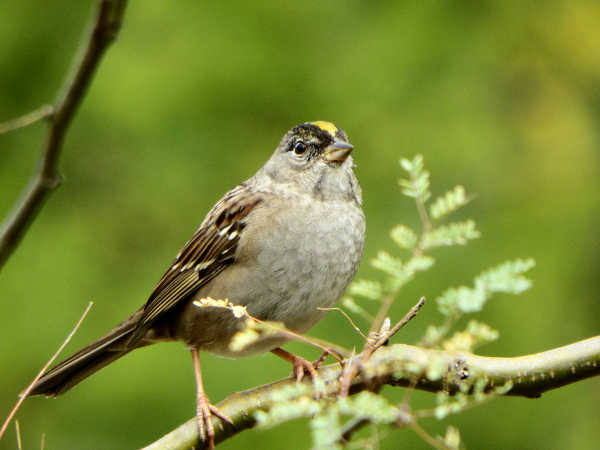
Because the golden-crowned sparrow hasn’t been studied a great deal, we don’t know very much about its breeding habits, except that it leaves our area to breed in the tundra areas up north in the summer months. These the birds are believed to be monogamous.
Another community science project, the Christmas Bird Counts, also seems to suggest that its populations are increasing throughout the United States. They’re usually the first migrants to show up in our region, and the last ones to leave.
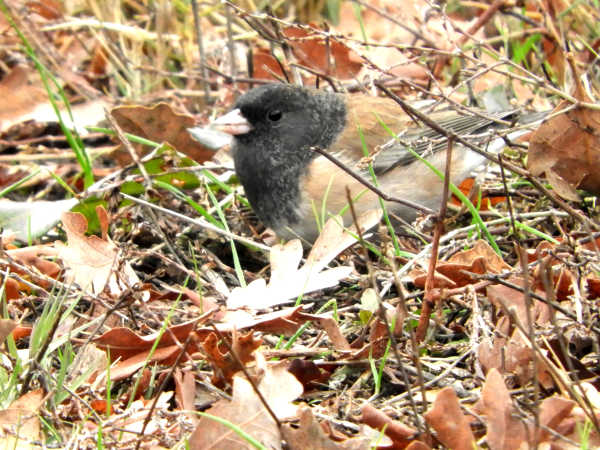
Like the white- and golden-crowned sparrows, dark eyed juncos (Junco hyemalis) are also sparrows and are actually considered to be the most abundant species in North America. They come in a broad variety of color morphs.
The color type we see most often in our region is the “Oregon” color pattern, but other colors include slate, pink-sided, white-winged, red-backed and gray-headed. Juncos with the Oregon color have a dark head, brownish-gray wings and a rusty-to-pink blush on the sides. Its beak is pale (usually pink or off-ivory).
At first, scientists believed that the different colors denoted different species, but recent studies seem to indicate that the color variations we’re seeing in the birds right now is actually the result of the process of evolution happening in real time. Many of the Juncos interbreed, so it’s not known which color morphs will survive and which ones will vanish over time.
Although they are not considered threatened or endangered at this time, the populations of dark-eyed juncos have decreased by 50 percent since 1966. What’s causing the decline isn’t yet fully understood.
Most of these sparrows will come to your wintertime birdfeeders to augment their diet, so set out feeders and suet for them where you can. White-crowns like sunflower seeds, juncos like millet, and golden-crowns will eat just about anything including seeds, flower buds and fruit.
Mary K. Hanson is a Certified California Naturalist, author and nature photographer. She developed and helps to teach the naturalist program at Tuleyome, a 501(c)(3) nonprofit conservation organization based in Woodland. For more information, visit http://tuleyome.org/.

Phosphorus is an essential nutrient for plants and animals.
However, excessive phosphorus in surface water can cause explosive growth of aquatic plants and algae.
This can lead to a variety of water-quality problems, including low dissolved oxygen concentrations, which can cause fish kills and harm other aquatic life.
Rivers connect our terrestrial landscape with downstream lakes, reservoirs, and coastal environments.
High phosphorus concentrations and associated water-quality degradation are a key water-quality concern in many of our nation’s rivers and streams.
A team of US Geological Survey scientists recently published a paper that investigates the potential sources of phosphorus that contribute to degraded river water quality.
Here’s what the lead author, Sarah M. Stackpoole, had to say about the study.
Q: What question were you trying to answer with your recent study?
Stackpoole: The link between agriculture, excess phosphorus, and excess algal growth in freshwater ecosystems is well established.
Management efforts to reduce the movement of excess agricultural phosphorus to surface waters have been in place for decades, but we have not seen widespread improvements in water quality.
This may be because the source of phosphorus leading to degraded water-quality conditions may not actually be linked to the manure and fertilizer currently being applied to nearby farms and fields.
Phosphorus contributions to current river water-quality degradation can also come from older, historical manure and fertilizer inputs that have built up in soils, and sometimes these phosphorus sources can be more than 20 years old.
We wanted to determine if historical phosphorus was a nutrient source to rivers and whether it was masking the effects of current conservation efforts.
Q: What’s unique about this study?
Stackpoole: Previous studies that have looked at current and historical phosphorus sources and their effects on water quality have been more limited in either space (number of watersheds) or time (period of analysis). Our study looked at water quality at 143 river sites for a 20-year time period, 1992–2012.
Q: What insights did you gain about current agricultural phosphorous management?
Stackpoole: The way we evaluated current agricultural phosphorus management was called an agricultural phosphorus balance, defined by phosphorus inputs and outputs. Two key inputs were fertilizer and manure applications to soils. One key watershed phosphorus output is crop uptake and removal of crop plant material in harvest.
You can think about the agricultural phosphorus balance in a similar way as a bank balance. Based on how many dollars that you put in compared to how many dollars you take out, you can have a deficit, a zero balance, or a surplus (also called a savings).
The difference between your bank balance and an agricultural phosphorus balance is that you usually want a surplus in your bank account, but most conservation efforts have been trying to reduce the surplus of phosphorus on the landscape and are aiming toward a zero balance.
We found that 7 percent of the river sites had deficits, meaning that the inputs were less than what was taken up by the plants, 25 percent were balanced, meaning that the inputs were equal to what was taken up by the plants. However, 68 percent of the river sites had surpluses, meaning that inputs were greater than outputs.
Q. What insights did you gain about historical phosphorus sources?
Stackpoole: We documented that historical phosphorus was a source of river phosphorus at 49 of 143 sites. The agricultural balances at these sites showed us that older legacy phosphorus sources, probably manure and fertilizer inputs from the 1980s, were still having an effect today as a source of river phosphorus.
The study documented increased phosphorus transport by the Kansas River at Desoto, Kansas, between 1992 and 2012.
Q: Did you see any indication that current conservation efforts are working?
Stackpoole: Yes, there is some good news in our story. At 43 river sites, where the agricultural balance has decreased over time, the water quality improved.
Q. What insights did you gain about current agricultural phosphorus management and water quality?
Stackpoole: Agricultural management efforts to reduce non-point P sources have been effective in improving water quality in some watersheds. However, additional strategies are needed to promote the adoption of nutrient-conserving practices without compromising agricultural yields.
Because of legacy sources, reductions in agricultural phosphorus inputs alone may not be enough to reduce phosphorus. The most effective management actions will be system-specific and account for both the long-term effects of total historical P storage and reductions in contemporary surpluses.