 How to resolve AdBlock issue?
News
In November, Lake County’s jobless rate was 4.5 percent, tying for the fourth-lowest rate recorded over the past 29 years. The county’s November 2018 unemployment rate was 4.9 percent.
Lake County had its lowest rate in the past three decades – 3.7 percent – in September, as Lake County News has reported.
November’s rate ties with August, also at 4.5 percent. In October, the county recorded a 4.1-percent rate and 4.2 percent in May.
Lake County’s November jobless rate ranks it No. 36 of California’s 58 counties.
Neighboring county jobless rates for November are: Colusa, 10.5 percent; Glenn, 4.7 percent; Mendocino, 3.4 percent; Napa, 2.6 percent; Sonoma, 2.4 percent; and Yolo, 3.6 percent, the report said.
For California as a whole, the report said unemployment remained at a record low of 3.9 percent in November, after registering the same rate in October. State unemployment was 4.1 percent in November 2018.
The federal Bureau of Labor Statistics said the November nationwide unemployment rate was 3.5 percent, down from 3.6 percent in October and 3.7 percent in November 2018.
Across California, the Employment Development Department said employers added 28,400 nonfarm payroll jobs in November, contributing to a record job expansion in California of 117 months, surpassing the long expansion of the 1960s.
California has gained 3,414,700 jobs since the expansion began in February 2010, accounting for more than 15 percent of the nation’s 22,537,000 job gain over the same timeframe, the Employment Development Department said.
Total nonfarm jobs in California’s 11 major industries totaled 17,604,300 in November. The state said total nonfarm jobs increased by 321,800 jobs, a 1.9-percent increase, from November 2018 to November 2019 compared to the U.S. annual gain of 2,204,000 jobs, a 1.5-percent increase.
A monthly federal survey of 5,100 California households which focuses on workers in the economy estimated that the number of Californians holding jobs in November was 18,730,500, an increase of 53,700 from October and up 22,700 from the employment total in November of last year.
The number of unemployed Californians was 761,700 in November, a decrease of 3,700 over the month and down by 39,800 compared with November of last year, based on the survey.
In November, there were 293,595 people receiving Unemployment Insurance benefits during the survey week in November compared to 260,709 in October and 261,022 people in November 2018.
Concurrently, 49,436 people filed new claims in November which was a month-over increase of 10,035 people, the Employment Development Department reported.
Email Elizabeth Larson at
The CHP is reminding everyone to buckle up, avoid distractions while behind the wheel, and have a plan in place if you intend to consume alcohol or other intoxicating substances.
The agency will start off the year with a New Year’s Day Maximum Enforcement Period, or MEP, during which it will be deploying all available personnel from 6:01 p.m. on Tuesday, Dec. 31, to 11:59 p.m. on Wednesday, Jan. 1.
The CHP said it will focus on impaired drivers, but officers will also watch for distracted driving, speeding and seat belt violations.
“As always, our officers will be at the service of motorists in need of assistance,” the agency reported.
The CHP reported that during its 30-hour-long Christmas Day Maximum Enforcement Period, 10 people were killed in collisions in California and more than half of the victims killed were not wearing a seat belt.
Additionally, CHP officers made 271 arrests for driving under the influence during the Christmas MEP.
To help keep the roadways safe during the New Year’s holiday, the CHP is joining forces with five other Western states with the slogan, “No safe place for impaired drivers,” to crack down on drunk and drugged driving for the coming holiday weekend.
In partnership with the National Highway Transportation Safety Administration, the state patrols of Arizona, California, Idaho, Nevada, Oregon and Washington will work as a Western States Traffic Safety Coalition to place special emphasis on the enforcement of drug-impaired driving.
The states will jointly stress that driving under the influence means drugs as well as alcohol in their educational efforts.
According to data from the CHP’s Statewide Integrated Traffic Records System, during the 2018 New Year’s MEP, which was 102 hours in length, at least 25 people were killed and 270 others were injured in collisions involving impaired drivers on California roadways.
In addition, CHP officers made 1,140 arrests for impaired driving during the same period.
“Please make smart choices this holiday season. Driving while impaired can have tragic results,” CHP Commissioner Warren Stanley said. “Whether impaired by alcohol or drugs, the result can lead to arrest, injury, or death. Either way, the impact will be life-altering.”
The CHP said there is no reason to place yourself behind the wheel while impaired. Have a plan. Public transportation, taxis, ride-sharing, or a designated sober friend or family member are the safe options.
The mission of the CHP is to provide the highest level of safety, service and security.

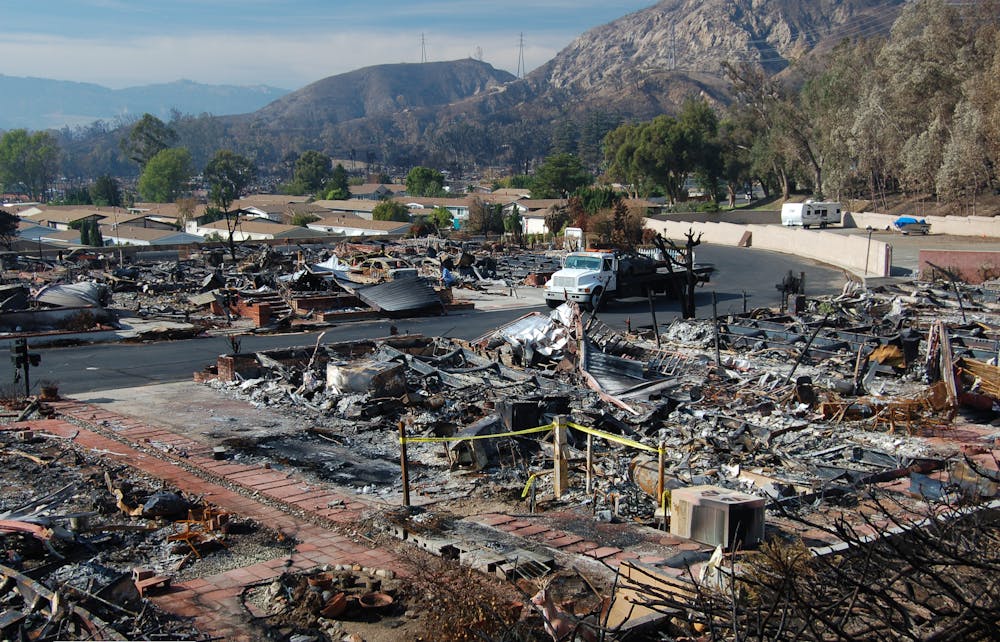
The most destructive and costliest wildfire in California’s history, the Camp Fire, killed 85 people and destroyed nearly 19,000 structures in November 2018. A year later, crews were still collecting and carrying away piles of wood, metals, appliances, contaminated soil, toxic household chemicals, and other debris and waste totaling more than 3.2 million metric tons – roughly the weight of 2 million cars.
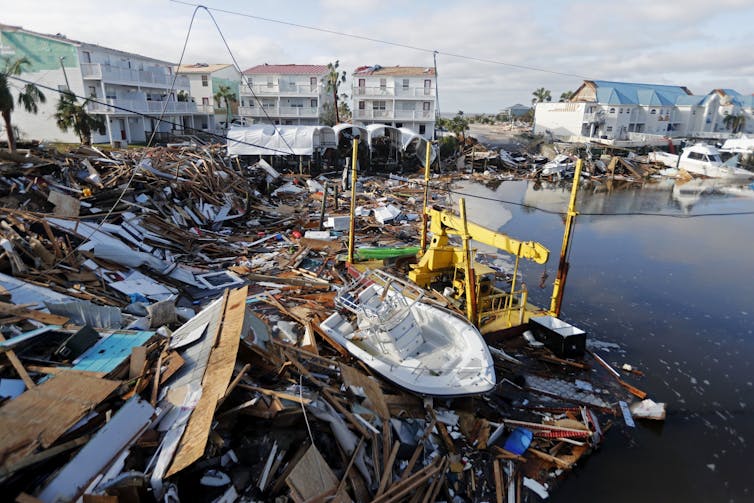
Hurricane Michael, which hit Florida in October 2018, left about 13 million cubic meters of debris. To visualize what that looks like, picture a pile of 13 million boxes, each the size of a washer and dryer. More than a year later, crews were still removing the waste.
Dealing with enormous quantities of debris and waste materials is one of the most significant challenges for communities in the wake of natural disasters. Often this task overwhelms local waste managers, leaving waste untouched for weeks, months or even years.
As researchers who study urban engineering, disaster management and planning, and waste management, we see this as a critical and under-studied problem. Disasters will continue to happen and the losses they cause will continue to grow as a result of climate change, population growth, urbanization, deforestation and aging infrastructures. Societies urgently need better strategies for dealing with the wastes these events leave behind.
Trails of wreckage
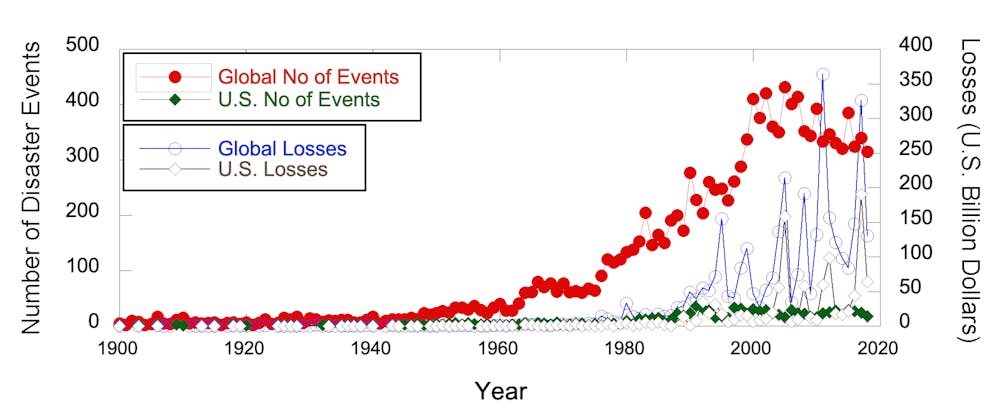
Climate-related disasters like floods, landslides, storms, wildfires, and extreme hot and cold waves afflict millions of people around the world. These events have been increasing over time, particularly over the past several decades, and so have the losses they cause.
In 2018, at least 300 major natural disasters wreaked havoc worldwide, including 14 billion-dollar disasters in the United States alone. Through November 2019, 276 such events had occurred worldwide, with multiple billion-dollar disasters in the U.S.
Disasters commonly produce thousands to millions of tons of debris in a single event. For example, waste from hurricanes includes vegetation, such as trees and shrubs; municipal solid waste, such as household garbage; construction and demolition materials; vehicles; and household hazardous materials, including paints, cleaning agents, pesticides and pool chemicals.
Debris from wildfires largely consists of ash, contaminated soils, metal and concrete, along with other structural debris and household hazardous items such as paints, cleaners, solvents, oils, batteries, herbicides and pesticides.
Dangerous and in the way
Debris collection and cleanup following a disaster is a slow, expensive and dangerous process. First, crews clear out debris from roads used for rescue efforts. They then move the material to temporary storage areas. No one has yet invented a way to easily sort or contain hazardous materials, so they remain mixed into the debris mass. This poses major challenges for reusing and recycling post-disaster waste.
Beyond direct health and safety risks, debris also threatens the environment. It can emit air pollutants and contaminate groundwater, surface waters and soil. Uncollected debris and waste can hamper rescue and recovery efforts and slow down rebuilding efforts.
As an example, when Hurricane Katrina flooded New Orleans in 2005, it left behind an estimated 75 million cubic meters of waste that interfered with and slowed down recovery efforts. The debris included close to 900,000 white goods, such as refrigerators, 350,000 cars and more than 16,000 metric tons of rotten meat. Cleanup costs were estimated at roughly US$4 billion.
Toward reusing disaster waste
At an expert workshop that we organized in May 2019, we identified steps for sustainably managing disaster debris and waste. As we see it, the key tasks are to (1) identify what is contained in these wastes; (2) find better approaches to recycling and reuse; (3) design new technologies to identify hazardous components and sort the different types of waste; and (4) develop markets to promote reuse and recycling.
Today public officials and planners know little about the amount and types of materials generated during disasters – what they contain, in what proportions, whether they are large and sortable versus fine and mixed, and how much can be reused or recycled. Developing new technologies and management approaches that can assist debris characterization, reuse and recycling should be a top priority.

For example, drones and autonomous sensing technologies can be combined with artificial intelligence to estimate amounts and quality of debris, the types of materials it contains and how it can be repurposed rapidly. Technologies that allow for fast sorting and separation of mixed materials can also speed up debris management operations.
Turning the problem around, creating new sustainable construction materials – especially in disaster-prone areas – will make it easier to repurpose debris after disasters.
Finally, new business models can help generate demand for and access to waste and recycled products. With proper sorting, some disaster materials can be used to make new products or materials. For example, downed whole trees can become timber resources for furniture makers. Today, opportunities to match materials with markets are wasted – pun intended.
[ Deep knowledge, daily. Sign up for The Conversation’s newsletter. ]
Sybil Derrible, Associate Professor of Sustainable Infrastructure Systems, University of Illinois at Chicago; Juyeong Choi, Assistant Professor, Florida A&M University-Florida State University College of Engineering, Florida State University, and Nazli Yesiller, Director, Global Waste Research Institute, California Polytechnic State University
This article is republished from The Conversation under a Creative Commons license. Read the original article.
The following cats and kittens at the Lake County Animal Care and Control shelter have been cleared for adoption.

Male domestic longhair
This male domestic longhair has a lynx point coat and blue eyes.
He is in cat room kennel No. 116, ID No. 13365.

‘Oreo’
“Oreo” is a female domestic short hair with an all-black coat and green eyes.
She has been spayed.
She is in cat room kennel No. 121, ID No. 13312.

Female domestic longhair
This female domestic longhair cat has a tortie coat and gold eyes.
She is in cat room kennel No. 142, ID No. 13347.
Lake County Animal Care and Control is located at 4949 Helbush in Lakeport, next to the Hill Road Correctional Facility.
Office hours are Monday through Friday, 11 a.m. to 5 p.m., and 11 a.m. to 3 p.m., Saturday. The shelter is open from 11 a.m. to 4 p.m. Monday through Friday and on Saturday from 11 a.m. to 3 p.m.
Visit the shelter online at http://www.co.lake.ca.us/Government/Directory/Animal_Care_And_Control.htm.
For more information call Lake County Animal Care and Control at 707-263-0278.
Email Elizabeth Larson at
The incident occurred shortly before 10 p.m. Saturday near the Clearlake Oaks Dollar General store, located at 13090 E. State Highway 20, according to Lt. Corey Paulich.
Paulich on Sunday said the deputy involved was Wesley Besgrove.
The name of the man who was shot and died at the scene is not being released pending notification of next of kin, Paulich said.
It was in the Dollar General parking lot that Paulich said Besgrove and the male subject – who was reported to have been armed with a knife – came into contact.
Paulich said the altercation between the deputy and man ended in a creek bed just west of the Dollar General.
The reason for the contact, number of shots fired and where the male subject was struck is all part of the ongoing investigation that Paulich said is being conducted by the Lake County District Attorney’s Office under the auspices of the county’s critical incident protocol.
Paulich said Besgrove had several injuries related to the altercation including a fractured leg, head contusion and bite marks.
Besgrove was treated and released at Adventist Health Clear Lake, Paulich said.
Paulich said Besgrove was the only deputy at the scene during this incident.
Paulich told Lake County News that Besgrove has been employed by the Lake County Sheriff’s Office for four years. Three of those years were spent in corrections, and he’s been on patrol as a deputy a little over a year.
Email Elizabeth Larson at
At 9:50 p.m. Saturday, a Lake County Sheriff’s deputy shot a male subject who was armed with a knife in the area of Highway 20 near the Dollar General store in Clearlake Oaks, according to Lt. Corey Paulich.
Paulich said medical aid was provided, but the male subject died from his injuries.
The deputy sustained minor injuries during the incident and was transported to a local hospital for treatment, Paulich said.
Radio reports indicated that the subject was down in a creekbed by the Dollar General. Deputies responding to the scene were directed to use caution due to possible crossfire across Highway 20.
Sheriff Brian Martin said the white male adult who was shot and died in the incident had not yet been positively identified.
Late Saturday, Martin had little information about what led to the shooting, explaining that investigators were waiting for the deputy’s attorney to arrive so they could conduct an interview about what occurred.
Paulich said the county’s critical incident protocol was initiated and the Lake County District Attorney’s Office was contacted to assume investigative responsibilities for this incident.
The name of the deputy is not yet being released, Paulich said.
He said the deputy will be placed on paid administrative leave as is standard protocol for incidents of this nature.
Email Elizabeth Larson at