 How to resolve AdBlock issue?
News

The U.S. has just entered the new decade of the 2020s.
What does our country look like today, and what will it look like 10 years from now, on Jan. 1, 2030? Which demographic groups in the U.S. will grow the most, and which groups will not grow as much, or maybe even decline in the next 10 years?
I am a demographer and I have examined population data from the U.S. Census Bureau and from the Population Division of the United Nations.
Projections show that whites will decline; the number of old people will increase; and racial minorities, mainly Hispanics, will grow the most, making them the main engine of demographic change in the U.S. for the next 10 years and beyond.
1. There will be more of us
The U.S. population today, at the start of 2020, numbers just over 331 million people.
The U.S. is the third largest country in the world, outnumbered only by the two demographic billionaires, China and India, at just over 1.4 billion and just under 1.4 billion, respectively.
Ten years from now, the U.S. population will have almost 350 million people. China and India will still be bigger, but India with 1.5 billion people will now be larger than China, with 1.46 billion.
2. The population will get older.
The U.S. is getting older and it’s going to keep getting older.
Today, there are over 74.1 million people under age 18 in the U.S. country. There are 56.4 million people age 65 and older.
Ten years from now, there will almost be as many old folks as there are young ones. The numbers of young people will have grown just a little to 76.3 million, but the numbers of old people will have increased a lot – to 74.1 million. A lot of these new elderly will be baby boomers.
For example, take the really old folks – people over the age of 100. How many centenarians are in the U.S. population today and how many are there likely to be 10 years from now?
According to demographers at the U.S. Census Bureau, the number of centenarians in the U.S. grew from over 53,000 in 2010 to over 90,000 in 2020. By 2030, there will most likely be over 130,000 centenarians in the U.S.
But this increase of centenarians by 2030 is only a small indication of their growth in later decades. In the year of 2046, the first group of surviving baby boomers will reach 100 years, and that’s when U.S. centenarians will really start to grow. By 2060 there will be over 603,000. That’s a lot of really old people.
I sometimes ask my undergraduate students how many of them have ever actually seen a person 100 years old or older. In my classes of 140 or more students, no more than maybe six raise their hands. Lots more college students will be raising their hands when they are asked that question in 2060.
3. Racial proportions will shift.
In 2020, non-Hispanic white people, hereafter called whites, are still the majority race in the U.S., representing 59.7% of the U.S. population.
In my research with the demographer Rogelio Saenz, we have shown that the white share of the U.S. population has been dropping since 1950 and it will continue to go down.
Today, after whites, the Hispanic population is the next biggest group at 18.7% of the U.S., followed by blacks and Asians.
What will the country look like racially in 2030? Whites will have dropped to 55.8% of the population, and Hispanics will have grown to 21.1%. The percentage of black and Asian Americans will also grow significantly.
So between now and 2030, whites as a proportion of the population will get smaller, and the minority race groups will all keep getting bigger.
Eventually, whites will become a minority, dropping below 50% of the U.S. population in around the year of 2045.
However, on the first day of 2020, whites under age 18 were already in the minority. Among all the young people now in the U.S., there are more minority young people than there are white young people.
Among old people age 65 and over, whites are still in the majority. Indeed white old people, compared to minority old people, will continue to be in the majority until some years after 2060.
Hispanics and the other racial minorities will be the country’s main demographic engine of population change in future years; this is the most significant demographic change Americans will see.
I’ve shown above how much older the U.S. population has become and will become in the years ahead. Were it not for the racial minorities countering this aging of the U.S. population, the U.S. by 2030 and later would have become even older than it is today and will be in 2030.
[ Deep knowledge, daily. Sign up for The Conversation’s newsletter. ]
Dudley L. Poston, Jr., Professor of Sociology, Texas A&M University
This article is republished from The Conversation under a Creative Commons license. Read the original article.

Perhaps you remember the opening scene of “Harry Potter and the Sorcerer’s Stone” that took place on Privet Drive. A bearded man pulled a mysterious device, called a deluminator, from his dark robe and one by one the lights from the street lamps flew into it.
For the last decade or more, Muggles around the world – including me – have been busy designing and perfecting a similar device called a coronagraph. It blocks light from stars so scientists can take pictures of planets orbiting them – the exoplanets.
More than 500 years ago Italian friar Giordano Bruno postulated that stars in the night sky were like our Sun with planets orbiting them, some of which likely harbored life. Starting in the 1990s, using ground-based and satellite observations astronomers have gathered evidence of the existence of thousands of extra-solar planets or exoplanets. The discovery of exoplanets earned the 2019 Nobel Prize in Physics.
The next major milestone in exoplanetary research is imaging and characterizing Jupiter-sized exoplanets in visible light because imaging Earth-size planets is much more difficult. However, imaging exo-Jupiters would show that astromomers have all necessary tools to image and characterize Earth-size planets in the habitable zones of nearby stars, where life might exist. Space missions capable of imaging exo-Earths in their habitable zones, such as Habitable Exoplanet Observatory or HabEx and Large UV/Optical/IR Surveyor or LUVOIR, are currently being designed by scientists and engineers around the globe and are at least a decade away from their flight.
In preparation for these flagship-class missions, it is critical that key technologies and software tools are developed and validated. A coronagraph is essential to all of these imaging efforts.
I am a professor of physics and lead a research group that has designed many experiments that have flown on NASA missions. For the last decade or so, our team has been developing technologies needed to directly image and characterize exoplanets around nearby stars and test them aboard rockets and balloons before they can be selected for flight on major space missions.

Imaging exoplanets in visible light
Even though we know about the existence of over 4,000 exoplanets, most were detected using indirect methods such as the dimming the light of the parent star when a planet passes in front and blocks some of its light – just like the recent transit of Mercury. This is the technique employed by the Kepler and Transiting Exoplanet Survey Satellite or TESS missions. The 2019 Nobel Prize winners used another indirect method, that relies on the measurement of minute and periodic motion of stars caused by planets orbiting them. But a photograph of an exoplanet, with characteristics similar to those in our Solar System, has not yet been taken.
Imaging exoplanets is hard. For example, even a huge planet like Jupiter is a billion times dimmer than the Sun. And when seen from far away, the Earth is 10 times dimmer than Jupiter. But the difficulty of imaging exoplanets is not because they are dim – large telescopes including the Hubble Space Telescope have imaged much fainter objects.
The challenge of imaging exoplanets has to do with taking a picture of a very faint object that is close to a much brighter one. Since the stars and their planets are far away, when photographed they appear as one bright spot in the sky, just like the headlights of a car look like one bright light from a distance. So, the challenge of imaging even the nearest exoplanet is akin to a person in California taking a picture of a fly 10 feet away from the bright light of a lighthouse in Massachusetts.
My research group recently flew a high-altitude balloon experiment named Planetary Imaging Concept Testbed Using a Recoverable Experiment – Coronagraph (PICTURE-C) that tested the coronagraph’s ability to work in space to image exoplanets and their environments.

Key components of PICTURE-C instrument
PICTURE-C’s coronagraph creates artificial eclipses to dim or eliminate starlight without dimming the planets that the stars illuminate. It is designed to capture faint asteroid belt like objects very close to the central star.
While a coronagraph is necessary for direct imaging of exoplanets, our 6,000 pound device also includes deformable mirrors to correct the shape of the the telescope mirrors that get distorted due to changes in gravity, temperature fluctuations and other manufacturing imperfections.
Finally, the entire device has to be held steady in space for relatively long periods of time. A specially NASA-designed gondola called Wallops Arc Second Pointer (WASP) carried PICTURE-C and got us part way. An internal image stabilization system designed by my colleagues provided the “steady hand” necessary.
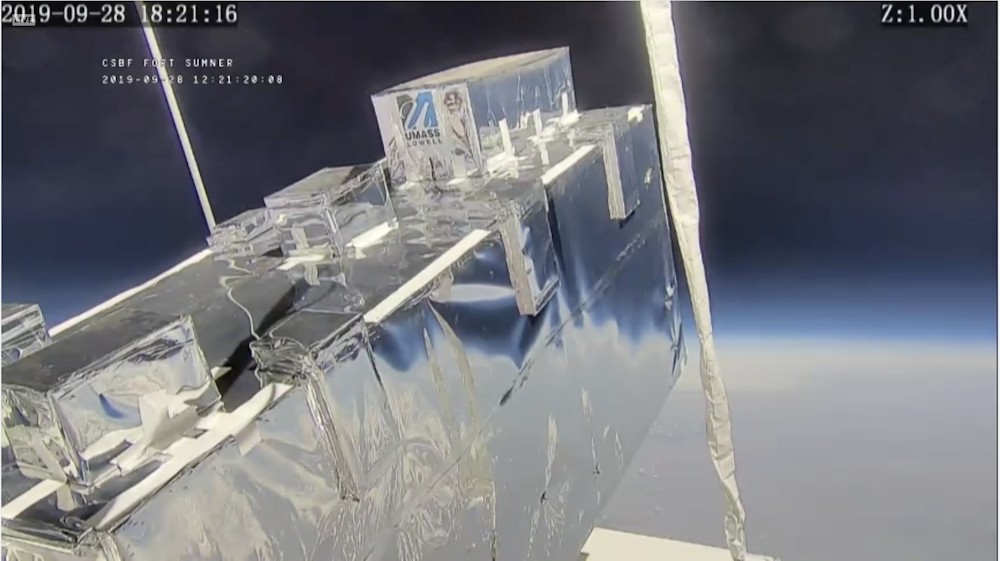
The maiden flight of PICTURE-C
After many tests to demonstrate that all systems were ready for flight our team launched PICTURE-C on the morning of September 29, 2019 from Ft. Sumner, New Mexico.
After the 20-hour test flight confirming that all systems worked well, PICTURE-C returned to the Earth using its parachute to land softly. The experiment has been recovered and returned to our laboratory. PICTURE-C wasn’t supposed to actually discover any exoplanets on its first test run. But it will fly again on another balloon when it will photograph several stars to explore if any of them have asteroid belts. These would be easier to see, and if we are lucky, it will snap a shot of a Jupiter-sized planet in September 2020.

Supriya Chakrabarti, Professor of Physics, University of Massachusetts Lowell
This article is republished from The Conversation under a Creative Commons license. Read the original article.
LAKE COUNTY, Calif. – On Friday, the Lake County Sheriff’s Office released videos from a Dec. 28 incident in which a deputy shot and killed a Lower Lake man during a fight.
On the night of Dec. 28, Deputy Wesley Besgrove shot 34-year-old Craig Ellis See as the two struggled in a creekbed behind the Dollar General store in Clearlake Oaks.
The shooting occurred at approximately 9:50 p.m., following a physical fight that lasted several minutes, authorities said.
Sheriff Brian Martin released two videos on Friday. One is a nearly 11-minute-long critical incident debrief, shown above, in which Martin introduces and explains the circumstances that led to the shooting.
That critical incident debrief video also has subtitles for the sometimes muffled words spoken or shouted during the incident.
The second video, posted below, runs 29 minutes and includes both mobile audio visual camera footage from inside Besgrove’s patrol vehicle as well as his body worn camera, which fell off during the foot pursuit but recorded audio from the deadly encounter.
The audio indicates that Besgrove shot his service weapon five times. Authorities have so far not reported how many times See was struck.
Both videos include language and audio that may be disturbing to some listeners.
Videos document deadly confrontation
Martin said that Besgrove had been patrolling Clearlake Oaks on the night of the shooting when he spotted See riding his bicycle down Highway 20 and into the Dollar General parking lot.
Two weeks prior to the shooting, Martin said Besgrove had investigated a report that See had shot a person in the foot.
The victim in that case had positively identified See as the suspect and Martin said Besgrove had submitted a report to the District Attorney’s Office. However, during that time he hadn’t been able to locate See.
The video begins with Besgrove getting into his patrol vehicle, which is parked along Highway 20 behind another vehicle after an apparent vehicle stop, facing west. A bicyclist rides by, wearing a headlamp but with no other lights on the bike.
After the vehicle in front of him leaves Besgrove pulls onto Highway 20 and does a u-turn, heading east, following the bicyclist, who had moved into the center lane of the highway before turning off the road and wheeling his bicycle across a sidewalk and then the grass in front of the Dollar General store.
Besgrove pulls into the store parking lots, parks his car facing the bicyclist, and exits the vehicle.
“How you doin’, man?” Besgrove is heard to say as he gets out of his vehicle and walks in front of the car and out of view toward See.
The video then changes to the body worn camera. It also shows Besgrove arriving at the scene and approaching See, who lays his bike down in the grass near the store’s front door. See is wearing blue jeans, a black hoodie, gray knit cap and a gray jacket.
Besgrove told See that he was speaking to him because he didn’t have proper lights and reflective equipment on the bicycle. See said there was a light on the bike.
Besgrove then asked See if he had his identification card on him. See said he didn’t, and then gave Besgrove a false name, said he was not on probation or parole, and also gave a false date of birth.
See asked Besgrove if he could go buy a pack of cigarettes. “Not right now,” Besgrove said.
Besgrove asked See to turn around and put his hands behind his head so he could do a pat-search because, according to Sheriff Martin, the deputy had seen what appeared to be a dirk or dagger concealed in See’s waistband. The video shows what appears to be a knife sheath on See’s left hip.
See raised his hands and started to turn around and then begins to run down the sidewalk, with Besgrove radioing dispatch and giving chase, shouting, “Stop now! Stop now!”
Martin said that the foot pursuit led around the building and into a creekbed. As he was running, Besgrove’s camera fell off and landed in tall grass, but it continued to record audio of the fight.
“As the deputy caught up to See in the creekbed, he felt a popping sensation in his knee,” Martin said. Besgrove would later find out his leg was broken.
Much of the video is black, but the two men can be heard struggling.
“Stay the f*** down! Keep your hands where I can see them, you understand me?” Besgrove shouted at See.
Besgrove told See that if he didn’t let go of Besgrove’s hand he was going to get socked.
“Please, just let me go, dude,” See said.
Martin said that See violently fought Besgrove, grabbing his arm and repeatedly biting him.
Besgrove used his pepper spray on See, but it didn’t have an effect on him and instead went back into Besgrove’s eyes, Martin said.
See then began to gouge Besgrove’s eyes, and the two struggled down a small hill, with See landing on top of Besgrove, according to Martin.
Martin said See headbutted Deputy Besgrove twice; the second time, it caused Besgrove’s vision and orientation to distort momentarily but he recovered.
At some point during the fight, Martin said See armed himself with the knife. Just before the five-minute mark in the 29-minute video, Besgrove begins yelling at See repeatedly to drop the knife.
See told him to let him go, Besgrove told him he wouldn’t let him go unless he dropped the knife.
Martin said See tried to stab Besgrove, who grabbed ahold of the knife as they both struggled for control of it.
With both hands on the knife, Besgrove felt pressure on his holstered service weapon. Martin said Besgrove believed See was trying to take his weapon away and then realized See was trying to unholster it.
In the audio, See can be heard saying, “You’re a punk (unintelligible) dude … I, I (unintelligible).” Based on the video, those are the last words he uttered.
Martin said that Besgrove, fearing for his life, removed his weapon and shot See several times.
Three gunshots are heard in rapid succession, with See screaming after the third. Besgrove then shoots twice more. The shooting begins at the 5:41 minute mark in the longer video, and at 8:47 in the shorter critical incident update video.
After the shooting, Besgrove radios, “Central 455, shots fired, shots fired. Suspect down.”
Besgrove then shouts at See, “Arms out! Arms out! Put your arms out at your side, now!”
Besgrove continued to tell See to put his hands out. He then radios to Central Dispatch that See had a knife and he wasn’t sure if he still had it. It also sounded as if Besgrove reported that he wasn’t injured.
However, Martin said that Besgrove was injured and that, due to his injuries, he was unable to render aid to See or place him in handcuffs.
At 9:55 p.m., according to Central Dispatch radio traffic, a dispatcher had called Besgrove several times, asking for his location.
When Besgrove responded a few minutes later, he reported that he was holding See at gunpoint. He asked for medical personnel and additional deputies to respond to his location in the creekbed.
See can still be heard groaning and breathing as Besgrove radios his location to Central Dispatch and asks for a Code 3 response – which means lights and sirens – to his location.
In the audio, there are about eight audible breathing sounds coming from See shortly after he was shot. They slow and cease just before the 6:30 minute mark in the full video. Besgrove continues to tell See not to move.
Just before the eight-minute mark, Besgrove reports to Central Dispatch that See is armed with a knife, although he was not sure if he still had it.
Sirens are first heard at about the 8:30 minute mark, as Besgrove tells See to keep his arms where he can see him.
At the 9:11 minute mark, Besgrove says there are possible crossfire issues as deputies approach Highway 20, and that he was trying to change his position.
At about the 9:40 minute mark, Besgrove calls out, “Lou!” to an arriving deputy.
“DId you shoot?” the other deputy asks.
Besgrove said yes. The second deputy radios to report shots were fired.
Other deputies then begin to arrive. Besgrove tells them he grabbed See’s knife and he’s not sure if his hand is cut.
One of the arriving deputies begins to order that medics respond.
“Were you facing him when all of this happened?” the other deputy asks.
“We were literally fighting, right over here,” said Besgrove, who added that his eyes hurt.
Other deputies’ flashlights begin to illuminate the grass around Besgrove’s camera at that point in the video.
One deputy orders others to go get crime scene tape.
Besgrove said his camera was in the creekbed. “I’m not worried about your camera,” the other deputy responded.
The lead deputy at the scene began to direct other deputies to start a crime scene log, to retrieve his cell phone from his vehicle and make notifications. Other approaching sirens can be heard in the background.
At about the 18:40 mark, another deputy starts yelling obscenities and said he hurt his knee.
A fixed-blade knife was recovered at the scene, Martin said.
Besgrove was transported to the hospital for treatment. Martin said Besgrove sustained a broken leg, a laceration to one of his fingers, several bite marks and other injuries.
See was declared dead at the scene, Martin said.
Sheriff’s office, District Attorney’s Office continue separate investigations
Martin said the sheriff’s office conducts very thorough use of force investigations, which require investigators to interview multiple witnesses, view numerous hours of video footage and analyze a significant amount of forensic evidence.
“These investigations can often take up to a year to complete, and our understanding of this incident may change as evidence is collected, analyzed and reviewed,” said Martin.
He said they don’t draw any conclusions about whether the deputy acted consistently with department policies and the law until all the facts are known and the investigation is complete.
Martin said that in Lake County, incidents involving the use of deadly force or in which a civilian or deputy suffers great bodily injury are investigated separately by the District Attorney’s Office.
“This is done to ensure that the investigation is, in fact, impartial,” he said.
District Attorney Susan Krones told Lake County News on Friday that she didn’t have an update on her investigation’s progress or a timeline yet for when it might be complete.
She said she and her investigator are waiting for a lot of forensic evidence to come back in the case.
Krones said See’s autopsy has been completed, but authorities have not released results from that yet.
“I would like to get it done as soon as possible,” Krones said of the investigation.
The sheriff’s office said Besgrove, who has been a patrol deputy with the sheriff’s office for one year following three years in corrections, was placed on administrative leave after the shooting. That is standard protocol in incidents when a weapon is discharged.
The sheriff’s office reported that, before the shooting, it had minimal contact with See for theft and trespass issues, in addition to his being identified as the suspect in the shooting case earlier in December.
See also had a 2018 felony domestic violence case, with an added misdemeanor charge of stalking from 2019, filed against him for incidents in Clearlake, based on court documents.
Rob Brown, a county supervisor who also owns a bail bonds business, confirmed to Lake County News that See had failed to appear in court on the case over the summer and so he had been looking for him because he had jumped bail.
Records released in accordance with state law
To maintain transparency and community trust, the Lake County Sheriff’s Office said it has developed a way to disseminate records for public inspection in qualifying cases in accordance with state laws SB 1421 and AB 748, both of which went into effect in September 2018 after being approved by then-Gov. Jerry Brown.
Lt. Rich Ward said members of the public can find a list of documents, videos, photographs and other information by navigating to the “Use of Force” page on the Lake County Sheriff’s website.
The newly created “Use of Force” tab can be found at the top of http://www.lakesheriff.com/ ; from there, users will be redirected to http://www.lakesheriff.com/resources/UseOfForce.htm.
Ward said additional materials in the case will be released as they become available.
Email Elizabeth Larson at
Below are the radio traffic audio recordings for the shooting incident on the night of Dec. 28. On the first audio recording, the incident doesn’t begin until 20 minutes into the recording. The second recording continues the incident traffic.
The National Weather Service said an upper-level trough and a cold front pushing into the region is spreading showers over the Coastal Range into Saturday.
The agency said another short wave trough system – an extended low-pressure region – will push over the area Saturday night into Sunday, with light showers possible over the higher elevations.
Chances of showers will continue over the northern mountains into Sunday afternoon. Forecasters said quieter conditions will return early this coming week.
The extended forecast shows potential for a weak weather system that could bring light rain on Tuesday, to be followed by a system expected to arrive on Friday and bring rain through next weekend.
The local forecast calls for showers Saturday, clearing in the evening, to be followed by clear and sunny conditions on Sunday and Monday.
Chances of rain are forecast on Tuesday, with conditions clearing again on Wednesday and Thursday. On Friday, there is a slight chance of rain.
Daytime temperatures over the next week are expected to range from the high 40s to mid-50s. Nighttime temperatures will hover in the low to mid-30s.
Single-digit winds of up to 9 miles per hour are forecast on Saturday and Sunday, the forecast said.
Email Elizabeth Larson at
The committee, or LEDAC, will meet from 7:30 to 9 a.m. Wednesday, Jan. 8, at Lakeport City Hall, 225 Park St.
The meeting is open to the public.
This first quarterly LEDAC meeting of the year will include election of the chair, vice chair and secretary for 2020, and an update on city projects and activities.
Committee members also will discuss the Lakeport Economic Development Strategic Plan implementation and get reports on various aspects of the plan, including the 2020 schedule for business walks, public safety power shutoff survey results and presentations, workforce development and coordination, ordinance revisions to strengthen the city’s downtown and lakefront areas, an update to the “Doing Business in Lakeport” brochure and a review of new activities for 2020.
LEDAC advocates for a strong and positive Lakeport business community and acts as a conduit between the city and the community for communicating the goals, activities and progress of Lakeport’s economic and business programs.
Members are Chair Wilda Shock and Vice Chair Denise Combs, Candy De Los Santos, Bill Eaton, Melissa Fulton, Pam Harpster, Judith Kanavle, Terre Logsdon, Andy Lucas, Laura Sammel and Panette Talia. City staff who are members include City Manager Margaret Silveira and Community Development Director Kevin Ingram.
Email Elizabeth Larson at
The California Natural Resources Agency, California Environmental Protection Agency and California Department of Food and Agriculture developed the draft to fulfill Gov. Gavin Newsom’s April 29 executive order calling for a portfolio of actions to ensure the state’s long-term water resilience and ecosystem health.
The portfolio can be found here.
Shaped by months of public input, the draft portfolio outlines more than 100 integrated actionable recommendations in four broad areas to help regions build water resilience as resources become available, while at the same time providing state leadership to improve infrastructure and protect natural ecosystems.
Those areas include:
– Maintain and diversify water supplies: State government will continue to help regions reduce reliance on any one water source and diversify supplies to enable flexibility amidst changing conditions. Diversification will look different in each region based on available water resources, but the combined effect will strengthen resilience and reduce pressure on river systems.
– Protect and enhance natural ecosystems: State leadership is essential to restore the environmental health of key river systems to sustain fish and wildlife. This requires effective standard-setting, continued investments, and more adaptive, holistic environmental management.
– Build connections: State actions and investment will improve physical infrastructure to store, move, and share water more flexibly and integrate water management through shared use of science, data, and technology.
– Be prepared: Each region must prepare for new threats, including more extreme droughts and floods and hotter temperatures. State investments and guidance will enable preparation, protective actions, and adaptive management to weather these stresses.
“This draft portfolio has been shaped to provide tools to local and regional entities to continue building resilience and to encourage collaboration within and across regions,” Natural Resources Secretary Wade Crowfoot said. “At the same time, state government needs to invest in projects of statewide scale and importance and tackle challenges beyond the scope of any region. Taken together, the proposed actions aim to improve our capacity to prepare for disruptions, withstand and recover from shocks, and adapt from these experiences.”
To develop the portfolio, state agencies conducted an inventory and assessment of key aspects of California water, soliciting broad input from tribes, agencies, individuals, groups, and leaders across the state.
An interagency working group considered the assessment and input from more than 20 public listening sessions across the state and more than 100 substantive comment letters.
“From Northern California to the Central Valley and the South, Californians from cities, farms, and other sectors are working together to develop innovative solutions to the climate-related water challenges that the state is already experiencing and that are expected to worsen,” said California Environmental Protection Agency Secretary Jared Blumenfeld. “This draft portfolio is an important step toward building resilience to ensure the long-term health of our water supplies and ecosystems.”
Members of the public will be able to submit written feedback on the draft portfolio through Feb. 7. A final water resilience portfolio will be released soon after that.
“State agencies are only one set of water decision-makers in California,” said CDFA Secretary Karen Ross. “Continuing to improve our water systems relies on collaboration across all groups of water users and all stakeholders. Accordingly, feedback on this draft will be important to refining and finalizing our portfolio.”
Information on how to submit written feedback on the draft can be found at http://WaterResilience.ca.gov.