 How to resolve AdBlock issue?
News
LAKE COUNTY, Calif. – The National Weather Service said two strong winter storms are headed to the region over the coming week, bringing rain and mountain snow.
The agency’s long-range forecast said that the first of the storms will push into interior Northern California Monday night.
That first storm will bring chances for snow in elevations above 3,000 feet. There are expected to be accumulations around 12 to 18 inches at Sierra pass levels and a few inches of snow possible for the I-5 mountain pass as well.
Midweek another wet weather system is expected to bring rain and lower snow levels to elevations between 2,000 and 3,000 feet – and potentially heavy mountain snow – across the North State.
The system also has the potential for gusty winds, the National Weather Service said.
The local forecast calls for a mostly sunny Saturday, with winds into the mid-teens and gusts of around 20 miles per hour.
There are chances of showers from Sunday through Friday, with winds in the mid-teens forecast through Sunday night. The possibility of snow also exists in Lake County’s higher elevations.
Temperatures overall are expected to be colder in the coming week. Nighttime temperatures will range from the low to high 30s and daytime temperatures from the lost to high 40s.
Email Elizabeth Larson atThis email address is being protected from spambots. You need JavaScript enabled to view it. . Follow her on Twitter, @ERLarson, or Lake County News, @LakeCoNews.
The agency’s long-range forecast said that the first of the storms will push into interior Northern California Monday night.
That first storm will bring chances for snow in elevations above 3,000 feet. There are expected to be accumulations around 12 to 18 inches at Sierra pass levels and a few inches of snow possible for the I-5 mountain pass as well.
Midweek another wet weather system is expected to bring rain and lower snow levels to elevations between 2,000 and 3,000 feet – and potentially heavy mountain snow – across the North State.
The system also has the potential for gusty winds, the National Weather Service said.
The local forecast calls for a mostly sunny Saturday, with winds into the mid-teens and gusts of around 20 miles per hour.
There are chances of showers from Sunday through Friday, with winds in the mid-teens forecast through Sunday night. The possibility of snow also exists in Lake County’s higher elevations.
Temperatures overall are expected to be colder in the coming week. Nighttime temperatures will range from the low to high 30s and daytime temperatures from the lost to high 40s.
Email Elizabeth Larson at
LAKE COUNTY, Calif. – On Tuesday, Jan. 21, Congressman Mike Thompson (CA-05) will hold two events in Lake County.
In the first event, Thompson will host a town hall at the Tom Aiken Community Hall at Kelseyville High School, 5480 Main St., from 5:30 to 7 p.m.
The second event, “Coffee with our Congressman,” will be held at the Grinders Steep Coffee Shop, 21187 Calistoga Road in Middletown, from noon to 1 p.m.
All constituents of California’s Fifth Congressional District and members of the press are invited to attend.
Thompson represents California’s Fifth Congressional District, which includes all or part of Contra Costa, Lake, Napa, Solano and Sonoma counties.
In the first event, Thompson will host a town hall at the Tom Aiken Community Hall at Kelseyville High School, 5480 Main St., from 5:30 to 7 p.m.
The second event, “Coffee with our Congressman,” will be held at the Grinders Steep Coffee Shop, 21187 Calistoga Road in Middletown, from noon to 1 p.m.
All constituents of California’s Fifth Congressional District and members of the press are invited to attend.
Thompson represents California’s Fifth Congressional District, which includes all or part of Contra Costa, Lake, Napa, Solano and Sonoma counties.
LAKEPORT, Calif. – At its first regular meeting of the year, the First 5 Lake Commission elected its leadership for 2020.
Tina Scott, District 4 supervisor for the county of Lake, will serve as the commission’s chair.
The chairperson of the First 5 Lake Commission presides at all meetings and may present to the commission matters that she deems as requiring attention, beginning discussions of such matters for the good of Lake County’s children – prenatally through age 5 – and their families.
The chair also exercises general supervision over the business and property of the commission and jointly executes all formal documents on behalf of the commission along with its executive director.
“As a county supervisor, I feel a sense of responsibility to build a better future for our youth. In my role as a commissioner, I am able to advocate for Lake County’s youngest residents and families,” said Scott. “We need to look for ways to create a culture that nurtures each child, giving them opportunities to achieve their full potential. As chair, I hope to continue the momentum of working collaboratively with our community partners.”
Denise Pomeroy, director of Health Services for the County, was elected as vice chair and will act as chairperson at any meetings and in any duties where the chair is absent.
“As the Health Services director, I have a responsibility to promote healthy lifestyles, good physical and mental health for all residents to lead a full, productive and enjoyable life,” Pomeroy said. “This starts with supporting our youngest community members and their families. The future health and wellbeing of our community starts with early childhood systems that allow for the success of our children at the earliest age possible.”
The next regular meeting of the First 5 Lake Commission will be held on Feb. 12 at the Lower Lake Town Hall. Meetings alternate monthly between Lower Lake and Lakeport.
More information about First 5 Lake can be found at www.firstfivelake.org.
Using funds derived from California Proposition 10’s voter-mandated tax on tobacco products, the First 5 Lake County Commission funds programs and services that benefit the health and development of young children and educate parents, grandparents, caregivers and teachers about the critical role they play during a child’s first five years.
Since its inception in 2000, First 5 Lake has supported thousands of families with programs and services designed to help Lake County children grow up healthy and ready to succeed in school and life. The Executive Director for First 5 Lake is Carla Ritz and current First 5 Lake
Commissioners are Dr. Derrick Barnes, vice chief of staff and obstetrician, Sutter Lakeside Hospital; Lake County Superintendent of Schools Brock Falkenberg; Susan Jen, Health Leadership Network director; Pam Klier, retired kindergarten teacher; Crystal Markytan, Lake County Social Services director; Allison Panella, Hope Rising executive director; Denise Pomeroy, Lake County Health Services director; Tina Scott, Lake County District 4 supervisor; Carly Swatosh-Sherman, Lake County Office of Education, education specialist.
Tina Scott, District 4 supervisor for the county of Lake, will serve as the commission’s chair.
The chairperson of the First 5 Lake Commission presides at all meetings and may present to the commission matters that she deems as requiring attention, beginning discussions of such matters for the good of Lake County’s children – prenatally through age 5 – and their families.
The chair also exercises general supervision over the business and property of the commission and jointly executes all formal documents on behalf of the commission along with its executive director.
“As a county supervisor, I feel a sense of responsibility to build a better future for our youth. In my role as a commissioner, I am able to advocate for Lake County’s youngest residents and families,” said Scott. “We need to look for ways to create a culture that nurtures each child, giving them opportunities to achieve their full potential. As chair, I hope to continue the momentum of working collaboratively with our community partners.”
Denise Pomeroy, director of Health Services for the County, was elected as vice chair and will act as chairperson at any meetings and in any duties where the chair is absent.
“As the Health Services director, I have a responsibility to promote healthy lifestyles, good physical and mental health for all residents to lead a full, productive and enjoyable life,” Pomeroy said. “This starts with supporting our youngest community members and their families. The future health and wellbeing of our community starts with early childhood systems that allow for the success of our children at the earliest age possible.”
The next regular meeting of the First 5 Lake Commission will be held on Feb. 12 at the Lower Lake Town Hall. Meetings alternate monthly between Lower Lake and Lakeport.
More information about First 5 Lake can be found at www.firstfivelake.org.
Using funds derived from California Proposition 10’s voter-mandated tax on tobacco products, the First 5 Lake County Commission funds programs and services that benefit the health and development of young children and educate parents, grandparents, caregivers and teachers about the critical role they play during a child’s first five years.
Since its inception in 2000, First 5 Lake has supported thousands of families with programs and services designed to help Lake County children grow up healthy and ready to succeed in school and life. The Executive Director for First 5 Lake is Carla Ritz and current First 5 Lake
Commissioners are Dr. Derrick Barnes, vice chief of staff and obstetrician, Sutter Lakeside Hospital; Lake County Superintendent of Schools Brock Falkenberg; Susan Jen, Health Leadership Network director; Pam Klier, retired kindergarten teacher; Crystal Markytan, Lake County Social Services director; Allison Panella, Hope Rising executive director; Denise Pomeroy, Lake County Health Services director; Tina Scott, Lake County District 4 supervisor; Carly Swatosh-Sherman, Lake County Office of Education, education specialist.
SACRAMENTO – On Friday Gov. Gavin Newsom submitted to the Legislature his 2020-21 State Budget proposal which he said makes responsible investments in the state’s economic future while tackling head-on persistent challenges facing the state.
“California’s economic growth has fueled the nation’s economy. As 2020 begins, California’s economy is the strongest in the nation and the fifth largest in the world. We’re eliminating debts, paying down pension liabilities, growing our reserve funds – the largest ever at $21 billion – and one out of every seven new U.S. jobs is in California,” said Gov. Newsom. “Despite the progress we’ve made, there are deep, structural challenges that threaten our state’s future and demand our urgent attention. These problems – our widespread affordability crisis, expanding homelessness crisis and catastrophic wildfires – have been decades in the making and won’t be fixed overnight. California is doing more than ever to tackle these challenges and this budget builds on that work with new investments and ideas to take on these longstanding issues.”
Sen. Mike McGuire, who represents Lake County in the State Senate, lauded the budget. “Governor Newsom has put forward an ambitious budget that prioritizes tackling some of our state’s biggest challenges like homelessness, affordable housing and emergency response, all while investing record funding in California’s kids and our public schools.”
McGuire also cited Newsom’s proposed investment in firefighting in order to get more boots on the ground to confront California’s new reality of mega fires. He said the proposal “would put more firefighters in the field than we’ve had in four decades and it’s about damn time.”
The California Farm Bureau said Newsom’s proposed budget follows through on his pledge to elevate issues affecting farmers, ranchers and rural communities.
“The governor’s budget reinforces his commitment to rural California,” CFBF President Jamie Johansson said. “In his inaugural address last year, Governor Newsom promised not to leave rural California behind, and he reiterated that commitment in a meeting with our Board of Directors last summer. The proposals contained in his draft budget reflect his concerns for the future of farmers, ranchers and the rural areas they support,” Johansson said.
The budget must be passed by the Legislature by June 15 and signed by the governor by July 1.
Building reserves and reducing liabilities
Newsom’s office said California is continuing to build a strong economic foundation to anticipate potential risks.
The budget continues to grow the reserves in the Rainy Day Fund and assumes an additional transfer of nearly $2 billion in 2020-21 and an additional $1.4 billion over the remainder of the three-year forecast period.
The Rainy Day Fund balance is projected to be $18 billion in 2020-21 and $19.4 billion by 2023-24.
The budget also:
– Maintains $900 million in the Safety Net Reserve.
– Sets aside $110 million more in the Public School System Stabilization Account, bringing its total balance to $487 million.
– Reserves $1.6 billion in the Special Fund for Economic Uncertainties to address emergencies and other unforeseen events. Overall, the Budget has $21 billion set aside in reserves.
Addressing the affordability crisis
The state’s affordability crisis continues to threaten working families who are burdened by the rising costs of health care and prescription drugs, and the sky-high cost of housing and rent.
Last year, the state passed historic measures to expand access to health care subsidies for the middle class, approved the strongest renter protection law in the nation, and provided $1 billion in tax relief for working families through the expanded earned income tax credit, while investing in affordable housing production efforts.
The administration has announced a new CalRx generic drug program making California the first state to create its own generic drug label and making the state’s generic prescription drugs available for sale to all Californians.
The budget transforms Medi-Cal to a more consistent and seamless system by reducing complexity and increasing flexibility and establishes a single market for drug pricing within the state.
The budget also moves the state toward universal coverage and furthers cost containment goals by expanding full-scope Medi-Cal coverage to low-income undocumented Californians aged 65 and above.
Building on the state’s new renter protection law and unprecedented $1.75 billion investment in last year’s budget to increase housing supply and hold cities accountable for regional housing goals, this year’s budget authorizes $500 million annually for the state's housing tax credit program and continues to support housing development on excess state lands. In addition, the administration is streamlining state processes to accelerate housing production.
Finally, the administration continues to work to establish a trust with $331 million that will provide borrower relief and support housing counselors or other legal aid agencies in representing homeowners and renters in housing-related matters.
Confronting the homelessness crisis
Homelessness is an issue that impacts both urban and rural communities throughout the state, and puts stress on public resources from emergency rooms to jails and public works departments.
It is a complex social services problem and must be combatted at its root causes, which is why the budget introduces several new strategies to build on the $1.15 billion provided to local governments in the last two budgets.
The budget proposes more than $1 billion to radically shift the state's involvement to house the many unsheltered individuals living in California, by launching the California Access to Housing and Services Fund with a $750 million initial investment.
This fund will create a structure for developing affordable housing units, supplementing and augmenting rental subsidies, and stabilizing board and care homes.
The additional funding will come from the Medi-Cal Healthier California for All initiative and will also contribute to addressing the homelessness crisis by transforming the Medi-Cal system to better serve individuals experiencing mental illness and homelessness.
The administration will form a task force to improve the state's behavioral health system as well as strategies to strengthen enforcement of behavioral health parity laws.
Emergency response and effective government
The 2019 Budget Act included nearly $1 billion to enhance the state's emergency response capabilities.
The budget builds on this foundation with investments that further strengthen California’s ability to prevent and respond to fires and that provide the state’s first responders with additional capabilities and support.
The budget enhances the Department of Forestry and Fire Protection’s operational capabilities by adding funding for new firefighters during peak fire season, increasing the number of year-round engines, and providing further relief coverage to support state firefighter health and wellness.
The budget also increases the use of technology by obtaining Light Detection and Ranging data to better inform resources management and hazard assessment decisions, and establishes a new Wildfire Forecast and Threat Intelligence Integration Center to analyze data on wildfire risk.
Promoting opportunity for all
The administration said it continues working toward a universal preschool system and a comprehensive, quality, and affordable child care system for California while helping parents thrive.
The budget builds on the historic investments made last year to expand access to child care, preschool and full-day kindergarten with funding for 10,000 additional full-day or full-year preschool slots, moving the state closer to its goal of universal preschool for all income-eligible four-year-olds.
The budget also expands the earned income tax credit, and increases the amount of child support payments retained by families on CalWORKs, effective Jan. 1, 2022.
The 2019 Budget Act expanded paid family leave from six to eight weeks, moving two-thirds towards the goal of six months of paid family leave for two parents to bond with a new child. The budget builds on this expansion by proposing to extend job protections to more employees, thereby expanding the number of families that can take advantage of this benefit.
The budget also proposes developing a new adverse childhood experiences, or ACEs, cross-sector training program with the goal of reducing adverse childhood experiences and toxic stress by half in a generation and establishing a new Department of Early Childhood Development under the Health and Human Services Agency, effective July 1, 2021.
Largest K-12 education per-pupil expenditure in history
Preparing students to succeed is important to California’s future. That’s why the budget proposes a historic level of funding for K-12 schools.
Per-pupil funding has grown by more than $7,200 since its low point in 2011-12 and achievement gaps are closing for many students.
The state has a well-documented, long-term, statewide teacher shortage in the areas of special education, science and math.
The budget proposes an investment of approximately $900 million in teacher training, including professional development, educator service awards, and teacher residency programs. These investments will increase and improve the teacher workforce, which is foundational to improving student outcomes.
The budget also includes $300 million one-time for grants and technical assistance to prepare and implement improvement plans at the state’s lowest-performing schools, and includes $300 million one-time for grants to develop community school models with innovative partnerships that support mental health and the whole child.
The budget includes a 40-percent increase in state funding for school nutrition programs to boost the quality of meals provided and to expand access. It also includes $10 million for grants to foster innovative farm-to-school linkages that support sustainable agriculture and make more healthy foods available to schoolchildren.
Local educational agencies will also continue to benefit from the massive $3.15 billion non-Proposition 98 General Fund payment made on their behalf to the California State Teachers' Retirement System, or CalSTRS, and the California Public Employees' Retirement System, or CalPERS, Schools Pool.
An estimated $850 million is buying down the employer contribution rates in 2019-20 and 2020-21 and the remaining $2.3 billion is being paid toward long-term unfunded liabilities. Overall, these payments are expected to save schools $6.9 billion over the next three decades.
Expanding access to higher education
The 2019 Budget Act included major investments in higher education that provided two years of tuition-free community college and increased enrollment and investments to improve student success across all segments.
The budget establishes expectations that the University of California and California State University increase undergraduate enrollment, increase student supports and encourage degree completion through innovative delivery methods, including University Extension centers.
The budget proposes major investments in Inland California communities that face higher unemployment and create fewer jobs in high-wage sectors.
The budget allocates additional ongoing funding to expand enrollment and increase operational support for the UC Riverside School of Medicine and to expand the UC San Francisco School of Medicine Fresno Branch Campus in partnership with UC Merced. The budget also includes funding for a major new food innovation corridor in the Central Valley.
Climate budget
The budget proposes a comprehensive approach to California’s investments to protect the state’s environment, address the effects of climate change, and promote resiliency. This climate budget includes $12 billion over the next five years.
Three key areas of the climate budget are a proposed climate resilience bond, cap-and-trade expenditures to continue the transition to a carbon-neutral economy, and a new Climate Catalyst Fund to promote the deployment of new technologies, especially by small businesses and emerging industries.
The Climate Catalyst Fund, which will be administered by the Infrastructure and Economic Development Bank, will finance investments in low-carbon transportation, sustainable agriculture and waste diversion through low-interest loans. The budget proposes to capitalize the fund with $1 billion General Fund over the next four years.
The fund will have a revolving loan structure that will leverage private capital and will support projects well into the future. It will be designed to support good jobs and a just transition to achieving California's climate goals.
Reimagining criminal justice
The budget builds on important steps taken last year, including shifting juvenile justice to focus on rehabilitation and reentry, investing in restorative justice, community-based violence prevention, substance-use disorder treatment, prison literacy and pretrial diversion.
The budget proposes to continue expansion of opportunities for rehabilitation and treatment – starting with the youngest offenders in state prison. It proposes to cluster the 5,800 young offenders (under age 26) into campus-style environments within existing facilities, with specialized programming and educational opportunities.
The budget also includes a major investment in technology for inmates participating in academic programs and expanded access to higher education programming through partnerships with the California State University system.
The proposed budget includes a major proposal to enhance staff development through a new training facility and training program for correctional officers and counselors.
Jobs, the economy and protecting the environment
As California enters a new decade, it must prepare for the jobs and economy of tomorrow. Rapid advancements in technology, automation and artificial intelligence are reshaping the economy and the nature of work, and the state needs to better align data, policy and program analysis for the state's workforce training programs.
The budget includes funding to establish a new Department of Better Jobs and Higher Wages to consolidate the workforce functions currently dispersed across the Labor and Workforce Development Agency.
It also funds the next $1 increase in the state’s minimum wage, bringing it to $13 per hour for most employees as of Jan. 1, 2020.
The budget also proposes to reduce the minimum franchise tax for new small businesses, removing a barrier to entrepreneurship and job creation.
Finally, the budget allocates $53 billion to the state's infrastructure over the next five years, focusing on investments that underpin economic activity and create a sustainable and resilient California.
The California Department of Food and Agriculture said the budget proposal also includes a significant change in the regulatory structure for cannabis, with the administration consolidating the three licensing entities – CDFA, the Department of Public Health and the Bureau of Cannabis Control – into a single Department of Cannabis Control by July 2021. The administration will submit more details on this proposal in Spring 2020.
More information on Governor Newsom’s budget proposal, including the full budget summary, is available at www.ebudget.ca.gov .
Republicans respond
Senate Republican Leader Shannon Grove (R-Bakersfield) issued a response to the budget on Friday.
"This year's budget proposal continues to add to the state's Rainy Day Fund which Republicans have long pushed for. Money for better emergency preparedness and forest management is overdue. I'm pleased that the governor is continuing to focus on the wildfire efforts with the additional funding for CalFire positions which will help ensure better disaster preparedness and response,” Grove said.
"But too much of this budget is out of touch with everyday Californians. For example, nearly $20 million will go towards cracking down on AB 5 and limiting worker's freedom, despite the pleas from so many industries to fix the law. This is a clear case of poor prioritization. We should be using this funding to house Californians instead of preventing them from earning an income the way they choose,” Grove said.
"More than 50 percent of Golden State residents are already considering fleeing because Democrats have imposed high costs on too many basic necessities. The governor offers a lot of new programs, but it's time to get back to the basics such as lowering the cost of living, ensuring safe communities, providing high-quality education, and serving the disabled,” Grove explained.
"Another immediate priority must be tackling the out-of-control homelessness crisis that we all agree on, but California needs to be smart about it. The state has provided significant investments on this issue over the last several years, yet the homeless population dramatically increased in California. Instead of addressing the root-causes of homelessness such as mental health and drug abuse, the Democrats have poorly prioritized their spending," said Grove.
Senate Republicans' priorities include the following:
– Improve Californians' quality of life by lowering the cost of living and shortening commutes.
Address the homelessness crisis by providing shelter and access to mental health services and substance use treatment.
– Prepare for natural disasters and bring down the high cost of insuring rural homes.
– Ensure California students have access to higher education and vocational training.
– Fulfill our longstanding commitment to fund needed services for those with developmental disabilities.
– Invest in public safety by properly funding our courts and law enforcement efforts.
– Increase the state's budget reserves and spending responsibly to prepare for the next recession.
“California’s economic growth has fueled the nation’s economy. As 2020 begins, California’s economy is the strongest in the nation and the fifth largest in the world. We’re eliminating debts, paying down pension liabilities, growing our reserve funds – the largest ever at $21 billion – and one out of every seven new U.S. jobs is in California,” said Gov. Newsom. “Despite the progress we’ve made, there are deep, structural challenges that threaten our state’s future and demand our urgent attention. These problems – our widespread affordability crisis, expanding homelessness crisis and catastrophic wildfires – have been decades in the making and won’t be fixed overnight. California is doing more than ever to tackle these challenges and this budget builds on that work with new investments and ideas to take on these longstanding issues.”
Sen. Mike McGuire, who represents Lake County in the State Senate, lauded the budget. “Governor Newsom has put forward an ambitious budget that prioritizes tackling some of our state’s biggest challenges like homelessness, affordable housing and emergency response, all while investing record funding in California’s kids and our public schools.”
McGuire also cited Newsom’s proposed investment in firefighting in order to get more boots on the ground to confront California’s new reality of mega fires. He said the proposal “would put more firefighters in the field than we’ve had in four decades and it’s about damn time.”
The California Farm Bureau said Newsom’s proposed budget follows through on his pledge to elevate issues affecting farmers, ranchers and rural communities.
“The governor’s budget reinforces his commitment to rural California,” CFBF President Jamie Johansson said. “In his inaugural address last year, Governor Newsom promised not to leave rural California behind, and he reiterated that commitment in a meeting with our Board of Directors last summer. The proposals contained in his draft budget reflect his concerns for the future of farmers, ranchers and the rural areas they support,” Johansson said.
The budget must be passed by the Legislature by June 15 and signed by the governor by July 1.
Building reserves and reducing liabilities
Newsom’s office said California is continuing to build a strong economic foundation to anticipate potential risks.
The budget continues to grow the reserves in the Rainy Day Fund and assumes an additional transfer of nearly $2 billion in 2020-21 and an additional $1.4 billion over the remainder of the three-year forecast period.
The Rainy Day Fund balance is projected to be $18 billion in 2020-21 and $19.4 billion by 2023-24.
The budget also:
– Maintains $900 million in the Safety Net Reserve.
– Sets aside $110 million more in the Public School System Stabilization Account, bringing its total balance to $487 million.
– Reserves $1.6 billion in the Special Fund for Economic Uncertainties to address emergencies and other unforeseen events. Overall, the Budget has $21 billion set aside in reserves.
Addressing the affordability crisis
The state’s affordability crisis continues to threaten working families who are burdened by the rising costs of health care and prescription drugs, and the sky-high cost of housing and rent.
Last year, the state passed historic measures to expand access to health care subsidies for the middle class, approved the strongest renter protection law in the nation, and provided $1 billion in tax relief for working families through the expanded earned income tax credit, while investing in affordable housing production efforts.
The administration has announced a new CalRx generic drug program making California the first state to create its own generic drug label and making the state’s generic prescription drugs available for sale to all Californians.
The budget transforms Medi-Cal to a more consistent and seamless system by reducing complexity and increasing flexibility and establishes a single market for drug pricing within the state.
The budget also moves the state toward universal coverage and furthers cost containment goals by expanding full-scope Medi-Cal coverage to low-income undocumented Californians aged 65 and above.
Building on the state’s new renter protection law and unprecedented $1.75 billion investment in last year’s budget to increase housing supply and hold cities accountable for regional housing goals, this year’s budget authorizes $500 million annually for the state's housing tax credit program and continues to support housing development on excess state lands. In addition, the administration is streamlining state processes to accelerate housing production.
Finally, the administration continues to work to establish a trust with $331 million that will provide borrower relief and support housing counselors or other legal aid agencies in representing homeowners and renters in housing-related matters.
Confronting the homelessness crisis
Homelessness is an issue that impacts both urban and rural communities throughout the state, and puts stress on public resources from emergency rooms to jails and public works departments.
It is a complex social services problem and must be combatted at its root causes, which is why the budget introduces several new strategies to build on the $1.15 billion provided to local governments in the last two budgets.
The budget proposes more than $1 billion to radically shift the state's involvement to house the many unsheltered individuals living in California, by launching the California Access to Housing and Services Fund with a $750 million initial investment.
This fund will create a structure for developing affordable housing units, supplementing and augmenting rental subsidies, and stabilizing board and care homes.
The additional funding will come from the Medi-Cal Healthier California for All initiative and will also contribute to addressing the homelessness crisis by transforming the Medi-Cal system to better serve individuals experiencing mental illness and homelessness.
The administration will form a task force to improve the state's behavioral health system as well as strategies to strengthen enforcement of behavioral health parity laws.
Emergency response and effective government
The 2019 Budget Act included nearly $1 billion to enhance the state's emergency response capabilities.
The budget builds on this foundation with investments that further strengthen California’s ability to prevent and respond to fires and that provide the state’s first responders with additional capabilities and support.
The budget enhances the Department of Forestry and Fire Protection’s operational capabilities by adding funding for new firefighters during peak fire season, increasing the number of year-round engines, and providing further relief coverage to support state firefighter health and wellness.
The budget also increases the use of technology by obtaining Light Detection and Ranging data to better inform resources management and hazard assessment decisions, and establishes a new Wildfire Forecast and Threat Intelligence Integration Center to analyze data on wildfire risk.
Promoting opportunity for all
The administration said it continues working toward a universal preschool system and a comprehensive, quality, and affordable child care system for California while helping parents thrive.
The budget builds on the historic investments made last year to expand access to child care, preschool and full-day kindergarten with funding for 10,000 additional full-day or full-year preschool slots, moving the state closer to its goal of universal preschool for all income-eligible four-year-olds.
The budget also expands the earned income tax credit, and increases the amount of child support payments retained by families on CalWORKs, effective Jan. 1, 2022.
The 2019 Budget Act expanded paid family leave from six to eight weeks, moving two-thirds towards the goal of six months of paid family leave for two parents to bond with a new child. The budget builds on this expansion by proposing to extend job protections to more employees, thereby expanding the number of families that can take advantage of this benefit.
The budget also proposes developing a new adverse childhood experiences, or ACEs, cross-sector training program with the goal of reducing adverse childhood experiences and toxic stress by half in a generation and establishing a new Department of Early Childhood Development under the Health and Human Services Agency, effective July 1, 2021.
Largest K-12 education per-pupil expenditure in history
Preparing students to succeed is important to California’s future. That’s why the budget proposes a historic level of funding for K-12 schools.
Per-pupil funding has grown by more than $7,200 since its low point in 2011-12 and achievement gaps are closing for many students.
The state has a well-documented, long-term, statewide teacher shortage in the areas of special education, science and math.
The budget proposes an investment of approximately $900 million in teacher training, including professional development, educator service awards, and teacher residency programs. These investments will increase and improve the teacher workforce, which is foundational to improving student outcomes.
The budget also includes $300 million one-time for grants and technical assistance to prepare and implement improvement plans at the state’s lowest-performing schools, and includes $300 million one-time for grants to develop community school models with innovative partnerships that support mental health and the whole child.
The budget includes a 40-percent increase in state funding for school nutrition programs to boost the quality of meals provided and to expand access. It also includes $10 million for grants to foster innovative farm-to-school linkages that support sustainable agriculture and make more healthy foods available to schoolchildren.
Local educational agencies will also continue to benefit from the massive $3.15 billion non-Proposition 98 General Fund payment made on their behalf to the California State Teachers' Retirement System, or CalSTRS, and the California Public Employees' Retirement System, or CalPERS, Schools Pool.
An estimated $850 million is buying down the employer contribution rates in 2019-20 and 2020-21 and the remaining $2.3 billion is being paid toward long-term unfunded liabilities. Overall, these payments are expected to save schools $6.9 billion over the next three decades.
Expanding access to higher education
The 2019 Budget Act included major investments in higher education that provided two years of tuition-free community college and increased enrollment and investments to improve student success across all segments.
The budget establishes expectations that the University of California and California State University increase undergraduate enrollment, increase student supports and encourage degree completion through innovative delivery methods, including University Extension centers.
The budget proposes major investments in Inland California communities that face higher unemployment and create fewer jobs in high-wage sectors.
The budget allocates additional ongoing funding to expand enrollment and increase operational support for the UC Riverside School of Medicine and to expand the UC San Francisco School of Medicine Fresno Branch Campus in partnership with UC Merced. The budget also includes funding for a major new food innovation corridor in the Central Valley.
Climate budget
The budget proposes a comprehensive approach to California’s investments to protect the state’s environment, address the effects of climate change, and promote resiliency. This climate budget includes $12 billion over the next five years.
Three key areas of the climate budget are a proposed climate resilience bond, cap-and-trade expenditures to continue the transition to a carbon-neutral economy, and a new Climate Catalyst Fund to promote the deployment of new technologies, especially by small businesses and emerging industries.
The Climate Catalyst Fund, which will be administered by the Infrastructure and Economic Development Bank, will finance investments in low-carbon transportation, sustainable agriculture and waste diversion through low-interest loans. The budget proposes to capitalize the fund with $1 billion General Fund over the next four years.
The fund will have a revolving loan structure that will leverage private capital and will support projects well into the future. It will be designed to support good jobs and a just transition to achieving California's climate goals.
Reimagining criminal justice
The budget builds on important steps taken last year, including shifting juvenile justice to focus on rehabilitation and reentry, investing in restorative justice, community-based violence prevention, substance-use disorder treatment, prison literacy and pretrial diversion.
The budget proposes to continue expansion of opportunities for rehabilitation and treatment – starting with the youngest offenders in state prison. It proposes to cluster the 5,800 young offenders (under age 26) into campus-style environments within existing facilities, with specialized programming and educational opportunities.
The budget also includes a major investment in technology for inmates participating in academic programs and expanded access to higher education programming through partnerships with the California State University system.
The proposed budget includes a major proposal to enhance staff development through a new training facility and training program for correctional officers and counselors.
Jobs, the economy and protecting the environment
As California enters a new decade, it must prepare for the jobs and economy of tomorrow. Rapid advancements in technology, automation and artificial intelligence are reshaping the economy and the nature of work, and the state needs to better align data, policy and program analysis for the state's workforce training programs.
The budget includes funding to establish a new Department of Better Jobs and Higher Wages to consolidate the workforce functions currently dispersed across the Labor and Workforce Development Agency.
It also funds the next $1 increase in the state’s minimum wage, bringing it to $13 per hour for most employees as of Jan. 1, 2020.
The budget also proposes to reduce the minimum franchise tax for new small businesses, removing a barrier to entrepreneurship and job creation.
Finally, the budget allocates $53 billion to the state's infrastructure over the next five years, focusing on investments that underpin economic activity and create a sustainable and resilient California.
The California Department of Food and Agriculture said the budget proposal also includes a significant change in the regulatory structure for cannabis, with the administration consolidating the three licensing entities – CDFA, the Department of Public Health and the Bureau of Cannabis Control – into a single Department of Cannabis Control by July 2021. The administration will submit more details on this proposal in Spring 2020.
More information on Governor Newsom’s budget proposal, including the full budget summary, is available at www.ebudget.ca.gov .
Republicans respond
Senate Republican Leader Shannon Grove (R-Bakersfield) issued a response to the budget on Friday.
"This year's budget proposal continues to add to the state's Rainy Day Fund which Republicans have long pushed for. Money for better emergency preparedness and forest management is overdue. I'm pleased that the governor is continuing to focus on the wildfire efforts with the additional funding for CalFire positions which will help ensure better disaster preparedness and response,” Grove said.
"But too much of this budget is out of touch with everyday Californians. For example, nearly $20 million will go towards cracking down on AB 5 and limiting worker's freedom, despite the pleas from so many industries to fix the law. This is a clear case of poor prioritization. We should be using this funding to house Californians instead of preventing them from earning an income the way they choose,” Grove said.
"More than 50 percent of Golden State residents are already considering fleeing because Democrats have imposed high costs on too many basic necessities. The governor offers a lot of new programs, but it's time to get back to the basics such as lowering the cost of living, ensuring safe communities, providing high-quality education, and serving the disabled,” Grove explained.
"Another immediate priority must be tackling the out-of-control homelessness crisis that we all agree on, but California needs to be smart about it. The state has provided significant investments on this issue over the last several years, yet the homeless population dramatically increased in California. Instead of addressing the root-causes of homelessness such as mental health and drug abuse, the Democrats have poorly prioritized their spending," said Grove.
Senate Republicans' priorities include the following:
– Improve Californians' quality of life by lowering the cost of living and shortening commutes.
Address the homelessness crisis by providing shelter and access to mental health services and substance use treatment.
– Prepare for natural disasters and bring down the high cost of insuring rural homes.
– Ensure California students have access to higher education and vocational training.
– Fulfill our longstanding commitment to fund needed services for those with developmental disabilities.
– Invest in public safety by properly funding our courts and law enforcement efforts.
– Increase the state's budget reserves and spending responsibly to prepare for the next recession.
NASA has captured an extremely crisp infrared image of the center of our Milky Way galaxy. NASA has captured an extremely crisp infrared image of the center of our Milky Way galaxy.
Spanning a distance of more than 600 light-years, this panorama reveals details within the dense swirls of gas and dust in high resolution, opening the door to future research into how massive stars are forming and what’s feeding the supermassive black hole at our galaxy’s core.
Among the features coming into focus are the jutting curves of the Arches Cluster containing the densest concentration of stars in our galaxy, as well as the Quintuplet Cluster with stars a million times brighter than our Sun. Our galaxy’s black hole takes shape with a glimpse of the fiery-looking ring of gas surrounding it.
The new view was made possible by the world’s largest airborne telescope, the Stratospheric Observatory for Infrared Astronomy, or SOFIA. Flying high in the atmosphere, this modified Boeing 747 pointed its infrared camera called FORCAST – the Faint Object Infrared Camera for the SOFIA Telescope – to observe warm, galactic material emitting at wavelengths of light that other telescopes could not detect.
The image combines SOFIA’s new perspective of warm regions with previous data exposing very hot and cold material from NASA’s Spitzer Space Telescope and the European Space Agency’s Herschel Space Observatory.
An overview paper highlighting initial results has been submitted for publication to the Astrophysical Journal. The image was presented for the first time at the American Astronomical Society annual meeting this week in 2020 in Honolulu.
“It’s incredible to see our galactic center in detail we’ve never seen before,” said James Radomski, a Universities Space Research Association scientist at the SOFIA Science Center at NASA’s Ames Research Center in California’s Silicon Valley. “Studying this area has been like trying to assemble a puzzle with missing pieces. The SOFIA data fills in some of the holes, putting us significantly closer to having a complete picture.”
Birth of stars
The Milky Way’s central regions have significantly more of the dense gas and dust that are the building blocks for new stars compared to other parts of the galaxy. Yet, there are 10 times fewer massive stars born here than expected.
Understanding why this discrepancy exists has been difficult because of all the dust between Earth and the galactic core getting in the way – but observing with infrared light offers a closer look at the situation.
The new infrared data illuminates structures indicative of star birth near the Quintuplet Cluster and warm material near the Arches Cluster that could be the seeds for new stars. Seeing these warm features in high resolution may help scientists explain how some of the most massive stars in our entire galaxy managed to form so close to each other, in a relatively small region, despite the low birthrate in the surrounding areas.
“Understanding how massive star birth happens at the center of our own galaxy gives us information that can help us learn about other, more distant galaxies,” said Matthew Hankins, a postdoctoral scholar at the California Institute of Technology in Pasadena, California and principal investigator of the project. “Using multiple telescopes gives us clues we need to understand these processes, and there’s still more to be uncovered.”
Ring around the black hole
Scientists can also more clearly see the material that may be feeding the ring around our galaxy’s central supermassive black hole. The ring is about 10 lightyears in diameter and plays a key role in bringing matter closer to the black hole, where it may eventually be devoured.
The origin of this ring has long been a puzzle for scientists because it may be depleted over time, but the SOFIA data reveal several structures which could represent material being incorporated into it.
The data were taken in July 2019 during SOFIA’s annual deployment to Christchurch, New Zealand, where scientists study the skies over the Southern Hemisphere. The full, calibrated dataset is currently available to astronomers worldwide for further research via the SOFIA Legacy Program.
The Spitzer Space Telescope will be decommissioned on Jan. 30 after operating for more than 16 years. SOFIA continues exploring the infrared universe by studying wavelengths of mid- and far-infrared light with high resolution light that are not accessible to other telescopes, and helping scientists understand star and planet formation, the role magnetic fields play in shaping our universe, and the chemical evolution of galaxies.
Some of the very faint points and dark regions revealed in SOFIA’s image can help plan targets for the telescopes of the future, like the James Webb Space Telescope.
SOFIA, the Stratospheric Observatory for Infrared Astronomy, is a Boeing 747SP jetliner modified to carry a 106-inch diameter telescope.
It is a joint project of NASA and the German Aerospace Center, DLR. NASA’s Ames Research Center in California’s Silicon Valley manages the SOFIA program, science and mission operations in cooperation with the Universities Space Research Association headquartered in Columbia, Maryland, and the German SOFIA Institute at the University of Stuttgart. The aircraft is maintained and operated from NASA’s Armstrong Flight Research Center Building 703, in Palmdale, California.
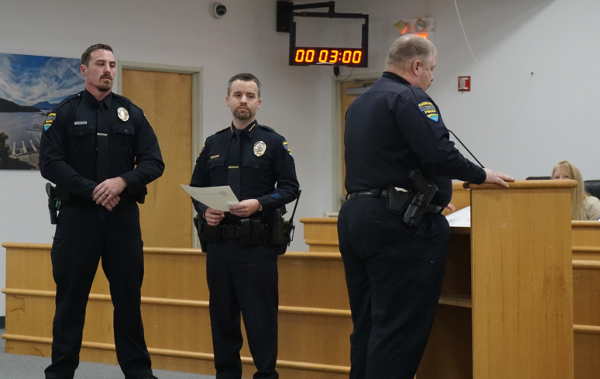
CLEARLAKE, Calif. – At Thursday night’s Clearlake City Council meeting, a Clearlake Police officer was honored for saving a man’s life.
Officer Chris Kelleher received a certificate and a life-saving award medal that he’s entitled to wear on his uniform to signify his efforts.
Presenting the award to Kelleher was Capt. Tim Celli and Chief Andrew White.
“Every once in a while we're at the right place at the right time, but this officer's actions went above and beyond,” said Celli.
On Dec. 2, Kelleher was on patrol on Walnut Avenue when he saw two suspicious subjects entering a property, Celli said.
Celli said Kelleher then saw a male subject on the ground. Kelleher found the man was not breathing and had no pulse, with his condition the result of a possible drug overdose.
Kelleher advised dispatch that he needed an emergency medical response and conducted cardiopulmonary resuscitation on the man until he developed a pulse, according to Celli.
Medical personnel then arrived on scene and found the man had a pulse and was breathing, Celli said.
Celli said the man was taken to the hospital for treatment, and he’s since been seen walking around town by other officers.
Based on the totality of the circumstances, Celli said they believe Kelleher’s actions saved the man’s life.
As a result, Celli recommended Kelleher for the life-saving award, which White presented to Kelleher.
Kelleher has been with the department for about four years.
Chief White told Lake County News that it was Celli, while serving as the department’s interim police chief, who instituted the life-saving award.
Previous recipients include Sgt. Travis Lenz, who saved a woman who had been held hostage at gunpoint in October 2015, and Officer Trevor Franklin, who in March 2016 saved an elderly couple from a house fire.
Email Elizabeth Larson at